


The moment the dashboard pinged and the rental company’s logo flashed up on my phone, I was inching through evening traffic on the bridge into Ortigia. I had trusted my navigation app, my hotel’s reassurance that they had “parking inside the historic centre,” and my own experience driving all over Europe. Yet here I was, learning in real time that I had driven straight through a camera-controlled ZTL entrance without authorization. Two weeks later, the damage was fully clear: one official fine expected at around 100 to 120 euros and two separate “administration” fees from the rental company totaling 90 euros, all triggered by a 300-metre crawl behind a taxi that my app swore was the correct route.
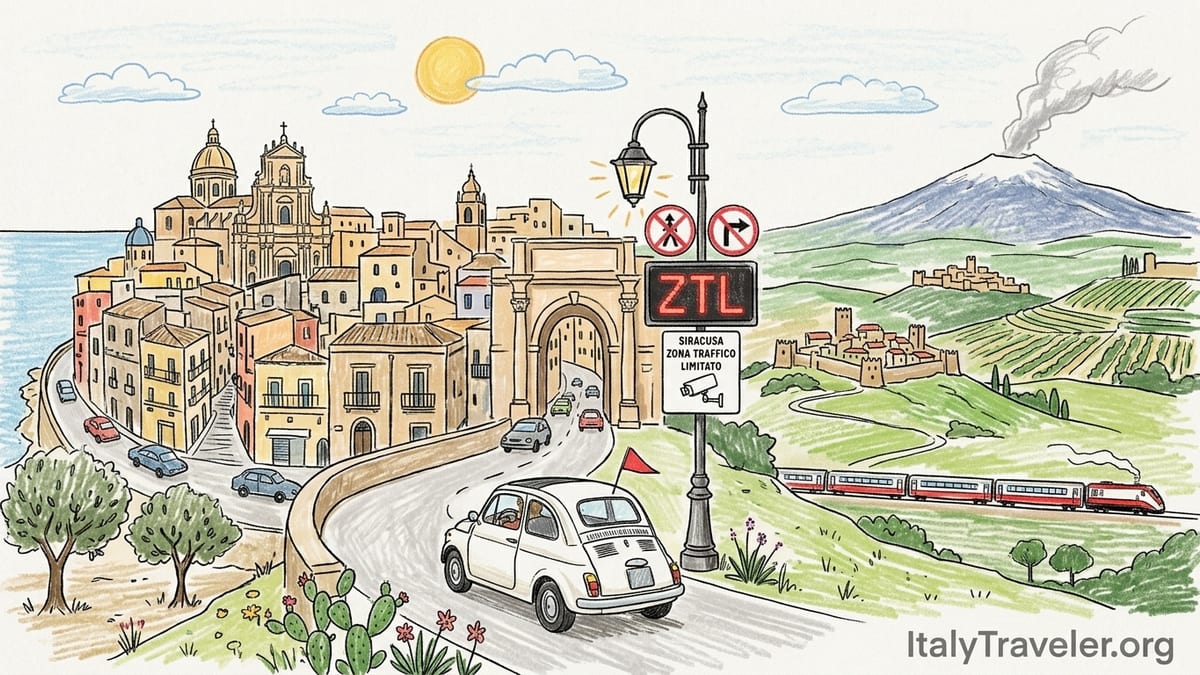
How One Wrong Turn into Ortigia Set the Tone for My Sicilian Road Trip
My route in Sicily was the classic first-time circuit: Palermo to Cefalù, across to Taormina, down to Syracuse and Ortigia, with a final night near Catania Airport. I picked up a compact Fiat 500X at Palermo Airport from a major broker brand partnered locally with Sicily by Car, paid a deposit of just under 1,000 euros on my credit card as a damage excess hold, and assumed the hardest part would be learning to love Italian roundabouts. Instead, the real challenge came from policies and systems that many road-trip guides mention only briefly: ZTLs, parking scarcity and the way rental companies monetize every mistake.
The Ortigia incident became the emblem of the trip. My hotel on the island confirmed they had private parking and told me by email that they would “take care of the ZTL,” the Zona a Traffico Limitato that covers almost the entire historic core. When I arrived on a Saturday evening in late September, my navigation app confidently routed me over Ponte Umbertino and onto the island. There was traffic, but no barrier, no police officer, just an electronic sign and a tangle of cars. I followed a taxi under a camera gantry, convinced that the hotel’s supposed registration of my plate meant I was covered.
Only after check-in did the receptionist ask for my license plate so they could “request authorization,” and casually mention that approval was not instantaneous. That is when I realized the uncomfortable truth that every driver in Sicily needs to understand. Parking permission, even when offered by a hotel inside a restricted area, does not automatically authorize you to cross a camera-controlled ZTL entrance. In Ortigia’s case, the expanded 2026 hours mean that most daytime and evening entries are restricted Monday to Saturday from 11:00 to 15:30 and again from 17:00 to 02:00, and on Sundays and holidays from 10:00 to 02:00. If the system does not recognize your plate in real time when you pass under the camera, a fine is generated regardless of what your hotel promises later.
Back home, the secondary sting arrived by email. The rental company notified me that they had received a request from the municipal police to identify the driver for an “infrazione ZTL Siracusa.” For this simple data transfer they charged an administration fee of 45 euros, debited directly from my card. They made clear that this was separate from any eventual municipal fine, which would arrive by post weeks or months later. In other words, a few minutes of confusion at a poorly signed camera entrance had turned into nearly 150 to 200 euros in combined costs, and there was nothing retrospective I could do to fix it.
Understanding How Camera-Controlled ZTLs Actually Work in Sicily
Driving in Sicily’s big cities and historic centres is not simply about reading signs. It is about understanding systems that operate with camera enforcement and near-total automation. A ZTL is a limited traffic zone where only authorized vehicles can enter during certain hours. In practice, that usually means residents, registered deliveries, public transport and pre-registered hotel guests. Entry points are monitored by automatic number-plate recognition cameras. If your plate is not linked to a valid permit at the exact moment you pass, the system records a violation.
This has two non-obvious consequences. First, there is no polite warning on the spot. There is no barrier that refuses to open, no parking ticket left on your windshield, and rarely a police officer to wave you away. You cross an invisible line and the fine is generated silently. Second, the system does not care that your hotel told you it would “add your plate” later or that you followed a local taxi. In Ortigia, for example, updated 2026 rules extend the ZTL hours so that the streets are camera-controlled almost all day and late into the night. In Palermo, much of the historic centre is within a ZTL that requires a paid daily pass for most conventional vehicles.
One regular source of confusion is Palermo’s paid access scheme. The municipality’s official information explains that petrol cars from Euro 3 to Euro 6 and diesel cars from Euro 4 to Euro 6 can buy a daily ZTL pass for 5 euros, while certain hybrid vehicles pay 2.50 euros. The pass can be purchased through official channels such as municipal apps or authorized vendors. Crucially, it must be activated in advance or, at the latest, before you cross into the zone. It cannot be backdated after an unauthorized entry. Many visitors mistakenly assume that if they realize their error the same day, they can simply buy a pass in the evening and retroactively sanitize their lunchtime detour. That is not how the system works.
Navigation apps contribute to the problem. Even with “avoid tolls” and “avoid motorways” turned off, mainstream apps can and do route foreign drivers straight through camera-controlled ZTL gates in Palermo, Catania or Ortigia, especially when the destination is inside the historic centre and the algorithm prioritizes the shortest path. Apps are not reliably updated with seasonal ZTL schedules. They also cannot know whether your plate has been correctly registered by a hotel or parking garage. The result is a perfect trap for visitors. A blue dot on your screen tells you that you are almost at your charming boutique hotel, but the unmarked archway you just slid under may be an expensive entrance.
Palermo, Catania and Historic Centres vs Highways and Rural Roads
Outside the cities, driving in Sicily can be straightforward and even relaxing. The A20 coastal highway between Palermo and Messina delivers long sea views, and the inland segments toward Enna or Caltanissetta are wide and relatively uncongested. Rural roads in the Madonie or around Mount Etna may be narrow and potholed, but traffic is usually light and the driving style, while spirited, is manageable. Pull off near a hilltop town, and the car feels like freedom.
That experience contrasts sharply with Palermo, Catania, Ortigia, Taormina and other historic centres. In Palermo, the surface traffic can feel anarchic: scooters threading between lanes, buses blocking intersections, pedestrians stepping off curbs mid-block. Aggressive driving here rarely means high speed. It means assertive positioning, last-second lane changes and a general expectation that everyone will squeeze through gaps too tight for comfort. As a foreign visitor in a rental car with a 1,000-euro excess, you quickly find yourself either over-cautious and constantly honked at, or dragged into manoeuvres that make you nervous about scraping bumpers.
Catania is different but hardly calmer. The streets near Piazza Duomo and Via Etnea funnel traffic through a mix of normal lanes, bus lanes and pedestrian priority areas. Temporary works or religious processions alter circulation patterns. A navigation app will draw a smooth blue line over this chaos, but on the ground you can find yourself pushed into a bus lane or edging through a semi-pedestrian street flanked by parked scooters. Taormina and Cefalù add another layer of stress: tight one-way systems climbing to hilltop centres, limited parking and coaches trying to execute impossible turns.
Historic centres are where the risk of minor damage spikes. Parking spaces are tight, protective bollards are unforgiving and locals are comfortable squeezing their compact cars within centimetres of yours. In Ortigia, streets narrow to alleys where one wrong reverse can scrape a wall. In Taormina, multi-storey garages outside the ancient core are better options, but reaching them involves hairpin ramps and tiny margins for error. The difference between highway cruising and city driving is not only subjective stress but also the statistical likelihood that your rental will acquire a new scratch that the company can charge for.
Palermo’s Paid ZTL, Ortigia’s 2026 Hours and the Hotel Parking Trap
Palermo tries to manage congestion and pollution in its centre with a paid ZTL scheme. For most tourists with conventional petrol or diesel rental cars that meet the Euro standards, the relevant product is the 5-euro daily pass, which confers the right to circulate in the zone during its operating hours. Some hybrids qualify for a reduced rate of around 2.50 euros per day under municipal rules. The permit is plate-specific. You buy and activate it for a particular vehicle, and the cameras cross-check the plate against the database when you enter.
The rules are strict. You cannot drive into the ZTL first and then buy the pass hours later, hoping it will be applied retroactively. If you do, the recording created at the moment of entry stands as an unauthorized access. Similarly, if you change rental cars mid-trip and reuse the old plate number in an app out of habit, you are technically unregistered. Palermo’s system is indifferent to whether you misunderstood the instructions or whether your hotel failed to explain that your plate needed to be provided before arrival, not at check-in.
Ortigia in Syracuse has chosen a different approach that ends up being just as challenging for visitors. From April 2026, new ZTL hours mean that from Monday to Saturday vehicles without authorization are barred from most of the island’s interior streets from 11:00 to 15:30 and from 17:00 to 02:00 the next day, and on Sundays and holidays from 10:00 to 02:00. The island’s main public car park at Talete sits just at the edge of the restricted area, and it is explicitly designed so that visitors can park there and then walk into the ZTL. Hotel and guesthouse websites in Ortigia frequently highlight that the entire island is a limited traffic zone, but the details about registration windows and specific camera gates are often hidden in small print.
This is where the hotel parking trap comes in. Properties inside Palermo’s or Ortigia’s ZTLs may indeed have the right to request a temporary authorization for their guests, sometimes for a fee. In Palermo, certain hotels or garages can arrange special passes in coordination with the municipality. In Syracuse, hotels can submit guests’ plate numbers so that they appear as permitted inside the zone. But none of this is automatic, instantaneous or guaranteed. If you arrive earlier than your check-in time, if the receptionist is busy, if a typo slips into your plate number, or if a staff member forgets to submit the request, the cameras have no way to know that the person behind the wheel of that white Fiat 500X with foreign plates is a legitimate guest.
The key lesson is harsh but necessary: hotel parking permission does not equal ZTL entry authorization unless you have explicit confirmation that your plate has been registered and the exact route you must follow. Even then, a cautious approach is to park outside the ZTL in a paid garage, walk to your accommodation, and only bring the car in once the hotel has confirmed in writing which entrance you are allowed to use and during which hours.
How Rental Companies Monetize Every Mistake: Administrative Fees and Damage Risk
Many first-time visitors to Sicily fixate on the municipal fine amounts but underestimate how rental companies layer their own fees on top. When a city like Palermo or Syracuse records a ZTL violation, it does not know who was driving. It sends a request to the vehicle’s registered owner, which is nearly always a rental company. The rental company then forwards the driver’s details to the authorities. For that clerical act, most brands charge an administrative fee per violation. Consumer-protection leaflets and traveler reports describe fees that can easily reach 40 to 60 euros or more per event, irrespective of the underlying fine amount.
This matters because a single evening of confusion can generate multiple chargeable events. If you loop around Ortigia trying to find your hotel, you may pass under several cameras within minutes. On paper, each recorded entry can lead to a separate municipal fine and a separate rental-company administration charge. Recent traveler complaints from Sicily describe cases where two ZTL fines issued a minute apart produced over 60 euros in rental admin fees alone, with the actual fines still pending. Some Italian authorities use dedicated agencies to handle cross-border fine collection, adding further fees for translation and processing on top of the local penalty.
Then there is damage risk. Many Sicilian rental desks routinely block 800 to 1,500 euros on a credit card as a damage excess, especially in high season. Super Collision Damage Waiver and similar extra insurance products, sold as daily add-ons, can reduce or waive this excess but frequently double the headline rental price. If you decline and rely only on a basic CDW, any scrape caused by squeezing into a tight hotel parking space or misjudging a stone corner in a medieval alley can become a chargeable event. In crowded Palermo or Catania streets, where scooters brush past and other drivers nose into crowded junctions, the odds of picking up a scuff are distinctly higher than on the A20.
On my own rental, I declined the most expensive insurance but used a separate third-party excess policy. Even so, every time I threaded that Fiat between concrete pillars, I was conscious that a mistake would mean a slow claims process involving photo evidence, rental invoices and back-and-forth emails. The stress subtly but significantly detracted from enjoying the cities. In retrospect, it felt absurd to be worrying about microscopic paint transfers under the baroque balconies of Ortigia when I could have been stepping off a train with nothing more to lose than a 20-euro ticket.
Trains vs a Full-Week Rental: What Changed After the Palermo–Catania Reopening
Until recently, one of the arguments for renting a car for the entire week in Sicily was the perception that trains were too slow or disrupted to be useful. That excuse is weaker after September 14, 2026, when the rail infrastructure manager RFI and the national operator Trenitalia confirmed the resumption of normal traffic along the Palermo to Catania route following major upgrade works. Timetables now show through trains again linking Palermo with Catania via intermediate stops, restoring a crucial spine for travelers who want to avoid driving between the island’s main cities.
Combine this reopened Palermo–Catania corridor with the long-established coastal Messina–Syracuse line that passes through Cefalù, Taormina-Giardini, Catania and onward to Siracusa, and a clear alternative emerges. A visitor with a week in Sicily who plans to focus on Palermo, Cefalù, Taormina, Catania and Syracuse can realistically rely on trains for the city-to-city transfers and only rent a car for one or two targeted rural days. Travel times vary by service, but fast regional and Intercity trains generally connect Palermo to Cefalù in under an hour, Cefalù to Taormina with a change at Messina, and Taormina to Syracuse via Catania in a few hours at most.
Cost-wise, the comparison is revealing. A one-week rental of a compact car from Palermo Airport in late September for a driver over 25 typically prices around 350 to 450 euros on major booking sites, before optional insurance. Add the airport pick-up fee, regionally higher one-way fees if you drop at Catania Airport, fuel that might total 80 to 120 euros for a circuit of several hundred kilometres, motorway tolls on the Palermo–Messina stretch, and at least 10 to 25 euros per day in paid parking in or near cities, and you can easily reach 650 to 800 euros for two people. This figure does not include any ZTL fines, administrative fees or damage charges.
By contrast, second-class train tickets bought in advance for key segments such as Palermo to Cefalù, Cefalù to Taormina-Giardini, Taormina-Giardini to Catania and Catania to Siracusa often sum to well under 50 to 80 euros per person in total, depending on flexibility and promotions. Even allowing for changes, seat reservations and a taxi or two between stations and accommodations, a rail-based itinerary for two people can be hundreds of euros cheaper than a full-week car rental, and it eliminates ZTL exposure in Palermo, Catania, Ortigia and Taormina.
There are, of course, trade-offs. Trains do not take you into the Madonie or Nebrodi mountains or around the rural roads that circle Mount Etna’s vineyards. Some hill towns are poorly connected by public transport, and bus timetables may not align well with day-trip patterns. But a hybrid strategy now looks even more compelling: use the upgraded rail network for long hops between major centres, then rent a car for just two or three days in a smaller town that sits outside a ZTL and serves as a base for countryside exploration.
Seven-Day Cost Comparison: Full-Week Car vs Trains plus Short Rural Rental
To test this in practical terms, consider a notional seven-day trip in late September, starting in Palermo and ending in Catania, for two adults. Option one is to rent a compact car at Palermo Airport on arrival and keep it for the full week, driving Palermo to Cefalù, Cefalù to Taormina, Taormina to Syracuse and finally Syracuse to Catania Airport. Option two is to rely on trains between the cities and only rent a car for a two-day rural loop from, for example, Syracuse or Catania.
For option one, a realistic breakdown might look like this in broad terms. Base rental for seven days: around 400 euros. Standard insurance included with a 1,000-euro excess and no extra protection. Fuel for roughly 700 to 900 kilometres: somewhere around 90 euros at current Italian prices for an economical petrol compact. Tolls on the Palermo–Messina motorway section and possible other tolled stretches: perhaps 25 euros. Parking in Palermo, Cefalù, Taormina and Syracuse, using a mix of city garages and edge-of-centre lots: conservatively 20 euros per day for five city days, so about 100 euros. That already totals roughly 615 euros before you factor in the intangible cost of risk.
Add to this potential ZTL-related costs. Even one inadvertent entry in Palermo without a valid daily pass could lead to a municipal fine in the realm of 90 to 100 euros plus a 40 to 60-euro rental-company admin fee. My own Ortigia experience suggests it is easy to accumulate 150 to 200 euros of combined charges from a single mistake. Include even one such episode, and your effective cost jumps to around 800 euros for the week, possibly more if you count time spent contesting or paying fines.
For option two, imagine buying train tickets for Palermo to Cefalù, Cefalù to Taormina-Giardini, Taormina-Giardini to Catania and Catania to Siracusa. With advance purchase and regional fares, two adults might expect to pay a combined total in the range of 120 to 160 euros for all these city-to-city legs. Add perhaps 60 to 80 euros in local buses, occasional taxis, and luggage storage where necessary. Then add a two-day car rental picked up outside a ZTL, say near Syracuse station or at Catania Airport, at a day rate of around 60 to 80 euros including basic insurance, for a total of 120 to 160 euros. Fuel for two rural days might be about 30 euros, plus minimal parking fees in small towns, perhaps 10 euros.
That puts the hybrid option in the approximate range of 320 to 440 euros all-in for transport for two people over seven days, substantially lower than the 650 to 800 euros a full-week rental can easily absorb. Just as crucially, almost all of that hybrid cost is predictable. You can book most tickets in advance, and your short rental can be structured to avoid cities and ZTLs entirely. Administrative fees for fines drop toward zero, because there is little scope for infractions when you are not driving into restricted centres.
Where I Would and Would Not Rent a Car Again in Sicily
After a week of constant vigilance for cameras, signs and scooters, plus the delayed sting of a ZTL violation and rental administration fees, my view of driving in Sicily has become unapologetically selective. I would absolutely rent a car again to explore certain parts of the island. Rural western Sicily, the interior around Enna, the Madonie and Nebrodi mountains, the agricultural plains south of Catania and the lesser-known coastal stretches between larger resorts all remain much more accessible with a car. The same is true for visiting dispersed archaeological sites and wineries in a single day, where relying on sparse bus timetables would cut deeply into the experience.
However, there are places where I would now firmly avoid driving, or at least avoid overnight stays with a car. Palermo’s historic centre is at the top of that list. The combination of a complex ZTL, aggressive surface traffic, scarce and expensive parking and a dense web of one-way streets makes it a hostile environment for a stressed visitor in a rental vehicle. Next is Ortigia in Syracuse, where the 2026 ZTL hours and near-complete coverage of the island mean that the safest option is to park on the mainland side, at structures like Talete or other edge-of-island car parks, and enter on foot.
Taormina and Cefalù fall into a middle category. I would be comfortable arriving there by train and using paid garages outside the ancient cores, walking or using local shuttles up to the centres. If I happened to have a car for a day or two, I would treat it as an instrument for excursions rather than a way of reaching my accommodation’s front door. In Catania, I would certainly avoid driving near the cathedral area or main shopping streets, as the mix of bus lanes, partial ZTLs and assertive local traffic leaves too much margin for error. Staying near the station or using taxis instead of a rental feels like a healthier trade of money for peace of mind.
In practical terms, if I were planning the same route again today, exploiting the reopened Palermo to Catania rail connection and the established coastal lines, I would structure my week differently. I would arrive in Palermo without a car, stay three nights using only my feet and public transport, then take trains onward to Cefalù, Taormina and Syracuse. Only after I had finished my city time would I pick up a car outside a ZTL for two rural days before flying out of Catania. The freedom of those countryside drives would finally feel like a reward rather than a recovery from city-induced anxiety, and my credit card would be less exposed to the invisible tollbooths of Sicily’s ZTL cameras.
The Takeaway
Renting a car in Sicily is often sold as the ultimate expression of freedom. In reality, that freedom comes with conditions, especially in 2026 as ZTL regimes tighten and camera enforcement expands. The most serious threats to your budget and sanity are not dramatic accidents on winding mountain roads but quiet infractions at camera-controlled entrances and the administrative machinery that converts them into months-later bills. Palermo’s 5-euro daily ZTL pass, Ortigia’s extended restrictions and rental companies’ per-fine administration fees all contribute to a landscape where a single navigational misstep can cost more than several days of train travel.
My own experience, turning a gentle drive into Ortigia into a multi-hundred-euro headache, was not an outlier. It was a fairly predictable outcome of systems that are poorly communicated to visitors and only partially integrated with consumer technology. The reopening of key rail routes between Palermo, Cefalù, Catania, Taormina and Syracuse after September 2026 shifts the balance further away from default car rental and toward a more nuanced strategy. For many itineraries, especially those focused on major towns and cities, trains plus a short rural rental now offer a more economical and less stressful alternative.
If there is one message I would pass on to future travelers, it is this. Do not let the romantic idea of a Sicilian road trip blind you to the practical downsides of driving into Palermo’s alleys, Ortigia’s stone lanes or Taormina’s bottlenecks. Respect the ZTLs, interrogate hotel promises about parking, scrutinize rental contracts for administrative fees and seriously consider leaving the car out of the equation for most of your urban days. You can still chase sunsets over olive groves and vineyards, but you may enjoy them more if you arrive by train first and pick up your keys later, far from the unblinking eye of a ZTL camera.
FAQ
Q1. Do navigation apps reliably keep you out of ZTLs in Sicily?
No. Mainstream navigation apps sometimes route directly through camera-controlled ZTL entrances in Palermo, Catania, Ortigia and other historic centres because they prioritize the shortest path and may not be fully updated with local restrictions or your permit status.
Q2. Is a hotel’s confirmation of parking inside a ZTL enough to drive to the door?
No. Hotel parking permission does not automatically authorize you to cross a camera-controlled entrance. Your license plate must be correctly registered with the municipality before you enter, and even then you need to follow the specific route the hotel indicates.
Q3. Can you buy a Palermo ZTL pass after entering and avoid a fine?
No. Palermo’s daily ZTL pass for qualifying petrol and diesel vehicles costs 5 euros, and certain hybrids pay 2.50 euros, but the pass cannot be activated retroactively after unauthorized entry. If your plate was not authorized at the time you crossed the camera, a fine is likely generated.
Q4. How do Ortigia’s 2026 ZTL hours affect visitors with cars?
From 2026, most of Ortigia’s interior streets are restricted Monday to Saturday from 11:00 to 15:30 and 17:00 to 02:00, and on Sundays and holidays from 10:00 to 02:00. Visitors without authorization should park outside the ZTL, for example at edge-of-island car parks, and walk in.
Q5. What are rental-company administrative fees for fines, and are they separate from the fines themselves?
Administrative fees are charges rental companies apply for processing traffic or parking violations, typically 40 to 60 euros per incident. They are separate from the official police or municipal fine, which will arrive later and must be paid independently.
Q6. Are Sicilian highways dangerous compared with city driving?
Highways and rural roads in Sicily are generally less stressful than city centres. The real difficulty lies in dense urban traffic, narrow historic streets, ZTL cameras and tight parking in places like Palermo, Catania, Ortigia and Taormina.
Q7. Does it still make sense to rent a car for an entire week in Sicily?
For an itinerary focused on major cities such as Palermo, Cefalù, Taormina, Catania and Syracuse, a full-week rental is often less attractive now that key rail routes have reopened. Trains plus a short rural rental can be cheaper and far less stressful.
Q8. Where in Sicily would you personally avoid driving again?
I would avoid driving inside Palermo’s historic centre, most of Ortigia, and the narrowest areas of Taormina and central Catania. In these places, ZTLs, parking scarcity and aggressive traffic outweigh the convenience of having a car.
Q9. Where is renting a car still genuinely useful in Sicily?
A car remains very useful for exploring rural areas such as the Madonie and Nebrodi mountains, the countryside around Mount Etna, dispersed archaeological sites and small inland towns that are poorly served by trains and buses.
Q10. How should I structure a one-week trip to minimize ZTL risk and still see a lot?
One effective approach is to use trains for city-to-city travel between Palermo, Cefalù, Taormina, Catania and Syracuse, and then rent a car for two or three days from a location outside a ZTL to explore the countryside before returning it prior to flying home.