


The morning I first walked into Palermo’s Ballarò market, the air smelled of frying chickpea batter, blood oranges and exhaust fumes. Venders were already shouting over one another, knives thudded into wooden blocks, and a cloud of steam drifted from a cart where someone was stirring a pot of boiling offal. That day I decided to eat my way through Ballarò, Mercato del Capo and Vucciria, paying close attention to what locals actually ordered, what it all cost, and which parts of Palermo’s street food culture still feel like a daily ritual rather than a performance for visitors.
Arriving Hungry at Ballarò: First Bites and First Impressions
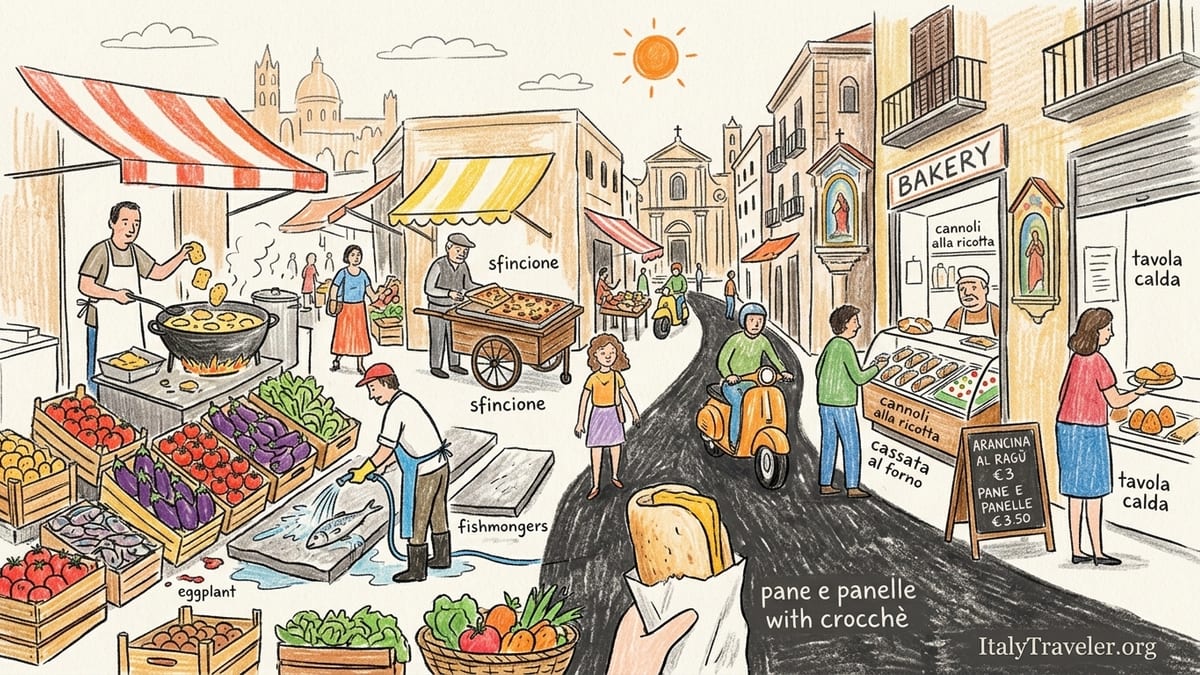
I started at Ballarò just after 9 a.m., entering from Piazza Casa Professa and following the sound of the vendors’ cries. Ballarò is often described as Palermo’s most intense market, and it lived up to the reputation. Plastic crates of tomatoes and eggplants spilled into the street, fishmongers hosed down marble slabs, and scooters somehow threaded through gaps that seemed far too narrow. Compared with other Italian city markets I have visited, Ballarò felt more like a working North African souk, which makes sense given Palermo’s long Arab and Mediterranean history and its role as a trading port.
The first smell that hooked me came from a tiny fry stand wedged beside a fruit stall, where a man in a flour-dusted apron was dropping rectangles of pale batter into a cauldron of oil. These were panelle, Palermo’s classic chickpea fritters, whose roots are usually traced back to Arab techniques of working with chickpea flour and spices that arrived in Sicily between the 9th and 11th centuries. I ordered a pane e panelle with crocchè, the most common way locals eat it: a sesame roll stuffed with hot fritters.
The vendor split a soft mafalda-style roll, piled in four panelle and two potato crocchè, sprinkled them with salt and a squeeze of lemon, and handed it over wrapped in paper. The price on the handwritten sign was 3.50 euros, right in line with 2026 reports that a panelle and crocchè roll in central Palermo now tends to range around 3 to 4.50 euros depending on the stall. The first bite was pure comfort food. The panelle were thin and floppy at the edges, creamy inside, tasting of chickpeas and parsley, while the crocchè were more about texture: mashed potato, almost mousse-like, with a crisp shell. It was heavy but not greasy, exactly the kind of snack that makes sense for people who work on their feet all morning.
Standing there with my sandwich, I watched a few locals order the same thing but add a slice of grilled eggplant or a handful of fried cardoons. Tourists, on the other hand, tended to point at everything and end up with overloaded buns. This was my first small lesson of the day: in Ballarò, the simplest option is usually what the regulars respect, and it is often the best value.
Following the Smell of Sfincione and My First Arancina
From the fry stand, I followed a sing-song chant that rolled down the alley: “Chi ciavuru, u sfinciuni!” The cry was coming from an elderly vendor with a wooden cart stacked with thick, tray-baked sfincione, Palermo’s answer to pizza. Sfincione has a soft, almost focaccia-like base topped with slow-cooked onions, tomato, anchovies, oregano and a layer of toasted breadcrumbs and caciocavallo cheese. Here the slices were cut into generous rectangles, warm from a portable oven, and sold at 2.50 euros each, matching the citywide range of roughly 1.50 to 3 euros per piece.
I ordered one slice. The bread was about three centimeters high, airy but chewy, and the topping was intensely savory. The slow-cooked onion gave a sweetness that cut through the salty anchovies, while the breadcrumbs added crunch. The vendor pointed out that this red sfincione is specifically Palermo-style. In nearby Bagheria, a town just to the east, there is a celebrated “white” sfincione without tomato that has its own annual festival in November, but that is another trip entirely.
Only after sfincione did I move on to my first arancina of the day. In Palermo, the name is feminine: arancina, not arancino. Locals will tell you that the word refers to the orange, arancia, and that in Palermo the rice balls are usually round, like little oranges, so the form is feminine. In eastern Sicily, especially around Catania, the masculine arancino dominates, and the shape tends to be more conical. This linguistic fault line matters in Palermo, and using the wrong term is a quick way to mark yourself as an outsider.
At a small tavola calda facing Via Ballarò, I chose an arancina al ragù from a glass counter that also displayed spinach, mushroom and butter-filled versions. According to the printed menu taped to the window, a classic ragù arancina was 3 euros, while more elaborate fillings like seafood or pistachio cost up to 5.50 euros, a sign of how prices in the historic center have crept up in recent years. My arancina arrived blisteringly hot, the rice stained yellow with saffron, encasing a core of minced meat ragù, peas and strands of melted cheese. The crust was thin and crisp, not as thick as Roman supplì, and the interior stayed cohesive without being gummy. I found it deeply satisfying, though by the last bites the richness began to weigh on me. It was easy to see why a single arancina has increasingly become a snack for visitors rather than working-class daily fuel.
Offal and Nerves: Confronting Pani Câ Meusa and Stigghiola
To understand Palermo’s street food honestly, it is impossible to avoid offal. The city’s historic poverty produced a cuisine built on leftover cuts and ingenuity, and two dishes embody that story better than any others: pani câ meusa and stigghiola. I approached them with a mix of curiosity and apprehension.
Near the southern end of Ballarò, a cart surrounded by men in flat caps was shrouded in steam. Here a vendor was assembling pani câ meusa, the famous spleen sandwich that has become a badge of local identity. The preparation is as unromantic as it sounds. Thin slices of veal spleen and lung are boiled, then finished in a pan of bubbling lard. When an order comes in, the vendor fishes out a handful of glistening meat, tucks it into a soft sesame roll and either serves it “schettu,” plain, or “maritatu,” married, with ricotta and grated caciocavallo cheese.
I ordered a small maritatu, priced at 4 euros. The first thing that struck me was texture. The lung pieces were spongy, almost bouncy, while the spleen was dense and slightly grainy. The lard gave a deep, animal richness that the ricotta and cheese tried to soften. Flavour-wise, it reminded me a little of strong liver. I managed half of the sandwich before admitting that it was not for me. I was glad I tried it, especially knowing that many first-time visitors skip it, but I would not line up again. Hygiene-wise, I had mixed feelings. The meat had been sitting in an open pan, frequently stirred but constantly exposed to dust and exhaust. Local authorities and regional gastronomy reports celebrate pani câ meusa as heritage, but from a cautious traveller’s point of view it pays to choose a busy cart and avoid late afternoon when the turnover slows.
Stigghiola, skewers of lamb or kid intestines wrapped around spring onions and grilled over charcoal, were the next mental hurdle. I found them closer to the railway side of Ballarò, where smoke drifted over crates of artichokes. A sign listed 3.50 euros for a portion of three skewers. The vendor salted them heavily and cooked them until the outside charred and blistered. Biting into stigghiola is an act of faith. The exterior was pleasantly crisp and smoky, but the interior was chewy, with a lingering minerality and a whiff of barnyard. I appreciated the historical logic of using every part of the animal in a city where meat was once a luxury, and I respected the grill work, but I would personally recommend this only to confident offal eaters. For everyone else, panelle and sfincione are more accessible windows into the same tradition.
Mercato del Capo: Lighter Lunch, Sweets and Quieter Corners
By late morning I walked across the historic center to Mercato del Capo, entering from Via Porta Carini behind Teatro Massimo. The change in atmosphere was immediate. Where Ballarò felt chaotic and immigrant-driven, Capo struck me as more compact and slightly calmer, with narrow lanes framed by church facades and painted shrines. It still functions as a neighborhood market, but there are more permanent storefronts and fewer shouting hawkers.
I was no longer in the mood for heavy fried food, so at Capo I gravitated toward baked items and sweets. A small bakery near the intersection with Via Beati Paoli displayed trays of sfincione, biscotti and cannoli shells. Inside, a woman was filling cannoli to order instead of letting them sit pre-filled, a detail that locals insist on. I ordered one cannolo alla ricotta for 3 euros, comparable with what food guides report for freshly filled cannoli in Palermo’s markets and inner-city bars. The shell shattered audibly, a sign it had not absorbed moisture, and the filling was grainy-smooth sheep’s milk ricotta with flecks of candied orange peel and dark chocolate. It was not overly sweet, which surprised me after northern Italian pastry habits.
The same bakery also sold slices of cassata al forno, a baked shortcrust ricotta tart cousin to the more decorated Cassata Siciliana. I tried a thin slice for 2.50 euros. The pastry was crumbly, the ricotta scented with citrus zest and a hint of cinnamon. While cassata’s roots involve a mix of Arab sugar and ricotta traditions, Norman and later baroque tastes layered on their love of rich, sweetened dairy and ornate presentation. Tasting it in a modest bakery rather than on a decorated cake stand in a tourist cafe helped me appreciate it as everyday food rather than a baroque spectacle.
For a break from sugar, I stopped at a bar on the edge of the market for a mandorla granita with a small brioche. The bartender scooped pale almond ice into a glass and slid over a still-warm brioche col tuppo. At 4 euros for both, this matched recent local guides that list almond granita with brioche in Palermo at about 3 to 5 euros depending on location. Although granita is more stereotypically associated with eastern Sicily, especially Messina and Catania at breakfast time, Palermo has adopted it with enthusiasm, and in the Capo area it works as a refreshing palate cleanser between savory rounds.
Capo also highlighted how guided food tours operate. As I walked, I saw two groups pass through, each with around ten to twelve people and a guide pointing out stalls. Later research confirmed that many Palermo food tours now charge roughly 70 to 90 US dollars per person for a three-hour walk through Capo and Vucciria, with around eight to ten tastings included. Watching the groups, I could see the appeal: guides helped guests navigate offal vocabulary, discussed Arab-Norman history and handled ordering. At the same time, the pre-arranged tastings meant no one lingered in quieter corners or ducked into obscure bakeries the way I did.
Vucciria By Day and Night: Market Versus Nightlife
My afternoon stop was Vucciria, the historic market quarter near Piazza Caracciolo, a short walk from Via Roma and the harbor. Historically, Vucciria was one of Palermo’s great fresh markets, its name linked to noisy shouting and bustling trade. Academic work and local commentary over the past decade, however, describe how the area has shifted from a daytime food market to a more contested, nightlife-driven foodscape, with decaying buildings converted into bars, street art covering shutters and a mix of migrant and local businesses trying to coexist.
Arriving in mid-afternoon, I found only a handful of produce stands operating, plus some fishmongers rinsing down for the day. What dominated instead were street bars, grills and small kitchens setting up for the evening. Men welded new metal counters, speakers appeared in doorways, and plastic tables spilled into Piazza Garraffello. It felt like a stage being built for a nightly performance rather than a market preparing to feed the city’s families.
I tried one grilled salsiccia panino from a stall on a side street. The price was 5 euros for a sausage on a roll with onions and peppers, clearly marked in multiple languages on a laminated menu. The sausage itself was tasty, coarse-ground pork flecked with fennel seed, but the bread was cold and the vegetables pre-cooked and reheated. Compared with my Ballarò sandwich, I felt more like a customer in an outdoor bar district than a participant in a living market. Around me, most people were already drinking long plastic cups of cocktails, a now-iconic element of Vucciria nights discussed on travel forums: huge, brightly colored drinks for 5 to 7 euros, strong but rarely subtle.
Later that night I returned to Vucciria after dark to see its other face. The transformation was complete. Music blasted across the square, crowds clustered around bar counters, and grills turned out mixed skewers, burgers, and some traditional items like panelle. I noticed as many locals in their twenties as tourists, and the atmosphere was energetic but chaotic. Several Palermo residents online describe the area as noisy and occasionally sketchy, more about cheap drinks and socializing than about serious food. That matched what I experienced. If you want to understand Palermo’s street food as a daily sustenance, Ballarò by day tells that story far better than Vucciria at midnight. If you want to see how that same food vocabulary has been repurposed as part of a nightlife identity, then Vucciria offers a vivid case study.
Street Food Tours Versus Eating Independently
In the days after my market walk, I joined one guided street food tour to compare it with my solo explorations. The tour cost just under 80 US dollars for about three hours, covering Capo and Vucciria with around ten tastings: an arancina, pane e panelle, sfincione, a small pani câ meusa, some cheese and olives, dessert and a drink. Group size was capped at twelve, and my group had ten participants.
The advantages were obvious. The guide explained the history of each dish, pointed out architectural details I might have ignored and translated rapid-fire Sicilian banter from vendors. In Capo, he contrasted Palermo’s arancina with the conical arancino of Catania, and explained how Arab irrigation systems enabled the citrus that still perfumes the city’s markets. At Vucciria, he acknowledged the area’s decline as a daytime market and its reinvention as a nightlife hub, citing local complaints about noise and public order alongside the benefits for small bar owners.
From a value standpoint, the tour’s ten tastings added up to at least 20 euros worth of food at market prices, possibly a bit more given the inclusion of dessert and a glass of wine. That still left about 50 to 60 US dollars covering the guide’s time, organization and company overhead. For solo travellers with limited Italian, or for those nervous about ordering offal or navigating busy alleys after dark, that premium can be worthwhile. The guide also steered us away from inflated prices, pointing out, for example, that a spritz or sandwich over 5 euros in the markets is usually aimed at unwary tourists.
Having done both, I came away with a clear preference. The tour gave me context and reassurance, but my independent day allowed more serendipity. I could linger with one sfincione vendor, skip repeat tastings, and duck into bakeries or bars that caught my eye. I also spent far less: my self-directed eating day at Ballarò, Capo and a brief Vucciria snack cost roughly 25 euros in total, including coffee and water, versus the 80-dollar tour ticket.
Planning Your Own Morning-to-Evening Palermo Street Food Day
If you want to follow a similar route, I would start where I did, at Ballarò around 9 a.m. Enter from the church side near Piazza Casa Professa to feel the market tighten around you. Begin light with pane e panelle and crocchè at a busy fry stall, watching for handwritten prices in Italian rather than laminated multilingual menus. If you tolerate offal, share a small pani câ meusa to understand Palermo’s most discussed sandwich, but do not feel obliged to finish it if the texture is not for you. Balance it with sfincione and one arancina, ideally from different vendors to compare styles.
By late morning, walk across the historic center to Capo for a change of pace and a bit more shade. This is where I recommend focusing on sweets and lighter flavors: a cannolo filled to order, a slice of cassata al forno and an almond granita with brioche. Take your time here; Capo’s charm lies in its hidden corners, side chapels and quiet conversations with stallholders. It is also a good place to sit at a bar for an espresso and people-watch, something that is harder to do in the more frenetic stretches of Ballarò.
In the late afternoon, I would rest away from the markets entirely, perhaps visiting one of Palermo’s Arab-Norman monuments or simply retreating to your accommodation. Only after dark would I head to Vucciria, and I would do so with adjusted expectations. Go for one grilled sausage or panelle portion and a drink, but treat the area primarily as nightlife rather than as a gastronomic highlight. Keep an eye on your belongings, agree prices before ordering, and be prepared for loud music until the early hours.
Vegetarians can eat well on this route if they focus on panelle, crocchè, sfincione, caponata, salads, grilled vegetables and sweets. The main landmines are hidden animal fats and fish: sfincione often includes anchovies, and some vegetable fritters may be fried in shared oil that also cooks meat or fish. Vegans face a tougher time, since many dishes rely on ricotta, cheese or egg-enriched doughs, but it is still possible to build a day around chickpea fritters, plain bread, olives, fruit and granita. Those with celiac disease or gluten intolerance should know that almost all of Palermo’s classic street food is gluten-heavy. There are a few specialty bakeries in the wider city that focus on gluten-free options, but they sit outside the historic markets and require targeted research and planning.
The Takeaway
Looking back on my Palermo street food day, what stands out is not any single dish but the contrast between markets, and how each reflects a different layer of the city’s history and present. Ballarò felt like the beating heart: messy, multicultural, slightly overwhelming, but alive with working-class routines and migrant energy. It was there that panelle, crocchè, sfincione and arancina felt most connected to daily life rather than to tourism. Capo offered a gentler window, where pastries, granita and quieter interactions gave me space to think about Arab, Norman and later Mediterranean influences without shouting in my ears.
Vucciria, by comparison, came across as a place where food is part of a nightly performance. Its grilled meats and oversized cocktails can be fun if you come in with that expectation, but anyone chasing the romantic idea of a traditional morning market will likely be disappointed. For that, you need to walk Ballarò’s alleys while the city is still waking up and the first arancine are hitting the fryer.
As for the best single bite, my surprise winner was not the dramatic pani câ meusa or the perfectly spherical arancina, but a simple slice of sfincione bought from a cart vendor who had memorized half the alley’s names. It tasted of long-simmered onions, anchovies and tomato, framed by bread that required real chewing. It felt honest. In terms of value, exploring independently gave me more flexibility and cost far less than a guided tour, though I did appreciate the guide’s historical context and ability to decode dialect heavy banter. For travellers nervous about language or hygiene, a small-group tour can provide a helpful first day introduction, after which you can confidently return on your own.
If I had to choose only one market to revisit, it would be Ballarò in the morning. That is where Palermo’s street food still feels like a necessity rather than a theme, where the debate between arancina and arancino is more than semantics, and where the city’s layered past plays out in every shouted price and sizzling pan.
FAQ
Q1. Which Palermo market is best for an authentic daytime street food experience?
Ballarò is the strongest choice for a daytime visit if you want a working market atmosphere, a wide range of street food and lower prices than more nightlife-oriented areas.
Q2. Is Vucciria still worth visiting if it is no longer a traditional morning market?
Yes, but mainly in the evening. Vucciria has evolved into a nightlife hub with bars, grills and music. Go for the atmosphere and a snack, not for serious market shopping.
Q3. How much should I expect to spend on a full day of street food in Palermo’s markets?
If you eat independently at market vendors, a full day from breakfast-style snacks through dessert can be done for about 20 to 30 euros per person, depending on appetite and drinks.
Q4. Are Palermo’s famous offal dishes like pani câ meusa and stigghiola safe to try?
Food safety standards are generally decent, but these dishes are often cooked and served in open-air conditions. Choose busy stalls, eat earlier in the day and avoid anything that looks like it has been sitting too long.
Q5. What is the difference between arancina in Palermo and arancino in eastern Sicily?
In Palermo, the feminine arancina is usually round and filled with ragù, butter and ham or spinach. In eastern Sicily, the masculine arancino is often conical and fillings and seasoning vary by city, especially Catania and Messina.
Q6. Do I need a guided food tour to enjoy Palermo’s markets?
No, but a tour can help with language barriers, offal vocabulary and historical context. Tours typically cost around 70 to 90 US dollars per person, more than you would spend eating on your own.
Q7. Is Palermo’s street food suitable for vegetarians and vegans?
Vegetarians can eat well on panelle, crocchè, sfincione, caponata and sweets. Vegans have fewer options but can rely on chickpea fritters, bread, olives, fruit and granita, watching for hidden dairy or egg in doughs.
Q8. How do prices at the markets compare with sit-down restaurants?
A satisfying market meal built around snacks like pane e panelle, an arancina and a drink often costs under 10 euros, which is significantly less than a comparable meal in a sit-down trattoria in the historic center.
Q9. Are there hygiene concerns at Ballarò, Capo and Vucciria?
Conditions vary. You will see open displays, shared frying oil and smoke from grills. Following locals to busy stalls, avoiding lukewarm items and eating earlier in the day can reduce risk.
Q10. Which single dish should a first-time visitor prioritize in Palermo?
If you eat meat, try a well-made arancina al ragù or a slice of sfincione from a busy cart. Both capture Palermo’s street food identity in an approachable way.