

When I turned onto the bridge that connects mainland Syracuse to Ortigia, the late afternoon sun was so bright on the water that I had to squint. To my left the Mediterranean opened wide and flat, a band of deep blue flecked with white. To my right, pale limestone facades rose almost directly from the sea, their balconies and baroque flourishes glowing honey gold. I had been to Sicily before, but this was my first real road trip through its Baroque southeast, and I had come with a clear plan: base myself in Ortigia, then drive a loop through Noto, Modica and Ragusa Ibla to see how these towns, all born again after the earthquake of 1693, differ when you walk their streets, climb their staircases and search for a parking space under the Sicilian sun.
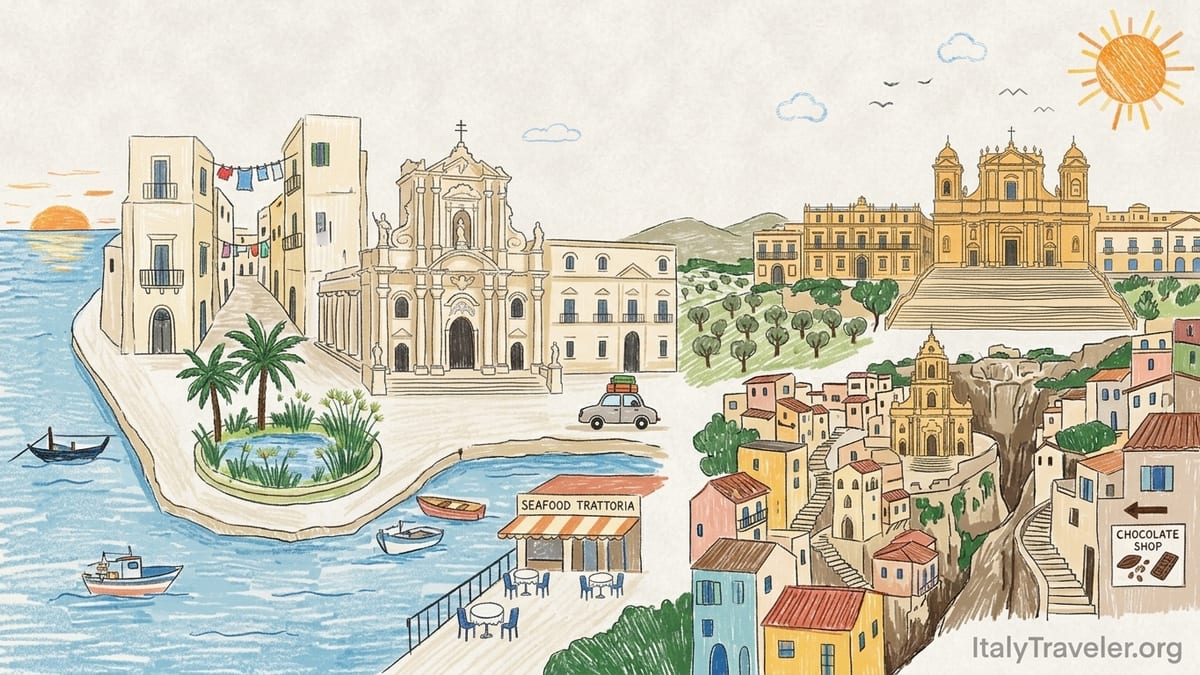
Arriving in Ortigia: Limestone, Sea Light and a Small Island Rhythm
I arrived in Ortigia on a warm evening in late spring, crossing Ponte Umbertino with my small rental car and a knot of anxiety about Sicily’s notorious ZTLs, the restricted traffic zones that can lead to fines if you stray into the wrong street. The first impression, though, was not stress but light. The island is encircled by low, pale stone buildings that catch the sun and throw it back in soft tones of cream and peach. The sea is never far away. You can smell salt as soon as you roll down the window.
I had booked a small guesthouse inside the historic center, a converted 18th century building on a narrow lane between Piazza Archimede and the seafront. The room was around 110 euros per night in May, including a simple breakfast of espresso, warm cornetti and fresh orange juice. Getting there by car required advance planning. Ortigia is mostly pedestrianized, with a controlled ZTL that usually operates every day, varying by season and time of day, and cameras at the entrances. In 2026, visitors are generally expected to park outside the core, either in the Talete car park on the northern seafront or in paid lots on the Syracuse side, then walk in or use a shuttle. I chose Talete, paying roughly 15 euros for 24 hours, and covered the last ten minutes on foot, my suitcase rattling over ancient paving stones.
Far from being a nuisance, the pedestrian layout shaped my experience in the best way. Within minutes I had slowed to the rhythm of Ortigia: laundry fluttering overhead between honey-colored facades, locals chatting in tight alleys, the faint hum of scooters at the periphery but almost no cars in the center. Without traffic, the island feels more like an open-air living room than a city. I found myself cutting down whichever vicolo looked prettiest, lingering to admire ornate door knockers and tiny shrines tucked into corners, with no need to watch for oncoming vehicles.
My first evening walk took me along Lungomare di Levante, where the limestone city wall meets the sea. The water was unusually calm, almost glassy, and the light softened to a warm pink that flattened shadows and turned the stone to butterscotch. I stopped at a simple seafood trattoria overlooking the water, ordered a plate of spaghetti ai frutti di mare for about 16 euros and a glass of local white wine for 6, and ate while watching children fish off the rocks. It felt like a proper arrival, the island hugging the shoreline and the sea wrapping around us both.
Ortigia’s Heart: Piazza del Duomo, Syracuse Cathedral and Fonte Aretusa
The next morning, I stepped into Piazza del Duomo and understood why so many people fall hard for Ortigia. The square is not large, but its curved, irregular shape and surrounding palazzi create a sense of stage-like drama. Everything is built from the same luminous limestone, so the cathedral, bishop’s palace and noble residences blend together in one cohesive backdrop, with glossy paving stones reflecting the sky.
Syracuse Cathedral dominates the piazza but in a quietly powerful way. Its Baroque facade, completed in the 18th century, ripples with columns and statues, yet behind it lies something far older: the structure incorporates the Doric columns of a 5th century BC Greek temple to Athena. Inside, I walked along walls where massive ancient columns form part of the side aisles, embedded in later Christian masonry. The entrance ticket was around 5 euros. What struck me most was not just the age layering but how it encapsulates Ortigia as a whole. The island is less a pure Baroque showpiece than a palimpsest of Greek, Roman, medieval and Baroque, all pressed into a tight urban fabric defined by the sea.
From the cathedral I wandered downhill toward Fonte Aretusa, a freshwater spring only a few steps from the saltwater harbor. Encircled by a stone wall and ringed with papyrus plants, the pool has an almost mythical feel, helped by the local legend that it was once a nymph transformed to escape pursuit. In practice, it is also a very real urban oasis. Families lean over the railings to watch ducks glide across the water, and the promenade that runs beside it links several cafes with outdoor tables. I paid about 3 euros for a strong espresso and sat under an umbrella, listening to a street musician play while ferries nudged in and out of the port.
Overall, Ortigia felt like a compact island city that never lets you forget its maritime setting. Fishing boats bob just beyond Baroque palaces, and a few minutes’ walk in any direction delivers you to open water. The architecture is ornate but never overwhelming, and the scale is human. It is easy to see why many travelers stay here and day-trip to the interior Baroque towns, though in my case the road was calling.
Driving Inland: ZTL Realities, Heat and the Road Toward Noto
Leaving Ortigia by car meant reversing the arrival steps. I walked back to the Talete car park in the morning, rolling my bag past early shoppers and delivery carts. Even at 9 a.m. the sun already had a hard edge. Southeastern Sicily in late spring and summer gets hot, and the limestone surfaces bounce the light around. I was glad I had packed a hat and refillable water bottle.
In 2026, the ZTL in Ortigia continues to be actively enforced, with automatic cameras at access points. Drivers staying inside the zone generally need to secure authorization through their accommodation, if available. Because I was parked in a designated lot outside the tightest core, I avoided the need to register, but I had to be careful to follow the signed route back over the bridge without slipping into restricted side streets. The lesson, which held true throughout the trip, was simple: always check current ZTL maps and hours with your hotel and avoid trusting only the GPS, which may not recognize recent changes.
The drive from Syracuse to Noto takes around 40 minutes on the main road, skirting olive groves, low hills and patches of scrub. It is not a dramatic mountain drive, but it feels increasingly rural compared with cosmopolitan Ortigia. I stopped at a roadside bar for a quick breakfast: a granita al limone with a soft brioche bun, about 4.50 euros in total. The granita was bright and tart, icy but not hard, with the slight graininess that characterizes Sicilian versions. Standing at the bar with truck drivers and local workers was a reminder that this is still a working landscape, not just a postcard route.
As Noto came into view, the difference from Ortigia was immediately clear. Instead of an island wrapped by sea, I saw a coherent Baroque town rising on a hillside, its churches and palaces all of a piece. Where Ortigia offers layers, Noto offers a kind of planned theatricality, much of it the product of rebuilding after catastrophe.
Noto: Baroque Stage Set and Evening Passeggiata on Corso Vittorio Emanuele
Noto is part of the UNESCO World Heritage property known as the Late Baroque Towns of the Val di Noto, a group of eight settlements rebuilt in a distinctive Baroque style after the 1693 earthquake devastated much of southeastern Sicily. Ortigia, for all its splendor, is not included in this inscription. The UNESCO property instead covers towns such as Noto, Modica, Ragusa and Scicli, which were rebuilt or significantly reshaped in the 18th century. In Noto, that heritage is visible the moment you step onto Corso Vittorio Emanuele.
I parked just outside the historic center in a blue-lined space, feeding coins into the meter for a few hours of paid parking at around 1.20 to 1.50 euros per hour. The heat in early afternoon was intense, so I planned my main exploration for the evening. Even so, the walk up toward Porta Reale was an exercise in seeking shade. Noto’s stone glows almost apricot in strong sun, and the wide streets can feel exposed.
Corso Vittorio Emanuele runs straight through the heart of the town, flanked by churches and palaces that unfold in careful sequence. The star is the Cathedral of San Nicolò, with its broad staircase and pale facade rising at the top of a large platform. Sitting on those steps at golden hour, I watched as locals and visitors drifted back and forth in the classic Sicilian passeggiata. Inside, the cathedral is relatively restrained, having been partially rebuilt after a dome collapse in the 1990s, but the sense of light and space is generous. The entrance was free when I visited, with small donations encouraged.
For dinner, I chose a trattoria one block off the main corso to escape the busiest crowds. I ordered a plate of cavati alla norma, short pasta with tomato, fried eggplant and ricotta salata, for about 13 euros, and a carafe of house red for 8. The flavors were simple but confident. Dessert was the real highlight: almond granita crowned with crumbled biscotti, around 4 euros. As I walked back to the car, the town felt like a well-composed scene, beautiful yet consciously arranged. In contrast to Ortigia’s intimate tangle of streets and nautical edges, Noto offered a more formal, planned version of Baroque, very much a product of post-earthquake urban vision.
Modica: Canyons, Churches and the Taste of Real Modica Chocolate
The next leg of my road trip from Noto to Modica took just under an hour, but the landscape shifted again. Modica sits in a series of deep ravines, with houses and churches stacked on terraces that climb the slopes. Arriving by car, I was immediately confronted by the reality of parking in a canyon town. The historic quarters, Modica Alta and Modica Bassa, have narrow and often one-way streets, and many spaces near the center are either resident-only or already taken. I eventually left the car in a paid lot at the edge of Modica Bassa, budgeting about 10 euros for the day.
Unlike Ortigia’s island intimacy or Noto’s theatrical avenue, Modica feels vertical and slightly chaotic. The town is famous as part of the Val di Noto UNESCO property, but what you feel most as a visitor is the topography under your feet. To visit key sights such as the churches of San Giorgio and San Pietro, you climb, descend and climb again. In the early afternoon heat, some of the staircases can be punishing. I stopped more than once in the shade of a doorway to drink water and catch my breath.
My first major stop was the Church of San Giorgio, a masterpiece of Sicilian Baroque perched high above Modica Bassa. The staircase leading up is monumental, with symmetrical flights framed by railings and small gardens. Inside, the church opens in a tall, airy nave, decorated with stucco and frescoes. A small voluntary donation of a couple of euros was suggested at the entrance. From the terrace outside, the view across the tangle of tiled rooftops and ravines is spectacular, especially in late afternoon when the sun picks out the contours of the landscape.
Later, I walked to the Church of San Pietro in Modica Bassa, closer to the main drag. Its facade is richly decorated, with a line of apostle statues on the staircase. Together, San Giorgio and San Pietro illustrate how Modica’s Baroque is deeply tied to its unique terrain, façades stepping up the hills and staircases functioning almost as public squares. The sense of a town rebuilt after disaster is here too, but the result feels more organic and less planned than in Noto.
Of course, Modica is equally famous for something sweeter: its chocolate. True Modica chocolate is made with a traditional cold-processing method that leaves sugar crystals intact, giving it a pleasantly grainy texture and intense flavor. I visited one of the historic chocolate shops near Corso Umberto and ordered a tasting plate with small squares flavored with cinnamon, vanilla and chili, plus an espresso, for about 7 euros. Bars of plain dark chocolate cost around 3 to 4 euros each. Later, I tried a slice of chocolate cake with a silky filling and the same distinctive flavor profile, around 5 euros in a sit-down cafe.
For dinner, I opted for a trattoria in Modica Bassa that specialized in local cuisine. I ordered ravioli di ricotta with pork ragù for about 14 euros and a side of caponata for 6. The portions were generous, and after a day of stairs my appetite matched. Compared with Ortigia and Noto, Modica felt slightly more workaday and less polished, but that was part of its charm. Here, the Baroque is not just a facade for visitors; it is the backdrop for daily life in a town that still operates very much on its own terms.
Ragusa Ibla: Layers, Gardens and a Different Baroque Personality
The final main stop on my loop was Ragusa Ibla, one of the two historic centers of Ragusa and another of the Val di Noto UNESCO towns. The drive from Modica to Ragusa takes about half an hour, winding through hills that open to views of plateaus and distant farmhouses. As with Modica, the challenge on arrival was again parking. Ragusa Ibla sits in a bowl below modern Ragusa, and access roads are tight and sometimes confusing.
I managed to find a spot in a pay lot near the lower part of Ibla, spending around 12 euros for a full day. From there, everything unfolded on foot in a maze of alleys and switchback lanes. Ragusa Ibla feels more refined and curated than Modica, with many renovated facades and boutique guesthouses, but it retains an authentic lived-in atmosphere, more neighborly than stage set.
The heart of Ibla is the cathedral square, dominated by the Cathedral of San Giorgio. The facade, designed in the 18th century, rises with a powerful vertical thrust, its bell tower slightly set back behind the front, creating a sense of depth. The piazza expands downhill like a shallow amphitheater, lined with cafes and restaurants. I ducked into the cathedral for a quiet look, leaving a small donation. Inside, the play of light through high windows and the orderly Baroque decoration gave me a different sensation than the canyon churches of Modica. Here, the Baroque feels more monumental but also more balanced, anchored by the geometry of the square.
A short walk away, the Giardino Ibleo offers a gentler counterpoint. This public garden sits at the edge of a promontory, with tiled paths, palms, benches and a balustrade overlooking the surrounding countryside. Entrance was free. In the late afternoon it filled with families, older couples and schoolchildren, all enjoying the shade and breeze. After days of hard stone underfoot and relentless sun, the combination of greenery and views made this one of my favorite spots of the entire trip.
My meal in Ragusa Ibla captured the town’s slightly more upscale, food-forward personality. At a modern osteria just off the cathedral square, I ordered a tasting of local cheeses and salumi for around 16 euros, followed by fresh busiate pasta with pistachio pesto and prawns for 18. A glass of well-chilled Grillo cost 7 euros. For dessert, I chose cannolo filled to order, 5 euros, the shell shatteringly crisp. Compared with Ortigia’s seaside plates of mixed grilled fish and Modica’s hearty ragùs, Ragusa Ibla’s dining scene felt more exploratory, with chefs riffing on tradition in subtle ways.
Heat, Stairs, Narrow Roads and the Reality of Driving Baroque Sicily
Across Ortigia, Noto, Modica and Ragusa Ibla, a few practical realities repeated themselves. The first was heat. From late spring through early autumn, the sun can be harsh, particularly in Noto’s wide streets and on Modica’s exposed staircases. Exploring middle-of-the-day without shade breaks and water felt unwise. I quickly learned to plan indoor visits around midday and save long climbs and major viewpoints for early morning or late afternoon.
The second reality was stairs. If you have mobility issues or heavy luggage, Modica and Ragusa Ibla in particular demand care. Hotels and guesthouses often occupy converted historic buildings reached via steep, narrow flights. In Modica Alta, many accommodations require climbing long external staircases as well as internal ones. I saw more than one traveler wrestling a large suitcase up dozens of stone steps. Packing light, with a bag you can comfortably carry, makes a big difference.
Driving itself brought its own challenges. Rural roads between these towns were generally in good condition, but historic centers are woven from lanes that feel almost comically tight, with parked cars on both sides and frequent blind corners. In Ortigia, the ZTL kept most of this traffic at bay, but in parts of Modica and Ragusa Ibla I crept forward with mirrors practically brushing walls. I was grateful I had chosen a small hatchback instead of a larger car.
Closures were the final recurring theme. Churches and smaller museums sometimes closed for long lunch breaks or on certain weekdays, especially outside peak tourist season. I arrived once at a church in Modica only to find the doors shut until late afternoon, and a small local museum in Ragusa Ibla was closed entirely on the day I had hoped to visit. It reinforced the value of checking current opening times in person or through your hotel rather than assuming that online listings are perfectly up to date.
Where I Stayed and What I Ate: Comparing the Overnight Experiences
I chose to spend one night in each of Ortigia, Noto, Modica and Ragusa Ibla to understand how they felt after day-trippers departed. The differences were striking. In Ortigia, I stayed in a mid-range guesthouse in a restored townhouse with high ceilings, tiled floors and a modest rooftop terrace. The rate was around 110 euros per night in May. Evenings brought a lively buzz to the lanes around my building. Restaurants filled up, and the sound of conversation drifted up until around midnight, though double-glazed windows kept most noise at bay. Waking up early, I watched vendors setting up in the nearby market, the smells of fresh fish and citrus filling the air.
In Noto, I booked a small B&B in an elegant palazzo just off Corso Vittorio Emanuele for roughly 95 euros per night. The room had tall windows and pale stone walls, and breakfast was served in a frescoed salon with simple pastries, fruit and coffee. At night, the town center remained busy, especially on weekends, but the atmosphere was softer than in Ortigia, more about strolling and gelato than late-night bars. The main downside was the walk back uphill from the parking area with my bag in the heat.
Modica offered a very different overnight mood. My guesthouse, around 85 euros per night, was carved into the hillside above Modica Bassa, accessed via a series of steep external steps. The view over the canyon and rooftops at dusk was unforgettable, with lights flickering on in layers. Evenings were quieter than in Ortigia or Noto, with fewer large groups and a more local crowd on Corso Umberto. The drawback was the climb back home after dinner. I timed my return carefully, carrying water and taking breathers along the way.
Ragusa Ibla was, for me, the most seductive place to stay. I found a small boutique hotel on a side street a short walk from the cathedral square, priced around 120 euros per night but including a very good breakfast with local cheeses, homemade cakes and fruit. At night, the square glowed softly, and the lanes around it were busy without feeling crowded. Walking back through Giardino Ibleo after dinner, with cicadas chirping and only a few people on the paths, gave the town a magical quality that I did not feel as strongly elsewhere.
Food experiences also shifted town by town. In Ortigia I gravitated toward seafood: mixed grills of swordfish, prawns and calamari for 20 to 24 euros, plates of raw marinated anchovies for around 10, and couscous di pesce for roughly 16. In Noto, the almond-based sweets and granita stole the show, with pastry shops presenting trays of cassatine, almond biscuits and cannoli for 2 to 4 euros each. Modica’s chocolate, with its crystalline crunch, found its way into everything from simple bars to elaborate desserts. In Ragusa Ibla, tasting menus and creative takes on local pasta shapes hinted at why this area has earned culinary recognition in recent years. Prices ranged from 30 to 60 euros per person for a multi-course dinner without wine at more ambitious places, though simpler osterie still offered filling mains for under 20 euros.
Planning a Two or Three Day Baroque Road Trip and Choosing Favorites
Looking back, I would structure a short Baroque road trip in two main ways, depending on how much time you have and how often you want to change hotels. With two full days and a car, one pragmatic option is to base yourself in Ortigia for both nights and treat Noto, Modica and Ragusa Ibla as day trips. On day one, you could drive to Noto in the late morning, explore Corso Vittorio Emanuele and the Cathedral of San Nicolò, linger over evening granita, then return to Ortigia for a late seafood dinner by the sea. On day two, you could set off early toward Modica, visit San Giorgio and San Pietro, taste chocolate and have lunch, then continue in the afternoon to Ragusa Ibla for the cathedral square and Giardino Ibleo before driving back to your island base.
A three-day version allows you to sleep inside at least one of the inland Baroque towns. In that case, I would recommend the following: first night in Ortigia, enjoying Syracuse Cathedral, Fonte Aretusa and the seafront; second night in Modica, to experience the canyon town at dusk and early morning; and third night in Ragusa Ibla, to savor its evening ambiance and garden walks. Noto works well as a stop between Ortigia and Modica or as a half-day excursion from either. This pattern minimizes one-night stays while still letting you feel the distinct character of each place after day-trippers have gone.
As for favorites, each town excelled at something different. My favorite overall town to wander was Ragusa Ibla, where the combination of cathedral square, intimate lanes and the Giardino Ibleo garden created a balanced, livable feel. The best pure Baroque architecture, in the sense of a coherent post-1693 vision, belonged to Noto, with its golden streets and showpiece Cathedral of San Nicolò arrayed along Corso Vittorio Emanuele. For food, I still dream about Ortigia’s simple grilled fish eaten a few meters from the sea and Modica’s intense chocolate enjoyed after climbing to San Giorgio.
If I had to choose which destinations deserved overnight stays, I would pick Ortigia and Ragusa Ibla without hesitation, with Modica as a strong third if you enjoy atmospheric, slightly rugged towns and do not mind stairs. Noto, beautiful as it is, felt to me more like a perfect day-trip town. Its main sights and culinary highlights can be comfortably enjoyed in an afternoon and evening, after which the experience does not deepen as much as it does when sleeping inside the canyons of Modica or the folds of Ragusa Ibla.
FAQ
Q1. Is Ortigia part of the UNESCO Val di Noto Baroque towns?
Ortigia is not one of the eight towns in the Late Baroque Towns of the Val di Noto UNESCO property. That inscription includes Noto, Modica, Ragusa, Scicli and several others inland, but not the historic island of Ortigia.
Q2. How strict are the ZTL rules in Ortigia in 2026?
In 2026, Ortigia’s restricted traffic zone is actively enforced with cameras at access points. Visitors without authorization from a hotel inside the zone are generally expected to park outside the core, such as in public car parks at the edge of the island or on the mainland, and walk in or use shuttles.
Q3. Is it better to stay overnight in Ortigia or use it only as a day trip?
Staying overnight in Ortigia changes the experience significantly. Early mornings and late evenings are quieter and more atmospheric, with markets, seafront walks and piazzas less crowded. For a short trip, it makes an excellent base for day trips to Noto, Modica and Ragusa Ibla.
Q4. How challenging are the stairs in Modica and Ragusa Ibla?
The historic quarters of Modica and Ragusa Ibla involve substantial stair climbing, both outdoors and inside older buildings. Visitors with mobility issues or very heavy luggage may find certain areas difficult, so choosing accommodations with easier access and packing light are important.
Q5. What kind of budget should I plan for meals in these Baroque towns?
In 2026, a simple sit-down lunch of pasta or a main dish typically costs between 12 and 18 euros, with seafood dishes often in the 18 to 24 euro range. Street snacks, pastries and granita usually fall between 2 and 5 euros, while a multi-course dinner at a more ambitious restaurant can range from about 30 to 60 euros per person before wine.
Q6. Is driving between Ortigia, Noto, Modica and Ragusa Ibla stressful?
The main roads between the towns are generally straightforward. The stress comes when entering historic centers, where streets are narrow, parking is limited and ZTL zones vary. Renting a small car, checking ZTL maps and parking just outside the tightest cores help reduce anxiety.
Q7. Do I need a car, or can I rely on public transport?
Some bus and train connections do exist between Syracuse, Noto, Modica and Ragusa, but schedules can be limited, especially for day trips that combine multiple towns. A car provides much more flexibility for short stays, though it comes with the tradeoffs of parking and traffic restrictions.
Q8. When is the best time of year to do this Baroque road trip?
Late spring and early autumn are often the most comfortable times, with warm but not extreme temperatures and longer daylight hours. High summer can be very hot, particularly in exposed places like Noto’s main streets and on Modica’s staircases, while winter may bring shorter days and more frequent closures.
Q9. Where is the best place to try authentic Modica chocolate?
The historic center of Modica Bassa, especially around Corso Umberto, is filled with traditional chocolate shops that produce the grainy, cold-processed Modica chocolate. Tasting plates and small bars allow you to sample classic flavors such as vanilla, cinnamon and chili without spending much.
Q10. If I have only two nights, which towns should I prioritize for sleeping?
With two nights, a popular and rewarding choice is to spend one night in Ortigia, for its sea views and layered history, and one night in Ragusa Ibla, for its cathedral square and Giardino Ibleo. Noto and Modica can then be visited as day trips, allowing you to balance variety with fewer hotel changes.