


I drove to Scala dei Turchi this September with the same dreamy images everyone knows: sweeping white steps pouring into turquoise water, couples strolling along the bright ridge at sunset, and travelers perched on the upper terraces as if on some natural amphitheater above the Mediterranean. What I found instead was a fenced-off entrance, a card reader, a strict 20-minute time slot for a €6 ticket, and a tightly managed experience that felt far removed from those famous photos.
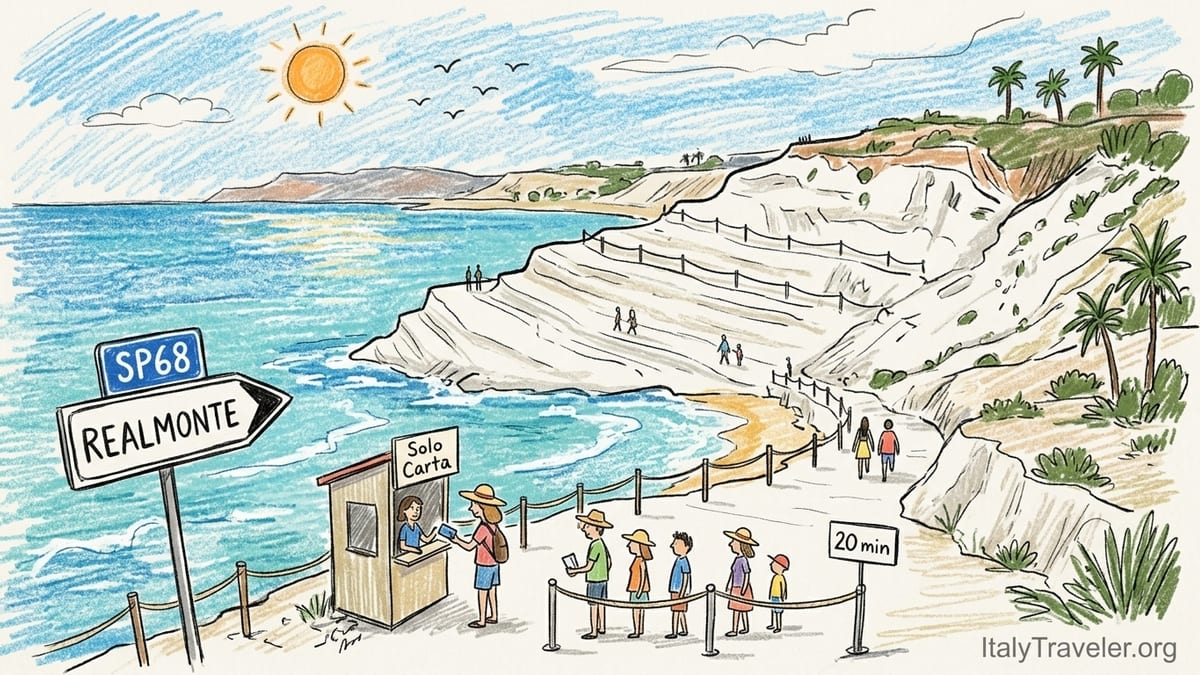
Arriving At Scala dei Turchi In 2026: My Actual Visit
My visit took place in mid-September 2026, on a hot, hazy afternoon with the air temperature hovering a little over 30 degrees Celsius. I arrived via the SP68 coastal road from Agrigento, having left the Valley of the Temples car park just after lunch and reached the Realmonte coast about 25 minutes later. The approach already feels different from the carefree beach stop many travelers still expect. Signs along the road and at the parking lots stress that Scala dei Turchi is now a controlled geosite with regulated access, time-limited visits and possible sudden closures.
I parked at one of the paid lots off the SP68, the same area referenced by the Municipality of Realmonte as the standard access zone for visitors. From there it was a short downhill walk to the beach-level entrance. Old online guides still describe simply walking along the sand and scrambling up the white rock at will. In 2026, you instead encounter a staffed checkpoint, fencing and information boards explaining that this is a fragile marl formation under protection, with access allowed in small groups for roughly 20 minutes at a time.
The sky was bright but slightly milky, with the kind of harsh early afternoon light that photographers dread and casual visitors underestimate. White marl behaves like a giant reflector. Even before stepping onto the rock, the brightness was intense enough that sunglasses were not optional but essential. Heat radiated from the pale surface, and I understood immediately why, according to the local rules, temperatures around 34 to 35 degrees can trigger full or partial closures. On some days, the site might simply be off limits during the hottest hours.
By the time my small group was lined up at the entrance, I had already been primed to think of Scala dei Turchi not as a spontaneous beach detour, but as something more like an outdoor museum: timed, surveilled and, in some ways, more constrained than many indoor galleries.
The €6 Ticket, Email Reservations And The 20-Minute Clock
For 2026, the official rules adopted by the Municipality of Realmonte describe a very clear framework: admission costs €6 per person, payment is by card at the entrance only, and visits are extremely short, scheduled in waves of roughly 20 minutes. Local reporting and municipal notices explain that up to about 1,800 entries per day are allowed, in groups of approximately 50 people every 20 minutes, from 08:00 until the last admission at 19:40. The idea is to spread visitors throughout the day while keeping the actual rock surface under constant control.
The municipality’s “My Scala dei Turchi” information, last updated in August 2026, still emphasizes reservations by email. In practice, when I visited, many travelers were simply arriving and queuing, relying on the card-only payment on site. That disconnect between the official instructions and the on-the-ground reality adds confusion. One Italian couple ahead of me had taken the email requirement literally, printed out their confirmation and were surprised that staff barely glanced at it before waving them into the same queue as everyone else.
At the small ticket booth, payment is contactless only. A handwritten sign makes this explicit: no cash. The staff member quietly repeated “solo carta” several times as visitors rummaged for coins. A Belgian family behind me, who had driven in from Palermo, had to shuffle through their wallets to find a card that would work. Once tickets were issued, our group was held behind a rope until the previous batch of visitors left the rock. It felt orderly but slightly rushed, as though we were boarding a short shuttle ride rather than entering a natural landscape.
The most jarring part is realizing how little 20 minutes feels once you step through the barrier. Guides and blogs sometimes frame this as a quick photo stop, but the combination of a long approach drive, paid parking, queuing and then a 20-minute countdown on site creates a sense of mismatch. You invest hours and a not insignificant travel budget, and in return you receive what amounts to a tightly timed stroll on a thin slice of the formation.
From Iconic Photos To A Narrow Walkway: Expectations vs Reality
The mental image most visitors carry comes from photographs taken before 2020: wide shots of people scattered across the full height of the Scala dei Turchi, lounging on the sweeping upper steps, and even sitting at the very lip of the cliff as the sea boils beneath them. Influencers and promotional shots show uninterrupted white curves with almost no sign of fencing, officials or timing.
Today's experience is different. The upper sections of the formation are now closed to the public, and only a lower band of the “steps” is open, cordoned off with ropes and small barriers. Official guidance highlighted by the municipality and regional press explains that visitors can walk only along a designated route at the base and on a modest central section. This is a deliberate conservation choice: the upper areas are the most fragile and the most vulnerable to erosion and collapse.
On my visit, the walking path felt surprisingly narrow. A marine-style rope line and discreet posts keep people from straying toward the steeper edges. Two staff members paced back and forth, reminding anyone who tried to climb higher that these zones were off limits. The famous “natural seats” on the upper steps were entirely out of reach. Every time someone tried to recreate a viral photo by climbing a little higher, they were quickly called back.
It is still beautiful. The curves of ice-white marl meet the shallow turquoise water in a way that seems almost artificial, like poured plaster shaped by waves. But you constantly feel the friction between the postcard you expected and the controlled strip of reality you are allowed to experience. This disconnect is at the heart of many visitors’ disappointment and a crucial factor in deciding whether the €6 and the logistics are worthwhile for you.
What Scala dei Turchi Really Is: Geology And Fragility
To understand the strict rules, it helps to know what you are actually standing on. Scala dei Turchi is a cliff made of white marl, a sedimentary rock composed of a mixture of calcium carbonate and clay. Geologists classify it as part of the Trubi Formation, a lower Pliocene unit that records the transition from the Miocene to the Pliocene in this part of Sicily. The material was laid down millions of years ago in a deep marine environment, where fine particles and the shells of microscopic organisms slowly settled to the seabed.
Unlike harder limestones or granites, marl is soft and relatively easy to scratch, crumble or wear down. It can feel almost chalky underfoot, with fine powder collecting around your shoes. That tactile softness is precisely why Scala dei Turchi photographs so well: the surface smooths into flowing curves under rain and wind. It is also why uncontrolled human traffic is such a problem. Every footstep contributes a little abrasion. Every person who sits, slides, or carves initials into the rock accelerates erosion beyond natural levels.
Local scientific and tourism organizations point out that this coastal stretch around Realmonte is among the world’s key reference points for understanding Pliocene stratigraphy. The cliff does not only attract tourists. It is also part of a global geological story, cited by academics and eventually recognized among notable international geosites. That scientific value is one of the major justifications for treating the formation more like a fragile museum piece than a casual beach backdrop.
From a visitor’s perspective, this fragility manifests in strict prohibitions. Staff stressed that footwear must be clean and non-damaging. Spiked or sharp-soled shoes are unwelcome. Removing even small fragments of rock or scraping the surface is forbidden and can lead to fines. These rules are not theoretical. They come after years of visible wear and high-profile cases of vandalism, including people staining the marl or chiseling out chunks as souvenirs. The 2026 regime is a corrective, not an overreaction invented in a vacuum.
Rules, Closures And The Reality Of A Short, Controlled Visit
The 2026 regulations consolidate earlier emergency measures into a permanent system. In summary, they implement controlled access with short time slots, close the upper steps, and make entrance conditional on environmental and safety criteria. This means that even if you have reached the coast after a long drive, there is no absolute guarantee you will be allowed onto the rock that day.
The municipality’s guidance makes clear that the site can close for several reasons. Heavy seas, including relatively moderate “choppy” conditions, automatically trigger a halt to visits. Strong wind that can destabilize footing on the smooth surface has the same effect. Rain is an immediate red flag because the marl becomes extremely slippery when wet. High temperatures around or above 34 to 35 degrees can lead to full or partial daytime closures to protect visitors from heat stress and to reduce physical impact on the rock when it is most vulnerable.
In 2026, this was not a theoretical list. For example, the Scala dei Turchi was closed to public access on 17 September, 29 September and again on 3 October 2026 due to adverse conditions flagged by the municipal civil protection office. These dates are a useful concrete reminder that even during the classic late-summer travel window, when many visitors assume stable weather, the site can be abruptly taken off the table. Travelers who had centered their itineraries around a single dedicated visit on one of those days would have been turned away at the final hurdle.
Seismic activity is another, lesser-known trigger. The rules provide for closure after local earthquakes above a certain magnitude threshold, even if damage is not immediately visible. Officials prefer to err on the side of caution in a coastal cliff that is already subject to natural cracking and minor rockfalls. All this means that Scala dei Turchi cannot be treated like a reliable, always-open photo stop. It behaves more like a small cable car or a mountain trail subject to daily operational decisions.
Walking The Route: What You Actually See In Those 20 Minutes
Once the rope dropped and our group stepped onto the rock, the clock started to matter. Most people instinctively rushed to walk as far along the allowed path as possible, then doubled back to take photographs on the way. The official circuit follows a narrow part of the lower steps, with occasional opportunities to sit briefly or pose. Staff carry portable radios and call out gentle reminders about time remaining.
In the first five minutes, the experience is intoxicating. The contrast between the velvety white surface and the clear blue water is exactly as striking as the postcards suggest. Small ledges and natural curves feel like they have been deliberately sculpted. Standing at the seaward edge of the allowed zone, you get the classic oblique view back toward the higher terraces, now empty of people, which gives the scene an almost surreal calm in contrast with older photos crowded with visitors.
Some people waded briefly in the shallow water at the base, where the rock softens into a sandy strip. This is technically outside the main formation but within the timed zone. Shoes quickly pick up fine white dust, and socks become stained a pale beige. A few children tried to dig into the marl near the waterline and were gently stopped by staff. That interaction encapsulates the tightrope the authorities are walking: allowing people to enjoy a unique surface while preventing the kind of playful erosion that, multiplied by thousands, would leave scars.
After about 15 minutes, the mood shifted. Guides began subtly steering people back toward the exit, reminding us that the next group was waiting. Several visitors looked frustrated, halfway through framing shots they had seen online but unable to replicate them because the best vantage points were either off limits or simply took too long to reach within the time limit. When the call came to leave, it felt abrupt. I glanced back at the emptying steps and realized I had used my 20 minutes mostly in mild haste, aware that my time on one of Sicily’s most photographed landmarks was clicking away.
Cost, Effort And The Question Of Value
Is €6 expensive for such a short visit? In absolute terms, no. The price is in line with many small cultural sites and far cheaper than major attractions such as the Valley of the Temples, where a standard adult ticket costs noticeably more. The issue is not the ticket itself but the ratio between time, effort and experience. For most travelers, Scala dei Turchi is not next door. It requires at least a short diversion, if not a long detour from coastal routes or from inland bases like Palermo or Catania.
On my trip, I had already rented a car, paid for fuel, and budgeted for several separate parking fees. The parking near the SP68 cost only a few euros for an afternoon, but added to the tally. If I had come from Catania specifically for Scala dei Turchi, driving nearly three hours each way, the 20-minute window would have felt disproportionately small. A round trip of 5 to 6 hours, plus parking and food, in exchange for one timed walk, is a questionable value proposition unless you are particularly passionate about geology or determined to see this specific landmark.
Where the €6 begins to feel more reasonable is when Scala dei Turchi is combined with a visit to Agrigento and the Valley of the Temples. The two sites lie roughly 15 kilometers apart, and local tourism boards now frame them as a natural pairing: ancient stone temples inland and dazzling white rock by the sea. In this context, Scala dei Turchi becomes a visually striking, but brief, complement to a fuller day built around the archaeological park, museums and a leisurely meal in Agrigento’s historic center.
The key insight is that you should rarely plan an entire day or a long detour around Scala dei Turchi alone. As a short add-on during a broader exploration of southwestern Sicily, the entry fee is acceptable, especially if you treat it more like a special viewpoint than a destination beach. As a single-focus excursion, particularly for travelers on tight schedules or traveling with children, it risks feeling like an over-controlled and underwhelming return on investment.
Seeing Scala dei Turchi Without Entering: Free Viewpoints And Alternatives
One of the most important practical points is that you do not need to set foot on the marl to appreciate Scala dei Turchi. Legal public viewpoints along the SP68 and from nearby beach areas offer excellent panoramas without entering the controlled-access zone or paying the €6 fee. Several overlooks around the Belvedere area above the cliff provide classic postcard views from a distance, especially at sunrise or late afternoon when the light is softer and shadows carve out the cliff’s contours.
Down at sea level, sections of nearby beaches allow you to walk along the sand and look up at the formation from a short distance, again outside the fenced entry zone. Local residents often recommend this approach for people who are short on time or traveling with older relatives who might find the descent and timed access stressful. From the shoreline, the scale of the formation and its context in the broader coastline are clear, even if you cannot feel the rock under your feet.
During my visit, I spent nearly as long at the free viewpoints as I did inside the paid zone. In some ways, these vantage points offer a more relaxed appreciation. There is no ticking clock, no need to shuffle along a rope line, and no pressure to capture specific photos before time runs out. You can simply watch the light change on the cliff, observe waves battering the base, and understand the site as part of a living coastline rather than a short Instagram stop.
For travelers nervous about the risk of closure due to weather or heat, building your day around these viewpoints, and treating the paid access as an optional bonus if conditions allow, is a smart strategy. You still get to enjoy the famous “Turkish Steps” visually, even if the gates are closed or time slots are fully booked.
The Takeaway: When Scala dei Turchi Is Worth It, And When To Skip
Looking back on my September 2026 visit, paying €6 for roughly 20 minutes did not feel like a rip-off, but it did feel underwhelming when isolated from the rest of my day. The formation is genuinely spectacular, and standing on the white marl is a memorable sensory experience. Yet the constraints of the modern “Scala dei Turchi Experience” leave little room for lingering, quiet observation or unstructured exploration. The site you have in your head, built from years of unrestricted photos, is not the site you will encounter on the ground.
If your Sicily itinerary already includes Agrigento and the Valley of the Temples, and you have a rental car or private transfer that can easily swing toward Realmonte, then Scala dei Turchi is worth considering as a tightly framed add-on. In that context, €6 is a modest supplement to a day that is otherwise anchored by world-class archaeology and broader coastal views. You accept the 20-minute walk as a curated taste of a fragile geosite rather than a full coastal outing.
On the other hand, if you are contemplating a long, dedicated drive of several hours each way solely to step onto the white steps, you should think carefully. Factor in the possibility of sudden closure due to wind, rough seas or heat, as demonstrated by the real-world shutdowns on 17 September, 29 September and 3 October 2026. Consider whether you will be satisfied with a short, managed stroll and some photos from a restricted lower band, instead of the free-roaming, upper-terrace adventure shown in older images.
For travelers who prioritize spontaneity, dislike crowds, or are traveling in high summer heat, a better strategy may be to enjoy Scala dei Turchi from public viewpoints and focus your paid time and energy on more flexible sites. Ultimately, the value of that €6 and those 20 minutes depends not only on your budget but also on your expectations. Scala dei Turchi is no longer a wild coastal playground. It is a fragile outdoor exhibit that, while still beautiful, rewards only those who arrive informed about what has changed.
FAQ
Q1. How much does it cost to visit Scala dei Turchi in 2026?
In 2026 the admission fee is set at €6 per person for the controlled-access area, payable by card at the entrance. This covers a short, supervised visit on the lower part of the marl formation.
Q2. How long can I stay on the rock once I enter?
Visits are limited to roughly 20 minutes per group. Staff manage entry in time slots and will guide you back toward the exit as your slot ends, so it is not possible to linger significantly longer.
Q3. Do I need to book my visit in advance?
The municipality’s information still mentions reservations by email, but in practice many visitors simply arrive and buy tickets on site. Because procedures can change, it is wise to check the latest local guidance shortly before your trip and, if possible, secure a time slot in advance during busy periods.
Q4. Can I still walk on the upper steps like in old photos?
No. The upper terraces of Scala dei Turchi are currently closed to protect the fragile marl and reduce the risk of falls or rock damage. Visitors are restricted to a lower, designated route and cannot climb to the prominent upper ledges seen in older pictures.
Q5. What kind of footwear and behavior are allowed on the rock?
Clean, non-damaging footwear is required, and staff discourage any shoes with sharp or abrasive soles. Running, sliding, carving, sitting on off-limits edges, or removing even small fragments of rock are strictly prohibited and may result in removal from the site or fines.
Q6. Why does Scala dei Turchi sometimes close at short notice?
The site can close due to rain, strong wind, rough or even moderately choppy seas, very high temperatures around 34–35 degrees, or seismic events. Real closures on 17 September, 29 September and 3 October 2026 illustrate how quickly conditions can lead authorities to halt access for safety and conservation reasons.
Q7. Can I see Scala dei Turchi without paying the entrance fee?
Yes. Public viewpoints along the SP68 and nearby beach areas offer excellent legal views of the formation without entering the fenced zone. From these vantage points you can photograph the entire cliff and appreciate its setting, although you will not stand directly on the marl.
Q8. Is Scala dei Turchi suitable for a standalone day trip?
For most travelers it is better as a short add-on to a day in Agrigento and the Valley of the Temples. As a standalone day trip involving several hours of driving, the 20-minute timed visit often feels too brief, especially given the risk of closure due to weather or heat.
Q9. How close is Scala dei Turchi to Agrigento and the Valley of the Temples?
Scala dei Turchi lies in the municipality of Realmonte, roughly 15 kilometers from Agrigento and its Valley of the Temples archaeological park. By car, the drive typically takes around 20 to 30 minutes, making it practical to visit both on the same day.
Q10. When is the best time of day to visit Scala dei Turchi?
Early morning and late afternoon usually offer the most pleasant combination of softer light, slightly cooler temperatures and less glare from the white marl. Midday summer visits can be extremely bright and hot, and high temperatures may increase the chance of temporary closures.