


Sicily’s coastline is long, varied and at peak times overwhelmingly busy. Planning a beach-focused trip works far better if you think in regions rather than chasing a single famous cove from an Instagram post. This guide divides the island into northwest, north, east, southeast and southwest coasts, and compares the main beaches you are likely to consider, from San Vito Lo Capo and Mondello to Fontane Bianche, Vendicari and the white cliffs of Scala dei Turchi.
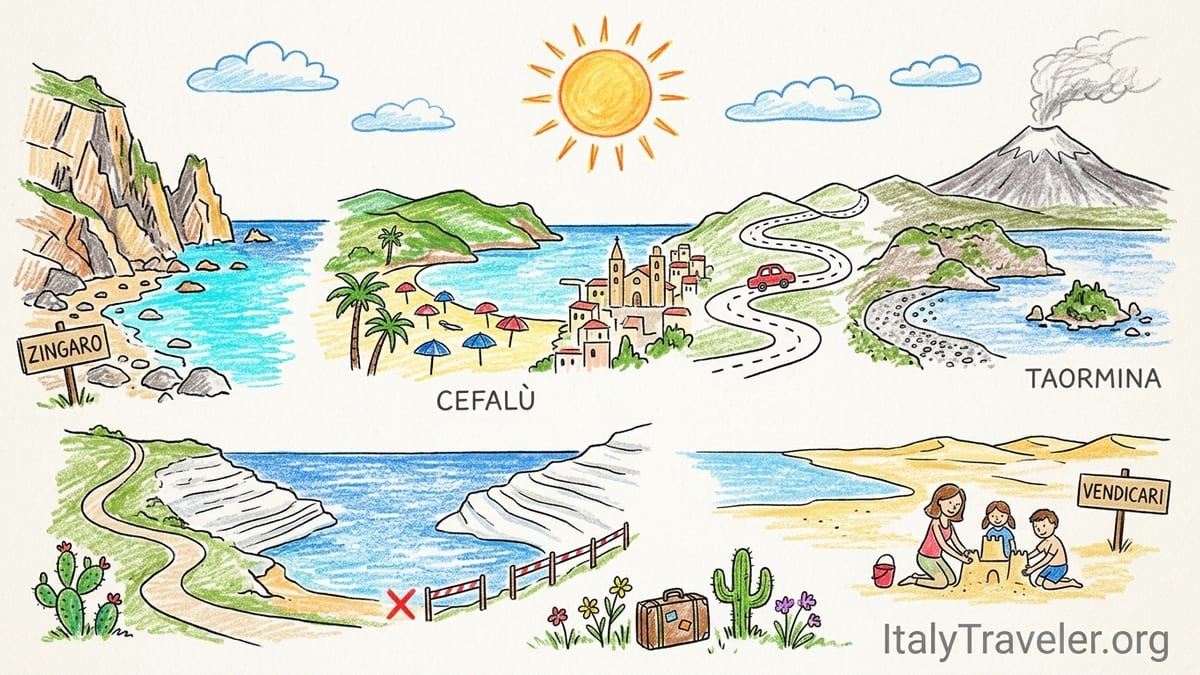
How to read Sicily’s coasts and driving times
The northwest coast, anchored by San Vito Lo Capo, Scopello and the Riserva dello Zingaro, is where rugged cliffs meet Caribbean-looking shallows. The north coast between Palermo and Capo d’Orlando mixes long town beaches like Mondello and Cefalù with smaller coves under green headlands. The east coast, including Isola Bella and Giardini Naxos, feels more volcanic and pebbly. The southeast around Syracuse and Vendicari is low, sandy and family-friendly. The southwest between Sciacca, Menfi and Scala dei Turchi is quieter, with wide open strands and windier conditions.
Distances look short on the map, but summer traffic and small roads mean you should plan for realistic driving times. From Palermo to Mondello is around 20 to 30 minutes by car in normal traffic. Palermo to Cefalù is about 1 hour on the A20. Palermo to San Vito Lo Capo is usually 1 hour 45 minutes to 2 hours depending on summer congestion. Catania to Taormina / Giardini Naxos takes around 50 minutes via the A18, while Catania to Syracuse is about 1 hour. Syracuse to Fontane Bianche is roughly 20 to 25 minutes, and Syracuse to Vendicari or San Lorenzo is closer to 50 to 60 minutes via the coastal road. Trapani to San Vito Lo Capo usually takes about 1 hour.
For most of the beaches below you will find a mix of public stretches and stabilimenti balneari (lidos) renting umbrellas and sunbeds. Recent reports and 2026 price lists suggest that a pair of sunbeds and one umbrella at popular Sicilian beaches often runs in the region of 25 to 40 euros per day in high season, with a few simpler setups costing a little less and stylish beach clubs costing more. Where local parking companies or municipalities publish current fees, those are mentioned so you can budget realistically.
Public transport along the coasts is improving but still patchy. Trains work well for the north coast line linking Palermo with Cefalù and Capo d’Orlando, but most of the northwest and southeast beaches described here are easiest by car or organized transfer. Car-free travelers should pay extra attention to the comparison table at the end, which highlights the few places where you can reliably reach the sand without driving.
Northwest coast: San Vito Lo Capo, Macari, Scopello and Zingaro
San Vito Lo Capo’s main beach is a long, fine, golden-sand crescent under Monte Monaco, with very shallow, clear water that deepens gradually. This is one of Sicily’s best beaches for non-swimmers and small children, since you can often walk out for many meters before it reaches adult waist height in calm conditions. Access is straightforward from the compact town, with promenades and side streets leading directly to the sand. Much of the beachfront is lined with lidos offering umbrellas, loungers, showers and bar service, alongside generous free sections between them. Recent guides to San Vito Lo Capo report equipped spots charging in the general range you will see elsewhere in Sicily, with lower prices in June and September and higher in August; weekend rates and front-row positions usually cost more. Parking is in municipal lots or on signed streets around town, where summer tariffs are clearly posted.
A few minutes west of San Vito by car lies the Macari area, where the coastline becomes rockier and more natural. Here you find small coves and low cliffs with coarse sand or pebbles and beautifully clear water. There are some seasonal kiosks and food trucks, but facilities are much more limited than in town. Access often involves walking from roadside pull-offs down short but occasionally uneven paths. Swimming here is more for confident swimmers because the seabed can drop more quickly and waves can be stronger on tramontana or maestrale wind days.
Scopello’s Tonnara is one of Sicily’s most photographed spots, with rock stacks rising from a small bay beside the old tuna fishery. The shore is pebbly and rocky, and swimming is into deep, crystalline water, ideal for confident swimmers and snorkelers. The site now functions as a private bathing establishment with controlled entry. Visitor numbers, opening months and prices can change, so you should always check the latest details locally or with your accommodation. Expect paid access and, in high summer, the possibility that advance booking is advised, particularly if you want a reserved lounger rather than just a swim.
Just beyond Scopello begins the Riserva Naturale Orientata dello Zingaro, a protected stretch of coast with a string of coves such as Cala Capreria and Cala dell’Uzzo. After a major wildfire on 25 July 2025 the reserve remained closed for months. A partial reopening started from the Scopello side in March 2026, and from 9 May 2026 both the Scopello and San Vito Lo Capo entrances reopened to the public with significant restoration work completed. Visitors can now walk the full coastal path and the middle-altitude trail, while the higher ridge path remains excluded for safety and ecological regeneration. Swimming coves reached by the coastal trail are typically pebble or small-stone beaches backed by cliffs, with very clear water that deepens fairly quickly. There are no lidos here, only simple services near the entrances, so you swim at your own responsibility and must carry water and sun protection.
Riserva dello Zingaro after the 2025 wildfire
The July 2025 fire left large areas of Zingaro blackened and unstable. Regional authorities closed the reserve entirely for safety reasons and to allow natural regeneration. From 14 March 2026 the Scopello entrance reopened first on a partial basis, and by 9 May 2026 access from San Vito Lo Capo was restored, meaning visitors can again traverse the entire coastal and middle routes between the two trailheads. The uppermost high trail remains closed and excluded from public access. Signage and maps at the entrances highlight which paths are currently open.
For travelers this means that Zingaro is once again a highlight of a northwest Sicily beach trip, but you must treat it more like a backcountry outing than a normal serviced beach. There are still no lidos or bars inside the reserve. Swim spots such as Cala Capreria are reached by walking portions of the coastal trail, sometimes in strong sun. Footwear that handles stones and hot surfaces, plenty of water, and respect for closure signs are essential. Authorities have publicly discussed the possibility of daily visitor caps in future to avoid returning to pre-fire annual visitor numbers, so in peak season you may encounter controlled access.
The official reserve website and notices from the managing authority are the only reliable sources for last-minute closures, which can be imposed after heavy rain, new landslides or renewed fire risk. Before committing to a long drive, especially from other parts of Sicily, you should always check the latest alerts and, if in doubt, call your accommodation near Scopello or San Vito Lo Capo to confirm conditions on the ground.
Driving times help you decide whether to visit on a day trip or stay in the area. From Palermo to the Scopello entrance is usually about 1 hour 20 minutes via the A29, while to the San Vito Lo Capo entrance it is closer to 1 hour 50 minutes, depending on traffic. From Trapani to the San Vito side is around 1 hour. Given these times and the heat, many travelers choose to stay at least one or two nights in San Vito, Castellammare del Golfo or Scopello to enjoy the reserve in the early morning or late afternoon when light and temperatures are softer.
North coast: Mondello, Cefalù and Capo d’Orlando
Mondello is Palermo’s city beach, a long, pale sandy bay framed by Monte Pellegrino. The sand is soft, the seabed very shallow for a long distance, and the water normally calm in summer. This is excellent for families with young children and for people who like to stand chatting waist-deep in the sea. Access is flat and easy, with buses and taxis linking Palermo’s center to the waterfront. The shore is divided between paid lidos and free stretches. Recent descriptions of a day in Mondello suggest that in 2026 a pair of loungers and umbrella in mid-range lidos costs on the order of several tens of euros in high season, cheaper midweek and in June.
Parking at Mondello is subject to summer tariffs. The public transport company AMAT announced for the June to September 2026 season that paid parking zones around Mondello are active every day from 08:00 to 20:00, with options that include roadside blue spaces and designated car parks. One example is the Galatea car park with a daily flat rate of a few euros, while other spots charge by the hour. If you are staying in central Palermo and visiting just for the day, it is often easier to take a bus or taxi rather than drive in peak August weekends, when congestion is intense.
Cefalù’s main beach is a long arc of sand shelves in front of both the historic center and modern town. The sand is medium-fine, and access to the sea is gently sloping and family-friendly. There are several lidos along the lungomare with standard loungers and umbrellas, showers and bars, as well as broad free areas near the town end. Cefalù can feel extremely busy in July and August, but the advantage is that you can swim, visit the Norman cathedral and eat dinner all on foot from seafront apartments or hotels. Parking close to the historic center is regulated; a dedicated “Cefalù Beach Parking” and other lots along the seafront operate with day rates in the summer, while a central parking company publishes seasonal tariffs for June to September. It is wise to book accommodation with parking included if you are staying in July or August.
Further east along the Tyrrhenian coast, Capo d’Orlando offers long, mostly pebbly or coarse-sand beaches with clear, deeper water and views to the Aeolian Islands on clear days. The main town beach has a promenade, occasional lidos and free stretches. Swimming here is straightforward but better for those who are comfortable in water that deepens more rapidly than at Mondello or Cefalù. Driving times here are longer: from Palermo to Capo d’Orlando is around 2 hours on the A20; from Catania via the interior motorway junction it is about 2 hours as well. Train connections along the north coast are good, which makes Cefalù and Capo d’Orlando some of the best options in this guide for car-free visitors.
East coast: Taormina, Isola Bella and Giardini Naxos
The east coast around Taormina has a different feel, with steeper slopes and volcanic geology. Isola Bella is a small pebble beach and nature area reached by cable car and footpaths from Taormina town or directly off the coastal road. The shore itself is narrow and made up of smooth pebbles; water becomes deep quickly and is wonderfully clear, ideal for snorkeling around the rocks that ring the small island. Sunbathing is more comfortable with water shoes and perhaps a beach mat. Parts of the bay are occupied by small lidos renting loungers and umbrellas for daily fees similar in scale to other popular Sicilian resorts, while other sections remain free. In high season visitor numbers can be controlled in the nature reserve portion, and you may be asked to wait for the cable car at peak hours.
Giardini Naxos, just south of Taormina, has longer stretches of mixed sand and small pebbles and a flatter, more relaxed seafront. The water remains clear, with a seabed that descends more gradually than at Isola Bella, making swimming more manageable for less confident swimmers. The promenade is lined with bars and lidos offering the usual packages of loungers, umbrella, showers and locker facilities. Free sections exist between concessions. Driving from Catania airport to Giardini Naxos is typically about 45 to 50 minutes, while to Taormina town it is a little under an hour by car.
Public transport connections from Catania to Giardini Naxos and Taormina are among the better ones on the island, with regular buses and regional trains. Car-free visitors can base themselves in Taormina or Giardini Naxos and reach Isola Bella by cable car plus a short walk, or by bus and walking. Parking along the coast is paid and limited, particularly in August, so advance accommodation with a dedicated space is a strong advantage if you do choose to drive.
Because the east coast is more built up, there are many mid-range hotels and apartments within a short walk of the seafront. Booking ahead for July and August is essential, and even in June and September the best sea-view rooms and apartments often sell out months before arrival, particularly in Taormina, where international demand has risen sharply in recent years.
Southeast coast: Syracuse, Fontane Bianche and Vendicari
South of Syracuse the character of the coastline becomes lower and sandier. Fontane Bianche is the classic Syracuse-area resort beach, with soft, pale sand and clear water that remains shallow for a reasonable distance. Several lidos operate here with full facilities, as well as public areas for those bringing their own umbrellas. A March 2026 analysis of Sicilian beach costs references Fontane Bianche as an easy, serviced option for those based in Syracuse or the southeast, highlighting a mix of comfort and accessibility. Driving here from Syracuse usually takes around 20 to 25 minutes along the coastal road.
A little further south, the Arenella area combines sandy inlets and rocky sections favored by snorkelers. One cove is organized with a lido and stepped access to the water, suitable for travelers who prefer not to scramble over rocks. Others remain more wild, reached via short paths from parking areas. Water depth varies: some spots stay shallow over sand patches, while rocky ledges drop into deep, transparent blue within a few steps, offering excellent visibility when seas are calm.
Beyond the built-up resorts lies the Vendicari nature reserve, including beaches such as Calamosche and San Lorenzo. Calamosche is a famously sheltered cove of golden sand set between rocky headlands, reached on foot from a parking area outside the reserve; the walking path is roughly 20 to 30 minutes over uneven, often hot ground, so sturdy sandals are useful. There are no lidos or permanent facilities on the sand, only occasional seasonal kiosks near the parking, so you must bring water and shade. The seabed here is mostly sandy with scattered rocks, shallow near the shore and protected from large waves, making it suitable for relaxed swimming.
San Lorenzo and the other long beaches edging Vendicari have pale sand, shallow entry and clear water, with a mix of free areas and organized lidos that provide sunbeds, umbrellas and beach restaurants. Because of their relative remoteness from big cities, these beaches attract both families and couples looking for quieter days than they might have around Taormina or Mondello. From Syracuse, driving times to San Lorenzo or the main Vendicari entrances are around 50 to 60 minutes. From Catania airport, allow roughly 1 hour 30 minutes by car. Accommodation nearby is mostly agriturismi, small guesthouses and villas; advance booking for August and key July weeks is effectively mandatory.
Southwest coast: Sampieri, Marina di Ragusa, Sciacca, Menfi and Scala dei Turchi
On the Ragusa stretch of the southwest, Sampieri offers a wide, soft, sandy bay backed by dunes and greenery. The seabed slopes gently, which suits families, and there is usually at least one lido with umbrellas and a bar as well as long free portions of beach. Marina di Ragusa is more developed, with a promenade, several organized lidos and many apartments and small hotels within walking distance of the sand. Water depth remains moderate near the shore, though this segment of coast can feel breezier and wavier than the southeast around Vendicari on certain days.
Further west, around Sciacca and Menfi, the coastline is less densely built up. You will find long sandy strands such as those near Porto Palo di Menfi or the beaches west of Sciacca, often backed by low dunes and vineyards. Many are free, with only seasonal beach bars or small lidos. Access is generally straightforward by car, parking in sandy lots or on verge pull-offs, then walking a short distance over sand. Facilities are lighter than in Marina di Ragusa or Giardini Naxos; this is better territory for travelers who enjoy quiet, semi-wild beaches and are comfortable bringing their own umbrellas and supplies.
Scala dei Turchi, near Realmonte west of Agrigento, is one of the most iconic coastal sights in Sicily, a white marl cliff sculpted into sweeping steps. Here it is vital to distinguish between ordinary beach access and the regulated access to the cliff itself. Coastal protection measures, strengthened after legal disputes and erosion concerns, have resulted in land seizures and stricter controls. Walking directly on the most fragile parts of the white formation may be limited or prohibited in certain zones or periods to prevent damage and respond to rockfall risk. Authorities also apply variable closures when strong winds or rough seas are forecast, with physical barriers blocking paths during weather alerts.
A standard visit today usually involves either descending marked paths to adjacent sandy or mixed beaches from which you can view the cliff from sea level, or driving to elevated public viewpoints, the belvederi, for panoramic photographs. Swimming is possible where bathing is allowed, typically on the stretches of beach adjacent to the cliff, but a municipal bathing ordinance in the area has in the past restricted swimming and diving immediately under the most unstable sections. The local coast guard’s 2026 bathing safety order also bans diving from cliffs along this entire stretch of coast, so cliff-jumping is explicitly forbidden and subject to fines. Drone use is constrained by general Italian aviation regulations and, in recent summers, by local objections when filming occurred outside permitted hours or without authorization. Visitors wanting aerial shots should seek up-to-date local rules and, where needed, permits rather than assume drones are allowed.
Sand, pebbles, facilities and who each area suits
Comparing Sicily’s beaches by type can help narrow your choices. For long sandy strands with shallow water and full facilities, San Vito Lo Capo, Mondello, Cefalù, Fontane Bianche, Marina di Ragusa and parts of San Lorenzo are the strongest candidates. These are the places where you can rent loungers, find lifeguards in high season and let children play with relatively gentle entries into the sea. Pebblier shores with quicker depth changes and excellent clarity for snorkeling include Scopello’s Tonnara, many of the Zingaro coves, parts of Macari and the bays around Isola Bella and Capo d’Orlando.
In practice, lido pricing along the coasts in 2026 is broadly comparable. A couple might expect to pay somewhere in the region of 25 to 40 euros for two sunbeds and an umbrella per day in the busiest months, sometimes more at fashionable beach clubs or in absolute peak August weeks. Cheaper options appear in less famous spots around Sciacca, Menfi or Sampieri, and in shoulder months such as June and September. Free beach access is guaranteed by Italian law; you are never obliged to rent a sunbed, but in some towns the proportion of organized lido to free space is high, so arriving early secures a comfortable public patch.
Parking costs also follow a pattern. Around Palermo’s Mondello, official summer tariffs are applied between early June and late September in marked zones from 08:00 to 20:00, with municipal car parks offering day rates and on-street blue spaces charging hourly. In Cefalù, dedicated beach and center parking operators publish seasonal day prices. Syracuse, Taormina and Giardini Naxos have mixed municipal and private lots near the water, all charging elevated summer rates. In more rural stretches like Vendicari, Menfi or much of the Sciacca area, private landowners often run basic paid lots a short walk from the sand, with daily prices that are generally lower than in major resorts.
When it comes to advance booking, it is rarely necessary for simple daily lido use outside the highest-demand periods. However, if you want a front-row umbrella at famous beaches in the Italian holiday weeks between about 10 August and 25 August, or weekends in July, pre-booking through a lido’s phone contact or online system is increasingly common in San Vito Lo Capo, Mondello, Cefalù, Taormina and Fontane Bianche. For accommodation, booking at least several months ahead is strongly advised for July and August in San Vito, Cefalù, Taormina, Syracuse and the Vendicari area, and advisable for weekends in May, June and September.
Comparison tables: families, couples, snorkelers and more
For families, the best combinations of sand, shallow water and services are San Vito Lo Capo, Mondello, Cefalù, Fontane Bianche, Marina di Ragusa and San Lorenzo. Among these, San Vito Lo Capo and Fontane Bianche offer especially gentle entries and many family-oriented lidos, while Mondello and Cefalù have the advantage of nearby urban amenities and playgrounds. Cefalù and Marina di Ragusa let you move between beach, evening passeggiata and restaurants entirely on foot, which is useful with strollers.
Couples looking for a mix of scenery and some seclusion might prefer Macari and Zingaro over central San Vito, Scopello’s Tonnara outside the busiest hours, Calamosche and the less crowded corners of Vendicari, or the quieter beaches west of Sciacca and around Menfi. For a blend of nightlife and romantic views, Taormina with its access to Isola Bella and the evening atmosphere in town remains hard to beat, but it is also among the busiest and most expensive areas.
Snorkelers will gravitate towards rocky coasts with clear, deeper water: the coves inside Zingaro, the Macari and Scopello area, Isola Bella and some rocky sections of Arenella and Vendicari. Photographers, on the other hand, are spoiled everywhere but should prioritize sunrise or early morning in San Vito Lo Capo and Cefalù to avoid crowds, late afternoon and sunset at Scala dei Turchi from the belvederi, and golden-hour hikes for cliff-top shots inside Zingaro and around Taormina.
Budget travelers get the best value by basing in towns with both trains and beaches, then using free sections of sand: Cefalù and Capo d’Orlando on the north coast, or Giardini Naxos on the east coast. Car-free travelers should also favor these, along with Mondello, which is reachable by city buses from Palermo, and the Syracuse area where Fontane Bianche and Arenella can be linked with regional buses and short taxi rides. The more remote reserves of Zingaro and Vendicari, and the stretches near Sciacca and Menfi, remain most practical with your own car.
Sample three-day routes and practical bases
For a three-day northwest coast itinerary, one practical plan is to base yourself in San Vito Lo Capo or nearby Castelluzzo. On Day 1, enjoy San Vito’s town beach using a lido for shade and lunch, and explore the evening passeggiata in town. On Day 2, drive early to the Scopello entrance of Zingaro, hike part of the coastal path and swim at one or two coves, then stop in Scopello village for dinner overlooking the tonnara. On Day 3, choose between returning to Zingaro via the San Vito entrance, visiting the quieter coves around Macari, or driving to Trapani and Erice for views and an urban break.
Driving times for that loop look roughly like this: Palermo to San Vito 1 hour 50 minutes; San Vito to Scopello entrance about 45 minutes by coastal and internal roads; San Vito to Trapani around 1 hour. If you fly into Trapani, basing in San Vito minimizes transfers; from Palermo airport you can choose between San Vito, Castellammare del Golfo or Scopello depending on whether you prefer a beach town, a small harbor or a countryside stay.
For a three-day southeast itinerary, many travelers choose Syracuse (including Ortigia) as a base if they value historic atmosphere and restaurants, and then day-trip to the beaches. Day 1 can focus on Fontane Bianche and nearby Arenella, using lidos for convenience or free sections if you have your own gear. Day 2 is dedicated to Calamosche and the Vendicari reserve, starting early to walk in before the heat, swimming and picnicking at the beach, then visiting nearby Noto in the evening. Day 3 could be spent along the broader sands of San Lorenzo or heading further to Marina di Ragusa and Sampieri if you are comfortable with more driving.
Driving wise, Syracuse to Fontane Bianche is around 25 minutes, Syracuse to the main Vendicari entrances and San Lorenzo closer to 50 to 60 minutes, and Syracuse to Marina di Ragusa about 1 hour 30 minutes. From Catania airport to Syracuse take roughly 1 hour, to Noto about 1 hour 30 minutes and to Ragusa around 1 hour 40 minutes. If you prefer to cut down daily car use, an alternative is to stay two nights near Noto or San Lorenzo and one in Syracuse or Ragusa, trading some evening urban life for quicker morning access to the sand.
On the southwest, a base around Sciacca or Menfi works well if your priority is quieter, more local-feeling beaches and easier parking. From these bases you can visit different stretches of coast each day and dedicate a half-day to visiting Scala dei Turchi, checking locally which access points and paths are currently open and whether any weather-related closures or restrictions are in force.
FAQ
Q1. Which Sicilian beach is best for small children?
San Vito Lo Capo, Mondello, Cefalù, Fontane Bianche and Marina di Ragusa all offer soft sand, shallow entry and plenty of lidos with shade and toilets, making them strong options for families with young children.
Q2. Do I need to book beach lidos in advance?
Outside peak August weeks you can normally just show up, but for front-row umbrellas at famous spots like San Vito, Mondello, Cefalù, Taormina and Fontane Bianche in mid-August or on busy weekends, advance booking directly with a chosen lido is wise.
Q3. Is the Riserva dello Zingaro fully open after the 2025 fire?
No. As of mid-2026, both entrances are open and the coastal and middle-altitude trails are accessible, but the highest ridge trail remains closed and you should always check official alerts before visiting.
Q4. Can I visit Scala dei Turchi like any normal beach?
You can usually access nearby beaches for swimming and views, but access to the white cliff itself is regulated and can be restricted for safety and environmental reasons, with bans on cliff diving and occasional temporary closures.
Q5. Which beaches are easiest without a car?
Cefalù, Mondello from Palermo by bus, Giardini Naxos and Taormina / Isola Bella from Catania by train or bus, and to a lesser extent Syracuse with Fontane Bianche are the most realistic options for car-free visitors.
Q6. Are there good snorkeling beaches in Sicily?
Yes. The rocky coves inside Zingaro, the Macari and Scopello area, Isola Bella, parts of Arenella and sections of Vendicari offer clear, deeper water and rocky habitats that suit snorkelers.
Q7. How expensive are sunbeds and umbrellas on Sicilian beaches?
In 2026, a pair of sunbeds with umbrella at popular lidos often costs in the region of 25 to 40 euros per day in high season, with simpler set-ups and shoulder-season dates coming in lower.
Q8. Can I rely on finding free beach space?
Yes, Italian rules guarantee free access, but on beaches with many lidos the free sections can be narrow. Arriving early helps secure a comfortable spot, especially in July and August.
Q9. Is it necessary to book accommodation months in advance?
For July and August in San Vito Lo Capo, Cefalù, Taormina, Syracuse and around Vendicari it is strongly recommended to book several months ahead, especially if you want parking or sea views.
Q10. What is the main advantage of basing in a town versus the countryside?
A town base like Cefalù, Syracuse or Marina di Ragusa offers walking access to the beach, restaurants and services, while countryside stays near Vendicari, Menfi or Scopello provide quieter nights and quicker access to less crowded stretches of coast, at the cost of needing to drive more.