


I landed in Palermo on 10 August 2026 believing, like many first-time visitors, that Sicily in peak summer would mean perfect blue skies, warm water and long, lazy evenings. All of that was true. What the glossy brochure version left out was the 40 degree heat index in the middle of the day, the endless hunt for parking at the coast, the restaurant that turned us away at 21:00 because they were fully booked for Ferragosto week, and the hotel in Mondello that cost noticeably more than the exact same category did when I checked the first week of June. By the time I left on 19 August, I knew I would never again plan a Sicilian holiday in high summer without thinking very hard about the heat, the crowds and the prices that quietly, relentlessly climb with them.
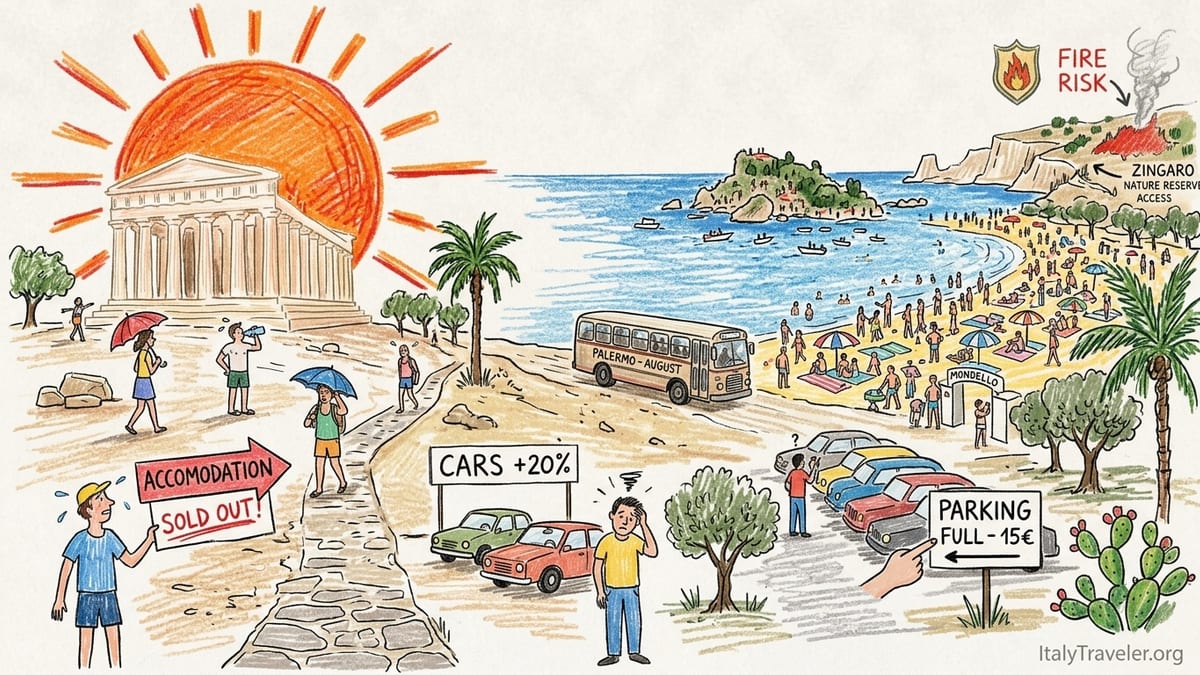
The Reality of an August 2026 Trip: Heat, Full Hotels and an Expensive Beach Break
My August 2026 itinerary looked picture perfect on paper: two nights in Palermo, three in Mondello for the beach, then on to Agrigento for the Valley of the Temples and a final stop near San Vito Lo Capo. In practice, the problems began before I even arrived. When I compared hotel prices while booking, a mid-range four-star in Mondello that I had seen in early June for around 190 to 210 euros per night for a double room was now listed between 260 and 290 euros for the same dates in mid-August, and several properties were sold out completely for the Ferragosto period. That was my first hint that “high season” was more than a marketing phrase.
On the ground the conditions were even starker. Weather data for Palermo in August 2026 shows several days with maximum temperatures in the mid 30s Celsius, and a local report late in the month forecast a perceived temperature of 41 degrees during a red alert for heat and fire risk around the city. I arrived at lunchtime on 10 August to 34 degrees in the shade at Palermo’s central station and a blast of hot, dry air that did not weaken much after sunset. It was technically manageable for a healthy adult, but walking with luggage from the bus stop to my guesthouse in the historic center left me drenched in sweat in less than ten minutes.
The financial impact of choosing August was constant rather than spectacular. Car rental quotes I checked for my dates were about 20 to 30 percent higher than the same car categories in late May. Simple trattoria meals that might feel affordable elsewhere in Italy did not suddenly double, but the combination of seasonal surcharges on accommodation, higher demand for parking close to the water, and occasional resort-style pricing on beach clubs added up. Over nine nights, I estimated that traveling in mid-August instead of June cost me in the region of 400 to 600 euros extra when I compared like for like hotels and car rental offers I had saved earlier in the year.
Most strikingly, several accommodation search tools and national statistics confirm that Sicily operates at a high level of saturation in August. Italy’s official tourism data show summer occupancy at some of the highest levels of the year, and recent commentary from the Ministry of Tourism described record national numbers in July and August. A technical report drawing on 2026 data for Sicily suggests a net occupancy index for hotel establishments of roughly the low 60 percent range in August, meaning that across all commercial beds on the island, more than half were in use. That sounds abstract, but I felt it concretely the moment I started looking for last‑minute rooms along the coast and found “sold out” banners where a few weeks earlier off‑peak prices had been easy to book.
Challenging the Myth: Warm Seas Do Not Cancel Out 38 Degree Ruins
The most persistent assumption about Sicily is that August is automatically “the best time” to go because it brings warm seas and dry, sunny days. It is true that the sea is at its most inviting in August, with water temperatures along the north and east coasts comfortably in the mid‑20s Celsius. My afternoon swims off Mondello and Isola Bella were more like stepping into a warm bath than bracing refreshment. But that comfort in the water comes at the cost of what happens on land.
Inland and around the major archaeological parks, August conditions reshape how you can move. At the Valley of the Temples near Agrigento, exposed paths, pale stone and minimal shade create a natural heat trap. Average August highs for inland Sicily already run hotter than the coast, and in 2026 local reports for the island highlighted late‑August temperatures near 35 degrees in Catania and other lowland areas. Walking between the Temple of Concordia and the Temple of Juno around midday, I watched visitors dart from the shadow of one olive tree to the next, faces flushed, hats and umbrellas up, water bottles constantly in hand. The classical fantasy of wandering at leisure simply did not match the physiological reality of the climate.
At Selinunte and Segesta the pattern was similar. Both sites stand on open hills and plateaus, with little shelter from the sun. In Segesta, the climb or shuttle ride up to the theater rewards you with sweeping views, but in August the stone seats turn scorching by late morning. Palermo’s historic core, Noto’s baroque streets and the inland hill towns may have more intermittent shade, yet the heat rising from asphalt and stone makes church‑hopping and café sitting a sweaty, energy‑draining operation between about 11:00 and 17:00. A cooler sea does not compensate for six hours each day when you either hide inside or risk heat exhaustion during sightseeing.
Moreover, that same heat amplifies other discomforts. Air conditioning units strain all afternoon, some older guesthouses lack efficient cooling, and a few traditional restaurants understandably prefer natural ventilation to sealed, refrigerated dining rooms. In Palermo I ate one dinner in an atmospheric trattoria near the Vucciria market without air conditioning; almost every diner fanned themselves persistently for the entire meal. August in Sicily may be technically dry and sunny, but for anyone who wants to explore rather than simply recline under an umbrella, those clear skies come at a real practical cost.
Early Morning, Midday and Evening: How August Rewrites the Sightseeing Day
The most effective way I found to survive August in Sicily was to treat the day in three distinct blocks. Early morning was usable, midday became almost off‑limits for serious walking, and evenings turned into a compressed window when everyone poured outside at once. This pattern is so entrenched that many major attractions adjust their opening hours to match it.
Take the Valley of the Temples. In summer the archaeological park typically opens early in the morning and extends into the late evening with illuminated night visits on selected days. That is not a romantic gimmick. It is a direct response to daytime heat that makes long walks between the temples uncomfortable for a wide range of visitors. I arrived for an 08:30 entry and had two reasonably pleasant hours. By 10:30, the light felt harsh, the stone pathways radiated stored heat, and a steady stream of arrivals meant that queues for water and shade lengthened.
Palermo’s main churches and palaces, including the Norman Palace and the Cathedral, often offer split hours or extended summer evenings for the same reason. Morning slots fill with organized tours trying to outrun the sun. By midday you see many more people sheltering in cloisters, cafés and shopping arcades than actively moving between sites. In Noto, where the historic center is compact but intensely exposed, I measured my walking in short hops between gelato shops and the few side streets with reliable shade. Inland hill towns that might be delightful to wander for an entire afternoon in April become effectively two‑hour morning or evening destinations in August.
Evening hours at attractions sound like a gift, and they are, but they also compress demand. When Segesta offers night visits to the temple and theater, hundreds of people who have hidden indoors all day converge at once in the cooler hours. That can mean queues at ticket offices well before sunset and a sense that every “escape the heat” strategy has been collectively discovered. The net effect is that while August technically stretches the day with late sunsets and after‑dark openings, in practice it shrinks the usable sightseeing window into crowded bands at each end.
Ferragosto: Sicily’s Busiest Week on Beaches, Roads and Restaurant Lists
All of this tightens around Ferragosto, Italy’s national holiday on 15 August. Rooted in ancient Roman celebrations and now aligned with the Catholic feast of the Assumption of Mary, Ferragosto sits at the cultural heart of the Italian summer. In Sicily, recent local travel advisories describe it plainly as the island’s busiest coastal week, with beaches around Palermo, Cefalù, San Vito Lo Capo, Taormina and the Aeolian Islands operating at full capacity. Contemporary guides for 2026 warn that collective boat trips, beach clubs and popular lidos can lose much of their charm that week simply because they are in such high demand.
My own Ferragosto 2026 experience began on Mondello beach, just outside Palermo. By 09:30 almost every front‑row sunbed at the main lidos was taken, and parking near the waterfront had become a slow‑moving, horn‑punctuated hunt through one‑way residential streets. Roadside attendants directed cars into improvised private lots for around 10 to 15 euros a day, sometimes more, often paid in cash. By midday the sand between the permanent umbrellas was a near‑continuous carpet of towels and folding chairs. The atmosphere was festive rather than menacing, with multigenerational families, music and picnic feasts, but anyone dreaming of quiet turquoise solitude would have been deeply disappointed.
On the evening of 15 August, Palermo’s center filled with concerts, late‑night food stalls and families strolling well past midnight. Public transport schedules into and out of the city were reduced compared with a regular workday, and several local guides explicitly advised staying either in the core or within walking distance if you wanted to participate without long, hot journeys. Nationally, reports describing Ferragosto note that highways often see heavier traffic as Italians travel to the coast and that smaller inland towns may close shops as residents head for the sea, a pattern that matches what I saw in western Sicily where many non‑tourist businesses were shuttered.
The week around Ferragosto also intensifies pressure on accommodation. An Italian tourism report in 2025 noted that more than 18 million Italians planned August holidays that year, with Sicily among the most popular domestic regions. For August 2026, the Ministry of Tourism has spoken of high summer occupancy nationwide and specifically identified Sicily as one of the regions with strong hotel utilization. Analysts describe average hotel occupancy in Sicily during August 2026 at roughly 63 percent across all categories. Crucially, that figure does not mean every single hotel is 63 percent full. It means that looking at the total number of hotel beds available across the region, close to two‑thirds were occupied, leaving the remaining third scattered unevenly between regions, towns and price bands. In practice, the mid‑range and well‑located options in beach towns near Palermo, Catania and Taormina felt much closer to sold out, while some inland or less obvious destinations still showed vacancies.
Crowding and Parking: San Vito Lo Capo, Mondello, Cefalù, Taormina and Isola Bella
If there is one issue that unites almost every August traveler complaint about Sicily, it is parking and crowding along the coast. Recent destination guides for San Vito Lo Capo, one of the island’s most famous beaches, explicitly warn that July and August are its busiest and most expensive months, and that parking is the town’s major practical drawback in peak season. Advice from those who know the town best is blunt: arrive by around 09:00 at the latest or book accommodation with its own parking. My own late‑morning attempt to park near the main beach in mid‑August ended with a 25 minute crawl into a remote lot and a long, hot walk back carrying beach gear.
Mondello, Palermo’s city beach, operates on a similar August logic. Locals I spoke to described avoiding it on summer weekends unless they could go very early or very late, and visitor accounts from recent years describe rows of umbrellas filled almost edge to edge on public holidays. During my stay, I watched cars circling for spaces along Via Regina Elena and side streets, and saw private parking operators charging summer rates that reflected the lack of alternatives. Public buses from central Palermo to Mondello were packed, standing room only, even outside the Ferragosto weekend.
Cefalù, on the north coast, pairs a handsome medieval core with a long sandy bay. It is one of the island’s postcard towns and understandably popular. Travel forums from 2025 and 2026 are full of August experiences that mention crowded historic streets and a beach that feels “jammed” by late morning. While I was there, midweek but still in August, the promenade was thick with sunbathers walking between lidos, and umbrellas formed a dense grid across almost the entire length of the central beach. Parking near the center required patience and a willingness to pay resort‑level daily rates.
Taormina and the small cove of Isola Bella below it have a similar reputation. The town itself clings dramatically to the hillside, accessible by narrow roads and a cable car down to the sea. Recent guides highlight that in August the cable car queues balloon in the late morning and early evening as day‑trippers and cruise passengers converge. The shingle beach at Isola Bella, which looks serene in promotional photography, in reality becomes a canvas of towels, kayaks and rental sunbeds throughout much of August. Isola Bella is also a protected natural area, so access to the tiny island and its paths can be limited when crowding or environmental risks such as fire become acute. It is not that these places lose their beauty, but in August they offer it to far more people at once than many travelers anticipate.
Wildfire, Heat Alerts and Access Risks in Protected Areas like Zingaro
High temperatures in Sicily bring another August complication that many first‑time visitors do not consider: wildfire and heat‑related access restrictions. In late August 2026, a Sicilian news outlet reported record heat across the island, with Catania reaching nearly 35 degrees and Palermo preparing for perceived temperatures around 41 degrees under a red alert issued by Italy’s civil protection authorities. Alongside heat warnings, authorities have also issued repeated fire‑risk alerts for parts of Sicily in recent summers, especially in scrubby, wind‑exposed coastal areas.
The Zingaro Nature Reserve, which stretches along the coast between Scopello and San Vito Lo Capo, illustrates how this can affect a holiday. Zingaro is renowned for its walking paths and small coves reachable only on foot or by boat. In periods of extreme heat and high fire risk, regional authorities have in recent years temporarily closed sections of similar protected areas or imposed access limits. While I cannot predict future closures for specific dates, it is reasonable to say that if you schedule your only day at Zingaro in August and a red flag fire warning appears, you may face restricted opening hours, blocked trails or at least official advice to avoid strenuous hiking.
Even when reserves remain open, the practicalities of hiking in August heat are sobering. I started a coastal walk near Zingaro’s southern entrance at 07:30 and by 09:30 the sun already felt punishing on the exposed path. Small coves that might feel delightfully quiet in May filled rapidly with boats and swimmers by mid‑morning in August, and by midday many hikers had sensibly vanished back to the shade of their accommodations. Planning long, scenic walks in protected areas for August therefore requires both careful timing and a willingness to accept that last‑minute weather or fire alerts may override your hopes.
The cumulative effect is a subtle but real reduction in freedom. In shoulder seasons, you can improvise a hike or a scenic drive based on mood and energy. In August, especially during heat and fire alerts, your options narrow: start very early, stay close to the water, monitor local advisories and have backup plans that do not depend on long midday exposure in reserves like Zingaro.
Prices Through the Seasons: August Versus June, September and October
All of this would be easier to accept if August delivered unique experiences that other months in Sicily could not. In reality, many of the things that make the island special are available, often more comfortably and affordably, in late spring or early autumn. A practical way to see this is to compare the cost of a seven‑night stay across different months using the same destinations and a similar standard of accommodation.
For this comparison, I looked at a notional one‑week itinerary in 2026 built around Palermo, Cefalù and Taormina, staying in well‑reviewed three‑ to four‑star hotels close to the center or seafront, and checked average nightly rates reported by major booking platforms during spring and summer promotion campaigns. While specific numbers vary year to year and between properties, a clear pattern emerged. In late May, double rooms in central Palermo and non‑luxury seafront hotels in Cefalù and Taormina often clustered in the 140 to 180 euro per night range, with occasional promotional dips below that for week‑long stays. In June, those prices nudged up, perhaps into the 160 to 200 euro band, though still with a healthy spread and more availability.
By August, especially the first three weeks, the same hotels commonly showed nightly rates 20 to 40 percent higher than their late May dates, often around 220 to 260 euros for a similar room type in central locations, and several required minimum stays or non‑refundable conditions. Inventory was also visibly tighter, reflecting the roughly 63 percent regional occupancy figure and the concentration of demand in the most desirable coastal towns. In September, particularly after the first week, prices began to relax again. Average nightly rates drifted back towards June levels while the sea remained warm and daytime temperatures moderated, especially in the evenings. Early October often offered the best value of all: double rooms under 150 euros in non‑luxury but attractive central properties, fewer sold‑out dates, and a climate that many travelers describe as ideal for city and countryside exploration.
Translating this into a seven‑night cost comparison, it is realistic to say that two people following a Palermo plus coast itinerary might spend around 1,000 to 1,200 euros on accommodation in late May, perhaps 1,100 to 1,300 euros in June, 1,400 to 1,700 euros in August, 1,100 to 1,400 euros in September and close to 1,000 to 1,200 euros in early October for similar hotel categories. Add car rental, which major brokers price noticeably higher for August pick‑ups compared with late spring and early autumn, and the August premium over May or October grows further. Exact figures will move with exchange rates and individual choices, but the directional difference is consistently confirmed by current listings: August costs more.
The Takeaway
After ten days in Sicily in August 2026, I did not fall out of love with the island. I still remember the evening light on Palermo’s Norman Cathedral, the honeyed stone of Noto at dusk and a late swim off Cefalù as the sky went soft pink behind the headland. What changed was my willingness to accept the trade‑offs that come with putting all of that inside an August frame. Higher prices for the same beds and cars, reduced freedom during the hottest hours of the day, crowded beaches from San Vito Lo Capo to Mondello and Isola Bella, and the intense pressure that collects around Ferragosto all add friction that simply does not exist to the same degree a few weeks earlier or later.
If you are locked into school holidays or work schedules that only permit August travel, then Sicily can still be rewarding, provided you work with the realities: book well ahead for coastal hotels and Ferragosto week, prioritize early morning and late evening for exploration, choose accommodations with their own parking in San Vito Lo Capo, Mondello, Cefalù, Taormina and similar hotspots, and keep a flexible eye on heat and fire advisories for hikes near reserves like Zingaro. But if you have any freedom at all, my firm verdict after this trip is to avoid the most touristed coastal resorts in August. I would personally skip San Vito Lo Capo, Mondello, central Cefalù and Isola Bella in that month, and think carefully before booking Taormina unless I was prepared to embrace the crowds.
Instead, I would look to late May and June for a first or second Sicilian holiday, when days are long, flowers are out, sea temperatures are rising and prices have not yet peaked, or to September and the first half of October, when the water is still inviting, evenings are cooler and hotel and car rental rates soften. Inland towns, baroque cities like Noto and Ragusa, and archaeological sites such as the Valley of the Temples, Selinunte and Segesta are all more forgiving outside August. Sicily remains one of the Mediterranean’s great destinations, but my August 2026 journey convinced me that the question is no longer whether to go, but when, and that the calendar choice matters at least as much as the guidebook sights.
FAQ
Q1. Is August really that hot in Sicily, or is it similar to the rest of Italy?
August in Sicily is among the hottest periods in Italy, with coastal highs often in the low to mid 30s Celsius and perceived temperatures higher during heat alerts, especially in cities like Palermo and Catania and in inland areas around major archaeological sites.
Q2. How bad are the crowds during Ferragosto around August 15?
The week around Ferragosto is the single busiest of the Sicilian summer, with beaches, coastal towns, ferries and popular restaurants heavily booked, highways busier than usual and central beaches such as Mondello, Cefalù and San Vito Lo Capo operating close to capacity by late morning.
Q3. Are hotels in Sicily completely full in August?
Official data for 2026 suggest that hotel occupancy in Sicily in August averages roughly the low 60 percent range across all categories, which means plenty of beds are filled but not every hotel is entirely full; however, well located and mid‑range properties in popular coastal towns can sell out or command much higher prices.
Q4. Is it still possible to visit the Valley of the Temples, Selinunte or Segesta in August?
Yes, but you need to plan carefully: visit early in the morning or in the evening, take advantage of extended summer opening hours and illuminated night visits where offered, carry water and sun protection, and be prepared for high heat and limited shade along exposed walking routes.
Q5. What are the main problems with staying in San Vito Lo Capo, Mondello, Cefalù or Taormina in August?
The biggest drawbacks are crowding and parking: traffic slows to a crawl near the beaches, public parking fills early, private lots charge summer premiums, and seafront promenades, lidos and cable cars down to beaches such as Isola Bella can become uncomfortably busy for travelers seeking a quiet atmosphere.
Q6. Are wildfires and heat alerts a serious concern for tourists in August?
They are a real consideration rather than a certainty; recent summers have seen red alerts for heat and fire risk in parts of Sicily, which can lead to temporary access restrictions or official warnings in protected areas like the Zingaro coast, so visitors should monitor local advisories and have flexible plans for hikes.
Q7. How much more expensive is a one week trip to Sicily in August compared with late May or early October?
Based on current hotel and car rental listings, a seven night mid‑range trip in August can easily cost several hundred euros more than an equivalent itinerary in late May, June, September or early October, due to higher nightly room rates, tighter availability and seasonal pricing on cars and some beach services.
Q8. Is the sea really that much better in August than in June or September?
The sea around Sicily is warm and swimmable from roughly June through October, with August bringing the highest water temperatures but not necessarily a better experience, since by then the water can feel almost tepid and beaches are much more crowded than in June or September.
Q9. If I must travel in August, how can I reduce the impact of heat and crowds?
Book coastal accommodation and parking early, schedule major sightseeing for early morning and evening, use public transport where practical, choose less famous beaches outside the main resort towns, and consider staying in larger cities that partially empty in August rather than only in flagship seaside resorts.
Q10. Which months do you personally recommend for a first trip to Sicily?
Based on my August 2026 experience and current conditions, I would recommend late May and June or September and early October for a first visit, when temperatures are more comfortable for walking, accommodation and car rental prices are lower than in August, and major sights and beaches are lively without the peak summer saturation.