


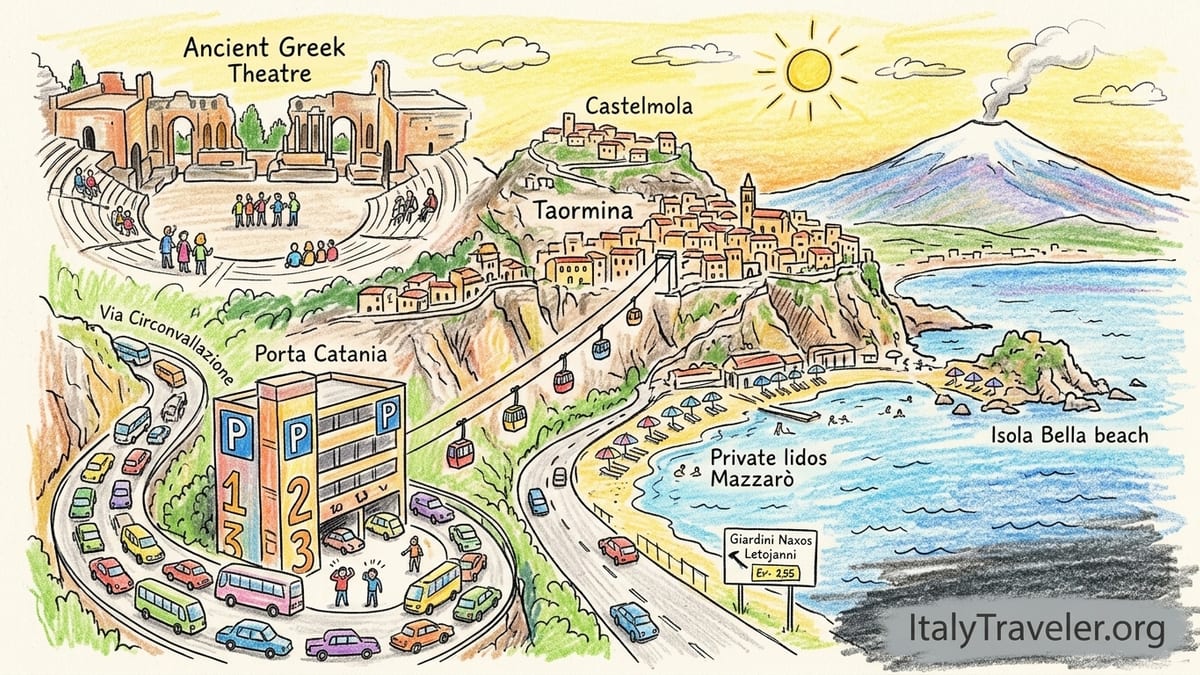
On the evening of 15 October 2024, I stood on Corso Umberto in Taormina, Sicily, watching a waiter slide a laminated “coperto” card onto our tiny table. Two spritz and a plate of average arancini on a side street had just turned into a 38 euro lesson in what it costs to sit within a few meters of the town’s most famous promenade. An hour earlier I had paid 30 euros to park for the day at Porta Catania, the main multistory car park perched under the historic center, after crawling up from the coast through honking traffic. By the time I added 32 euros for two tickets to the Ancient Theatre and 16 euros for return cable car rides down to Mazzarò, my romantic idea of Taormina as a hilltop dolce vita dream was colliding hard with the reality of a small town that now feels priced for cruise excursions and Instagram reels.
When the Dream Meets the Receipt
I arrived in Taormina on 15 October 2024, a shoulder-season Tuesday when the worst of the August crowds should have faded. Yet the snaking vehicles queuing up towards the Porta Catania parking garage already hinted at how popular this town has become. Official tariff updates published in 2024 and 2025 show that for non-residents in high season, Porta Catania can reach 34 euros for 24 hours and 30 euros for 12 hours, figures that matched the amount printed on my own ticket that day. For a couple driving in, your Taormina experience can start with a parking bill that rivals a mid-range hotel night in other Sicilian towns.
From the garage elevator you step almost directly into the southern end of Corso Umberto, Taormina’s pedestrianized main street. I had pictured lazy Sicilian bar chatter and old men leaning on doorways. Instead I walked into a narrow corridor of souvenir shops, luxury boutiques and hostesses standing with bilingual menus. Within minutes, a waiter quoted 8 to 10 euros for an Aperol spritz on a prime-view terrace, closer to northern European city pricing than most of Sicily. It was here, with the car park ticket folded into my wallet and the first drinks already costing nearly 20 euros, that I started to question whether Taormina’s fame now functions primarily as a price multiplier.
As night fell and yet more tour groups poured through the stone gate at Porta Messina, I kept reminding myself that this was mid-October, technically off-peak. In July and August, when cruise excursions from Messina and Catania are at full tilt, visitors report shoulder-to-shoulder traffic jams on foot along Corso Umberto for much of the day. If I already found it borderline exhausting in the shoulder season, what exactly are people buying when they book a high-summer stay here at two or three times the cost of elsewhere on the Ionian coast?
Corso Umberto and Piazza IX Aprile: Views vs. Veneer
Taormina’s main draw, beyond the famous theatre, is the sequence of views you get as you wander along Corso Umberto from Porta Catania to Porta Messina. Piazza IX Aprile opens like a balcony above the sea, with Mount Etna hovering on the horizon. At sunset, it is hard to argue with the beauty. The church facades glow pink, the checkered piazza tiles shine after a quick wash from the bar staff, and the railings are lined with couples taking the classic Taormina photo. Standing there, you feel the postcard come alive.
Step back ten meters, however, and you are once again in a world of polished jewelry shops, branded fashion chains and souvenir stands. Piazza IX Aprile’s perimeter is ringed with cafes and bars whose menu prices would not look out of place in Rome’s historic center. A simple coffee with a seat on the square can easily reach 4 to 5 euros; cocktails often sit between 12 and 16 euros. None of these prices are shocking in isolation, but when paired with the fact that you are in a town of barely 11,000 residents, they speak to a micro-economy tailored heavily to transient visitors with limited time and a willingness to pay for the view.
Corso Umberto itself feels less like a lived-in Sicilian main street and more like a curated resort village. A few tiny alimentari and local bakeries do survive on the alleyways leading off the corso, but the spine of the town is dominated by shops selling linen dresses, Etna wine and high-margin ceramics. I walked several laps at different times of day and saw very few errands being run, almost no children’s pushchairs and hardly any of the casual street life that animates places like Catania, Syracuse or even nearby Acireale. Taormina’s center still has historical architecture, but in daily function it now operates as a visitor-oriented shopping and dining strip.
This does not automatically make it inauthentic. Sicilian towns have always adapted to trade, and the shopkeepers and bar staff are overwhelmingly local. Yet the transaction-first rhythm shapes your experience. Hosts intercept you with multilingual greetings, menus list separate “service” or “music” fees, and chalkboards are written in English and German before Italian. The question is not whether Taormina has become a tourist town; it plainly has. The question is whether the prices and density of commerce match what you receive in return.
The Ancient Theatre: Spectacular, Crowded and Not Cheap
The Ancient Theatre is the one place in Taormina where I would still argue the hype has some grounding. Perched on a terrace with Etna and the sea framed behind the stone stage, it is one of the great classical viewpoints in Europe. That said, entering in 2024 and 2025 now costs considerably more than the 14 euros often mentioned in older guidebooks. Updated ticket information for 2026 indicates a full adult entry price in the mid-teens to around 16 euros per person, with reduced tickets a little under 10 euros, and some visitors in 2025 already reported paying about 15 euros each.
On my October 2024 visit, two standard adult tickets came to 32 euros, plus the usual online booking fee for timed slots if you do not buy on-site. For a family of four, that pushes the bill towards 60 euros or more simply to enter a single monument in a town that already charges a premium on parking, food and accommodation. Once inside, you may also find sections closed for concert setups or scaffolding for summer festivals, which can partially obstruct the classic panoramic photo you have seen a hundred times in promotional materials.
Then there are the crowds. Even on a mid-morning shoulder-season visit, the cavea steps were packed with tour groups following their umbrellas, many stopping for exactly the same selfies on the central axis. It remains a powerful place, but it does not feel contemplative. Audio guides and guided tours add another 10 to 20 euros per person if you want historical context, bringing a couple’s visit into the 50 euro range very quickly. Considering that the theatre in Syracuse, larger and more significant archaeologically, is often cheaper and comes bundled in a broader archaeological park, Taormina’s pricing feels like a surcharge on the view.
Would I skip it entirely? No. But if you are on a tight budget or traveling with children who may not appreciate ancient ruins, it is important to recognize that this one site can swallow a large portion of your daily spend, especially when combined with everything else that costs extra in town.
Cable Cars, Beaches and the Steep Price of Getting to the Sea
Because Taormina sits high above the Ionian coast, you need to either drive, take a bus or use the cable car to reach the beaches at Mazzarò and Isola Bella. According to recent municipal and transport information, the Mazzarò Taormina cable car has been running with a base single ticket in the low single digits per person, but for non-resident visitors various announcements in 2024 and 2025 outlined steeper tariffs and surcharges, especially in peak periods. Many visitors now report paying around 4 euros per one-way ticket. For a couple doing a simple round trip that already adds up to about 16 euros; for a family of four, you are in the 30 euro range just to move between town and sea for a single day.
Once down at Mazzarò or the narrow strip of shore by Isola Bella, the costs continue. The beaches are pebble, not soft sand, and comfortable swimming usually requires either water shoes or renting a lounger. Private lido setups with two sunbeds and an umbrella in 2024 and 2025 typically ranged between roughly 30 and 50 euros for the day, with front-row spots towards the higher end in high season. Basic drinks on the beach run 4 to 6 euros; simple panini or salads can quickly hit 12 to 15 euros. It is a perfectly pleasant place to sunbathe, but nothing about the beach itself is exceptional compared with other pebbly coves around Sicily that charge much less for the same services.
The terrain also matters. Walking back up from Isola Bella to the main road involves a long, steep staircase that many visitors underestimate, particularly in the midday heat of July and August. Combine that climb with queues for the cable car and crowded buses, and a simple beach afternoon can feel surprisingly logistical. If you are staying down at sea level in Mazzarò or nearby Letojanni, you gain easier beach access but must still deal with transport up to Taormina proper, especially in the evenings when queues for the cable car can stretch and buses are packed with day-trippers.
In this context, the idea of paying top-tier accommodation prices in Taormina itself becomes even more questionable. You are not on the beach, you are not in a major city, and much of your experience consists of moving up and down a hillside through a series of paid bottlenecks, each with its own small mark-up.
Hotel Sticker Shock: Taormina vs. Mazzarò, Giardini Naxos and Letojanni
To understand just how much Taormina charges for the privilege of sleeping inside the hill town, I compared accommodation prices for identical dates, looking at mid-October 2024 and sample summer 2025 weekends across major hotel platforms. In almost every case, rooms within walking distance of Corso Umberto commanded a 30 to 70 percent premium over similar-rated properties in Giardini Naxos, Letojanni or Mazzarò.
Consider a three-night mid-October stay for two adults. In Taormina’s center, many well-reviewed three-star hotels and guesthouses were listing double rooms between roughly 220 and 320 euros per night, often for quite modest spaces without pool or sea view. Step down to Giardini Naxos, 10 to 15 minutes away by car or bus, and you could find seafront accommodation in the 120 to 180 euros per night range, some including breakfast and balconies facing the bay. In Letojanni, prices dipped even lower, with small family-run hotels quoting under 120 euros for clean, simple rooms steps from the beach.
At the luxury end, the gap widens further. Iconic five-star addresses perched in or just under Taormina can easily break the 700 to 1,500 euro per night mark in peak season, driven in part by their association with celebrity stays and film shoots. While Mazzarò does host some equally eye-watering resorts, Giardini Naxos and Letojanni offer larger modern chain hotels and boutique properties that, while still expensive in summer, frequently undercut Taormina itself by several hundred euros per night for similar facilities.
This is not simply a question of budget travel versus splurging. It is a question of value. In Taormina’s center, many hotels sit on narrow lanes without parking, relying on paid garages, shuttles or valet services that add another daily line to your bill. Space is at a premium, so rooms are often compact, and noise from Corso Umberto or nearby piazzas can be significant in high season. When you realize that you could halve your nightly spend and still be within a short bus ride or taxi of the town, the allure of a central address begins to feel like an emotional purchase rather than a rational one.
Does Taormina Still Feel Like a Living Town?
One of the most common defenses of Taormina is that, regardless of cost, it remains magical in the quieter hours when day-trippers have gone. I tested this by walking Corso Umberto early in the morning and later at night on my October visit, and by returning briefly during a spring 2026 trip that coincided with no major festivals or cruise arrivals. There were indeed calmer moments: an elderly man walking his dog under Porta Catania, a fruit vendor unloading crates on a side street, a group of teenagers in school uniforms chatting on a bench away from the main drag.
Yet these glimpses felt like fragments between waves of visitors rather than the dominant rhythm of a lived-in community. Real estate prices in and around Taormina have risen significantly in recent years, and many traditional homes have been converted into boutique hotels, B&Bs or short-term rentals. This is particularly visible in the narrow streets climbing towards Via Circonvallazione, where doorbells now often list “Rooms” or “Suites” instead of family names. There are still churches, local festivals and residents preserving traditions, but they operate under the ongoing pressure of a visitor market that can outbid almost any local budget.
Importantly, this does not mean Taormina is fake. The churches are centuries old, the stone alleys genuinely medieval, and the views genuinely stunning. But the proportion of daily life devoted to serving outsiders is higher here than in almost any other Sicilian town I have visited. Even compared with Syracuse’s island of Ortigia or Cefalù’s historic center, Taormina feels tilted more decisively towards tourism in every practical sense: shop mix, language on signs, business opening hours and the sheer volume of short-stay visitors.
If your primary goal is to feel immersed in contemporary Sicilian life, hearing dialect in markets and watching everyday routines unfold, Taormina offers only flashes of that experience, usually found away from Corso Umberto, near residential pockets on the town’s periphery or in nearby villages. Inside the postcard, you are mostly inside a high-end visitor economy.
Alternatives and Complements: Castelmola, Acireale, Aci Trezza and Syracuse
Criticizing Taormina often provokes a fear of missing out: if you skip it, will you regret not seeing one of Sicily’s icons? Rather than suggesting you cut it entirely, it helps to place Taormina within a broader regional context, including nearby places that deliver strong scenery and culture with fewer crowds and lower prices.
Castelmola, perched higher above Taormina, offers similarly dramatic views of Etna and the coast without quite the same intensity of commercialism. The village is small, with a central piazza and a handful of bars and trattorias, and while tourism is important there too, prices for coffee, drinks and simple meals generally come in lower than Taormina’s center. Parking remains a challenge, but overall it feels more like a village that happens to welcome visitors than a resort town rebuilt around them. Many travelers who stay in Taormina end up visiting Castelmola and remarking that it was their favorite part of the area.
To the south, Acireale sits on lava terraces above the sea with richly decorated Baroque churches and a genuine year-round community. The city’s historic center sees far fewer international tour groups, yet its cafes, pastry shops and neighborhood markets offer a vivid window into daily Sicilian life at a fraction of Taormina’s cost. Ten more minutes along the coast lies Aci Trezza, a small fishing town facing the Cyclops Islands. Here, the waterfront is lined with modest seafood trattorie, small boat rental kiosks and gelato stands that primarily serve locals from Catania and surrounding villages. It is touristy on summer weekends, but the prices, language and rhythm feel firmly grounded in the region.
Syracuse, about an hour and a half’s drive from Taormina, provides perhaps the strongest contrast. Its island of Ortigia combines beautiful sea views, Greek and Baroque architecture, lively piazzas and a substantial permanent population. The archaeological park on the mainland includes a huge Greek theatre, quarries and a Roman amphitheater, with ticket prices that typically undercut Taormina’s Ancient Theatre while delivering a broader historical experience. Accommodation in Syracuse spans everything from budget guesthouses to refined boutique hotels, at price points that, even in summer, usually remain below what equivalent properties demand in Taormina.
None of these places are one-to-one replacements for Taormina. The specific combination of cliffside town, framed view of Etna and famous theatre is unique. But if your main reasons for visiting Sicily are landscape, food, architecture and atmosphere, it is worth asking whether a shorter stop in Taormina, combined with more nights in these alternatives, delivers a richer and more affordable trip.
Seasonality, Cruise Ships and the Timing Question
Taormina’s reputation is also shaped by when you visit. In peak summer, especially July and August, the town absorbs coachloads of cruise passengers from Messina and Catania, plus independent travelers staying along the east coast. Tour operators design itineraries around a few compressed hours, so crowds spill into Corso Umberto, Piazza IX Aprile and the Ancient Theatre in concentrated waves. Restaurant tables may be time-limited, menus lean heavily on fast-turnover dishes, and the general mood can feel rushed and transactional.
In the shoulder seasons of April to early June and late September to October, the atmosphere softens but does not evaporate. My mid-October 2024 experiences still involved busy evenings, limited parking availability and queues for the cable car on sunny days. However, accommodation prices were noticeably lower than high-summer peaks, and it was easier to find last-minute tables at smaller trattorias on side streets or in nearby villages. If you are determined to stay in Taormina, these shoulder months and the quieter winter period from November to March offer a more sustainable balance between enjoyment and expense.
Weather is another factor. Taormina’s appeal includes outdoor terraces, sea swims and long views; in winter, some of that is muted by shorter days, occasional rain and cooler temperatures. On the other hand, the lower tourist volume means you may finally be able to stand in Piazza IX Aprile or the theatre without feeling jostled. Winter closures of some seasonal businesses can limit choice, but the basic services and many hotels remain open, often with considerably friendlier rates.
Ultimately, timing moderates but does not erase the fundamental dynamics. Taormina is set up to extract high value from limited visitor time. Whether that feels justified depends on how sensitive you are to crowds, how much you value postcard views and how far your budget stretches once you add up each cable car ride, entrance fee and café stop.
The Takeaway
By the time I drove back down from Taormina after that October 2024 stay, my receipts told a clear story. Between 30 euros for parking, more than 60 euros on fairly standard food and drinks along Corso Umberto, 32 euros for two Ancient Theatre tickets and 16 euros on the cable car, I had spent well over 130 euros in a single day before even considering accommodation. For a couple on a week-long Sicily trip, that is the kind of outlay you might sensibly reserve for a special splurge dinner or a full-day excursion, not the basic cost of being in town.
Is Taormina overrated? In my view, yes, if you treat it as a primary base or plan multiple nights at the heart of the hill town. The views from Piazza IX Aprile and the Ancient Theatre are extraordinary, but they are increasingly framed by a commercial system built around short-stay visitors willing to pay a premium for a quick taste of glamour. The historic core feels less like a functioning Sicilian community and more like a very scenic shopping and dining mall with real history woven through it.
What would I do differently next time? I would absolutely still visit, but as a tightly planned stop. A half day or full day trip, ideally timed for early morning or late afternoon in the shoulder seasons, feels sufficient to walk Corso Umberto, see Piazza IX Aprile, tour the Ancient Theatre and take in the classic Etna panorama. I would base myself overnight in Syracuse, Acireale, Aci Trezza, Giardini Naxos or Letojanni, where accommodation prices and everyday life feel more in step with the rest of Sicily. From those bases, dipping into Taormina becomes a choice, not an obligation.
Most importantly, I would refuse to pay again for certain things: I would not book an expensive central hotel just to be steps from Corso Umberto; I would avoid eating main meals on the main drag, choosing side streets or nearby towns instead; I would think twice before riding the cable car multiple times in a day when buses or staying closer to the sea can reduce costs; and I would treat the theatre’s rising ticket price as a one-off investment, not something to repeat on a rushed, crowded visit. Taormina will likely remain Sicily’s postcard darling for years to come, but your trip does not have to be structured, or priced, around that postcard.
FAQ
Q1. Is Taormina still worth visiting in 2026?
Taormina is worth a visit for its views and the Ancient Theatre, but rising prices and heavy crowds make it better suited to a short stop than a long stay for most travelers.
Q2. How much should I budget for a day in Taormina?
A realistic day for two adults including parking, theatre tickets, cable car rides and a couple of meals can easily exceed 120 to 150 euros, even outside peak season.
Q3. Is it cheaper to stay in Giardini Naxos or Letojanni instead of Taormina?
Yes. Comparable hotels in Giardini Naxos and Letojanni often cost 30 to 50 percent less than central Taormina, with easier beach access and lower everyday prices.
Q4. Are the beaches near Taormina good for swimming?
The beaches at Mazzarò and Isola Bella are scenic and good for swimming, but they are pebbly, and comfortable access usually requires paid sunbeds or water shoes.
Q5. Do I need a car to visit Taormina?
You do not strictly need a car, since buses and trains connect nearby towns, but many travelers drive. If you do, factor in high parking costs at Porta Catania or Lumbi.
Q6. When is the best time of year to visit Taormina?
The shoulder seasons of April to early June and late September to October balance milder crowds and more moderate prices, though the town is never truly quiet.
Q7. Is the Ancient Theatre entrance fee really worth it?
For many visitors the theatre’s view justifies the mid-teens ticket price once, but it is a significant cost, especially for families, and the site can be very crowded.
Q8. How does Taormina compare with Syracuse for history and atmosphere?
Syracuse offers a larger archaeological park, a vibrant old town on Ortigia and lower prices, while Taormina delivers a more compact, theatre-focused and touristy experience.
Q9. Can I find authentic Sicilian food in Taormina?
Yes, but you usually need to look away from Corso Umberto and the main piazzas, or dine in nearby towns, to find more local-oriented menus and fairer prices.
Q10. Should I stay overnight in Taormina or visit as a day trip?
If budget and crowds are concerns, a day trip or brief stop combined with overnights in nearby towns like Giardini Naxos, Letojanni or Syracuse is often the better choice.