


Mount Etna is one of those places where the brochure images do not prepare you for the scale of the volcano in front of you. But working out how far up you can actually go, what it will cost, and which tours are truly high-altitude volcanic experiences is less straightforward. In 2026 the rules, prices and access on Etna are tightly controlled, and the difference between a relaxed lower-crater visit and a guided summit-style excursion can mean hundreds of euros and several hours of effort. This guide compares the main options cable car, 4x4 excursions and guided summit hiking and explains what they really offer on both the south and north sides of the mountain.
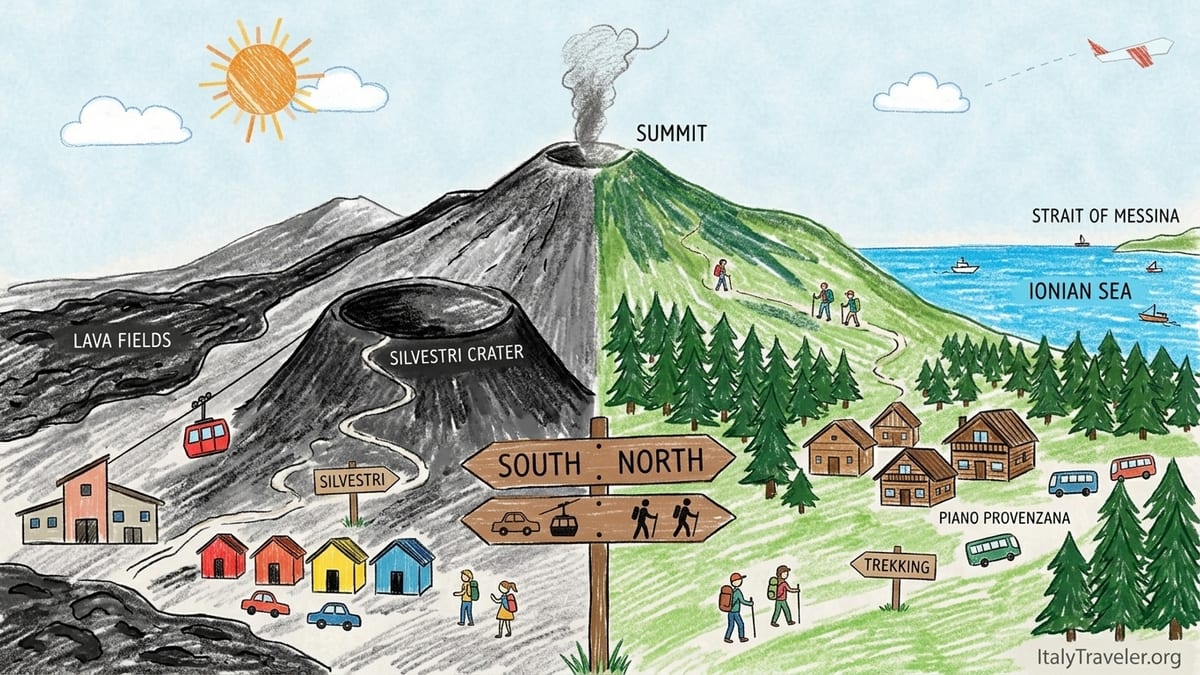
Etna South vs Etna North: Two Very Different Volcano Experiences
Most organized tours and independent visitors approach Etna from one of two bases. Etna South is centred on Rifugio Sapienza, at about 1,923 metres on the road above Nicolosi. Etna North is focussed on Piano Provenzana at roughly 1,800 metres in the municipality of Linguaglossa. The difference between them is immediately visible. The south side around Sapienza is stark and almost lunar, with wide lava fields and black ash slopes and the cable car station right above the car parks. The north side at Piano Provenzana is immersed in pine forest with an alpine feel and wide views over the Ionian Sea and the Strait of Messina.
On Etna South the star attraction for casual visitors is the Silvestri Craters. These are old lateral craters right beside the parking area and the main road, reachable in a few minutes on foot. Paths climb around their rims, and in dry weather many visitors explore them without a guide. It is a genuine volcanic landscape, but it is still low altitude sightseeing rather than a serious mountain outing. On Etna North the equivalent easy targets are the 2002 craters and short lava-field walks starting from Piano Provenzana, again reachable with limited effort and, for some itineraries, without a guide.
The infrastructure also differs. Rifugio Sapienza has large paid parking areas, multiple souvenir shops, basic restaurants and hotels, plus the Funivia dell’Etna cable car station. Piano Provenzana is smaller, with ski facilities, a few hotels and chalets, parking on several terraces and kiosks or mountain huts. The atmosphere in the north is quieter and less commercial, which many travellers who prefer hiking and photography appreciate, while families and cruise passengers often gravitate towards the more built-up and obvious facilities on the south side.
These contrasts matter because they influence not only the scenery and crowds you will encounter, but also what kind of excursions are practical. High-altitude guided hikes to the summit craters usually start from the north, using 4x4 vehicles from Piano Provenzana, while the most popular mid-altitude excursions by cable car and 4x4 combine start from Rifugio Sapienza on the south.
Lower Crater Sightseeing: Silvestri and Self-Guided Walks
Before looking at cable cars and 4x4 vehicles, it is important to separate the basic lower-crater sightseeing that most visitors experience from genuine high-altitude excursions. Around Rifugio Sapienza you can walk straight from the car park onto the slopes of the Silvestri Craters. Paths of compacted ash and rock circle the rims and cross the saddle between the cones. The terrain feels wild enough to be memorable, yet you are within sight of cafés and souvenir stalls. Many half-day group tours from Catania and Taormina class this as a “Mount Etna experience,” even if they do not go higher than about 2,000 metres.
These self-guided walks at the Silvestri Craters are free once you have reached Rifugio Sapienza. Typical costs are parking for a car, which is usually a modest hourly or daily fee, and whatever you spend in bars or shops. Physically, anyone with average fitness who can comfortably walk up and down a few flights of stairs can explore this area, although the loose ash can be tiring. Children often enjoy running up and down the cinder slopes, but parents need to watch for sudden drops on crater rims and strong gusts of wind.
On Etna North, independent visitors with a car can walk among the lava fields and old craters around Piano Provenzana. Short signed trails lead across the 2002 lava flow and to viewpoints over the forest and the coast. This is again low or mid-altitude exploration, not a summit approach. It offers softer scenery than the south, with the contrast between black lava and green pine forest, and is particularly rewarding for photographers who want landscape shots without large crowds in frame.
These lower-level walks are ideal for travellers on a tight budget or those who are anxious about heights or altitude. However, they are limited in terms of volcanic features. You will not be at the active summit craters, you will not see persistent fumaroles in most conditions, and in 2026 access regulations mean that all truly high-altitude zones are reachable only with a professional mountain or volcanological guide, usually as part of an organized excursion.
Funivia dell’Etna Cable Car: Mid-Altitude Access from the South
The Funivia dell’Etna cable car is the defining feature of the south side. It carries passengers from near Rifugio Sapienza at roughly 1,923 metres up to about 2,500 metres. As of late 2026 the official return ticket price published by Funivia dell’Etna is around 54 euros per person for the cable car alone, not including any 4x4 transport or guide services. Travellers should always recheck the exact fare at the ticket office or on the operator’s information channels, as seasonal adjustments are possible.
The ride itself takes around 15 minutes in each direction, in enclosed cabins that are comfortable even in windy conditions. At the top station, in summer, many visitors simply walk a short distance onto the ash slopes and nearby panoramic knolls, sometimes accompanied by local guides for brief interpretive walks within the safe zones. In winter and early spring, the top station serves as a ski hub, and the same cable car ticket allows skiers to access the pistes when they hold the appropriate ski pass.
For most mid-altitude excursions sold online, the cable car ticket is bundled into a package. For example, many agencies in Catania advertise Etna “3000 metre” trips that include hotel pickup, return transport to Rifugio Sapienza, the Funivia dell’Etna cable car and time at the upper station area. Travellers should read the inclusions carefully. In some cases the listed price covers return cable car tickets and a short guided walk near 2,500 metres, while in others a cheaper tour price hides the fact that guests will need to pay for the cable car separately at the station.
From a physical point of view, using the cable car to 2,500 metres is relatively easy. You step out a few metres above sea level in Catania in the morning, ride by bus or car to Rifugio Sapienza, then the cable car does the heavy lifting. At 2,500 metres healthy adults and school-age children usually cope well, but people with heart or serious respiratory conditions, and anyone very sensitive to altitude, should discuss their plans with a doctor before booking. Weather is a significant factor: in high winds or during intense activity on the volcano, the cable car can be suspended at short notice.
Cable Car plus 4x4: Funivia Tour 3000 and Similar Excursions
Above the Funivia dell’Etna upper station, motorized access continues in the form of special 4x4 buses in summer and snowcats in winter. The company’s flagship product on the south side is currently branded as “Tour 3000.” According to the official description, this package combines a return ride on the cable car from around 1,923 to 2,500 metres with onward travel by 4x4 bus or snowcat along a private track, accompanied on foot at stops by an alpine or volcanological guide. As of the latest price information checked in autumn 2026, the cost is advertised at about 82 euros per person for the standard adult ticket from Rifugio Sapienza.
The name “Tour 3000” can be misleading. In practice the vehicles drive from the cable car top station up to the maximum altitude permitted by local authority ordinances and volcanic monitoring advice on the day. Sometimes that may be close to 2,900 or 3,000 metres. At other times, especially during heightened activity or after recent eruptions, access can be limited to significantly lower altitudes. The tour remains a high-altitude volcanic excursion, but there is no guarantee of standing exactly at 3,000 metres or reaching the rim of the active summit craters.
During Tour 3000 and similar cable-car-plus-4x4 packages, participants typically make one or more stops to walk with the guide around recent craters, lava flows or fumarolic fields. The exact route changes with conditions. The walking sections are usually short, perhaps 30 to 45 minutes in total over uneven but not technical terrain. You will feel the altitude when climbing even small slopes, and in strong wind or cold temperatures this can be taxing, so warm clothing, a windproof layer and closed footwear with good grip are essential. Funivia dell’Etna and independent shops at Rifugio Sapienza rent jackets and boots, but availability can be limited on very busy days.
Many agencies in Catania and Taormina sell full-day packages that include hotel pickup, road transport to Rifugio Sapienza, time at the Silvestri Craters and participation in Tour 3000. These often range around 110 to 150 euros per adult, depending on the season and whether lunch is included. Some tours keep the Funivia ticket separate to give guests the choice on the day. For example, a Catania-based operator might charge around 60 to 70 euros for the guided bus excursion to the south side with lower-walks and lava cave visits, and then explain that those who want to add the cable car and 4x4 must purchase the 82 euro package directly at the station. Checking this structure before booking avoids awkward surprises.
Etna North 4x4 Buses and True Summit Hiking
If your goal is to get closer to the true summit craters, most serious guided hikes in 2026 still operate from Etna North. From Piano Provenzana, standing at about 1,800 metres, large 4x4 buses take groups up the lava tracks to around 2,800 metres, sometimes higher, again depending on volcanic activity and municipal ordinances. Several local operators publish prices for these excursions. High-altitude hikes that aim for the summit crater area often list rates around 100 to 130 euros per person, which typically include the 4x4 transport and the services of a certified mountain or volcanological guide.
One common format is an Etna North summit crater excursion: participants board 4x4 buses at Piano Provenzana, ascend to a high starting point near 2,800 metres, then hike for several hours to reach the summit complex at roughly 3,300 to 3,340 metres when allowed. Walking times can total four to five hours, with significant elevation gain over loose ash and scoria. On descent, groups usually hike back down to about 2,800 metres, where the buses collect them. Total outing time from Piano Provenzana and return to the parking area is often in the range of six to seven hours.
Not every high-altitude excursion on the north side goes all the way to the summit craters. Some 4x4 tours include a shorter guided walk among high-level craters and fumaroles around 2,800 metres without the demanding final climb. Prices there are usually lower than full summit ascents, more in line with mid-altitude experiences, and physical demands are moderate rather than extreme. However, these trips still cross into zones where municipal ordinances require the presence of licensed guides, and operators respect closures by modifying routes or temporarily suspending summit attempts during active phases.
For travellers, the key distinction is that Etna North is where high-altitude trekking is taken most seriously. The starting environment at Piano Provenzana is calmer and more alpine, and many guides are based in Linguaglossa or nearby villages. They expect participants to arrive equipped with proper mountain boots, layered clothing, gloves, hats and sufficient water. Some operators indicate a minimum age, often around 10 to 12 years for summit attempts, and may refuse participation if they judge someone’s fitness or clothing inadequate on the day.
Who Controls Access: Etna Park, Municipalities and Guides
Access to Etna’s upper slopes is not decided by tour operators alone. Three main sets of public bodies are involved. First, the Etna Park authority, established by regional law, defines the park’s zoning and conservation rules. Its mandate is environmental protection as well as promoting sustainable tourism. Second, individual municipalities such as Nicolosi on the south side and Linguaglossa on the north issue local ordinances that can set or adjust altitude limits for excursions in response to volcanic activity, weather, or civil protection alerts. Third, regional civil protection and scientific monitoring bodies advise on risk levels, feeding data from seismic and gas sensors and visual observations.
A typical municipal ordinance might specify that, due to ongoing activity at the summit, excursions with guides are permitted only up to a certain contour, for example 2,700 or 2,900 metres, and that independent hikers are prohibited above a lower threshold. In 2025 and 2026, several such measures have been taken in response to eruptive episodes, temporarily suspending all summit crater visits and restricting organized groups to intermediate altitudes. The Etna Park authority has publicly reminded visitors that these ordinances have legal force and that operators and guides are required to comply.
Licensed alpine and volcanological guides play a central role in practice. They are authorized to lead groups into high-altitude zones within the limits set by ordinances on a given day. Before departures they consult the latest bulletins and coordinate with civil protection teams. When a new eruptive vent opens or tremor increases, guides may shorten routes or turn back. They also manage on-the-ground safety: spacing groups on steep ash slopes, monitoring participants for signs of fatigue or altitude discomfort and setting a pace that keeps people together.
Because of this framework, travellers must never attempt to independently enter closed high-altitude zones, even if they see vehicle tracks or old footpaths. Crossing into prohibited areas is not only dangerous, with potential exposure to sudden gas emissions or explosive activity, it is also subject to fines. The fact that guided groups might be moving higher up the mountain does not give individual hikers permission to follow. Those groups operate under specific rules, with radios, gas masks when necessary and constant contact with authorities. Responsible travellers respect barriers, ropes and warning signs, and choose high-altitude experiences only through reputable operators who clearly explain the current limits.
Durations, Difficulty, Age Limits and Equipment
Comparing Etna excursions is easier if you think in terms of duration, physical effort and necessary gear. A basic lower-crater visit to the Silvestri area from Catania or Taormina, using a standard minibus tour, often lasts five to six hours door to door. Actual walking time may be only one hour in total on gentle slopes. These trips usually allow children of almost any age, though prams are hard to push on ash and loose rock. Closed shoes, a light jacket and sun protection are normally sufficient in summer.
Adding the Funivia dell’Etna cable car to about 2,500 metres turns the outing into a mid-altitude experience. From Catania, a typical organized tour that includes transport, a guide on the bus, cable car tickets and a short high-station walk might last six to eight hours. Physical difficulty remains moderate. However, the cooler temperatures and thinner air mean that warm layers, a windproof jacket and better-soled shoes are strongly advised even in July and August. Many tour descriptions mention a minimum recommended age of around five to six years for this section, mainly due to the altitude and exposure to sudden weather changes.
Tour 3000 and equivalent cable-car-plus-4x4 packages extend the time spent above 2,500 metres and introduce steeper short walks at higher altitude. Total duration from Rifugio Sapienza and back is often about two and a half to three and a half hours. Including road transfer from Catania or Taormina, a full-day schedule of eight to nine hours is common. The altitude, strong wind and volcanic dust can be tiring for younger children and older adults. Operators may set an age floor around six to eight years and might decline participation for people with known cardiac or respiratory conditions unless they have medical clearance.
By contrast, Etna North high-altitude hikes that aim at summit zones demand good fitness. Expect a total time on the mountain of six to seven hours from Piano Provenzana, with four or more hours of actual uphill and downhill walking on shifting ash. Altitude gain from the highest vehicle drop-off point to the summit craters can approach 500 to 600 metres, with much of it above 3,000 metres when ordinances allow full access. Equipment lists from north-side operators routinely specify high ankle boots, long trousers, multiple warm layers, waterproof shell, gloves, hat, sunglasses and at least one and a half litres of water per person. Age limits often start around 12 years, and guides screen participants at the meeting point.
Cancellation rules differ by provider. Funivia dell’Etna’s own operations can be suspended by weather or volcanic conditions, in which case cable car or Tour 3000 tickets purchased on site are typically refunded or revalidated. Third-party tour companies that include the cable car in a package often set free cancellation periods of 24 to 48 hours before departure. After that, they may charge partial or full fees, especially when hotel pickup and lunch are included. For private summit hikes, guides who block a full day for a small group sometimes ask for non-refundable deposits, with rescheduling offered if conditions on the volcano make the planned route unsafe.
Reaching Etna: Transport, Parking and Hotel Pickup
Reaching either Rifugio Sapienza or Piano Provenzana without a car takes some planning. From Catania, a public bus operated by a regional company runs once daily in the morning to Etna South and returns in the afternoon, mainly serving day trippers to Rifugio Sapienza and the cable car area. In practice, however, by 2026 most international visitors use organized tours or private transfers rather than relying on this single bus, because its schedule can be tight for those wishing to add Tour 3000 or extended walks.
From Taormina, there is no direct public transport to Etna’s high bases. Travellers without a hire car usually book excursions with hotel pickup or meet-the-bus points in Taormina, Giardini Naxos or nearby towns. Many operators advertise “Etna from Taormina” half-day tours that include transport up to either Etna South or Etna North, visits to craters and a lava cave, and sometimes wine tasting on the slopes. Prices for these small-group outings in 2026 often fall in the 80 to 120 euro range per adult, depending on inclusions. Some combine Etna in the morning with several afternoon hours in Taormina itself, making them long but efficient days for cruise passengers based in Catania.
For self-drivers, both Rifugio Sapienza and Piano Provenzana have paid parking close to the main facilities. Spaces fill quickly on summer weekends and during eruptive episodes that attract large numbers of sightseers. It pays to arrive early in the morning, not only for parking but also to dodge the strongest midday heat and clouds that often build up around the summit after lunch. Rental cars from Catania, Taormina or the coastal towns reach the Etna bases in about one to one and a half hours in normal traffic.
Hotel pickup is a major factor in tour pricing. A basic Etna lower-crater group tour from Catania, without cable car and using a minibus, might be advertised around 60 to 70 euros per adult with pickup in the city. The same style of tour with door-to-door pick up in Taormina can cost noticeably more, reflecting the longer driving time. Packages that include Tour 3000, lunch and winery visits naturally climb higher in price. When comparing offers, check whether cable car or 4x4 tickets are already included or must be bought on site, whether entrance to lava caves or park fees are covered, and whether child discounts apply.
Total Costs and Recommendations for Different Travellers
Because so many elements are optional, the total cost of an Etna day out can vary widely. For a couple with a rental car who simply drive to Rifugio Sapienza, pay for parking and explore the Silvestri Craters on foot, the outlay may be limited to fuel, parking and refreshments. Adding return cable car tickets at about 54 euros each raises the core cost to just over 100 euros for two, plus any food or rentals. Opting instead for Tour 3000 at roughly 82 euros per person, bought directly at the Funivia dell’Etna ticket office, would mean around 164 euros for the couple on site, not counting transport from the coast.
Families need to multiply these figures. Two adults and two children old enough to ride the cable car and 4x4 buses at near-adult prices could see on-site costs of several hundred euros, particularly if everyone takes part in Tour 3000 and clothing or boots need to be rented. To manage budgets, some families choose a compromise: they might all visit the Silvestri Craters together and ride the cable car, but have only one parent and an older child add the 4x4 portion, while the other parent stays at the upper station café with younger siblings.
For serious trekkers aiming at a north-side summit hike, expenses shift towards guide fees. A high-altitude summit group hike from Piano Provenzana may cost around 110 to 130 euros per person including 4x4 transport. A couple should therefore plan on at least 220 to 260 euros for the excursion itself, plus the cost of reaching Piano Provenzana by car or transfer and any gear rental. Private summit hikes with exclusive guides can be substantially more, but some private guides price per group rather than per person, which can be economical for groups of four to six experienced walkers.
Different traveller profiles will gravitate to different products. Non-hikers and those prone to vertigo often find that exploring the Silvestri Craters and perhaps adding the cable car ride offers enough drama without prolonged exposure on steep ash slopes. Photographers who want more varied landscapes and fewer crowds may prefer Etna North, booking a 4x4 plus short high-altitude walk from Piano Provenzana that emphasizes viewpoints over maximum altitude. Families with school-age children usually do well with a structured tour from Catania or Taormina that includes hotel pickup, a mix of walking and vehicle time, and clear guidance on what is and is not included in the price.
Budget travellers with time but limited funds can minimize costs by using the Catania public bus to Rifugio Sapienza, skipping the cable car and enjoying the lower craters and lava fields on foot. If they want one paid upgrade, the cable car alone is often the best value per euro in terms of views gained. On the other end of the spectrum, experienced mountain walkers and volcano enthusiasts should focus their research on Etna North, looking for summit or near-summit guided hikes with small groups and clear explanations of how current ordinances might affect the route on the chosen date.
The Takeaway
Mount Etna in 2026 offers everything from short roadside walks on ancient craters to demanding high-altitude summit attempts. The key to a satisfying visit is understanding that not all “Etna tours” are equal. Lower-crater sightseeing around Rifugio Sapienza or Piano Provenzana delivers atmospheric volcanic scenery at minimal physical effort and cost, but it does not take you into the active summit zone. The Funivia dell’Etna cable car and its Tour 3000 package provide relatively comfortable access to higher altitudes on the south side at clear, published price points, yet even these are subject to shifting safety limits set by park authorities and municipalities.
For those seeking deeper volcanic immersion, Etna North remains the gateway to serious summit-style hiking under the supervision of certified guides, using 4x4 vehicles to reach high starting points and then continuing on foot. These excursions demand more time, fitness and equipment, and they cost more, but in favourable conditions they bring participants close to the living heart of the volcano. Across all options, respecting closures, listening to guides and choosing reputable operators are non-negotiable if you want an experience that is not only memorable but safe.
When planning, start by deciding whether you primarily want views and atmosphere with limited walking, or a true mountain day with significant altitude and effort. From there, match your choice of side south for cable car convenience and busy infrastructure, north for alpine forests and serious treks your budget, and your willingness to accept that on a restless volcano, last-minute changes are part of the story. With that mindset, Etna can be the highlight of a Sicilian trip, whether you stand on a cinder cone at 2,000 metres or tread the ash near the summit under a guide’s watchful eye.
FAQ
Q1. What is the main difference between the cable car, 4x4 tours and summit hikes on Etna?
The cable car from Rifugio Sapienza takes you to about 2,500 metres for mid-altitude views with relatively little effort. Cable-car-plus-4x4 packages such as Tour 3000 extend this to higher ground with short guided walks, but still focus on comfort and accessibility. True summit hikes, mainly from Etna North, combine 4x4 transport with several hours of demanding trekking to reach the summit crater area when ordinances allow.
Q2. Does Tour 3000 guarantee reaching exactly 3,000 metres or the active summit craters?
No. Despite the name, Tour 3000 goes only as high as current safety regulations and municipal ordinances permit on the day. Sometimes that may be near 3,000 metres, while during periods of heightened activity the route can be limited to lower altitudes, and it does not promise access to the active summit crater rims.
Q3. Which side of Etna should I choose, Etna South or Etna North?
Choose Etna South around Rifugio Sapienza if you want straightforward access, the Funivia dell’Etna cable car, and easy walking at the Silvestri Craters. Pick Etna North around Piano Provenzana if you prefer a quieter, more alpine atmosphere, pine forests and sea views, and if you are interested in high-altitude guided treks that approach or reach the summit craters when allowed.
Q4. Is it possible to visit Etna on my own without a tour?
Yes, for the lower and some mid-altitude areas. With a rental car you can drive to Rifugio Sapienza or Piano Provenzana, pay for parking and walk independently around the lower craters and lava fields. You can also buy cable car tickets on site. However, high-altitude zones above certain limits can only be entered with licensed guides, and you must respect any closures and warning signs.
Q5. Are Etna tours suitable for children and older travellers?
Lower-crater walks and cable car rides are suitable for most families and older travellers who are comfortable walking on uneven ground. High-altitude 4x4 and summit hikes are more demanding and often have minimum age recommendations, usually around six to eight years for mid-altitude tours and about 10 to 12 years for summit attempts. Older travellers with health concerns should consult a doctor before booking high-altitude excursions.
Q6. What clothing and equipment do I need for an Etna excursion?
At a minimum, plan on sturdy closed shoes, a windproof jacket, long trousers, sun protection and plenty of water. For high-altitude hikes you will need proper mountain boots, warm layers, gloves, a hat and sunglasses. Some operators and shops at the bases rent jackets and boots, but availability can be limited in peak season.
Q7. How much does a typical Etna day trip cost from Catania or Taormina?
Prices vary by inclusions. A lower-crater group tour without cable car might cost around 60 to 70 euros per adult from Catania, and more from Taormina due to longer transport. Adding the cable car and 4x4 elements, either as Tour 3000 or similar packages, can raise total per-person costs into the 110 to 150 euro range or more, especially when lunch and winery visits are included.
Q8. Can weather or volcanic activity cancel my Etna tour?
Yes. Strong winds, sudden storms or increased volcanic activity can lead to the suspension of the cable car, closure of high-altitude tracks or a ban on summit access. In such cases, operators may modify itineraries to stay at lower elevations or cancel departures entirely. Refund or rescheduling policies depend on whether you booked directly with the cable car operator or through a third-party tour company.
Q9. Is it safe to hike independently to the summit of Etna?
No. Independent hiking to the summit is not permitted under current regulations. High-altitude zones near the active craters are accessible only with licensed guides and within altitude limits set by municipal and civil protection ordinances. Attempting to reach the summit alone is both unsafe and subject to fines.
Q10. How far in advance should I book an Etna summit or high-altitude tour?
For high season months like June to September and during periods of noticeable volcanic activity, booking several weeks in advance is wise for summit-style hikes and small-group high-altitude tours, especially from Etna North. For lower-crater or cable car outings on the south side, a few days’ notice or even same-day arrangements can work, although popular time slots and hotel pickup services still fill up quickly.