


On the morning of 24 October 2026, I wheeled my suitcase down to Milazzo’s port with that mix of excitement and low-level ferry anxiety that only island travel can produce. The Aeolian Islands had lived in my imagination for years as dots of volcanoes and whitewashed villages scattered across the Tyrrhenian Sea, but this trip would finally test all the glossy brochure promises about “easy island hopping.” Over six days I would learn, very concretely, what a difference it makes to rush past these islands on a multi-stop hydrofoil versus slowing down long enough to sleep under their volcanoes.
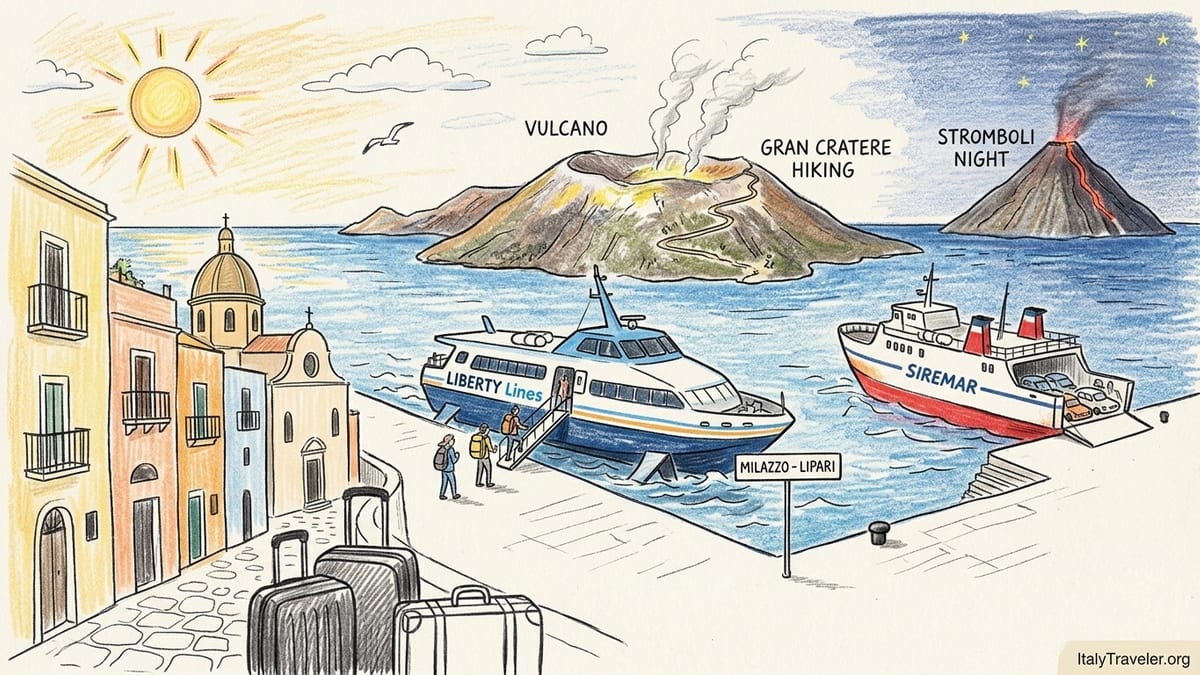
Crossing From Milazzo: First Lessons at Sea
I started with the classic Milazzo to Lipari route, the backbone of Aeolian transport. Liberty Lines and Siremar cover the crossing with high-speed hydrofoils and slower ferries, and by late October there were still multiple departures a day. I chose a mid-morning Liberty Lines hydrofoil, a direct Milazzo–Lipari run scheduled at just over one hour, instead of the roughly two-hour Siremar ferry that carries cars as well as foot passengers.
Buying the ticket the day before at the Milazzo port office, I was reminded that hydrofoil convenience is no longer cheap. Base adult fares on this route in late 2026 were around 16 to 20 euros one way, but Liberty Lines had recently increased fuel-supplemented tariffs and, importantly for anyone with more than a cabin bag, charged extra for larger suitcases. At check in, my medium-wheelie was measured visually, declared oversize, and I paid an additional fee of just under 5 euros each way. Travelers I met later who showed up with large trekking packs reported the same treatment. Siremar’s ferries, in contrast, fold basic luggage into the passenger fare but are slower and more exposed to swell.
That first crossing set the tone for the week. The sea between Milazzo and Lipari was a mottled steel blue under a northerly breeze, with a low, choppy swell that had coffee cups sliding on the plastic tray tables. Even in October, our hydrofoil was close to full. Locals shrugged at the movement, but several tourists around me turned pale. The captain announced “mare mosso” and we slowed slightly as spray hammered the windows. It was not terrifying, but it was a clear reminder that these islands live in a real sea, where wind and wave can and do cancel departures, particularly outside high summer.
At Milazzo’s ticket hall that morning, a handwritten note already warned that afternoon hydrofoils to some islands could be subject to last-minute cancellation if the wind strengthened. A clerk pointed to Siremar’s larger ship on the outer quay and explained that, on rougher days, the car ferries are often the last boats still running. They are slower and less glamorous, but they ride the swell better. For anyone with a flight to catch, that distinction matters far more than the marketing language in a brochure.
Choosing Nights Over Checklists: My Aeolian Itinerary
Like many first-time visitors, I had been tempted by the idea of a single long day tour from Milazzo or even from the mainland: a high-speed dash touching Vulcano, Lipari, maybe Panarea and Stromboli, capped off with a nighttime volcano viewing from a boat. These tours are heavily promoted, and they do exactly what they promise: you collect island names like stamps. What finally changed my mind were the autumn ferry schedules and the weather statistics. In late October, hydrofoil connections are thinner, the risk of cancellations higher, and the margin for error if you miss a last boat vanishingly small.
Instead, I built a slower loop. I booked three nights on Lipari as a base, with a day trip to nearby Vulcano. Then I added a night on Stromboli at the end, accepting that I would have to connect via Lipari to get there and back. In total I spent four nights in the islands: three on Lipari, one on Stromboli, traveling between 24 and 29 October 2026. My operators were Liberty Lines for the Milazzo–Lipari and Lipari–Stromboli hydrofoils, and a Siremar ferry back from Lipari to Milazzo when swell picked up on the final day.
This choice shaped everything else. On Lipari I woke up in the old town, not on a deck chair. On Stromboli I walked down dark alleys after the last boats had left, when the volcano’s low grumble replaced the sound of suitcase wheels. I still saw plenty of other islands from the water, but I experienced two of them in the way that counts most: overnight, with nowhere else to rush off to. The difference between that and a six-islands-in-one-day itinerary would become starkly clear in the days that followed.
Living Lipari: Old Town, Castle and Coast
Lipari’s old town rises immediately above the port like a layered amphitheater of ocher and white, with laundry lines and church domes stacked behind fishing boats. My guesthouse sat in an alley off Corso Vittorio Emanuele, the main pedestrian spine. From the harbor it was an easy ten-minute walk, even hauling my suitcase over polished cobbles. Had I brought a car, I would have paid significantly more: Siremar’s published 2025 vehicle tariffs for routes to the Aeolians already listed one-way car transport in the 60 to 90 euro range depending on length, plus around 25 to 30 euros per adult passenger, and local residents told me that 2026 fuel surcharges had pushed those figures higher. Keeping things to foot travel felt suddenly very wise.
The Lipari castle and archaeological park dominate the skyline. On my first afternoon, under streaky October clouds, I climbed the steep, stone-paved lane to the citadel. Inside the walls, the Aeolian Archaeological Museum turned out to be the opposite of the rushed, photo-stop travel I had rejected. The exhibits tell five thousand years of island life, from Bronze Age hut models to the obsidian trade that first made these islands important. I wandered past shelves of amphorae hauled up from shipwrecks, impressed not by numbers but by the sense of continuity. Outside, cats sprawled on the walls, staring down at the ferries that now replace those ancient cargo ships.
What struck me in Lipari was how much more the town rewarded a slow rhythm. Early each morning, the fishing boats returned and sold their catch directly on the quay. By mid-morning, the old town filled with day trippers in bright lanyards, following guides up to the citadel and back in precise, ninety-minute windows. By late afternoon they were gone, and the same streets belonged to local kids on bikes and to the handful of visitors lingering multiple nights. It was in those quieter hours that I found my favorite viewpoints, including a little terrace by the church of San Giuseppe, where the curve of the port and the pastel houses looked like an old postcard brought to life.
With three nights, I could look beyond the center. One day I took a public bus up to Quattrocchi, one of Lipari’s most celebrated viewpoints. The ride, on a small island bus with a driver who seemed to greet everyone by first name, climbed out of town past vineyards and citrons. From Quattrocchi the cliffs plunge vertically into the sea, with Vulcano’s smoking profile framed across the channel. The wind up there could knock a hat off, and the sound of the swell far below carried on the gusts. It was a world away from the tight time windows of organized excursions, where buses pull in, guests snap a few photos, and engines stay idling.
Beaches and Boat Days Around Lipari
Lipari is often sold as the hub, the place where you stay to see all the other islands. It also has its own quietly compelling coastline. On my second full day I took the bus to Canneto, a broad arc of grayish pebbles and black sand just north of town. The beach is lined with low-key bars and rental umbrellas, and even in late October a few locals were swimming. The sea was brisk but perfectly swimmable, as the lingering summer warmth held in the Tyrrhenian. A couple from Milan who had miscalculated their timing told me they had tried to squeeze Vulcano and Stromboli into a single long day from Lipari. Ferry delays meant they abandoned Stromboli entirely and spent the afternoon pacing the harbor, watching the schedule boards.
I chose a different approach and booked a small-boat excursion around Lipari and Vulcano for the third day, leaving from Marina Corta, the smaller harbor a short walk from the old town. These boats, often carrying 20 to 40 passengers, trace the coastlines, stopping for swim breaks and short village visits. Our captain steered close to pumice cliffs that look more like snowdrifts than rock, explaining that large-scale pumice quarrying had been heavily reduced in recent years, leaving surreal white scars above the turquoise water. We idled off the Faraglioni sea stacks while he pointed out caves eroded into the cliffs, then crossed the narrow channel to Vulcano for a midday stop.
On the water, the difference between “seeing” islands and “knowing” islands became vivid. In the space of a single day we glided past smoking crater rims, sea arches, and quiet coves. Passengers checked off islands in loud, satisfied tones. Yet we never stayed long enough anywhere to adapt to the island’s rhythm. That would only come later, when I returned to Vulcano on my own feet, without the pressure of a captain watching the clock and the last hydrofoil back to Lipari looming.
Vulcano: Between Legal Trails and Forbidden Fumaroles
Vulcano is the Aeolian island whose very name still gives us the word “volcano,” and it wears its geology close to the surface. As our excursion boat rounded into Porto di Levante, the smell of sulfur hit first, drifting from the fumaroles that hiss near the shoreline. The island’s Gran Cratere, the main crater of the Fossa cone, rises behind the port, streaked in yellow and gray. For years this was the classic short hike: an accessible, half-day walk up to the crater rim. Today, access is more nuanced.
Italian civil protection authorities and the municipality of Lipari, which administratively includes Vulcano, now adjust access to the Gran Cratere according to volcanic gas emissions and seismic monitoring. In recent years increased gas levels around the summit and fumarole fields have led to periods when access to the upper parts of the cone was restricted or temporarily closed. By autumn 2026, hiking up the legal trail from Porto di Levante to the rim was in principle possible on days when municipal ordinances allowed it, but specific fumarole areas and sections nearest to active vents often remained off limits or required strict adherence to marked paths and time limits.
On my October visit, warning signs at the trailhead were clear. A municipal noticeboard summarized the latest ordinance, and large pictograms showed the difference between the permitted path to the official viewpoint and the cordoned-off zones near the most active fumaroles. Rangers at the start of the trail checked that hikers carried at least water and sturdy shoes, and strongly recommended carrying a mask to mitigate occasional gas whiffs, though the broader route was open. The message was very plain: follow the waymarked path, respect closures around fumarole fields, and do not wander onto the crater floor or into visibly steaming areas, even if older guidebooks still show photos of people doing exactly that.
Time constraints meant I had to choose: either climb toward Gran Cratere or sit in one of the modest shoreline bars with a plate of arancini and watch the boat schedules. Because I knew I would return another time with a full day devoted to Vulcano, I opted for a shorter coastal stroll and an honest look at how rushed my schedule already felt. Talking to other travelers, I met a German couple who had attempted to squeeze a Gran Cratere hike into a two-hour Vulcano stop on a long multi-island day tour. They turned back halfway for fear of missing their boat, frustrated and a little annoyed at how the excursion brochure had implied that “Gran Cratere hike” was almost guaranteed.
Stromboli Nights: Black Sand, Lava and Limits
Stromboli was always going to be the emotional climax of my Aeolian trip. I left Lipari on an afternoon hydrofoil operated by Liberty Lines, which took just under two hours with intermediate stops. The sea had calmed compared to my arrival from Milazzo, and as the boat approached Stromboli, the conical silhouette of the volcano rose sharp against a hazy sky. White houses clung to the lower slopes, framed by black-sand beaches where old lava meets the sea.
The main village, often simply called Stromboli, spills gently from the small port uphill toward the church of San Vincenzo. There are no cars, only electric carts and three-wheeled vehicles, and luggage is often shuttled to guesthouses for a fee that in my case was 10 euros for a five-minute ride. My small B&B sat along a narrow lane with bougainvillea spilling over its walls. From the terrace I could see both the sea and, looking inland, the dark bulk of the volcano, periodically releasing small puffs of steam.
Stromboli’s personality changes after the last day-trippers leave. The air smells of jasmine and woodsmoke, and conversations in the tiny bars shift from ferry times to eruption rumors. Yet the practical reality of visiting an active volcano in 2026 is governed by rules that are refreshingly clear. A municipal ordinance from 2025, still in effect during my stay and echoed in recent trail information from local hiking associations, established strict altitude limits for visitors. From Stromboli village, unguided hikes were allowed only up to about 290 meters above sea level. Beyond that, up to roughly 400 meters, access required an authorized volcanological guide, with helmet and protective gear. Above about 400 meters, higher slopes and the classic Pizzo sopra la Fossa summit area remained off limits under most conditions, accessible only when civil protection authorities explicitly relaxed restrictions.
This “290/400” rule shapes every step you take on Stromboli. On my first afternoon, I followed the marked path from the village up toward the viewpoint at around 290 meters. The trail, clearly signposted and occasionally stepped, climbs through low Mediterranean scrub and lava fields. Even at this modest altitude, the view was extraordinary. Below, the village looked like a scattering of sugar cubes on black rock. Above, clouds scudded across the crater zone, occasionally revealing faint plumes. From the 290 meter platform, you can sometimes glimpse lava activity in daylight as reddish flashes or smoke puffs, though much depends on the weather and current eruptive phase.
Guided Hikes and Boat Views: What Stromboli Really Offers
That evening, I joined a guided hike organized by a local operator working with certified volcanological guides, similar in style to groups run by well-known outfits such as Magmatrek and other AGAI-affiliated teams. Their standard itinerary led from the village up to around 400 meters, the highest elevation currently permitted for guided groups under the ordinance in force during my visit. We met in front of the guide office, where helmets and headlamps were distributed and a short safety briefing emphasized gas risks, footing on loose ash, and the importance of following instructions if wind direction changed.
The hike itself was steady but manageable for anyone with moderate fitness, about 5 hours round trip with frequent pauses. As dusk deepened, we reached a series of terraces where, in good conditions, eruptions can be seen arcing above the crater lip and falling onto the Sciara del Fuoco, the steep lava scar that plunges down to the sea on the northwest side of the island. On my October night, the volcano was in a relatively modest phase. We saw several small, glowing bursts and heard the muffled thud of explosions, but nothing like the continuous fountains that color travel posters. The guides were careful to underline that this was normal. Stromboli is active, but not a theme park, and even from 400 meters you are never guaranteed a show.
The next day I experienced Stromboli from the water. Evening boat tours leave from the port and motor around to the Sciara del Fuoco side, anchoring offshore to watch for eruptions in darkness. It is an undeniably atmospheric experience. The boat’s lights are cut, people fall silent, and everyone stares up at the black triangle of the mountain. Every now and then, a brief red flare appears, and a collective murmur rises from the deck. There is a powerful sense of ritual to it. Yet as captivating as it is, this boat-based viewing often gets oversold in marketing language as a “summit experience.” In reality, you remain at sea level, far below the craters, and the captain will turn back if conditions deteriorate. It cannot replace, or legally imitate, the sensation of climbing on the volcano itself.
During my stay, some visitors were clearly disappointed that they could not hike to the classic 900 meter summit plateau they had seen in older photographs. Guides patiently explained that, for now, those higher paths were closed for good safety reasons following recent stronger explosions. For me, the 400 meter threshold felt like a fair compromise: high enough to sense the volcano as a living mountain, low enough to keep risk at an acceptable level for ordinary hikers. Anyone planning a trip in the future should plan around that 290 meter unguided and 400 meter guided distinction, and check the latest municipal ordinance just before arrival, rather than trusting outdated guidebooks or blog posts.
Day Tours Versus Staying Put: What I Learned
By the time I left the Aeolian Islands, I had seen both sides of the island-hopping coin. The small-boat excursion from Lipari had given me a sampler of coastlines and distant silhouettes. In a single long day I had seen Vulcano’s steaming slopes, Lipari’s pumice cliffs, and the outlines of Salina and Panarea on the horizon. That format works if your time is very limited, the sea is calm, and your priority is simply to say “I have seen the Aeolians.” But it comes with hidden costs. You are at the mercy of every delay in boarding and every line of people waiting to reembark. Lunch becomes a rushed affair between departure times. Unforeseen changes in weather, common in October, can truncate visits or eliminate stops entirely.
Staying three nights on Lipari and one on Stromboli taught me that the real Aeolian experience exists between departures, not during them. On Lipari, having time meant I could pick my ferry crossings for calmer parts of the day, rather than accepting whatever came with a rigid tour timetable. When a morning hydrofoil was canceled due to swell one day, I simply wandered the old town longer and took an afternoon Siremar ferry instead. Had I been on a day tour with a tight onward train connection, that same cancellation would have produced real stress.
Overnights also distribute costs differently. While ferry tickets and guided hikes have fairly fixed prices, everything from coffee to dinner gets cheaper when you are not competing with a shipload of day tourists in the same 90-minute window. In Lipari’s quieter back streets, I found trattorie offering generous plates of swordfish pasta at moderate prices, while waterfront venues timed around tour groups listed the same fish at noticeably higher rates. On Stromboli, booking directly with a small B&B gave me flexibility when weather forecasts shifted, something a day-boat ticket does not allow.
Perhaps the most important lesson, though, was emotional. Multi-island excursions encourage a counting mentality. You step off in Vulcano already thinking about Salina. You land in Panarea wondering if the boat to Stromboli will leave on time. Nights on Lipari and Stromboli created the opposite effect. I stopped counting islands and started noticing details: the way light hits the castle walls at 5 p.m., the exact color of the lava glow against low clouds, the patterns of fishermen’s conversations on the quay. Those small things are what linger now that I am back on the mainland.
The Takeaway
If I were to return to the Aeolian Islands, I would do almost everything the same way, with one important adjustment. I would add at least one more night, ideally two. My ideal minimum would now be five nights: three on Lipari, as a central base with time to explore the old town, archaeological sites, Quattrocchi and the beaches, plus two nights on Stromboli to allow both a guided 400 meter hike and a separate evening by boat at the Sciara del Fuoco, with a weather buffer in case either is canceled.
High-speed day tours absolutely have their place. For travelers with just a couple of spare days based on the Sicilian mainland, a Liberty Lines hydrofoil out and back with a coastal excursion from Lipari can still deliver a first tasting of the Aeolians. But they should be approached as introductions, not as substitutes for experiencing the islands. The seas can be rough, luggage rules can add surprise costs, and taxi or electric cart transfers on smaller islands can quickly push up your budget when you have no time to walk.
For anyone planning now, especially outside the peak summer months, the most realistic way to enjoy the Aeolians is to slow down and accept that you will not see everything. Pick at most two islands for a short trip. Treat ferry timetables as a framework, not a guarantee. Recognize that Stromboli’s access rules limit unguided hiking to about 290 meters and guided access to around 400 meters, and that boat views at the Sciara del Fuoco are a beautiful complement to, but not a replacement for, walking on the volcano. The islands reward those who adapt to their pace.
As for me, if I had to choose just one island to revisit, it would be Stromboli. Not because it is more beautiful than Lipari, but because a single night there felt like only a prologue. I would like to wake again to the sound of ash underfoot, to the sight of fishermen launching their boats into black water, and to the low, distant rumble from the mountain that governs island life. The Aeolians are not a checklist. They are a slow conversation between sea and fire. To listen properly, you need nights, not hours.
FAQ
Q1. How long does the ferry or hydrofoil from Milazzo to Lipari take?
On high-speed hydrofoils operated by companies such as Liberty Lines the trip usually takes around 1 hour to 1 hour 10 minutes, while Siremar ferries, which also carry vehicles, take roughly 2 hours on the Milazzo to Lipari route depending on intermediate stops.
Q2. Do I need to book Milazzo to Lipari tickets in advance?
In high summer and on weekends it is wise to book ahead, especially for morning departures and if you carry large luggage, because hydrofoils can fill up. In late October, I was able to buy tickets the day before and even on the same morning, but I still preferred to book early to choose my departure time and to avoid queues at the port ticket offices.
Q3. How expensive is it to bring a car to the Aeolian Islands?
Taking a car significantly increases costs. Recent Siremar vehicle tariffs show typical one-way charges of around 60 to 90 euros for a small car on routes between Sicily and the main Aeolian islands, plus separate passenger fares of roughly 25 to 30 euros per adult. Seasonal fuel surcharges can push totals higher, and some islands impose seasonal restrictions on non-resident vehicles, so many visitors find it cheaper and simpler to travel as foot passengers.
Q4. What is the difference between Liberty Lines and Siremar services?
Liberty Lines runs high-speed hydrofoils focused on foot passengers, with shorter crossing times but strict luggage rules and more sensitivity to rough sea conditions. Siremar, part of the Caronte & Tourist group, operates conventional ferries that carry both passengers and vehicles, take longer, but tend to be more stable in choppy seas and are often the last services running when strong wind or swell forces hydrofoil cancellations.
Q5. How many nights should I spend in the Aeolian Islands?
From my experience, an absolute minimum to feel you have really visited is four nights, split as three nights on Lipari and one on Stromboli. A more comfortable plan is at least five nights, adding a second night on Stromboli or an extra day on Lipari to allow for weather-related ferry changes and to explore viewpoints, beaches and archaeological sites without rushing.
Q6. What are the current hiking limits on Stromboli?
As of late 2026, municipal ordinances and civil protection rules generally allow unguided hikes from Stromboli village up to around 290 meters above sea level on marked trails. To go higher, up to approximately 400 meters, you must join an authorized guided group with certified volcanological guides. Access above roughly 400 meters, including the classic summit plateau, is usually closed unless authorities explicitly relax restrictions, so travelers should always check the latest local regulations before hiking.
Q7. Is the boat trip to the Sciara del Fuoco a substitute for a summit hike?
No. Evening boat trips to the Sciara del Fuoco offer dramatic views of Stromboli’s eruptions from sea level and are a wonderful complement to hiking, but they do not take you up the volcano. You remain offshore, watching from the water. They cannot legally or practically replace the experience of walking on the mountain itself, which in 2026 is limited to about 290 meters unguided and 400 meters with a guide.
Q8. Can I hike to the crater rim of Vulcano’s Gran Cratere on my own?
Access to Vulcano’s Gran Cratere depends on volcanic gas levels and up-to-date municipal and civil protection ordinances. At times, the main trail from Porto di Levante to the rim is open to independent hikers along a clearly marked route, while areas close to fumaroles or specific summit sections remain restricted. At other times, access can be more heavily limited or temporarily closed. Always read the notices posted at the trailhead and follow any instructions or closures, and consider hiring a local guide if you are unfamiliar with volcanic terrain.
Q9. Is October a good time to visit the Aeolian Islands?
October can be an excellent time in terms of temperature and crowds, with warm seas, quieter villages and lower accommodation prices. However, ferry and hydrofoil schedules are reduced compared with July and August, and the risk of cancellations due to wind or swell is higher. You should build extra flexibility into your itinerary, avoid tight connections with flights or trains on the same day, and be prepared to switch from hydrofoils to slower ferries if sea conditions deteriorate.
Q10. Is it better to take a multi-island day tour or stay overnight on one island?
Multi-island day tours are useful if you have only a single day and want a visual overview from the sea, but they involve rushed stops, little flexibility and more vulnerability to delays. Staying overnight on at least one or two islands, such as Lipari and Stromboli, lets you experience the old towns before and after the day crowds, adapt to ferry changes, plan hikes with sufficient time, and generally connect much more deeply with island life.