


Southern Italy rewards travelers who slow down, and one of the best ways to do that is by train. From the volcanic skyline of Naples to the baroque streets of Lecce and the sea views along the Calabrian coast, the rail network links most major centers efficiently and affordably. Yet this is also a region of remote beaches, hill towns and convoluted coastal roads where renting a car can save hours and unlock places trains simply do not reach. This guide explains how to plan a rail-based trip across Campania, Puglia, Calabria and Sicily, when high-speed services make sense, when you will be on slower regional trains, how to buy tickets, what to expect with luggage and connections, and where switching to a rental car becomes the more practical choice.
Understanding Southern Italy’s Rail Network
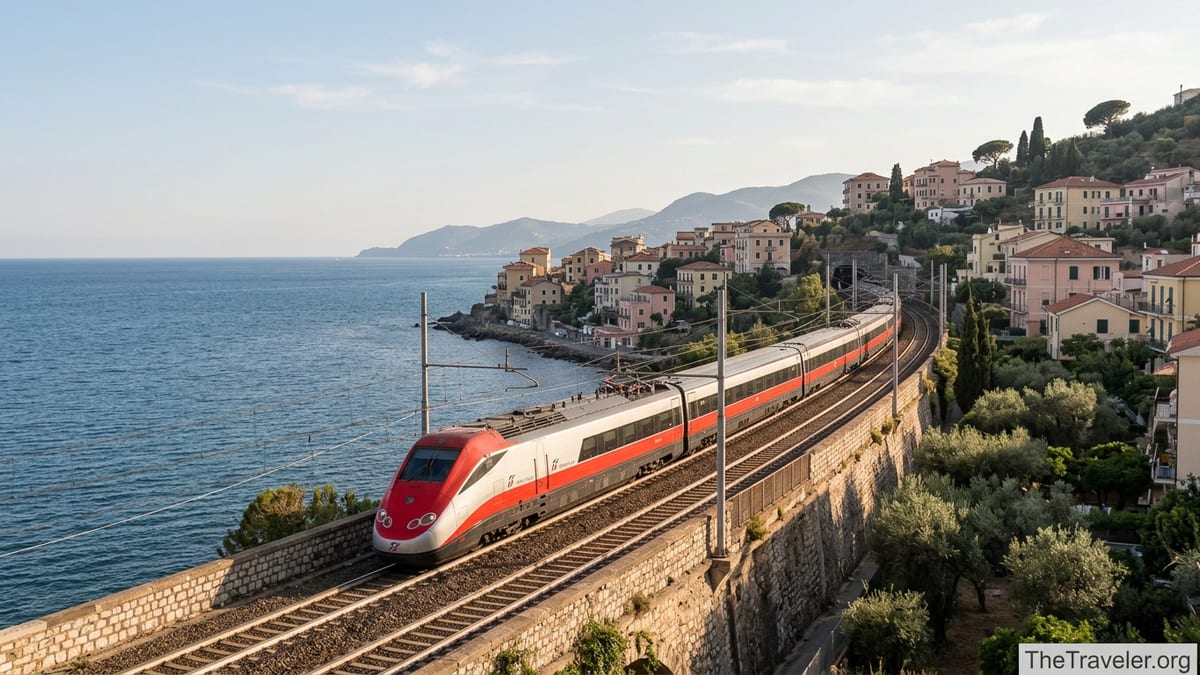
For a first visit, it helps to think of southern Italy’s trains in three layers. At the top are high-speed services such as Trenitalia’s Frecciarossa and Italo trains, which run at up to about 300 km/h on dedicated lines connecting Naples, Salerno, Bari and sometimes down to Brindisi and Lecce. These are the services you would use, for example, to travel from Rome to Naples in around 1 hour 10 minutes, or from Naples to Bari in roughly 3 hours with a single high-speed connection. They are comfortable, air conditioned and usually offer assigned seats, power sockets and luggage racks.
Just below that are Intercity and Intercity Notte trains, which use conventional tracks but cover longer distances with limited stops. These are important for through journeys such as Naples to Reggio Calabria, Bari to Reggio Calabria, or overnight sleeper services linking the mainland with Sicily. A typical daytime Intercity between Naples and Reggio Calabria might take around 5 to 6 hours, while still providing reserved seats, air conditioning and on-board toilets.
At the base are regional and metropolitan trains, including Trenitalia’s Regionale services and smaller operators such as Ferrovie Appulo Lucane and Ferrovie del Sud Est in Puglia. These slower, commuter-style trains are what you will use to reach places like Pompeii from Naples, smaller stops between Salerno and Paestum, or local towns around Bari and Lecce. They run more frequently on short hops, but have basic seating, no reserved seats and fewer amenities. Because so many southern itineraries combine these three layers, smart planning focuses on where you can leverage high-speed or Intercity trains and where a humble regional train or a rental car is the only realistic option.
For most travelers planning a route such as Naples – Salerno – Bari – Lecce – Reggio Calabria – Sicily, this means a mix. You might use a Frecciarossa from Rome to Naples, a regional hop down to Salerno, an Intercity or high-speed connection across to Bari, and then a blend of regional and Intercity trains down the Adriatic and Tyrrhenian coasts before crossing the Strait of Messina to Palermo or Catania. Knowing roughly what each train category offers helps you decide if the extra cost of a faster service is worth it for your schedule and comfort level.
Key Routes: Naples, Salerno and the Campania Coast
Naples is the main southern gateway for high-speed trains from northern Italy, and most international visitors will pass through Napoli Centrale at least once. From here, Frecciarossa and Italo connect quickly up to Rome, Florence and Milan, but for southern itineraries the focus is on routes south to Salerno and beyond. A direct high-speed train from Naples to Salerno can take as little as about 35 minutes, making it an easy repositioning leg at the beginning or end of a coastal stay.
Regional services from Naples link to destinations that are awkward by car, such as Pompeii and Herculaneum, where train stations are a short walk from the archaeological sites. A typical ticket on a regional train from Naples to Pompeii often costs only a few euros and takes under 40 minutes, which is significantly less stressful than navigating heavy traffic and limited parking near the ruins. Similarly, regional trains from Naples or Salerno to Paestum provide simple access to its Greek temples without the need to drive the busy coastal road.
However, once you look at the Amalfi Coast itself, the limitations of rail become obvious. There are no train stations in Positano, Amalfi, Ravello or Praiano. You can get as far as Salerno or Sorrento by rail, then must continue by bus, ferry or car along narrow cliff roads often restricted by seasonal traffic regulations and ZTL (limited traffic zones). In high season, buses can be crowded and slow, with travelers standing for much of a one-hour trip. This is one of the clearest cases where renting a car for a couple of days, or relying on local drivers, can be more practical than clinging to trains for every leg.
One common strategy is to use trains for the long approach and departure legs, then rent a car in Salerno or Sorrento for two or three days specifically to explore the coast and inland villages. Returning the car before moving on by train south toward Calabria or east toward Puglia keeps the driving to the sections where it genuinely adds value.
Crossing to Puglia: Naples, Salerno, Bari and Lecce
The rail connection from Campania to Puglia has improved significantly in recent years, with high-speed and Intercity trains linking Naples and Salerno to Bari and, further south, to Brindisi and Lecce. A practical example is an early morning Frecciarossa or Intercity from Naples to Bari, often taking roughly 3 to 4 hours with a change in Caserta or Benevento on some departures. From Salerno, direct services to Bari can also be available, so checking both departure cities sometimes reveals better timings or fares.
Bari Centrale is Puglia’s main hub, with Trenitalia’s long-distance services meeting regional lines and smaller private railways. If you are heading to Lecce, you can usually take a direct Intercity or high-speed train from Bari, covering the distance in about 1 hour 40 minutes to 2 hours. A second-class ticket on one of these longer-distance services can vary widely depending on how far in advance you book and whether there are promotions, but it is often reasonable enough that upgrading from a slower regional service is worthwhile for the comfort and shorter journey time.
Within Puglia, regional trains connect Bari and Lecce to popular towns such as Polignano a Mare, Monopoli, Brindisi and Ostuni. For instance, a regional train from Bari to Polignano a Mare typically takes around 30 minutes, and fares are generally modest, making day trips by rail highly practical. These regional trains do not offer seat reservations, so in peak summer you may find them busy, but they are still a straightforward option compared with finding parking in old towns with tight ZTL rules.
There are still good reasons to consider a car in parts of Puglia. The white towns of the Valle d’Itria, such as Alberobello, Locorotondo and Martina Franca, are connected by local trains and buses, but schedules may not line up well for travelers trying to see several towns in one day. Similarly, more remote beaches in Salento, especially along the Ionian coast, can require multiple changes if using public transport. A typical hybrid approach is to travel by train from Naples or Salerno to Bari or Lecce, spend a couple of days exploring by rail, then rent a car from Bari, Brindisi or Lecce for a loop through inland villages and coastal spots before returning the vehicle in the same city and continuing by train.
Down the Coast to Reggio Calabria and Across to Sicily
The Tyrrhenian coastline between Salerno and Reggio Calabria is one of southern Italy’s most scenic rail corridors. Intercity trains and some regional services run close to the sea, passing towns such as Sapri, Scalea and Lamezia Terme. From Salerno, an Intercity to Reggio Calabria usually takes around 4 to 5 hours, depending on stops. The journey offers sea views and avoids the fatigue of driving several hundred kilometers of motorway and curving coastal sections.
Reggio Calabria and nearby Villa San Giovanni are the springboards for Sicily. Villa San Giovanni’s railway station sits next to the ferry terminal, and some Intercity and Intercity Notte trains from the north actually roll onto ferry boats that cross the Strait of Messina, a distinctive feature of Italy’s network. Other times, you will change from the train to a fast ferry service that shuttles foot passengers between Villa San Giovanni and Messina on the Sicilian side, with departures running regularly throughout the day and night.
From Messina, regional and Intercity services fan out across Sicily, connecting to Catania, Palermo, Syracuse and inland towns. For example, a traveler coming from Lecce might take an Intercity or regional train down the Ionian coast of Calabria to Reggio Calabria, transfer by ferry to Messina, then continue by train to Taormina-Giardini for resort stays or to Catania for flights. While journey times are not as swift as on the mainland high-speed lines, they are usually predictable and allow you to avoid the complexities of taking a rental car across the strait.
Driving still has a role along the Calabrian and Sicilian coasts, particularly for reaching small beach coves, mountain villages in the Aspromonte or Nebrodi, and rural agriturismi. However, if your main aim is to connect major cities like Reggio Calabria, Messina, Catania and Palermo, trains plus ferries are generally more relaxing. One workable approach is to drop a rental car in Salerno or Lamezia Terme before taking the train down to Reggio Calabria and on to Sicily, then rent again on the island only if you plan to spend significant time exploring the countryside.
High-Speed vs Regional Trains: Comfort, Cost and Booking
On a map, two journeys might appear similar in distance, but whether you are on a high-speed Frecciarossa, an Intercity, or a regional train makes a big difference in how your day looks. High-speed trains such as Frecciarossa and private competitor Italo usually offer assigned seating, Wi-Fi on many services, power outlets, luggage racks and dedicated quiet or premium cars. Fares can be higher, but advance purchase discounts, economy and super-economy fares, and occasional promotions often bring the cost closer to that of last-minute Intercity services.
Regional trains are slower, stop more often and do not come with seat reservations. For short hops, such as Salerno to Paestum or Bari to Ostuni, this is usually fine and you save money. A regional ticket for a short journey in southern Italy is often just a handful of euros. However, for longer distances, such as Bari to Lecce or Salerno to Lamezia Terme, the additional comfort, speed and predictability of an Intercity or high-speed service can be worth paying extra, especially when you are traveling with luggage or children.
Booking habits can also differ. High-speed and Intercity trains are best booked in advance, especially on peak summer weekends, national holidays and Friday evenings when city workers travel home. You can usually buy tickets online or at station ticket offices and machines, choosing specific trains and seats. By contrast, regional tickets may be sold as flexible, valid for a certain time window on a date and then validated before boarding on older systems, or issued for a specific train if purchased online. Always check the rules on the ticket and on local signage to avoid accidental fines.
In practical terms, many travelers build their itineraries around high-speed and Intercity legs for the longest hops. For instance, you might book a Frecciarossa from Rome to Naples and an Intercity from Salerno to Bari months ahead, then leave regional hops such as Bari to Polignano a Mare or Lecce to Gallipoli flexible to adjust for weather and energy levels. This balance keeps costs reasonable and gives you a reliable backbone of long-distance reservations while preserving some spontaneity.
Tickets, Seat Reservations and Managing Luggage
When traveling through southern Italy by train, understanding ticket types and how they interact with luggage and seat reservations saves stress. High-speed and Intercity tickets almost always include a specific train, date and carriage with an assigned seat. On these services, you simply board the indicated car, find your seat and stow baggage in overhead racks or at the ends of the carriage. Suitcases up to typical airline cabin or checked sizes are common, but space can be tight on fully booked departures, so traveling with one main suitcase and a daypack rather than multiple large bags is easier.
Regional tickets are more varied. If you buy at a station machine for a same-day journey, you may receive a paper ticket that is valid within a certain period and must be time-stamped in a validation machine before boarding on some routes, or a printed ticket for a specific train. Mobile and online tickets often show the exact train and departure time and act as your proof of payment without further validation, but rules can vary between operators. Always double-check whether your regional ticket needs to be validated and keep it accessible for inspection on board.
Since most Italian trains handle luggage without weight limits or extra fees for standard suitcases, your main concern is practicality rather than cost. For example, if you are traveling from Naples to Lecce with changes in Salerno and Bari, hauling very heavy bags up and down platform stairs or through crowded corridors will quickly become tiring. Using rolling suitcases that you can manage alone, packing lighter, and avoiding rigid hard-shell bags that are difficult to fit into overhead racks all make connections smoother.
Plan connections with luggage in mind. Allow buffer time at key hubs like Naples, Salerno, Bari and Reggio Calabria, especially when changing from high-speed to regional or from train to ferry. A 10-minute connection may technically be doable if trains run on time and platforms are adjacent, but giving yourself 20 to 30 minutes reduces anxiety if your incoming service is a little late or you need to navigate busy station corridors. In summer, remember that platforms can be hot, so having water and not rushing with heavy bags improves the experience.
When Renting a Car Becomes More Practical
Trains work exceptionally well for linking the major cities and many mid-sized towns in southern Italy, but they are less efficient for scattered coastal villages, remote beaches and hill towns. Renting a car becomes more practical whenever your daily plans involve multiple small destinations that are awkward to combine with limited bus timetables or infrequent regional trains. A classic example is exploring the Amalfi Coast beyond one base. If you want to visit Ravello, tiny fjord-like beaches, rural lemon terraces and inland viewpoints in a single day, relying on buses that may run only once an hour is often frustrating.
In Puglia, a car is very useful for stitching together the white towns of the Valle d’Itria and the beaches of both the Adriatic and Ionian coasts. Trains reach Bari, Lecce, Brindisi and some intermediate towns, but smaller destinations such as Cisternino or coastal spots south of Gallipoli may require multiple changes or long walks from the nearest station. With a car, you can leave Lecce in the morning, swim at a cove near Santa Maria di Leuca, lunch inland at a masseria and stop at a vineyard on the way back, all without worrying about missing the last bus.
Calabria and Sicily offer similar patterns. Inland Calabrian villages and national parks such as Aspromonte have limited public transport, and rural agriturismi are often kilometers from the closest station. In Sicily, trains work well between Palermo, Cefalù, Messina, Catania and Syracuse, but beyond these axes, reaching small baroque towns, wineries on the slopes of Mount Etna or quiet coves around the south coast is much quicker by car. For these segments, renting a vehicle for just a few days, rather than for the entire trip, usually balances cost and convenience.
It is important to consider driving challenges. Historic centers in cities like Naples, Bari and Palermo have restricted ZTL zones with automatic cameras, steep fines for unauthorized entry, and parking shortages. Coastal roads such as the Amalfi Coast can be narrow and crowded in summer, sometimes with rules limiting access based on license plate numbers at peak times. If you are not comfortable with Italian driving styles, tight parking and serpentine roads, lean more heavily on trains and supplement with taxis, local drivers or organized day trips instead of insisting on driving everywhere.
Practical Itineraries Combining Trains and Cars
Putting the pieces together, one realistic two-week itinerary might start with arrival in Rome and a high-speed train to Naples for several nights. From Naples, use regional trains to visit Pompeii and Herculaneum, then take a short train to Salerno. Here, pick up a rental car for three days to explore the Amalfi Coast, basing yourself in a smaller town where parking is included at your accommodation. After returning the car in Salerno, continue by Intercity to Bari, spending a couple of days exploring Bari’s old town and nearby Polignano a Mare and Monopoli by regional train.
From Bari, travel by high-speed or Intercity train to Lecce and spend several nights in the historic center. For a deeper dive into the Salento countryside and beaches, rent a car in Lecce for three or four days, driving a loop that includes Otranto, Santa Maria di Leuca, Gallipoli and inland villages, then return the car in Lecce. Next, catch an Intercity or regional train across Calabria to Reggio Calabria, enjoying the sea views along the way, and then take the ferry to Messina in Sicily.
On Sicily, you could choose to remain rail-based, using trains to reach Taormina-Giardini, Catania and Syracuse, with occasional local buses or taxis filling gaps, or rent another car in Catania or Palermo to explore rural corners, vineyards and archaeological sites such as the Valley of the Temples near Agrigento. To end the trip, you might fly out of Catania or Palermo, or backtrack by overnight Intercity Notte sleeper from Sicily to Naples or Rome, experiencing the unique train-ferry crossing while you sleep.
Shorter trips can apply the same logic in compressed form. For example, a one-week route might focus just on Naples, Salerno and the Amalfi Coast, using trains for arrival and departure and a car only for two or three days in the middle. Another week-long option would be Bari, Lecce and Salento, traveling between cities by train and renting a car only for a long weekend of beach and countryside exploration. In both cases, thinking carefully about when you need the flexibility of a car versus the ease of trains prevents you from overpaying for a vehicle that sits unused in city garages.
FAQ
Q1. Do I need to book southern Italy trains in advance?
For high-speed and Intercity services, advance booking is highly recommended, especially in summer and on weekends, both for better fares and to guarantee a seat. Regional trains can often be bought on the day, although purchasing online in advance can be convenient and sometimes required for specific trains.
Q2. How much does a typical regional train journey cost?
Prices vary by region and distance, but short hops such as half-hour rides between nearby towns often cost only a few euros in second class. Longer regional legs will be more but are generally cheaper than Intercity or high-speed tickets covering the same route.
Q3. Is it safe to take luggage on trains in southern Italy?
Yes, most travelers use trains with standard suitcases and backpacks without issues. Keep valuables with you, stow bags in overhead racks or designated luggage areas, and avoid leaving belongings unattended during longer stops or when the train is in a station.
Q4. Are there overnight trains between the mainland and Sicily?
Yes, Intercity Notte sleeper trains run between northern and central Italian cities and Sicily, with portions of the train ferried across the Strait of Messina. These offer seats, couchettes and sleeper cabins and can be a memorable way to cover a long distance while saving on a night’s accommodation.
Q5. Should I rent a car for the entire trip through southern Italy?
Usually it is more efficient to combine trains and short car rentals. Use trains for long intercity segments such as Naples to Bari or Reggio Calabria to Messina, and rent a car only for a few days where you plan to explore rural areas, coastal roads and small towns.
Q6. Can I rely only on trains to visit the Amalfi Coast?
You can reach gateways such as Salerno or Sorrento by train, but the core Amalfi Coast towns themselves have no rail stations. From those gateways you must switch to buses, ferries, taxis or a rental car to reach Positano, Amalfi, Ravello and similar villages.
Q7. Do trains in southern Italy have air conditioning and Wi-Fi?
High-speed and most Intercity trains are air conditioned and many offer Wi-Fi, though connections can vary. Regional trains are usually air conditioned in summer but may not have Wi-Fi or power sockets, and comfort levels can differ between older and newer rolling stock.
Q8. How easy is it to drive with ZTL zones and parking rules?
Driving can be challenging in historic centers because of ZTL restrictions and limited parking. It is important to research your accommodation’s access and parking options, follow local signage carefully and avoid entering restricted zones without permission to prevent fines.
Q9. Can I take a rental car on the ferry to Sicily?
Some rental companies allow cars on ferries, while others prohibit it or charge extra. Check your rental contract carefully. Many travelers choose to drop a car on the mainland, cross as foot passengers, and rent a new car on the Sicilian side to simplify logistics.
Q10. What is the best season to travel southern Italy by train?
Spring and autumn are ideal, with pleasant temperatures and fewer crowds than in July and August. Trains still run year-round, but shoulder seasons often offer a better balance of availability, comfort and overall travel experience.