

Choosing between Sicily and Sardinia is one of the happiest dilemmas in Italian travel. Both islands promise turquoise water, long lunches and sun‑bleached villages, but they deliver very different kinds of trips. Sicily feels like a full‑throttle Mediterranean adventure, with ancient ruins, smoky volcanoes and lively cities where dinner rarely starts before 9 pm. Sardinia is slower and wilder, a place of dazzling coves, pine forests and low‑key resort towns where the sea is the main event. This guide compares the two islands in detail so you can match the right Italian island to your style, budget and travel companions.
Beaches and Sea: Caribbean Colors vs Dramatic Coasts
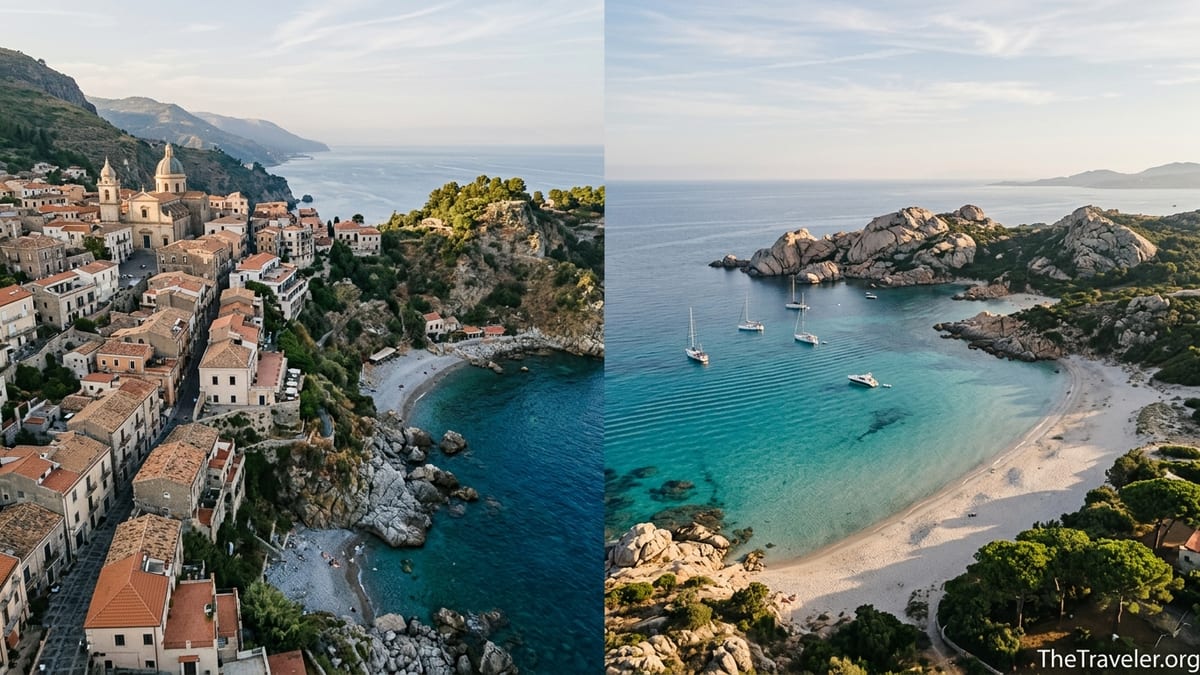
If your trip is mostly about swimming and sunbathing, Sardinia usually wins. Much of its coastline looks like a Mediterranean postcard come to life, with shallow, crystal‑clear water and soft, pale sand. Around the famous Costa Smeralda in the northeast, beaches such as Spiaggia del Principe or Capriccioli are framed by smooth granite boulders and fragrant maquis scrub. Families can spend entire days here while children paddle in calm, transparent shallows that often feel more like a lagoon than an open sea.
Sardinia’s east coast, around the Gulf of Orosei, raises the drama. Here, coves like Cala Goloritzé and Cala Mariolu are tucked beneath high limestone cliffs and reached by boat trips from Santa Maria Navarrese or Cala Gonone, or via steep hiking trails. The water here is a shock of turquoise over pale pebbles, and on summer days you see a mix of local fishing boats, small rental dinghies and the occasional yacht anchored just offshore.
Sicily’s beaches are more varied and often come with a strong sense of place. In the northwest, San Vito Lo Capo is the classic choice for a week of sand and sea, with a wide bay of fine sand backed by a small town of gelato shops and seafood trattorias. To the south, Scala dei Turchi has become famous for its gleaming white marl cliffs that fall into shallow blue water. On the opposite side of the island, near Taormina, tiny Isola Bella is a pebbly cove backed by lush greenery and overlooked by terraces full of sunset bars.
The sea itself also feels different. Sardinia tends to have clearer, calmer water ideal for long swims and snorkeling, especially along the northeast and east coasts. Sicily’s waters can be choppier in certain seasons, but you gain black‑sand volcanic beaches in the Aeolian Islands, wild coves in the Zingaro Nature Reserve and long sandy stretches like Mondello near Palermo or Fontane Bianche south of Syracuse. For a pure beach holiday with minimal sightseeing, Sardinia has the edge. For a mix of good beaches plus culture, Sicily is usually more satisfying.
Cities, History and Culture
When it comes to cities and historic sights, Sicily is in a different league. Palermo and Catania alone could fill a week, with baroque churches, lively markets and a nightlife scene that runs on late dinners and street food. Palermo’s Ballarò and Capo markets are especially atmospheric: stalls piled with swordfish steaks, glossy tomatoes and oranges, tiny cafes serving espresso in thick ceramic cups and vendors calling out in rapid‑fire dialect. In Catania you get dramatic views of Mount Etna over black‑lava pavements and a restaurant scene heavy on grilled fish and pasta alla Norma.
Across the island, major archaeological sites anchor day trips. The Valley of the Temples near Agrigento lays out a row of remarkably intact Greek temples across a ridge, while Syracuse’s Neapolis Archaeological Park combines a Greek theater still used for performances with Roman ruins and atmospheric stone quarries. Smaller towns add layers of history: baroque Noto and Ragusa rebuilt after an earthquake, medieval Erice perched on a hilltop above the sea, and Taormina with its Greek theater and upscale boutiques.
Sardinia feels quieter and more contemporary on the surface, but its history runs deep if you seek it out. Scattered across the island are thousands of Nuragic sites, remnants of a Bronze‑Age civilization unique to Sardinia. At places like Su Nuraxi di Barumini you can climb inside round stone towers and walk through prehistoric settlements surrounded by sheep pastures. Cagliari, the main city, offers a compact old town with narrow streets, a hilltop citadel and a surprisingly good restaurant and bar scene, but it is still far smaller and more relaxed than Palermo or Catania.
In practical terms, travelers who love museums, grand architecture and varied historic sites will get more out of Sicily. You can sleep in small cities such as Syracuse, Palermo or Catania and combine urban life with easy day trips to ruins and countryside. Sardinia’s cultural experiences are more dispersed; you might weave in a few Nuragic sites or old towns like Alghero and Bosa, but between those stops you are mostly driving through rural landscapes and heading back to the beach.
Food, Wine and Nightlife
Both islands eat extremely well, but Sicily is often considered one of Italy’s great food destinations. Its cuisine reflects centuries of Greek, Arab, Norman and Spanish influence. In coastal towns like Trapani you will find couscous di pesce, a North African‑style couscous with local fish broth, on the same menus as pasta con le sarde with wild fennel and raisins. Street food is part of daily life: panelle chickpea fritters and arancini rice balls sold from corner bars in Palermo can stand in for a cheap, filling lunch for just a few euros.
Sicily’s desserts and drinks are equally distinctive. In summer, locals in cities like Catania and Messina start the day with a brioche con gelato or a brioche dunked in icy granita. On the wine side, Mount Etna has become one of Italy’s most talked‑about wine regions, and it is easy to join a half‑day tour from Catania or Taormina that pairs vineyard visits with tastings of Etna Rosso and crisp whites made from carricante grapes.
Sardinia’s food culture feels more rustic but no less satisfying. Inland, many restaurants highlight roast suckling pig called porceddu, served with potatoes and myrtle leaves, while coastal towns focus on grilled fish, bottarga and simple pasta dishes. In resort areas near Olbia or Villasimius, most travelers alternate between hotel restaurants and small local trattorias where a seafood pasta and a glass of local vermentino will still be cheaper than a similar meal on Capri or the Amalfi Coast.
Nightlife differs too. Sicily’s larger cities have energetic evening scenes, especially in summer. In Palermo, whole streets around Piazza Olivella and the Vucciria district fill with outdoor tables, craft cocktail bars and late‑night kiosks selling beer and panini. Taormina and Cefalù offer smaller‑scale versions with wine bars, gelaterie and the occasional beach club with a DJ. Sardinia is generally quieter after dark, aside from pockets like Porto Cervo in peak season, where yacht parties and exclusive clubs attract a well‑heeled crowd. In Cagliari you will find enough bars and live music venues for a fun night out, but many smaller coastal towns are more about evening walks along the promenade than dancing until dawn.
Road Trips, Transport and Practical Logistics
How you like to move around should strongly influence your choice. Sardinia is one of those destinations where a rental car is almost essential if you want to see more than a single resort town. Public buses exist but are infrequent on many routes, and train lines do not reach key coastal areas such as the Gulf of Orosei or parts of the north. Many travelers fly into Olbia or Cagliari, pick up a car at the airport and use a single base like Santa Teresa Gallura, Orosei or Villasimius to explore nearby beaches and villages.
Sicily, on the other hand, offers more flexibility for travelers who prefer not to drive. There is a functioning train network that links major cities like Palermo, Catania, Messina and Syracuse, as well as regional buses connecting them to smaller towns. For example, you can base yourself in Catania and take a train to Taormina, a bus up Mount Etna and another train down the coast to Syracuse without renting a car. It may be slower than driving in some cases, but it is perfectly feasible for independent travelers and less stressful than tackling Sicily’s notoriously assertive traffic.
Both islands reward those who enjoy longer road trips. A classic 10‑day journey in Sicily might link Palermo, the hill town of Erice, the Greek temples near Agrigento, baroque towns like Modica and Noto, and finish in Catania with a day on Etna. In Sardinia, you could drive a northern loop from Olbia through Santa Teresa Gallura, the Maddalena archipelago, Alghero and back via the countryside, with daily stops at different coves and viewpoints. The key difference is that Sicily offers more non‑beach stops that feel essential, while in Sardinia the best days often revolve around getting to that perfect cove by mid‑morning.
Ferries and flights are similar in complexity from mainland Italy, with seasonal routes multiplying in summer. If you are combining the islands with Rome or Florence, note that budget airlines often run several daily flights to Palermo, Catania, Cagliari and Olbia in peak season. For a short one‑week trip where you do not want to think too hard about logistics, it can be easier to pick one city base in Sicily with train or bus day trips than to design a Sardinian itinerary without a car.
Costs, Crowds and Accommodation
In broad terms, Sardinia tends to be more expensive than Sicily, especially in high‑end coastal areas. Along the Costa Smeralda in July and August, it is common to see four‑star hotels starting from rates that feel closer to the French Riviera than rural Italy, and even simple apartments near the beach can book out months in advance at premium prices. Beach clubs often charge higher daily fees for sunbeds and umbrellas than equivalent spots in southern mainland Italy.
Sicily, while not cheap in peak summer, usually offers better value. In cities such as Palermo, Catania or Syracuse, you can still find midrange hotels and well‑located guesthouses at more approachable prices than in major northern Italian cities, particularly if you visit in May, June, September or early October. Coastal towns like Cefalù or San Vito Lo Capo see prices rise significantly in August, but budget‑minded travelers can still combine city stays with a few nights in smaller inland towns to keep the overall trip cost lower.
Accommodation styles also vary. Sardinia has more classic beach‑resort setups, especially near Olbia, Villasimius and Chia, where families book a week or two at a single property with half‑board and spend their days moving between pool and private beach. In Sicily, you will find some resort complexes, but a large share of visitors stay in small city hotels, agriturismi in the countryside or apartments in towns like Ortigia, Ragusa Ibla or Trapani, combining cultural sightseeing by day with dinners in local trattorias.
Crowds follow similar patterns. Sicily receives more overall visitors, but they are more widely distributed between cities, inland towns and various coastlines. In Sardinia, crowds concentrate heavily on certain beach areas in July and August, while much of the interior remains quiet. If you want warm weather with manageable visitor numbers on either island, the sweet spots are typically late May and June or mid‑September to early October, when sea temperatures are comfortable and accommodation rates drop from their August peak.
Best Choice for Families, Couples and Different Travel Styles
For families with young children who mainly want beach time, Sardinia is often the easier win. Many beaches gently shelve into the sea, making paddling and swimming feel safe, and resorts are set up with kids’ clubs, playgrounds and simple on‑site dining. A typical family week might involve flying into Olbia, renting a car and checking into a midrange hotel near San Teodoro, then spending each day at a different easy‑access beach like La Cinta or Cala Brandinchi, with short drives and minimal city stress.
Families who like mixing beach days with history, street life and varied food will likely prefer Sicily. A base in Syracuse or Cefalù gives you access to a walkable old town, a family‑friendly beach and day trips to archaeological sites or countryside farms. Children tend to love small adventures like riding the cable car above Taormina or taking a short boat trip along the coast near Scopello, and there is always gelato or granita as a reward for museum visits.
For couples, the decision hinges on mood. Sardinia delivers quiet coves, long coastal walks and rural guesthouses where evenings are spent over slow dinners and local wine, perfect for honeymooners who want to unplug. Areas like the Gulf of Orosei or the southwestern coast around Chia and Teulada feel particularly romantic for travelers who do not need nightlife. Sicily, by contrast, is more intense and varied: sunset aperitivi with Etna views in Taormina, late‑night passeggiate in Palermo, and boutique hotels in baroque towns like Noto that double as design destinations in their own right.
Active travelers will find ample hiking and biking on both islands, though Sardinia’s rugged interior and long coastal trails lend themselves well to multi‑day treks. Sicily offers different kinds of adventure, from guided hikes on Mount Etna’s lava fields to boat trips between the volcanic Aeolian Islands. In short, if you picture your ideal day as a series of swims broken up by naps under a parasol, Sardinia is probably your island. If you want each day to combine some culture or scenery with good food and a swim at the end, Sicily will likely feel more rewarding.
The Takeaway
There is no universally “better” choice between Sicily and Sardinia. Instead, each island shines for a different kind of Italian holiday. Sardinia excels as a beach‑first destination: clearer water, more consistently sandy coves and an overall rhythm built around the sea. It is the natural pick for families who want an easy resort week or couples looking for quiet coves, provided you are comfortable renting a car and paying a bit more for prime locations in high season.
Sicily, in contrast, is the island of layers. You can swim off picturesque towns like Cefalù or Ortigia in the morning, wander Greek temples or baroque streets in the afternoon and finish the day with seafood, local wine and a passeggiata through historic piazzas. It usually offers better value, richer food culture and a wider range of transport options, but beaches can be more mixed and some driving conditions feel hectic for nervous drivers.
If you have a week and want mostly sun and sea with minimal logistics, Sardinia is hard to beat. If you have 10 days or more and enjoy a trip with shifting scenery, stories and flavors, Sicily will almost certainly leave a deeper impression. Many travelers end up visiting both over different years, using Sardinia for pure relaxation and Sicily for a more immersive taste of southern Italy. Think honestly about how you like to spend your days, how much you want to move around and how important budget is, and the right Italian island will usually reveal itself quickly.
FAQ
Q1. Which island has better beaches, Sicily or Sardinia?
Sardinia generally has the edge for classic sandy beaches and very clear, shallow water, especially along the Costa Smeralda and the east coast. Sicily still has excellent options such as San Vito Lo Capo, Cefalù, Mondello and Isola Bella, but the coastline is more varied, with a mix of sand, pebbles and rocky coves.
Q2. Is Sicily or Sardinia cheaper for a one‑week trip?
Sicily is usually more budget‑friendly overall, especially if you stay in cities such as Palermo, Catania or Syracuse and travel in late spring or early autumn. Sardinia can be noticeably more expensive in popular coastal areas in July and August, both for hotels and beach services, although inland towns remain more affordable.
Q3. Which island is easier to visit without renting a car?
Sicily is easier if you prefer not to drive. Trains and buses link major cities and many small towns, so you can base yourself in places like Catania, Palermo, Taormina or Syracuse and still see a lot. In Sardinia, many of the best beaches and rural areas are difficult to reach without a car, and public transport timetables can be limited.
Q4. Where should families with young children go, Sicily or Sardinia?
Families focused on calm, shallow water and resort comforts often prefer Sardinia, particularly areas like San Teodoro, Chia or the northeast near Olbia. Families who like a mix of beach days and sightseeing tend to enjoy Sicily more, with bases in Cefalù, Syracuse or Taormina offering easy access to both the sea and historic sites.
Q5. Which island is better for couples and honeymoons?
For a quiet, beach‑centered honeymoon, Sardinia’s coves and countryside hotels feel very romantic, especially around the Gulf of Orosei or the southwest coast. Couples who want a livelier atmosphere with more restaurants, wine bars and historic settings often gravitate to Sicily, staying in places like Taormina, Noto, Ortigia or Palermo.
Q6. How many days do I need in Sicily versus Sardinia?
For Sardinia, 5 to 7 days is enough for a relaxing stay in one or two coastal areas with day trips to nearby beaches. Sicily rewards a bit more time; 8 to 12 days lets you combine at least two regions, such as Palermo and the northwest coast plus the southeast baroque towns and Etna or Taormina.
Q7. Is driving more difficult in Sicily or Sardinia?
Many travelers find driving in Sicily more stressful, mainly because of busier cities, faster traffic and tighter streets in historic centers. Sardinia involves plenty of driving, but roads are often quieter outside peak season. In both places, avoiding city centers with a car and parking on the edge of old towns helps a lot.
Q8. Which island has better nightlife?
Sicily generally offers more varied nightlife, with Palermo, Catania and Taormina providing late‑night bars, music venues and busy streets in summer. Sardinia has pockets of glitzy nightlife, notably in Porto Cervo at the height of the season, but many coastal towns are more about relaxed evening strolls and drinks by the sea.
Q9. Can I visit both Sicily and Sardinia on one trip?
It is possible, especially in summer when there are direct flights between the islands or good connections through Rome and Milan, but combining them in a single short trip can feel rushed. For most travelers, it works better to focus on one island per trip unless you have at least two full weeks and are comfortable with multiple flights or ferries.
Q10. If it is my first time in Italy, which island should I choose?
If you want an island that still feels distinctly Italian while offering cities, ruins, food culture and beaches, Sicily is usually the stronger first choice. If your priority is a simple, relaxing week on beautiful beaches with minimal sightseeing, Sardinia may be the better fit. Think about whether you will enjoy a culture‑rich itinerary or a mostly beach‑based stay, and choose accordingly.