


On a hot Tuesday in late August 2026, I watched my bus to Cala Gonone pull away from Nuoro’s ARST stand two minutes earlier than I expected. It was the 14:22 departure on ARST line 520, the service that winds from Nuoro down through Oliena and Dorgali to the seaside village of Cala Gonone on the Gulf of Orosei. I arrived at the platform at 14:20, convinced I had a leisurely margin. Instead, the driver closed the luggage hold, pulled out, and left a small crowd of us blinking in the heat. The next direct bus to Cala Gonone was not until late afternoon, and the information office calmly suggested a taxi: about 75 to 90 euros, at high-season prices, for a journey that costs less than 6 euros on the bus. I had nonrefundable seats booked on a 17:00 boat to Cala Luna. I did not make that boat. That missed bus, and the long, expensive afternoon that followed, crystallised for me how unforgiving Sardinia can be without private transport once you leave the main towns.
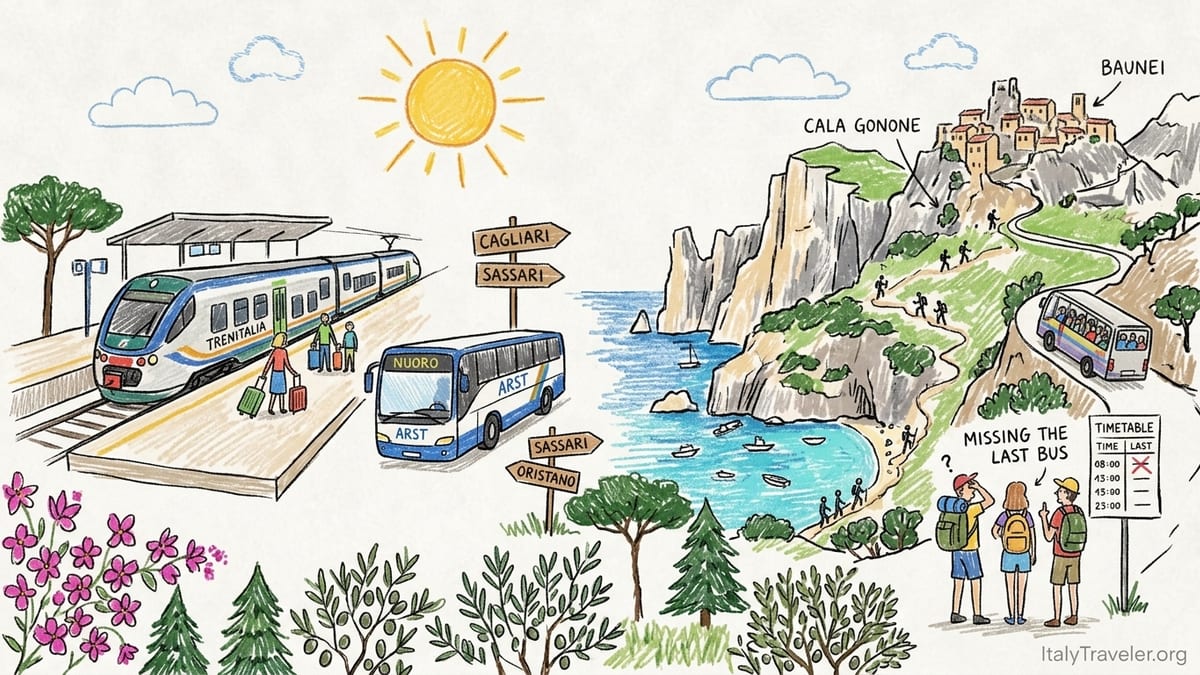
Trains and Mainline Buses: Sardinia Looks Easy at First Glance
If your Sardinian trip is limited to Cagliari, Oristano, Sassari, Olbia and Porto Torres, public transport initially feels reliable and even good value. Trenitalia operates the backbone of the island’s rail network, and on paper the connections look straightforward: Cagliari to Oristano in roughly one hour, Cagliari to Sassari in about three hours with a change at Macomer or Ozieri Chilivani, and links from Ozieri Chilivani to Olbia and Porto Torres. Second class fares on these regional trains often fall in the 8 to 20 euro range per adult, purchased a few days in advance.
In 2026, however, a series of planned maintenance works quietly complicated these apparently simple journeys. Rete Ferroviaria Italiana announced infrastructure upgrades and extraordinary maintenance on the Cagliari to Decimomannu and Cagliari to Oristano sections, as well as works between Ozieri Chilivani and Porto Torres and on the lines toward Olbia and Golfo Aranci. During several windows in summer and autumn 2026, this meant replacement buses on parts of the Cagliari to Oristano route and adjusted timetables on the Cagliari to Sassari and Olbia related services. In practice, that can turn a neat two-connection itinerary into an early start, a bus transfer in an industrial suburb, and longer total journey times.
Still, for the triangle of Cagliari, Oristano and Sassari, plus the corridor to Olbia and Porto Torres, trains and regional buses remain usable if you are flexible. Services are relatively frequent by Sardinian standards, roughly hourly or every couple of hours at peak times. If you stay overnight in these towns, you can make day trips and return without much drama. The trouble begins as soon as those timetables become the foundation for reaching beaches, small villages or archaeological sites where the last bus back leaves early and there is no station staff to help if something goes wrong.
This mismatch between expectations and reality is especially stark for visitors coming from mainland Italy, France or Germany, where regional trains run late into the evening and coastal resort buses multiply in summer. Sardinia is different. Once you use the rail lines primarily as feeders to more remote corners, their strengths vanish and their limitations suddenly define your day.
The Harsh Lesson of Cala Gonone and the Gulf of Orosei
Cala Gonone, gateway to the Gulf of Orosei, illustrates this better than anywhere. The village is reachable by ARST buses, mainly on line 520 between Nuoro and Cala Gonone via Dorgali. According to the current timetable, the day is punctuated by a handful of departures from Nuoro bus station toward Cala Gonone, with several morning buses, a midday option around late morning or just after noon on many days, and a mid or late afternoon service that, in high summer, can be packed with hikers and beachgoers returning to their guesthouses. The journey itself takes around 70 to 90 minutes and costs under 10 euros.
The problem is not that buses do not exist. The problem is that there may only be a few per day in each direction, spacing between them stretches to several hours outside peak season, and they can be crowded or shifted by seasonal timetable changes that are not always obvious in English. When my 14:22 bus from Nuoro departed earlier than the time I thought I had read, I had two options: wait several hours and lose the prebooked boat excursion, or hire a taxi for more than ten times the bus fare. On the pavement beside the station, other tourists flicked frantically between unofficial journey planners and the ARST website, trying to understand what had just happened.
Even reaching Cala Gonone is only half of the story. The famous coves of the Gulf of Orosei Cala Luna, Cala Mariolu, Cala Goloritze are not accessible on foot from town in any reasonable day. They require boat trips or demanding hikes along exposed paths. In summer 2026, standard shared boats from Cala Gonone to Cala Luna cost in the region of 35 to 50 euros per adult for a simple return, more for itineraries that include multiple coves or stops at Cala Mariolu and Cala Biriola. Private dinghy or RIB rentals for those with nautical licences can easily reach 120 to 250 euros per day plus fuel. None of that is covered by any public transport ticket, and all of it assumes you can at least reach the harbour in Cala Gonone on time.
Once you mix a sparse bus schedule, inflexible boat departures and the risk of delays or misread timetables, the margin for error shrinks to almost nothing. A missed bus at Nuoro can translate into a lost boat, a wasted beach day, and a domino of extra costs. If you have a hire car, that same route from Nuoro to Cala Gonone takes about one hour via Dorgali and the tunnel road, and you decide when to leave. Without one, you are negotiating your plans around a handful of bus lines that were designed for locals going to work and school, not for visitors sprinting to catch coastal excursions.
Baunei, Su Porteddu and the Myth of the Seamless Hike
North of the Gulf of Orosei, Baunei and the Supramonte coast have become cult destinations for hikers and photographers, with images of Cala Goloritze and the limestone cliffs of Pedralonga plastered across social media. From a public transport perspective, though, Baunei is effectively a cul-de-sac. Reaching the village usually means first getting to Nuoro or Tortoli and then taking an ARST bus into the mountains. The services exist, but they are oriented toward residents and may run only a few times a day.
From Baunei, trailheads fan out toward Su Porteddu, the Golgo plateau and the start of paths to Cala Goloritze. Many of these trailheads sit several kilometres outside the village itself. There is no regular bus that drops hikers neatly at the Su Porteddu agriturismo or at each coastal path start. Unless your agriturismo hosts offer shuttle lifts or you arrange a taxi, you will often face a long hot road walk before and after already demanding hikes. Local taxis in this area commonly quote 30 to 50 euros each way to shuttle small groups between Baunei and remote starting points, a fair reflection of road conditions and time lost, but a shock to anyone who assumed Sardinia without a car equated to inexpensive roaming.
Add in early cut off times for the last bus back toward Nuoro or Tortoli, and it becomes clear how precarious a car free hiking itinerary can be here. If your loop walk runs late, or you misjudge the effort in the heat, you may miss the only realistic connection out that day. Once again, it is not that Sardinia lacks buses, it is that they are not designed as a safety net for ambitious one day adventures far beyond town limits.
Contrast this with Cagliari’s Poetto beach, where urban buses and seasonal lines run frequently along the seafront, or with Alghero’s Maria Pia and Lido beaches, linked to the historic centre by city buses that usually run every 15 to 30 minutes in summer. In those urban contexts, a late return simply means waiting for the next vehicle. Around Baunei and Su Porteddu, a late return can mean calling the one taxi that serves a broad rural area and hoping they are free.
Gallura, La Maddalena and the Illusion of Effortless Island Hopping
In northern Sardinia, the Gallura region sells itself as a breezy world of turquoise coves and granite headlands. The reality, without a car, is patchier. Buses from Olbia to Palau and Santa Teresa di Gallura do exist and form part of ARST’s extra urban network, but frequencies drop significantly on Sundays and shoulder seasons, and many of the most attractive beaches are nowhere near the main road. A bus might deliver you to Palau, but reaching an isolated cove beyond Porto Pollo often involves a further taxi ride or a 30 minute or longer walk in full sun.
La Maddalena, just offshore, is a partial exception. Passenger and vehicle ferries run all year between Palau and La Maddalena, operated primarily by Delcomar, with crossings roughly every 20 to 40 minutes in summer and a short sailing time of about 15 minutes. A walk on passenger ticket for this route in 2026 typically hovers around 5 to 7 euros one way for adults, with cars paying a separate vehicle tariff. In practice, this means that getting from mainland Sardinia to the island of La Maddalena is relatively simple and flexible, even without a reservation, particularly outside the absolute peak dates of early August.
Once you are on La Maddalena, things become more complex. The urban bus network on the island covers the main town and some beaches, and in high summer additional services run toward popular stops like Bassa Trinita or Spalmatore. However, services are neither dense nor late running enough to give the same freedom as an urban seaside city. Reaching remote viewpoints or timing a sunset at a western cove still frequently requires walking long distances back to town or paying for a taxi that might cost 20 to 30 euros each way for a relatively short hop.
Caprera, connected to La Maddalena by a causeway, is even keener to expose the limits of public transport. There are usually a few bus services that cross to Caprera in summer, but they do not stop at every little inlet. If you want to linger at Cala Coticcio or explore quieter bays, you must either accept long hikes on narrow, unlit roads, rent a bicycle and manage the heat and gradients, or arrange transfers as part of organised boat or jeep tours that can cost from roughly 50 euros per person upwards. The romantic picture of casual island hopping by foot and bus turns out to involve a good deal more planning and spending.
Meanwhile, in Porto Cervo and the more exclusive corners of the Costa Smeralda, public buses do exist but are a poor match for resort geography that assumes private cars and hotel shuttles. Some luxury hotels provide complimentary transfers to nearby beaches, but those staying in independent rentals, especially on headlands and cul de sacs, can find themselves marooned. Waiting for an extra urban bus on the main road, only to discover that the last useful departure back to Olbia left mid afternoon, is a recurring summer story.
Seasonal Beach Buses: Helpful but Full of Traps
Several Sardinian municipalities and ARST run seasonal beach buses that, on first inspection, appear to solve the car free puzzle. The Cagliari area, for example, is served by frequent buses to Poetto beach, forming part of the city’s CTM network. Similarly, from Cagliari’s ARST station, line 101 heads east toward Villasimius and Costa Rei. The current timetable shows multiple daily departures from Cagliari to Villasimius via the coastal road, with morning and early afternoon services such as 05:02, 08:15, 11:15, 14:05, 18:30 and later options in some periods. One way fares are usually in the high single digits of euros.
For Villasimius and Costa Rei, these buses can work well if you pick an accommodation within walking distance of the main stop or along the route. Once you branch off toward secluded coves or long stretches of beach between settlements, the limitations resurface. The walk from the nearest stop to the sand might be 20 to 30 minutes along a busy road with limited shade. Last departures back to Cagliari often leave in the early evening, not at night, and missing them means a taxi ride exceeding 100 euros across a long coastal stretch.
In Cala Gonone, Dorgali’s municipality has experimented with local shuttles between the village, the harbour and some hotels, at times even running free services between Dorgali and Cala Gonone to ease summer congestion. These are genuinely useful, but they are also subject to change from year to year, and their operating periods are usually restricted to the high summer months of roughly late June to early September. Outside that window, you revert to the skeletal all year ARST lines.
Across the island, similar patterns apply. City and resort beach buses around Cagliari and Alghero are relatively frequent and forgiving, while last mile access to more remote beaches in Gallura, the Gulf of Orosei or the Ogliastra coast remains weak. Services might run only once or twice in the morning and afternoon, often ending their day well before sunset. Timetables are published, but not always translated or clearly explained, and real time delay information is rare. If you plan your day assuming you can simply “grab a bus back” in the evening, you risk long waits at dusty stops and unplanned taxi expenses.
Car Free City Breaks vs Rural and Coastal Stays
In Cagliari and Alghero, staying car free is not only feasible but often pleasant. Cagliari’s compact historic centre rises just inland from its central station, where both Trenitalia and ARST services converge. From there, city buses connect to Poetto beach, the Molentargius wetlands with their flamingos, and neighbourhoods spread across the hills. A standard single ticket on Cagliari’s urban network costs only a few euros, daily passes are modestly priced, and services run into the late evening. For a three day stay focused on food, history and dips at Poetto, a solo traveller can confidently budget under 30 to 40 euros for all local transport.
Alghero offers a similar pattern on a smaller scale. The historic centre and harbour are walkable, and city buses run along the Lido and out toward beaches like Maria Pia and, less frequently, to Le Bombarde and Lazzaretto. A summer day might include two or three bus rides total, adding up to under 10 euros per person. Taxi use is optional rather than obligatory, and the airport bus connects the terminal and town in roughly 25 minutes with a fare in the range of a few euros. For couples and families, this public transport framework makes a car free holiday perfectly realistic if they accept some limits on how many outlying beaches they will reach.
Shift the same car free approach to Porto Cervo, Baunei or a rural agriturismo near an inland archaeological site, and the equation changes sharply. An agriturismo 8 kilometres from the nearest ARST stop might cheerfully describe itself as “reachable by public bus,” yet the last stretch involves either walking along a narrow road without sidewalks or prebooking a taxi that may cost 20 to 40 euros each way. Over a seven night stay, a couple who wants to dine out in the nearest town three times and visit a few sites can easily exceed 300 euros on local taxis alone.
In Baunei, a three night hiking base without a car can mean choosing between repeating the same nearby routes that start in or just above town, or paying for transfers to Golgo and other trailheads. For a family of four, two or three return taxi trips to different trailheads at 40 to 60 euros each quickly outstrip what a modest three day car rental might have cost, especially if booked outside the absolute peak weeks. The advertisement of “bus connections from Nuoro” is technically true yet practically incomplete.
The lesson is not that visitors must drive, but that car free stays require matching location and expectations to the actual transport mesh. In Cagliari and Alghero, that mesh is reasonably dense. In Porto Cervo, Baunei and many inland farm stays, it is sparse and rigid, and every deviation from the bus lines bears a price.
What It Really Costs: Three and Seven Day Scenarios
To understand the trade offs, it helps to sketch realistic cost scenarios, using 2026 prices as a rough guide. Consider first a three day solo city break in Cagliari focused on urban sightseeing and Poetto. Return rail from Oristano or Iglesias to Cagliari might cost around 10 to 20 euros depending on the route and booking conditions. Urban buses and trams within Cagliari for those three days come to perhaps 20 to 25 euros if you buy daily or multiple ride tickets. Occasional ARST journeys, such as an extra urban bus to the Nora archaeological site near Pula, might add another 15 to 20 euros. In total, a solo traveller could easily keep all transport under 60 euros across the three days, with no taxis required.
Now imagine a three day, car free stay in Cala Gonone, trying to visit at least one remote cove by boat. Getting from Cagliari to Nuoro by ARST bus or a combination of train and bus would likely run in the 20 to 30 euro range each way. The Nuoro to Cala Gonone section on ARST might add another 6 to 10 euros per direction. A shared boat trip from Cala Gonone to Cala Luna with a couple of hours on the beach may cost 40 to 60 euros per person. If a missed bus or tight connection forces a taxi for one leg between Nuoro and Cala Gonone at roughly 75 to 90 euros, the three day transport bill for a solo traveller suddenly climbs toward 200 euros or more, and that is before paying for any extra taxis to and from trailheads or late evening returns.
For couples and families, multipliers sharpen these contrasts. A couple spending seven days car free in Cagliari and Alghero, moving between the two by train or bus, might spend 150 to 250 euros in total on all transport, including airport buses and a couple of regional trips. The same couple attempting seven days split between Baunei and a rural agriturismo inland from Olbia, relying on ARST plus taxis and tours, could easily see their transport costs approach or exceed 400 to 600 euros. A family of four paying for transfers to La Maddalena boat tours, multiple taxi rides around Caprera, and several long taxi legs between coastal villages can watch their outlay creep into four figures over a week.
Short term car hire rates in Sardinia in summer 2026 varied widely, but compact cars booked in advance outside the very peak weeks could often be found in the approximate bracket of 50 to 80 euros per day, sometimes less for longer rentals outside August. Add fuel for a week of moderate driving, perhaps 80 to 120 euros depending on distances, and most three or seven day itineraries reveal a clear threshold. For solo travellers sticking mainly to one city, buses and trains are cheaper even with occasional taxis. For couples or families, particularly those heading to scattered beaches and trailheads, a shared car’s daily cost divided by two, three or four people often undercuts the cumulative cost of taxis, tours and enforced overnight stops.
There is one more subtle cost of relying exclusively on public transport in rural Sardinia: the cost of lost flexibility. If a stormy morning causes boat operators to cancel departures from Cala Gonone, car free visitors who reached the village on the once daily bus may find themselves trapped for 24 hours with few alternatives. Drivers, by contrast, can cross to a different coast or pivot to an inland site like Su Nuraxi or a vineyard without asking anyone’s permission beyond checking road conditions.
The Takeaway
After a season of testing Sardinia without a car, I no longer pretend that the island offers a seamless car free paradise. The network of Trenitalia trains between Cagliari, Oristano, Sassari, Olbia and Porto Torres is real, and the ARST buses that spider out across the island are a lifeline for residents. Ferries to La Maddalena from Palau are reliable and frequent. In Cagliari, Alghero and a handful of other urban pockets, public transport gives visitors a practical, inexpensive way to explore.
Outside those zones, though, particularly in the Gulf of Orosei, Baunei, Su Porteddu, remote Gallura beaches and rural agriturismi, the system is fragile. Long intervals between buses, early last departures, limited evening services and the absence of last mile links to beaches and trailheads mean that a small slip a misread line on a timetable or a delayed train during 2026 maintenance works can cascade into missed boats, expensive taxis and abandoned plans. For couples and families who want freedom to chase the best weather and explore remote corners, short term car hire is often not an indulgence but a practical tool that keeps overall costs manageable.
I would still happily attempt car free trips focused on Cagliari, Oristano, Sassari, Alghero, Olbia town, Porto Torres and La Maddalena town, combining trains, ARST buses and local ferries. I would also consider a carefully planned car free stay in Villasimius or Costa Rei, provided I booked accommodation right by a main bus stop and accepted that I would only visit a subset of beaches on foot. Yet I would no longer try to build a tight, beach hopping itinerary along the Gulf of Orosei, a hiking intensive week around Baunei and Su Porteddu, or a scattered Gallura coastal tour without at least a few days of car rental.
Sardinia rewards those who match their transport choices to the island’s true infrastructure rather than to brochure fantasies. Buses and trains here are excellent value on the main corridors and for slow, rooted stays in a single town. For the ambitious, spontaneous, or beach obsessed traveller keen to reach every cove, relying on them alone is a bet I would not place again.
FAQ
Q1. Is it realistic to visit Sardinia without renting a car?
It is realistic if you focus on cities like Cagliari and Alghero, accept slower travel and limit remote beach or hiking ambitions. Beyond main towns, relying only on buses and trains becomes difficult and often expensive.
Q2. Which parts of Sardinia work best for a car free holiday?
Cagliari, Oristano, Sassari, Alghero, Olbia town, Porto Torres and La Maddalena town work best, thanks to rail links, relatively frequent buses and walkable centres.
Q3. How often do buses run to Cala Gonone and the Gulf of Orosei?
ARST line 520 between Nuoro, Dorgali and Cala Gonone offers several services per day in summer, but they are not hourly, and gaps of several hours are common, especially outside peak periods.
Q4. Can I reach famous coves like Cala Luna and Cala Mariolu by public transport alone?
No. Public transport can get you as far as Cala Gonone or Santa Maria Navarrese, but the coves themselves require boat services or demanding hikes that are not covered by bus or train tickets.
Q5. How easy is it to use public transport on La Maddalena and Caprera?
Ferries between Palau and La Maddalena are straightforward and frequent. On the islands themselves, buses exist but are limited, so reaching remote beaches often still requires walking, taxis, bikes or tours.
Q6. Are seasonal beach buses in Sardinia reliable?
They usually run as advertised during their operating periods, but those periods are short, often limited to high summer, with early last departures and sparse evening services.
Q7. For a family, is public transport cheaper than hiring a car?
In cities, public transport can be cheaper. For rural and coastal itineraries involving taxis and tours, a shared hire car for a week often works out at a similar or lower total cost for a family of four.
Q8. How did 2026 rail maintenance affect travel around Sardinia?
Maintenance works on lines such as Cagliari to Oristano, Cagliari to Sassari and toward Olbia and Porto Torres led to timetable changes and replacement buses, lengthening journeys and complicating some connections.
Q9. Is it safe to walk from bus stops to remote beaches or agriturismi?
Safety varies. Many roads lack pavements and shade, and distances can be longer than they appear on a map. Daytime visibility is good, but it is not advisable to rely on road walking after dark.
Q10. Which trips would you personally never attempt car free again in Sardinia?
I would avoid car free itineraries that combine multiple Gulf of Orosei coves, Baunei and Su Porteddu trailheads, scattered Gallura beaches and rural agriturismi in a tight schedule. I would keep car free trips anchored in cities and well served coastal towns instead.