


On 18 August 2026, I paid 180 euro for two sunbeds and an umbrella at A-Mare, the Costa Smeralda-branded beach club on Liscia Ruja, and came away wondering how a stretch of sand I could have accessed for free had just cost more than my first monthly rent. The water was as turquoise as the brochures promised, but the experience felt strangely transactional: staff gently upselling bottles of Franciacorta before I had sat down, background music louder than the waves, and a row of nearly identical Instagram shoots unfolding along the front row. That single day became the lens through which I began to question whether Costa Smeralda’s premium pricing genuinely buys a better Sardinian holiday, or simply a more expensive version of something Gallura already does very well for less.
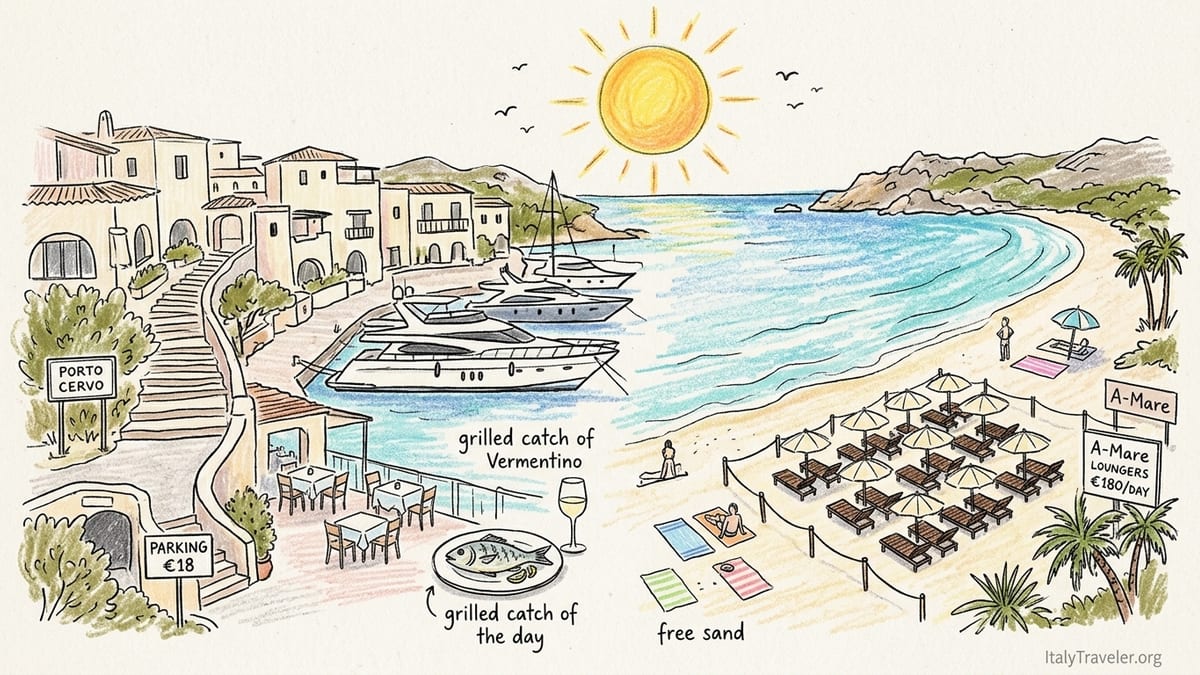
Porto Cervo, One Expensive Afternoon in August
I based myself in Olbia for this investigation and drove up to Porto Cervo for the first time on 17 August 2026. With mid-August traffic, the 35 kilometre trip took almost an hour, and the costs started before I even parked. In high season, the central Porto Cervo car parks charge hourly rates that quickly add up if you stay for aperitivo and dinner, as local travel guides now warn when they list parking as a non-trivial budget line for Costa Smeralda days out. For a late-afternoon stroll around the marina followed by dinner in the village, I paid just under 18 euro in parking fees alone.
That evening I ate at a waterfront restaurant facing the Marina di Porto Cervo. My main course of grilled catch of the day, one shared side and a glass of local Vermentino came to about 60 euro. The fish was fresh, the wine excellent, and the service polished but brisk. Nothing was overtly wrong, yet the overall feeling was that I was paying a premium not for exceptional cooking but for proximity to superyachts. Marina tariffs published for 2024 already show daily rates that place Porto Cervo among the better-heeled moorings of the Mediterranean, and the dining prices on the quay have risen in parallel, calibrated to a clientele for whom 60 euro fish plates are a casual choice rather than a conscious splurge.
Walking through the Piazzetta later, I ticked the boxes most visitors associate with Porto Cervo. Luxury boutiques in cream-coloured low-rise buildings, polished stone steps, and discreet logos for brands that usually anchor the most expensive streets of major capitals. It is elegant, but it is also deliberately disconnected from the older Sardinian villages only a short drive away. The overall impression that first night was not of a bustling Mediterranean town but of a curated open-air mall that happens to look out over one of the most expensive marinas in Europe.
The next day at Liscia Ruja, on Costa Smeralda’s biggest beach, finally gave me the comparison I needed. Having seen both the price lists and the free sand, I could directly measure what “luxury” actually buys on this coastline, and what it does not.
Liscia Ruja and A-Mare: What 180 Euro Really Buys
Liscia Ruja is part of the Arzachena coastline and is officially classed as public beach. Municipal and tourism information confirms that most Costa Smeralda beaches, including Liscia Ruja, have free stretches of sand coexisting with concessions that rent umbrellas and loungers. The beach itself, sometimes called Long Beach, is a deep curve of pale sand facing the bay of Cala di Volpe and remains accessible without charge if you are prepared to bring your own shade and arrive early enough to secure parking.
A-Mare, which opened as a Costa Smeralda-branded beach club on Liscia Ruja in 2024 under the umbrella of Smeralda Holding, occupies one of these concessions. Beach-club guides updated for summer 2026 document that standard front-row “stations” of two loungers and one umbrella are advertised in the rough band of 160 to 200 euro per day in peak season, with second or third rows priced somewhat lower. An independent national beach-club directory that audited A-Mare in July 2026 notes that the package typically bundles beach towels, a bottle of fresh drinking water, access to Wi-Fi, use of the beach facilities, and parking, with waiter service to the loungers and a landscaped garden area just behind the sand.
On 18 August 2026, I paid 180 euro for a second-row station booked directly by phone the day before. The inclusions were exactly as described: thick towels, chilled water on arrival, efficient beach staff who would materialise within minutes when summoned, and access to a spotless changing area and bar-restaurant under light wood pergolas. What that price did not include was lunch, drinks beyond the first water, or any form of exclusivity over the sea. Stepping a few metres sideways along the shoreline brought me into the free section, where local families and independent travellers had spread out their towels on the very same sand, facing the same turquoise shallows, under the same August sun.
This is a crucial point for anyone considering Costa Smeralda: in Italy the coastline remains public domain, and even where concessions exist, there must be free access along the waterline. Paying for a beach club almost always means paying for services, not for the sea itself. At Liscia Ruja, the services are undeniably high-end, but the view does not change abruptly at the edge of the concession. If you are happy with a simpler day and can carry your own umbrella, you can enjoy exactly the same bay for the cost of parking.
Costa Smeralda’s Origin Story vs Older Sardinian Towns
To understand why Porto Cervo and its satellite beaches feel so different from the rest of Gallura, it helps to look briefly at how Costa Smeralda came to exist. In the early 1960s, a consortium of investors led by Karim Aga Khan IV began to develop what was then a sparsely populated stretch of northeastern Sardinian coast. Under the direction of architects and planners, they created Porto Cervo and nearby resorts more or less from scratch, with strict aesthetic rules about building height, colour and signage. The resulting villages are intentionally homogeneous, with curved walls, low roofs and pastel tones designed to blend into the granite and macchia landscapes.
That design discipline makes Porto Cervo photogenic, but it also means it lacks the layered history you feel in older Gallurese communities such as Santa Teresa Gallura, Palau or the hill town of Tempio Pausania. Those towns grew around ports, agriculture and internal trade, and their historic centres still show this in their churches, granite squares and everyday shops. By contrast, nearly every storefront in Porto Cervo’s centre is there to extract holiday spending, be it in luxury goods, fine dining, yacht services or high-end real estate.
Modern travel reports on Costa Smeralda regularly describe it as one of the most expensive coastal destinations in Europe, noting that prime property prices rose sharply again in 2023 and that rentals for villas and moorings track the inflow of global wealth rather than local wages. Walking the marina, you feel that reality in the scale of the yachts and in the brands lining the quays. It is a manufactured bubble that trades on natural beauty but prices itself as an exclusive club.
When you leave that bubble and drive twenty or thirty minutes to a town like Cannigione or Palau, the contrast is immediate. Those communities are busy in August, of course, but the high streets still contain hardware stores, bakeries and cafes serving workers as well as tourists. In Porto Cervo’s designed streets, almost every space is a boutique, a high-concept restaurant or a marketing suite for luxury developments.
Beach Clubs, Free Sand and What You Really Pay For
One of the most confusing aspects for first-time visitors is understanding what is free and what is not on Costa Smeralda’s famous beaches. Municipal and regional guidelines make clear that the shoreline itself must remain accessible without payment, even in areas where concessions cover most of the depth of the sand. On many Costa Smeralda beaches, including Spiaggia del Principe, Capriccioli and Liscia Ruja, you find a mixed system. There are paid areas where operators rent umbrellas, loungers and sometimes cabanas, and there are completely free sections where you can lay a towel without charge, subject to local rules about emergency access strips along the water.
At Liscia Ruja, Arzachena’s own tourism materials emphasise that the beach is public and describe it as the largest in Costa Smeralda, accessible by a network of dirt tracks from the main road. The arrival, however, is where costs come in. Parking is regulated and monitored, with the municipality announcing enforcement campaigns and traffic-management orders in recent summers to protect the fragile dunes and limit the number of vehicles. Arrive late on an August morning and you may find the public car park full and an informal secondary market for spaces, again adding to the effective price of a “free” beach day.
What beach clubs like A-Mare monetise is predictability and comfort. For a fixed price far above the Italian average, you are guaranteed a set of loungers in a well-managed area, shade at the height of the day, and easy access to a bar-restaurant that has every incentive to keep high-spending clients content. The same logic applies at other Costa Smeralda establishments where pizzas can easily cost around 30 to 40 euro and cocktails run into the high teens, as detailed in several 2026 traveler reviews of nearby luxury hotels and marinas that mention 40 euro pizzas and 18 euro gelato portions at associated beach venues.
Compare this with settings further down the Gallura coast. On La Cinta in San Teodoro or at the beaches near Santa Teresa Gallura, you can still find basic deckchair rentals and simple kiosks that charge closer to what most Italians would recognise as everyday seaside prices. The sand and water may be only marginally less photogenic. The big difference is that your daily spend does not creep into three figures unless you choose to dine lavishly.
Hotel Costs: Porto Cervo vs Cannigione, Palau, Santa Teresa, Olbia and San Teodoro
To put numbers on the sense of “overpriced,” I compared mid-August 2026 accommodation options across a week using widely available price lists and booking data: seven nights for two adults, 10 to 17 August 2026. In Porto Cervo proper, four and five-star hotels and serviced apartments routinely show nightly rates well above 600 euro in that period, with many premium properties crossing the 1,000 euro threshold for standard double rooms or junior suites. Even more modest three-star options tied to the Costa Smeralda brand push beyond 350 to 400 euro per night in peak weeks.
In Cannigione, about 20 minutes’ drive to the west and still on the same stretch of Gallura coast, published price lists for holiday apartments and midrange hotels show a very different picture. Weekly tariffs in 2026 catalogues for two-bedroom units often fall between roughly 800 and 1,400 euro in August, depending on distance from the sea and facilities. That translates to something like 115 to 200 euro per night for a space that can comfortably accommodate a small family, often with kitchen facilities that help keep restaurant spending under control.
Palau and Santa Teresa Gallura, both ferry ports with long-established local communities, undercut Porto Cervo still further. Here, midrange hotels in August 2026 often cluster around 150 to 250 euro per night for a double room, with simpler pensions and B&Bs lower again if you are prepared to trade views for value. In Olbia, the gateway city with an international airport, chain hotels and local three-stars provide a base from around 120 to 200 euro per night in high season. South again in San Teodoro, a lively beach town popular with Italians, apartments and resort-style hotels compete hard on price. Weekly schedules and resort price sheets indicate that August weeks there can still be had in the 1,000 to 1,600 euro bracket for a family-sized unit, particularly a few blocks back from La Cinta.
Put simply, a one-week stay in Porto Cervo in mid-August that includes a superior hotel room, a couple of beach-club days and regular dining out can easily run to 7,000 or 8,000 euro for two people once you factor in taxis, transfers and extras. The same week using Cannigione or Olbia as a base, renting a car and mixing free beaches with occasional paid loungers can come in at half that amount, if not less, without dramatically compromising on the quality of the sea or the weather.
Northern Gallura Beaches: Iconic vs Accessible Alternatives
The case for Costa Smeralda rests heavily on its beaches. Names like Spiaggia del Principe, Capriccioli, Romazzino and Liscia Ruja appear on almost every list of Sardinia’s “must-see” bays. Spiaggia del Principe, also known locally as Poltu di li Cogghj, is promoted by both the Costa Smeralda consortium and independent beach guides as a jewel of the coast, associated by tradition with the Aga Khan. Access is via a dusty path from a paid car park, and the beach itself remains technically free, with some limited rental of umbrellas and loungers.
Capriccioli, another famous cove of pale sand and polished granite boulders, has become iconic partly because scenes for a James Bond film were shot there in the late 1970s. The bay is divided into small inlets, some more sheltered from particular winds than others, and in summer the surrounding parking and access roads are tightly managed by the municipality of Arzachena, which has issued specific ordinances to limit traffic, enforce no-parking zones and protect the fragile coastal vegetation. As a visitor you feel this management in the early-morning rush to secure legitimate parking and in the steady presence of local police around the access points.
Liscia Ruja, by contrast, is vast for Costa Smeralda. Official descriptions call it the largest beach in the area, facing the open gulf with a backdrop of gentle dunes. Its scale means that, even in August, it is possible to walk beyond the concessions and find room, but its reputation and accessibility still see the car park fill quickly. Local discussion boards feature repeated advice to arrive by around 8.30 or 9.00 in peak summer if you want to park legally and avoid a long, hot walk back to your car in the afternoon.
When you step back from the marketing and compare these celebrated beaches with others in Gallura, the differences become more subtle. The sand at Rena Bianca in Santa Teresa Gallura, at Porto Pollo near Palau or at La Cinta in San Teodoro is no less white, the water no less transparent on a calm day. What Costa Smeralda often has that these do not is highly controlled urban design just behind the shoreline and a concentration of branded services, from yacht tenders to high-end beach clubs. For travellers who value wildness or local everyday life as much as postcard views, the more accessible alternatives can feel richer, precisely because kiosks sell panini instead of sushi and the people next to you on the sand are as likely to be local schoolteachers as international yacht crews.
Taxis, Parking and the Hidden Frictions of a Luxury Coast
Transport is where the gap between expectation and reality bites many visitors. Marketing material for Costa Smeralda usually depicts a seamless lifestyle of sunset cocktails and late-night clubs, but the practicalities of getting between beaches, hotels and nightlife without your own car are far from glamorous. Sardinian nightlife guides for 2026 note bluntly that there is no dense network of night buses linking Porto Cervo with nearby towns. Distances between resorts like Porto Cervo, Porto Rotondo, Baja Sardinia and Olbia run to 15 to 30 minutes by car, and while taxis exist, their tariffs rise sharply on summer nights and weekends, with long waits common at peak times.
Recent traveler reports echo this. One widely discussed 2026 review of a design hotel near Poltu Quatu, just outside the formal Costa Smeralda area but very much within its orbit, describes 40 euro beach-club pizzas, 18 euro for three scoops of ice cream, and an additional 7 euro just to have drinks brought to a pool cabana. Another 2026 discussion about Porto Cervo calls taxis “expensive and scarce,” advising visitors who want to drink in the evenings to budget accordingly or stick with rental cars and designated drivers.
Parking policies add another layer. In Porto Cervo and nearby resorts, paid parking typically runs from morning until late at night in high season, sometimes up to midnight, which means every long beach day that slides into aperitivo and dinner quietly accumulates several tens of euros in parking fees. Along the approach roads to Capriccioli and Liscia Ruja, the municipality of Arzachena has increased enforcement, with fines for illegal roadside parking introduced partly in response to congestion and environmental concerns. The intention is good, but the effect for visitors who arrive late or underestimate demand is more cost and frustration.
These are not glamorous expenditures. Spending 180 euro on a glamorous daybed may at least buy you a spread of fruit and pristine towels. Paying 35 euro for an unremarkable taxi ride between two villages or collecting a parking ticket because the official lots filled up at 9.30 feels like throwing money away, yet these are precisely the kind of incidental costs that inflate a Costa Smeralda holiday budget without adding much joy.
Restaurants, Shopping and Whether the Premium Feels Worth It
Is the food and shopping experience in Porto Cervo so exceptional that it justifies accommodation and access costs double or triple those in neighbouring towns. The answer, after multiple visits, feels complicated. On the one hand, Porto Cervo has some very good restaurants, excellent wine lists and a few chefs who treat local produce with respect rather than as a backdrop for theatrics. Service in higher-end venues is generally professional, multilingual and efficient, and if you choose carefully you can have a memorable meal overlooking the marina or the bay.
On the other hand, the widespread perception even among frequent luxury travellers is that prices have detached from the actual level of cooking and service. Observers who have stayed at nearby design hotels in 2026 point to 40 euro pizzas and nearly 20 euro dessert portions at associated beach venues as crossing the line between aspirational and unjustifiable. My own experiences in Porto Cervo’s mid-upper range eateries confirmed that feeling. Dishes were nicely plated but not more technically accomplished than those I paid half as much for in Olbia’s better trattorie, and the ambience often felt curated more for social media than for relaxed enjoyment.
The shopping scene is similar. If you actively want to buy luxury fashion, jewellery or homeware in a setting designed to flatter those brands, Porto Cervo delivers. International labels cluster closely, and late-night opening hours in August turn the streets into a kind of Mediterranean luxury arcade. For many ordinary travellers, though, this is window-shopping rather than actual shopping. When budgets are already stretched by high accommodation and restaurant bills, few visitors have spare thousands for a watch or handbag. In that context, the luxury storefronts become background scenery rather than a meaningful part of the holiday experience.
In contrast, wandering along Via Nazionale in Santa Teresa Gallura or through the centre of San Teodoro, the shops may be more modest, but the exchange feels more grounded. You can buy locally made ceramics, beachwear at non-astronomical prices, and pastries from family-run bakeries without the sense that every transaction is calibrated for the ultra-wealthy. The question for most readers of this article is not whether Porto Cervo can cater to those already at the very top of the spending pyramid, but whether its price level makes sense for travellers who have to make choices.
The Takeaway
After two weeks in northern Sardinia in August 2026, splitting time between Porto Cervo and more workaday bases like Olbia, Cannigione and Santa Teresa Gallura, I came away convinced that Costa Smeralda is both as beautiful as its reputation suggests and, for many ordinary travellers, significantly overrated. The emerald water is real, the coves are exquisite, and the 1960s planning rules have preserved a relatively low-rise coastline compared with other parts of the Mediterranean. Yet the premium prices in Porto Cervo and its branded beach clubs often buy atmosphere and status signaling rather than a genuinely superior holiday.
Would I stay in Costa Smeralda again. Yes, but likely not in Porto Cervo itself, and not for a whole week. Porto Cervo, in my view, does not need more than an afternoon or evening for most visitors: a walk around the marina to admire the yachts, an aperitivo on a terrace, perhaps a single splurge dinner if your budget allows. After that, the law of diminishing returns kicks in. Each additional night you sleep within the Costa Smeralda bubble is a night you are overpaying for a bed compared with nearby towns that access more or less the same stretch of coast.
If I were planning a future trip, I would choose Cannigione or Palau as bases for exploring the northern Gallura beaches by car, or Santa Teresa Gallura if I wanted a lively town with beautiful sand at Rena Bianca and easy ferry links to Corsica. Olbia makes sense for shorter trips or for those relying on public transport, thanks to its airport and ferry port, while San Teodoro offers a younger, more Italian holiday atmosphere with La Cinta and several other beaches within quick reach.
Costa Smeralda will likely continue to thrive as long as there is a global elite willing to pay for its curated combination of privacy, design and brand cachet. For travellers reading this with finite budgets and a desire to balance value with beauty, my conclusion is straightforward. Use Porto Cervo as a glamorous excursion, perhaps treat yourself to one carefully chosen day at a high-end beach club like A-Mare, but sleep and eat elsewhere. Sardinia’s northern coast is full of bays and towns that offer almost as much natural splendour with far less pressure on your wallet.
FAQ
Q1. Is access to beaches like Liscia Ruja and Spiaggia del Principe actually free?
Yes. The coastline itself is public, and official information confirms that beaches such as Liscia Ruja and Spiaggia del Principe have free access, although parking is usually paid and certain sections of sand are occupied by concessions renting umbrellas and loungers.
Q2. What do Costa Smeralda beach clubs like A-Mare include in their prices?
In 2026, verified beach-club guides report that an A-Mare station of two loungers and an umbrella for a day, priced around 160 to 200 euro in peak season, generally includes towels, a bottle of fresh water, access to facilities, Wi-Fi, parking and waiter service to your bed, but not lunch or alcoholic drinks.
Q3. How much more expensive is it to stay in Porto Cervo compared with nearby towns?
In mid-August 2026, four and five-star hotels in Porto Cervo often quote well above 600 euro per night, with many rooms over 1,000 euro, while midrange options in Cannigione, Palau, Santa Teresa, Olbia or San Teodoro commonly fall between roughly 120 and 250 euro per night for two people.
Q4. Are taxis and public transport convenient around Costa Smeralda?
Not especially. There is limited night-time public transport between resorts, and 2026 nightlife guides and traveller reports describe taxis as relatively scarce and expensive, especially on summer evenings, making a rental car or careful planning important.
Q5. Is Porto Cervo worth visiting if I am not interested in luxury shopping?
For most travellers, Porto Cervo is worth a half-day visit to see the marina, architecture and atmosphere, but beyond an afternoon or evening many find that the village offers limited variety unless you are actively seeking high-end shopping and dining.
Q6. Can I enjoy Costa Smeralda beaches without paying for a beach club?
Yes. You can bring your own umbrella and use the free sections of beaches such as Liscia Ruja, Capriccioli and Spiaggia del Principe. The main costs will be parking and any food or drinks you choose to buy from kiosks or bars.
Q7. Which nearby bases offer better value than Porto Cervo?
Cannigione and Palau provide good access to the same stretch of coast with more affordable accommodation, Santa Teresa Gallura combines a charming old town with great beaches, Olbia is practical for shorter stays and public transport, and San Teodoro offers a lively atmosphere with lower overall prices than Porto Cervo.
Q8. Are the famous Costa Smeralda beaches really better than others in Sardinia?
They are stunning, but many travellers find that beaches around Santa Teresa Gallura, Palau and San Teodoro offer equally clear water and white sand. What Costa Smeralda adds is a concentration of luxury services and controlled architecture behind the shoreline, which may or may not matter to you.
Q9. When is the best time to visit Costa Smeralda for fewer crowds and slightly lower prices?
Late May, June and September usually bring warm weather and swimmable seas with fewer crowds and more moderate prices than peak August. Accommodation and some beach-club rates often drop noticeably outside the central weeks of the Italian holiday season.
Q10. If I splurge on one thing in Costa Smeralda, what should it be?
If your budget allows a single indulgence, consider a carefully chosen day at a reputable beach club like A-Mare on Liscia Ruja or a special dinner with a marina view. Then balance the rest of your trip with more affordable meals, free beach days and a base in one of the nearby towns for better overall value.