


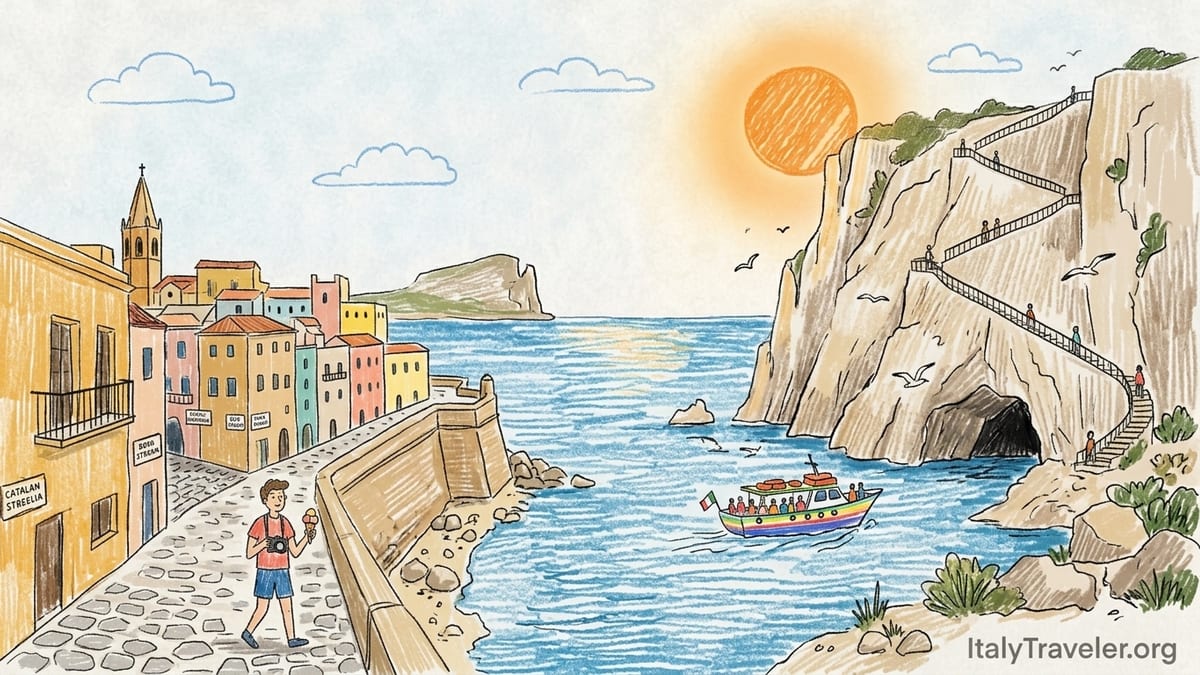
On a windy afternoon in late May 2024, I leaned over the sea walls of Alghero’s old town and watched the sun fall behind Capo Caccia’s white cliffs. I was staying at a small family hotel just outside the bastions, near Via Catalogna, and getting around mostly on foot and by local bus. From the promenade, Capo Caccia looked almost unreal, a flat-topped headland cutting a sharp silhouette against the sky. Somewhere inside that cliff, guides kept saying, lay one of Sardinia’s most dramatic sea caves: the Grotta di Nettuno, or Neptune’s Grotto. Reaching it, I would discover, is at least half the adventure.
Setting the Scene in Alghero’s Old Town
Alghero first seduced me long before I set foot inside Neptune’s Cave. The old town’s cobbled lanes, Catalan street names and coral jewelry shops created a small-world feeling, even in late May when the season was beginning to pick up. In the evenings, I would walk the Bastioni Marco Polo and Bastioni Magellano, pausing at the cannons to watch waves slap against the sea wall below. From here, Capo Caccia is a constant presence on the horizon, a pale limestone block that glows pink as the sun sinks into the Mediterranean.
I based myself at a modest but comfortable three-star hotel between the marina and the Lido, close enough to reach the historic center in about ten minutes on foot. This location made it easy to keep plans flexible. I did not rent a car for my stay in Alghero, relying instead on the ARST bus to reach Capo Caccia and on harbor boats when I wanted to be on the water. That choice turned every excursion into a door-to-door journey from the old stones of the bastions to the wild cliffs outside town.
My first evening ritual became a simple one. I would pick up a cone of gelato from a small gelateria off Piazza Civica, then walk up to the bastions for the golden hour. Families strolled, teenagers perched on the walls, and restaurant staff set out tables for dinner. Directly in front of us, the outline of Capo Caccia sharpened as the light softened, and people pointed phones at the sunset without needing any explanation. I knew that behind that silhouette was the Grotta di Nettuno, and that future me would either be sweating up its legendary staircase or watching the cliffs from the deck of a boat.
The question was how to get there. Locals and tourism staff repeated two options again and again. I could arrive by land, descending the Escala del Cabirol, the “goat’s staircase” carved into the face of Capo Caccia with around 650 steps, or by sea, boarding a boat directly from Alghero’s harbor that would drop me at the cave entrance. Each promised its own challenge. In the end, curiosity won. I decided to experience both on different days, so I could understand what those steps and that sea journey really feel like.
Choosing Between 654 Steps and the Boat from Alghero
Planning a visit to Grotta di Nettuno is not just about times and tickets. It starts with a decision about effort and comfort. The Escala del Cabirol is famous for a reason. Official guides usually cite 654 steps from the parking area at Capo Caccia down to the cave entrance, though I had read some older descriptions putting the total closer to 660. In practice, the number matters less than the gradient. This is a staircase hammered into a nearly vertical cliff, with long zigzags, metal railings and a sheer drop to the sea on one side.
The boat, by contrast, seems like the easy route. Large excursion vessels operated by local companies run a line from the tourist port of Alghero directly to the cave entrance in around 35 to 40 minutes each way in good conditions. Current information at the harbor and on tourism platforms listed adult boat fares in the range of about 18 to 22 euros for the round trip, depending on season and operator, and made it very clear that this price covered only the transport, not the cave admission itself. Compared with the staircase, sitting on a bench with sea spray and a camera feels indulgent.
Ticketing rules nudged my choices. According to the official booking system managed through Alghero’s tourism network, reservations are mandatory if you plan to reach the cave on foot via the Escala del Cabirol. You buy or integrate your entry ticket, then select a specific time slot for the guided visit inside the cave. The time on your booking is the start of the cave tour, not the beginning of the staircase, which means you must allow ample time to walk down. By contrast, for those arriving by sea directly from Alghero between roughly April and November, no advance reservation is requested for the cave itself. You pay the boat company for the crossing, then purchase your cave ticket from staff at the entrance on arrival.
Price was another consideration, although in this case not a deciding one. In 2024, adult admission to Grotta di Nettuno, when bought as a stand-alone ticket unconnected to broader museum passes, sat around 14 to 15 euros according to local information and park materials. That amount is paid whether you arrive by sea or by land, and it is separate from any bus, car fuel, parking or boat fare you incur along the way. For me, the real calculation was physical. On a cool, bright morning I felt ready to tackle the staircase. On a warmer, slightly rougher day, the boat seemed the wiser option.
Descending the Escala del Cabirol by Bus and Boot
My land-based visit began with the early ARST bus number 9321 from Alghero toward Capo Caccia, leaving from near Via Catalogna a short walk from my hotel. The ride took a little under an hour, looping past the beaches of Fertilia and the protected landscape of the Porto Conte area, then climbing gradually until the cliffs dominated the horizon. I climbed off at the Capo Caccia stop together with a handful of other passengers, most of whom looked as if they had dressed for a light hike rather than a beach day.
A short walk brought us to the parking area at the top of Capo Caccia, where the view shot straight down into turquoise water broken by white foam. There were a few interpretive panels about the protected area and a sign indicating the direction of the Grotta di Nettuno. Another sign reminded visitors that access to the cave is subject to weather and sea conditions and that, although we were reaching it via land, the cave could be closed if swell or wind made the entrance unsafe. I checked the time. My booked cave slot was in forty minutes. It was time to begin the descent.
The first steps of the Escala del Cabirol felt deceptively gentle. The path begins with a wide concrete staircase and sturdy stone balustrades before shifting into more exposed sections cut directly into the rock. After the first switchback, the full geometry of the staircase appears. It zigzags sharply across the cliff, each leg running just a few meters from the void. To my left, the limestone dropped straight to the sea. To my right, the rock face rose almost vertically, scarred by ancient erosion and dotted with tufts of hardy vegetation.
Going down, I was grateful for the mild weather. A breeze kept the air cool, and clouds occasionally softened the sun. Even so, I paused often, partly for photographs and partly to let my knees rest. I passed small groups coming up who were already breathing hard halfway, and we exchanged sympathetic smiles. Almost everyone commented on the steps. One Italian couple laughed that the count depended on your mood. Official signs and park materials talk about 654 steps, but by the time you add the few extra around the cave entrance, it is easy to feel as if you have done 660 or more.
The Hard Truth of the Return Climb
At the base of the staircase, the rock suddenly folded inward, revealing the cave entrance at sea level. The roar of the waves echoed inside a dark gap guarded by railings and a small ticket office. Even after the descent, I had a few minutes before my scheduled visit time, which I used to drink water and watch the surface of the sea as it swelled in and out of the entrance. Staff checked our bookings against a list and reminded those of us who had come via the Escala del Cabirol to allow at least 30 to 40 minutes for the climb back up once the tour ended.
I found the climb back far more demanding than the initial descent. When the tour finished, our group spilled out of the cave into bright daylight. A few people immediately took off up the stairs, eager to beat the rush. I lingered long enough to let them get ahead, then began what felt like an endless series of step sets. The wind that had refreshed me on the way down now seemed to die, and the sun hit the exposed segments of the staircase hard. Even in late May, temperatures on the rock rose quickly.
I tackled the return in sections. I would climb one full zigzag, then move aside to rest a moment against the inner wall, letting faster climbers pass. At several points, I joined impromptu pauses with other visitors where we compared how much water we had left and whether we believed the step count signs. I met a family with teenagers who had reached the cave by boat that morning on a different day and had decided to “try the stairs” this time. Halfway up, they admitted that doing both routes in the same week had given them a healthy respect for Capo Caccia.
When I finally reached the top, my legs trembled and my shirt stuck to my back, but the sense of satisfaction was undeniable. The view across to the pierced island of Foradada rewarded every calorie burned, its limestone mass cut clean through by a natural arch. If you are reasonably fit and choose a cooler part of the day, the Escala del Cabirol offers unforgettable scenery and a tangible sense of achievement. If you suffer from vertigo, have knee issues or are traveling in the peak heat of July or August, I would think hard before committing. In that case, the boat from Alghero is not just easier. It is safer.
Experiencing Neptune’s Grotto from the Sea
A few days after my staircase adventure, I returned to Grotta di Nettuno by sea. This time, I walked from my hotel to the tourist port of Alghero, where the ticket offices of the boat companies lined the waterfront. Staff posted timetables for departures spread across the morning and early afternoon, usually concentrating in the mid-morning when visitor demand peaks. Display boards listed round-trip fares in the high-teens to low-twenties in euros for adults, with discounts for children. Right beside those boards, prominent notices reminded passengers that the cave ticket, about 14 to 15 euros for adults during the 2024 season, would be paid separately at the cave entrance.
I booked a mid-morning departure on a broad, two-deck vessel with both indoor seating and an open upper deck. The sea was calm that day, with only a low swell, and staff confirmed that the cave was open. They also explained a crucial detail that many visitors miss. If wind or waves worsen during the morning, boats might have to cancel later departures or even skip landing at the cave, in which case they either refund or reroute passengers on a coastal cruise instead. Access to Neptune’s Grotto is always conditional on favorable marine conditions, regardless of how you plan to arrive.
Once we left the harbor, Alghero’s old town shrank behind us into a tidy cluster of ocher buildings and bastions. The boat followed the coastline north, passing sandy coves and stretches of low cliff before the headland began to rise. From sea level, Capo Caccia’s limestone face felt monumental, its white walls streaked with orange where water had leached minerals out of the rock. The captain steered close enough for us to see caves at the base of the cliffs and wave-carved inlets. When the island of Foradada appeared, with its tunnel visible right through the center, cameras and phones rose in near unison.
The approach to Neptune’s Grotto from the water is theatrical. As we rounded a final point, the cave entrance appeared as a shadow at the base of the cliff, with a small concrete platform and metal railings. Above it, impossibly high, I could trace sections of the Escala del Cabirol zigzagging along the rock face. Watching other visitors move like small ants on the staircase gave me a new respect for what I had done days earlier. The boat nudged the landing carefully. Crew members helped us step onto the wet platform, then we filed toward the ticket control, where staff sold or scanned the cave entry tickets before guiding us into the darkness.
Inside Grotta di Nettuno: Water, Stone and Crowds
Whether you arrive breathless from the staircase or mildly sunburned from the boat deck, the first steps into Grotta di Nettuno trigger an immediate change of atmosphere. The temperature drops noticeably. The sound of waves outside turns into a muffled surge, and the air smells faintly of minerals and sea salt. Our guide gathered us near the entrance, switching between Italian and English to outline the rules: no touching the formations, no flash photography in some sections and staying with the group for safety.
The path through the cave is structured, with handrails and a built walkway that leads past stalactites hanging like stone icicles and stalagmites rising from the floor. Soft, warm-toned lighting picks out the most striking formations, leaving other chambers in shadow. The centerpiece of the visit is Lake Lamarmora, a large underground saltwater lake whose still surface reflects the stalactites above with mirror clarity when the group falls silent. Our guide explained that the lake connects with the sea outside and shifts with the tides, but remains protected from direct swell by the structure of the cave.
We spent around 35 to 40 minutes inside from entrance to exit. That matches the timing described by local tourism materials and felt adequate to appreciate the main chambers without rushing, although in high season the experience is shaped strongly by crowd levels. On my land-based visit via the Escala del Cabirol, our group was moderately sized, perhaps thirty people, and there was space to linger a moment at viewpoints. During the boat-based visit later in the week, the group swelled significantly when two vessels arrived close together. In narrower passages, this created a slow-moving line, and conversations sometimes drowned out the guide’s commentary.
Content-wise, the guide’s talk mixed geology with anecdote. We heard about the formation of the cave in soft limestone over millions of years, the first documented explorations in the nineteenth century and the long period when access was only possible from the sea. The Escala del Cabirol itself dates from the 1950s, which means earlier visitors had to time their arrival carefully to calm seas and approach by rowing boat. While the script felt rehearsed, details such as pointing out where thin stalactites had snapped due to human contact brought home why the access rules matter.
Exiting the cave, I felt both impressed and slightly conflicted. The beauty of the formations and Lake Lamarmora is undeniable, and walking through such a space just above the sea is rare. At the same time, the volume of visitors on popular days and the logistics of moving large groups through a fragile environment can erode some of the magic. For travelers sensitive to crowds, the first or last tour slots of the day, especially outside peak summer months, are likely to offer a calmer experience.
Weather, Closures and Comparing Transport Options
One reality that every visitor to Grotta di Nettuno must accept is the cave’s dependence on weather and sea conditions. Official park information and recent visitor guidelines emphasize that the site only opens when the combination of wind, swell and tides allows safe access through the sea-level entrance. Even if the sky is blue above Alghero, a strong mistral can send heavy waves crashing against the base of Capo Caccia, making the landing platform unsafe and affecting both boat docking and the low tunnel that leads into the cave.
For those arriving by boat, this translates into cancellations or last-minute route changes. On the day of my sea visit, staff at the harbor made a point of telling us that departures remained subject to confirmation up to the last minute. They recommended checking the situation in person or by phone that morning rather than assuming that a previously printed timetable guaranteed access. Information sheets from local authorities for the 2024 season echoed this advice and suggested monitoring official channels for closure announcements.
For visitors choosing the Escala del Cabirol, the relationship with weather is more nuanced. The staircase itself can be open while the cave is closed, allowing people to enjoy the descent, views and climb even if they cannot join a tour inside. However, reservation systems for land access now link your step effort directly to a timed cave slot, and operators encourage checking that the cave is confirmed open before setting out, precisely to avoid frustration. Strong sun and heat also transform the staircase from a challenging hike into a potentially dangerous undertaking, especially for those not used to steep climbs.
Comparing the three main transport approaches I saw around me helps clarify choices. Driving offers autonomy. Many visitors arrive at Capo Caccia in rental cars, parking in the lot near the top of the staircase. This suits those on tight schedules or traveling with equipment for beach hopping in the Porto Conte area, but it still leaves the 654-step descent and ascent to tackle. Harbor boats from Alghero prioritize simplicity: you walk to the port, pay for a round trip and let someone else handle navigation and mooring. Organized excursions, including combinations of boat trips, snorkel stops and a cave visit, exist too, often at higher prices but with door-to-door service from hotels or campsites. As someone without a car, I found the mix of bus and stairs one day, and harbor boat another day, both manageable, though each required some advance planning.
Eating, Walking and Watching Sunsets Back in Alghero
Returning from Capo Caccia, either flushed from the climb or salt-dusted from the boat, Alghero itself becomes part of the Neptune’s Grotto experience. On my staircase day, I took the afternoon ARST bus back and rewarded myself with a late lunch in the old town. Many restaurants around Via Carlo Alberto and Piazza Civica advertise seafood platters and Catalan-inspired dishes such as aragosta alla catalana, a lobster salad with tomatoes and onions. My budget favored simpler plates, so I chose a small trattoria serving fregola with clams and a carafe of local Vermentino. The combination of chewy Sardinian pasta and briny shellfish felt perfectly tuned to a day spent under limestone cliffs.
On my boat day, arrival back in Alghero coincided with the late afternoon lull. The port quieted, and the old town began to stretch into its evening rhythm. I stopped at a waterfront bar along the bastions for an aperitivo. A spritz arrived with a small plate of olives, pecorino cubes and pane carasau, the paper-thin Sardinian flatbread that shatters between your teeth. From my stool, I could follow the outline of the day in reverse: the boats returning from Neptune’s Grotto, the line of cliffs in the distance, the staircase invisible but now vivid in my muscles’ memory.
If you have only one night in Alghero around a visit to Grotta di Nettuno, I would suggest timing your dinner with the sunset along the sea walls. Restaurants tucked into the bastions often place tables so close to the parapet that you feel suspended above the water. On clear evenings, the sky over Capo Caccia shifts from pale blue to orange, then deepest red. Locals linger, tourists rush to take final photos, and the day’s micro-dramas at the cave, successful climbs and canceled boats alike, dissolve into the wider calm of the bay.
Those quieter hours after a physically demanding excursion are also ideal for exploring corners of Alghero that many visitors skip. The Coral Museum, housed in a Liberty-style villa, offers context for the “Riviera del Corallo” name that adorns so many signs. The narrow alleys off Via Roma reveal tiny wine bars where you might find Cannonau by the glass and simple plates of bottarga-topped bruschetta. In my memory, the day is bracketed by limestone and by coral: the pale stone cliffs of Capo Caccia and the deep red of worked coral in old town shop windows.
A One-Day Alghero and Capo Caccia Itinerary and Costs
For travelers with limited time, it is perfectly possible to fit both Alghero’s old town and Neptune’s Grotto into a single, well-structured day, as long as you choose one primary access method to the cave. Based on my experience, here is how such a day might play out if you opt for the harbor boat. Start with an early breakfast near your accommodation, then walk to the port to buy a ticket for one of the morning departures to Neptune’s Grotto. Aim for a departure around 9:00 or 10:00 to avoid the hottest part of the day on the boat deck and inside the cave. Budget roughly 18 to 22 euros for the return boat fare and 14 to 15 euros for the adult cave ticket. The complete boat plus cave experience will absorb around three hours.
Back in Alghero around lunchtime, head into the old town for a sit-down meal. A simple two-course lunch with water and perhaps a glass of local wine in a mid-range restaurant in 2024 typically ran in the range of 25 to 35 euros per person, depending on your choices. After lunch, you might rest at your hotel or stroll the Lido beach, then return to the historic center for late-afternoon exploration of the bastions, the cathedral and small museums. Factor in another 10 to 15 euros for gelato, coffee or an aperitivo along the sea walls before dinner.
If, instead, you decide to experience the Escala del Cabirol in your one long day, the structure changes. You will need to secure a timed cave reservation via the official platform in advance and coordinate your transport to Capo Caccia. Using the ARST bus from Alghero to Capo Caccia and back, tickets for 2024 hovered in the low single digits of euros each way. Combine that with the cave entry, again around 14 to 15 euros, and you have a very cost-effective but effort-heavy excursion. Just ensure that your chosen bus departure allows enough margin to reach the top of the staircase, descend safely and arrive at the cave entrance before your booked tour time.
All told, a one-day combination of Neptune’s Grotto and Alghero’s old town will typically cost an adult traveler somewhere between 60 and 90 euros in direct expenses, depending on access method and dining style. A budget-minded visitor who takes the bus, packs snacks and orders simpler meals can remain closer to the lower end. Someone who chooses the boat, a seafood lunch and aperitivo on the bastions will drift toward the higher end. In my case, splitting the experiences over two days raised transport costs slightly but allowed more relaxed pacing. If I had to compress it all into one day, I would choose the boat option to conserve energy for evening walks in town.
The Takeaway
Looking back on my twin encounters with Grotta di Nettuno, one from the sea and one from the stone, I realize that the cave itself is only half the story. The other half lies in the approach. Descending and climbing the 654 or so steps of the Escala del Cabirol stitched the landscape of Capo Caccia into my muscles and breath. Watching the cliffs slide past from a boat stitched it into my sense of scale. Both routes converged inside the same cool darkness, by the same mirror-still Lake Lamarmora, yet each framed that moment differently.
If you are fit, not prone to vertigo and traveling in a cooler shoulder season month such as May, early June or late September, I would absolutely recommend experiencing the staircase at least once. Just carry water, wear good shoes and book an early cave slot to avoid climbing in the midday heat. For most travelers, however, especially families with small children, older visitors or anyone visiting in the high summer heat, the boat from Alghero strikes the best balance between effort and reward. It offers dramatic views of the cliffs, easy logistics from the old town and the security of not facing a long climb after the tour.
Admission pricing and rules, including the separate cave ticket of around 14 to 15 euros for adults and the obligation to reserve time slots for land access, are not small details. They shape how you experience the day and how much flexibility you retain. The same goes for the weather. Planning Neptune’s Grotto into your Alghero stay works best if you keep another half-day available as a backup in case wind or waves force a closure. Treat the cave not as a guaranteed theme-park attraction but as a natural site that reveals itself on its own terms.
If I had to choose only one method again, I would personally return by sea. The staircase was unforgettable, but the combination of harbor atmosphere, coastal views, cave visit and a gentle ride back into Alghero’s embrace is the version that I can imagine repeating with friends or family of varied abilities. Either way, pairing Neptune’s Grotto with an evening on the bastions, a plate of fregola and a glass of Vermentino is what turns it from a simple excursion into a complete Alghero story.
FAQ
Q1. How many steps are there on the Escala del Cabirol to Neptune’s Grotto?
Most official sources and on-site signs put the count at 654 steps from the parking area at Capo Caccia down to the cave entrance, though some guides and visitors mention slightly higher counts once you include smaller access steps. In any case, you should be prepared for a long, steep staircase rather than focusing on the exact number.
Q2. How much does it cost to visit Grotta di Nettuno?
In 2024, the standard adult admission to Grotta di Nettuno was around 14 to 15 euros when bought as a stand-alone ticket. This fee is separate from transport costs. If you arrive by boat from Alghero, expect to pay an additional 18 to 22 euros or so for the round-trip crossing, depending on the operator and season. Bus tickets or car fuel and parking for those going via Capo Caccia add only a few more euros.
Q3. Do I need to book in advance to visit the cave?
Advance booking is mandatory if you plan to reach Grotta di Nettuno by land using the Escala del Cabirol, because you must choose a specific time slot for the guided tour. For visitors arriving by boat directly from Alghero during the main season, the current system does not require a prior reservation for the cave itself. You simply buy your boat ticket at the harbor and your cave ticket at the entrance, subject to capacity and weather-related openings.
Q4. How long does the visit inside the cave take?
The guided route inside Grotta di Nettuno typically lasts around 35 to 45 minutes, depending on group size and conditions on the day. This includes stops at major formations and at Lake Lamarmora. You should plan at least three hours in total for the activity if you travel by boat from Alghero and a half-day if you combine the staircase descent, tour and climb back up from Capo Caccia.
Q5. Is the visit suitable for children and older travelers?
Arriving by boat makes Grotta di Nettuno accessible to a wider range of visitors, including many children and older adults who are comfortable with stairs but not with long climbs. However, the cave path still involves steps and some uneven surfaces, so it is not ideal for very young children, heavy strollers or those with significant mobility issues. The Escala del Cabirol, with its 654-step climb and exposed position on the cliff, is best left to reasonably fit visitors with no serious vertigo or heart and knee problems.
Q6. When is the best time of year to visit Neptune’s Grotto?
Late spring and early autumn, especially May, early June and late September, provide a good balance of milder temperatures, generally calmer seas and somewhat lighter crowds compared with peak summer. The cave usually opens to boat visitors from roughly April to November, depending on sea conditions, while land access via the staircase can be possible outside that window when the site is open. Always check current information close to your travel dates.
Q7. Can I drive to Capo Caccia and still avoid the steps?
You can certainly drive to Capo Caccia and park near the top of the Escala del Cabirol, but reaching Grotta di Nettuno from that point on foot always involves the full staircase descent and climb. There is no alternative lift, tunnel or road access directly from the clifftop to the cave entrance. If you want to avoid the staircase entirely, your only practical option is to take a boat that lands you at the cave platform at sea level.
Q8. What happens if the weather is bad on the day of my visit?
If wind and sea conditions are unfavorable, authorities may close Grotta di Nettuno completely for safety. Boat companies then cancel or modify excursions, generally offering refunds or alternative coastal cruises. For visitors with land reservations, the booking platform provides information about closures and options to reschedule. If only the cave is closed but the staircase is accessible, you might still be able to descend part of the way to enjoy the views, but you will not be allowed inside the cave.
Q9. Are there facilities at Capo Caccia and near the cave?
At Capo Caccia there is a parking area and some basic services within driving distance, but facilities directly at the top of the staircase are limited. At the cave entrance, you will find the ticket office and staff, but there are no extensive amenities inside or right beside the cave itself. It is wise to carry water, especially if you plan to tackle the Escala del Cabirol, and to use restrooms in nearby towns or at the port before departure.
Q10. If I can only choose one way to reach the cave, which should I pick?
If you value dramatic coastal views and convenience and prefer to save your energy for exploring Alghero, the harbor boat from the old town is the most user-friendly choice. If you are relatively fit, unafraid of heights and keen on earning your cave visit through a physically intense approach with spectacular panoramas, then the Escala del Cabirol offers a uniquely memorable experience. Having tried both, I would personally choose the boat again for its balance of effort, comfort and scenery.