


On Tuesday 18 August 2026, I sat in an apartment in Alghero with two laptops and a phone open, logged into the official La Pelosa booking site, waiting for the clock to hit 09:00. The goal sounded simple: secure four spots for the following Thursday, see the famous shallow turquoise water for myself, and decide whether Sardinia’s most controlled beach still deserved a full day of my holiday. Ninety frantic seconds, one failed payment, and 14 euros later, my enthusiasm had already started to drain away.
How the 2026 Booking System Really Works When You Try to Use It
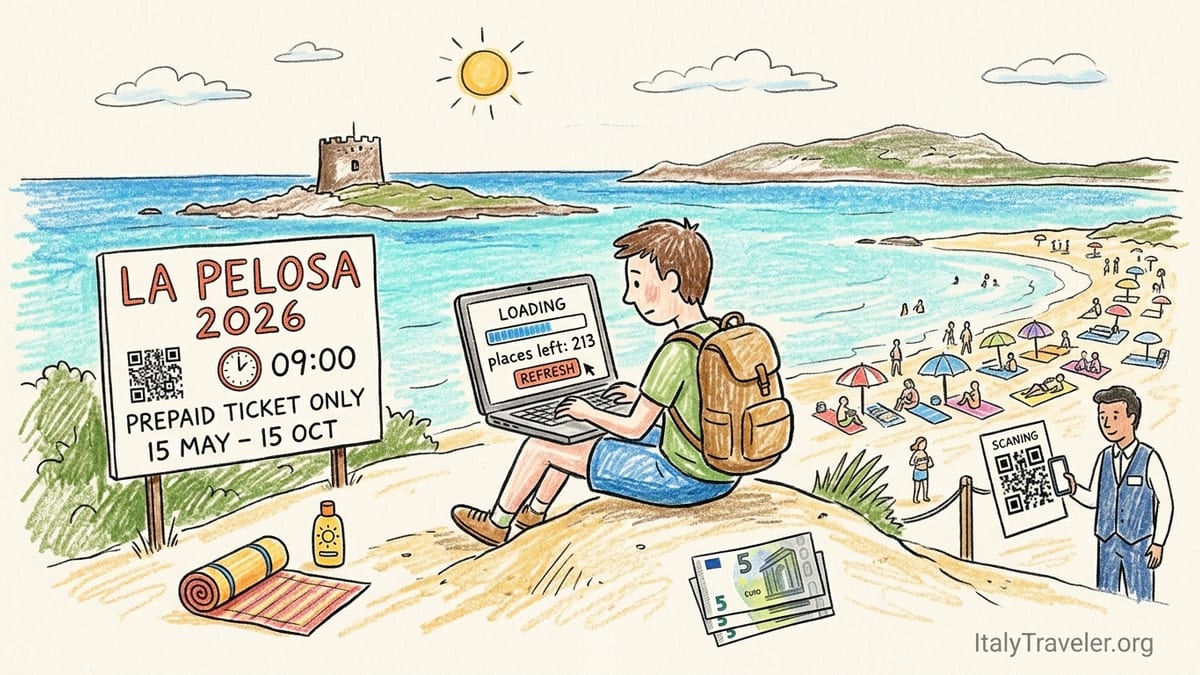
The first surprise was discovering that visiting La Pelosa in 2026 is less like going to the beach and more like booking concert tickets. From 15 May to 15 October 2026, access is capped at 1,500 visitors per day, and entry is only possible with a prepaid ticket purchased through the official municipal platform. The daily fee is 3.50 euros per person for anyone aged 12 and over, while children under 12 enter free but still need to be included in the reservation’s headcount. The municipality and local tourism boards repeat one key message: use only the official booking channel, because several third-party sites try to resell access at inflated prices.
The quota is split in two. There are 500 places that can be booked at any time, well in advance, for any date between 15 May and 15 October. Those are snapped up by organised planners and accommodation partners long before most people even book their flights. The remaining 1,000 places are released exactly 48 hours before the day of access at 09:00 local time. That means that if you want to visit on a Thursday in high season, you are effectively forced to be online at 09:00 on Tuesday, hitting refresh like a ticket scalper.
For this visit, those were the only spaces left. At 08:59:50 I watched the counter on the site; at 09:00:10 the 1,000 new seats appeared. The interface lets you book for up to four people per reservation. I selected four adults, accepted the price of 14 euros, and moved to payment. At 09:01, the first card transaction failed with a generic error. By the time I re-entered the card details and completed payment at 09:03, the counter that showed “remaining places” had dropped to the low hundreds. Within a few more minutes, the day was sold out.
The reservation generates a QR code that must be presented at the beach entrance. The system sends a confirmation email, but the detailed ticket and QR can take hours to arrive. There is also a firm payment deadline built into the process; if the transaction does not complete within a short window, the held places are released back into the pool. In theory this keeps things fair. In practice it adds another layer of stress to what should be a simple day at the sea. By 09:10 that morning in Alghero, I already felt like I had worked a shift.
From Postcard Paradise to Car Park Reality
Photos of La Pelosa are among the most shared images in Mediterranean travel marketing: powder-white sand, knee-deep milky turquoise water, and the stone watchtower of Torre della Pelosa floating on a glassy lagoon. Those pictures are real in the most literal sense; the water truly is that shallow and that blue on a clear day. What the camera frames out is the complicated choreography required to get yourself, your family and your beach bag onto that sand under the current regime.
I based myself in Alghero, roughly 50 kilometres away. In mid-August 2026, a compact rental car booked at the airport cost around 70 to 90 euros per day once insurance add-ons were factored in. The drive to Stintino took just under an hour early in the morning, along provincial roads lined with dry fields and low hills. Public transport is possible but awkward: seasonal buses run between Alghero and Stintino, but schedules are limited and rarely align neatly with the peak entry times at La Pelosa. For a family of four, the bus plus local shuttle quickly approaches the cost of a small car, and it adds a lot of rigidity to the day.
Arriving by car, the first real bottleneck is parking. The beachfront itself is reserved for residents and authorised vehicles; visitors are funnelled into pay-and-display zones and private car parks scattered along the access road. In August 2026, street-side parking in the controlled zone around La Pelosa was priced around 1.50 to 2 euros per hour in high season, enforced via ticket machines and mobile apps. Private lots a few minutes’ walk away advertised full-day rates in the region of 10 to 15 euros, cash on arrival. On my visit, after circling twice past full signs and wardens waving drivers onward, I settled for a gravel lot at 12 euros for the day, a ten-minute walk up and down the hill in beach sandals.
By the time I joined the line at the pedestrian entrance, the mythical turquoise expanse was still out of view, hidden behind pine trees and the low dune. What I did see immediately were the controls: a fenced funnel, staff in municipal vests with handheld scanners, and a clear message that this was a controlled access site, not an open shoreline. The QR codes were scanned efficiently, but anyone without a reservation was turned away or directed to nearby rock and pebble sections outside the regulated sandy core.
What It Actually Feels Like on the Sand
Once you descend the short wooden staircase and finally step onto La Pelosa’s sand, the images that fill Instagram feeds snap into focus. On a calm August morning the sea was a pale blue-green plate, so shallow you can walk fifty metres out with the water still around your waist. The Asinara island and Torre della Pelosa complete a stage set that is, visually, as perfect as the brochures promise. The colour gradients in the water are genuinely surreal.
The controlled access, however, does not translate into a sense of space. Even with a cap of 1,500 visitors per day, the usable sandy strip is narrow and the arrangement of people is dense. On my visit, towels and mats were laid edge to edge along most of the shoreline by 10:30. The regulation that everyone must use a mat beneath their towel to protect the sand from being carried away means that each group effectively claims a rectangular plot. Staff walk up and down checking for compliance, and anyone without a mat is politely but firmly told to move off the sand until they can produce one.
Combined with the no-smoking rule on the sand and the clear separation between the regulated beach and the rocky areas, the result is a space that feels more managed than relaxed. The water, while shallow and ideal for wading, quickly becomes crowded with floating bodies, inflatables and children’s games. Swimming any distance requires weaving between people. It is beautiful, but it is not tranquil. The crowd level is not unlike a popular city lido, just with much better scenery.
Comfort is also limited by the scarcity and cost of sunbeds. Official concession areas near La Pelosa and the neighbouring Pelosetta beach rent pairs of loungers and umbrellas at daily rates that often exceed 35 to 40 euros in peak season, depending on row and provider. On the day I visited, the cheapest available set in a second row cost just under 40 euros, and those were the only spots left by mid-morning. For couples or families trying to keep costs manageable, that price, on top of tickets and parking, pushes many people back onto the mat-and-towel solution in the most congested area of sand.
Understanding the Rules: Mats, Sand, Dogs and Smoking
At first glance, the layers of regulation at La Pelosa can feel excessive. To enter, you need a QR code tied to a specific day, you must use a mat beneath your towel, you cannot smoke on the sand, you cannot bring dogs in high season, and you are explicitly forbidden from removing even a jam-jar lid of sand or pebbles. These are backed up by municipal regulations and fines, and local police do, in fact, enforce them. The rules are not arbitrary; they are a response to years of erosion and degradation caused by unmanaged mass tourism.
The mat rule, perhaps the most distinctive, has a simple logic. When thousands of people lay towels directly on the sand and then shake them out at the end of the day, each one unknowingly carries away a thin layer of grains. Multiplied by decades, this contributes to the loss of the beach’s surface. The municipality requires people to place a mat of straw, wood, plastic or similar material directly on the sand and then put towels on top of that. Mats are not provided at the entrance; you have to bring your own or buy one from vendors in Stintino or kiosks near the beach, where prices in 2026 ranged roughly from 7 to 15 euros depending on size and quality.
Smoking is banned on the sand itself. Designated smoking areas are set along the boulevard or near specific ashtrays behind the beach, usually within a few metres of signposted points. This is meant to keep cigarette butts out of the sand and water, a chronic problem at Mediterranean beaches. Enforcement is mostly educational; staff remind visitors to step back to the promenade if they light up, but repeat offenders can be fined under local regulations.
Dogs are heavily restricted in high season. In practice, during the regulated period from mid-May to mid-October, family pets are not allowed on the main sandy section of La Pelosa. Some nearby rockier areas and certain private establishments have their own dog policies, but the postcard stretch itself is effectively a no-dog zone in summer. Finally, removing sand, shells or stones is illegal across Sardinia under national maritime law, and La Pelosa is one of the places where that is actively monitored. There have been documented cases of tourists fined hundreds or even thousands of euros at airports when jars or bottles of sand were found in luggage.
Seen from an environmental perspective, these interventions make sense. La Pelosa has suffered visible erosion, and without limits and behavioural rules, the sand would simply vanish under the pressure of tens of thousands of annual visitors. Yet the cumulative effect is to transform a public beach into an experience that feels closely supervised at every step, from online booking to how you lay a towel. If you travel with teenagers, smokers, or a dog, or you simply like spontaneous, low-pressure beach days, that atmosphere may feel more constricting than protective.
Hidden Costs: Getting There, Parking, Food and Sunbeds
Evaluating whether La Pelosa is “worth it” in 2026 means looking beyond the 3.50 euro headline ticket fee. From Alghero, a typical base for international travellers, a realistic day budget builds up quickly. A mid-size rental car in August can easily cost 80 euros per day once insurance and fees are added, especially for short hires. Fuel for the return trip to Stintino and back is modest, roughly 10 to 15 euros depending on the car, but parking near La Pelosa adds another 10 to 15 euros if you use a private lot or several hours of meter parking.
On the sand, there are no free fixed umbrellas or public chairs. If you want shade and a comfortable place to sit, you pay a private operator. In 2026, travellers reported paying around 35 to 45 euros for a pair of loungers and a sun umbrella for the day at La Pelosa and neighbouring sections, with front-row sets often more expensive or booked out days in advance by hotel guests. For a couple, that turns a 7 euro pair of access tickets into a 50 to 60 euro outlay before any food or drinks.
Food options cluster around the road behind the beach and in Stintino itself. Prices match the location’s fame. A simple beach bar lunch of two panini, water and coffee can easily reach 25 to 30 euros. A sit-down restaurant meal for a family of four, including drinks and a shared dessert, frequently crosses 80 euros. Many people try to bring their own picnic, which is allowed, but you must factor in the logistics of carrying cool bags, mats, and umbrellas from car to sand under the summer sun.
Putting this together, a realistic couple’s budget from Alghero for a single high-season day at La Pelosa might look like this: 7 euros in access fees, around 100 euros for car hire and fuel, 12 euros for parking, 40 euros for two loungers and an umbrella, and 30 euros for basic food and drinks. That is close to 190 euros for what is, in the end, several hours on a crowded but beautiful beach. A family of four, with two teenagers paying full price and perhaps needing two sunbed sets or extra food, can easily see that figure rise well above 250 to 300 euros.
How La Pelosa Compares with Le Saline, Ezzi Mannu and Rena Majore
To understand whether La Pelosa deserves that investment, it helps to compare it with some of its neighbours. Le Saline, a few kilometres south of Stintino, shares much of the same lagoon system but looks and feels different. The beach is long, lined with smooth white pebbles and coarse sand. There is more space to spread out, and while parts of the shoreline can be windy and choppy, on many days you still get clear blue water without the sense of being crammed into a narrow corridor. Importantly, Le Saline does not currently require an access ticket or reservation, though paid parking and private sunbed concessions exist, generally at similar or slightly lower prices than at La Pelosa.
Ezzi Mannu, further along the same coast, offers another alternative. It has a wilder feel, with stretches of white pebbles and sand and fewer buildings pressing against the shore. There are some beach bars and concessions, but overall the environment feels more open, and you can usually find space even in high season by walking a little further from the main access points. Families trade the iconic tower view for a calmer experience and a sense of freedom: you can show up when you like, move as the wind shifts, and leave without worrying about QR codes or time slots.
Rena Majore, north of Alghero along the coast towards Santa Teresa Gallura, is a different proposition again. It is a wide bay framed by rocks and Mediterranean scrub, with fine sand and water that shifts from deep blue to transparent turquoise on sunny days. There is a slope to the seabed, so the water gets deeper faster than at La Pelosa, but there are still plenty of shallows near the shore for children. Access in 2026 remained open, with no ticket system, though parking is again paid in high season and can be briskly enforced.
None of these alternatives reproduce La Pelosa’s absolute visual drama of tower, island and lagoon. What they offer instead is ease. You can decide at 11:00 after breakfast whether the weather looks good, drive up, pay for parking, and be in the water half an hour later. There are still rules about smoking, waste and sand, as on most Sardinian beaches, but you do not have to wrestle with an online ticketing platform or worry about missing a tiny payment window two days before you want to swim.
Crowds, Expectations and the Question of Value
The real tension at La Pelosa in 2026 lies in the gap between expectation and lived experience. Online, the beach is marketed and shared as a dreamy, almost private lagoon. Influencer photos tend to be taken early in the morning or with tight framing that excludes other people. In reality, if you visit in July or August, even with the cap at 1,500 people, you will almost certainly experience it as a crowded, carefully managed facility, not an untouched paradise. That does not make it worthless, but it changes what “worth it” means.
For couples or solo travellers deeply invested in photography, the booking, cost and rules might feel like a reasonable price to pay for a few hours of world-class visuals. Arrive at opening time, sit close to the waterline, and you can capture those famous colours and enjoy a morning of gentle floating in lukewarm shallows. You will, however, share that frame with many others, and by midday the experience will likely shift from contemplative to congested.
For families, especially those with younger children, the ultra-shallow water can be a strong advantage. Toddlers can paddle safely near the shore under supervision, and parents enjoy the reassurance of a sandy bottom without sudden drop-offs. The flip side is that keeping a family of four within budget here requires careful planning. A child forgetting the mat rule, a teenager going to smoke on the sand, or a pet dog turning up in the wrong zone can all generate friction with staff or even fines, which is not everyone’s idea of a relaxing holiday.
What disappointed me most was not the rules themselves, which are justified by conservation, but the way the system concentrates hassle at every stage. You must think about La Pelosa days in advance to catch booking windows, wake up early on the crucial morning, monitor payment emails, then on the day of your visit navigate parking scarcity, queues and on-beach enforcement. When you add the visual mismatch between postcard emptiness and on-the-ground density, the overall value proposition begins to look shaky unless La Pelosa has been a lifelong dream.
The Takeaway
After going through the full 2026 process, from frenzied 09:00 refresh to QR-code scan, my conclusion is clear: La Pelosa is exceptionally beautiful, but the combination of cost, bureaucracy and crowding means it no longer makes sense as a casual full-day beach choice for most travellers. It works best as a carefully targeted highlight, perhaps a half-day visit focused on photography and a short swim, framed by more relaxed time at less famous beaches nearby.
For a couple staying in Alghero, a realistic full-day budget at La Pelosa in high season is around 180 to 200 euros once you account for the ticket, car hire, fuel, parking, a shared umbrella and sunbeds, and simple food. A family of four, with two paying teenagers, might easily face 250 to 300 euros for the same experience, especially if they opt for comfort items like extra loungers or a restaurant lunch. That is a significant share of a weekly holiday budget for what can feel, at the busiest times, like standing in a turquoise version of a busy municipal pool.
If you are the kind of traveller who enjoys planning, accepts strict rules, and prioritises iconic views over spontaneity, booking La Pelosa can still make sense. Go prepared: secure tickets as early as possible via the official site, arrive close to opening time, bring mats for everyone, and consider skipping expensive sunbeds in favour of an early-morning stay followed by a move to Le Saline or Ezzi Mannu for the afternoon. On the other hand, if your ideal Sardinian beach day involves waking up without an alarm, choosing a spot based on the wind and mood, and moving freely along the shore, then nearby alternatives such as Le Saline, Ezzi Mannu or Rena Majore are far more aligned with that style and deliver clear water and soft sand without the digital queue.
Is La Pelosa worth it in 2026? For me, as a travel writer and visitor, the honest answer is: only if you are willing to treat it as an expensive, logistically demanding attraction rather than a normal beach. Once I stepped away from the crowd and found space along the pebbles of Le Saline and the wide arc of Rena Majore, I realised that the most rewarding Sardinian days were the ones without QR codes. The turquoise postcard is real, but its price is higher than the 3.50 euros printed on the ticket.
FAQ
Q1. Do I really need to book La Pelosa in advance in 2026?
Yes. From 15 May to 15 October 2026, access to La Pelosa’s main sandy area is only allowed with a prepaid reservation for that specific date, and tickets often sell out quickly for peak days.
Q2. How many people are allowed on La Pelosa each day and what does it cost?
The daily cap is 1,500 visitors, including children. The access fee is 3.50 euros per person for visitors aged 12 and over, while younger children are free but must still be counted in the booking.
Q3. How are the 1,500 tickets for La Pelosa distributed in 2026?
There are 500 tickets that can be booked freely in advance for any date in the 15 May to 15 October window, and 1,000 tickets released two days beforehand at 09:00, creating a daily scramble for last-minute visitors.
Q4. Where do I get the QR code and how is it checked?
After paying on the official booking platform, you receive a confirmation email and, later, a ticket with a QR code. Staff scan this QR at the beach entrance, and anyone without a valid code is turned away from the regulated sandy area.
Q5. What happens if I miss the payment window or make a mistake during booking?
If payment is not completed within the system’s time limit, your provisional spots are released back into the pool and can be taken by others. In busy periods, that can mean losing your chance for that day entirely.
Q6. Why are mats under towels mandatory and can I rent them on the beach?
Mats are required to reduce sand loss caused by towels being shaken out. You cannot usually rent mats at the official entrance, so it is better to bring your own or buy one from shops or kiosks in Stintino before you arrive.
Q7. Are smoking, dogs and music allowed on La Pelosa?
Smoking is banned on the sand but allowed in designated areas behind the beach. Dogs are generally not allowed on the main sandy section in high season, and visitors are expected to keep noise, including loud music, to a low level.
Q8. How much should a couple budget for a full day at La Pelosa from Alghero?
Including tickets, car hire, fuel, parking, a shared umbrella and sunbeds, and basic food, a realistic high-season budget for a couple is around 180 to 200 euros for the day.
Q9. Which nearby beaches are good alternatives to La Pelosa?
Le Saline and Ezzi Mannu near Stintino, and Rena Majore further north, all offer clear water and attractive settings without mandatory reservations, making them strong alternatives for more spontaneous beach days.
Q10. Is La Pelosa still worth visiting at all under the 2026 rules?
It can be, if you value its unique scenery and are prepared for the booking process, costs and strict rules. For many travellers, however, a shorter visit or choosing less famous nearby beaches will feel more relaxed and better value.