


I arrived in Cagliari hungry, slightly salty from the sea breeze that rolls in from the Gulf of Angels, and walked straight into what I thought would be the famous San Benedetto Market. Instead I found a construction site, fencing and cranes, and a small sign explaining that the historic market hall was closed for renovation. The real action, several stallholders later told me, had moved to a temporary structure in Piazza Nazzari. That small detour set the tone for my days in Cagliari: a city where you have to look a little closer, step around the obvious pizzerias and spritz bars, and follow the people who live here if you want to understand what Sardinian food really tastes like.
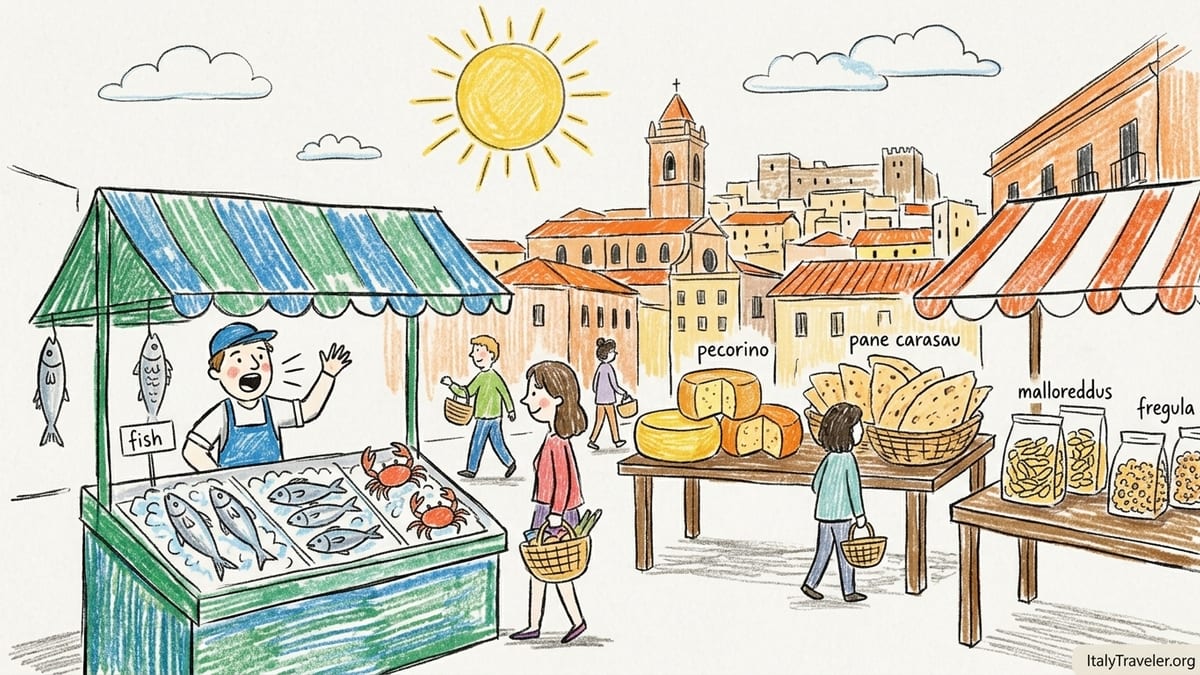
Finding San Benedetto at Piazza Nazzari
I started my food route at the heart of Cagliari’s everyday eating: the traders from San Benedetto, now operating in the temporary market at Piazza Nazzari. The original concrete market, opened in the late 1950s and long famous for its fish and produce, closed in March 2025 for a major overhaul. By October 22, 2026, the city had officially pushed the reopening of the renovated San Benedetto building into 2028, which means that for the next few years anyone looking for “the market” needs to head for Piazza Nazzari instead of the old hall.
The temporary market looks nothing like the romantic images you find in old guidebooks. From the outside it is a functional, modern shed structure with metal cladding and a small paid car park. Inside, though, it feels like a compressed slice of Cagliari: fishmongers shouting out the morning catch, butchers with neat pyramids of pork sausages and locals queuing with shopping trolleys. Around mid-morning on a weekday the fish section can still be lively, with gleaming dorade and sea bass laid on ice, crates of small local clams and, when the season is right, thick-lipped mullet that will later become bottarga.
What struck me first was how particular the offering is compared with mainland Italian markets I know. Here I saw mountains of pecorino sardo, often marked as dolce or maturo, not generic “pecorino romano.” A cheesemonger cut me a thin triangle of a semi-aged sheep’s cheese from the inland hills, with a price tag around 18 to 22 euro per kilo, explaining that this style is what many Cagliaritani grate over their pasta instead of Parmigiano. Nearby, a baker’s counter displayed sheets of pane carasau, so thin and toasted they looked almost too delicate to touch, selling at roughly 4 to 5 euro per large packet.
I did not sit down to a full cooked meal in Piazza Nazzari, because this is primarily a working market rather than a food court, but I did what locals do. I bought a still-warm wedge of focaccia layered with tomatoes and olives for about 2.50 euro, and a small piece of fresh pecorino. At a simple coffee counter beside the produce area I stood with office workers for an espresso priced around 1.20 euro, strong and quick, the barista sliding it across the counter without fuss. It felt honest, local and very different from the polished aperitivo culture by the marina.
Sardinian Flavors Beyond the Mainland Italian Template
Walking out of Piazza Nazzari with cheese, bread and a bag of ripe figs, I realized how little of this food I had seen in standard “Italian” restaurants elsewhere. Sardinian cuisine shares building blocks with the mainland but arranges them in ways that feel distinctly insular. Wheat is there, but in forms like fregula, tiny toasted semolina beads developed in the south of the island, and pane carasau, a twice-baked flatbread that originated in the central-eastern Barbagia as a way for shepherds to carry bread for weeks.
At the seafood stalls I watched an older woman pick through small clams destined for fregula cun cocciula, fregula with clams, which is a reference dish in Cagliari. Unlike spaghetti alle vongole in Naples or Rome, this dish is almost soupy, somewhere between pasta and stew. Fregula soaks up the clam liquor and fish broth, and in Cagliari it is often finished with a light dusting of bottarga, dried mullet roe typically grated finely on top rather than piled in thick slices.
Meat, too, has a different profile. Rather than the veal cutlets and beef tagliata I associate with central Italy, Cagliari’s butchers load their counters with pork cuts aimed at whole roasted suckling pig and thick fresh sausages scented with wild fennel. These sausages will later appear on mixed grills in simple trattorie. In the cheese section, the dominance of pecorino sardo over cow’s milk cheeses is a reminder that Sardinia’s interior has long been shepherd country, and those traditions still shape what appears on plates in the capital.
The market’s pastry counters also hinted at sweets I would meet again in cafés: golden seadas, large ravioli-shaped pastries filled with fresh cheese and fried before being coated in warm honey, and smaller ricotta-based tartlets called pardulas or casadinas, usually scented with lemon zest or sometimes saffron. These are not the creamy gelato cups that define dessert on much of the mainland. They are more rustic, still closely linked to rural households that made cheese first and then found ways to sweeten and preserve the excess.
Lunch in Marina: From Market Bench to Fregula with Clams
From Piazza Nazzari I walked downhill toward the waterfront and the Marina neighborhood, one of Cagliari’s historic quarters situated between Via Roma and the port. Here the mood changes completely. Neon signs advertise menus in multiple languages and waiters compare specials in English along Via Sardegna and its parallel streets. It is easy to stumble into a generic tourist restaurant, but among them survive long-running seafood trattorias that take their supply from the very traders I had just visited.
For lunch I chose a restaurant in Marina that clearly leaned on those market connections. At my table outside, shaded by an awning and with a partial view of Via Sardegna’s constant pedestrian flow, I ordered fregula with clams. The menu described it in Italian as fregola con arselle, priced around 17 euro. When it arrived the fregula grains were swollen but still had a pleasant bite, bathed in a brick-colored broth enriched with tomato and clam juice. The clams were small and sweet, each shell half-open like a tiny bowl, and on top there was a gentle snowfall of grated bottarga that added a savory depth rather than the assertive punch I had expected.
This was where Sardinia diverged most clearly from the mainland pasta habits I knew. Instead of spaghetti or tagliatelle, I was spooning up spoonfuls of tiny toasted pasta that behaved more like couscous. The flavor leaned into the sea, but the pecorino I had bought that morning emerged as a memory in the back of my palate, another reminder that sheep and sea share the stage here. The portion was generous without being excessive, and with a glass of local Nuragus white wine around 6 euro and cover charge, the total for lunch settled in the mid-20s. It felt fair for a dish that felt rooted in the city and not something that could have been served anywhere in Italy.
To round off the meal I skipped dessert and instead ordered a simple coffee and a glass of chilled myrtle liqueur, mirto, that appeared almost unbidden when the owner realized I had been asking many questions about the cooking. This small gesture, which would be rare in more formulaic tourist venues, reinforced that some Marina restaurants still see themselves as an extension of the market and the home table, even if they work in streets lined with souvenir shops.
Stampace: Pasta, Pork and Pane Carasau
In the afternoon I climbed gently into Stampace, another historic quarter that stretches up from the lower streets near the harbor toward the Roman amphitheater. The atmosphere here is less obviously touristic. Grocers spill crates of vegetables into the streets, and small family-run places are tucked into ground-floor spaces with a couple of outdoor tables. I chose one of these trattorie for a later lunch on another day, drawn in by a blackboard that listed malloreddus alla campidanese, Sardinia’s answer to ragù but worlds away from Bologna.
Malloreddus are short, ridged pasta shapes, sometimes translated as “Sardinian gnocchi” although they are made from durum wheat semolina rather than potato. The “alla campidanese” sauce originates from the Campidano plain that runs north of Cagliari and typically combines fresh pork sausage, tomato and a generous finish of grated pecorino sardo. My plate arrived steaming, the pasta clearly cooked to a firm al dente, the sauce clinging in every groove. The sausage was crumbled rather than sliced, with a gentle fennel note that I had already met in the raw links at the market.
The price for this main course hovered around 14 euro, and I paired it with a carafe of house red wine, likely a Monica or Cannonau blend, for roughly 8 euro for half a liter. The table was laid simply, with plain paper placemats, and the service was pragmatic but friendly, with the waiter checking in just enough to see if I wanted more bread. Here the bread was pane carasau rather than the soft rolls common on the mainland. It arrived in large, papery sheets that shattered when I broke them, ideal for scooping up the last streaks of sausage-rich sauce.
At this trattoria I finally tried seadas for dessert. The waiter rolled his eyes affectionately when I asked if they were “too heavy” after pasta, then brought one anyway, fried to order. It arrived bigger than my palm, the thin, crisp shell dusted with sugar, the inside filled with melted fresh cheese that balanced sour and milky flavors. Locally produced honey, likely from citrus groves outside the city, dripped slowly down the sides. At around 6 euro, it felt like good value for a dessert that would easily feed two after a full meal. It tasted rustic and deeply satisfying, with a savory backbone that sets it apart from the purely sugary desserts I often find on the mainland.
Villanova and the Lure of Culurgiones
From Stampace I crossed toward Villanova, a district of narrow lanes and pastel houses that climbs gently toward the foothills of the Castello quarter. Originally a gardeners’ district, Villanova still feels residential despite a growing number of design-conscious cafés and wine bars. It was here, in a small contemporary trattoria, that I finally ordered culurgiones, a dish that many visitors now associate with Sardinia generally but that historically belongs to Ogliastra, a mountainous area on the island’s eastern side.
The menu made that origin explicit, listing culurgiones d’Ogliastra and describing the filling as potato, pecorino and mint. When the plate arrived there were six large dumplings arranged in a shallow pool of simple tomato sauce, each one sealed with the distinctive spine-like braid that skilled cooks pinch along the top. The texture was closer to a filled dumpling than to ravioli, thicker and more substantial, and the filling combined creamy potato with salty cheese and the cooling edge of mint. It was unlike anything I have eaten in mainland Italy, where mint rarely appears in filled pastas.
Because culurgiones are not native to Cagliari itself, I appreciated that the restaurant framed them as a regional specialty rather than a generic “local” dish. The price, at around 15 euro for a plate, reflected both the labor involved in hand-shaping each piece and the fact that they have become a kind of culinary emblem for Sardinia. I chose a glass of Vermentino di Sardegna at roughly 6 euro, its herbal notes matching the mint and pecorino in the filling.
Villanova also became my preferred place for a late afternoon snack and coffee. In one bakery-café I ordered pardulas, small tartlets made with ricotta and semolina, scented with lemon zest. They were displayed on a tray beside other traditional sweets, and at about 1.50 to 2 euro each they made an easy way to taste something local without committing to a full dessert course at a restaurant. The texture was slightly grainy from the semolina, and the flavor more about cheese and citrus than sugar. Sipping a macchiato beside elderly locals chatting in Sardinian, it was easy to forget I was only a few hundred meters from the city’s main shopping streets.
Markets vs Marina Restaurants: Service, Price and Atmosphere
Experiencing both the Piazza Nazzari market and the restaurants of Marina and the other historic quarters highlighted the trade-offs involved in eating in Cagliari. At the market I paid the lowest prices and had the most direct contact with ingredients. My bag from one morning’s shop, with a packet of pane carasau, a wedge of pecorino sardo, seasonal fruit and some olives, came to under 15 euro and could have fed two people for lunch. Service here is transactional but not cold; traders are happy to explain differences between pecorino styles or offer a taste of a particular salami if you show genuine interest.
In Marina, especially along Via Roma’s side streets, prices step up and English menus appear. The fregula with clams I ordered for lunch cost more than it would have if I had cooked it myself from market ingredients, but I was also paying for a seat, a tablecloth, and someone else’s skill in timing the pasta and shellfish. There are places that feel more like tourist machines, where the menu jumps restlessly from pizza to burger to paella. I chose restaurants with shorter menus, a clear focus on seafood and a strong local wine list, and in return I felt the prices were fair rather than inflated.
Stampace sat somewhere in the middle. Trattorie there tended to offer hearty portions of malloreddus, grilled Sardinian meats and seadas at prices that felt aimed at residents rather than cruise passengers. Portions were large enough that ordering antipasti, primo, secondo and dessert would have been overkill; I usually chose one substantial pasta and a dessert or coffee. In Villanova, where the dining scene leans more contemporary, presentation becomes more refined and prices inch up a little, especially for carefully plated culurgiones and curated wine flights. Yet even there, the overall bill rarely felt disproportionate to the quality and context.
If I had to define one basic difference between the relocated market and the Marina restaurants, it would be this: at Piazza Nazzari you are inside Cagliari’s food supply, buying from the same people who serve the city’s chefs, while in most restaurants you are at the end of that chain. Both experiences are valuable, but they answer different questions. The market tells you what Cagliaritani cook and eat at home. The restaurants show you how a professional kitchen interprets those same products for a mix of locals and visitors.
What Food Tours and Guides Add in Cagliari
Given all this, I was curious about the growing number of food tours operating in Cagliari. Many now explicitly include the Piazza Nazzari market rather than San Benedetto, reflecting the ongoing closure of the original hall. A typical small-group tour lasting three to four hours, often scheduled in the morning, includes a guided walk through the market, tastings of cheese, cured meats and olive oil, then a progression through the historic quarters with stops for pane carasau, a small portion of fregula or malloreddus and a final sweet like seadas or gelato. Prices in late 2026 often fall in the 60 to 80 euro per person range, including food and a couple of glasses of wine.
I joined one such tour one morning to see whether it could show me anything I had not already found alone. The most immediate benefit was translation and context. At the market, my guide introduced me to a fishmonger who explained in detail which clams work best in fregula cun cocciula and how to spot fresher bottarga. At a cheese stall, the guide coaxed the vendor into letting us compare a young pecorino sardo with a much older wheel that locals grate over pasta. Without a guide, I might have hesitated to ask for these side-by-side tastings.
The guide also navigated etiquette questions that are hard to intuit as a visitor. For example, at a busy market bar, regulars knew to pay only after finishing their coffee, while at another stand payment was taken upfront. On my own I would have watched and copied others; with the guide, those unwritten rules were quietly explained. During tastings of malloreddus and culurgiones in Stampace, she pointed out how the tomato sauces tended to be slightly lighter and more aromatic than the slow-cooked ragù you might expect in Emilia-Romagna, and how mint in culurgiones almost certainly signaled an Ogliastra origin.
Is a food tour essential in Cagliari? Not necessarily. Confident travelers who speak some Italian and enjoy spontaneous exploration can piece together a rich experience alone, especially if they start at Piazza Nazzari and then follow their noses through Marina, Stampace and Villanova. But for visitors with limited time, mobility concerns or no Italian, a good guide compresses years of local knowledge into a single morning and steers you toward places that value repeat custom over quick tourist turnover.
A Half-Day and Evening Food Route in Cagliari
After several days in the city I settled on a food route that I would happily recommend to anyone with one afternoon and evening to spare for eating in Cagliari. Start late morning at Piazza Nazzari, arriving around 10:00 when the stalls are still well stocked but the morning rush has eased. Wander the halls and buy a packet of pane carasau, some seasonal fruit and a piece of pecorino sardo. This small picnic will cost around 10 to 15 euro depending on how much cheese you choose.
From there, walk down toward Marina and stop at a simple bar on or near Via Roma for an espresso or cappuccino, rarely more than 1.50 to 2 euro. Use this pause to watch the flow of port traffic and decide where you might want to eat later. Then climb into Stampace for a late lunch. Choose a trattoria with malloreddus alla campidanese on the menu and order that as your main dish, perhaps adding a mixed salad. Expect to spend around 20 to 25 euro including wine and water. After lunch, drift toward Villanova, exploring its small churches and side streets, and pause in an artisan bakery for a pardula and a coffee for roughly 4 to 5 euro.
In the early evening, as the light softens, circle back toward Marina for a seafood-focused dinner. Here is where you might choose fregula with clams if you have not already tried it, or a grilled fish of the day served simply with olive oil and lemon. If you are hungry, share an antipasto of local cured meats and cheeses, but be aware that portions can be generous. A full dinner for two with a starter, two pasta or main courses, a shared dessert like seadas and a bottle of Sardinian wine might come to 70 to 90 euro, depending on the restaurant’s level and your wine choice.
By the end of this half-day route, a realistic total spend for one engaged but not extravagant eater might land around 60 to 80 euro, including market snacks, coffee stops, a trattoria lunch and a more refined dinner. Vegetarians can navigate this path by leaning on pane carasau, vegetable antipasti, tomato-based pastas without sausage, culurgiones where the filling is cheese and potato, and salads. Those with shellfish allergies should ask carefully about broths used in fregula dishes and consider choosing meat-based pastas and grilled cheeses instead. Communication is easier where staff are used to visitors, particularly in Marina and the more contemporary spots in Villanova.
The Takeaway
My days in Cagliari taught me that this is not a city to rush through as “just another stop” on a broader Italian itinerary. Its food is shaped by the island’s relative isolation and by the tension between sea and interior. In Piazza Nazzari’s temporary market I watched that interplay in its raw form: clams and mullet roe beside stacks of sheep’s cheese and thin sheets of shepherds’ bread. In Marina’s seafood restaurants I tasted how cooks translate those ingredients into fregula that tastes of the sea and bottarga that brings depth without overwhelming everything else on the plate.
Stampace showed me the heartier side of the island: malloreddus alla campidanese rich with sausage and pecorino, plates of grilled Sardinian meats and seadas that blur the line between sweet and savory. Villanova, with its culurgiones d’Ogliastra and pastry counters loaded with pardulas, reminded me that Cagliari is the capital of a diverse island, not a closed world of its own. The city’s kitchens borrow from inland provinces but tend to signal those origins frankly, allowing you to taste the geography in each bite.
If your idea of Italian food centers on pizza, risotto and tiramisu, Cagliari will gently redraw your map. Here, pane carasau stands in for bread baskets, pecorino sardo answers the question of grated cheese, and desserts speak a language of ricotta, honey and olive oil. I left with the sense that Cagliari does deserve time specifically for its food, not because it is flashy or endlessly inventive, but because it is deeply itself. Eating here connects you to an island that has long fed itself from its own waters, hills and fields.
When San Benedetto eventually reopens in its renewed form sometime after 2028, the city will likely have an even more impressive stage for its culinary identity. For now, the relocated market at Piazza Nazzari, the trattorie of Marina and Stampace, and the cafés of Villanova already offer more than enough to justify at least a couple of days dedicated purely to eating and drinking. If you are willing to look past the obvious tourist menus and spend time where locals actually shop and eat, Cagliari quietly reveals itself as one of the most distinctive food cities in Italy.
FAQ
Q1. Is the historic San Benedetto Market open in its original building?
The original San Benedetto building is closed for renovation and, as of late October 2026, its reopening has been pushed into 2028. The active food market is in the temporary structure at Piazza Nazzari, so visitors should go there instead of the old hall.
Q2. Where can I experience a local market atmosphere in Cagliari right now?
Head to the relocated San Benedetto traders at Piazza Nazzari. The setting is more modern and functional than the old hall, but inside you will find busy fishmongers, butchers, bakers and cheese stalls serving everyday shoppers from across the city.
Q3. What Sardinian pasta dishes should I prioritize in Cagliari?
Look for fregula with clams in seafood-focused restaurants, malloreddus alla campidanese in traditional trattorie and culurgiones d’Ogliastra in places that emphasize regional specialties. Each highlights a different facet of Sardinian wheat and sauce traditions.
Q4. Are culurgiones originally from Cagliari?
No. Culurgiones are particularly associated with Ogliastra, a province on Sardinia’s eastern side. Many Cagliari restaurants now serve them, but good menus usually acknowledge their Ogliastra origin.
Q5. What makes Sardinian bread and cheese different from what I find on the mainland?
Pane carasau is a very thin, crisp flatbread baked twice, created for shepherds to carry on long journeys. Pecorino sardo, made from local sheep’s milk, dominates cheese boards and is often used for grating instead of Parmigiano or Grana from the mainland.
Q6. How much should I budget for a day of eating well in Cagliari?
A realistic budget for market snacks, coffee stops, a trattoria lunch and a seafood dinner is around 60 to 80 euro per person, depending on wine choices and whether you share dishes. Spending less is possible if you self-cater more from the market.
Q7. Is Cagliari a good city for vegetarians?
Yes, with some planning. Vegetarians will find pane carasau, vegetable antipasti, cheese plates, tomato-based pastas without sausage, culurgiones filled with potato and cheese, salads and ricotta-based sweets like pardulas. Purely vegan options are more limited but growing in the newer cafés.
Q8. I have a shellfish allergy. Can I still enjoy Cagliari’s food?
It is important to communicate your allergy clearly, especially because dishes like fregula may be cooked in mixed fish or shellfish broths. Focus on meat-based pastas, grilled meats, cheeses, breads and vegetable dishes, and ask staff directly about ingredients and cross-contamination.
Q9. Are food tours in Cagliari worth the cost?
For travelers with limited time or no Italian, a guided food tour can be worthwhile. Guides provide context at the market, arrange tastings of products like pecorino sardo and bottarga and steer you toward places that value local repeat customers. Independent travelers can still have a rich experience exploring alone.
Q10. Does Cagliari deserve a visit specifically for its food?
In my experience, yes. Cagliari offers a distinct food culture shaped by the island’s sheep-farming interior and its surrounding sea, with dishes like fregula, malloreddus, culurgiones, pane carasau, pecorino sardo and seadas that you rarely encounter elsewhere. It rewards anyone willing to explore beyond generic tourist menus.