


Reaching Sardinia in 2026 has never been easier, but choosing between taking a ferry with your own car or flying and renting one on arrival is not always obvious. Routes, dates, vehicle size, cabins, fuel, tolls and even pet policies all change the real cost. This guide brings together verified routes and recent price ranges to help you compare ferries and flights side by side, so you can see when the ferry genuinely saves money and when flying is clearly the better buy.
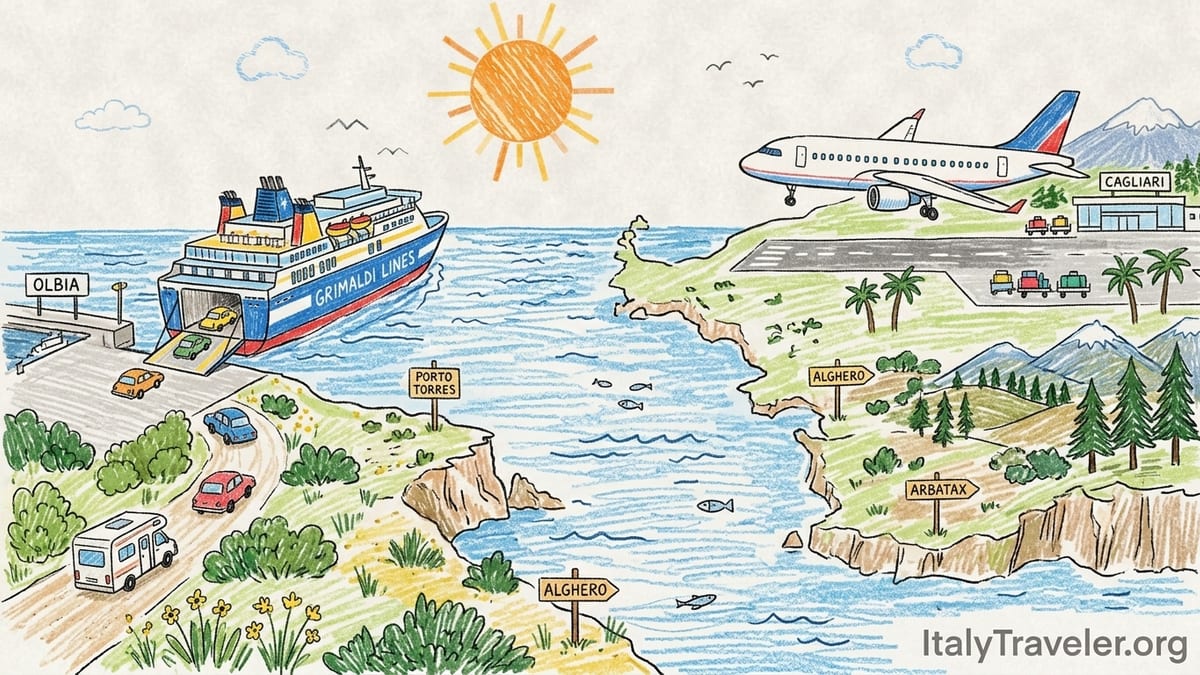
Sardinia’s Sea Gateways and Airports at a Glance
Sardinia has five main ferry ports that act as sea gateways from mainland Italy, France and Corsica: Olbia and Golfo Aranci on the northeast coast, Porto Torres in the northwest, Arbatax on the east, and Cagliari in the south. Ferries from Genoa, Livorno, Civitavecchia, Naples, Toulon, Nice and Corsican ports connect to these harbors with overnight and daytime sailings, mostly operated by Moby, Grimaldi Lines, GNV and Corsica Ferries, sometimes also Tirrenia. Routes are concentrated between late spring and early autumn, but several Livorno, Genoa and Civitavecchia connections operate all year.
The main airports mirror this geographic spread. Olbia Costa Smeralda serves the Costa Smeralda and much of the northeast, with a strong summer schedule of Italian and European leisure flights and some winter links to Rome and Milan. Cagliari Elmas is the island’s busiest airport overall, with year round domestic routes under the Sardinian territorial continuity scheme and an expanding international network each summer. Alghero Fertilia covers the northwest, with summer links to various European cities and Italian hubs; in the off season, frequencies drop but core domestic routes are maintained.
For a typical trip, mainland travelers will usually compare Genoa, Livorno or Civitavecchia ferries against flights into Olbia or Cagliari. Those coming from northern Spain, southeastern France or Corsica often look at Porto Torres, Golfo Aranci or occasionally Arbatax. The key is to match your arrival port or airport with your Sardinian base: a ferry into Olbia is ideal for the northeast coast and La Maddalena, while Cagliari or Arbatax work better for the south and central east coast, and Porto Torres or Alghero for the northwest.
Understanding where each route actually lands you, and how that relates to your final destination on the island, is essential before you begin comparing ticket prices. A cheap flight to Cagliari may still mean three hours of driving if you are staying near Santa Teresa di Gallura, and likewise an attractive ferry to Porto Torres makes less sense if your holiday home is south of Villasimius.
Key 2026 Ferry Routes and How They Really Operate
For 2026, the backbone of Sardinia’s ferry network remains the routes from northern and central Italy. Livorno to Olbia is served year round by Moby and Grimaldi Lines, with crossing times of about 6 and a half to 8 hours depending on the ship and whether you travel by day or night. From Genoa, long overnight crossings serve Olbia and Porto Torres, typically taking 9 to 12 hours. These northern routes are heavily used by drivers coming from France, Switzerland, southern Germany and northern Italy.
Civitavecchia, the port of Rome, offers crucial central Italian links. Year round departures connect Civitavecchia with Olbia and Porto Torres, usually as night sailings. In addition, Grimaldi’s faster Civitavecchia to Olbia service operates specifically for the 2026 summer season between 1 June and 30 September, with daytime and overnight departures in this window only, not in winter. This seasonal pattern is important: a schedule that suits a July road trip might simply not exist in November.
Further south, Naples maintains a long route to Cagliari that combines passengers and freight, appealing to travelers from Campania and southern Italy who want to bring a car. Crossing times are around 13 to 15 hours and departures are less frequent than on northern routes. On the international side, Corsica Ferries connects Toulon and Nice with Porto Torres in summer, and Toulon plus the Corsican port of Propriano with Golfo Aranci on certain dates. These French and Corsican options are especially useful for those driving from Marseille, Lyon or beyond, or combining Sardinia and Corsica in a single itinerary.
Arbatax, on the eastern coast, sees a handful of seasonal ferries, for example combined Civitavecchia to Arbatax and Cagliari routes operated in peak months. Because schedules and even operators can shift slightly each year, anyone planning beyond the core Livorno and Genoa links should always verify the specific 2026 calendar on the operator’s booking engine before committing to accommodation.
What Your Ferry Ticket Actually Buys: Deck, Seats, Cabins and Vehicles
The base fare you see for a Sardinia ferry typically refers to a single person in “deck passage,” which means the right to be on board without any reserved seat or bed. You can stay in lounges, sit in cafeteria areas or, in good weather, out on deck. This is the cheapest way to cross, especially on daytime sailings, but it is not ideal for an overnight trip when you need real rest, or if you are traveling with children or older relatives.
The next tier is a reserved recliner or “poltrona” seat. This is a numbered airline style or coach style seat in a quiet lounge. Adding a reserved seat can change a rock bottom night sailing into something much more practical for a long crossing from Genoa or Civitavecchia, without the cost of a cabin. On a typical July night departure from Livorno to Olbia, for example, upgrading from deck to seat for a single adult might add roughly 20 to 40 euros each way, depending on the operator and demand at the time of booking.
Cabins provide private beds, a shower and WC and a door that locks, which transforms a ferry into something close to a simple overnight hotel. Options usually include inside cabins without windows, outside cabins with a porthole, and sometimes “deluxe” or suite categories. For a family of four in July, a four berth inside cabin can easily add several hundred euros to a return booking once summer demand peaks, but it brings privacy, secure space for luggage and a predictable rest experience. Solo travelers and couples sometimes choose a cheaper inside cabin and trade the sea view for a lower price.
Vehicles are priced separately from passengers and can dramatically change the fare. Ferries categorize vehicles by length and height brackets, with higher fares for long estate cars, SUVs, vans and motorhomes. A standard hatchback or compact car under 4.5 meters in length will usually pay considerably less than a 7 meter motorhome or a high 4x4 with a roof box. Motorcycles are generally the cheapest vehicle category and can be a smart compromise for solo travelers who want the freedom to tour Sardinia without paying full car tariffs.
Real 2026 Cost Drivers: From Mainland Fuel and Tolls to Sardinian Roads
The apparent price difference between ferry tickets and flights hides several cost layers that only become clear when you add everything up. On the ferry side, headline fares shown on comparison sites usually start with deck passage for one adult without a vehicle. As soon as you add a car, even a small one, the fare can double or triple on busy July and August dates. Then cabins, pets, meals and priority boarding all build on that base. For 2026 examples published by Italian and Sardinian travel agencies, a July weekend return Livorno to Olbia for a car plus two adults often falls somewhere in the mid hundreds of euros, but can push higher when a private cabin is included both ways.
Mainland driving to the port also costs money. If you are coming from Milan to Genoa or Livorno, you will pay Italian motorway tolls, which can add several tens of euros to a return trip, plus fuel at Italian average prices. National figures for 2026 suggest petrol and diesel both around the mid 1 euro per liter range, with fluctuations. That means a round trip of 600 to 800 kilometers to and from the port can cost another 70 to 120 euros in fuel alone for a typical family car, more for heavy vehicles or higher speeds.
Within Sardinia itself there are no motorway tolls. The island’s main roads, including the north south “Carlo Felice” route between Cagliari and Porto Torres and the fast roads towards Nuoro and Olbia, are free to use. However, you still need to budget for fuel, parking in resort towns or at popular beaches, and normal vehicle wear and tear. Distances are longer than they appear on the map: a cross island drive from Olbia to Cagliari takes around three hours, and reaching more remote areas of the Barbagia or Ogliastra regions can involve mountain roads that use more fuel and time.
On the flight side, published examples for 2026 show that low season return flights from mainland Italy to Sardinia can be found from around 60 to 150 euros, while peak August dates can climb to the 200 to 400 euro range for economy tickets, particularly on Fridays and Sundays. Adding a checked bag often costs extra on low cost carriers. Once in Sardinia, car rental for a week in July can range from roughly 300 to 700 euros for a standard compact, depending on supplier, exact dates, and how early you book. You may also face cross border or one way fees if you collect and return in different locations, or higher charges for young drivers.
Comparing Scenarios: July vs September and Different Traveler Profiles
To make these trade offs more concrete, it helps to imagine real 2026 return trips for common traveler types using the same dates. Consider two adults living near Florence planning a July holiday on the northeast coast, and comparing a return ferry Livorno to Olbia with car versus flying and renting. If they drive to Livorno, park overnight on the ferry with their own car, and book an inside cabin both ways, their total might include at least a few hundred euros in ferry fares for two adults plus car and cabin, along with perhaps 40 to 60 euros in fuel and tolls for the round trip to the port. They save on car rental but commit to an overnight on the ship and longer total travel time.
The same couple flying from Florence or Pisa to Olbia in July may find return airfares for two in the mid hundreds of euros including at least one checked bag. On arrival, a seven day compact rental with standard insurance could add another few hundred euros, along with fuel on the island. When you break it down per person, the difference between ferry plus own car and flight plus rental may narrow considerably once all costs are counted. In some published comparisons, flying and renting comes out slightly more expensive overall, but not dramatically so for two adults travelling without bulky sports equipment.
Now consider a family of four from northern Italy in early September, traveling with substantial luggage for a two week stay near San Teodoro. On the Grimaldi or Moby Livorno to Olbia ferries, a return fare for a family of four with car and an inside cabin each way can price surprisingly competitively compared with four airline seats and two weeks of car rental. Some September fare examples show that, outside the August peak, cabins and car transport drop in price, while flights also become cheaper but car rental remains a major cost. For this profile, the ferry often wins financially, especially if children’s fares are discounted and the family values the ability to pack sports gear, beach equipment and food in the car.
For travelers with substantial luggage such as cyclists with their own bikes, divers with full gear or musicians with instruments, the ferry becomes even more attractive. Airlines will often charge multiple sports baggage or oversize luggage fees on top of the base fare, and some items require special handling. A private car on the ferry lets you load everything once at home and unload in Sardinia, without weighing each bag at the airport. However, the environmental and time cost of a long car and ship journey compared with a short flight may still matter to some, so the decision is not only about money.
Pets, Comfort, Accessibility and the Human Side of the Journey
Pets are an important factor for many Sardinia travelers. Ferries generally accept dogs and cats for an additional fee, and several operators now offer pet friendly cabins or designated pet areas where animals can stay with their owners rather than in onboard kennels. There are still rules about leads, muzzles for some breeds, and where animals can go, so checking the specific 2026 policy of your chosen operator is essential. Taking a pet by ferry can be more comfortable than subjecting them to an aircraft hold, but it also lengthens the journey and may be stressful if the weather is rough.
Air travel with pets is possible but governed by stricter airline and airport regulations, and some carriers limit animals to the cargo hold except for small pets that fit under the seat in cabin. Costs can be significant, and in summer, some airlines restrict pet transport on very hot days. For older or anxious animals, the familiarity of your own car and a cabin where they can stay with you on a ferry may outweigh the longer door to door time.
Seasickness is another human consideration. Although modern cruise ferries on routes like Genoa to Porto Torres or Livorno to Olbia are large and relatively stable, the Tyrrhenian Sea can still be choppy. Travelers prone to motion sickness should choose mid ship cabins on lower decks where movement is reduced, travel outside stormy shoulder season weeks when possible, and consider medication. If you know you suffer badly from seasickness, a short flight into Cagliari, Olbia or Alghero with a stable drive afterwards may be physically easier than spending a night on board in rough weather.
Accessibility also differs between ferries and flights. Ships have lifts, wheelchair accessible cabins and assistance services, but there may still be ramps, gangways and long walks during embarkation and disembarkation. In some ports drivers and passengers are asked to remain in vehicles in the garage decks until docking is complete, which can be uncomfortable for people with mobility or respiratory issues. Airports and airlines, by contrast, are generally well set up for passengers with reduced mobility, with assistance that runs from check in to aircraft seat and then into the arrivals hall, though everything must be arranged in advance. For elderly relatives, the choice between a single short flight and a long overnight sailing plus driving is often a question of stamina and comfort more than pure price.
Cancellations, Flexibility and One Way Rentals
Both ferries and flights to Sardinia come with cancellation rules that can materially affect the true cost. Cheap ferry tickets in 2026 often come as non refundable or with change fees that increase close to departure. Flexible fares cost more but allow date changes for a supplement. If you are booking months ahead for the peak July or August period, it may be worth paying slightly more for flexibility, especially when travel insurance only covers certain causes for cancellation.
Airlines serving Cagliari, Olbia and Alghero have their own fare structures. The lowest economy tariffs can be changeable only with a fee, while mid and higher fare classes permit free or low cost changes. With the growth of territorial continuity services on core routes like Cagliari to Rome or Milan, residents receive protected fares, while non residents see more dynamic pricing. From a visitor’s perspective, a modest premium for a flexible ticket on a key Saturday flight in July can be cheap insurance if your plans are not completely fixed.
One way rentals and open jaw itineraries add another layer. A classic example is driving from Milan to Genoa, taking a ferry to Olbia, touring the island, then flying back from Cagliari to Rome or another mainland city and leaving the car behind. If you use your own car, this implies a long return drive later to collect it or accept a purely circular route. If you rent a car in Sardinia, one way drop fees between airports like Olbia and Cagliari or Alghero vary; some promotions waive them, others charge an extra daily or flat fee. These surcharges can tilt the balance back towards a simple round trip, whether by ferry or air.
Weather related disruption affects both options. Strong mistral winds and storms can delay or cancel ferries, especially in late autumn and winter shoulder seasons. Airlines also cancel or divert flights, but the shorter sector length to Sardinia makes weather windows easier to manage. Anyone planning tight connections, such as landing at Olbia and catching an onward long haul flight the same day, should build in buffer time or overnight stays, whatever mode they choose to reach the island.
Why Adding a Car and Cabin Makes Ferries Look Expensive
Many travelers are surprised when a Sardinia ferry quote that started at an attractive price suddenly feels expensive once a vehicle and cabin are added. The reason is that each component scales with demand. On the most popular July and August sailings between Livorno or Civitavecchia and Olbia, or Genoa and Porto Torres, vehicle decks and cabin inventories are limited. When many Italian and European families all want to sail with their cars on the same weekends, operators apply yield management similar to airlines, so the price for each additional element rises as departure fills up.
A stripped back July night crossing for a solo backpacker on deck from Livorno to Olbia might be available from a modest double figure sum each way when booked early. The same departure for two adults, a car and an outside cabin can climb into the high hundreds of euros for a return once port fees and environmental surcharges are included. A seven meter motorhome instead of a compact car can raise the total further, sometimes approaching or exceeding what a budget hotel plus car rental plus flights would cost for the same period.
Cabins are also sold per unit, not per passenger. A family of four in one four berth cabin pays roughly the same cabin supplement as two adults in a private two berth, so the per person cost for families is actually better value. For couples, by contrast, the cabin portion of the fare can look proportionally high. This is one reason ferry travel often shines for families, small groups and anyone with a vehicle full of luggage, but looks less appealing for solo or minimalist travelers who can easily fly with hand baggage.
It is worth comparing not just absolute totals but what you receive for the money. An overnight ferry with a cabin effectively includes a bed, private bathroom and transport across the sea in one price, while a flight usually delivers only the transport. If you would otherwise pay for an airport hotel or lose a full day in transit, the ferry’s higher sticker price may conceal some savings in accommodation and daytime holiday time.
A Simple Calculator: When Ferries Win and When Flying Is Better
To bring all of this together, you can build a simple comparison using a few real world inputs. Imagine three cases on comparable July 2026 dates: two adults from central Italy, a family of four from northern Italy, and a pair of travelers from Germany with substantial luggage. For each, total up all line items for both options: ferry with own vehicle, and flights plus Sardinian car rental.
For ferries, your calculator line items would include: fuel and tolls to the departure port and back; return ferry fare for all passengers; vehicle surcharge based on length and height; chosen accommodation type on board (deck, seat or cabin); pet fees if relevant; and basic onboard spending such as one meal per crossing. For flights, include: fuel or train tickets to and from your departure airport; return airfares with any necessary checked baggage; airport parking or transfer costs; full car rental price in Sardinia including insurance and any one way or cross border fees; and fuel for planned island driving.
In broad terms, ferry travel to Sardinia in 2026 tends to save money in three typical situations. First, families of three or more in one vehicle, especially in shoulder season months like June and September, often find that a car plus cabin on routes like Livorno to Olbia or Genoa to Porto Torres undercuts the combined cost of four airfares and a long car rental. Second, travelers carrying bulky or multiple items of luggage, from windsurf boards to camping gear, usually find freight and sports baggage charges on airlines so high that driving and sailing is cheaper and simpler. Third, residents or repeat visitors who already own a suitable car and are happy to book early can lock in lower ferry and cabin prices long before summer.
Flying is clearly more convenient, and sometimes cheaper, in other scenarios. Solo travelers or couples with only hand baggage, particularly those who can travel midweek outside August, often find that a short flight to Olbia, Cagliari or Alghero plus a compact rental car for a few days costs less and takes far less time than a long drive and overnight sailing. Visitors from outside Europe connecting through major hubs also generally choose flights into Sardinia to avoid complex changes between intercontinental flights and ferry ports. And anyone with very limited holiday time will appreciate that a two hour flight and short drive can place them on the beach the same day, whereas a ferry based itinerary usually consumes at least one extra day in each direction.
To use this calculator style approach in practice, write two simple columns and assign realistic figures for your own origin, dates and group size. Adjust the ferry side first by trying different ports and times; then experiment on the flight side with different departure airports and rental durations. The option that aligns with your budget, luggage, tolerance for long journeys and desire to have your own vehicle rather than a rental will usually emerge clearly once every cost is written down.
The Takeaway
Choosing between a Sardinia ferry and a flight in 2026 is not about one universally “better” mode, but about matching real routes, real dates and real costs to your style of travel. Ferries from Livorno, Genoa, Civitavecchia, Naples and French or Corsican ports offer the freedom of bringing your own car, generous luggage and even pets, at the price of longer journey times and fares that climb sharply when cars and cabins are added in high season. Flights into Olbia, Cagliari and Alghero deliver speed and simplicity, with competitive fares outside August, but make you dependent on rental cars and baggage allowances.
For couples with light luggage and limited holiday time, flying almost always wins for convenience and often for cost, especially on shoulder season weekdays. For families, groups, and travelers carrying sports or camping gear, the ferry frequently becomes the smarter buy once car rental and bag fees are fully counted, particularly in June and September when both ferry and cabin prices soften. Looking at total door to door cost, including fuel, tolls, parking, rental insurance and the value of your time, is the most reliable way to decide.
If you are planning Sardinia for summer 2026, start by choosing the part of the island you want to explore, then shortlist the most logical ferry ports and airports for that region. From there, build two complete price scenarios for your exact dates: ferry plus own vehicle and flights plus car rental. With that side by side comparison in hand, the financial and practical winner for your particular trip will usually become obvious long before you step on board or check in at the gate.
FAQ
Q1. Is it cheaper to take the ferry to Sardinia or to fly in 2026?
For couples or solo travelers with light luggage, flying plus renting a car is often similar in price or cheaper than driving to a port and taking a ferry, especially outside August. Families or groups bringing a car and traveling in June or September frequently spend less overall with the ferry once they factor in rental car costs, baggage and the value of having their own vehicle.
Q2. Does Grimaldi’s Civitavecchia to Olbia ferry run all year?
No. Grimaldi’s enhanced Civitavecchia to Olbia service for 2026 operates seasonally from 1 June to 30 September, with specific daytime and overnight crossings in that period. Outside those dates, you must use other year round services or different routes.
Q3. Which Sardinian port is best if I am staying on the Costa Smeralda?
Olbia and Golfo Aranci are the most convenient sea gateways for the Costa Smeralda and nearby resorts like Porto Cervo, San Teodoro and Palau. Ferries from Livorno, Genoa, Civitavecchia and French or Corsican ports serve these harbors, reducing your driving time on the island compared with arriving at Cagliari or Porto Torres.
Q4. Are there toll roads in Sardinia?
No, there are no motorway tolls in Sardinia. However, you will still pay for fuel, parking in towns and resorts, and normal running costs. Some mountain routes are slower and use more fuel than coastal or four lane roads, so journey times and consumption can be higher than you expect.
Q5. How far in advance should I book a Sardinia ferry with a car?
For July and August crossings from Livorno, Genoa or Civitavecchia with a car and cabin, booking several months in advance usually secures better prices and cabin availability. For June and September, there is more flexibility, but it is still wise to reserve early for weekend departures to avoid last minute fare increases or sold out vehicle decks.
Q6. What is the difference between deck passage, reserved seats and cabins?
Deck passage is the basic, cheapest option that lets you stay in public lounges or on deck without a reserved place to sleep. Reserved seats provide an assigned reclining chair in a quiet lounge, offering more comfort on overnight trips. Cabins are private rooms with beds and a bathroom, sold per unit rather than per person, and turn a long crossing into a night in a simple hotel.
Q7. Is it better to bring my car or rent one in Sardinia?
Bringing your car makes sense if you are a family or group traveling for at least a week, especially outside the August peak, and if you value extra luggage space or carrying sports gear. Renting in Sardinia is usually more convenient for shorter trips, solo travelers or couples, and for anyone living far from the ferry ports, since it avoids long drives and mainland tolls.
Q8. How do ferries and flights handle pets?
Ferries to Sardinia typically accept dogs and cats for an extra fee, and some offer pet friendly cabins or designated areas where animals can stay with you. Airlines allow pets subject to size limits, health requirements and carrier rules, often in the hold rather than the cabin. Costs and conditions vary, so always check your chosen operator’s 2026 policy before booking.
Q9. What happens if my ferry or flight is cancelled?
If your ferry is cancelled, operators normally offer rebooking on the next available sailing or a refund according to the fare rules, but same day alternatives may be limited in peak season. Airlines rebook passengers onto later flights when possible or refund according to the ticket conditions. Travel insurance that covers delays and cancellations can help with extra accommodation or transport costs in both cases.
Q10. Which airport should I choose: Olbia, Cagliari or Alghero?
Choose Olbia if you are staying in the northeast or on the Costa Smeralda, Cagliari for the south and much of the island’s interior, and Alghero for the northwest and nearby beaches. Check current 2026 schedules from your departure city, since each airport has a different mix of routes and some operate only seasonally.