


I learned the hard way that in Puglia, “train-accessible” and “easy without a car” are not the same thing. On 18 June 2026, I missed the 10:35 Regionale Veloce from Bari Centrale to Lecce after a delayed local train from Polignano a Mare rolled in at 10:33. That Bari to Lecce service, listed as RV 4399 in the summer timetable between 14 June and 12 December 2026, was the one that should have connected me to an afternoon bus towards Otranto. Instead, I watched taillights leave the platform, lost 1 hour 57 minutes waiting for the next fast regional, and ended up paying 65 euro for a last-minute taxi for the Lecce to Otranto leg when the bus connection did not wait. All the planning in the world could not change the basic reality: the trains in Puglia do a solid job between main cities, but once you try to push beyond those corridors into Valle d’Itria, Gargano, or remote Salento beaches, the final stretch turns into an obstacle course of sparse buses, rail-replacement coaches, and expensive taxis.
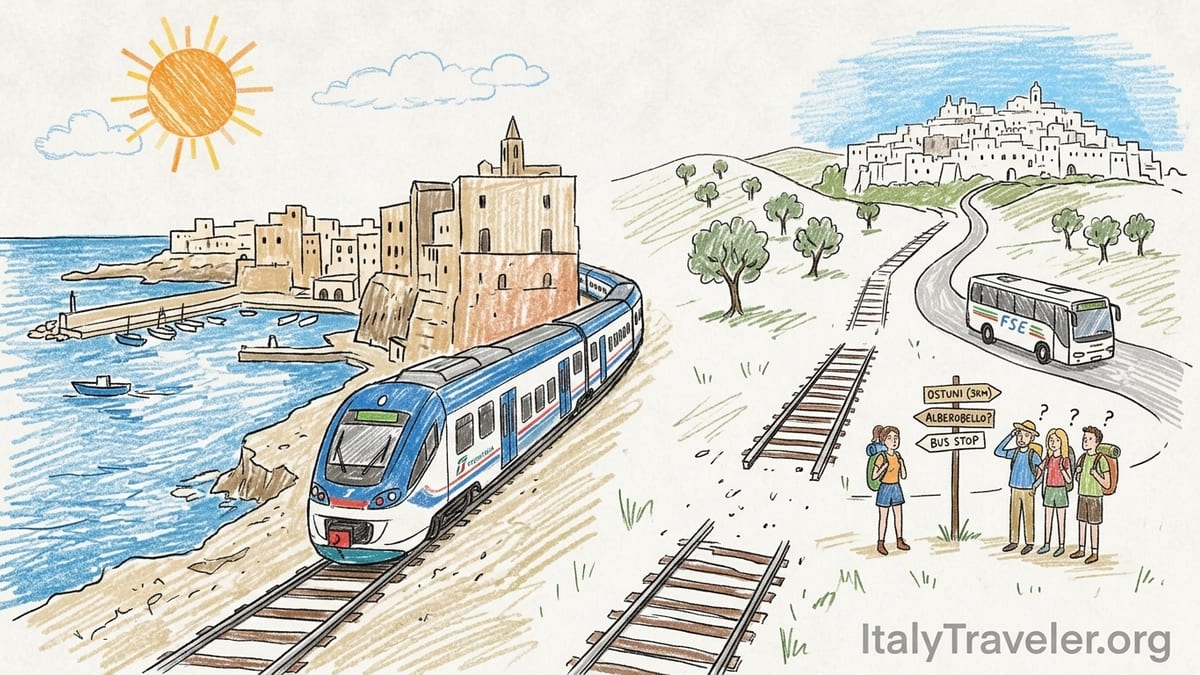
Why the Bari–Lecce Main Line Feels So Reliable
If your mental image of car-free Puglia is based on the route between Bari and Lecce, it is easy to feel optimistic. Trenitalia’s regional and Frecciarossa services between the two cities run frequently through the day, with typical journey times of about 1 hour 25 to 1 hour 45 minutes and base regional fares around 15 euro for a one-way ticket in 2026. Fast Regionale Veloce and a handful of high-speed Frecciarossa trains connect Bari Centrale with Brindisi, Ostuni and Lecce at intervals that work for both day-trippers and people moving between bases. On busy summer days you can stand on platform 5 in Bari and feel that trains are almost always coming.
These mainline services are part of what Trenitalia brands as the Salento Line, a set of regional connections that explicitly promote the idea of stepping off in Polignano a Mare, Monopoli, Ostuni and Lecce. The promotional material even notes that services are timed to coincide with bus links to beaches around Monopoli, Capitolo, Porto Cesareo and Otranto. In practice, I found the core claim largely true on the main axis itself. Trains from Bari to Polignano and Monopoli usually run at least once an hour in the daytime. Brindisi and Lecce see a dense mix of regional, Intercity and high-speed trains on a predictable pattern, and if you are staying in either Bari or Lecce, hopping between the two cities and the intermediate stops feels almost like using a suburban rail network.
This reliability is what lulls many travelers, myself included, into assuming the rest of Puglia will work just as smoothly without a car. You get used to walking into Bari Centrale, scanning the departure boards, and knowing that if one train is delayed, another appears within the next hour or so. That is not a trivial level of service for a largely rural region, and it genuinely underpins itineraries focused purely on Bari, Polignano, Monopoli, Brindisi and Lecce. Where the problem begins is when you try to stretch this comfort blanket over places that sit off the main spine, even when tourism boards describe them as “well connected.”
It is also worth stressing one subtle catch even here. The Salento Line information is declared valid “until 26 May 2026,” with seasonal adjustments and updated timetables after that. If you build a summer 2026 itinerary based on a spring information sheet, you can find a late-evening train or a convenient beach link truncated or shifted forward by 15 minutes, enough to break a connection. I watched two backpackers in Lecce discover that the regional they thought would get them back from Brindisi after dinner in August was no longer running that late, and they ended up racing for a bus and then pooling an 80 euro taxi.
Where Rail Works: Bari, Polignano, Monopoli, Brindisi and Lecce
Within the frame of Puglia’s realities, some places really are comfortably reachable without a car. Bari itself is the obvious base. Bari Centrale is the hub for Trenitalia’s national and regional trains, but it is also served by private and regional operators whose stations sit just across the square. From Bari, I have taken inexpensive regional services north towards Trani and south towards Polignano and Monopoli, plus the urban-style trains to Bari Palese airport. For a visitor staying near Bari Vecchia or Murat, walking 10 to 15 minutes to Bari Centrale and jumping on a train is straightforward, and much quicker than driving in circles hunting for parking.
Polignano a Mare and Monopoli benefit from being small coastal towns with stations within a reasonable walk of the historic centers. In Polignano, the walk from the station to the old town took me about 10 minutes along a slightly uphill road, entirely manageable with a carry-on suitcase. In Monopoli, it was closer to 15 minutes along pavements that are not charming but are practical. In both, the main beaches closest to the historic center are within walking distance. If your vision of a Puglia beach day is simply to spread a towel on a town beach before wandering back for gelato, the combination of train plus short walk works very well.
Brindisi and Lecce function as proper rail cities for travelers. Brindisi’s station leads fairly directly into the modern center, from where you can walk to the port and historic area. Lecce’s station sits about 15 to 20 minutes on foot from the baroque heart, and a local city bus runs right outside the station doors. As a base, Lecce excels for people who want to rely on trains: you can come in on a Regionale Veloce from Bari in the morning, wander its churches by afternoon, and then use secondary lines and buses to attempt excursions deeper into Salento. The trick is that “attempt” part. Lecce itself works brilliantly by rail; everything beyond requires more patience than the brochures imply.
If your week in Puglia is confined to Bari, Polignano, Monopoli, Brindisi and Lecce, plus perhaps a side trip north to Trani and Barletta, you can absolutely do it without a car. The regional trains are frequent, comparatively cheap, and as long as you build in 15 to 30 minutes of buffer for delays, connections are manageable. I have done that circuit twice, once as a solo traveler and once as a couple, with none of the stress that defined my later attempts to reach more remote corners.
Where Rail Falters: Valle d’Itria, Gargano and Remote Salento Beaches
The trouble arrives the moment you introduce names like Alberobello, Locorotondo, Ostuni’s hilltop centro storico, Gargano’s coastal towns, or beaches like Baia dei Turchi and Torre Lapillo into your car-free dreams. Valle d’Itria is a good example. On the map, Alberobello and Locorotondo look like short hops from Bari. In conversation, people say “You can just take the train.” In practice, the relevant services are run by Ferrovie del Sud Est, a regional operator whose timetables are less frequent and whose lines weave through inland towns rather than along the main coast. The trains between Bari and Alberobello can involve changes and long waits in small intermediate stations, and in 2026, some stretches are still affected by infrastructure works that introduce bus substitutions.
One morning in May 2026 I set out from Bari to visit Alberobello and Locorotondo in a single day using only public transport. The outbound trip, including a change in Putignano, took just under 2 hours 15 minutes, but the return posed an unwelcome choice: leave early and be back in Bari before dinner, or wait for a mid-evening train with a 1 hour 20 minute gap between connections. I ended up waiting at a windswept platform, watching as a dozen confused visitors approached the small ticket office to ask whether the train they had seen in online planners was actually running. Several stretches of the FSE network have ongoing works that are not always reflected cleanly in international planning apps, and staff confirmed that on weekdays certain segments operated by bus instead of train.
Gargano is even more stark. Names like Vieste, Peschici and Mattinata carry a particular romance, and images of dramatic cliffs and turquoise water lure many to plan car-free trips. Yet Gargano’s rail network is limited to Ferrovia del Gargano lines that stop inland, and the last legs out to the seaside towns are handled by regional buses with seasonal timetables, early cut-off times and weekend reductions. On a July scouting trip, I met a German family in Foggia who had tried to reach Vieste without renting a car; by the time their late-running Intercity arrived, they had missed the only afternoon bus that would have taken them all the way, and instead had to pay 120 euro for a taxi van from Manfredonia to make it to their holiday apartment before dark.
Remote Salento beaches show a similar pattern. Places like Santa Maria di Leuca, Porto Cesareo, Torre Lapillo, Punta Prosciutto or the coves north of Otranto might be technically “reachable” by a multi-step chain of train plus local bus plus seasonal shuttle, but the margin for error is tiny. A 15-minute train delay between Bari and Lecce can cause you to miss the bus from Lecce to Gallipoli; a crowded summer bus from Gallipoli onwards to a specific lido might fill and leave you standing. Without a car, your beach day becomes a long logistical exercise built around bus timetables that often run more for residents’ school and work schedules than for tourists’ desire to linger over lunch.
Understanding FSE Rail Replacement Buses in 2026
In 2026, Ferrovie del Sud Est still operates significant sections of its network with rail-replacement buses because of ongoing infrastructure upgrades. A regional mobility update in September 2026 confirmed that bus substitutions continue on key stretches such as Casarano to Gallipoli and Maglie to Otranto, at least on weekdays. This matters far more for car-free travelers than a simple “bus instead of train” line in a timetable might suggest. It affects where you actually board, how long your journey takes, and what it feels like to do it with luggage and kids in tow.
On the Lecce to Gallipoli route, for example, trains typically reach as far as Casarano, where passengers continuing to Gallipoli must transfer to a bus. In reality, the bus stop may not be on the same platform or even directly adjacent to the station building. In Casarano, I was directed out to a curbside sign near the station forecourt, along with about twenty other passengers. The transit itself stretched what would be a roughly 35-minute rail leg into more than 50 minutes once loading, traffic and intermediate stops were counted. The ride on narrow local roads also meant standing passengers and suitcases rolling in the aisle.
The Maglie to Otranto connection works similarly. From Lecce, an FSE train will carry you as far as Maglie. There, a bus takes over to Otranto along regional roads. For a solo traveler with a small backpack, the inconvenience may be acceptable. For a couple with rolling suitcases, it becomes a test of patience when drivers ask you to stack luggage in the front stairwell because there is no dedicated luggage area. For families, the lack of guaranteed seat reservations on the bus segment and the need to fold strollers can turn what appears on the timetable as a modest journey into a stressful one. You can still reach Otranto without a car, but it feels less like a smooth rail experience and more like patching together components of a municipal bus system.
The underlying problem is coordination. Trenitalia’s mainline trains, the FSE inland network and local bus operators all operate within a region-wide transport plan, but as my missed connection in Bari illustrated, timetables are not lovingly aligned to guarantee seamless transfers. A delay of 10 or 15 minutes on the Bari to Lecce line can easily cause you to miss an FSE departure towards Gallipoli or Maglie, and the next service may not leave for an hour or more. International route planners often present these as clean chains with five-minute or ten-minute connections. On the ground, those margins are far too thin for comfort in a region where delays are not rare.
The Myth of “Arriving in Town”: Stations, Hilltops and Beaches
There is another layer of misalignment that only becomes obvious once you arrive. Reaching “Ostuni” by train does not mean you are anywhere near the whitewashed hilltop town and its old streets. Ostuni station sits roughly 3 kilometers from the historic center, on a busy road at the bottom of the hill. There is a local bus that climbs from the station up to the centro storico, and in principle it meets certain arriving trains. In practice, I have stepped off a mid-morning Regionale from Bari to find no bus in sight, just a cluster of visitors staring at a timetable posted in a glass case. On one visit, with no bus for nearly 40 minutes and the sun already harsh, three of us shared a taxi; the short ride cost 15 euro, a jarring contrast to the modest train fare.
The same disconnect appears in many coastal towns. Taking the train to Monopoli or Polignano does land you within walking distance of town beaches, but that is not the case everywhere. In the Lecce area, for instance, the city is inland. Even if you ride comfortably into Lecce by train, nothing about that arrival gets you to the sand at San Cataldo, Torre dell’Orso, or the more famous Baia dei Turchi. You then depend on regional buses that often operate seasonally, with limited evening services and reduced Sunday timetables. If you assume a northern European level of integrated rail-to-beach transport, you may be surprised by how little information is available on the platform itself about onward bus options.
Porto Cesareo is a classic trap for car-free planners. Promotional material for the Salento Line mentions connections towards Porto Cesareo, and regional authorities support a Porto Cesareo Link bus service that runs in summer, connecting Lecce with the resort and some beaches nearby. Yet the key phrase is “in summer” and the exact operating dates change year by year, often starting in June and tapering off in early September. When I tried to verify the 2026 dates, the available public documents outlined planned funding and routes but did not yet list day-by-day timetables. Without those, it would have been reckless to promise readers that a given 19:30 bus from Porto Cesareo back to Lecce will exist on a specific date in late September 2026.
The Otranto Link service follows a similar pattern. It is designed as a seasonal shuttle that connects Otranto and some nearby coastal spots with rail and coach arrivals. Official material promotes its synergy with the Salento Line, yet for 2026 the English-language marketing simply states validity “until late summer,” with details pushed into downloadable timetables issued closer to the start of the season. The result for a traveler is uncertainty. You can reasonably plan on an Otranto Link bus operating in high summer between mid-June and late August, but you cannot stake a once-a-year holiday on a shoulder-season trip that relies on a service whose exact final operating day you cannot confirm more than a few weeks ahead.
Otranto, Gallipoli, Porto Cesareo and Santa Maria di Leuca in Practice
Comparing Lecce’s connections to Otranto, Gallipoli, Porto Cesareo and Santa Maria di Leuca highlights the limits of car-free planning. Otranto is, on paper, the easiest. From Lecce you can travel by FSE train to Maglie, then connect to a rail-replacement bus to Otranto, or take a direct regional bus in summer. In shoulder seasons, the chain becomes more precarious. On my June 2026 attempt, the bus from Maglie ran about 20 minutes late, and the return service left Otranto earlier than some timetable aggregators indicated, forcing an unplanned early departure from the seafront.
Gallipoli offers a similar mix of promise and frustration. The train tracks still reach into Gallipoli, but with the Casarano to Gallipoli segment often served by bus due to works, a straightforward Lecce to Gallipoli train ride becomes at least one transfer and a series of uncertainties. I met a couple from the Netherlands who had booked accommodation in Baia Verde, just outside Gallipoli proper, on the assumption that once they reached the town by train, they could walk or catch a frequent local bus. In reality, buses out to the beaches were limited outside the core summer window, and they spent two of their six days paying for short taxi hops that added about 20 euro each way to their beach outings.
Porto Cesareo illustrates the importance of reading beyond glossy brochures. When the Porto Cesareo Link runs at full summer strength, it can indeed make a day trip from Lecce manageable: about a one-hour bus ride each way, with some runs extending towards Torre Lapillo. If you time a morning departure around 9:00 and a late-afternoon return around 18:00, you can enjoy a reasonable six to seven hours on the coast. Outside that high season window, the Link either runs less often or not at all, and you are left using sparse regional buses that locals primarily use for commuting. On one September visit, I watched a Spanish family in Lecce station discover at the ticket counter that the frequency of Porto Cesareo buses had dropped for the shoulder season; they pushed their planned beach day into a weekday to catch the only workable combination of departure and return.
Santa Maria di Leuca, the literal end of the road at Italy’s heel, is the place that finally convinced me I would not plan another Puglia trip without at least some rental-car days. To reach it from Lecce by public transport, you stitch together a train or bus to Gagliano del Capo or another inland town and then a further bus down to the cape. The journey can easily stretch to 3 hours each way when timetables do not align, and evening returns are notoriously thin. When I quizzed locals in Lecce about doing it without a car, most shook their heads and suggested an organized day tour or renting a car for a day or two. That informal advice aligns with my own experience: Santa Maria di Leuca is technically reachable, but not in a way that feels relaxed or resilient to delays.
Seven Days in Puglia: Car-Free, Hybrid and With a Car
To understand the trade-offs, I sketched three realistic seven-day scenarios: one entirely by public transport, one with a few targeted rental-car days, and one assuming a car throughout. All assume travel in late June 2026, when most summer services are running but timetables have not yet slipped into August chaos. Prices and durations use current 2026 information where available, but specific bus timetables and seasonal shuttles may still change slightly year to year, so think of them as ballpark rather than precise promises.
The fully car-free option works best for solo travelers or couples who value simplicity over range. You might base yourself three nights in Bari and four nights in Lecce. From Bari, you can take day trips by regional train to Polignano and Monopoli on one day, and to Trani or Barletta on another. Regional train fares around 5 to 8 euro each way make these inexpensive. From Lecce, you might attempt one day trip to Otranto using the train plus bus combination, and another to Gallipoli. That gives you a solid slice of coast and two baroque cities without ever touching a steering wheel. Your cost profile emphasizes train tickets and perhaps one or two unavoidable short taxi rides, such as from Ostuni station up to the historic center if you choose to stop there on the way between Bari and Lecce.
A hybrid week that mixes public transport and two or three rental-car days opens far more possibilities, especially for couples and families. One version I tested has four nights in Bari using only trains and city walking, then three nights in a countryside stay near Locorotondo or Martina Franca with a rental car. You can collect the car at Bari airport or city on day four, drive yourself to Valle d’Itria, and suddenly places like Alberobello, Locorotondo, Cisternino and rural masserie become easy hops rather than multi-connection slogs. With a car, you can also reach Ostuni’s historic center directly, stopping at the station only if you need to drop someone onto a train. For families with children, having the car for the middle segment of the week is a pressure valve that removes the anxiety of missing a bus or hauling suitcases on and off rail-replacement coaches.
The all-car week suits groups and families who want to chase far-flung beaches in Gargano or southern Salento but comes with headaches of its own, notably parking, ZTL restricted zones in historic centers, and higher costs. You might start in Bari, collect a car immediately and drive to Vieste or Peschici for a couple of nights, then cut back through Valle d’Itria before ending near Lecce. The upside is maximal freedom: sunrise swims at secluded coves, easy grocery runs, and no need to think about shuttle dates. The downside is that you lose the calmer rhythm of rail travel and must pay closer attention to road rules, especially ZTL camera enforcement in places like Ostuni and Alberobello. For many readers, the hybrid plan represents the best compromise: use trains where they are strong, then rent a car specifically for the days when you need to bridge the gaps the network does not cover well.
A Practical Four-Day Car-Free Itinerary Focused on Bari and Lecce
If you are determined to stay car-free, a focused four-day itinerary centered on Bari and Lecce offers excellent value for your time and money. On day one, arrive in Bari and settle into a hotel near the old town or within a 15-minute walk of Bari Centrale. Spend the afternoon exploring Bari Vecchia, the seafront promenade and the food markets. Without a car, your movement is delightfully simple: everything is within walking distance, and you can safely ignore parking signs and traffic patterns that baffle new arrivals.
Day two becomes your coastal tasting plate. Take a morning Regionale train from Bari to Polignano a Mare, a ride of roughly 30 minutes at a fare in the range of 3 to 4 euro. Walk from the station into town and down to the cliffside viewpoints. After lunch, hop back on a train for the short trip to Monopoli. Spend the afternoon between its old harbor and the central town beach, then return to Bari in the evening by train. None of this day requires advance reservations, though in high season it is wise to buy your return ticket from Monopoli to Bari earlier in the day to avoid queues at the station machines.
On day three, travel from Bari to Lecce on a mid-morning Regionale Veloce, ideally one of the fast services that make the trip in about 1 hour 40 minutes for around 15 euro. If you want to see Ostuni’s historic center, you can break your journey, but accept that you will need to pay a taxi from the station to the top of the hill and then back again, which can easily add 30 euro or more to the stop. Once in Lecce, walk or take a local bus from the station into the baroque core and spend the rest of the day on churches, piazzas and aperitivo. Staying centrally makes it easy to stroll back to your accommodation at night without needing any more transport.
Day four is your only ambitious excursion day, and it is where you feel the constraints of being car-free. You can choose between Otranto and Gallipoli, but I would not recommend trying to do both in one day using public transport. From Lecce, go to Otranto via the FSE train and rail-replacement bus or a direct bus if it is operating in summer. Plan for at least 1 hour 30 minutes each way and build in a buffer to catch the return service. Alternatively, head to Gallipoli via the Lecce to Casarano train and Casarano to Gallipoli bus, or via a direct bus if one matches your schedule. In both cases, accept that you will have limited time on the beach and in the old town compared to what a driver might manage. Return to Lecce for a final evening and then depart the next morning by train or coach.
The Takeaway
After repeated trips to Puglia in 2025 and 2026, my conclusion is blunt. I would not plan a region-wide Puglia itinerary entirely around trains and buses again. Bari, Polignano, Monopoli, Brindisi and Lecce reward rail-based travel, and a concentrated week among those cities and nearby towns can be delightful without a car. You enjoy good-value regional trains, walkable centers, and the relaxed rhythm of station platforms. But the moment you try to weave in Valle d’Itria’s countryside, remote Salento beaches, Santa Maria di Leuca or Gargano’s promontory, the cracks in the network widen into fissures. Rail-replacement buses on routes like Maglie to Otranto and Casarano to Gallipoli in 2026 add friction, uncertainty and physical discomfort that most holidaymakers do not factor into their plans.
What a car buys you in Puglia is not simply speed but control over your margins. It lets you decide when to leave a beach or hillside town, rather than racing for the last bus of the day. It frees you from worrying about whether the Otranto Link or Porto Cesareo Link will run into late September, and from dragging luggage across hot parking lots to reach temporary bus stops. For solo travelers with high tolerance for uncertainty, a well-planned rail-and-bus itinerary can still work, especially if you concentrate on the mainline towns. For couples and families, especially those eyeing Valle d’Itria trulli or distant coves in Salento, I now recommend either a hybrid plan with two or three car days or the strategic use of small-group tours and occasional taxis to bridge the last kilometers.
Puglia remains one of Italy’s most seductive regions, but the marketing phrase “easily reachable by train” obscures as much as it reveals. Reaching a station called Ostuni does not mean you have arrived at the postcard hilltop, and rolling into Lecce says nothing about how you will stand in the shallows of Baia dei Turchi or Torre Lapillo. In my future itineraries and in my advice to readers, I draw a sharp line. For Bari to Lecce, for Polignano and Monopoli, and for a compact introduction to Puglia’s cities, car-free travel is a joy. For Gargano, Valle d’Itria’s rural corners, Porto Cesareo, Santa Maria di Leuca and the farthest Salento beaches, a rental car, a carefully chosen tour, or a budget line for taxis turns frustration back into freedom.
FAQ
Q1. Can I visit Puglia for a week without renting a car at all?
Yes, if you focus on Bari, Polignano a Mare, Monopoli, Brindisi and Lecce, plus perhaps Trani or Barletta. Regional trains cover these well, and you can add one or two cautiously planned excursions from Lecce to Otranto or Gallipoli using Ferrovie del Sud Est services and regional buses.
Q2. Is Alberobello easy to reach by train from Bari?
Not really. Services to Alberobello run on the inland Ferrovie del Sud Est network, usually with at least one change and relatively sparse frequencies. The journey often takes around 2 hours each way. It is possible but not convenient for a relaxed day trip, especially if you also want to see Locorotondo or Martina Franca on the same day.
Q3. How close is Ostuni’s train station to the historic center?
Ostuni station is about 3 kilometers from the whitewashed hilltop old town. There is a local bus that links the station and the center, but services do not always align neatly with arriving trains. Many visitors end up taking a taxi, which can cost around 10 to 15 euro for the short uphill ride.
Q4. Are the Otranto Link and Porto Cesareo Link services reliable in 2026?
They operate seasonally and are generally reliable during the core summer period, but exact 2026 operating dates and timetables are confirmed closer to the season. You can assume reasonable coverage from mid-June to late August, but should not plan late spring or late September trips around them without checking updated regional transport information shortly before you travel.
Q5. How do FSE rail-replacement buses affect travel to Otranto and Gallipoli?
Because of ongoing infrastructure works in 2026, sections like Maglie to Otranto and Casarano to Gallipoli are often operated by bus instead of train. These buses may depart from different spots than the station platforms, take longer than the equivalent rail journey, and offer limited luggage space. The result is longer and less predictable trips, particularly challenging for families or travelers with large suitcases.
Q6. Is it realistic to reach Santa Maria di Leuca by public transport from Lecce?
It is technically possible using a combination of train or bus to an inland town such as Gagliano del Capo followed by a local bus, but journey times often exceed 3 hours each way and evening services are limited. For most travelers, a rental car for a day or an organized tour from Lecce is a more practical and less stressful option.
Q7. What are typical train fares between Bari and Lecce in 2026?
Regional trains between Bari and Lecce usually cost around 15 euro one way in second class, with journey times of about 1 hour 25 minutes to 1 hour 45 minutes depending on whether you take a fast Regionale Veloce or a slower regional service. High-speed Frecciarossa services cost more but can save some time on certain departures.
Q8. For families, is a hybrid itinerary with some car days worth it?
For families, mixing public transport with two or three rental-car days is often the most comfortable approach. You can rely on trains between Bari, Polignano, Monopoli and Lecce, then rent a car to explore Valle d’Itria, distant beaches around Gallipoli or Porto Cesareo, or Santa Maria di Leuca. This reduces stress around missed buses and gives you flexibility at nap and meal times.
Q9. Are taxis a viable backup if I miss a connection?
Taxis can rescue a missed bus or train connection, but they are expensive over rural distances. Short trips such as Ostuni station to the old town may cost around 10 to 15 euro, while longer coastal transfers, like from Manfredonia to Vieste or Lecce to Otranto at short notice, can easily exceed 60 to 80 euro. They are best treated as an emergency option rather than a routine part of a car-free budget.
Q10. If I only have four days, should I bother trying to see Gargano or Santa Maria di Leuca without a car?
With only four days and no car, it is wiser to focus on Bari, Polignano, Monopoli and Lecce, plus perhaps one carefully chosen excursion from Lecce to either Otranto or Gallipoli. Gargano and Santa Maria di Leuca are too time-consuming and fragile to reach by public transport in such a short window, and you will enjoy your trip more by not overreaching.