


On a Saturday in late July 2026, at 10:15 in the morning, I found myself in a slow, sweltering crawl on Via Martiri di Dogali, the main access road into Polignano a Mare. I had left Bari at 8:45, naively thinking that a 35-minute drive would secure me a calm beach day at legendary Lama Monachile. Instead, I spent nearly another 35 minutes hunting for a parking space before giving up and paying 2.50 euros per hour in a blue-line street bay just beyond the historic center walls. By the time I walked down to the famous cove with my beach bag and water shoes, it was clear: the pictures had not prepared me for how cramped, uncomfortable and relentlessly busy Polignano’s signature beach really is.
Lama Monachile: The Reality Behind the Postcard
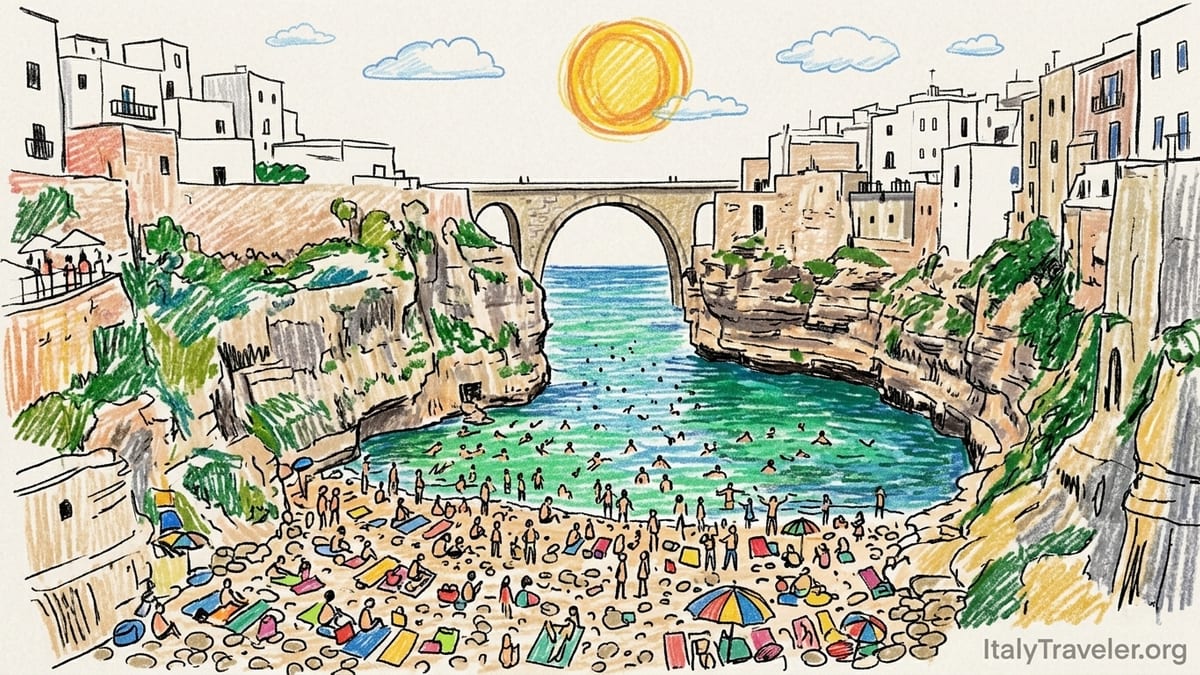
Lama Monachile is almost unavoidable if you have ever typed “Puglia beaches” into a search bar. Official Italian tourism describes it as a tiny cove carved into a former riverbed, flanked by high limestone cliffs with Polignano’s white houses perched above. The cove, also known as Cala Porto, sits directly beneath the Roman bridge and the edge of the historic center, which is why it stars in so many drone shots and sunset reels. It is, without question, visually spectacular. It is also, in high season, one of the least relaxing places I have tried to spread a towel.
When I arrived on that July morning, the pebbles were already carpeted with bodies. The official Italia.it description is unambiguous about its limitations: Lama Monachile is very small and “always particularly crowded, especially in summer,” with a recommendation to arrive early if you want a spot at all. That was not a stylistic flourish. Standing on the bridge, I could see there was no continuous patch of empty stones larger than a square meter. Families were wedged between strangers’ bags, elbows brushing as people navigated to the shoreline. The space that looks so open from above is, at ground level, a narrow funnel of rock.
The geography that makes Lama Monachile so photogenic is exactly what makes it uncomfortable. It is a narrow pebble cove at the end of a deep limestone ravine, hemmed in by vertical cliffs and concrete platforms on each side. There is no broad shelf of sand. Instead, the beach slopes quite quickly from the back wall down to the sea, which means that lying flat on a towel often puts your head lower than your feet and your belongings sliding downhill. The white limestone amplifies the sun, while the cove’s shape traps heat and sound. Every shout, Bluetooth speaker and ice-cream vendor’s call ricochets between cliffs.
Visually, the effect is extraordinary. From the Belvedere su Lama Monachile or the terraces near Via Roma you get a cinematic view: emerald water, stone bridge, cliff houses and the ribbon of white pebbles below. Yet what the photographs cannot show is how aggressively busy it becomes by mid-morning in summer, and how little functional space exists for a traditional “beach day” in the sense of spreading out, reading a book and forgetting the world for a few hours.
Pebbles, Shade and Getting into the Water
The first thing you notice underfoot at Lama Monachile is the texture. The beach is made of polished white pebbles and small stones, beautiful to look at, punishing to walk on. Local tourism sites and guides make a specific point of recommending water shoes for this beach, not as an optional extra but as a practical necessity if you have sensitive feet or children. Even with sandals, I felt each step on the slope, and the pebbles shift under your weight, making it easy to lose balance when carrying bags or guiding kids to the sea.
Shade is limited and contested. Because the cove is hemmed in by cliffs, there is some natural shadow early in the morning and late in the afternoon, as the sun moves behind the rock walls. In the core of the day between about 11:00 and 16:00, however, much of the beach is in direct exposure. Only narrow strips at the back or edges of the cove remain cooler, and these fill first with those in the know. There are no rows of umbrellas to rent here in the way you would find at nearby Capitolo or San Vito, since Lama Monachile is essentially a free urban cove rather than a serviced lido.
Entry into the water is beautiful yet awkward. The sea is clear and clean, with a quick drop-off that suits confident swimmers. The lack of sand, combined with the incline and rolling stones, makes the shoreline a slippery transition. I watched more than one visitor lose a flip-flop to a wave or stumble as they backed into the surf. Parents carried small children in their arms until knee-deep, simply to avoid tears. Once you are afloat, the view back to the cliffs and the bridge is unforgettable, but getting to that point involves some undignified shuffling.
Room for towels is the defining issue. My two-by-one-meter beach towel, which feels modest on most coasts, suddenly felt extravagant here. To lay it reasonably flat, I had to negotiate with a couple who shifted their bags ten centimeters and a family who moved an umbrella pole closer to their feet. This is not the place to bring a large parasol or a picnic spread. Official tourism advice and multiple regional guides consistently highlight that the cove is small, urban and extremely busy in summer. That is not a deterrent if you come for a quick swim or the view, but it fundamentally limits its usefulness as an all-day beach base.
Crowds, Facilities and the Price of a “Perfect” View
Crowd density at Lama Monachile on my July visit reminded me more of a city festival than a beach. By 11:30, people were hovering at the access point waiting for others to leave, scanning the pebbles for spaces. At peak weeks in August, local accommodation owners told me, it is common for the cove to feel full by 9:30 in the morning. The sense of being pressed in is heightened by the verticality of the cliffs and the bridge perched directly above, where yet more visitors lean over with cameras and phones.
Facilities are basic for such a famous place. There are no changing cabins on the stones themselves, and toilet access depends on nearby bars or public facilities on the upper level. Showers are limited and shared by a large number of users. Food and drink are technically close, with cafés and gelato shops just a few minutes’ walk away in the historic center, but that also means trekking up stairs in wet swimwear if you want more than the offerings of roaming vendors. Compared with many Blue Flag beaches in Puglia that pair clean water with well-organised services, Lama Monachile operates largely on the strength of its natural drama.
The economic side of the experience extends beyond the pebbles. When I priced accommodation for a notional two-night stay in mid-July 2026, a simple double room in Polignano’s historic center without sea view often ranged between about 180 and 230 euros per night. A room with a direct sea view or balcony perched over the cliffs frequently pushed that above 260 to 300 euros per night for the same dates. In contrast, in nearby Monopoli for identical July dates, well-reviewed guesthouses inside the old town or a short walk from sandy coves appeared starting closer to 130 to 170 euros per night, with only the higher-end sea-view suites matching Polignano’s premium.
That price differential might feel fair if the beach experience under your window were equally impressive in practical terms. Yet those expensive sea views in Polignano look down on a cove that you cannot comfortably use for long, and on cliffs where sunbathers cluster on concrete platforms rather than broad sand. If your priority is swimming and relaxing rather than a few dramatic photos, it becomes hard to justify the premium once you compare what those same euros buy in Monopoli or along the Capitolo strip.
Parking, Trains and the True Cost of Getting There
For day trippers, the friction often starts before you even see the water. In July and August, driving into Polignano requires patience. Approaches from both north and south along the SS16 feed into a limited network of town streets that were not designed for modern traffic. On my own July visit, once I exited the highway it took roughly half an hour to inch through roundabouts, wait at pedestrian crossings and circle side streets in search of a legal space.
Recent local parking guides highlight a few options. There is a free parking area near the train station, about a six-minute walk from Piazza Aldo Moro, which can be an excellent deal if you arrive early enough to claim a spot. Closer to the historic center, paid blue-line street parking dominates, with hourly rates that in 2026 are broadly in the 1.50 to 2.50 euro range depending on zone, plus potential service fees if you pay via apps such as EasyPark. Several private lots on the north and south sides of town, sometimes little more than fenced gravel fields, advertise flat day rates around 5 to 10 euros in high season, though convenience and shade vary.
Taking the train from Bari or Monopoli is, in many ways, the calmer and cheaper option. Regional trains on the Bari Lecce line connect Bari Centrale to Polignano a Mare in around 30 to 35 minutes, with standard tickets in 2026 around 3 to 4 euros one way. From Monopoli, the ride is even shorter, about 10 minutes, at roughly 1.50 to 2 euros. The station in Polignano is within walking distance of the historic center and Lama Monachile, making this a sensible choice if you plan only a few hours of sightseeing and a quick dip, rather than hauling umbrellas and coolers for a full beach day.
However, that calculation shifts once you factor in how little usable beach space Lama Monachile actually offers. If you are driving with the intention of swimming and staying all day, the fuel, tolls and parking charges feel poorly spent once you realise that other beaches along this coast provide infinitely more space and comfort for roughly the same transportation cost. The train, while very convenient, also locks you into Polignano’s limited options unless you plan a multi-stop itinerary. In short, the town is easier to access by public transport than many Puglian resorts, but its headline beach does not fully reward the effort if your goal is leisure rather than photography.
Historic Center, Viewpoints and Café Culture: Beautiful but Not Cheap
None of this is to deny the appeal of Polignano’s historic center. Its whitewashed alleys, archways and little balconies are genuinely charming. The viewpoint terraces along the cliffs, particularly near Piazza Vittorio Emanuele II and the statue of Domenico Modugno, deliver the famous angles on Lama Monachile and the caves. At sunset, the stone glows and the sea deepens to a rich blue-green that makes it obvious why advertising campaigns and film crews love this place.
Yet here, too, the gap between image and experience shows. On that same July Saturday, finding a café table with even a partial sea view meant either joining a waiting list or accepting a premium. A simple espresso at a bar on a side street near the old town might be 1.20 or 1.30 euros, in line with much of Puglia, but that same espresso at a terrace overlooking the cliffs could easily be closer to 2 euros. An aperitivo with a modest snack plate in a front-row bar commonly ranged from about 8 to 12 euros. Dinner in a mid-range restaurant in the center often started around 25 to 30 euros per person for a main and a drink, climbing rapidly with seafood platters and wine.
These prices are not extreme by broader Italian tourist-town standards, but they sit noticeably above what I paid in Monopoli, where similar quality restaurants a block back from the sea quoted closer to 18 to 22 euros for a main. In Polignano, you are paying as much for the cliff-edge address and proximity to that famous cove as for the food itself. The viewpoints are technically free, of course, but the pressure to monetise every angle is palpable, from souvenir stands under the archways to the line of people waiting to take the same photograph on the same balcony.
As an atmospheric place for an evening passeggiata, Polignano’s center works very well. As a base for a multi-day beach holiday, the combination of narrow streets, seasonal crowds, elevated prices and the underwhelming practicality of Lama Monachile makes it feel like a location optimized for short visits rather than extended stays.
Comparing Beach Convenience: Polignano vs Monopoli and Capitolo
To test whether I was simply expecting too much of a photogenic cove, I spent the following day in nearby Monopoli, an easy 10-minute train ride or 15-minute drive down the coast. The contrast was immediate. The shoreline here unfolds as a sequence of coves and small beaches right along the edge of the old town, followed by a long arc of sandy coast at Capitolo to the south. Regional tourism sources describe this stretch as one of the most appealing in central Puglia, and in 2026 Monopoli holds multiple Blue Flags for water quality and beach management.
Within walking distance of Monopoli’s historic center, small city coves like Cala Porta Vecchia feature predominantly sandy bottoms and shallow water, ideal for families or anyone who finds Polignano’s pebbles punishing. Behind the old town walls lie several more calette, such as Porto Bianco and Porto Rosso, where sandy patches alternate with low rocks. None of these are undiscovered secrets. In July they are busy, especially on weekends. Yet even at midday, I could find a square of sand large enough for a towel without asking three strangers to shift their belongings.
Further south, Capitolo offers exactly what Lama Monachile does not: width. Here, a string of beaches with fine sand and gradually sloping entrances to the sea runs for several kilometers. There are both free public stretches and organised lidos, so you choose between paying for sunbeds and umbrellas or simply bringing your own gear. The area is known locally for its beach clubs and summer nightlife, and on Friday and Saturday evenings these shores are very crowded. During midweek mornings, however, there is still enough space to walk along the waterline without stepping on someone else’s towel every few meters.
From a cost perspective, basing yourself in Monopoli while visiting Polignano as a day trip often makes more sense. For identical mid-July dates, entry-level hotels and guesthouses near Monopoli’s beaches typically come in below Polignano’s cliffside equivalents, especially once you factor in the premium charged for sea-view balconies in Polignano. The added benefit is that from Monopoli you can choose between sandy family-friendly coves, rocky inlets and beach clubs in Capitolo, all reachable by short drives, local buses or even bicycle, instead of relying on a single small pebble cove beneath a bridge.
Cala Incina, San Vito and Other Local Alternatives
If you still want dramatic rock formations and caves without being locked into Lama Monachile’s tight bowl, the coastline between Polignano and Monopoli offers several alternatives. Cala Incina, a rocky cove carved into the cliffs north of Monopoli, has a similar “fjord-like” profile, with a narrow inlet, stone walls and clear, deep water. It is popular with locals and featured in regional guides as a scenic swim stop rather than a sandcastle beach. There is very little flat space for towels, and access to the water involves clambering over rocks or jumping from low ledges. It is not less wild or less crowded in peak summer than Polignano, but it feels less like a stage set and more like a natural swimming hole.
To the north of Polignano, the small settlement of San Vito combines a picturesque harbor, an old abbey and several rocky and small sandy access points to the sea. Parts of this coastline have been recognized in Blue Flag listings alongside Polignano’s Cala Paura and other local sites, highlighting strong water quality. Here again, the experience is less about lying on a long beach and more about finding a patch of rock or small cove from which to swim and then retreating to a bar or trattoria overlooking the harbor.
None of these alternatives are empty in July and August. Local advice and traveler reports make it clear that Capitolo, San Vito and the Monopoli coves all become crowded during weekends and Italian holiday weeks. Parking can still be competitive at the more popular lidos, and sunbeds in fashionable beach clubs often start in the 25 to 35 euro range per day for two beds and an umbrella. The difference is structural rather than magical. These places offer either a longer coastline with multiple access points or a greater variety of sandy and rocky options, so the load is distributed. If one cove feels too packed, you walk or drive a few minutes to the next.
What they do not do is promise something they cannot deliver. A beach club at Capitolo sells you a package of services on a wide stretch of sand, usually with clear information on price and availability. Lama Monachile, in contrast, is often sold internationally as “Polignano’s beach” without a clear explanation that this “beach” is a small, steep pebble ravine that functions best as a quick swim stop and photo backdrop, not as the heart of a week-long seaside holiday.
Does Polignano Deserve a Day, a Night or Just a Stop?
After several visits over different seasons, my conclusion is that Polignano a Mare is absolutely worth seeing, but it is not automatically worth anchoring your Puglia beach plans around. On a sunny spring weekday in May or late September, when cruise buses are fewer and the cove less crowded, you can easily spend half a day here, wandering the alleys, enjoying a coffee in the piazza, photographing Lama Monachile from above and perhaps taking a brisk swim if conditions allow. Add a lingering lunch in a side-street trattoria and a late-afternoon train back to Bari or Monopoli, and you have a rich, compact excursion.
In high summer, particularly between late June and the end of August, Polignano functions better as a short scenic stop than as a multi-day beach base. A realistic pattern would be to arrive by mid-morning by train from Bari or Monopoli, walk through the center, admire the viewpoints, descend to Lama Monachile for a single swim and then retreat before the heat and crowds peak. From there, you could continue down the coast to Monopoli or Capitolo for the remainder of the day on a more expansive stretch of sand or in a calmer cove.
Would I personally book a whole week in Polignano in July, paying a premium for a sea-view room that looks down on an overcrowded pebble funnel? No. I would choose Monopoli as a base, with its mix of small sandy coves like Cala Porta Vecchia and the broader Capitolo beaches, and visit Polignano once or twice by train or car for its historic center, viewpoints and perhaps an evening aperitivo watching the cliffs glow. If I wanted dramatic rocks and caves in the water, I would reserve that for a separate boat trip article, since exploring Polignano’s grottoes is a different experience entirely from its land-based beach reality.
The core of my criticism is not that Polignano is unpleasant or unworthy. It is that the global hype around Lama Monachile as a beach destination often glosses over its physical constraints and urban context. Those spectacular photographs are real. So are the aching feet on pebbles, the scramble for towel space and the sense of paying extra at cafés and hotels for a view of a cove that many travelers, once they are actually standing in it, find surprisingly impractical for a traditional day at the sea.
FAQ
Q1. Is Polignano a Mare worth visiting if I am mainly interested in beaches?
Polignano is worth visiting for its views, cliffs and historic center, but if your priority is long, comfortable beach days, nearby Monopoli and Capitolo offer more practical sandy and mixed options with better space for towels and easier access to the water.
Q2. How crowded does Lama Monachile get in summer?
In July and August, Lama Monachile can feel effectively full by mid-morning, with pebbles almost entirely covered by towels and little personal space, especially between about 10:00 and 17:00.
Q3. Is it better to reach Polignano a Mare by car or by train?
For a short visit, the regional train from Bari or Monopoli is usually simpler and cheaper, avoiding summer traffic and the hunt for paid parking, which often costs several euros per hour near the center.
Q4. Are the pebbles at Lama Monachile really a problem?
The polished stones are beautiful but tough on bare feet, especially on the sloping part of the cove. Many local guides recommend water shoes both for walking across the beach and entering the water more securely.
Q5. How do hotel prices in Polignano compare with Monopoli for the same dates?
For equivalent mid-summer dates, basic double rooms in Polignano’s historic center often cost noticeably more than similar accommodation in Monopoli, and sea-view rooms in Polignano can attract a significant premium without improving actual beach convenience.
Q6. If I stay in Polignano, where is the best place nearby for a proper beach day?
Many visitors base in or near Polignano but drive or take transport to Capitolo’s long sandy beaches or to Monopoli’s coves, combining Polignano’s charm with more spacious, comfortable swimming spots.
Q7. Are alternatives like Cala Incina and San Vito less crowded than Lama Monachile?
They can be slightly less packed, especially outside weekends, but they are still popular in peak season. Their advantage lies more in offering different styles of rocky coves and small sandy inlets along a longer stretch of coast.
Q8. Can I spend a full week in Polignano without getting bored?
You could, especially if you plan day trips along the coast and inland towns, but for a week focused on swimming and sunbathing, most beach-oriented travelers find Monopoli or other Puglian resorts more convenient bases.
Q9. Is Polignano a good destination for families with small children?
Families enjoy the town, but Lama Monachile’s steep pebbles and quick drop-off into deep water can be challenging with toddlers. Shallow sandy coves in Monopoli or parts of Capitolo are generally easier with young kids.
Q10. How much time should I realistically allocate to Polignano a Mare?
For most travelers in summer, a half day to a full day is enough to explore the historic center, viewpoints and cove, with overnight stays better reserved for those who value atmosphere and cliff views over beach practicality.