


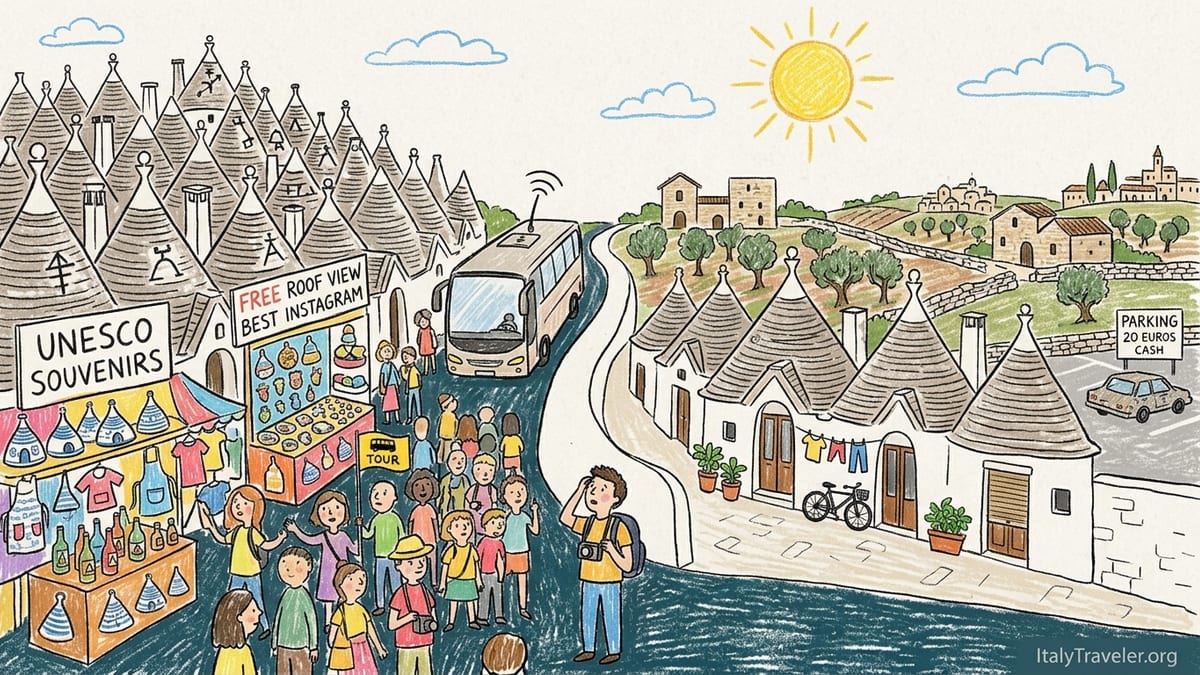
On 21 September 2026, I paid 20 euros to park in an unofficial gravel lot on the edge of Alberobello, spent 210 euros for a one-night stay in a “romantic trullo suite,” and then queued behind coach groups to shuffle down Via Monte San Michele. Within fifteen minutes I realised something uncomfortable: the UNESCO-listed town I had long imagined as a quiet labyrinth of white cones had been transformed into a dense, relentlessly commercial stage set. I was not just disappointed. I felt misled by the image of Alberobello that dominates Instagram and tourism marketing, and I began to question whether the trulli experience, as it is currently packaged, deserves its global fame.
From UNESCO Dream to Souvenir Arcade
I arrived in Alberobello late morning on a warm, cloudless Monday, expecting shoulder-season calm. Instead, the roads around the historic centre were already saturated with cars and tour buses. The official pay-and-display lots near Largo Martellotta were close to full, with hourly rates around 2 to 3 euros and daily caps edging towards 15 euros. Faced with a queue of campervans waiting to enter, I turned back and accepted the “help” of a man in a fluorescent vest waving drivers into a rough gravel lot behind a café. He asked for 20 euros in cash for day parking. There was no ticket, only a handwritten phone number and a shrug. It was an inelegant start to a visit that was supposed to be about heritage and architecture.
Crossing Largo Martellotta into the Rione Monti district, the first thing I saw was not an information board about dry-stone construction or the history of the town’s feudal origins. It was a long line of souvenir shops selling nearly identical ceramic trulli, fridge magnets, slogan aprons and limoncello in cone-shaped bottles. Several storefronts had price boards in English and Korean, and one trullo advertised “Free Roof Terrace – Best Instagram View” in large printed letters. The UNESCO designation, granted in 1996 to protect more than 1,500 traditional trulli concentrated in Rione Monti and Rione Aia Piccola, felt very far away from this aggressively commercial reality.
My rental trullo sat just above Via Monte Pertica, wedged between two gift shops. Online it was styled as an “authentic 18th-century dwelling,” with language about “sleeping under history” and “living like a local.” The nightly rate in late September was 190 euros before cleaning and service fees, bringing the total to just over 210 euros. For that price I expected at least a sense of domestic history. Instead, I opened the low wooden door into a single vaulted room that could have been anywhere in southern Europe: gray laminate flooring, recessed LED strips in the stone, a modern platform bed, a compact sofa and some generic coastal prints on the wall.
The carved stone niche that once held cooking pots now contained a kettle and capsules for a coffee machine. The only reference to the building’s history was a laminated sheet on the table that repeated two paragraphs from the official UNESCO description and added a line about respecting the neighbours. It was comfortable, yes, but it was also unmistakably a hotel room inside an old shell. The gap between the UNESCO rhetoric of “exceptional historic urban landscape” and the reality of sleeping in an expensive, heavily refurbished bubble was obvious from the first hour.
Rione Monti: A Heritage District Turned Open-Air Mall
It is important to say why Rione Monti matters before criticising what it has become. This hillside district contains more than a thousand trulli, the conical, dry-stone structures that made Alberobello famous. They were once modest homes and storage buildings for agricultural workers, built without mortar by corbelling layers of local limestone. UNESCO highlights Rione Monti and neighbouring Aia Piccola as the most complete surviving urban ensemble of this building type anywhere in the Mediterranean, an 11-hectare townscape where the density and homogeneity of the trulli are part of the site’s value.
Walking Rione Monti today, that density is still visually spectacular. Rooftops pile upon one another like a field of stone mushrooms, many capped by decorative pinnacles and painted symbols. From any slightly elevated spot the view is extraordinary: a rippling carpet of cones, chimneys and whitewashed walls. Yet at street level, the experience is dominated not by architecture but by commerce. It felt as though almost every second doorway had been converted into a shop. Many still retain the exterior form of a trullo, but the interiors are packed with mass-produced goods that could have been ordered from the same catalogue in Naples or Milan.
On Via Monte Nero, I counted several adjacent trulli that had been knocked through into a single space to accommodate a medium-sized souvenir supermarket. In another, an illuminated sign advertised “Trullo Wine Tasting” which, in practice, meant a quick pour of two local wines at the doorway in exchange for a strong push to purchase bottles and vacuum-packed taralli. Some sales staff were friendly and informative about local products, but there was little effort to connect the goods to the specific history of trulli life. The emphasis was transactional rather than interpretive.
The crowding amplifies the sense of being in a theme park. By early afternoon, Via Monte San Michele and Via Monte Pertica resembled a one-way pedestrian conveyor belt, with tour leaders raising coloured umbrellas and calling out meeting times. I heard more English, German and French than Italian. Short-term rentals have proliferated to meet this demand, something even local residents quietly acknowledge when they talk about the difficulty of finding long-term housing in the historic centre. That shift from residential to commercial and tourist use is exactly what UNESCO and conservation bodies warn about when they discuss tourism pressure on historic urban landscapes, yet in Rione Monti it already feels like a completed process rather than a creeping risk.
Rione Aia Piccola: A Residential Counterpoint Under Pressure
From Largo delle Fogge, a short climb leads not into more shops but into a different world. Rione Aia Piccola, historically more residential and still promoted by local authorities as a quieter counterpart to Rione Monti, retains a more lived-in character. Here the lanes twist between roughly 400 to 600 trulli, many of them still used as homes. Laundry hangs outside low wooden doors. Children ride bicycles along the cobbles in the late afternoon. A few discreet bed and breakfasts operate here, but they are scattered among dwellings that show signs of everyday life: stacked firewood, potted basil, a car bonnet propped open in a tiny garage.
The contrast is immediate. Where Rione Monti offers an almost continuous row of open doorways inviting visitors to browse or climb to a viewing terrace, Aia Piccola presents mostly closed façades. That is exactly what many travellers say they want: an authentic place where people still live rather than a frozen museum. Yet Aia Piccola is not immune to the pressures that transformed Monti. Conversion to short-term rentals is visible in the number of freshly restored cones with identical outdoor chairs and neutral decor glimpsed through windows. Some properties bear multilingual signs announcing that they are “historic suites.”
Local and UNESCO documents have, for years, flagged the risk that growing tourist numbers could push residents out of the core trulli districts by driving up prices and making everyday life impractical. The concern is not anti-tourism so much as a recognition that the “outstanding universal value” of Alberobello is tied to the continuity of traditional urban fabric, which includes residential use. Walking Aia Piccola in 2026, it is hard not to feel that this district is a last redoubt of that continuity, surrounded by a commercialised environment that could easily spill over the ridge.
As a visitor, I found my own feelings becoming uncomfortably conflicted. Part of me loved the quiet lanes and low doorways of Aia Piccola and wanted to explore every corner. Another part recognised that my presence, camera in hand, was part of the same demand that encourages owners to transform homes into holiday rentals. Unlike Rione Monti, where the heritage has already been monetised to the hilt, Aia Piccola still has something fragile to lose.
Why the Trulli Matter Beyond the Postcard
It is tempting, after an afternoon of dodging tour groups, to dismiss Alberobello as a pile of pretty cones. That would be unfair. The trulli matter for reasons that surface-level visits often obscure. Architecturally, they are the clearest surviving urban expression of a pre-modern dry-stone construction tradition built without mortar, using flattened limestone slabs corbelled inward to create a self-supporting dome. The walls are thick, often more than a metre deep at the base, with whitewashed plaster inside and out to improve reflection of light and regulate humidity.
Originally, trulli were modest structures for small landowners and agricultural workers. Many incorporated sub-floor cisterns to capture precious rainwater, a practical adaptation to the karst landscape of the Valle d’Itria. The stones were often taken from clearing fields, which means the very fabric of the buildings encodes the labour of making the land arable. Inside, a single large conical space might be subdivided with alcoves and internal arches, sometimes extended by attaching secondary cones for storage or additional sleeping spaces. This modularity is part of what allowed Alberobello’s trulli quarters to grow into dense neighbourhoods without a formal street grid.
The World Heritage designation recognises not a handful of picturesque houses but the collective townscape of more than 1,500 trulli clustered in Monti and Aia Piccola, plus a few significant stand-alone examples such as Trullo Sovrano and Casa d’Amore. Together they form an exceptional historic urban landscape, one that illustrates both vernacular ingenuity and a particular social history linked to feudal control and later struggles for autonomy. That narrative is complicated and not always romantic. It involves landlords encouraging dry-stone construction to avoid royal taxes on permanent settlements, and local inhabitants eventually petitioning the king to be recognised as a town in their own right.
Yet almost none of this complexity is visible if your only exposure to trulli interiors is through souvenir-shop doorways in Rione Monti. There, the original niches and alcoves are usually obscured by shelving. The heavy stone floors are covered with laminate or tile. The conical roofs are lit from below by colour-changing LEDs. At best you might glimpse an old loom or copper pot, used more as atmosphere than as part of any coherent story about rural life. The architecture is reduced to a decorative shell, its meaning flattened to a backdrop for sales.
Trullo Sovrano and Casa Pezzolla: Where Heritage Still Speaks
For a more grounded understanding of trulli life, two places stand out: Trullo Sovrano and the Museo del Territorio housed in the Casa Pezzolla complex. Both require modest entry fees yet deliver far more interpretive value than most of the free doorway peeks in Rione Monti.
Trullo Sovrano, located north of the main trulli hill, is the largest trullo in Alberobello and the only one with a true upper floor. Today it functions as a house museum, furnished to evoke the life of a prosperous family in the eighteenth and nineteenth centuries. When I visited, tickets were a few euros per adult, payable at a small kiosk before stepping inside. The interior immediately felt different from the commercial trulli nearby. Explanatory panels in Italian and English outlined the building’s history, and the rooms were arranged around practical functions: kitchen, bedroom, weaving area, storage, small oratory.
Standing beneath the tall cone, you can appreciate the engineering of the corbelled vault and see how the addition of a mezzanine and stairs made the most of the vertical space. The focus here is on interpretation rather than consumption. There is a small gift counter near the exit, but it is not the point of the visit. For the first time that day, I had a sense of how families actually inhabited these structures and how social status could be expressed within an ostensibly humble building tradition.
The Museo del Territorio in Casa Pezzolla, located near Piazza XXVII Maggio, occupies a cluster of interconnected trulli, reportedly around 15 cones joined together. This complex once belonged to a local doctor and now houses an ethnographic and territorial museum. The entry fee was slightly higher than at Trullo Sovrano but still reasonable by Italian museum standards. Inside, themed rooms presented tools, textiles, archival photographs and models explaining the evolution of Alberobello, the agricultural economy of the Valle d’Itria and the technical aspects of trullo construction.
What makes Casa Pezzolla particularly valuable is that it connects the architecture to broader patterns of life. One room, for example, is dedicated to the social rituals of the town, including religious festivals that still draw pilgrims each September. Another examines land tenure and the long relationship between peasants and feudal lords. Rather than treating trulli as picturesque curiosities, the museum situates them within a living landscape that extends to surrounding olive groves and masserie farmsteads. Compared with the superficial displays in many commercialised trulli, these two institutions justify their ticket prices because they add knowledge rather than simply providing another angle for photographs.
Sleeping in a Trullo: Charm, Compromises and Parking Headaches
One of the big selling points of Alberobello’s tourism push is the chance to sleep in a trullo. By 2026, dozens of properties in both Rione Monti and Aia Piccola, as well as on the fringes of the historic centre, advertise themselves as traditional cone-roof accommodation. My one-night stay in Monti, booked for a late-September Monday, captured both the charm and the compromises of this experience.
The positives are obvious. The conical ceiling above the bed gives a sense of intimacy, and the thick walls help keep out street noise once the day-trippers leave. When I returned from dinner around 10 p.m., the alleys were finally calm, with only a few couples wandering between softly lit cones. There is a real pleasure in stepping out of a low stone doorway with a morning coffee and seeing hundreds of trulli glowing in early light.
The drawbacks are less romantic. Space is limited, especially in single-cone conversions. My “suite” was, in reality, one main room with a bed, small table and a compact bathroom carved into what had likely been a storage alcove. The shower cubicle was narrow, and ceiling height varied from comfortable in the centre to head-bumping low at the edges. Temperature control is another challenge. The stone keeps interiors cool in summer heat, which is an advantage, but in shoulder seasons it can feel clammy without effective heating and dehumidification. My trullo had a modern air-conditioning unit mounted high on the wall, which hummed through the night.
Parking is perhaps the least discussed but most frustrating aspect of staying in the core districts. Most trulli do not have on-site parking, so guests rely on public lots or arrangements with private garages. Some accommodations offer paid parking a short walk away for an extra fee, which can add 10 to 20 euros to the bill. Lugging bags up steep lanes from an overcrowded lot does little to enhance the magic. When comparing costs with nearby towns such as Locorotondo, Cisternino or Martina Franca, where mid-range hotels often include easier access and more generous rooms, the value proposition of a trullo stay becomes questionable.
Alberobello vs the Valle d’Itria: Same Date, Different Experience
To understand whether Alberobello is overrated, it helps to look sideways rather than backwards. On the same late-September trip, using identical dates, I divided my time between Alberobello and three other centres in the Valle d’Itria: Locorotondo, Cisternino and Martina Franca, plus one night in a countryside masseria between olive groves.
In Locorotondo, a short drive from Alberobello, I stayed in a vaulted stone room inside the whitewashed historic centre for around 120 euros per night, breakfast included. The town is officially recognised as one of Italy’s most beautiful villages, yet its lanes in the early evening were pleasantly busy rather than overwhelmed. Ground-floor spaces held a mix of wine bars, artisan shops and actual homes, with fewer signs that the centre had been hollowed out into a pure tourist economy. Views from the town’s belvedere across a patchwork of trulli-dotted countryside were arguably more moving than any single rooftop vista in Alberobello.
Cisternino offered a similar sense of balance. Its Centro Storico, a network of white alleyways and stone archways, had dining terraces set along small squares where locals and visitors mixed. Prices felt gentler than in Alberobello, both for accommodation and for simple meals like orecchiette with tomato and a glass of local red. Martina Franca, larger and more baroque, provided the greatest contrast. On the same date that Rione Monti felt like an overrun stage set, Martina’s streets around Piazza Maria Immacolata and the Basilica were animated with normal weekday life: schoolchildren, elders on benches, people emerging from offices.
The night in a masseria, a fortified farmhouse converted into agriturismo lodging, cost slightly more than my trullo stay. Yet the experience was far richer: dinner made with the farm’s own oil and vegetables, explanations of traditional dry-stone walls that segment the fields, night skies unpolluted by urban glare. Interestingly, many masserie incorporate trullo structures in their grounds, letting guests experience the cones within a broader agricultural context. In that setting, the trulli felt like part of a living rural system rather than isolated objects for photographing.
Comparing identical dates across these places, Alberobello came out worst on crowds, parking stress and price-to-experience ratio, despite sharing the same regional cuisine, climate and broader landscape as its quieter neighbours. Its unique concentration of trulli is undeniable, but the way that concentration has been packaged for tourism compromises the depth of experience for anyone looking beyond a quick photo stop.
Tours, Rooftops and the Myth of the “Must-Do” Trulli Experience
Paid trulli tours and rooftop viewpoints are aggressively marketed in Alberobello. Signs promise “secret history,” “exclusive rooftops” and “the best panorama” for fees that, while not extortionate individually, add up across a day. It is worth examining what these extras actually deliver.
Rooftop terraces above shops along Via Monte San Michele and neighbouring streets usually require a purchase or a small fee, even when advertised as “free,” since staff often expect you to buy a drink or souvenir first. The view is indeed lovely: layers of cones, a glimpse across to Aia Piccola, the bell towers of newer parts of town beyond. Yet it is essentially the same scene repeated from slightly different angles, and often without any explanation of what you are looking at beyond “this is the UNESCO zone.” The terraces provide photos, not understanding.
Guided group tours, which cluster around Largo Martellotta and the main approaches to Rione Monti, range from brisk one-hour walks to half-day packages that combine Alberobello with wine tasting or olive oil visits. Some independent guides and smaller operators appear to be knowledgeable, focusing on construction techniques, social history and current debates about conservation and overtourism. Others seem more intent on steering groups into affiliated shops and collecting commissions on purchases.
In my experience, the most valuable paid interpretive moments were those anchored in formal heritage institutions, such as audio guides or docents at Trullo Sovrano and Casa Pezzolla. These stayed close to documented history and architecture, rather than inflating legends for entertainment. By contrast, several commercial tours I observed in Rione Monti reduced complex stories about feudal taxes and dry-stone engineering to simplified, sometimes dubious anecdotes. When assessing tours, the key question is whether the fee funds deeper understanding or simply packages the same streets you could walk alone with added pressure to consume.
Time of day also shapes whether you need a guide at all. Midday in Monti is so crowded that a guide’s commentary may be hard to hear and appreciate. Early morning or after dinner, when the streets quieten, wandering independently with a good printed or digital background on trulli history can feel more rewarding and less rushed.
When to Go: Midday, Morning and Evening Compared
On my September visit, I deliberately walked Rione Monti and Aia Piccola at three different times: midday, early morning and evening, to test the widely shared advice that you can “beat the crowds” by timing your visit right. The results were mixed, and they deepened my feeling of disappointment rather than rescuing it.
Midday was, unsurprisingly, the worst. Between late morning and about 3 p.m., coach parties from coastal resorts and cruise ships converge on Alberobello. Streets became slow-moving corridors of people angling cameras and selfie sticks. Queues formed to climb the narrow steps into certain rooftop terraces and to enter a few hyped “house museums” that are, in reality, privately owned trulli filled with a mixture of heirloom objects and generic decor. Street temperatures under the exposed sun felt several degrees hotter than in shaded hill towns like Locorotondo, and the polished limestone paving made walking slightly treacherous in sandals.
Early morning, by contrast, was undeniably atmospheric. Before 9 a.m., Rione Monti was quiet enough to hear footsteps echo under the cones. Delivery vans edged up the lanes, stocking cafes before opening. The whitewash glowed soft pink in the first light, and without the crush of people I was able to notice small details: carved lintels, patched stonework where restoration had taken place, religious symbols painted on some rooftops. This is the moment when Alberobello comes closest to the images that draw visitors in the first place.
Evening fell somewhere between the two. After sunset, day-trippers departed and the focus shifted to restaurants and bars. The main streets remained busy until about 10:30 p.m., especially around Largo Martellotta, but the atmosphere was more leisurely. Staying overnight did offer the chance to experience these quieter windows. Yet it also meant absorbing all the daytime frustrations, from parking to queues, that might be avoided by treating Alberobello as a short early-morning or late-afternoon stop while basing yourself elsewhere.
This rhythm matters for planning. If your primary aim is to photograph the trulli without crowds, a very early morning arrival from a nearby town like Locorotondo or Martina Franca may achieve that without the cost and compromise of a central trullo stay. If you want to see how the town feels once the buses have gone, dinner followed by a stroll before driving back to a less pressured base is also feasible, though you must of course consider Italy’s drink-driving laws and your own stamina after dark.
The Takeaway
So, is Alberobello overrated? Based on my September 2026 visit, I would say that the town’s global reputation and UNESCO status are not matched by the depth of experience available to the average visitor in Rione Monti. The core heritage values of the trulli their ingenious dry-stone construction, dense urban ensemble and connection to a specific social history remain compelling. What disappoints is how thoroughly those values have been subordinated to a commercial model that treats the historic fabric as a backdrop for mass retail.
If your itinerary in Puglia is tight, Alberobello may not warrant a full overnight stay in the most touristy district, especially at high-season prices. A focused morning visit, arriving by 8 a.m. from a base in Locorotondo, Cisternino, Martina Franca or a nearby masseria, can deliver the essential visual impact of the trulli with far less frustration. In that shorter window, you can prioritise heritage-rich stops like Trullo Sovrano and Casa Pezzolla, walk the quieter lanes of Aia Piccola, and leave before the worst of the crowds and heat.
For travellers deeply interested in vernacular architecture or urban heritage, an overnight stay can still make sense, but I would consider looking for accommodation on the fringes of the historic centre or in Aia Piccola rather than in the heart of Rione Monti’s souvenir strip. That approach provides access to dawn and evening atmospheres without committing fully to the commercial circus. Crucially, it should be paired with time in less saturated Valle d’Itria towns and rural settings, where the relationship between trulli, land and contemporary life feels more balanced.
Despite the overwhelming souvenir trade, certain cultural experiences in Alberobello still feel worth protecting. These include the continued residential presence in Aia Piccola, formal museums that interpret trulli within their historical and territorial context, and community rituals linked to the town’s churches and annual festivals. Conservation efforts that support residents to remain in the historic quarters, and that encourage owners to prioritise heritage-compatible uses over short-term profit, will be key to whether Alberobello can recover some of the authenticity that first justified its place on the World Heritage List.
FAQ
Q1. Is Alberobello worth visiting at all, given the crowds and commercialization?
Alberobello is still worth visiting if you manage your expectations and time your visit carefully. The unique concentration of trulli and the visual impact of the historic townscape are remarkable, especially in the early morning or evening. However, if you dislike crowded, highly commercial environments, you may prefer to limit your time there and focus more on nearby towns like Locorotondo or Cisternino.
Q2. Should I stay overnight in a trullo or just visit for a few hours?
Staying overnight in a trullo offers quiet early-morning and late-evening moments when the streets empty, but it comes with higher prices, limited space and parking challenges. For many travellers, a short visit of a few hours, combined with a stay in a less crowded town or countryside masseria, offers a better balance between experiencing the trulli and avoiding the downsides.
Q3. Which areas of Alberobello feel most authentic?
Rione Aia Piccola, historically more residential, currently feels more authentic than Rione Monti. Its lanes still show signs of everyday life, with trulli used as homes rather than almost exclusively as shops. At the same time, it is under pressure from the same tourism forces shaping Monti, so visitors should tread respectfully and remember they are walking through a living neighbourhood.
Q4. What are the most meaningful heritage sites to prioritize?
Trullo Sovrano and the Museo del Territorio in Casa Pezzolla are the two most meaningful heritage stops. Both provide context about how people lived in trulli, how the town developed and why the architecture matters. They go far beyond the superficial glimpse you get from peeking into souvenir shops and make the World Heritage designation easier to understand.
Q5. Are the paid rooftop viewpoints in Rione Monti worth the money?
Rooftop viewpoints do offer attractive photos of the trulli skyline, but many add little historical interpretation. If your budget is tight, you can often find good viewpoints from public areas or as part of your accommodation. Consider paying for rooftops only if you are particularly focused on photography and comfortable with the commercial setting.
Q6. How does Alberobello compare with Locorotondo, Cisternino and Martina Franca?
On the same dates, these nearby towns generally feel less crowded and more balanced between local life and tourism. Locorotondo offers sweeping views across the countryside, Cisternino has a convivial old town with lively but not overwhelming streets, and Martina Franca combines baroque architecture with a functioning local centre. Prices for lodging and dining often feel more reasonable relative to the quality of experience.
Q7. Is it difficult to park in Alberobello?
Parking can be frustrating, especially near the historic centre. Official lots fill quickly and charge hourly or day rates, while informal parking areas sometimes demand cash payments without clear signage. If you are driving, it is wise to arrive early in the morning or later in the afternoon, and to confirm parking options with your accommodation in advance.
Q8. What is the trullo interior really like for sleeping?
Trullo interiors are atmospheric but compact. Expect low or irregular ceilings, limited floor space and bathrooms carved into former alcoves. Climate control is usually provided by modern air-conditioning units that can be noisy. While the thick stone walls help with insulation, they can also make interiors feel damp in shoulder seasons if heating and ventilation are not well managed.
Q9. Can I experience trulli without staying in Alberobello itself?
Yes. Trulli are scattered throughout the Valle d’Itria, including around Locorotondo, Cisternino and in the countryside. Many masserie and rural properties incorporate trulli, letting you experience the architecture within a quieter, more agricultural context. A day trip to Alberobello from one of these bases can then provide the concentration of cones without committing to the most commercial environment.
Q10. How can I visit Alberobello more responsibly?
Visit outside peak midday hours, respect residential areas such as Aia Piccola, support museums and heritage-focused institutions, and avoid treating homes as props for photographs. Choosing accommodation that does not displace long-term residents, minimizing purchases of generic souvenirs and prioritizing local food and crafts can also help ensure that tourism benefits the community without eroding the qualities that made Alberobello special in the first place.