

I arrived in Bari Vecchia just after eleven on a warm October morning, when the sun had already heated the limestone alleys enough to release that dusty, salty smell that seems unique to old Mediterranean ports. The new town behind me hummed with traffic, but as I passed under the stone arch at the edge of the historic center, the noise dropped away and I was suddenly in a different city: one of echoing footsteps, church bells and, most of all, the smell of baking bread and frying oil.
First Steps Into Bari Vecchia: Following the Smell of Focaccia
I started my walk at the edge of the old town, coming from the seafront and slipping into the maze near Piazza del Ferrarese. Within a few turns the streets narrowed dramatically, the white stone walls closing in so tight that I could have stretched out my arms and touched both sides. Laundry hung overhead like improvised flags, scooters were wedged into every corner, and from somewhere ahead drifted a powerful scent of tomato, oregano and hot olive oil that made it clear my first stop would not be a monument but a bakery.
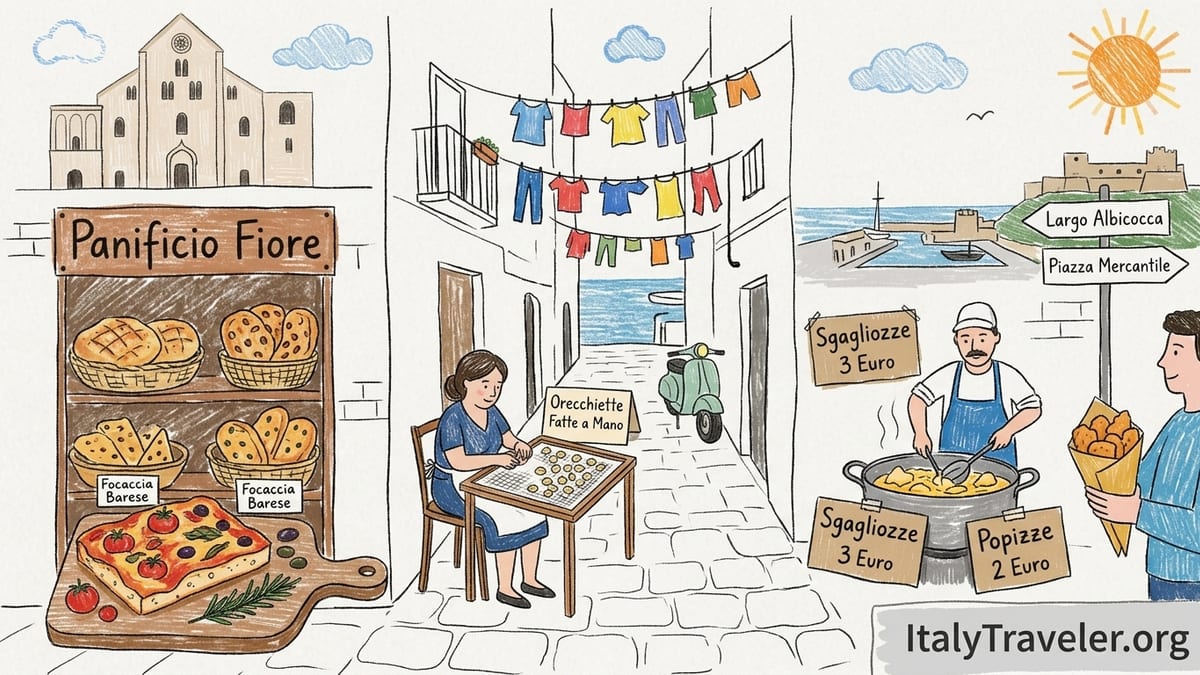
That scent led me along Strada Palazzo di Città toward Panificio Fiore, one of the most talked-about bakeries in Bari Vecchia. By late morning the small shop was already crowded, locals queuing with aluminum trays and paper bags, a few visitors hovering by the door trying to work out how things worked. Inside, behind a fogged-up glass counter, round trays of focaccia barese were stacked on metal shelves, their surfaces blistered and shining with oil, dotted with sunken cherry tomatoes and black olives.
I ordered a single slice of classic focaccia barese. In October 2026, a generous hand-sized piece here cost 2 euros, cut from a large round still warm from the oven. The dough was thick yet airy, with a crisp bottom from the oiled tray, and the top was almost caramelized around the edges where the tomato juices had mingled with olive oil. Ingredients were simple and traditional: soft wheat flour and boiled potato in the dough, extra-virgin olive oil, cherry tomatoes, oregano, coarse salt and a few olives. Eating it standing in the lane outside, with crumbs falling on the ancient stones, felt exactly right. It was salty, satisfying and filling enough that I understood how locals treat half a focaccia as a cheap lunch.
As a first bite in Bari Vecchia, I would absolutely eat this focaccia again. It set a benchmark that later slices from other bakeries never quite beat, although several came close. It also established an important rule for the rest of the day: street food here is not a quick snack between sights. It is the main event.
Under Arches and Laundry Lines: Walking Respectfully Through Arco Basso
From Panificio Fiore I followed the flow of people inland, aiming for Arco Basso, the now-famous “strada delle orecchiette.” The route there is not signposted as an attraction. Instead you pick your way through a living neighborhood of tight corners, shrines set into walls, and low archways where conversations bounce between windows. The further I walked, the more often I had to step aside for residents carrying shopping bags or maneuvering strollers through gaps that felt scarcely wide enough.
When I reached Arco Basso, the street was quieter than the Instagram images suggested. A few women sat at low tables just inside their doorways, hands working quickly over wooden boards dusted with semolina. The familiar small ear-shaped orecchiette appeared under their fingers with practiced flicks, then were spread to dry on mesh frames. Alongside them were bags and trays of pasta for sale, although not every doorway was active and some tables held only family portions.
I chose not to buy fresh pasta here. In December 2024, city inspectors closed a well-known home restaurant in this very street after controversy over the sale of orecchiette that were allegedly not made in-house and concerns around operating without proper commercial registration. The case received wide coverage in regional media and triggered tighter checks on who can legally sell homemade pasta from private homes. Today, the municipality allows pasta sales only from premises registered as food businesses, even if they are in these same alleys.
Walking Arco Basso now, it is important to remember that this is first and foremost a residential street, not an open-air museum. I watched the orecchiette making from a respectful distance, keeping my camera down unless a resident clearly indicated they were comfortable being photographed. For me, the experience was less about getting a souvenir bag of pasta and more about glimpsing a domestic craft that still survives behind many doors. I did eat orecchiette later in the day, but in a regular restaurant where I knew the kitchen was set up for serving the public.
Fried Heat in the Square: Sgagliozze and Popizze Around Largo Albicocca
Leaving Arco Basso, I cut back toward Largo Albicocca, one of the liveliest little squares in Bari Vecchia and a known center for fried street food. The space opens unexpectedly after a run of tight lanes, with grapevines climbing up walls, plastic chairs stacked outside doorways and the smoky smell of hot oil hanging in the air. This is where I tasted the two bites that best explain why Bari’s street food is as much about texture as flavor: sgagliozze and popizze.
Sgagliozze are simple in theory: slices of firm polenta, usually cut into rectangles, fried until the outside is crisp and golden. In practice they are addictive. From a small fry stand at the edge of the square, I ordered a paper cone that held six or seven pieces, freshly drained and still too hot to hold for long. The price was 3 euros in cash, no receipt, which is typical for these informal corners. The ingredients list could not be shorter: cornmeal, water, salt and frying oil, probably sunflower or mixed vegetable oil. The woman at the fryer sprinkled coarse salt over the cone just before handing it to me.
The first bite nearly burned my tongue, but the contrast between the hard shell and the soft, creamy interior was worth the delay. There was no sauce, no cheese pull, just the clean flavor of corn and salt and oil. I ate them standing among a mix of students, workers on break and a few tourists, everyone holding the same greasy paper cones. Of all the fried foods I tried that day, these are the ones I would most happily repeat: cheap, filling, and as much a piece of local routine as of culinary tradition.
Right next to the sgagliozze station another vendor was dropping small balls of yeast dough into oil. These were popizze, sometimes called pettole in other parts of Puglia. I bought a smaller cone for 2 euros, with about ten little dough balls inside. Ingredients are again minimal: wheat flour, yeast, water, salt, oil for frying. The result is lighter than a doughnut and less sweet, usually eaten plain or with just a dusting of salt. I found them pleasant but a little bland compared with the sgagliozze, more about texture than flavor. On a cooler evening I might crave them, but if I had to choose only one fried snack in Largo Albicocca, I would return to the polenta slices first.
Castle Walls and A Killer Pasta: Around the Norman-Swabian Castle
From Largo Albicocca I walked north, skirting the outer edges of Bari Vecchia toward the Norman-Swabian Castle. The streets opened up for a while, the white cube houses giving way to the massive gray walls and defensive moat of the fortress. Standing here, with the sea breeze funneling through the gaps in the stone, I felt suddenly small and hungry again. It seemed like the right moment to graduate from snacks to a plate of pasta.
I found a small trattoria just off the castle’s outer wall that specialized in local dishes and had a chalkboard listing orecchiette con cime di rapa and spaghetti all’assassina. I chose the latter, partly because it is the dish that locals describe with a mix of pride and warning. Spaghetti all’assassina is “killed” in the pan: the dry pasta is cooked directly in a shallow layer of tomato and water, then pushed into near-burning contact with the metal until parts of it char and crisp.
The portion I received was a deep plate, roughly 120 grams of dried spaghetti before cooking, for 12 euros. Ingredients were straightforward: spaghetti, tomato passata, garlic, chili pepper, olive oil, water and salt. The dish arrived with some strands still bright red and others almost blackened. The flavor mirrored the appearance. Each forkful moved from sweet tomato to smoky bitterness and biting chili. It was more aggressive than any other pasta I ate in Bari, and not a dish I would recommend to someone who dislikes heat or char.
Would I eat it again? Yes, but only once on a trip and ideally at lunchtime, when I still had hours to walk it off. It was rich, a little heavy, and demanded a beer or at least sparkling water to cut through the intensity. This was also my first proper sit-down meal of the day rather than street food: a plated dish, bread basket, and service charge added, in a room filled with a mix of locals in office clothes and a few tables of visitors studying maps. The contrast with the casual cones of sgagliozze in the square was sharp and useful. Bari’s food culture runs from doorways to dining rooms, and the castle area is a good place to feel that shift.
Down to the Harbor Squares: Panzerotti and Piazza Mercantile
After the pasta I walked downhill through the alleys toward Piazza Mercantile, one of the main open spaces at the edge of Bari Vecchia and a natural magnet for anyone craving panzerotti. The square opens onto the sea side of the old town, lined with cafes and street food counters. By mid-afternoon, people were already clustering at high tables with paper napkins and plastic cups of beer.
I headed for a well-known specialist that fries panzerotti to order on the corner of the square. A classic “normal” panzerotto here, filled with tomato and mozzarella, started at 2.50 euros in October 2026, with more elaborate versions rising to 5 euros. I chose the basic one to keep room for other tastings. The dough was folded into a half-moon, crimped and dropped into a deep fryer of hot sunflower oil, then handed over in a cardboard sleeve after a few minutes, still sizzling and blistered.
Ingredients were gloriously simple: wheat flour dough enriched with a little oil, yeast and salt, a filling of tomato, fior di latte mozzarella and a touch of oregano. As with any good panzerotto, the real challenge was waiting long enough not to burn myself when biting in. The first mouthful released a rush of molten cheese and sauce that dripped down my wrist. The outside was crisp and only lightly oily, not greasy. Compared with the Naples-style fried pizza, this felt lighter and more snackable, though still substantial enough that one unit could replace a small meal.
Panzerotti in Bari can be found in many corners, from kiosks near Piazza del Ferrarese to takeaway counters in newer districts, but eating one in Piazza Mercantile, with the harbor breeze and the noise of groups comparing fillings, felt particularly right. If I were to repeat one specific moment from this day, it would be this: a single hot panzerotto, a plastic cup of cold Peroni for 2 euros, and a spot at a standing table looking out toward the harbor. Among all the foods I tried, this is tied with the first slice of focaccia as the bite I would most insist on repeating.
Basilica Bells and A Bowl of Orecchiette: Between Faith and Lunch
From Piazza Mercantile I climbed back into the heart of Bari Vecchia, following the sound of bells toward the Basilica di San Nicola. The atmosphere here shifted again. Tour groups clustered under the Romanesque façade, pilgrims queued at the entrance, and souvenir stands buzzed with conversations in English, French, Russian and Polish. Yet step a single alley back from the main square and you are once more in a web of quiet lanes, with neighbors chatting from balconies and the occasional television voice drifting through open windows.
In one of these side streets I settled at a small trattoria that advertised cucina barese without photos of food on the menu, usually a promising sign. I ordered orecchiette con cime di rapa, determined to try the city’s signature pasta in a setting where I could taste it in full, plated form. The portion was standard for Italy, about 100 grams of dried pasta, and cost 11 euros including a small cover charge.
The dish arrived looking modest but deeply local. Ingredients were fresh orecchiette, turnip tops (cime di rapa), garlic, anchovies, chili pepper, olive oil and a crumbly local cheese that tasted similar to pecorino. The greens were bitter and slightly spicy, softened by the oil and the umami of the melted anchovy. The orecchiette themselves had that particular chew you only get from fresh semolina dough, thicker at the rim and rough enough to hold the sauce. After watching women shape these same little ears by hand earlier in Arco Basso, it felt good to meet them again here in the bowl, properly cooked and seasoned.
Of all the sit-down dishes I tried in Bari Vecchia, this is the one I would seek out again. It captured the balance I associate with the city: simple ingredients, strong flavors, and a sense that this is something people actually eat in their homes, not a dish invented for visitors. If you are choosing between orecchiette with tomato and this version with cime di rapa, I would strongly recommend the latter at least once, provided you are comfortable with a touch of bitterness in your greens.
Self-Guided Tasting vs Food Tours: Price, Portions and Stories
By the end of the afternoon I had eaten focaccia, sgagliozze, popizze, spaghetti all’assassina, panzerotti and orecchiette con cime di rapa, all within a compact loop around Bari Vecchia. My total food spending for this self-guided day, excluding coffee and water, was just under 30 euros. For that I had two substantial snacks and two full restaurant dishes, more than enough for one hungry visitor.
Walking around, I crossed paths with several organized food tours. One group stood near Arco Basso listening to a guide explain how legal requirements for selling homemade pasta have changed in recent years, including the clampdown on unregistered home restaurants. Another clustered in Largo Albicocca while their guide pointed out which sgagliozze stall had the crispest fry. Typical small-group street food tours in Bari in 2026 cost between about 50 and 60 euros per person for three to four hours, with four or five tastings included. Private tours are often more expensive per head, with some published rates above 100 euros for one participant, dropping gently as the group gets larger.
Comparing this with my self-guided route, the price difference is clear. I spent roughly 30 euros for a full day of eating exactly what I wanted, at my own pace, while a guided experience with a similar number of tastings could easily cost double that amount. On the other hand, tours provide structured interpretation: explanations of why sgagliozze are almost always made from day-old polenta, or how the dough for focaccia barese traditionally includes boiled potato to keep it soft. A good guide can also help you navigate where to buy fresh pasta legally and respectfully, and which vendors to support.
For my travel style, I found that a self-guided walk worked well. Bari Vecchia is compact and safe in daylight, and most must-try foods are clustered within a ten-minute radius. Menus are generally understandable, and prices are clearly posted in most bakeries and fry shops, especially those geared to both locals and visitors. I appreciated being able to linger longer at some stops and skip others entirely. If you are short on time, anxious about language barriers, or keen to get deeper into the stories behind recipes, a guided tour can add value. If you enjoy wandering and are comfortable asking simple questions in Italian or English, you can eat very well on your own for substantially less money.
Planning Your Own Half-Day Food Route in Bari Vecchia
Looking back at my walk, I would shape a half-day food route for another visitor around the same backbone of stops, adjusting only for appetite and dietary needs. Starting mid-morning helps you catch the bakeries while the focaccia is still warm and ensures fryers in Largo Albicocca are already working. I would begin, as I did, near Piazza del Ferrarese and walk directly to a historic bakery for focaccia barese. Budget 2 to 4 euros for a slice, depending on thickness and location, and treat it as a late breakfast or early lunch.
From there, I would wander toward Arco Basso, not as a guaranteed tasting stop but as a cultural one. Spend ten or fifteen minutes observing the pasta-making from a respectful distance. If you decide to buy fresh orecchiette, ask explicitly whether the vendor is operating as a registered business and be aware that rules have tightened since the high-profile enforcement case of December 2024. If in doubt, or if no clear price list and business setup are visible, I suggest skipping the purchase and instead trying orecchiette later in a restaurant.
Next, aim for Largo Albicocca for your fried interlude. Here you could share a cone of sgagliozze for around 3 euros and, if you have room, a smaller cone of popizze for another 2 euros. This makes a perfect salty break between bread and pasta. Afterward, continue toward the Norman-Swabian Castle and decide whether you want a full restaurant meal, such as spaghetti all’assassina or orecchiette con cime di rapa, or prefer to keep things lighter and leave space for a panzerotto at Piazza Mercantile later.
For many travelers, the sweet spot will be one sit-down meal plus one or two street snacks. A realistic food budget for a half-day route like this in 2026 is around 20 to 25 euros per person, not counting alcohol. Two adults sharing some items could comfortably eat well for 35 to 40 euros in total, including coffee and a couple of small beers. Prices rise in more formal restaurants or at heavily touristed venues, but in Bari Vecchia it is still possible to eat heartily for far less than in many other Italian cities on the coast.
The Takeaway
My day in Bari Vecchia taught me that the city’s street food is at its best when treated as part of the urban fabric rather than a checklist of famous bites. The focaccia at a crowded panificio tasted better because I had watched locals step in and out with trays for their families. The sgagliozze and popizze in Largo Albicocca were shaped as much by the square’s life as by their ingredients. The panzerotto in Piazza Mercantile made sense only with the harbor breeze and chatter around me, and the orecchiette con cime di rapa near the basilica felt like a natural pause between layers of history.
If you follow a similar route, I would recommend repeating, without hesitation, the focaccia barese from a good old-town bakery and a classic panzerotto fried to order near Piazza Mercantile. I would gladly seek out sgagliozze again on a cool evening, cone in hand, and return for a well-made plate of orecchiette with greens. Spaghetti all’assassina I would keep as an occasional indulgence rather than a daily habit, a dish that leaves a vivid impression but not one my stomach wants to meet too often.
On the question of guided tour versus self-guided exploration, my conclusion is balanced. A tour can give structure, context and access, and can be worth the extra cost if you are short on time, traveling with children, or particularly interested in stories and history. For independent travelers comfortable walking and making simple orders in Italian or English, a self-guided food walk through Bari Vecchia offers better value and more flexibility. Either way, treat Arco Basso and the surrounding alleys as living neighborhoods, not stage sets, and remember that behind every doorway is a home, not just a photo opportunity.
In the end, the food I would most insist on eating again in Bari Vecchia is not tied to a single named establishment but to specific moments: a warm slice of focaccia in my hand as church bells echo in the lane, a burning-hot panzerotto cooling slowly in a paper sleeve, a cone of sgagliozze shared with a friend as the square fills with evening voices. Build your own day around those moments, spend thoughtfully, and Bari will feed you very well.
FAQ
Q1. How much should I budget for a half-day street food walk in Bari Vecchia?
For a mix of focaccia, fried snacks and one sit-down pasta dish, a realistic 2026 budget is about 20 to 25 euros per person, or 35 to 40 euros for two adults sharing several items.
Q2. Is it still possible to buy fresh orecchiette on Arco Basso?
You may still see women making and selling pasta on Arco Basso, but after a December 2024 enforcement action, only vendors operating as registered food businesses are allowed to sell. If you are unsure, it is safer to enjoy watching the craft and eat orecchiette in a licensed restaurant instead.
Q3. What are the absolute must-try street foods in Bari Vecchia?
Based on my experience, the unmissable bites are focaccia barese from a historic bakery, a classic tomato-and-mozzarella panzerotto fried to order, and a cone of sgagliozze in or near Largo Albicocca.
Q4. Can vegetarians and vegans enjoy Bari street food?
Yes, but with some care. Focaccia barese, sgagliozze, popizze and simple tomato panzerotti are vegetarian, and many are vegan if made without cheese. Orecchiette con cime di rapa often includes anchovy, so vegans and strict vegetarians should ask for a version without it.
Q5. Are street food stands in Bari Vecchia open all day?
Bakeries usually open in the morning and stay open until late afternoon or early evening, or until they sell out. Fryers for sgagliozze, popizze and panzerotti are often more active from late afternoon into the evening. Midday options exist but can be fewer, so plan key tastings for late morning and late afternoon.
Q6. Is it better to join a street food tour or explore on my own?
A guided tour, often priced around 50 to 60 euros per person, offers structured tastings and local explanations. Exploring alone is significantly cheaper and more flexible. If you are comfortable walking, reading menus and asking simple questions, a self-guided route is excellent value.
Q7. Are there gluten-free street food options in Bari Vecchia?
Most classic street foods here are wheat-based. Some restaurants near the basilica and in the newer parts of town offer gluten-free pasta and pizza, but dedicated gluten-free street food is rare. Travelers with celiac disease should rely more on sit-down places that can confirm ingredients and preparation.
Q8. How crowded does Bari Vecchia get, and is it safe to walk while eating?
In peak season evenings the alleys can be busy but still manageable. It is safe to walk with food in hand, but in narrow lanes step aside for residents and keep an eye on uneven stones. Petty theft is not a major issue, yet normal big-city awareness is sensible.
Q9. What time of day is best for a food-focused visit?
Late morning is ideal for warm focaccia, and late afternoon into early evening for fried snacks and panzerotti. A half-day route from about 10:30 to 15:00 or from 16:30 to 21:00 works well for sequencing different foods without rushing.
Q10. Do I need to speak Italian to order street food in Bari Vecchia?
You can manage with basic English and a few Italian words. Pointing, saying the item name and indicating size or number is usually enough. Having small coins and notes ready also smooths the process and keeps queues moving.