


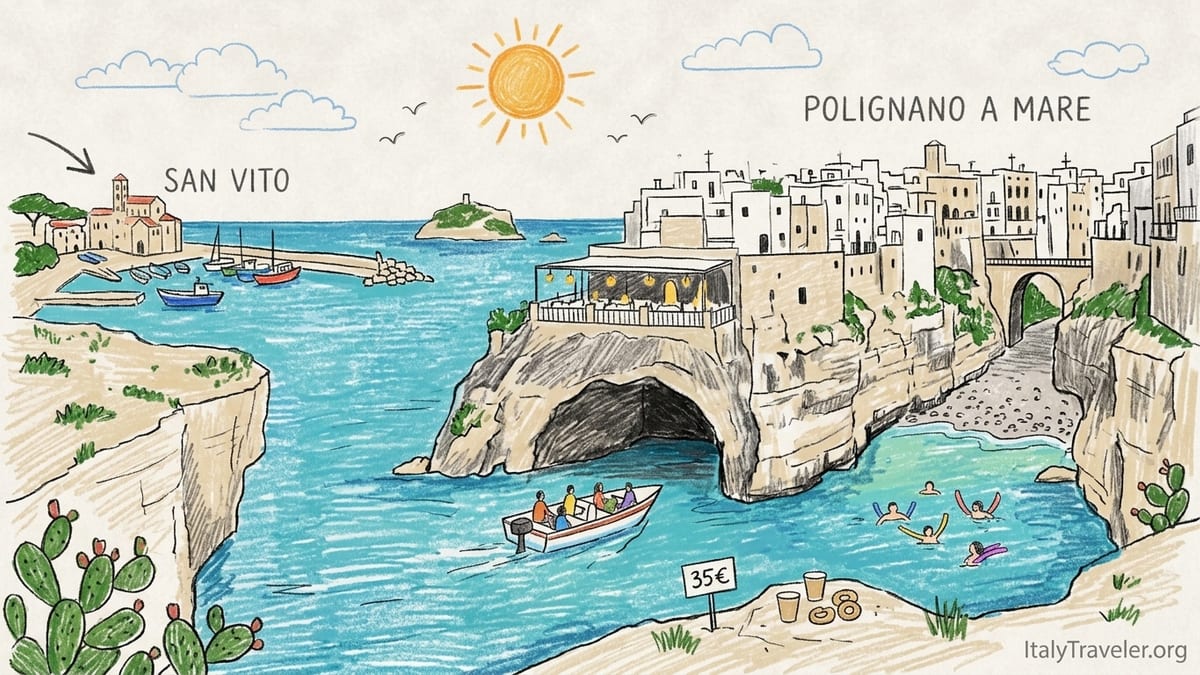
From Polignano a Mare’s clifftop viewpoints, the Adriatic looks like a postcard. I had admired the whitewashed town and its famous Lama Monachile cove from above, but I wanted to know what the coastline felt like at water level. So on a warm afternoon in late June 2025, I joined a shared sea-cave boat tour from nearby San Vito to see Grotta Palazzese, the limestone cliffs and hidden coves from the perspective usually reserved for fishermen and cliff divers. I came away with a camera full of blue and a clearer idea of what these cave cruises actually deliver for the price.
How I Booked My Cave Tour and What It Cost
I traveled to Polignano a Mare at the end of June 2025, when cave tours are in full swing and departures run almost continuously along the coast. After comparing several local operators, I booked a 90-minute shared cave tour similar to the ones sold by Dorino Gite in Barca from Via San Vito and by other long-established outfits working out of the small harbor of San Vito, a frazione about 3 kilometers north of Polignano’s historic center. Adult fares across reputable operators at that time clustered around 35 euro for a 1.5-hour shared tour on a small open motorboat, with children’s discounts and higher peak-season prices in July and August.
The tour I joined cost 35 euro per adult, in line with offers published by companies such as Blue Wave and other San Vito based operators that advertise 1.5-hour shared excursions along the caves for about that amount outside the very high season. The price included the skipper, fuel, commentary in Italian and English, a short swim stop if sea conditions allowed, and a simple aperitivo of taralli and a plastic cup of chilled local wine or soft drink. There was no hotel transfer, so I walked from Polignano’s old town to San Vito in about 35 minutes; a local bus or short taxi ride is another option for those who prefer not to walk.
Most operators in the area use similar boats for these shared trips, typically 6.5- to 7-meter open fiberglass motorboats designed to duck into low caves. My boat had padded perimeter seating, a sun canopy that could be folded back near the caves, and a central console for the skipper. The maximum legal capacity was around ten passengers plus crew; on my departure eight paying passengers joined, which meant we were close to full but not packed shoulder to shoulder.
It is worth noting that some more upscale private experiences sold through hotels and concierge services cost far more, sometimes 300 to 400 euro for exclusive use of a similar boat for 1.5 to 2 hours. Those itineraries are not fundamentally different, but they cap numbers at a couple or family group and include more generous drinks and snacks. I chose the shared option deliberately, both to keep costs realistic for most travelers and to see what the average visitor actually gets for a typical cave cruise fee.
Departure from San Vito and First Impressions at Sea Level
Although Polignano a Mare looks like it should have its own picturesque harbor under the old town, most cave tours do not depart from beneath the historic center. Instead they leave from practical marinas a few minutes away by road, with San Vito the main launch point for small open boats and gozzi. My tour began at the tiny port in front of San Vito Abbey, a Benedictine complex that faces a sheltered inlet. Skippers from different companies milled around the quayside, checking a choppy Adriatic that afternoon, coffee cups in hand.
We left the dock at 3:30 p.m., the sun still high and harsh. The sky was almost cloudless, the air temperature around 29 degrees Celsius, and a moderate northerly breeze ruffled the surface. The skipper warned us in both Italian and English that a “mare un po’ mosso” mildly rough sea meant we might not be able to enter every cave. He also made it clear that anyone prone to seasickness should sit near the stern where movement is calmer, and he stored bags in the driest part of the boat before we motored out past the breakwater.
The moment we cleared the protection of the harbor, the character of the trip changed. From land, Polignano’s limestone cliffs appear sheer and monolithic. At sea level, they broke into intricate layers: undercut ledges, jagged overhangs, fault lines filled with darker rock. The swell lifted us up and down against the base of the cliffs, bringing the reality of that geology close enough to splash us when a wave slapped the stone and bounced spray back into the boat.
Heading south toward Polignano, the skipper kept us within several dozen meters of the coastline. This proximity is a key difference between the sea-level viewpoint and the clifftop terraces. From above, you are looking at a broad spectacle. From the boat, you see the erosion in detail, the salt streaks, the plant roots spilling out from crevices, and the small informal ladders and rock steps locals use to reach hidden fishing spots and swim platforms that are invisible from the town’s panoramic balconies.
Lama Monachile and the Approach to the Sea Caves
The first famous landmark we recognized from the water was Lama Monachile, also known as Cala Porto, the narrow pebble beach squeezed between high cliffs directly under Polignano’s old bridge. Approaching from the north, we saw the cove gradually open, the pebbles a strip of white between towering walls of rock and stone houses perched improbably above them. The skipper idled the engine and nosed the boat closer, though not all the way into the cove because of swimmers and other boats.
From the water, Lama Monachile felt more confined than from above. The cliffs rose almost vertically on three sides; we could see the Red Bull Cliff Diving platform fixed high above, tiny from our level but still intimidating. The sea inside was calmer and a deeper emerald, floored by pale stones. At this point the skipper reminded us that jumping from the cliffs is reserved for professional athletes with special permission and that regular visitors are limited to the beach and marked swim zone. The boat stayed just outside the line of buoys, which preserved a safe distance between us and the swimmers.
As we continued south along the cliffs, the succession of caves began. There are dozens of named and unnamed openings along this stretch Grotta Palazzese, Grotta Ardito, Grotta delle Rondinelle, Grotta delle Monache, among others but whether a particular tour physically enters them depends entirely on the size of the boat and that day’s sea conditions. On my afternoon, the swell from the north wrapped slightly around the headlands, so every cave mouth breathed in and out; you could see the water rise and fall against the ceiling inside.
The skipper set expectations clearly. Some caves, he said, would be viewed from the entrance only because the combination of low roof and rolling swell made it dangerous to drive a motorboat deep inside. Others with higher vaults and more sheltered entrances might allow the bow to slip a few meters into the darkness for a closer look. This distinction sounds technical, but it made a big difference to how immersive each cave felt and how much “value” I felt I was getting from the tour.
Grotta Palazzese, Grotta Ardito and Other Named Caves
Grotta Palazzese was the star everyone on board had heard of, famous for the luxury restaurant built into its upper opening. Approaching from the sea, the cave revealed itself as a wide arch in the cliff, the restaurant terrace enclosed above with soft lighting and railing. In our moderate swell, the skipper steered the boat carefully toward the mouth but never promised that we would go all the way in.
We did not actually enter Grotta Palazzese. Instead the boat held just outside the opening, bow pointed in, engine in neutral for a minute or two. From that position I could see perhaps ten to fifteen meters into the interior, where the light turned aquamarine against the rock. The ceiling lowered toward the back, and waves surged and sucked at the base of the columns supporting the restaurant. It was undeniably impressive, and photographically it did not matter much whether we crossed the threshold by a few extra meters. But it is important to stress that on a rougher day, or on a larger vessel, you might only ever see this cave from the level of its entrance, not glide dramatically into its heart.
Grotta Ardito, further along the coast, offered a different experience. The entrance here is narrower but more sheltered, and the cave bends slightly, creating a change in light as you move inside. On our tour, the skipper judged the conditions acceptable and invited those of us sitting at the aft to shift weight toward the center. He then eased the boat in carefully. We entered perhaps five or six meters, enough that the roof closed overhead and the outside daylight narrowed to a bright frame behind us.
Inside Grotta Ardito, the water deepened to a rich cobalt and the walls showed layers of cream, rust and charcoal limestone. We could see small ledges where birds nested, and the acoustics changed completely; voices echoed, and the slap of the waves against the walls sounded amplified. The skipper cut the engine for a few seconds so we could listen. This was one of the two caves on my tour that we truly entered rather than just peered into, and it felt dramatically different from viewing a cave from just outside the opening.
We also passed the mouths of other named caves, such as Grotta delle Rondinelle and Grotta delle Monache, along with various unnamed fissures and double-arched openings. In some, the skipper took us just over the threshold for a brief look, the bow sliding under an overhang before reversing out. In others, especially where the roof dipped low and the swell lifted us close to the rock, he stayed prudently outside. Each time he explained his reasoning, which helped temper expectations and underscored that safety, boat size and sea state dictate access more than any published route map.
Hidden Coves, Portalga and Scoglio dell’Eremita
Beyond the most photographed caves below the historic center, the coastline began to open out and fold into smaller coves, some ending in pocket beaches accessible only by boat or steep paths from the land. One of the prettiest sections was around Portalga, a narrow inlet framed by rocky arms. Here, the sea took on a softer blue, and the swell lost some of its energy as waves dissipated against the rocks before entering the cove.
We did not beach the boat at Portalga, but we idled at the mouth long enough to appreciate why many tours list it among their highlights. Small fishing boats were moored deeper inside, swinging gently on their lines, and a few locals sat on the rocks with towels laid out, unreachable from any obvious road. From town, this indentation reads as a minor notch in the coastline; from the sea, it feels like a pocket world.
Nearby, Scoglio dell’Eremita a rocky islet just offshore provided another distinctive marker. We circled it slowly, close enough to see the rough texture of the stone and the hardy vegetation clinging to its top. The skipper told a brief story about the rock’s name, linked in local legend to a hermit who supposedly once lived there. Whether or not that is historically accurate, the islet works as a visual punctuation mark on the route and as a nesting place for seabirds, which we could see wheeling overhead.
In this middle section of the tour, the caves were less about spectacular vaults and more about the rhythm of inlets, ledges and swim ladders cut into the rock. The boat drew alongside one deserted platform where a metal ladder disappeared into water so clear you could count the steps three meters below. It was here that the skipper decided conditions were safe enough for our swim stop, away from the busiest caves but still under the looming presence of the cliffs.
The Swim Stop: Water Clarity, Depth and Safety
Swimming is often advertised as a central part of Polignano cave tours, but it is always at the discretion of the skipper and depends heavily on sea state. Many companies, including those operating from San Vito, make it clear in their terms that a swim stop can be shortened or omitted entirely if waves or wind pick up. On my tour, despite the moderate swell, the skipper found a reasonably sheltered spot between two rock outcrops where the water oscillated but did not break.
He cut the engine, dropped a ladder from the stern and reminded everyone of the rules. Anyone entering the water had to be confident in open sea, stay close to the boat, and keep well away from the rocks. He handed out a few foam noodles for less confident swimmers and asked non-swimmers to remain seated. Life jackets were available on request, and he kept a constant count of how many people were in the water.
I joined the swim. The first sensation stepping down the ladder was the cool bite of the Adriatic, probably around 23 degrees Celsius. Once fully in, the water felt refreshing rather than cold. Visibility was excellent; hanging near the boat I could see my toes clearly and watch schools of small fish flit among submerged rocks several meters below. The depth near the ladder dropped off quickly, likely to five or six meters, so there was no touching the bottom unless you were an experienced freediver.
We had about ten minutes in the water, long enough for everyone who wanted to swim to have a turn. The boat rolled gently, but because the swim spot was chosen away from tight cave mouths, there was no dangerous surge against rock walls. Climbing back aboard, we were handed cups of Prosecco or soft drinks and a paper cone of crunchy taralli. It was a simple, almost ritualized moment repeated on many tours along this coast, but it delivered a real sense of having inhabited the landscape rather than just observed it from the deck.
Comfort on Board, Crowding and Motion at Sea
One of the most useful things I learned from experiencing the tour firsthand was how physically demanding it can feel for certain travelers. Our open motorboat, similar to those used by several reputable operators, had cushioned benches but no individual seats or backs. Eight adults plus the skipper filled most of the perimeter, and while no one was physically crushed, personal space was limited. On sharper rolls some passengers bumped shoulders or knees. Anyone expecting yacht-style loungers would be disappointed on a standard 35 euro cave cruise.
The motion of the sea also mattered. Although conditions were officially safe, the constant up-and-down near the cliffs produced a fair amount of vertical movement. Two passengers who had eaten a late lunch looked distinctly queasy by the halfway point. They found some relief by focusing on the horizon and sitting toward the stern, where the boat’s motion was slightly dampened. Those prone to seasickness should not underestimate this aspect; a calm-looking sea from the clifftop can feel more restless when you are at water level under overhangs where swells are funneled.
Spray was another unavoidable factor. As we approached certain caves, the combination of breeze and reflected waves sent regular splashes over the bow. The skipper had warned us at the dock that no one could guarantee staying dry, and he was right. Passengers in the front took the brunt and periodically shielded cameras and phones. It felt exhilarating to me, part of the experience, but travelers hoping to remain selfie-ready might want to dress accordingly and bring a light windbreaker or quick-dry clothing.
Despite these discomforts, the human scale of the boat fostered a convivial atmosphere. Our skipper’s commentary, delivered in both Italian and serviceable English, was informal rather than scripted. He pointed out not only the major caves but also lesser-known fishing spots and private ladders used by Polignano locals. That sort of detail rarely makes it into official brochures, yet it is much of what justifies taking a small boat tour instead of passively viewing the coastline from the promenade.
Shared Tour vs Private Sunset Cruise: What the Premium Buys
During my stay, I also inquired locally and online about private and sunset cave tours to compare them with the shared mid-afternoon experience I had just had. Several operators and booking platforms advertise private cave tours from San Vito or Polignano-area marinas at 300 to 400 euro for a 1.5- to 2-hour outing, often on similar-sized boats but reserved for a single couple, family or small group. Prices tend to rise further in July and August and for sunset slots, when demand is highest.
At first glance, the itinerary for private and shared tours often looks nearly identical on paper: departure from San Vito or another nearby marina, navigation along the caves between San Vito and Portalga, stop for a swim, simple aperitif of taralli and drinks, and return. The coastline itself does not change just because you pay more. What the premium buys is almost entirely in the realm of atmosphere and flexibility rather than route.
On a private tour, you have more control over pace and emphasis. If your group falls in love with a particular cove, the skipper can linger there longer without worrying about a tight rotation of back-to-back departures. If you prefer to skip swimming and instead spend more time under Grotta Palazzese’s arch taking photos, that choice is easier to accommodate. Sunset departures add softer, more flattering light on the cliffs and old town, which matters to photographers and romantics. You also gain more personal space on the boat, which makes a significant difference for families with small children or anyone who finds close quarters stressful.
However, in terms of entering caves, the decisive factors are still sea state and boat size, not ticket class. A private boat of the same length and draft as a shared one faces identical physical limitations. If the swell is too high or the roof too low, no responsible skipper will risk taking you fully inside, whether you have paid 35 euro per person or 350 euro for exclusive use. For travelers attracted by the idea of a private tour because they hope it will guarantee access to every named cave, this is an important reality check.
Weather, Cancellations and Days When the Sea Closes the Caves
Polignano’s cave tours are highly sensitive to weather and sea conditions. Wind direction, swell height and even recent storms elsewhere in the Adriatic can all affect whether the caves are safe to approach or enter. On my June visit, I woke on one morning to a visibly agitated sea, whitecaps marching toward the cliffs and no boats leaving San Vito harbor. Local skippers described it as a day when “il mare chiude le grotte” the sea closes the caves. Tours were simply canceled.
Most reputable operators state clearly that in such cases they will either reschedule customers to a later departure when conditions improve or offer a full refund. The caveat is logistical rather than financial. If you have only one night in town, and that happens to coincide with a day of rough seas, you may not get out at all regardless of how flexible the ticket is. In shoulder seasons like March or November, when there are fewer daily departures, the chances of missing your window increase.
There is also the intermediate case, which is what I experienced on my own tour: conditions are safe enough to operate, but not calm enough to allow entry into every cave or to guarantee a long, leisurely swim. Operators tend to be conservative in their wording here, promising to show the caves along the coast and offer a swim stop “if possible.” That phrase hides a lot of nuance. On such days you might see Grotta Palazzese only from its entrance and skip some of the lower-roofed caves entirely, even though the ticket price remains the same as on calmer days.
From a traveler’s perspective, the key is to treat the cave tour as an inherently weather-dependent activity, not a fixed product. Those with flexible itineraries would do well to book early in their stay, leaving room to reschedule if the sea turns. Packing a quick-dry layer, securing valuables in waterproof pouches and mentally preparing for the possibility of canceled or modified itineraries can help avoid disappointment if the Adriatic decides to assert itself.
Costs for Solo Travelers, Couples and Families and Was It Worth It?
By the time we glided back into San Vito harbor, slightly salty and pleasantly tired, I had a clearer sense of the real costs and benefits of seeing Polignano from the water. My 35 euro ticket bought 90 to 100 minutes of navigation, commentary, partial entry into several caves including a memorable visit inside Grotta Ardito, a swim stop in clear blue water, and the simple ritual of taralli and Prosecco under the cliffs. It did not buy guaranteed access to every famous cave, nor did it promise comfort on the level of a yacht.
For a solo traveler, a standard shared cave tour at current prices represents a moderate but manageable splurge. Allowing for a 35 to 40 euro adult ticket depending on season, plus perhaps 10 euro for a bus or taxi to and from San Vito if you do not want to walk, the total sits around 45 to 50 euro for the experience. There are no hidden fuel surcharges or port taxes on the small local tours I researched, and tipping, while appreciated, is not aggressively solicited. Compared with the cost of a restaurant meal in Polignano’s old town, it is a similar outlay for a very different kind of memory.
For a couple, the math doubles quickly. Two adults on a shared tour can expect to spend 70 to 80 euro on tickets alone, plus any transport to the marina. At that point, some pairs begin to consider private sunset options, especially if they are marking an anniversary or honeymoon. Yet on-the-ground research suggests that a private 1.5- to 2-hour cave cruise often runs 300 to 400 euro in the main season, a substantial jump from 80 euro for the same coastline. Whether the added intimacy and flexibility justify that premium depends entirely on priorities and budget.
Families face an even more delicate calculation. Shared tours commonly charge full adult prices for teenagers and reduced fares for younger children. On offers I reviewed, a typical breakdown might be 35 to 40 euro per adult, around 20 to 30 euro for children roughly from ages 3 to 6, and free or nominal rates for infants who can safely be held on a lap. For a family of four with two school-age children, the total can easily approach or exceed 120 euro before snacks or transfers. It is an unforgettable outing but not a trivial expense, especially when weighed against a day spent enjoying Polignano’s free viewpoints and public beach.
So was the cave cruise worth it compared with simply exploring Polignano’s terraces and alleys at no cost? For me, yes, but in a specific way. The sea-level perspective revealed the undercut bases of the cliffs, the true relationship between town and void, and the scale of caves like Grotta Palazzese and Grotta Ardito in a way no balcony view could. It also delivered the sensory experience of being inside the rock, listening to the amplified slap of waves and feeling the boat rise and fall in confined spaces. However, if budget is tight and you are satisfied with panoramic photos and cliff walks, you will still appreciate Polignano immensely without ever setting foot on a boat.
FAQ
Q1. Do Polignano a Mare cave tours really enter Grotta Palazzese?
On some days small boats can slip partway into Grotta Palazzese, but access depends on sea conditions and boat size. On my tour the skipper held the boat just outside the entrance because a moderate swell made it unsafe to go fully inside. Travelers should expect to admire the cave mainly from its mouth rather than rely on dramatic deep entry.
Q2. Where do most cave tours actually depart from?
Many shared cave tours depart from San Vito, a small harbor about 3 kilometers from Polignano a Mare’s historic center, or from nearby marinas such as Cala Ponte. Departure directly under the old town is less common for these small-boat trips. Plan for a short bus ride, taxi or a half-hour walk from Polignano to reach the meeting point.
Q3. How long do the standard shared cave tours last?
Most reputable operators along this stretch of coast run shared cave tours of about 90 to 100 minutes. That duration typically allows time to cruise between San Vito and Portalga, pause at landmarks like Lama Monachile and Grotta Palazzese, visit or view several other caves, and include a short swim stop if the sea is calm enough.
Q4. How much should I expect to pay for a Polignano cave tour?
Adult prices for shared small-boat cave tours commonly sit around 35 euro per person outside the peak of summer, rising to roughly 40 euro in July and August on some services. Children often pay a reduced fare, and infants may ride free. Private or sunset cruises usually start around 300 euro for a 1.5- to 2-hour outing reserved for a couple or small group.
Q5. Are swim stops during the tour guaranteed?
Swim stops are never guaranteed. Operators present them as an option “if conditions permit,” which reflects reality on the water. On calm days skippers usually choose a sheltered cove and allow 10 to 20 minutes for swimming, but waves, wind, crowding near rocks or limited visibility can all lead to the swim being shortened or canceled entirely for safety reasons.
Q6. How rough does the sea feel on a typical cave tour?
Even when conditions are judged safe, there can be noticeable movement near the cliffs, where swells reflect off rock walls and lift the boat up and down. Passengers who are prone to motion sickness may feel queasy, especially in the bow. Sitting near the stern, looking at the horizon and avoiding heavy meals right before departure can make the motion more manageable.
Q7. Is a private or sunset tour worth the higher price?
Private and sunset tours do not change the fundamental route but add comfort, space and flexibility. You are paying for fewer people on board, more say in how time is spent, and often better light for photography at sunset. If budget allows and you value intimacy and custom pacing, the premium can feel justified. For many travelers, though, the standard shared tour already provides a strong sense of the coastline.
Q8. Can young children safely join a Polignano cave tour?
Many operators accept families with children and offer reduced fares for younger ages, but parents should realistically assess both their children’s comfort with boats and their own ability to supervise in close quarters. Life jackets are typically available on request, decks can be wet and slippery, and there is no enclosed cabin on the small open boats used for most cave trips.
Q9. What happens if my tour is canceled due to bad weather?
When wind or waves make cave tours unsafe, reputable local companies usually cancel departures and offer guests the choice of rescheduling to another slot or receiving a full refund. The main risk is timing rather than money; if your stay in Polignano is very short, a spell of rough seas can mean you simply miss the chance to go out.
Q10. Is the cave tour essential if I am already enjoying Polignano’s viewpoints?
The cave tour is not essential to appreciating Polignano a Mare, but it does add a distinct dimension. Clifftop viewpoints and narrow alleys give sweeping vistas and charming urban scenes, all for free. The boat tour, by contrast, offers immersion in the geology, close contact with the caves and the physical sensation of being under the town’s overhangs. Whether that is worth the extra cost depends on your budget and how much you value that specific kind of experience.