


I arrived in Lecce late on a warm Friday afternoon, the kind of light that makes even a parking lot look romantic. But the moment I wheeled my small suitcase toward the historic center and the first blocks of pietra leccese appeared in front of me, the city snapped into focus. The stone was exactly as people describe it, a warm straw color that does not glare like marble but seems to glow softly, and the narrow streets between tall facades felt less like a museum and more like a lived-in stage set. Within ten minutes of entering through the edge of the centro storico, I knew this would be one of those cities I would wish I had more time in.
Arriving in Lecce and First Steps into the Historic Center
I based myself just outside the thickest knot of Baroque streets in a small guesthouse near Porta Rudiae, a five to seven minute walk from Piazza Sant'Oronzo. Arriving by rental car from Bari meant facing the practical side of Lecce before the romantic one. Street parking close to the old town was marked by blue lines, pay and display, and on a Friday afternoon I circled for almost twenty minutes before giving up and slotting into a guarded lot just beyond the walls. The daily rate was around 15 to 20 euro, not ruinous but enough to make me glad I was staying two nights rather than one.
From the guesthouse, the walk into the historic center felt effortless. Lecce’s core is flat and compact, and within a few blocks the regular modern buildings gave way to facades in soft Lecce stone, their balconies threaded with wrought iron and potted geraniums. The stone is famously easy to carve when freshly quarried and then hardens over time, which is why even small corners and window frames are smothered in swirls, cherubs and floral details. In the late afternoon, the color is closer to honey than white, and as the sun dropped, the first shadows began to cut diagonally across doorways and archways, picking out the depth of the carvings.
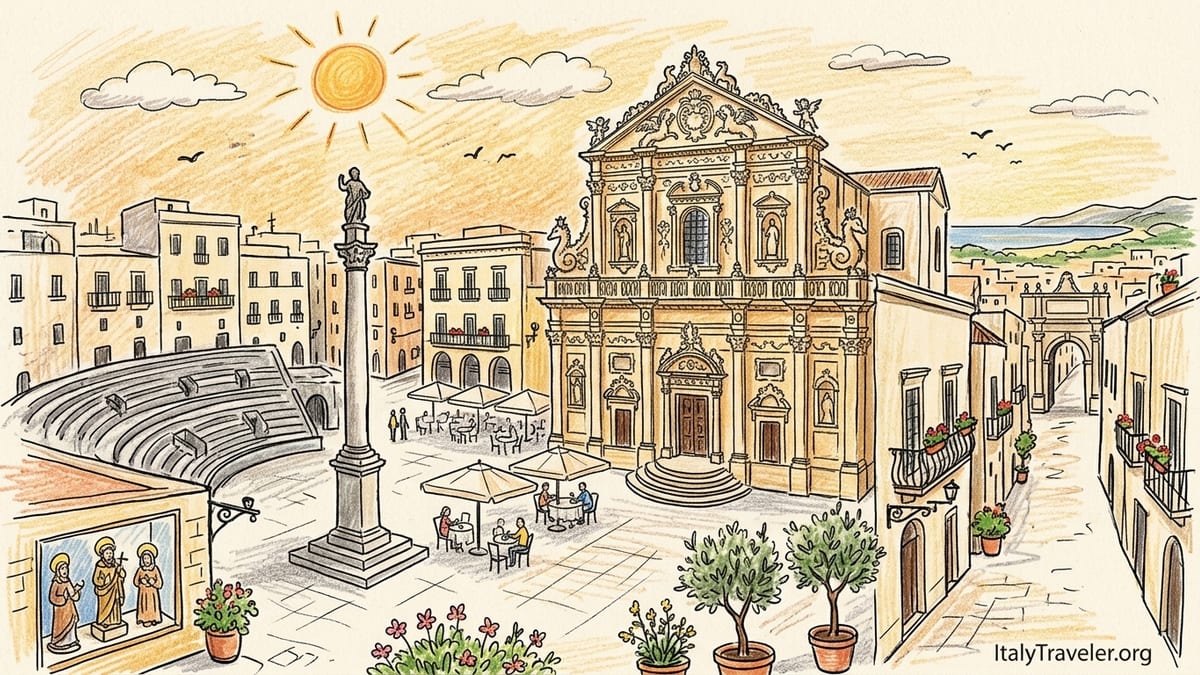
My first real “I am in Lecce” moment came as the narrow lane opened onto Piazza Sant'Oronzo, the city’s beating heart. The effect is sudden. One second you are hemmed in by high walls, the next you are facing a wide stone square, the column of Sant'Oronzo himself rising on one side, and right beside it a Roman amphitheater sunk below street level like a giant excavation made permanent. Cafes ring the arc of the square, with tables spilling out under large umbrellas, and the traffic noise drops to a background murmur. It was tempting to sit immediately, order a caffè leccese and simply watch, but curiosity tugged me further along the square’s edge.
Standing at the rail above the amphitheater, I looked down at the curved stone seating and uneven ground that once held crowds of spectators. Only a portion of the ancient structure is visible, but the contrast between the creamy Baroque palazzi and the grey, worn Roman stone makes it feel more powerful. It was my first taste of how Lecce stacks its centuries on top of one another, often in the space of a single city block.
Following the Baroque Thread: Sant'Oronzo to Santa Croce
My first evening walk followed what would become my default route: Piazza Sant'Oronzo to the Basilica di Santa Croce and on toward Piazza del Duomo. Leaving the square along Via Vittorio Emanuele II, the city narrowed around me again, but the street was crowded with life. Locals wove confidently around clusters of visitors who stopped to photograph niches and balconies. Shops alternated between contemporary clothing and souvenir stands, then suddenly a quiet doorway would reveal a dim gallery or a small church set back from the street.
The Basilica di Santa Croce appears almost without warning. One turn, and the facade rises over the street like a stone tapestry, packed with details that seem almost excessive until you start to notice the logic in the chaos. Mythical creatures, columns that look like bundled ropes, fruits, saints, all layered around a huge central rose window. I had seen countless photos of it, but in person the depth is what stands out. Even in the muted early evening light, the shadows inside the carvings created an almost three-dimensional effect, and the pale stone looked soft to the touch.
Santa Croce is part of the LeccEcclesiae circuit, the diocesan network that manages several of the city’s major churches as a unified cultural itinerary. I bought my ticket on my first full morning, choosing the standard multi-site option for 11 euro. That pass, valid for several days, granted access to a group of churches and related sites, including Santa Croce, the cathedral complex and other Baroque highlights. Paying once and not thinking about individual entry fees made the rest of my wandering simpler, and it also, I admit, nudged me into stepping inside more churches than I might otherwise have entered.
Stepping into Santa Croce’s interior after lingering on the facade brought a different kind of surprise. Despite the decorative excess outside, the nave feels measured inside, its white walls and arches directing the eye forward. Light slid in through the high windows and the rose, leaving small pools of brightness near the altars while corners stayed almost in shadow. The coolness of the stone was immediate after the warmth of the street, and I found myself slowing down, looking more closely at side chapels and carved wooden details that document centuries of local devotion and craftsmanship.
LeccEcclesiae and Climbing the Duomo Bell Tower
With the 11 euro LeccEcclesiae ticket in hand, I continued my exploration in a deliberate loop that made the most of the pass. After Santa Croce, I returned toward Piazza Sant'Oronzo and then followed the gentle curve of streets toward Piazza del Duomo. The square is one of Lecce’s most harmonious spaces, enclosed on three sides and open on the fourth, so that you enter almost as if stepping onto a stage. The cathedral, the campanile, the bishop’s palace and the seminary form a continuous wall of Baroque architecture, but the space never feels heavy. Instead, it has a quiet, almost cloistered quality, especially earlier in the day before tour groups arrive.
Access to the Duomo, its crypt and the adjoining cloister was included in my standard ticket, and I spent a generous hour there. The crypt, with its forest of columns, had a hushed, almost subterranean atmosphere that contrasted strongly with the brightness above. In the cloister, the square of sky framed by arches and a central well felt like a pause between streets. During my visit, explanatory panels were clear enough to give context without the need for an audio guide, and the custodians were happy to answer short questions about the artworks and chapels.
Where LeccEcclesiae’s pricing asked for a real decision was the Duomo bell tower. Including the tower and its panoramic view bumps the total cost of a ticketed experience to around 21 euro. I chose to pay the difference and climb, partly out of curiosity and partly because I like seeing how a city fits together from above. The ascent is timed and guided for safety, and the climb is vertical enough that anyone with mobility issues should think carefully. The stairs are relatively narrow, and in summer the interior can feel warm, though in my case the scheduled slots avoided the peak midday heat.
From the upper levels, the view opened in layers. Closest, I could see down into Piazza del Duomo itself, the different textures of the paving stones and the play of people’s shadows as they crossed the square. Beyond, the ochre and cream roofs of the historic center spread out like a low relief map, roof terraces and church domes poking up. In the distance, on a clear day, you can sense the flat Salento plain and, if you are lucky, a hint of the sea. Was it worth paying roughly 10 euro more than the base ticket? For me, yes, partly because it helped fix Lecce in my mental geography. For budget travelers who are less interested in cityscapes, though, the standard 11 euro pass offers excellent value on its own.
Walking to Porta Napoli and Losing Myself in Smaller Streets
After the Duomo, my route north pulled me toward Porta Napoli, another essential point along Lecce’s architectural spine. The walk itself was one of my favorite stretches of the weekend, as it passes through streets that are busy but not overwhelming. Small food shops and cafes inhabited ground floors under balconies that seemed to hover above the street. At a certain corner, the line of buildings breaks and Porta Napoli appears, a monumental gateway dedicated in the sixteenth century and today functioning mostly as an elegant stone frame between old and new parts of the city.
The arch is not richly carved like Santa Croce, but its clean lines and proportion feel powerful, especially when you stand just beneath it and look up at the reliefs and inscriptions. On the far side, modern traffic hums past, a reminder that Lecce is a living city and not only a Baroque postcard. I lingered there for a moment, then turned back into the old town along one of the smaller side streets, choosing lanes almost at random.
This was where Lecce began to feel most personal. Away from the named piazzas, I passed small shrines set into corners, laundry hanging from balconies, and workshops where doors stood half open. Not every palazzo is restored to postcard perfection. Some facades are chipped or darkened, the carved faces and leaves no longer crisp. Yet even in this more worn state, the softness of the stone gives the streets an inviting quality. It is easy to understand why some travelers base themselves here for a week, using Lecce as a base to explore the rest of Salento while returning each evening to these golden lanes.
The flatness and compact scale made the entire weekend essentially car free once I had parked. From my accommodation near Porta Rudiae, I could reach Piazza Sant'Oronzo in under ten minutes, Santa Croce in fifteen and Porta Napoli in around the same. Distances that on a map look moderate feel even shorter because of what fills the space between: details in facades, glimpses into courtyards through partly open doors, the occasional surprise of a small church interior waiting behind a simple portal.
Cartapesta and Lecce’s Papier-Mâché Workshops
I knew before arriving that Lecce had a strong tradition of cartapesta, but it was only when I started to see the range of papier-mâché work in shop windows that I understood how embedded it is in the city’s identity. Figures of saints, nativity scenes, masks and more playful contemporary pieces all shared the same slightly matte surface, painted in soft, often earthy colors. Prices varied widely, from small souvenir-sized pieces under 20 euro to complex sculptures that were clearly serious investments.
Wanting to go beyond window shopping, I visited a workshop near Santa Croce where the artist was shaping a figure’s hands from layers of paper and glue over a rough core. The room smelled faintly of paste and paint, and wooden shelves displayed works in different stages of completion. The artisan explained that Lecce’s cartapesta grew in part because the soft Lecce stone was not ideal for fine indoor statuary, while papier-mâché offered a lighter, more adaptable medium that could be painted to resemble more expensive materials. Today, while traditional religious subjects remain important, many workshops also produce modern designs to keep the craft relevant to new generations.
To understand the broader context, I combined this workshop visit with a small museum display where cartapesta pieces were shown alongside tools and photos of historic masters. Seeing older nativity figures, some with expressive faces and detailed clothing, underscored how refined the technique can be. It is easy to dismiss papier-mâché as a school project material, but in Lecce it can rise to the level of serious sculpture. Guided experiences are available through local tourism networks, including three-hour workshops where visitors can try basic techniques under the supervision of an artisan, often for fees around 40 to 60 euro per person. For travelers who like hands-on culture, setting aside half a day for such an experience is, in my view, far more memorable than buying a generic souvenir.
The value of having a guide became clear here. While Lecce’s churches and stone facades overwhelm you visually without explanation, cartapesta benefits from context. A guide or artisan who can tell stories about how the craft developed, how certain families passed techniques down, and how orders for religious festivals used to support entire neighborhoods enriches the experience. During my weekend, a short, focused workshop and conversation with a maker did more to anchor Lecce in my memory than many of the more photographed monuments.
Eating in Lecce: Rustico, Pasticciotto and Simple Plates
Lecce is not a city where you need to chase fine dining in order to eat well. Most of my meals were simple and, with the exception of a couple of clearly touristy markups near Piazza Sant'Oronzo, reasonably priced for a southern Italian city in high season. On my first morning, I joined the stream of locals at a central bar and ordered a rustico leccese and a cappuccino at the counter. The rustico, a round puff pastry filled with tomato, mozzarella and a hint of béchamel, cost around 2.50 to 3 euro, with the coffee adding another 1.50. The pastry came hot, its edges flaky and the center just molten enough to risk a burned tongue if you were impatient.
Later that day, after hours of walking between churches, I sat down in a quieter pasticceria a few streets away and ordered a pasticciotto and a small bottle of water. The pasticciotto, a shortcrust pastry filled with eggy custard cream and baked until the top just began to brown, arrived still warm. At around 2 euro, it felt like a bargain, especially considering that this dessert is not just a tourist treat but recognized locally as a traditional product of the province. Eating it while leaning against the cool stone of a doorway, watching people pass by, felt like the simplest possible way to connect with the city.
Caffè leccese, the local iced coffee with almond syrup or almond milk, became my afternoon anchor. Prices ranged between 2 and 3.50 euro depending on how central and polished the bar was. Ordered at the counter rather than seated at an outside table, it provided both a sugar and caffeine lift as the heat climbed. Speaking of heat, visiting in summer means accepting that midday hours between roughly 1 and 4 p.m. are better spent indoors. Many locals adjust their rhythm accordingly, and I quickly learned to do major sightseeing in the morning and then again from late afternoon into the evening.
Dinners alternated between informal osterie tucked into side streets and places on or near the main squares. In the lanes behind Santa Croce, I found a small trattoria where a plate of orecchiette with cime di rapa, a carafe of house red and a side of grilled vegetables came to just under 20 euro. Closer to Piazza Sant'Oronzo, the same meal pattern easily pushed past 30 euro once service and a more expensive wine were added. Menus were generally posted outside, and a quick scan made it easy to distinguish places charging a premium for their location from those focused more on regulars. One of the few drawbacks of staying inside or just next to the historic center is that truly budget dining options are thinner on the ground in the most photogenic streets.
Evenings in the Squares and Lecce’s Atmosphere After Dark
If Lecce’s stone glows during the day, it seems to radiate from within at night. As the sun dropped each evening, I found myself drawn back to Piazza Sant'Oronzo and the pedestrian streets radiating from it. Street musicians took up positions at key corners, playing everything from Puglian folk tunes to soft jazz. Children chased each other across the paving stones while older locals occupied the same cafes night after night, watching the slow theater of passeggiata unfold.
The Roman amphitheater, which by day can look slightly stranded between modern buildings, becomes an atmospheric void after dark. The lighting emphasizes its curves and creates a sense of depth that daytime flat light cannot match. From there, looking back toward the surrounding facades, you can see how the golden color of Lecce stone works with artificial light as well as with sun. It reflects enough to feel bright but not so much as to become harsh, so even overhead streetlamps lend the façades a softness.
Compared with the focused concentration of daytime church visits, evenings were about movement. I rarely sat for more than one drink, preferring to walk slowly along Via Vittorio Emanuele II toward Santa Croce, back through smaller lanes, and then toward Piazza del Duomo. While the Duomo square is not as lively at night as Sant'Oronzo in terms of noise, its enclosed form and selective lighting create a sense of calm. Standing in the center and looking up at the illuminated facades, one feels both very small and strangely at home.
This is also when the limitations of historic-building accommodation become clear. My guesthouse, housed in a converted older building, had charming high ceilings and thick stone walls but struggled to deal with noise from the street below once windows were open for ventilation. Air conditioning helped, but at the cost of closing out some of the ambient sounds that make staying in the center appealing. Travelers sensitive to noise should inquire carefully about room orientation and soundproofing when booking within the old town.
Guided Baroque Tours, Workshops and When a Guide Helps
Over the course of the weekend, I blended independent wandering with one structured Baroque walking tour booked through a local operator. The group tour, lasting around two hours and priced near 25 euro per person for a small group, covered many of the landmarks I had already seen on my own: Piazza Sant'Oronzo, Santa Croce, the Duomo and Porta Napoli. Yet, with a knowledgeable guide, my understanding of the city’s Baroque identity deepened considerably.
Where I had previously admired facades as simply “ornate,” the guide pointed out specific symbolic elements. He explained how certain families used heraldic motifs to assert their influence, how the friars who commissioned Santa Croce shaped the narrative of its facade, and how Lecce’s stone allowed craftsmen to improvise almost like scribbling in the margins of a book. Small details I would never have noticed alone, such as a particular grotesque face or a tucked-away animal figure on a balcony support, suddenly became part of a coherent story.
I found that guided time was especially valuable at the beginning of a stay. Had I done the tour on my first morning instead of my second evening, I might have moved more intentionally through the city afterward, spotting patterns rather than treating each church as a separate object. For travelers with limited time and a strong interest in architecture, allocating funds for one well-reviewed Baroque-focused tour makes sense, particularly given that self-guided information in English inside some churches remains relatively minimal.
The same logic applied to craft workshops. I am comfortable walking into a shop and asking questions in basic Italian, but having a structured papier-mâché workshop slot reserved, with materials and a clear teaching element, removed social friction. In three hours, I learned how to build a simple figure’s structure, apply initial layers of paper, and understand drying stages. My resulting object was not pretty, but the process gave me a tactile memory of Lecce that photographs alone could not provide. For a weekend stay, one guided cultural activity plus one hands-on workshop provides a satisfying balance between seeing and doing.
Two-Day Itinerary, Day Trips and How Long to Stay
Looking back on my weekend, it is easy to translate my wandering into a practical two-day plan. On Day 1, I would suggest arriving by late morning, checking into accommodation outside the most restricted traffic zone if arriving by car, and spending the afternoon on a first loop: Piazza Sant'Oronzo, the Roman amphitheater, a slow walk to Santa Croce and then onward to Piazza del Duomo. This is the time to buy the LeccEcclesiae ticket, step inside Santa Croce and the Duomo, and, if energy allows, visit the crypt and cloister before late afternoon heat sets in. Coffee and a rustico or pasticciotto can anchor the day at whichever bar feels welcoming.
Evening of Day 1 is best kept light. Stroll the main pedestrian streets again as they transform, have an aperitivo in or near Piazza Sant'Oronzo, then choose a simple dinner in the lanes behind Santa Croce or near Porta Napoli to see a slightly quieter side of town. For those interested in photography, this is also the moment to capture facades under mixed natural and artificial light, when the stone color shifts toward amber.
Day 2 can begin with a guided Baroque tour, ideally scheduled for mid-morning to avoid the sharpest sun. With the historic layout and symbolism freshly explained, the afternoon can then be dedicated to cartapesta and other crafts: visiting a papier-mâché workshop, browsing artisan shops and, if pre-booked, participating in a short hands-on session. Late afternoon is a good time to climb the Duomo bell tower if you have opted for the extended ticket, as the lowering sun makes the view particularly satisfying. The second evening can then focus on revisiting favorite spots, perhaps sitting longer in Piazza del Duomo to enjoy the square’s quieter nighttime atmosphere.
If you have a third day, Lecce makes an excellent base for a short day trip. Otranto, with its mosaic-floored cathedral and seafront setting, and Galatina, with the frescoes of the Basilica di Santa Caterina d’Alessandria, are both reachable by regional train or car in under an hour. Each offers a slightly different facet of Salento’s history and art while allowing you to return to Lecce’s stone glow at night. With only two full days, I would prioritize staying in Lecce itself rather than adding an excursion, unless you are already returning from or continuing to the coast.
In terms of ideal length of stay, I left feeling that two nights were enough to feel oriented but three would have allowed a more relaxed rhythm. With three nights, you can build in a true midday rest, spend longer in individual churches without watching the clock, and perhaps schedule both a craft workshop and a short excursion without rushing. Lecce rewards slowness. The details that make it special are not only the major monuments but also the way a narrow lane suddenly widens into a small, unnamed square at just the right moment in the evening.
The Takeaway
My weekend in Lecce unfolded less like a checklist and more like a series of overlapping impressions: the softness of the stone under changing light, the cool interiors of churches entered almost on a whim thanks to a single shared ticket, the quiet concentration in a cartapesta workshop, the taste of a just-baked pasticciotto eaten standing up. Practically, the city is compact, walkable and straightforward once you have solved the question of where to park or how to approach the center, but emotionally it leaves a much larger footprint than its size suggests.
Among all the places I visited, Piazza del Duomo remains my favorite monument and space, not because it is the most elaborately decorated, but because of the way it balances enclosure and openness. Standing there at dusk, after a day that might have begun at Santa Croce and wound through smaller churches, workshops and cafes, I felt that I had stepped fully into Lecce’s story rather than simply observed it from outside. Two nights gave me that feeling, but three would have let it deepen. If you like cities where architecture, craftsmanship, food and evening atmosphere intertwine on a human scale, Lecce is the sort of place you will most likely wish you had just one more day in.
FAQ
Q1. Is Lecce’s historic center walkable for a weekend stay?
The historic center of Lecce is largely flat and compact, with most major sights such as Piazza Sant'Oronzo, Santa Croce, Piazza del Duomo and Porta Napoli within a ten to fifteen minute walk of each other. Staying in or just outside the old town means you can explore entirely on foot once you have arrived and parked.
Q2. How does the LeccEcclesiae ticket work and is it worth it?
The standard LeccEcclesiae ticket costs around 11 euro and grants access to a group of key churches and related sites over several days, with one entry per site. For travelers interested in architecture and sacred art, it offers good value, simplifies entry and encourages you to visit smaller churches you might otherwise overlook.
Q3. Should I pay extra to climb the Duomo bell tower?
Including the Duomo bell tower increases the cost of the overall experience to roughly 21 euro. The climb involves stairs and scheduled time slots, but the panoramic view over the historic center and surrounding Salento plain adds a strong sense of orientation. It feels worthwhile if you enjoy cityscapes and are comfortable with the physical effort.
Q4. What are typical prices for rustico leccese, pasticciotto and caffè leccese?
In central bars and pasticcerie, a rustico leccese usually costs about 2.50 to 3 euro, a pasticciotto around 2 euro and a caffè leccese between 2 and 3.50 euro. Ordering at the counter is normally slightly cheaper than table service, especially in the main squares.
Q5. Is Lecce expensive for dining compared with other Italian cities?
Lecce’s restaurant prices in the historic center are moderate by Italian standards, generally lower than major cities like Rome or Milan but higher in the most touristed squares. Simple dinners in side-street osterie can fall under 25 euro per person including wine, while meals on main piazzas may cost closer to 30 euro or more.
Q6. How hot does Lecce get in summer and how should I plan my sightseeing?
Summer temperatures in Lecce often climb above 30 degrees Celsius in the afternoon, with strong sun on the stone streets. It is sensible to focus church and museum visits in the morning, rest or take a long lunch during the early afternoon, then resume walking and outdoor sightseeing from late afternoon into the evening when light is softer and the city livelier.
Q7. What are the drawbacks of staying inside the historic center?
Accommodation in historic buildings offers atmosphere but can bring some compromises. Common issues include limited car access, higher parking costs just outside the old town, occasional street noise at night and older structures where soundproofing and air conditioning may not match modern hotels, so it is worth asking detailed questions before booking.
Q8. Do I need a guided tour to appreciate Lecce’s Baroque architecture?
You can certainly enjoy Lecce’s facades by wandering alone, but a focused Baroque walking tour adds meaningful context about symbolism, history and craftsmanship. A two-hour tour early in your stay can help you notice recurring motifs and stories that would be easy to miss without an expert pointing them out.
Q9. How can I experience Lecce’s papier-mâché tradition in a short visit?
In a weekend, you can visit one or two cartapesta workshops near Santa Croce, browse shops selling papier-mâché figures and, if you book ahead, join a short hands-on workshop lasting a few hours. Talking directly with artisans about techniques and history makes this traditional craft feel much more vivid than simply buying a finished piece.
Q10. Is Lecce a good base for day trips to Otranto or Galatina?
Yes, Lecce’s rail and road connections make it an effective base for day trips across Salento. Otranto and Galatina are each less than an hour away by regional train or car, so with three nights in Lecce you can comfortably dedicate one full day to an excursion and still enjoy the city’s evening atmosphere.