


Puglia has exploded in popularity, but deciding where to base yourself is now one of the hardest parts of planning a trip. Do you stay in a well-connected city like Bari or Lecce, a romantic seaside town such as Monopoli or Polignano a Mare, a countryside masseria among the olive groves, or at a true beach resort on the Gargano or Salento coasts? This guide compares the main options and prices so you can choose the right base, or mix a couple, for a four to ten night stay.
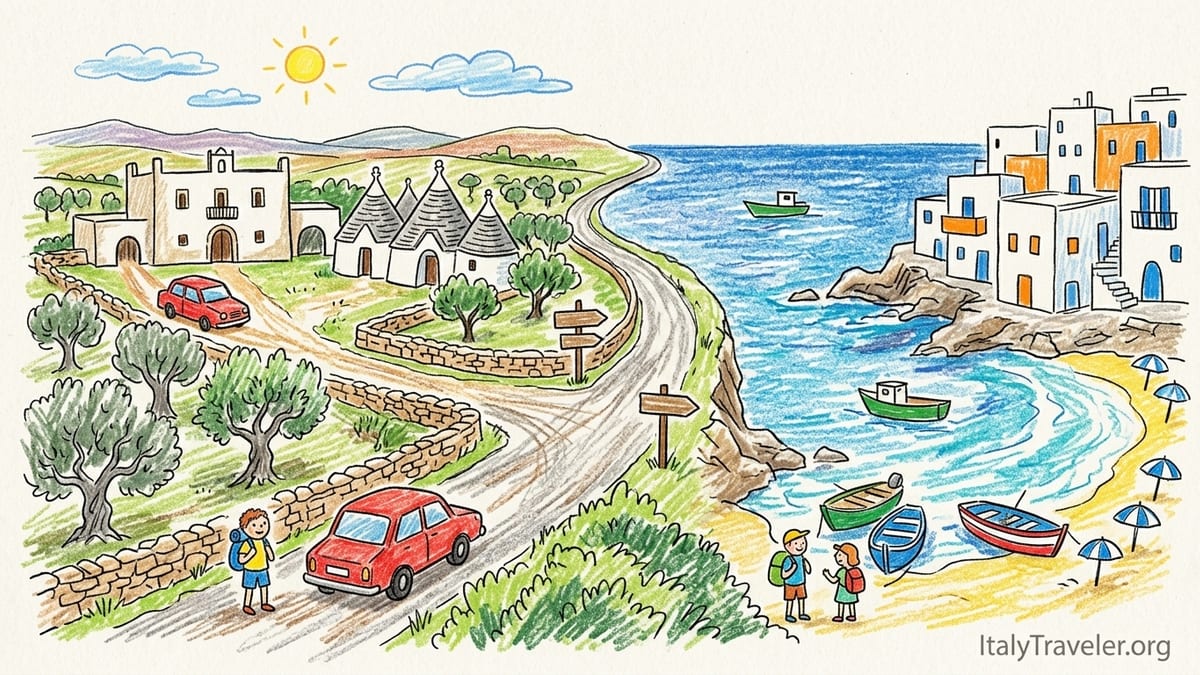
How to choose your base in Puglia
Most first-time visitors underestimate distances in Puglia. Trains run efficiently along the Adriatic spine linking Bari, Polignano a Mare, Monopoli and Lecce, but the Valle d'Itria hilltowns such as Alberobello, Locorotondo, Cisternino, Martina Franca and many countryside masserie require a car. On the opposite side of the region, Ionian coast towns like Gallipoli and Porto Cesareo are not on the same train line and demand more driving time.
Before you fall in love with an Instagram masseria or a cliff-top room, decide what matters most: easy public transport, daily beach time, village hopping in the countryside, or historic-city atmosphere and nightlife. Also think about your trip length. For a four-night stay it usually makes sense to pick a single base. For ten nights, splitting time between the Bari or Valle d'Itria area and Lecce or the wider Salento often gives a richer yet less rushed experience.
Season affects both feel and cost. In Bari, typical hotel prices across the city average around 135 US dollars per night in June, rising to about 205 dollars in July when demand peaks. In Lecce’s historic center, mid-range hotel averages in June sit just above 130 dollars per night for two adults, dropping slightly in September when the weather is still warm but the crowds thin. June and September are usually the sweet spots for value and pleasant temperatures, while August is the priciest and busiest period almost everywhere in Puglia.
In this guide, prices refer to recent examples for a couple in a standard double with breakfast when available, using flexible dates in June, August and September. Taxes like city tourist levies, often 2 to 4 euros per person per night, are usually added on top on arrival. Families can expect to pay around 30 to 60 percent more for a larger room or apartment with extra beds, or to rent a small trullo or cottage with a pool.
Strategy 1: Stay in a well-connected city (Bari, Lecce, nearby)
Bari is the main transport hub for northern and central Puglia and works well if you want to rely on trains. Bari Centrale station connects directly to Polignano a Mare, Monopoli, Fasano and on to Lecce, as well as inland lines toward Alberobello and Martina Franca. From the old town you can walk or take a short bus to the city’s urban beaches, but these are narrow strips of sand or shingle rather than the sweeping turquoise bays many visitors picture when they think “Puglia beach holiday.”
Hotel prices in Bari span from roughly 100 to 200 US dollars per night for a central double in June, with four-star properties such as JR Hotels Oriente Bari or Mercure Villa Romanazzi Carducci often quoting around 110 to 140 dollars for a flexible June night with breakfast, rising toward 160 to 200 dollars in peak July and August. A four-night city break for a couple in June therefore typically lands near 450 to 600 dollars before local tax, and about 900 to 1,200 dollars in a good four-star for a full week in high summer for two. Having a car in central Bari is possible, but many hotels charge 15 to 25 euros per day for parking and the traffic around the station can be intense.
Lecce offers a different kind of base: a compact Baroque city about 1 hour 40 minutes by direct train from Bari. Its honey-colored palaces and churches, busy aperitivo scene and good dining make it ideal for urban sightseeing before or after beach days in Salento. Mid-range hotels and B&Bs in the historic center often price standard doubles for June around 120 to 150 dollars including breakfast, with averages for the neighborhood reported close to 130 dollars per night for two. Prices peak in August, where central properties can easily reach or surpass 160 dollars nightly. Parking is more limited in Lecce’s old town than in modern districts, but several garages just outside the walls charge roughly 15 to 20 euros per day.
Using Bari or Lecce as a single base works best if you are comfortable planning day trips by train or have a car and do not mind driving out of town most mornings. Couples on a budget who prioritise museums, markets and nightlife over long beach days often enjoy Bari, while culture-focused travelers who want to pair churches and art with some Salento beaches generally prefer basing in Lecce. In both cities, breakfast is usually a strong point, with buffets heavy on local pastries and fruit. Pools, however, are rarer than in resort or countryside properties, so if daily swims are essential you may want at least part of your trip based elsewhere.
Strategy 2: A walkable seaside town (Polignano a Mare, Monopoli, Vieste, Peschici)
If you imagine days spent strolling to a little cove, swimming, then returning on foot to your room for a shower before dinner, a compact seaside town is the most practical base. On the Adriatic just south of Bari, Polignano a Mare and Monopoli are the stars. Polignano a Mare sits dramatically on limestone cliffs above the sea, with narrow streets and famous viewpoints. Its main beach, Lama Monachile, is striking but small and pebbly, squeezed into a cove under a bridge. There are other bathing platforms in town and sandy options a short drive away, but space on the main cove is limited in July and August and sunbathers quickly cover every inch of stone.
Monopoli, by contrast, has a working harbor, a graceful waterfront promenade and a string of small coves and lidos south of town that offer more classic beach days. The town’s central beach at Cala Porta Vecchia is right beneath the old walls, and within a few kilometers you reach larger sandy stretches served by beach clubs that rent umbrellas and loungers. Because of this, many travelers and local advisors recommend Monopoli over Polignano if daily swimming and sand are core priorities. Both towns sit on the main Bari to Lecce rail line, so using trains for day trips to Bari, Polignano, Monopoli, Ostuni and even Lecce is straightforward.
Recent pricing guides indicate that in Monopoli, a mid-range sea view room in June or September typically costs around 120 to 200 euros per night with breakfast, increasing to roughly 180 to 300 euros for similar rooms in July and August when demand is highest. More simple guesthouses and B&Bs away from the harbor can still be found in the 80 to 130 euro range in shoulder season. For a couple staying four nights in June in a harbor-front mid-range hotel with breakfast, a realistic budget might be 550 to 750 euros before tax. For seven nights in August in a similar category, 1,400 to 2,000 euros is common for two adults.
On the Gargano peninsula in northern Puglia, Vieste and Peschici offer another version of the seaside-town strategy. Here, long sandy beaches stretch for kilometers, framed by white cliffs and pine forest. Both towns have atmospheric historic centers perched on rocky promontories, with beaches reached on foot or through short shuttle rides. Prices on this part of the coast often run slightly lower than in Monopoli and Polignano, especially in June and September, although August remains expensive because Italians themselves holiday here. If your priority is long, sandy beaches with space to spread out and you are happy to be farther from Valle d'Itria and Salento, Gargano towns can be excellent value.
Strategy 3: Countryside masseria or trullo stay (Valle d’Itria, Ostuni, Fasano and surroundings)
The romantic image that draws many visitors to Puglia is not a city or town at all, but a stone farmhouse surrounded by olive trees and dry-stone walls. The densest concentration of masserie and trulli is in and around the Valle d’Itria, between Ostuni, Cisternino, Locorotondo, Alberobello, Martina Franca, Fasano and Monopoli’s inland countryside. This is where you find everything from simple agriturismi offering dinner from their own fields to luxury retreats with design pools, spas and private beach clubs.
Staying near Ostuni or in the wider Valle d’Itria is ideal if you want to spend days hopping between white hilltowns, vineyards and countryside restaurants. However, it usually demands more driving. Most masserie are several kilometers from the nearest town, located at the end of narrow lanes, and public transport is limited. It is technically possible to reach some properties by taxi from Ostuni or Fasano stations, but you will otherwise be dependent on transfers. For this reason, couples and families who want a countryside base with flexibility generally rent a car for this part of their stay.
Prices vary widely. A family-run agriturismo or modest countryside B&B with a pool can sometimes offer doubles in June and September in the band of 120 to 180 euros per night with breakfast, while well-known luxury masserie between Fasano and Savelletri can easily start around 500 euros per night in high summer and climb much higher for suites. Historic properties that combine trulli cones and lamia outbuildings, plus a large pool and on-site restaurant, often publish rate tables where mid-season, which for many runs from May to late June and again in early September, is meaningfully cheaper than the July and August high season.
There is also a practical difference between a converted trullo and a full-service luxury masseria. Many traditional trulli are small independent units with thick stone walls, one or two cones, and limited floor area. Rooms can feel cosy rather than spacious and some have small windows, which keeps them cool but less bright. Not every standalone trullo has central air conditioning; some rely on the natural insulation of stone. In contrast, luxury masserie usually offer hotel-style rooms with more generous square meterage, proper wardrobes, contemporary bathrooms and individual temperature control. They often sit closer to main roads for easier access and bundle breakfast, daily cleaning, restaurant service and sometimes kids’ clubs and bikes into the nightly rate.
For budget planning, imagine a couple booking a well-reviewed agriturismo with pool near Ostuni in June at 160 euros per night including breakfast and parking. Four nights would sum to around 640 euros before tax, and a week in September at a similar rate might be just over 1,100 euros. A family in a two-bedroom trullo with private pool in the Valle d’Itria might see weekly prices in late June or early July in the low to mid-thousands of euros. Luxury masserie, by comparison, can reach several thousand euros for seven nights in August for a couple, especially once half-board dinners and spa treatments are added.
Strategy 4: Beach resorts and Salento coasts (Gallipoli, Porto Cesareo, Otranto and Fasano coast)
If your top priority is long, sandy beaches and warm water, then true beach resort areas make the most sense. On the Ionian Sea, Porto Cesareo and the nearby lidos toward Punta Prosciutto are famous for Caribbean-like shallows. Further south, Gallipoli combines a lively old town on an island with newer resort strips along the coast where mid-range hotels and holiday villages line the sand. On the Adriatic in Salento, Otranto offers pretty coves and clear waters backed by a historic center, while the stretch down toward Santa Maria di Leuca features a mixture of rocky platforms and tucked-away sandy pockets.
Compared with staying in Lecce itself, these coastal towns allow you to walk or take a short drive to the beach and then return easily to your room. The trade-off is that you are farther from the main rail line and often more dependent on a car, especially in the evenings if you want to explore restaurants beyond your immediate neighborhood. Parking at hotels here is usually easier than in historic centers, with many properties including on-site parking or charging only a modest daily fee.
On the central Adriatic between Fasano and Savelletri, several high-end resorts combine countryside calm with private beach clubs, including some of the best-known luxury masserie. In this belt, nightly rates for June and September are often high but not yet at August extremes, while the core school-holiday weeks in August can see starting rates for doubles that are multiples of shoulder-season prices. Because these properties tend to be all-encompassing, with elaborate breakfast buffets, pools, kids’ areas and often half-board options, many guests spend much of their time on-site and treat the resort as the destination itself.
In practical budget terms, a mid-range family resort near Gallipoli or Porto Cesareo might price a double room with breakfast in June around 150 to 220 euros per night, increasing in August to 250 euros or more, with suites or quadruple rooms for families attracting a further surcharge. For a four-night June stay for a couple focused purely on beach time, you might expect a total accommodation cost between 600 and 900 euros. For a family of four over seven August nights in a resort environment, budgeting from the mid-two thousands of euros and upwards is sensible once you factor in a larger room category and local taxes.
Comparing seasons, trip lengths and costs
When comparing Puglia bases, it helps to look at concrete examples across June, August and September. In Bari, where average citywide hotel prices hover around 135 dollars per night in June, a couple booking four nights in a central hotel with breakfast could reasonably expect a total bill in the region of 540 to 600 dollars before tax. In August, with higher seasonal averages reported in much of Puglia, that same stay could edge closer to 700 to 800 dollars for similar properties. Extending to seven nights, a June city stay might fall between 900 and 1,000 dollars for two, while peak August can approach or exceed 1,400 dollars for a week in a good four-star.
In Lecce’s historic center, where typical June prices are quoted in the 130 dollars per night range for commonly booked hotels, a four-night June stay for a couple might sit around 520 to 600 dollars, with a seven-night stay around 900 to 1,100 dollars. In August, when average prices in Lecce rise toward the mid-160 dollar mark for popular central options, four nights could cost in the area of 650 to 750 dollars for two adults, and a full week might easily reach 1,200 to 1,400 dollars.
For seaside towns like Monopoli and Polignano a Mare, it is helpful to think in euros and in more detailed categories. Using recent June and September ranges of roughly 120 to 200 euros per night for a sea-view mid-range room with breakfast, a four-night shoulder-season stay for a couple might cost between 480 and 800 euros before tax. In July and August, with similar rooms quoted more in the 180 to 300 euro band, four nights for two can land anywhere from 720 to 1,200 euros, while a full week for two can easily stretch from around 1,300 to well over 2,000 euros depending on outlook, pool access and flexibility of cancellation terms.
Families in these same towns often face two options: book a single large room or suite with sofa bed and perhaps a bunk bed, or take two standard doubles where children are older. A family of four might therefore see their June accommodation costs climb to 200 to 300 euros per night for mid-range hotel options, or around 800 to 1,200 euros for four nights and 1,400 to 2,100 euros for seven nights. Choosing a self-catering apartment in the old town can reduce nightly prices, particularly in June and September, but cleaning fees and the lack of a pool or breakfast are important trade-offs to consider.
Practical differences: city hotel vs trullo vs luxury masseria
Beyond price and location, the style of accommodation in Puglia greatly shapes your experience. In Bari or Lecce a typical mid-range city hotel offers standardised doubles around 18 to 24 square meters with efficient bathrooms, reliable air conditioning, daily cleaning and a breakfast buffet. Many have no pool and limited outdoor space, though some in Bari offer small gardens or rooftop terraces. Parking is either in a paid garage or street spaces at a daily fee. Cancellation terms are often flexible in shoulder season, with free cancellation up to a few days before arrival, while cheaper non-refundable rates are common in August.
A converted trullo in the Valle d’Itria is almost the opposite. Here, a couple might have an independent cone-shaped stone building or a small group of cones with thick whitewashed walls. The bedroom can be compact but atmospheric, with curved ceilings and alcoves rather than flat walls. Bathrooms are often modernised but can be tight and not always separated from the sleeping area by solid doors. Many trulli rentals are self-catering, with kitchenettes, outdoor barbecues and private or shared pools. Breakfast is not always included, and daily cleaning may be weekly instead. Air conditioning can be built discreetly into the structure but in some simpler trulli the inherent coolness of stone is relied upon instead.
Luxury masserie blend historic architecture with hotel comfort. Rooms tend to be larger, often 25 square meters or more, with proper wardrobes, spacious bathrooms and high-quality bedding. Almost all have full air conditioning and heating, strong Wi-Fi, large pools and manicured grounds. Many top-end masserie near Fasano and Savelletri also operate private beach clubs with shuttles to reserved sections of the coast, offering sunbeds and restaurant service included or at negotiated daily rates. Breakfasts are usually elaborate, with a wide spread of local cheeses, cakes, fruit and made-to-order eggs, and half-board or tasting-menu dinners are common.
From a total-cost perspective, city hotels in Bari and Lecce usually win on price per square meter and simplicity, while trulli and luxury masserie offer experience and character at a premium. For example, comparing seven nights in June for a couple, a central Bari hotel at around 135 dollars per night could total roughly 950 dollars before tax with breakfast and no pool. A countryside agriturismo in the Valle d’Itria with a shared pool might price at 170 euros per night, for a weekly total around 1,200 euros plus car hire. A luxury masseria, meanwhile, could easily start from 450 or 500 euros per night in June for a double, meaning a seven-night stay might land in the region of 3,000 to 3,500 euros or more once drinks and extras are added.
When to split your stay: Bari or Valle d’Itria plus Lecce or Salento
For a ten-day trip, many travelers debate between one central base or a split itinerary. Given Puglia’s elongated geography, splitting your stay often improves the experience, especially if you want to see both the Bari or Valle d’Itria area and the southern Salento coasts without very long day trips. A popular pattern is to spend four or five nights in or near Bari, Polignano a Mare, Monopoli or a masseria near Ostuni or Fasano, then another five or six nights in Lecce, Otranto, Gallipoli or along the Ionian around Porto Cesareo.
This split works particularly well for visitors arriving and departing via Bari airport or arriving in Bari and leaving from Brindisi. You could start in Bari for easy access on day one, use trains to explore Polignano and Monopoli and perhaps join a day tour to Alberobello, then move by train to Lecce and rent a car there for the Salento portion. Alternatively, rent a car on arrival, head straight for a countryside masseria near Ostuni or Fasano for four nights of pool and hilltown-hopping, then drive on to a seaside base near Otranto or Gallipoli for the rest of the trip before finishing with a night in Bari or Lecce.
Splitting the stay does add one extra move and potentially two hotel changeovers, which can be more work for families with lots of luggage or those who prefer to unpack only once. On the other hand, it cuts down on daily driving. Instead of doing repeated 90-minute each-way trips from a single base to see distant parts of the region, you change hotels once and then keep day drives shorter. From a budget point of view, you can also mix price levels, for example choosing a more modest but well-located city hotel in Bari and then splurging on a few nights in a special masseria in the Valle d’Itria, or vice versa.
In simple terms, using one base works best if your itinerary is narrow and focused, such as a beach-heavy week around Monopoli, Polignano and the nearby countryside, or a culture-first break focused on Bari or Lecce plus a handful of nearby excursions. Splitting between the Bari or Valle d’Itria area and Lecce or Salento is usually better when you want equal parts countryside, beaches and cities and are comfortable with at least one hotel change in the middle of your stay.
The Takeaway
There is no single best base in Puglia, only the best choice for your priorities, season and budget. Bari is excellent for train connections, urban life and a soft landing or final night near the airport, but its beaches are urban strips rather than the turquoise bays seen in promotions. Lecce offers a walkable Baroque center with strong dining and nightlife, and works especially well when paired with a coastal base for Salento’s beaches. Polignano a Mare delivers cliff drama and a photogenic stone cove but relatively limited sandy space in high season, while Monopoli balances an atmospheric old town, harbor views and easier access to a series of nearby coves and sandy lidos.
Inland, the Valle d’Itria around Ostuni, Fasano, Locorotondo, Cisternino, Alberobello and Martina Franca is ideal for masseria and trullo stays and village exploration, but you will almost certainly need a car and will drive more than from city bases. Luxury masserie near the coast often function like small resorts, complete with pools and beach clubs, while more modest agriturismi and trulli offer character and countryside quiet in exchange for some practical compromises on space, services and, sometimes, air conditioning.
For four-night trips, decide on a single strategy: a city break in Bari or Lecce with well-planned day trips, a seaside town stay in Monopoli, Polignano, Vieste or Peschici, a countryside masseria holiday in the Valle d’Itria, or a pure beach escape near Gallipoli, Porto Cesareo or Otranto. For ten days, consider splitting your time between the Bari or Valle d’Itria area and Lecce or Salento, balancing your budget by mixing simpler city hotels with a few nights in a special masseria or sea-view property.
Whichever base you choose, booking early for August is important, as this month sees Italian holidaymakers fill coastal towns and push prices up across the board. June and September, by contrast, regularly combine more manageable rates with warm seas and quieter lanes, making them ideal months for travelers who want to experience both the beaches and the hilltowns without the most extreme crowds or costs.
FAQ
Q1. Is Bari a good base for a first trip to Puglia without a car?
Bari works very well if you plan to rely on trains, as it has direct rail connections to Polignano a Mare, Monopoli, Fasano and Lecce, plus inland lines toward Alberobello and Martina Franca. You can explore the old town, enjoy the seafront and take day trips along the Adriatic, although for a classic sandy-beach holiday you may prefer a smaller coastal town.
Q2. How do Monopoli and Polignano a Mare compare for beach time?
Polignano a Mare is famous for its dramatic cliffs and the photogenic but small pebble cove at Lama Monachile, while Monopoli offers a working harbor, city beach under the walls and a string of coves and sandy lidos just south of town. If your priority is daily swimming with more space to spread out on sand, Monopoli usually has the edge.
Q3. Do I need a car to stay in Ostuni or the Valle d’Itria?
Ostuni town itself is reachable by train and taxi, but most masserie, trulli and rural B&Bs in the Valle d’Itria are scattered among olive groves and reached by small country lanes. Public transport is limited, so renting a car is strongly recommended if you want the freedom to explore villages like Locorotondo, Cisternino, Alberobello and Martina Franca from a countryside base.
Q4. What is the difference between staying in a trullo and a masseria?
A trullo stay usually means a compact, cone-roofed stone building with lots of character, sometimes self-catering and not always with full hotel-style services or large rooms. A masseria is a fortified farmhouse complex that has often been turned into a hotel, with larger rooms, regular cleaning, substantial breakfasts, pools and sometimes a spa or beach club. Luxury masserie cost more but behave like full-service boutique resorts.
Q5. When are accommodation prices highest in Puglia?
Across much of Puglia, July and especially August are the most expensive months for hotels, with rates in popular coastal towns and luxury masserie significantly higher than in June or September. City averages in places like Bari and Lecce also rise in these months, reflecting peak holiday demand from Italian and international visitors.
Q6. Is Lecce better than staying directly on the Salento coast?
Lecce offers a rich Baroque urban experience with excellent restaurants, bars and cultural sites, and works well as a base for day trips by car to both the Adriatic and Ionian coasts. Staying directly in coastal towns like Otranto, Gallipoli or Porto Cesareo, however, places you closer to the beach and simplifies daily swimming, at the cost of being farther from Lecce’s nightlife and rail connections.
Q7. How do four-night and seven-night stays compare for budgeting?
Because nightly rates often decrease slightly on longer stays and you spread fixed travel costs over more days, seven-night trips can be better value per night than very short breaks. For planning, expect a couple in June to spend around 500 to 700 euros for four nights in a mid-range coastal town hotel and perhaps 900 to 1,200 euros for a full week, with August stays substantially higher, particularly for sea-view rooms and pool access.
Q8. What should families consider when choosing a base in Puglia?
Families often benefit from properties with pools, larger rooms or apartments, on-site parking and easy access to kid-friendly beaches. Seaside towns like Monopoli, Vieste and Peschici, or family-focused resorts near Gallipoli and Porto Cesareo, can work well. A countryside masseria with a pool is another strong option, provided you are comfortable driving to beaches and villages.
Q9. Is it worth visiting Alberobello, Locorotondo and Cisternino if I am not staying there?
Yes. These Valle d’Itria villages are some of Puglia’s most distinctive sights, with trulli districts, whitewashed lanes and panoramic views. Even if you base yourself in Bari, Monopoli or Lecce, it is worth planning at least one day or an overnight trip to explore Alberobello and nearby hilltowns, either by rental car or an organised tour.
Q10. Should I split a ten-day holiday between two bases or stay in one place?
If you mainly want beaches around one area, or prefer to unpack once, a single base can be simpler. However, if you hope to combine the Bari or Valle d’Itria area with Salento’s coasts and Lecce, splitting ten days into two bases usually reduces daily driving and lets you experience both northern and southern Puglia at a more relaxed pace.