


Puglia’s long Adriatic coastline, whitewashed hill towns and baroque cities make it one of Italy’s best regions for a self-drive holiday. Its geography, however, stretches for more than 350 kilometers from the Gargano headland in the north to the tip of Salento in the south, which means first-time visitors need to be realistic. Seven days is enough for a rich taste of central Puglia and northern Salento, but not enough to cover Gargano, the Valle d’Itria and all of Salento without turning the trip into a blur of hotel check-ins and rushed photo stops. This guide lays out three different but complementary itineraries for 7, 10 and 14 days, built around Puglia’s north-to-south geography so you can choose the route that fits your pace, budget and interests.
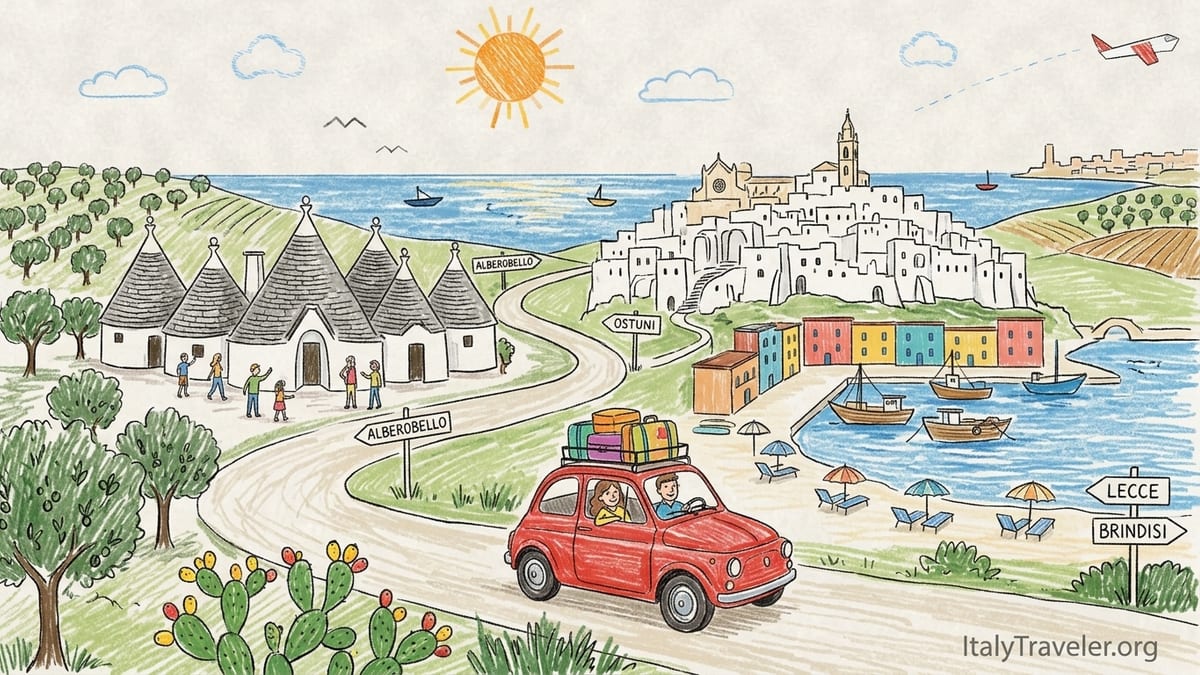
How to Structure Your First Puglia Road Trip
Puglia runs like a long, narrow heel: Gargano and the Tavoliere plains in the north, Bari and the Valle d’Itria in the middle, and Lecce with the Salento peninsula in the south. Distances look short on the map, but many roads are single carriageway and summer congestion around seaside towns can add 30 to 60 minutes to journey times. For example, Bari to Lecce is about 150 kilometers along the main SS16/SS613 and often takes around 1 hour 45 minutes by car in normal traffic, while Bari to Vieste on the Gargano is only slightly longer in distance but can take 3.5 hours once you hit winding coastal and forest roads.
Flying into Bari and out of Brindisi works well for most travelers because it follows the region’s natural north–south flow. Bari airport has more long-haul and low-cost connections, while Brindisi is closer to Lecce and the southern beaches. Car rental companies operating at both airports, such as larger international brands and regional outfits like Puglia by Car, usually permit one-way rentals between Bari and Brindisi, often with a one-way fee that can range from roughly 30 to 70 euro added to your rental price for a compact car if booked in advance. Some brokers advertise one-way offers that already include this fee, so it is worth checking the final total before confirming.
Trenitalia’s coastal railway offers an alternative spine between Bari, Polignano a Mare, Monopoli, Brindisi and Lecce, with frequent Regionale and Frecciargento services linking these cities in 45 to 90 minutes. This works well if you base yourself in two or three hubs such as Bari, Monopoli and Lecce, then add local transfers. However, inland villages like Locorotondo, Alberobello and many beaches near Ostuni, Otranto or Gallipoli either lack direct rail connections or sit several kilometers from the nearest station, so you still need buses, taxis or organized excursions. For most travelers keen on beaches and countryside, a rental car remains the most flexible option.
The itineraries below assume you are comfortable driving a small manual car, which is standard in Italy, and that you will avoid entering historic centers where ZTL (limited traffic zones) apply. In old towns like Bari Vecchia, Monopoli, Ostuni and Lecce, cameras enforce these zones and fines are sent months later via the rental company. A simple rule is to park just outside the center in marked paid lots or blue-lined street parking and walk in. Expect to pay from around 1 to 2.50 euro per hour in summer for official parking in popular coastal towns, with some private lots near main beaches charging a flat daily rate.
Seven-Day Itinerary: Central Puglia and Northern Salento
This 7-day route keeps your driving manageable and concentrates on Bari, the dramatic cliffs of Polignano a Mare, the harbor town of Monopoli, the Valle d’Itria hill towns of Alberobello and Locorotondo, the white city of Ostuni and baroque Lecce, with one curated beach excursion. You will fly into Bari and out of Brindisi, with two or three hotel bases to reduce packing and unpacking.
Day 1: Bari arrival and overnight Bari. From Bari airport to the city center is about 12 kilometers, usually 25 to 35 minutes by car. Plan 2 to 3 hours to stroll Bari Vecchia’s lanes, visit the Basilica di San Nicola and the seafront promenade. Parking garages around the Murat district give you a base to explore on foot, with daily costs in the region of 15 to 25 euro depending on location. Dinner along Via Argiro or in the old town often costs 25 to 40 euro per person for pasta or seafood, house wine and dessert in a mid-range trattoria.
Day 2: Bari to Polignano a Mare and Monopoli. Overnight Monopoli. Bari to Polignano is around 35 kilometers, commonly 40 minutes along the SS16. Spend the morning on Polignano’s viewpoints over Cala Porto, then consider a 1.5-hour sea-cave cruise with a local operator, with prices for shared tours in 2026 often around 35 to 45 euro per person for a small-group rubber boat or motorboat. These usually include visits to several grottoes and a short swim stop. Continue to Monopoli, 10 to 15 minutes south by car, where you can park in paid lots near the harbor and explore its compact historic center and promenade for 3 to 4 hours. Expect about 80 kilometers of total driving for the day, and allow at least 6 to 8 hours for sightseeing and the boat tour combined.
Day 3: Valle d’Itria loop from Monopoli. Overnight Monopoli. A circular day trip to Alberobello and Locorotondo from Monopoli covers roughly 70 kilometers of country roads. Monopoli to Alberobello takes about 40 minutes, and you will want a minimum of 3 hours to explore the trulli zones, visit a small trullo museum and stop for lunch. Paid parking areas sit just outside the monumental trulli district and usually charge hourly rates similar to coastal towns. Continue 15 minutes to Locorotondo, known for its white circular old town and wine bars, for a 1.5 to 2-hour stroll and tasting. You will spend 6 to 7 hours in total between visits and breaks. Return to Monopoli for dinner by the port.
Day 4: Castellana Caves and Ostuni. Overnight Ostuni. From Monopoli, drive 20 to 25 minutes inland to Castellana Grotte for the Castellana Caves. The official complex offers guided tours with different lengths, with 2026 adult tickets for the full route including the White Cave quoted in the low twenties in euro per person. There is paid parking signed around the entrance, including a main P1 area close to the visitor services. Reserve a morning tour then continue 35 to 45 minutes to Ostuni, roughly 40 kilometers via secondary roads. Plan 3 hours to walk Ostuni’s steep alleys, cathedral and viewpoints in the afternoon and evening. Driving distance today sits near 80 kilometers, with 5 to 7 hours spent between the caves and town.
Day 5: Beach day near Ostuni. Overnight Ostuni. Use Ostuni as a base for the Dune Costiere area. Beaches like Torre Guaceto, Rosa Marina or Pilone are within 20 to 35 minutes by car. Torre Guaceto’s protected area usually requires parking in external lots, then taking shuttle services or walking into the reserve, with parking and shuttle charges applied during the high season. Reserve a beach club where possible if you want guaranteed loungers and shade, as the most popular lidos near Ostuni often sell out on August and weekend mornings. A full beach day allows time to return to Ostuni for an evening aperitivo. Driving distance can be kept under 60 kilometers, with 5 to 7 hours by the sea.
Day 6: Ostuni to Lecce via coastal towns. Overnight Lecce. Drive about 80 to 90 kilometers today. Reach Brindisi in roughly 35 minutes if you follow the SS379, then continue another hour to Lecce along the SS613. With stops, this can become a half-day transfer. Instead of multiple short halts, choose one stop, either for a quick harbor walk in Brindisi or a late lunch in a coastal town such as San Cataldo near Lecce. Aim to be in Lecce by late afternoon, leaving 3 to 4 hours to explore its baroque churches, the Roman amphitheater and Piazza Sant’Oronzo. Several parking lots ring the old town; daily rates typically run around 12 to 20 euro. Evening dining for two in Lecce, including antipasti, mains and wine, often totals 60 to 90 euro depending on restaurant.
Day 7: Lecce and departure from Brindisi. Overnight none. If your flight from Brindisi is later in the day, keep the car until departure and use the morning for final Lecce sightseeing or a quick side trip. Lecce to Brindisi airport is about 45 kilometers and often 35 to 40 minutes by highway. Factor in at least 2 hours before departure to return the car and clear security, especially in peak months. Total driving over this 7-day itinerary generally falls between 450 and 550 kilometers, which keeps daily journeys short enough to preserve beach and village time.
Ten-Day Itinerary: Adding Otranto, Gallipoli and Southern Salento
The 10-day version expands the 7-day route by adding Otranto on the Adriatic, Gallipoli on the Ionian side and the Porto Cesareo coast so you experience both seas without rushing. You still fly into Bari and out of Brindisi, but you add a third southern base, which can be either Otranto or somewhere between Gallipoli and Porto Cesareo depending on beach preferences.
Days 1 to 5 follow the 7-day itinerary from Bari to Lecce, with the same overnight stops in Bari, Monopoli, Ostuni and Lecce, and one relaxed beach day in the Ostuni area. From Day 6, remain in Lecce for one more night but use your time for a cultural focus rather than covering more towns. Consider booking a guided walking tour or a cooking class in Lecce, many of which last 2.5 to 4 hours and cost roughly 40 to 100 euro per person depending on group size and inclusions. This keeps the day light on driving while adding context to Salento’s food and architecture.
Day 7: Lecce to Otranto. Overnight Otranto. Lecce to Otranto is around 45 kilometers and often 40 to 50 minutes by car on fairly straightforward roads. Stop en route at the Alimini Lakes area or a stretch of coast such as Torre dell’Orso if you want a swim. Allocate 3 hours within Otranto to visit the cathedral with its famous mosaic floor, walk the compact historic walls above the harbor and swim at the town beach if time and season allow. Parking is in signed lots and pay-and-display areas just outside the walls. Expect about 80 kilometers of total driving including short detours, with 5 to 7 hours between driving and exploration.
Day 8: Capo di Leuca coastal loop. Overnight Otranto. Use Otranto as a base for a full-day drive around the tip of Salento. Otranto to Santa Maria di Leuca via the coastal SP358 is about 70 kilometers, but the winding scenic road, viewpoints and photo stops easily turn this into a 2-hour journey. Plan a stop at sites such as Grotta della Poesia or the sea-cliff views near Castro Marina. From Santa Maria di Leuca, continue up the Ionian side toward Gallipoli, then back inland to Otranto, covering roughly 160 to 180 kilometers in total. Build in a half-day of beach time on the Ionian side, where sand is softer and the water often calmer, before returning to Otranto in the early evening.
Day 9: Otranto to Gallipoli and Porto Cesareo. Overnight near Porto Cesareo or in Gallipoli. Otranto to Gallipoli is around 75 kilometers across the peninsula, usually 1 hour 15 minutes by car. Gallipoli’s old town sits on an island linked by a bridge, with several paid parking lots on the mainland side so you can walk in without entering the narrow historic streets by car. Many visitors spend 3 to 4 hours in town wandering its lanes, visiting the castle and enjoying seafood lunches on the waterfront. Continue 35 to 40 minutes up the coast to Porto Cesareo for late-afternoon beach time. Here you will find a concentration of stabilimenti balneari, or lidos, that rent umbrellas and loungers. In July and August many require advance reservations for front-row spots, either directly or via hotel concierge services, with day packages for two sunbeds and an umbrella frequently running from around 25 to 40 euro depending on the club and weekend surcharges.
Day 10: Beach time and departure via Brindisi. Overnight none. From Porto Cesareo or Gallipoli, Brindisi airport is 60 to 80 kilometers away, usually 1 to 1 hour 15 minutes by car. Spend your final morning on the beach or at a relaxed lunch, then drive toward the airport. In total, this 10-day plan adds several hundred kilometers of coastal driving to the 7-day baseline, but spreads them out so you have at least one substantial beach or village block most days instead of continuous transfers.
Fourteen-Day Itinerary: Including Gargano or Slowing Down
With two weeks in Puglia you can either extend north into the Gargano peninsula or take a slower loop that keeps you between Bari and Santa Maria di Leuca with fewer hotel changes. Gargano feels almost like a separate region, with white cliff towns such as Vieste and Peschici and dense beech woodland in the Foresta Umbra. Reaching it adds significant driving, so it suits travelers who enjoy road time and varied landscapes.
Option 1: Gargano extension. Fly into Bari and immediately drive toward Gargano, spending 3 or 4 nights split between Vieste and Peschici. Bari to Vieste is roughly 185 to 200 kilometers, often 3.5 hours or a bit more in high season because of narrow, twisting sections of road as you approach the peninsula. Vieste offers sandy beaches, a dramatic white town and boat tours to coastal grottoes. Peschici is smaller but also perched above the sea and serves as a gateway to forest drives and smaller coves. The provincial road between Vieste and Peschici follows the coast for about 20 kilometers and can take 35 to 45 minutes, though views and photo stops will likely stretch the time.
Dedicate at least one day to exploring the Foresta Umbra, the beech and oak forest at the heart of the Gargano National Park. Access roads climb from the coast into cooler woodland, with picnic areas and walking trails signed near the main visitor hubs. The former state road through the forest, now a provincial road, links the Gargano interior with the coastal routes and carries heavy summer traffic as visitors move between beaches and mountain viewpoints. You will want a full day here, with 60 to 100 kilometers of total driving depending on your chosen trailheads and detours.
From Gargano, drive back toward Bari for a night or two in Trani or Bari itself before continuing with a condensed version of the central Puglia and Salento itinerary. This might mean skipping one of the Valle d’Itria towns to avoid backtracking. Another option during a 14-day Gargano trip is to add an excursion to the Tremiti Islands, reached by ferry from ports such as Vieste or Termoli. Regional regulations currently restrict non-resident motor vehicles on the Tremiti Islands between early May and late October, so visitors usually leave their car in long-stay parking near the mainland port for the length of the island stay. Check availability and costs for these lots well ahead of time, as facilities near smaller ports can be seasonal and limited.
Option 2: Slow Puglia route. If you prefer fewer hotel changes, use 14 days to deepen your stays around Bari, the Valle d’Itria and Salento rather than extending to Gargano. One workable pattern for a slow route is 4 nights in or near Monopoli for Polignano, Castellana Caves and the hill towns, 4 nights in a countryside masseria near Ostuni for beaches and day trips, and 5 or 6 nights around Lecce or a seaside village like Otranto or Gallipoli. This approach reduces urban driving and allows unscheduled days by the pool or sea while still reaching highlights such as Otranto’s cathedral, Gallipoli’s old town and the far tip of Santa Maria di Leuca on single-day outings.
On a two-week slow itinerary your total driving distance can stay within 800 to 1,100 kilometers, even including several inland loops. Most days involve no more than 1.5 hours on the road, and some days none at all. This suits families traveling with younger children or couples who prefer longer dinners and beach days to frequent packing. Choosing agriturismi or masserie with on-site restaurants or tasting menus can also reduce night driving on rural roads.
Driving, ZTLs, Parking and Beach Logistics
Driving in Puglia is manageable for most visitors used to European or North American conditions, provided you take a compact car, avoid city cores during rush hours and pay close attention to ZTL signs. In Bari, Lecce, Ostuni and other historic centers, ZTLs are marked at their access points; cameras read license plates and issue fines automatically. Many hotels inside or near ZTL areas in smaller towns can register your plate for temporary access if they have arrangements with the municipality, but you must confirm this before driving in. A simple strategy is to book accommodations that either include parking on-site just outside the historic core or clearly state that they provide guidance to ZTL-safe garages.
Parking ranges from municipal lots to privately run facilities near beaches and marinas. Official public parking generally uses blue street lines with pay-and-display machines or app payments, and white lines for free parking when signed. Daily costs in coastal towns can reach 15 to 20 euro or more in peak season if you stay several hours. Near popular beaches on the Gargano and in Salento, seasonal lots often charge a flat fee for the day, sometimes around 5 to 10 euro, collected at entry. Take small notes and coins, as some lots do not accept cards and machines can be slow when busy.
Summer beach logistics require more planning than many first-time visitors expect. At well-known stretches such as Porto Cesareo’s lidos, the Baia Verde area near Gallipoli, or parts of the coast north of Otranto, a majority of the shore is managed by beach clubs. These clubs rent umbrellas and loungers in rows, with first and second rows usually priced higher than those further back. Booking ahead via phone, email or your hotel is strongly recommended from late June through early September, particularly for weekends. If you prefer free public sections, arrive early in the morning to secure space and shade.
When considering experiences that need advance reservations, three often stand out in a Puglia road trip: Castellana Caves, Castel del Monte and Polignano sea-cave cruises. The official ticket office for the caves recommends buying tickets online up to the day before your visit to guarantee a place on your preferred tour slot, as day-of availability can be limited in August and during holidays. Castel del Monte, the octagonal castle inland from Bari and Andria, charges a modest entry fee for adults, in the single-digit euro range, and can be combined with a half-day trip from Bari or Trani. Guided tours and shuttle services from parking areas at the base of the hill are available, though you should verify times and prices before travel.
Comparing Car, Train and Car-Free Alternatives
For a first-time Puglia visit focused on both towns and beaches, renting a car remains the most flexible way to follow the itineraries above. Compact manual cars are often the most economical choice, and recent market checks suggest that a 10-day high-season rental booked a few months ahead at Bari airport can land in the range of several hundred euro before extras, with child seats, additional drivers and premium insurance plans adding to the total. Some regional operators require a security deposit in the mid-hundreds of euro on your card at pickup, especially if you opt for partial rather than full insurance cover. Larger international rental brands typically build mandatory regional fees into your quote, but you should still read terms carefully for airport supplements and late-return charges.
The main advantages of driving are access to rural masserie, hill towns not directly served by Trenitalia, and beaches where buses run infrequently or not at all. Inland roads around the Valle d’Itria and Gargano are usually in decent condition but can be narrow with limited shoulders. Night driving on unlit country lanes demands extra caution for pedestrians, cyclists and wildlife. Some travelers choose to split their transport, using trains between Bari, Polignano, Monopoli, Brindisi and Lecce, then renting a car only for a Salento or Gargano segment. This can reduce parking stress in larger cities and keep total rental days, and thus costs, lower.
Car-free travelers can still follow a simplified version of these itineraries by focusing on the coastal rail corridor and joining organized day trips. Bari, Polignano a Mare and Monopoli are linked by frequent trains, and local tour companies offer excursions by minivan to Alberobello, Matera, Ostuni and some beaches. In Salento, Lecce serves as a hub for buses to Otranto and Gallipoli, although schedules can be sparse outside summer. This approach suits travelers who prioritize historic centers, architecture and food over remote beach coves and are comfortable working around timetables rather than spontaneous stops.
History-focused visitors could even construct an itinerary almost entirely by train and bus, spending extended time in Bari, Trani, Barletta, Lecce and Otranto. This would shift emphasis from beach clubs to castles, cathedrals and museums, including Bari’s Basilica di San Nicola, Trani’s waterfront cathedral, Barletta’s fortress and Lecce’s baroque churches. You would still need occasional taxis or organized transfers for more remote sites like Castel del Monte or certain archaeological parks, but your base rhythm would rely on fixed rail and bus routes rather than driving.
Trip Budgets for Couples and Families
Trip budgets in Puglia vary widely based on travel dates, accommodation style and how many organized experiences you choose. For a couple following one of the itineraries above in June or September, a realistic mid-range daily budget might include 100 to 160 euro for accommodation with air conditioning and private bathroom, 50 to 90 euro for meals and drinks depending on whether lunch is a sit-down meal or beach snack, 30 to 60 euro averaged per day for car rental and insurance spread over the rental period, and 10 to 25 euro for parking, tolls and fuel. Add 20 to 40 euro per day for entry tickets and experiences like the Castellana Caves, occasional boat trips, tasting menus or guided tours. This places a 7-day couple’s road trip in a rough band from around 1,500 to 2,200 euro excluding flights, and a 14-day stay roughly double, subject to season and choices.
For a family of four in high summer, accommodation in larger rooms or apartments often ranges from 150 to 250 euro per night in popular coastal areas, sometimes more for masserie with pools. Restaurant meals can still be kept under 25 to 35 euro per person at casual places if you share antipasti and focus on pasta, pizza and simpler seafood dishes, though beach-club lunches and gelato rounds add up quickly. Car rental costs rise with vehicle size and required child seats, which can add 5 to 8 euro per seat per day up to a capped amount per rental with some companies. Parking at busy beaches and towns can also be a more noticeable line in the budget when you stay a full day in one lot.
Families or groups trying to keep costs lower can travel in late May, early June or late September, when nightly rates and beach-club prices are often softer than in late July and August. Self-catering apartments with kitchens help reduce meal costs, especially at breakfast and for some dinners. Choosing fewer paid experiences and more free activities, such as walking coastal paths, visiting free public beaches and exploring old towns independently, also keeps the budget in check without feeling deprived.
Travelers who skip the car and rely on trains and buses will save on rental and fuel expenses but may spend more on central accommodation and organized day tours. For a history-focused couple traveling car-free and staying mainly in Bari and Lecce, daily budgets might fall 15 to 25 percent below those of drivers, depending on hotel choices and how many guided excursions they join. They also avoid potential surprise costs like parking fines or ZTL violations that can occur if signage is missed.
The Takeaway
Planning a Puglia itinerary starts with acknowledging its stretched-out geography. Seven days is enough to enjoy Bari, the cliffs around Polignano a Mare and Monopoli, the trulli and white towns of the Valle d’Itria, a carefully chosen beach near Ostuni and the baroque city of Lecce, but it is not enough to comfortably add Gargano and all of southern Salento. Extending to 10 days lets you experience both Adriatic and Ionian coasts through Otranto, Gallipoli and Porto Cesareo while preserving long, unhurried beach and village stops. With 14 days you can either fold in Gargano’s cliffs, forest and possibly the Tremiti Islands, or slow down and deepen your time in central and southern Puglia with fewer moves.
Choosing a route also means deciding how you like to travel. Drivers willing to navigate ZTL boundaries, pay for parking and prebook a few key experiences gain maximum flexibility to reach rural masserie and quieter coves. Car-free visitors trade some of that flexibility for less stress behind the wheel and simpler logistics in rail-linked towns. In every case, reserving in advance for summer beach clubs, sea-cave cruises, caves and castles will prevent long queues or sold-out signs from eating into your limited vacation days.
Whichever itinerary you pick, think of Puglia as a sequence of distinct zones rather than a single line on a map. Enjoy the contrast between Bari’s busy waterfront and Monopoli’s relaxed harbor, between Alberobello’s iconic trulli and Lecce’s intricate stonework, between Otranto’s Adriatic light and Gallipoli’s Ionian sunsets. Leave space in your schedule and budget for an unplanned seaside lunch, an extra swim or a detour to a hilltop belvedere, and your first Puglia road trip will feel like the beginning of a longer relationship with Italy’s heel rather than a frantic box-ticking dash.
FAQ
Q1. Is seven days enough to see all of Puglia?
Seven days is enough for central Puglia and a slice of Salento, but not to cover Gargano, the Valle d’Itria and all of Salento in a relaxed way.
Q2. Do I really need a car for this Puglia itinerary?
A car gives you the most flexibility for hill towns and beaches, but you can combine trains with organized tours if you focus on Bari, Monopoli, Brindisi, Lecce and Otranto.
Q3. How bad is summer traffic and parking in Puglia?
In late July and August you should expect heavier traffic near coastal towns, full parking lots by mid-morning at popular beaches and more time needed to reach your hotel or lido.
Q4. What should I watch out for with ZTLs when driving?
Look for ZTL signs at the entrances to historic centers, avoid driving past them unless your hotel confirms you are registered, and favor parking just outside the old towns.
Q5. Is it worth paying extra for a one-way car rental from Bari to Brindisi?
For itineraries that start in Bari and end in Salento it often saves backtracking, and typical one-way fees between the two airports are moderate compared with the time saved.
Q6. How far in advance should I book Castellana Caves or Polignano boat tours?
In high season it is wise to secure tickets or places on tours at least a few days ahead, and for peak weeks or weekends up to a week in advance if you have fixed dates.
Q7. Can I visit the Tremiti Islands with a rental car?
You usually leave the rental car on the mainland and use ferries as some seasonal rules restrict non-resident vehicles from landing on the islands in summer.
Q8. Are Puglia’s trains useful for beach days?
Trains are very useful along the main coastal corridor, but many good beaches lie several kilometers from stations so you may still need buses, taxis or bikes to reach the sand.
Q9. How expensive are beach clubs in Salento?
Prices vary, but a pair of loungers and an umbrella in a popular Salento lido can often cost the equivalent of a modest restaurant meal, especially in front-row positions in high summer.
Q10. What is a realistic daily budget for a couple on a Puglia road trip?
Including mid-range accommodation, meals, car costs, parking and a few paid experiences, many couples find a daily budget somewhere in the low to mid hundreds of euro works comfortably.