


Driving across northern Italy links some of Europe’s most dramatic mountains, romantic lakes and historic cities in one compact region. From the mirror-like waters of Lake Como and Lake Garda to the jagged peaks of the Dolomites, from Venice’s lagoon to the vineyards of Piedmont and the pastel ports of Liguria, a road trip lets you connect these landscapes at your own pace. This guide focuses on the practical side of the journey: how to rent a car, navigate tolls and mountain passes, avoid costly ZTL fines, and choose scenic routes that make the drive as memorable as the destinations.
Planning Your Northern Italy Road Trip Route
A classic loop for a one to two week road trip in northern Italy starts and ends in Milan, which has major international flights and a wide choice of rental car companies. One common pattern is Milan to Lake Como, then across to Lake Garda and the Dolomites, down to Venice and Verona, then west through the Prosecco or Valpolicella wine areas towards Piedmont’s Langhe hills, before dropping to the Ligurian coast and finally back to Milan. Each leg is typically two to four hours of driving on a mix of toll motorways and local roads.
If you have around 10 days, you might spend two nights on Lake Como, two on Lake Garda, three in the Dolomites, one in Venice, one in Verona and two split between Piedmont and Liguria. With two full weeks you can add an extra night in Venice, more time in the Dolomites and a slower roll through the Langhe villages such as Barolo and La Morra, or along Liguria’s quieter western Riviera between Finale Ligure and Sanremo. Try to cluster your city stays together so you can return the car before Venice, or pick it up only after Venice, to avoid parking headaches and ZTL risks.
Season matters for this itinerary. High summer brings long days and the best odds of clear lake and mountain views, but also heavier traffic on the autostrade and in the Dolomites. September and early October are excellent for road conditions, with harvest in Piedmont and fewer crowds, while late October through April can bring snow and temporary closures on higher passes in the Dolomites. If your trip is outside late May to early October, plan to stick mostly to valley roads in the mountains.
Before you finalize the loop, check where you actually need a car. For example, many travelers now take the train from Milan to Venice, explore the lagoon car free, then collect a rental at Venice Mestre or Verona Porta Nuova before heading to the Dolomites and lakes. This avoids Venice’s parking costs and the stress of arriving in a car-dependent city for your first Italian driving experience.
Rental Cars, Insurance and Driving Essentials
Most international brands and Italian companies operate from Milan Malpensa, Milan Linate, Venice Marco Polo, Verona and Turin airports, as well as major rail stations. Compact and mid-size cars are best suited to narrow village streets and mountain hairpins; a typical manual compact may cost roughly 35 to 60 euros per day in shoulder season, with automatics often 30 to 50 percent more. If you are not comfortable with manual transmissions, book an automatic well in advance, especially for summer and school holiday dates, as fleets are limited.
When reserving, scrutinize insurance. Basic legally required coverage is included, but collision damage waivers often come with a high excess that may be around 800 to 1500 euros. You can reduce or eliminate this with the rental company’s premium package or rely on a separate excess insurance policy or a credit card that explicitly covers rentals in Italy. At pick up, walk around the car, take time-stamped phone photos of every scratch and wheel scuff, and make sure the rental agreement records them.
Italy drives on the right, with metric speed limits: typically 130 km/h on autostrade in dry conditions, 90 km/h on secondary roads and 50 km/h in built-up areas unless indicated otherwise. Speed cameras are common on motorways and secondary roads and fines can be mailed months later to your home address, often via the rental company. In the mountains and lakes region, be prepared for local habits such as brisk overtaking on two-lane roads and scooters appearing in blind spots; steady, predictable driving is safer than trying to match aggressive locals.
For navigation, an offline-enabled app like Google Maps or another GPS tool works well, but cross-check its suggested shortcuts in cities. Some apps will cheerfully route you across ZTLs or down impossibly narrow lanes. A practical habit is to zoom in on city centers and refuse any route that cuts directly through a historic core; choose the ring roads and clearly marked parking areas instead. CarPlay and Android Auto work in many newer rentals but do not depend on them without a backup plan saved on your phone.
Tolls, Autostrade and Practical Costs
Northern Italy’s main motorways are toll roads, known as autostrade. On most routes, you take a ticket when entering, then pay when exiting based on distance and vehicle class. For example, a typical passenger car journey from Milan to Venice or Milan to Bolzano will cost roughly 20 to 30 euros in tolls one way, while shorter hops such as Milan to Lake Como or Verona to Lake Garda might be in the 4 to 10 euro range depending on the exact exit. Toll prices are usually displayed on boards at the plaza, but amounts for long trips can still surprise first-time visitors so it is wise to budget at least 10 to 15 euros of tolls per substantial driving day.
At toll booths, keep to the lanes marked with a white ticket symbol or the cash and card icons. The yellow Telepass lanes are for subscribers and should be avoided by rental drivers unless your car is specifically equipped. Contactless cards and major credit cards are widely accepted, but it is still useful to have some cash for occasional older booths or machines that reject foreign cards. If you accidentally enter a Telepass-only lane and the barrier does not raise, you can press the help button and follow the operator’s instructions, which may include paying at a nearby office or online later.
Toll and fuel costs add up quickly in this region because distances can be deceptive on the map. Moving between lakes, Dolomites and Verona often involves zigzagging across major roads. Fuel prices at motorway service areas are usually higher than at supermarkets or village stations, so it can be worthwhile to top up away from the autostrada when convenient. Many travelers find that a two-week loop of roughly 1500 to 2000 kilometers, driven in a compact petrol car, might consume around 130 to 180 euros in fuel at current average prices, though this varies with driving style and exact routing.
Some newer bypass motorways in Lombardy and Veneto use free-flow tolling captured by your license plate or transponder rather than traditional tickets. If your itinerary includes these, ask the rental desk how charges are handled. In many cases, fees are automatically billed to the rental company’s account and passed on to you with an administrative surcharge, which might be a fixed amount per toll or per invoice. Reading the rental company’s motorway and fine policy in advance can prevent unpleasant surprises weeks after you return home.
ZTL Zones, Parking and City Driving
Historic centers of Italian cities often have restricted traffic areas, known as ZTL zones, that are controlled by cameras. Cities in this northern loop such as Verona, Padua, Milan, Turin and many smaller towns operate ZTLs, typically signposted with a white circle containing a red ring and the letters ZTL. Entering without authorization means a fine for each camera you pass, not just for being in the area once. Fines can be around 80 to 100 euros per violation before administrative fees, and rental companies add their own processing charges when they pass your details to police.
To avoid problems, plan to park outside historic centers and walk or use public transport in. In Verona, for example, visitors often use large paid car parks such as those around the Porta Nuova station or multi-level facilities near the arena that are clearly outside the ZTL boundary, then stroll into the old town. On Lake Como, a town like Bellagio has limited central parking; many drivers leave their cars in peripheral blue-line paid spots or private lots and move around on foot or by ferry. In Venice, almost everyone leaves vehicles in Mestre on the mainland or in large garages at Piazzale Roma or Tronchetto, then switches to waterbuses or walking.
Parking rules differ by color of lines: white spaces usually indicate free parking but may be resident-only at certain hours, blue lines are paid parking with a meter or ticket machine, and yellow lines are for special use such as loading or permits. Always check signs on the nearest pole rather than assuming. Typical city-center car parks in this part of Italy may charge around 2 to 4 euros per hour, while day rates in secured garages can run from about 15 to 30 euros depending on the location. Smaller villages around the lakes may have cheaper public lots, but in high season they fill early in the day.
When booking hotels in cities like Verona, Turin or Genoa, confirm whether they are inside a ZTL and if they can register your license plate for temporary access. Some accommodations in restricted zones can pre-authorize guests, which means you can legally drive to their garage along a specific route. Get written instructions, follow them precisely and keep screenshots in case of disputes later. If you dislike navigating traffic, consider staying in suburbs or secondary towns with train connections and treat the cities as easy day trips by rail.
Scenic Routes: Lakes, Dolomites and Ligurian Coast
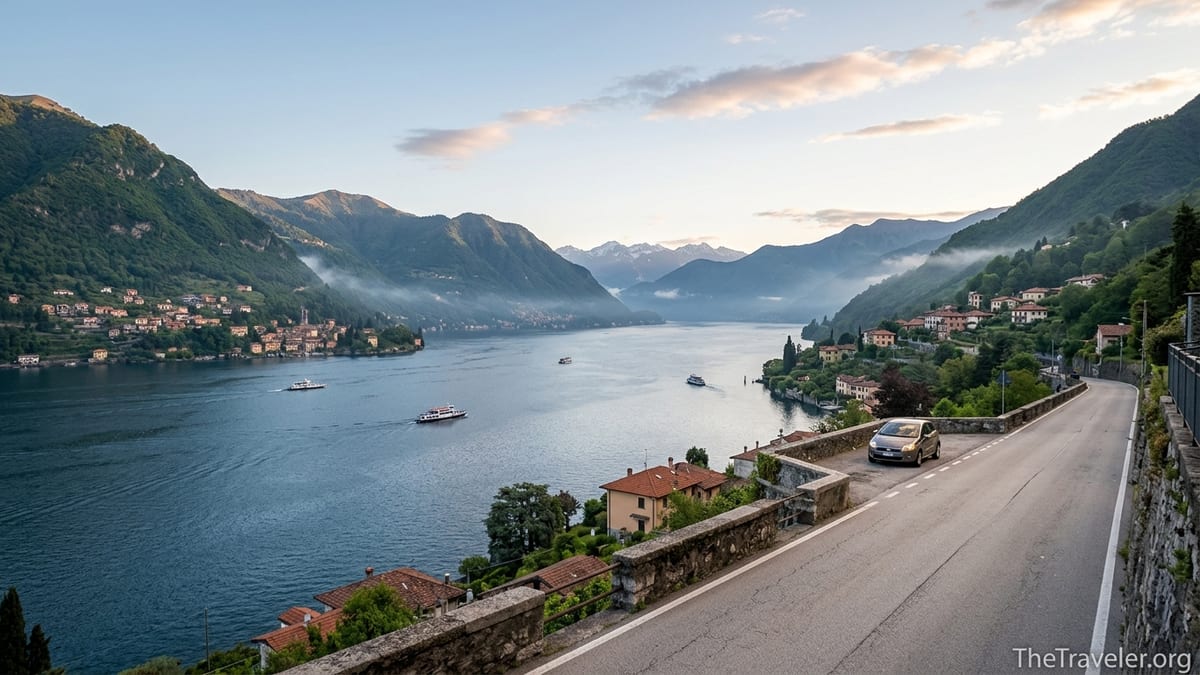
While autostrade are efficient, the joy of a northern Italy road trip lies on the slower roads skirting lakes and winding into mountain passes. On Lake Como, a classic drive runs from Como town along the western shore through Cernobbio, Argegno and Tremezzina to Menaggio. The road is narrow in places, sometimes with rock walls on one side and guardrails above the water on the other, and local buses can feel huge as they squeeze past. Take your time, pull into lay-bys to enjoy the views and consider crossing on one of the short ferries between Menaggio, Bellagio and Varenna rather than circling the entire lake.
Lake Garda offers two very different shores. The eastern side between Peschiera and Malcesine has broader, busier roads passing through Garda, Bardolino and Torri del Benaco, where you will see long promenades and family-friendly resorts. The western side, from Desenzano through Salo and on to Limone sul Garda, is more dramatic, with tunnels and cliff-hugging stretches such as the section north of Gargnano. A popular scenic option is to combine a stay at Sirmione or Bardolino with a day drive up the lake and then into the Trentino mountains towards Riva del Garda, maybe looping back via the Val di Ledro or the wine country around Trento.
In the Dolomites, the Great Dolomites Road connecting Bolzano to Cortina d’Ampezzo is one of the most rewarding drives, typically covered in a long day with plenty of stops. The route threads past viewpoints, alpine lakes and ski villages, and includes several passes with tight hairpins and steep gradients. In high summer, these roads can be crowded with cyclists, motorbikes and campervans, so plan for slower progress than the map might suggest. For overnight bases, towns such as Ortisei in Val Gardena, Corvara in Alta Badia or San Candido in the eastern Dolomites give easy access to loops over famous passes and cable car stations.
On the Ligurian coast, driving is about balancing views with practicality. The Cinque Terre villages themselves are largely off-limits to non-resident traffic, so most drivers base in nearby towns like La Spezia, Levanto or Sestri Levante and visit the cliffside villages by train or boat. However, stretches of the Aurelia road between Genoa and La Spezia offer wonderful sea panoramas, and the coastal segment west of Genoa towards Finale Ligure, Noli and Varigotti passes fragrant terraces of olives and lemons with pullouts above crescent beaches. In peak summer, traffic can choke on weekends, so early morning departures and midweek moves are kinder on your nerves.
Mountain Roads, Seasons and Safety in the Dolomites
The Dolomites are crisscrossed by passes that can make any driver feel like they are in a car commercial, but they demand respect. Many passes are above 2000 meters, with gradients that frequently touch 8 to 10 percent and sequences of tight hairpins. In July and August, you share these roads with tour buses negotiating wide arcs, enthusiastic motorcyclists leaning into corners and road cyclists climbing at their own pace. A realistic strategy is to pick one major loop per day, such as a Sella Ronda-style circuit around the Sella massif, and stop often for short walks, coffee breaks and photos instead of pushing to cover everything.
Pass conditions vary by season. Higher routes typically open from late May or early June, once snow clearance is complete, and stay accessible until late October or early November in a typical year. In winter, some passes close entirely while others remain open with snow clearing, especially those serving major ski areas. Between mid November and mid April, many provincial regulations require either winter tires or chains on board for cars using mountain roads. Rental contracts in northern Italy often include appropriate tires in winter at an extra daily fee, or provide chains that you must know how to fit; at check-in, ask staff to show you how the chains work before you drive away.
Weather in the Dolomites can change very quickly, even in summer. Afternoon thunderstorms are common on hot days, which can make steep descents slippery and reduce visibility dramatically. Always check local forecasts the night before, and on the day itself be prepared to adjust your plan. If the mountains are socked in with cloud, consider swapping driving passes for exploring valley towns such as Brunico, Bressanone or Cavalese, where roads are generally less exposed. Keep your fuel tank at least half full in mountain areas, as petrol stations can be sparse late at night or on Sundays outside major resorts.
On narrow mountain roads, use low gears on descents to avoid overheating your brakes, and pull into designated lay-bys or wider spots if traffic builds up behind you. Many drivers new to the Alps forget that stopping in the middle of a hairpin just to take a photo can be dangerous and illegal; instead, use officially signed viewpoints or parking pockets. If you feel uncomfortable with a particular pass due to weather or fatigue, there is almost always a lower alternative through a valley that will simply take longer but feel more relaxed.
Venice, Verona, Piedmont and Liguria by Car
Venice rewards those who leave their cars behind. If your road trip includes the city, the most stress-free option is often to park at Mestre on the mainland and take a short train or tram into Venezia Santa Lucia. Daily parking in secure Mestre garages is usually cheaper than at Piazzale Roma or the Tronchetto garages at the edge of the lagoon. If you do choose to drive all the way in, follow signs carefully, expect slower traffic on the causeway and be prepared for parking fees that can exceed 30 euros per day in peak season. Once you step into Venice proper, cars play no role, so treat it as a break from driving.
Verona, by contrast, works well as a stop on a road itinerary. The city sits just off the A4 motorway between Milan and Venice and provides quick access to Lake Garda, Valpolicella vineyards and the Lessinia hills. Many drivers stay in neighborhoods just outside the historic core, such as near Porta Nuova or on the Adige’s opposite bank from the arena, where hotels with garages offer easy in and out. A typical pattern is to park the car after arrival, spend an afternoon and evening exploring the arena, Piazza delle Erbe and Castelvecchio on foot, then use the car the next day for a loop through wine country with tastings at local estates that welcome visitors by appointment.
Piedmont’s Langhe and Roero regions are particularly suited to leisurely driving. Roads snake between vineyard-covered hills, linking villages like Barolo, Monforte d’Alba, Neive and Barbaresco. Distances are short but packed with stops at viewpoints, wineries and small restaurants serving regional dishes. In autumn, especially around October and early November, traffic increases due to the Alba truffle fair and harvest events, and hotel parking fills quickly, so advance bookings matter. In contrast to crowded lakes and coasts, many midweek days here feel relaxed, with farm lanes and hilltop chapels almost to yourself.
Along the Ligurian coast, Genoa is both a gateway and a slightly challenging drive, with tunnels, elevated roads and sharp ramps merging quickly. Some travelers choose to bypass the city center by staying in outer districts or continuing directly to smaller resort towns. In the eastern Riviera, basing in Santa Margherita Ligure or Rapallo works well if you plan day trips by ferry or train to Portofino and the Cinque Terre. In the western Riviera, Finale Ligure, Alassio and Bordighera offer more traditional seaside promenades; parking ranges from curbside blue-line spaces to larger paid lots near the beach, often filling by late morning in July and August.
The Takeaway
A northern Italy road trip stitching together lakes, Dolomites, Venice, Verona, Piedmont and Liguria offers an unusually rich mix of landscapes and cultures within manageable driving distances. Success comes from treating the car as a flexible link between regions rather than a burden in historic cities, and from respecting the realities of toll roads, ZTLs, tight parking and mountain weather. By choosing a compact vehicle, planning overnight bases with easy parking, and favoring one scenic drive per day over rushed box-ticking, you create space for long lunches, unplanned swims and impromptu photo stops.
With thoughtful planning, the practicalities fall into place and the logistics fade into the background. You remember not the toll booths or parking meters, but the glow on Lake Garda at sunset, the silence on an early-morning Dolomite pass before the traffic builds, a late dinner under arcades in Verona, the smell of fermenting grapes in Piedmont and the sound of waves beneath Ligurian cliffs. This guide gives you the tools to navigate northern Italy confidently behind the wheel so that your time and attention can rest where they belong, on the journey itself.
FAQ
Q1. Do I really need a car for a northern Italy trip, or can I rely on trains?
Trains connect major cities like Milan, Venice, Verona and Turin very well, but a car is valuable for exploring lakeside villages, Dolomite valleys, Piedmont vineyards and smaller Ligurian towns that have limited or infrequent public transport.
Q2. Which size of rental car is best for the Dolomites and lake roads?
A compact or mid-size car is usually ideal, as it fits better on narrow streets, tight hotel garages and mountain hairpins. Larger SUVs can be more comfortable but are harder to park and maneuver in historic areas.
Q3. How expensive are tolls on a typical northern Italy road trip?
Costs vary by route, but many travelers on a 10 to 14 day loop might spend roughly 70 to 150 euros on tolls, with single long runs like Milan to Venice or Bolzano often around 20 to 30 euros each way.
Q4. How can I avoid ZTL fines in cities like Verona or Turin?
Use car parks on the edge of the historic center, follow signs carefully, and never drive past a ZTL camera sign unless your hotel has specifically authorized your plate and given you a clear route. When in doubt, park farther out and walk in.
Q5. Is it safe to drive the Dolomite passes if I have limited mountain experience?
Yes, if you drive cautiously, avoid bad weather, use low gears on descents and allow plenty of time. Choose well-known passes, start early in the day and skip routes that feel beyond your comfort level, especially in rain or fog.
Q6. What is the best time of year for a northern Italy road trip including the Dolomites?
Late June through September usually offers the most reliable conditions for high passes and lake activities. May and October can be wonderful shoulder seasons, though some passes or cable cars may have limited operations or temporary closures.
Q7. Where should I base myself for exploring Lake Como by car?
Towns like Menaggio on the western shore or Varenna on the eastern side work well, with parking options and easy ferry links to Bellagio. Many people park the car for a day or two and use boats to move between villages.
Q8. Can I park in or near the Cinque Terre villages with a rental car?
Access for non-resident cars is very restricted. It is usually easier to stay in La Spezia, Levanto or another nearby town with parking, then visit the Cinque Terre by train or boat and leave the car parked.
Q9. Are winter tires mandatory for driving in northern Italy in colder months?
In many alpine provinces, including parts of the Dolomites, regulations require winter tires or chains on board between mid November and mid April on certain roads. Rental companies in northern Italy typically equip cars accordingly, sometimes for an extra fee.
Q10. Is it better to pick up the rental car in Venice or Milan for this loop?
Many travelers fly into Milan, spend time in the city or on Lake Como and then start the driving loop there. Others visit Venice first by train and collect a car at Venice Mestre or Verona Porta Nuova afterward to avoid driving and parking in the lagoon area.