


Sardinia is often reduced to a simple choice between "north" and "south," but the island is far more varied than that. Before you book flights into Olbia, Alghero or Cagliari and lock in a hotel, it helps to think in terms of coastlines and character: granite coves in Gallura, limestone cliffs in Ogliastra, city life around Cagliari and quiet sandy bays in the southwest. This guide breaks the island into practical regions, compares major towns, looks at real-world costs for a one-week stay, and offers a clear decision framework so you can pick the right part of Sardinia for your first or next trip.
How Sardinia Really Breaks Down: Regions, Airports and Access
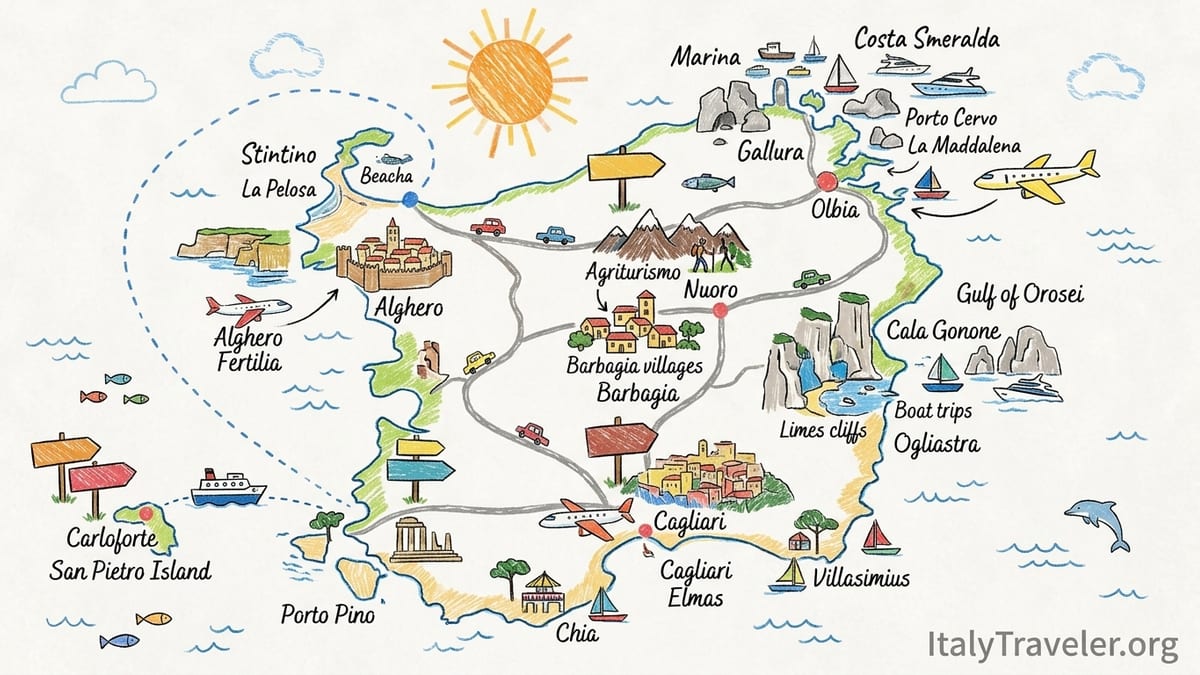
Sardinia has three international airports: Olbia Costa Smeralda in the northeast, Alghero Fertilia in the northwest and Cagliari Elmas in the south. These three entry points effectively divide the island into travel regions. Olbia works best for the northeast Gallura coast, including Porto Cervo, Cannigione, Palau, Santa Teresa Gallura, San Teodoro and inland Arzachena. Alghero serves the northwest, including Alghero itself, Stintino and the historic town belt toward Sassari. Cagliari is the gateway to the south and southwest, from Villasimius and Costa Rei in the southeast to Pula, Chia and the island of San Pietro with Carloforte in the southwest.
For planning, it is more practical to think in five coastal bands plus an inland zone rather than just “north versus south.” The northwest runs from Stintino down to Bosa and covers Alghero. The northeast or Gallura region covers Santa Teresa Gallura, Palau, La Maddalena, Cannigione, Arzachena and Porto Cervo. The central east coast includes Olbia’s southern fringe, San Teodoro, Orosei and Cala Gonone on the edge of Ogliastra. The south runs from Villasimius and Costa Rei on the east through Cagliari’s Poetto beach and down to Pula and Chia on the southwest corner. The true southwest, around Carloforte and Porto Pino, feels like a separate, quieter world again.
Driving between these regions takes longer than many visitors expect. Cagliari to Olbia is roughly three and a half hours by car, and Alghero to Villasimius can easily exceed four hours with summer traffic. If you have one week, it generally makes more sense to choose one main region and perhaps add a short inland stay around Nuoro and Barbagia than to split your time between north and south. Ferry ports such as Olbia, Golfo Aranci and Porto Torres also influence itineraries, especially for travelers bringing a car from mainland Italy or France.
Public transport connects the larger towns and airports, but outside Cagliari and Alghero city areas a rental car remains the most realistic way to move between beaches and villages. Bus connections exist between Cagliari and Pula or Villasimius, and between Olbia and nearby resorts such as San Teodoro and Cannigione, yet frequencies drop outside July and August and services are sparse in the evening. This is an important factor if you are planning a car-free trip.
Northwest Sardinia: Historic Towns, Stintino’s Sand and Reasonable Prices
The northwest coast, centered on Alghero and stretching toward Stintino, suits travelers who want a blend of beaches and historic atmosphere without the full price premium of northeastern Costa Smeralda. Alghero itself is an attractive Catalan-influenced port town with a walled old center, cobbled lanes and a seafront promenade. Urban beaches like Lido di San Giovanni are not as spectacular as those in Gallura or Chia, but within a short drive you reach coves such as Le Bombarde and Lazzaretto with clear, shallow water.
Stintino, about an hour north of Alghero, is known for La Pelosa, one of Sardinia’s most photographed beaches. In July and August the area is extremely busy, and La Pelosa now has daily visitor limits and a small access fee in peak season, which helps protect the fragile dune system but also requires advance planning. Accommodation in Stintino in August is generally more affordable than in Porto Cervo, yet prices still spike, and parking near La Pelosa can be tightly regulated with paid lots and fines for roadside parking.
In terms of costs, average hotel prices in the wider Sardinia market in August sit somewhere above 140 to 150 euro per night for a midrange double, with June and September a little lower according to large booking platforms, and Alghero often comes in slightly under that island-wide average for comparable properties. Travelers willing to stay in guesthouses or agriturismi a short drive from the coast can often find rooms under 120 euro in June and September, even closer to 90 euro in less central locations. Restaurant prices are moderate: a pizza and a drink in Alghero typically runs around 15 to 20 euro per person, while a seafood dinner with wine in the old town can approach 40 to 50 euro per person.
This northwest band is a good choice for visitors who want some nightlife and dining choice in Alghero, a sense of history and walkable streets, but who are not focused solely on the turquoise coves that define the northeast and parts of the south. It is also well placed for day trips inland toward Sassari and to quieter beaches south toward Bosa for those who prefer a less polished but more local-feeling coastline.
Gallura and the Northeast: Granite Coves, La Maddalena and the Costa Smeralda Debate
The Gallura region in the northeast is where the stereotypes of “north Sardinia” often come from, especially the polished Costa Smeralda strip around Porto Cervo. Gallura’s coastline is built from sculpted granite, creating small coves and rocky headlands that shelter intense blue water. Towns such as Palau, Cannigione, Arzachena and Santa Teresa Gallura each offer different takes on this landscape, while the La Maddalena archipelago offshore is a protected marine area with some of the island’s clearest water.
It is important to separate Costa Smeralda from the rest of the northeast. Porto Cervo and the immediate Costa Smeralda area are among the most expensive places in Sardinia, especially in August, with luxury hotels easily charging four-figure sums per night and even basic rooms costing several hundred euros. By contrast, Cannigione or Palau a short drive away often have midrange hotels in June and September around the 130 to 180 euro range per night for a double, sometimes less in early June, and self-catering apartments that keep food costs down. Arzachena’s inland hamlets and agriturismi can come in below 120 euro per night outside the absolute peak weeks.
Boat trips define much of the experience here. From Palau and La Maddalena, full-day shared boat excursions through the La Maddalena archipelago typically cost in the region of 50 to 70 euro per adult in 2026 for larger boats, with more intimate sailing or catamaran trips running higher and private charters costing several hundred euros per day. These tours usually last six to eight hours, include multiple swimming stops at islands such as Spargi, Budelli and Santa Maria, and return to port by late afternoon. Car ferries connect Palau to La Maddalena in less than 30 minutes, with round-trip fares for a car and two adults typically under 50 euro in total, making it realistic to stay on the mainland and day trip to the islands or vice versa.
La Maddalena town itself has a compact historic center and feels more village-like than Porto Cervo, with evening passeggiata along the harbor and smaller guesthouses rather than big resorts. Santa Teresa Gallura at the far north combines a busy summer town square with access to the sandy Rena Bianca beach and ferries to Bonifacio in Corsica. Nightlife in Gallura centers on Porto Cervo’s clubs and designer bars in July and August, while Cannigione and Palau offer a more low-key set of waterfront bars, gelato shops and family-friendly promenades.
Central East and Ogliastra: Limestone Coastlines around Orosei and Cala Gonone
Moving south from Olbia toward San Teodoro, Orosei and Cala Gonone, the feel of the coast shifts. The granite coves of Gallura give way to a more dramatic limestone coastline, especially along the Gulf of Orosei and into Ogliastra. This is where you find towering cliffs dropping into the sea, caves accessible only by water and beaches such as Cala Luna, Cala Mariolu and Cala Goloritzé reached by boat or strenuous hiking trails.
San Teodoro, roughly 30 minutes south of Olbia airport by car, offers long sandy beaches such as La Cinta and a lively summer town center with bars and markets. It is popular with younger Italian travelers and families alike. Accommodation prices here in August rise significantly, but June and September can still offer double rooms under 150 euro per night and apartments at lower nightly rates when shared by families or groups. Restaurants range from simple panini bars close to the beach to seafood trattorie in town, with typical main courses in the 15 to 25 euro range.
Further south, Orosei and nearby Cala Gonone feel more remote and are good bases for nature-focused trips. Cala Gonone, at the foot of steep limestone slopes, has a small harbor from which numerous boat companies depart daily in season for tours along the Gulf of Orosei. Full-day excursions with multiple beach stops often cost between 50 and 80 euro per adult on shared boats, while renting a small rubber dinghy for the day with basic guidance can run higher but gives more freedom. Hiking routes in Ogliastra’s interior, such as those descending toward Cala Goloritzé, draw adventurous visitors in shoulder season when temperatures fall.
This stretch of coast appeals strongly to hikers and travelers seeking more active holidays who do not mind less nightlife and a steeper landscape. Driving between beaches and towns involves winding mountain roads, and public transport is limited, so a rental car is highly recommended. Compared with Gallura, however, accommodation prices for similar quality are often a little lower, especially away from San Teodoro in peak weeks.
Cagliari, Villasimius, Costa Rei and the South Coast
The southern band of Sardinia is anchored by Cagliari, the island’s largest city and capital. Cagliari combines a historic hilltop center, a working port and a long city beach at Poetto that stretches for several kilometers. Unlike purely seasonal beach towns, Cagliari has year-round life, museums, markets and dining. For visitors in spring or autumn, the ability to combine city exploration with beach time and inland excursions is a major advantage.
To the east of Cagliari, Villasimius and Costa Rei offer some of Sardinia’s most accessible white-sand beaches, including Simius, Punta Molentis and the long stretch at Costa Rei itself. Villasimius is about an hour and fifteen minutes by car from Cagliari airport and operates very much as a summer resort town with a compact center, evening pedestrian zones and a broad mix of hotels and holiday rentals. Costa Rei is more spread out along the shoreline, with clusters of holiday villages and villas. During August, prices here rival those in the northeast, but in June and September they are often significantly more affordable than Porto Cervo and more in line with Cannigione or Palau for midrange stays.
West of Cagliari, the coast bends toward Pula and Chia. Pula is a charming small town known for the nearby archaeological site of Nora, where seaside Roman ruins and a small amphitheater sit directly on the coast. Chia is a collection of beaches and a few resort clusters rather than a single town, with wide sandy bays and dunes that attract families and windsurfers. In peak season, beach parking near Villasimius, Costa Rei and Chia is usually paid, with daily rates that can add a noticeable amount to a week’s budget for travelers who drive to the beach each day.
Average nightly accommodation prices in southern Sardinia vary widely by location and season. Data drawn from regional and commercial sources suggests that Cagliari’s midrange hotels often remain a little less expensive in August than the most in-demand beach towns, both north and south, with some double rooms for under 180 euro even in peak weeks if booked early. In June and September, both Cagliari and the surrounding coastal towns generally see more competitive rates, with three-star hotel doubles often found in the roughly 110 to 150 euro range and self-catering apartments giving good value to families.
Southwest Sardinia and Carloforte: Quieter Beaches and Archaeology
The true southwest, beyond Pula and Chia, is where Sardinia feels furthest from the glossy image of Costa Smeralda. Here, coastal villages, long sandy beaches and important archaeological sites sit next to small industrial and mining relics from the island’s more recent past. The island of San Pietro, home to the town of Carloforte, is a highlight. Carloforte is reached by short car ferries from the Sulcis coast and blends Ligurian fishing traditions with Sardinian culture, creating a unique atmosphere and food scene, particularly around tuna and pesto dishes.
Beaches on this side of the island, such as those near Porto Pino, Chia’s western bays and the dunes south of Teulada, are largely sandy and can feel much less crowded than their better-known northeastern counterparts in all months except mid-August. Archaeology fans will find Punic and Roman remains not just at Nora near Pula but also inland and along the coast, providing variety for those who do not want a pure beach holiday. Nightlife here is limited, with evenings centering on seaside promenades, small bars and summer festivals in towns like Carloforte rather than clubs.
In price terms, the southwest often undercuts both Costa Smeralda and southeast Sardinia in peak season. Midrange hotels and guesthouses in Carloforte, Pula and nearby coastal villages can still book up in August, but June and September tend to offer doubles under roughly 130 to 150 euro per night in many properties. Parking is easier and often cheaper than around the most famous northeast and southeast beaches, and driving is less stressful outside a few bottlenecks on summer weekends.
For travelers who care more about long walks on wide beaches, local cuisine and archaeological day trips than about designer shopping or nightlife, this region is a strong alternative to the north. It pairs particularly well with a few nights in Cagliari at the start or end of a trip because travel times are manageable and the same airport serves both areas.
Nuoro and Barbagia: Agriturismo, Hiking and Cultural Travel
Inland Sardinia, centered on Nuoro and the Barbagia villages, offers a completely different style of trip that blends easily with either a northern or southern coastal base. Nuoro itself sits on a plateau with views of the surrounding mountains, while nearby villages such as Orgosolo, Oliena, Mamoiada and Gavoi retain strong Sardinian traditions, from murals and poetry to wine and cheese-making. The region is associated with writers such as Grazia Deledda and with a slow, introspective view of island life.
Agriturismi, or farm stays, around Nuoro and in the Barbagia hills typically include dinner and breakfast featuring local products, from roast suckling pig and goat stews to pecorino cheese and Cannonau wine. Prices for a double room with half-board in these rural properties often compare favorably to coastal hotels, especially in August, with rates that can sit comfortably below 160 euro per night for two people, though the most refined agriturismi can cost more. For travelers interested in culture and food, even a two-night detour inland can become a highlight of a Sardinia trip.
Hiking opportunities abound in this area, including routes around Monte Ortobene near Nuoro and more challenging trails in the Supramonte and Gennargentu ranges. Temperatures are cooler than on the coast, especially at night, making Barbagia particularly attractive in July and August when the beaches are hottest and most crowded. However, rental cars are almost essential to move between villages and trailheads, and roads can be narrow and winding, so confident driving is required.
Combining Barbagia with either Orosei and Cala Gonone on the east coast or with the southwest around Carloforte creates itineraries that feel very different from a simple north versus south beach comparison. This is one reason why thinking in terms of regions and interests leads to more satisfying trip planning than a basic island split.
Costs in Practice: Seven-Night Stays in June, August and September
To get beyond generalizations and into real decisions, it helps to compare what a seven-night trip might cost in different regions at three key times of year: June, August and September. The examples below assume a couple staying in a midrange hotel or comparable apartment, plus a rental car and typical local parking and excursion costs. Prices are approximate, drawn from recent 2025 and 2026 rate patterns from booking platforms, car hire aggregators and regional price surveys, and are intended to show realistic orders of magnitude rather than exact quotes.
In June, a couple staying in Porto Cervo in the heart of Costa Smeralda might expect a midrange hotel to start around 280 to 350 euro per night, making accommodation alone 2,000 to 2,450 euro for a week. The same couple in Cannigione or Palau on identical dates could often find comfortable doubles in the 140 to 190 euro range, or 1,000 to 1,330 euro for seven nights. In nearby Arzachena inland hamlets, agriturismi and smaller hotels might come in around 130 to 170 euro per night, or roughly 900 to 1,200 euro for the week. In comparison, Cagliari city hotels in June might average around 130 to 180 euro per night, Villasimius and Costa Rei around 150 to 200 euro, and Pula or Carloforte generally in a similar or slightly lower band.
In August, costs diverge much more sharply. A midrange stay in Porto Cervo can easily climb to 400 to 600 euro per night or more, pushing a seven-night accommodation bill for a couple toward 2,800 to 4,200 euro. The same dates in Cannigione or Palau might see doubles in the 220 to 280 euro range, around 1,540 to 1,960 euro for the week, while Arzachena’s inland options can remain below 220 euro per night in many cases. In the south, Cagliari might still offer midrange doubles starting under 200 euro even in August for early bookers, and beach towns such as Villasimius, Costa Rei, Chia and Pula often sit around or a little above 200 to 260 euro per night for similar comfort levels. These ranges underline that Costa Smeralda is an outlier in price rather than a proxy for all of northern Sardinia.
September often brings a noticeable price drop while the sea remains warm. Porto Cervo might fall back toward 260 to 350 euro per night, Cannigione and Palau to 140 to 190 euro, Arzachena and Barbagia agriturismi to around 120 to 170 euro, and Cagliari and the south to roughly 120 to 180 euro for midrange hotels. For families of four, self-catering apartments in Cannigione, Palau, Orosei or Villasimius can often keep total accommodation costs near or even below 1,800 euro for a week in June or September, rising above 2,200 euro in August in the most in-demand spots.
Car rental is an additional significant line item. In recent seasons, compact rental cars booked ahead for a week in June or September have often been available in the 280 to 350 euro range at Cagliari and Olbia airports, with August rates sometimes jumping over 450 to 600 euro or more amid strong demand. Add to this beach parking, which in many coastal communes now costs a few euros per hour or 7 to 15 euro per day, and you might add 80 to 120 euro in parking fees for a week of daily beach visits. Shared boat excursions to La Maddalena or the Gulf of Orosei typically add 100 to 160 euro for a couple, or 200 to 300 euro for a family of four, depending on the type of boat and inclusions.
Comparing Key Towns: Atmosphere, Beaches and Practicalities
Within these regions, individual towns differ considerably in feel. Alghero offers the most atmospheric historic center in the northwest, with plenty of restaurants and bars, while Stintino is more of a seasonal village built around its famous beach. Santa Teresa Gallura in the northeast has a compact town square, ferries to Corsica and a central town beach, making it a lively yet manageable base. Palau and Cannigione both have practical harbors and promenades, acting as gateways to La Maddalena and the wider Costa Smeralda coast, but with more modest price tags and a family-friendly orientation.
Porto Cervo is purpose-built for high-end tourism, with designer boutiques, yacht marinas and clubs. The village itself is small and feels exclusive, especially in high season. By contrast, Arzachena’s inland hamlets and small local centers 10 to 20 minutes from the coast are quieter and more residential, despite being part of the same administrative area. La Maddalena town, on its island, has a more lived-in feel, with year-round residents, schools and working fishing boats, yet still plenty of summer hotels and restaurants.
On the east coast, San Teodoro is one of the liveliest summer towns, with night markets and music, while Orosei’s historic center retains more stone houses, churches and narrow lanes with a somewhat calmer pace. Cala Gonone is compact and dramatic, squeezed between mountains and sea. In the south, Cagliari is a full city with neighborhoods ranging from the historic Castello district to modern shopping streets, while Villasimius and Costa Rei feel like classic Mediterranean resort towns. Pula combines a pretty center with proximity to Nora, whereas Chia is mostly a set of beaches with hotels, villas and a few services.
Travelers without a car should prioritize bases with compact layouts and good local transport. Cagliari tops this list, followed by Alghero and, to a lesser extent, towns like Olbia, Palau, La Maddalena and Villasimius that have seasonal bus links and walkable cores. Spread-out areas like Costa Rei and much of Chia are poorly suited to car-free stays because beaches and services are often several kilometers apart. Families often favor Cannigione, Palau, Orosei, Villasimius and Pula for their mix of supermarkets, calm evening streets and easy access to child-friendly beaches.
North vs South Crowds: When and Where Sardinia Really Fills Up
Tourism data from Sardinian and Italian statistical bodies confirms what many locals observe on the ground: the bulk of overnight stays clusters in July and especially August, with some municipalities in coastal areas seeing a particularly sharp August peak, especially in the northeast around Arzachena and the Costa Smeralda. Within Gallura, August nights far exceed those of June and September, and crowding is especially evident along the small coves and in ports like Porto Cervo and Poltu Quatu.
Crowding, however, is not uniform across the island. Northeast centers such as Porto Cervo, Cannigione, Palau and Santa Teresa Gallura attract a dense concentration of visitors in August, driven by both Italian vacation periods and international arrivals. Parking lots at famous beaches can fill early, and restaurant reservations become necessary. By contrast, Cagliari spreads its visitors more evenly thanks to city and business travel, and the southwest around Carloforte, Porto Pino or less-publicized beaches near Teulada and Iglesias tends to see noticeably fewer visitors outside mid-August weekends, even at the height of summer.
The eastern Gulf of Orosei and Ogliastra also experience a seasonal spike, but because access to many beaches is by boat or long hike, the sense of overcrowding on land can be less intense than in road-accessible resorts, even if boats cluster in popular bays during the middle of the day. Inland Barbagia villages see their highest activity during festivals and specific events, which often take place outside the hottest weeks of summer.
For travelers, this means that “north versus south” is less useful as a crowd predictor than specific choices of town and timing. A week in Porto Cervo in mid-August will feel far more crowded and expensive than a week in Carloforte or even Cagliari at the same time, while a June stay in Cannigione or Palau can feel relaxed and uncrowded compared with an August stay in any of the island’s main resort areas.
Decision Framework: Matching Regions to Different Types of Traveler
For first-time visitors with one week, a practical approach is to choose a single coastal region with good airport access and, optionally, add one or two nights inland. A first-time couple flying into Olbia in June who want a mix of beaches and day trips without extreme prices might stay in Cannigione or Palau, take a boat excursion to La Maddalena, and add a one-day drive down to San Teodoro. A first-time traveler flying into Cagliari in September might combine three nights in the city with four nights in Villasimius or Pula, mixing museums, Nora’s ruins and beach days.
Honeymooners and travelers seeking a splurge often gravitate toward Porto Cervo and parts of Costa Smeralda, but similar scenery is available at more moderate prices in Cannigione, Arzachena hamlets and Palau. For instance, a June honeymoon week in Cannigione with a sea-view room, one private boat charter to La Maddalena and dinners in good seafood restaurants might deliver the same emotional impact as Porto Cervo at a significantly lower overall cost. For couples visiting in high season, splitting time between a few days in a premium village and a few inland nights at a Barbagia agriturismo can balance budget and experience.
Families with younger children often benefit from basing themselves where beaches are shallow and services are close at hand. Cannigione, Palau, San Teodoro, Orosei, Villasimius, Costa Rei and Pula all work well in this respect. In these places, a rental car is still valuable but daily driving distances can be short. Booking a self-catering apartment or holiday home outside peak August can keep weekly costs reasonable, especially when supermarket shopping replaces some restaurant meals. For families visiting in August, the south and southwest can sometimes offer a better balance of price and space than Costa Smeralda, particularly if they are willing to stay a little inland.
Hikers and active travelers should look closely at Orosei, Cala Gonone and inland Barbagia as well as Palau or La Maddalena for coastal and island hikes. A two-base trip, with four nights in Orosei or Cala Gonone and three nights in a Barbagia village, allows for boat trips along the Gulf of Orosei plus mountain hikes and cultural visits. Visitors without cars are best served by Cagliari, Alghero, Olbia and a handful of compact resorts with strong seasonal bus links such as Villasimius and, to a lesser degree, Palau and La Maddalena. For these travelers, north versus south is mainly a question of flight availability and whether they prefer a more urban stay (Cagliari, Alghero) or smaller resort base.
FAQ
Q1. Is northern or southern Sardinia better for a first visit?
For a first visit, both can work. If you want classic granite coves and boat trips, the northeast around Cannigione, Palau and La Maddalena is ideal. If you prefer city life with good beaches and easier public transport, Cagliari plus the nearby south coast is often more practical.
Q2. Is Costa Smeralda the same as all of northern Sardinia?
No. Costa Smeralda is a relatively small and very expensive part of the northeast centered on Porto Cervo and nearby bays. Towns like Cannigione, Palau, Santa Teresa Gallura and La Maddalena share similar scenery but generally have more moderate prices and a broader mix of travelers.
Q3. Which side of Sardinia has better beaches?
Both north and south have excellent beaches, but in different styles. Gallura in the northeast features small granite coves and islands, while the south and southwest offer long sandy bays such as those around Villasimius, Costa Rei, Chia and Porto Pino. The east coast around Orosei has dramatic limestone cliffs and boat-access coves.
Q4. Where should I stay if I do not want to rent a car?
Cagliari is the best choice for a car-free trip because it has a walkable center, city beach, frequent buses and regional train links. Alghero is another strong option. In resort areas, Villasimius, Palau, La Maddalena and San Teodoro can work without a car in high season, but expect to rely on walking and local buses and to limit how many different beaches you visit.
Q5. How much does a week in Porto Cervo cost compared with Cannigione or Palau?
Approximate midrange prices suggest that a couple might spend 2,800 to 4,200 euro on accommodation alone for a seven-night August stay in Porto Cervo, while Cannigione or Palau on the same dates might total roughly 1,500 to 2,000 euro for similar comfort. June and September are noticeably cheaper in all three places.
Q6. Is it worth visiting inland areas like Nuoro and Barbagia?
Yes, especially for travelers interested in culture, food and hiking. A two-night agriturismo stay near Nuoro or in villages such as Oliena or Mamoiada adds traditional meals, local wine, festivals and mountain landscapes that you will not experience on the coast alone.
Q7. When is Sardinia least crowded but still warm enough for the beach?
Late May, June and late September generally offer a good balance of warm sea, open services and manageable crowds. July and especially August are busiest, particularly in Costa Smeralda, San Teodoro, Villasimius and other marquee resorts.
Q8. Are boat trips to La Maddalena and the Gulf of Orosei expensive?
Shared full-day excursions to La Maddalena or the Gulf of Orosei usually cost in the region of 50 to 80 euro per adult, depending on the type of boat and inclusions. Private charters and smaller groups cost more, while families can sometimes find modest discounts for children.
Q9. Which areas in the south suit families best?
Villasimius, Costa Rei, Pula and parts of Chia are very family friendly, thanks to wide sandy beaches, shallow water and a good supply of apartments and holiday homes. Cagliari itself can also work as a base for families who want a mix of city experiences and day trips to beaches and Nora’s ruins.
Q10. Should I split my trip between north and south, or focus on one region?
With one week, focusing on one coastal region plus an optional inland detour usually makes for a more relaxed trip, because driving between north and south takes time. With 10 to 14 days, it can be rewarding to split between two regions, for example a week in the northeast around Palau and Cannigione plus several nights in Cagliari and the southwest, or a combination of Orosei and Barbagia.