


I have based myself in Naples, Sorrento and along the Amalfi Coast on different trips, chasing the perfect mix of sea views, easy transport and local life. Each time I arrived certain I had finally picked the “right” base, and each time I left with a more nuanced view. What follows is a comparison drawn from those firsthand stays, with a few clearly marked researched details added to update prices and logistics for 2026. Rather than crown a single winner, I want to show how each base genuinely felt on the ground so you can match the town to the trip you want.
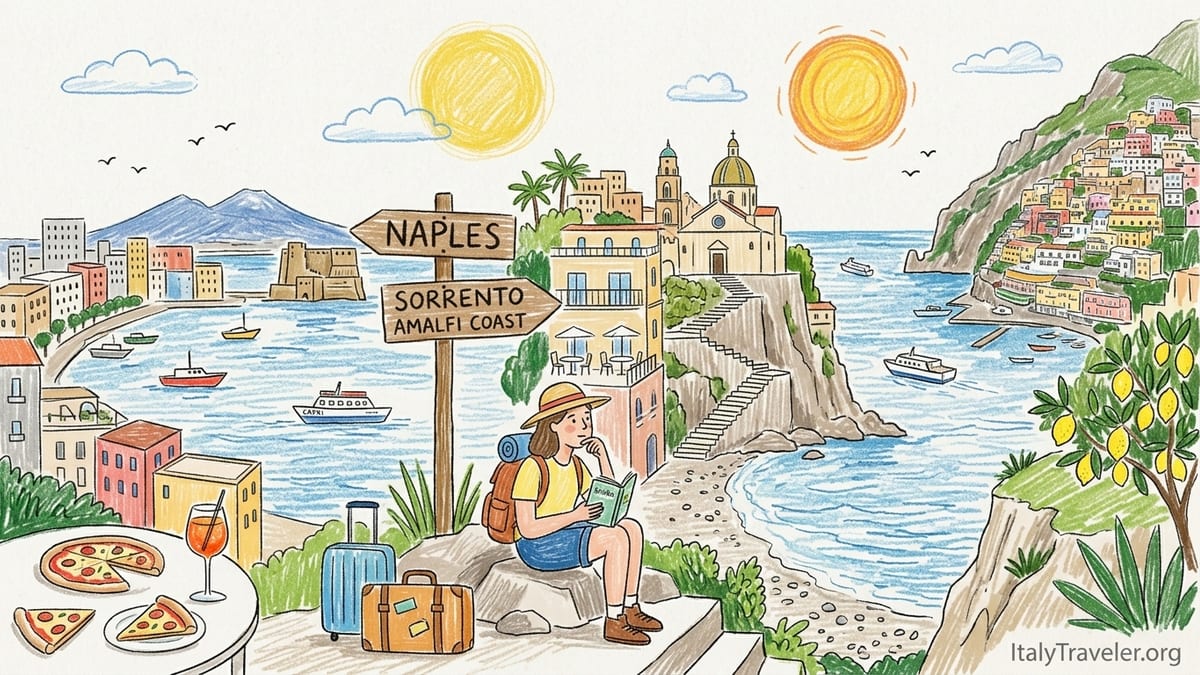
How I Stayed in Naples, Sorrento and the Amalfi Coast
Across three separate trips spread over late May, September and early October, I chose a different base each time. The first year I stayed five nights in Naples, splitting time between a guesthouse near Piazza Bellini and a hotel on the seafront in Santa Lucia. On the second trip I booked a full week in Sorrento, in a small hotel up the hill from Piazza Tasso with a partial sea view and breakfast terrace. The third time I decided to live right on the Amalfi Coast, spending four nights in Amalfi itself and three in Positano in small family run hotels tucked into the hillside.
My days followed a similar pattern in all three bases. I planned archaeological trips to Pompeii, Herculaneum and the Naples Archaeological Museum, ferried out to Capri and Ischia, and threaded my way along the coast by bus and boat. I ate in casual trattorie more often than fine dining restaurants and leaned heavily on public transport instead of private drivers. This consistency gave me a clear feel for how each base worked in real life, rather than as dots on a map.
For 2026, I have checked current transport information and sample prices where my memories relied on older figures. Circumvesuviana trains between Naples and Sorrento still take about an hour and remain one of the cheapest ways to reach Pompeii and the coast, with updated fares of only a few euros each way as of spring 2026 based on EAV and local transport guidance. Ferries between Sorrento, Capri and Amalfi are still frequent in season, with one way adult tickets around the low twenties in euros on the Sorrento to Capri route plus Capri’s seasonal landing fee, according to current ferry operators and local guides. I have woven these researched details into what I actually experienced on the ground.
Hotel Costs and What You Actually Get
Naples was consistently my best value. Near Piazza Bellini, I paid under 130 euros per night in late May for a spotless room with tall ceilings, a generous breakfast and a tiny balcony that looked into an interior courtyard hung with laundry. A few nights on the waterfront in Santa Lucia cost more, around 170 euros per night in shoulder season, but I woke to views of Castel dell’Ovo and Vesuvius instead of scooters. Even at this higher tier, I felt I was getting a lot of city and comfort for the price, with money left over for museum tickets and long lunches.
Sorrento felt like a step up in price for a step up in polish. On my September stay, my midrange hotel above Piazza Tasso cost just under 220 euros per night when booked several months in advance, roughly in line with recent estimates that a typical double in Sorrento for two people averages around 180 to 200 euros depending on season. My room was compact, but I had a sea glimpse from a small balcony, crisp linens, a strong shower and a breakfast buffet with fresh sfogliatelle and fruit. Sorrento’s price premium bought a certain resort smoothness and consistently friendly service, but I noticed that equivalent comfort would have been cheaper in Naples.
On the Amalfi Coast itself the equation tilted again. In Amalfi town I paid about 240 euros per night in early October for a modest room up several flights of stairs in a charming but basic pensione just a few minutes from the duomo. The bathroom was small, and the window looked not at the sea but at lemon trees and laundry lines, yet I was still paying more than I had for a much larger room and seafront view in Naples. Positano strengthened this impression. A simple double with a shared sea facing terrace cost around 300 euros per night in late May. Friends who visited in July reported paying well above that for similar rooms. On the coast, the view and the right to wake up already in Positano or Amalfi are what you are paying for, more so than square meters or luxury finishes.
Food, Restaurants and Evening Atmosphere
Of all three bases, Naples gave me the deepest and most varied food experiences at the lowest cost. Near Via dei Tribunali I quickly fell into a rhythm of grabbing slices of pizza fritta for a few euros, sitting with a spritz at a bar on Piazza Bellini, and splurging one night at a seafood trattoria near the port where the antipasti crudo and grilled octopus still cost less than similar dishes in Sorrento. The atmosphere after dark in Naples felt electric but local. Teenagers crowded the steps by the piazza, older couples strolled the lungomare, and most bars were filled with Italians first and tourists second.
In Sorrento my dinners felt more oriented toward visitors, but still enjoyable. The lanes around the old town were lined with trattorie where English menus were normal, and I overheard more American and British accents than Italian on most evenings. Yet I still found warmth. A small place up a side street served me a memorable plate of gnocchi alla sorrentina and poured me an unsolicited limoncello at the end of the meal. Prices were higher than Naples: mains in the 16 to 22 euro range were common in 2025 and 2026 based on current menu scans, and a glass of house wine tended to be a few euros more than in the city. The tradeoff was a relaxed, on holiday feeling. In the evenings families and couples filled the Corso Italia, licking gelato and listening to live music on the main square.
Along the Amalfi Coast, the food quality stayed high but the costs climbed again. In Amalfi I paid around 20 to 25 euros for seafood pastas on the seafront in early October, similar to current menu ranges. One night I ducked up a narrow alley and chose a small osteria without a sea view, where the same dish cost several euros less and came with stories from the owner about past winters when only locals remained. In Positano the price jump was obvious. A simple pizza and glass of wine with a view over the vertical town could easily reach 25 to 30 euros in total, and seaside restaurants frequently offered mains in the high twenties and above. What I did gain on the coast was romance. After sunset the lights of Positano climbing the cliff and the soft hush of Amalfi’s piazza by the duomo gave the evenings a dreamy quality that Sorrento only partly matched and Naples did not attempt.
Transport, Ferries and Getting to Pompeii
For archaeology and day trip logistics, Naples was the clear practical winner. From Napoli Garibaldi station I could be at Pompeii in about 35 minutes on the Circumvesuviana train, paying only a few euros for the ride based on current fare bands. On one September morning I left my hotel near Piazza Bellini just after 8, walked down to the metro, connected to the Circumvesuviana and was standing at the Porta Marina entrance of Pompeii well before 9. I returned the same afternoon and still had time for an early evening stroll along the lungomare. Herculaneum was even closer and felt like an easy half day. For the Naples Archaeological Museum, I simply walked. Using Naples as a base, all of these world class archaeological sights slotted naturally into my days without long transfers.
Sorrento struck a balance between archaeological access and coastal convenience. From Sorrento’s station I rode the same Circumvesuviana line back toward Naples to reach Pompeii, with the trip taking around 40 minutes and ticket prices again in the low single digits in euros for 2026. On my week in Sorrento I visited Pompeii twice, once early in the morning and once in the late afternoon, and both times I was back in town with enough energy to sit in Piazza Tasso before dinner. Ferries from the lower port made reaching Capri and Amalfi simple. In season I could walk down the stairs from the centro to Marina Piccola, buy a ticket for a mid morning crossing to Capri for roughly 22 euros one way plus Capri’s current 5 euro landing fee in peak months, and be on the island in about 20 minutes according to the 2026 schedules. Fast ferries to Amalfi and Positano also ran frequently in my travel windows, turning those towns into straightforward day trips.
Staying in Amalfi and Positano put me in the landscape but made every archaeological trip more of a project. To reach Pompeii I woke early, caught a SITA bus from Amalfi to Sorrento, jostled for a seat on the twisting road, and then transferred to the Circumvesuviana. The SITA ride alone took more than ninety minutes on a congested May morning, matching recent accounts that this route can feel very slow when traffic builds. Buses within the coast are still inexpensive, with tickets often only a few euros depending on distance, and newer consortium services in the area list fixed fares such as around 5 euros between Maiori and Amalfi. Even so, the time and uncertainty made me think carefully before planning a second archaeology day from Amalfi. When I based in Naples or Sorrento, Pompeii and Herculaneum fit naturally into my week. From the coast, each visit was a commitment.
Crowds, Stairs, Beaches and Nightlife
Naples had crowds, but they felt like city crowds rather than resort crowds. In the historic center I shuffled behind school groups at San Gregorio Armeno and waited for tables at popular pizzerias, yet I could step a block or two away and find quieter corners where locals were running errands and chatting outside shops. Stairs were present on the hillsides toward Vomero, but I could easily choose flat routes in the centro and along the waterfront. Beaches in Naples were not the reason I stayed, although I did swim once near Mappatella Beach with local teenagers, more as a novelty than a beach holiday.
Sorrento felt busy in a different way. Cruise ship passengers poured into town in waves during the day, and Piazza Tasso could feel almost saturated by late afternoon in high season. Yet by evening, especially in shoulder months, the mood softened. I remember one September night when the main square was still animated around 10 p.m., but side streets had grown quiet enough that I could hear clinking dishes and televisions from apartments above. Stairs in Sorrento were manageable. The main strain came from the walk down to the marina and back up again, which I felt in my calves after a late ferry return from Capri. Beaches were mostly small patches of sand and platforms along the base of the cliffs. I paid for a spot at a lido one hot day, enjoying clear water and easy access, but Sorrento did not feel like a classic beach town so much as a cliff top resort with sea access.
On the Amalfi Coast, stairs became part of daily life. In Positano my hotel sat about halfway up the cliff. Each morning I walked down winding pedestrian lanes and staircases to the Spiaggia Grande, and each afternoon I climbed back up, counting landings instead of steps. In Amalfi town the terrain was gentler at sea level, but walks to viewpoints or to quieter lodgings quickly introduced staircases. Anyone with mobility challenges would find these towns significantly more demanding than Sorrento or central Naples. Crowds here also felt more intense, though concentrated into smaller spaces. On a sunny May afternoon Andrea in Amalfi’s main square was shoulder to shoulder, and the narrow coastal road routinely backed up with buses and scooters. Nightlife on the coast was more about dinners and hotel bar cocktails than late nights. Positano had a couple of busier spots by the beach, but overall the atmosphere after 11 p.m. was subdued compared with Naples.
Best Base for Culture and Archaeology
Judged purely on culture and archaeology, Naples is where I would base myself again. Walking out of my guesthouse into the noise of Via dei Tribunali, turning a corner and suddenly facing the vast facade of the Duomo, slipping into a tiny church with faded frescoes on my way to buy coffee, all of this made the city feel like a living museum. The Naples Archaeological Museum, which holds many of the finest pieces from Pompeii and Herculaneum, was close enough that I visited twice on different trips, once for a general overview and once focusing on the mosaics. Between these visits and easy, short train rides to the sites themselves, Naples gave me the densest concentration of historical experiences per day.
On my archaeology focused trip staying in Sorrento, I found that while Pompeii and Herculaneum were still very doable by train, I missed the immediacy of Naples. In Sorrento my days tilted naturally toward the sea, even when I had planned otherwise. A planned second visit to Herculaneum shrank into a half day in Pompeii instead, after I decided an extra morning on a Sorrento terrace sounded more appealing than another hour on the Circumvesuviana. If your heart is set on seeing multiple archaeological sites, the museum collections in Naples and perhaps Paestum further south, I would personally lean strongly toward basing in Naples for at least part of the trip.
From Amalfi and Positano I still managed one Pompeii day, but it felt like threading a needle between bus timetables, ferry options and my own energy. I woke earlier, worried more about missing connections and returned later than planned due to afternoon bus congestion. The day was memorable and worth the trouble, but I would not use Amalfi or Positano as my only base on a trip whose main goal was archaeology. They work better as scenic extensions after you have already satisfied the historical part of your curiosity from Naples or Sorrento.
Best Base for Amalfi Coast Sightseeing and a Slower Coastal Stay
When my main goal was simply to soak up the coastline, watch the light change on the water and not think too much about transport schedules, staying on the Amalfi Coast itself had no equal. Waking up in Positano to the clatter of breakfast trays and the sound of church bells, stepping out on a shared terrace to find the sea and pastel houses spilling below, and then wandering down to catch a mid morning ferry to Amalfi or Minori felt like the holiday I had imagined long before my first visit. One late afternoon I returned from a boat trip, grabbed a gelato on the beach and simply sat as the town lights slowly blinked on. No return bus, no final train, just a short, steep walk back to my room.
In Amalfi, the slower rhythm suited me even more. The town filled quickly in the morning with day trippers spilling from buses and ferries. By evening, though, the duomo steps emptied, and I could hear the murmur of conversation from just a few open restaurants. One night I ate grilled fish at a simple trattoria a few alleys back from the waterfront, then walked ten minutes along the seafront promenade in almost complete darkness except for the glow from hotel windows. That feeling of being already there, without needing to commute in and out from a base, defined my happiest coastal hours.
Sorrento, by contrast, offered more of a structured, convenient coastal stay. It is an excellent jumping off point, with fast ferries to Capri and Amalfi, straightforward bus connections to Positano, and reliable trains to Pompeii and Naples. On my week there I appreciated the routine. Mornings on the terrace, a simple walk to the station or port, and evenings on Corso Italia felt easy. Yet I never quite escaped the sense that Sorrento was a hub rather than the destination itself. My sea swims felt like interludes below the cliff top town, not the core of the experience. For a first time visitor who wants both convenience and some coastal charm, Sorrento works very well. For a return trip when the goal is to slow down and live inside the Amalfi landscape, I personally preferred staying in Amalfi or Positano despite the cost and stairs.
Which Base I Would Pick for Different Trips
If a friend told me they were visiting Campania for the first time and wanted to see Pompeii, Herculaneum, Capri and at least get a feel for the Amalfi Coast, I would suggest splitting time between Naples and Sorrento. Start with three or four nights in Naples to absorb the city, visit the Archaeological Museum and do day trips to Pompeii and Herculaneum. Then move to Sorrento for three or four nights to enjoy an easier, more relaxed base with a straightforward ferry to Capri and comfortable access to Amalfi and Positano. This combination has worked best for my own mixed interest trips, keeping logistics simple without sacrificing the coast.
If the priority is culture, food and archaeology, and the sea is secondary, I would base almost entirely in Naples. Even when I stayed only in the city and limited my coastal exposure to a single day trip to Sorrento, I never ran out of things to see or eat. Wandering Spaccanapoli, ducking into churches, eating pizza that cost less than an espresso in some other European capitals and riding short trains to ancient sites made the days feel dense and rewarding. I appreciated returning each night to a city with a rhythm that belonged to itself rather than to tourism.
For a slower coastal stay, with fewer museums and more time on terraces and boats, I would choose the Amalfi Coast itself again, accepting the higher prices and the stairs as part of the package. If budget matters but you still want that immersion, consider Amalfi over Positano. In my experience, Amalfi’s prices were slightly gentler, and the terrain around the harbor made daily movement easier. Positano, on the other hand, delivered the most famous views and a more glamorous feel, with boutique shops and high end restaurants cascading down to the beach. On my longest coast stay I felt happiest doing a few nights in each.
The Takeaway
After staying in all three, I no longer look for a single best base in Campania. Instead I think in terms of which base best matches the trip’s priorities. Naples gave me the richest everyday culture, the easiest archaeology and the best value food and lodging. It was the place where I felt closest to contemporary southern Italian life, even when that meant noise and chaos along with beauty. Sorrento offered a comfortable, well organized base with polished hospitality and simple access to Capri, Pompeii and the Amalfi Coast. It was the town where I would happily send a first time visitor who wanted a gentle landing with plenty of day trip options.
Staying in Amalfi and Positano cost more in money and effort, especially in terms of stairs and transport for archaeology, but those nights gave me the coastal dream I had imagined. Waking up to the sound of the sea, stepping directly from my hotel toward the beach or ferry, and watching the cliffside lights after dark felt worth the premium at least once. For a long weekend or the final days of a longer trip, basing on the coast itself created memories that no day trip from elsewhere quite matched.
Personally, I would choose Naples again for a culture and archaeology heavy week, Sorrento for a first time mixed itinerary that included Pompeii, Capri and quick tastes of the coast, and Amalfi or Positano for a slower, more indulgent coastal stay when the main goal is simply to be in the landscape. None of them is the objective winner, but each proved the right choice when I matched it to the right kind of trip.
FAQ
Q1. Is Naples safe enough to use as a base for day trips?
In my experience staying near Piazza Bellini and on the waterfront, Naples felt busy and gritty but manageable. I kept an eye on my belongings on crowded streets and trains and avoided very quiet alleys late at night, and I did not run into problems. For day trips to Pompeii and Herculaneum, trains and stations felt no different from other big European cities in terms of basic precautions.
Q2. How many days should I spend in Sorrento on a first trip?
On my first Sorrento stay, a full week let me alternate busy days with slower ones on terraces and at the lido. For most first time visitors who also stay in Naples or on the Amalfi Coast, I think three to four nights in Sorrento is a good balance. That allows a Capri day trip, one or two Amalfi Coast excursions and at least one relaxed day in town.
Q3. Is it realistic to visit Pompeii from Amalfi or Positano in one day?
I have done Pompeii as a day trip from Amalfi and found it long but possible. It involved an early SITA bus to Sorrento, a transfer to the Circumvesuviana and the same route in reverse in the afternoon, with the bus portion taking well over an hour each way when traffic was heavy. For one major site it is realistic if you start early and accept a long day. For multiple archaeology days it becomes tiring.
Q4. Are ferries between Sorrento, Capri and the Amalfi Coast reliable?
On my September and early October stays, ferries between Sorrento, Capri and Amalfi or Positano ran regularly and were the most pleasant way to move along the coast. For 2026, operators still list frequent daily sailings in high season, with crossings from Sorrento to Capri around 20 minutes and adult fares a little over 20 euros one way plus Capri’s landing fee. In rough seas, though, smaller coastal ferries can be cancelled, so I always checked the next day’s schedules locally.
Q5. Which base worked best for nightlife?
Naples had the liveliest nightlife in my experience, especially around Piazza Bellini and the Chiaia neighborhood, where bars were busy well past midnight. Sorrento offered a softer, resort style evening with live music in the square and bars that quieted earlier. Amalfi and Positano were more about dinners with a view and hotel bars, with only a couple of spots in Positano feeling truly late night.
Q6. How bad are the stairs on the Amalfi Coast really?
In Positano I climbed several flights every day just going between my mid level hotel and the beach, and walks to some viewpoints involved long staircases. Amalfi town is flatter near the harbor, but side valleys and higher hotels still require steady climbing. If you have knee or mobility issues, I would consider Sorrento or central Naples instead, or choose accommodation close to sea level in Amalfi.
Q7. Is Sorrento worth the higher hotel prices compared with Naples?
For me, Sorrento’s premium felt justified on trips that prioritized convenience and a gentle holiday feel. I paid more than in Naples for a smaller room, but the combination of sea views, relaxed streets and straightforward ferries and buses made my days easier. When my focus was on museums and food, though, I preferred to save money by staying in Naples and visiting Sorrento as a day trip.
Q8. Can I visit the Amalfi Coast as day trips from Naples instead of staying there?
I have done day trips from Naples to Sorrento and beyond, using a mix of trains and ferries. It is feasible to get a taste of the coast that way, but travel times add up, and you miss the early morning and late evening atmosphere on the Amalfi Coast itself. If time and budget allow, I found at least a couple of nights in Amalfi or Positano much more satisfying than only day trips.
Q9. Which base is best if I am mainly interested in beaches?
For true beach time, I preferred staying on the Amalfi Coast, where even small towns have pebble beaches or platforms right at sea level. Sorrento’s swimming areas are pleasant but sit below cliffside platforms, and Naples beaches felt more urban and less like a dedicated beach holiday. Just remember that most Amalfi Coast beaches are pebbly and often organized with paid loungers.
Q10. If I can only choose one base, which would you recommend?
Based on my own trips, if I had to choose a single base for a first visit that combined archaeology, Capri and coastal scenery, I would pick Sorrento. It gave me easy train access to Pompeii and Naples, simple ferry links to Capri and the Amalfi Coast and a comfortable, walkable town to come home to each night. For later visits focused more heavily on culture I would switch that answer to Naples, and for a slow coastal escape I would choose Amalfi or Positano despite the higher cost.