


When I first planned a week around the Bay of Naples and the Amalfi Coast, I assumed the hardest choice would be which ruins to see or which beach club to book. In reality, the decision that shaped the entire trip was my base: Naples, Sorrento, an Amalfi Coast village, Capri, or Ischia. After several visits, bouncing between all five, I have learned exactly how each place feels as a base, how much time transfers really consume, and what it is like to drag a suitcase up those infamous Campanian stairs. This guide is written from those overnight stays and early-morning ferry dashes, to help you choose the right home base for the trip you actually want rather than the one Instagram suggests.
How Your Base Changes Your Campania Trip
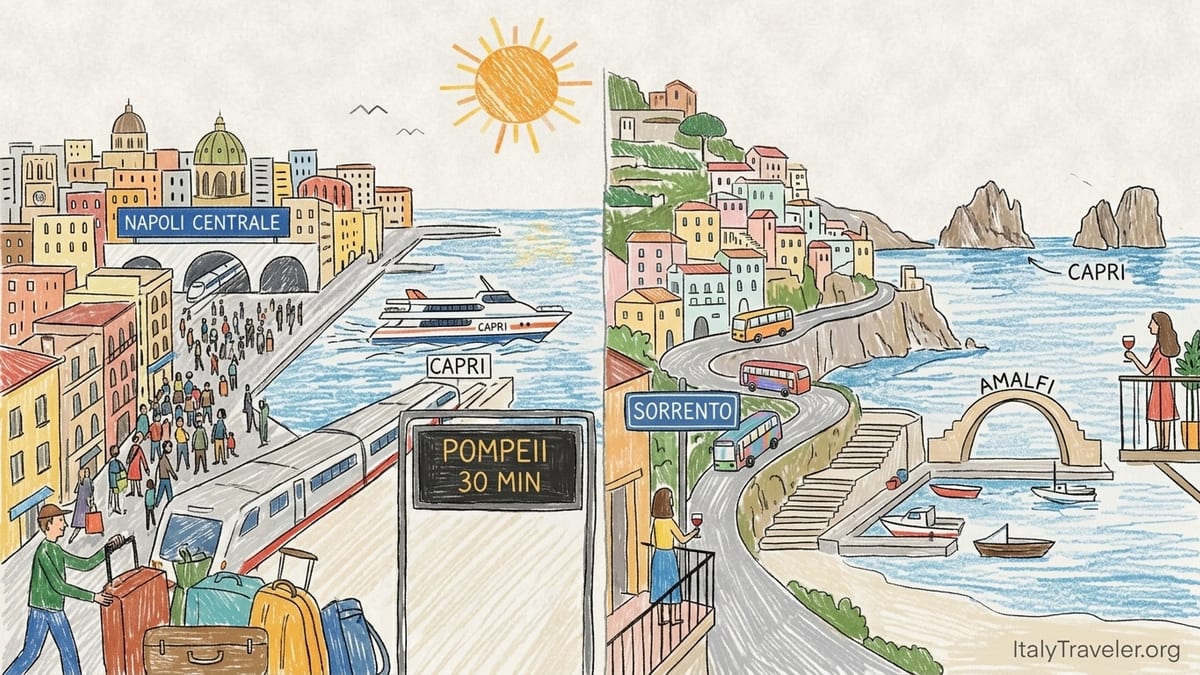
On paper, all five bases sit within a relatively compact region. In practice, where you sleep reshapes your days. When I based myself in Naples, my evenings were about street food, late-night metro rides and early departures from the Centrale station or the ferry piers. From Sorrento, my days tilted toward Pompeii and easy boat trips, and I found myself back on my balcony with a glass of wine by sunset. Sleeping on the Amalfi Coast meant committing to winding bus and ferry schedules but waking up directly in postcard views. On Capri and Ischia, everything slowed down; ferries dictated the rhythm and the last boat out defined when day trippers disappeared and the island quieted.
Transport is the first practical divider. From Naples, I could be on the Circumvesuviana train to Pompeii in under 30 minutes and in Sorrento in about 70 minutes for a few euros, with trains running roughly every half hour along the line that continues to Sorrento. Ferries to Capri and Ischia leave from two central piers, Molo Beverello and Calata Porta di Massa, with high speed boats to Capri advertised around 50 to 60 minutes and conventional ferries closer to 80. From Sorrento or Amalfi villages, travel times to those same places stretch out once you factor in local buses, stairs and waits on crowded jetties.
The second divider is terrain. Naples and Sorrento both have relatively flat, step free cores around their stations, though Sorrento adds serious hills down to its marinas. Many Amalfi Coast hotels involve flights of outdoor steps with no car access. On Capri and Ischia, I learned quickly to ask hotels in advance about porter services and how far their entrances are from the nearest taxi stop or funicular. The more I traveled here, the more my decision became about how much energy I wanted to spend on daily logistics versus waking up directly in the scenery.
Finally, evening atmosphere matters more than I expected. Naples is loud, gritty and rich in cultural life, from late performances at the San Carlo opera house to pizza dinners that start after 9 pm. Sorrento feels built for visitors, with a compact old town full of restaurants and limoncello shops that stays busy without being wild. Amalfi and Positano go quieter once day visitors leave, apart from a few cocktail bars and hotel terraces. Capri at night turns from crowded to almost village like. Ischia’s evenings center on long dinners, thermal park night entries and waterfront strolls, especially in Ischia Porto and Forio.
Staying in Naples: Culture, Transit and Real City Life
When I stay in Naples, I usually choose an area that balances access to Napoli Centrale station and the historic center, such as around Piazza Garibaldi or along Via Toledo. This keeps both rail and ferry connections straightforward. From Centrale or the linked Garibaldi station, the Circumvesuviana trains reach Pompei Scavi in just under half an hour and Sorrento in a little over an hour for around 3 to 5 euros depending on the exact ticket, based on 2026 prices and regional transport information. At the same time, the metro connects quickly to the Municipio stop near Molo Beverello, the main pier for fast ferries to Capri and Ischia.
On one trip, I landed in Naples in the afternoon, checked into a guesthouse near the station, and was eating pizza on Via dei Tribunali within an hour. With no luggage to worry about the next morning, I walked to Molo Beverello in about 20 minutes, bought a high speed ferry ticket to Capri on the day, and boarded with ten minutes to spare. Recent fare data for Caremar and other operators shows Naples to Capri conventional ferries around 15 euros and high speed options around the low 20s plus a 5 euro landing tax for Capri. That combination of price, frequency and a short walk from central neighborhoods is what makes Naples unbeatable as a transport hub.
Luggage in Naples is easy compared with the coastal villages. Taxis can pull up directly to most hotels and guesthouses in central areas, and sidewalks are generally flat even if occasionally cracked. Elevators are common in mid range and higher end properties. The main challenge is street noise; I have learned to request upper floor rooms or courtyard views and to pack earplugs. In exchange, evenings are rich with local food and culture, from simple fried pizza stands near the university district to long tasting menus in neighborhoods like Chiaia.
If your trip is heavy on day trips to Pompeii, Herculaneum and perhaps Caserta, or if you have an early or late flight from Naples airport, I strongly favor staying here for at least part of your time. You can still visit Sorrento or an Amalfi village on a later leg. For a two or three night stay focused on archaeology, museums, and authentic urban life with the occasional island day trip, Naples is where I would personally base.
Staying in Sorrento: A Practical Gateway to Pompeii and the Coast
In Sorrento, the trade off is clear. You gain a calmer, more resort like setting overlooking the Bay of Naples, and you lose some of the immediacy and intensity of a working Italian city. The town concentrates around Piazza Tasso and the upper plateau, with the main Circumvesuviana station a short walk inland. From there, 2026 schedules show frequent trains to Pompeii and back toward Naples, with Sorrento to Pompeii rides typically around 30 minutes and a few euros each way. I often set out on the first or second morning train, reached the site near opening time, and was back in Sorrento by mid afternoon for a swim or a drink on the cliffs.
Access with luggage in Sorrento depends entirely on where you stay. Hotels near the station or along Corso Italia are the easiest; I have wheeled my suitcase along mostly flat pavement in under ten minutes. Properties closer to Marina Grande or Marina Piccola, or on the roads that zigzag down to the sea, involve serious slopes and sometimes long staircases. When I once booked a sea view room near the old fishing harbor, arriving by ferry, I had the choice of paying for a taxi or porter service up from the marina or climbing several hundred steps. There are public elevators from the marina level to the town but you still need to cover the distance from the dock to the lift with luggage, and then from the upper elevator exit to your hotel entrance.
The flip side is that Sorrento is one of the easiest places to combine coast and islands without moving hotels. Fast ferries from its small port run to Capri, and seasonal connections link Sorrento with Amalfi Coast towns. Current Capri ferry timetables show roughly 20 to 30 minute crossings from Sorrento in high season, though fewer sailings than from Naples. I have used Sorrento as a base for a three day sequence of Capri day trip, Pompeii and Vesuvius, then a relaxed circuit of the Amalfi Coast villages via bus and boat, always returning to the same bed.
Evenings in Sorrento feel curated but pleasant. The streets around Piazza Tasso stay lively with outdoor seating, gelato shops and limoncello tastings. Many restaurants cater to international visitors, so I now look for places a few streets back from the main square where menus are shorter and local families are eating. For a first visit focused on Pompeii, Capri and a taste of the Amalfi scenery, especially if you prefer tidy, walkable resort towns over big cities, Sorrento is where I would choose to stay most or all nights.
Staying on the Amalfi Coast: Positano, Amalfi and Village Trade Offs
Sleeping directly on the Amalfi Coast delivers those blue and pastel views as your everyday backdrop, but it comes with logistical strings attached. On my first overnight in Positano, I underestimated how much time simply getting in and out would take. Arriving from Naples by train and bus took close to three hours once I factored in a transfer in Sorrento, the curving Amalfi Drive and traffic at peak season. Most of that distance is on a narrow, cliff hugging road, shared by cars, scooters and tour buses. When I later arrived by ferry from Sorrento, the sea journey was beautiful but I still faced a steep climb from the dock to my guesthouse, which had no road access and required about ten minutes of staircase walking with my bag.
Amalfi town is slightly easier for luggage because part of the village fans out more gently from the harbor. On one stay in Amalfi, my hotel arranged a porter to meet me at the ferry and push my suitcase up to the entrance for a set fee that I confirmed in advance. The walk would have been tiring but manageable on my own. In both towns, I now always ask hotels about exact access, whether taxis can reach the door, and if they work with porters. It is common to have 50 to 100 steps between the last car accessible point and your room, especially at mid range price levels where you are not in a large, elevator equipped property right on the road.
The reward is immediate scenery. Waking up in Positano meant opening shutters to a cascade of houses and the sound of early morning boat engines. Afternoon ferries brought waves of day visitors, but by night the village felt surprisingly small, with a handful of restaurants and bars clustered near the beach and along the pedestrian lanes. In Amalfi, evenings centered around the cathedral square and a few waterfront promenades, with some late drinks in nearby Atrani reached through a short tunnel. Dining is more limited than in Naples or Sorrento, and I learned to reserve sea view spots in high season or aim for earlier or later seatings.
From an Amalfi Coast base, day trips shift in character. It is realistic to visit Capri on a day trip by early ferry and return by late afternoon boat, but the timing is tight and cancellations due to sea conditions are more disruptive. Reaching Pompeii from Positano or Amalfi involves a bus to Sorrento or Salerno and then a train, so it usually consumes most of a day. For travelers who care more about simply being on the coast than about ticking off multiple major sights, I would stay here and accept the transfer time as part of the experience. For a first timer who wants Pompeii, Capri and flexibility, I would limit Amalfi Coast overnights to a few nights at the end of the trip rather than using it as the only base.
Staying on Capri: The Overnight Island Experience
Capri changes completely after the last large day trip boats leave. During one stay in Capri town, I watched the main piazza go from packed at 4 pm to almost hushed by 8 pm. Hotel terraces filled with guests lingering over aperitivo, and a few small shops stayed open along the Via Camerelle, but the narrow lanes felt like a village again rather than a theme park. That contrast is the main reason I recommend sleeping here at least one night if your budget and schedule allow. You experience the Blue Grotto and the Faraglioni by day, then the island’s more local rhythms by evening.
Arriving with luggage takes planning. Fast ferries from Naples and Sorrento dock at Marina Grande, the main port. From there, the quickest way up to Capri town is the funicular, a short ride that feels like a small mountain tram. In high season I have waited 30 to 40 minutes in line with my bag, and the funicular carriage can be crowded. An alternative is to take a taxi, which climbs a series of switchbacks to a drop off near the Piazzetta. Hotels in both Capri town and Anacapri often offer porter services to handle luggage from the port for a fee. I once booked a small guesthouse in Anacapri that arranged for my suitcase to be tagged at the Marina Grande pier; a porter delivered it up the hill while I rode a local bus with only my backpack.
Hotel access on Capri is often by pedestrian lane. In Capri town, my favorite small hotels sit two to ten minutes’ walk from the Piazzetta, down narrow, tiled streets where no cars can pass. At check in, staff or porters helped with the bag for the last stretch. Anacapri properties can be closer to bus stops and slightly flatter, though some still require stair climbs. Before confirming a booking, I now email to ask how many minutes and what kind of path separates the nearest taxi or bus stop from the entrance, especially if traveling with heavier luggage or anyone with mobility concerns.
Once settled, Capri works best when you accept the island pace. Ferries from Naples tend to cluster in the morning, especially between around 7 am and late morning, and timetables published for 2026 show high speed crossings around 50 to 60 minutes with several operators. I have boarded an early hydrofoil, checked into my room, spent midday hiking towards the Arco Naturale or Villa Jovis, then taken a late afternoon boat circuit around the island. Evening restaurant choice in Capri town is surprisingly wide given its small size, from simple trattorias tucked in side lanes to high end spots with dress codes. For a romantic, slower paced trip where budget is flexible and you want that island after dark atmosphere, Capri is the base I would choose for at least a couple of nights.
Staying on Ischia: Beaches, Thermal Spas and Local Rhythm
Ischia feels like the opposite of Capri in several ways. The island is larger, with multiple towns such as Ischia Porto, Ischia Ponte, Forio and Sant’Angelo, and a strong local life that continues well beyond the tourist season. On my first stay, based in Ischia Porto, I noticed right away that most people on the evening promenade spoke Italian, and that supermarkets and ordinary shops outnumbered designer boutiques. The mood is more relaxed and less performative, centered on beaches and thermal springs rather than shopping streets.
Reaching Ischia from Naples is straightforward but takes a little more time than Capri. Hydrofoils and ferries run from Molo Beverello and Calata Porta di Massa to ports such as Ischia Porto and Casamicciola. Recent 2026 schedule examples show high speed boats around 50 to 60 minutes and conventional ferries around 70 to 90 minutes. Published fares for operators like Caremar indicate prices in the twenty euro range for passengers, plus small landing taxes where applicable. I usually allow at least 90 minutes from my Naples hotel door to setting foot on the island, including walking to the pier and queuing.
Luggage handling on Ischia depends heavily on where you stay. In Ischia Porto, several mid range hotels sit within a ten minute, mostly level walk of the ferry dock. I have rolled a medium suitcase along the waterfront promenade without trouble. In Forio, my guesthouse was a five minute walk from the small harbor along flat streets. The challenge arises with properties up the hillsides or near the spa parks like Negombo and Poseidon; in those cases, taxis or hotel shuttles are essential, and I confirm in advance whether they are included or charge a per ride fee. Sant’Angelo, in particular, is mostly pedestrian, and my luggage was pulled the last stretch on a small electric cart arranged by the hotel.
What sets Ischia apart is the combination of beaches and thermal spas. I spent days alternating between sandy stretches near Ischia Porto and long sessions in thermal parks, soaking in pools of varying temperatures surrounded by vegetation. Many parks offer evening openings in summer, so I would arrive around late afternoon, watch the light change over the sea from a warm pool, then bus back to town for dinner. Evenings in Ischia are low key but pleasant, with many casual trattorias and wine bars rather than a dense strip of tourist restaurants. For a slower, wellness oriented trip, especially of a week or more, Ischia is where I would personally stay the longest.
How I Choose My Base for Different Trip Styles
After several circuits through Campania, I no longer look for a single perfect base. Instead, I match each place to a type of trip. For a first visit of four to six nights where the priorities are Pompeii, Herculaneum, one island, and a taste of the coast, my personal choice is to split time between Naples and Sorrento. I might start with two nights in Naples to visit the Archaeological Museum, eat in the historic center, and take the train to Pompeii. Then I would move to Sorrento for two or three nights to visit Capri or even Ischia on a day trip and enjoy easier transfers to the Amalfi Coast by ferry or bus.
For a more romantic, scenery first trip of a similar length, I would lean towards Capri and an Amalfi Coast village, accepting the extra cost and logistical friction as part of the experience. One itinerary that worked beautifully for me was a night in Naples to recover from the flight, two nights in Capri, then three nights in Amalfi. The key was to travel with manageable luggage, prebook ferries where advisable, and coordinate check in and check out times with boat departures so that we were never stranded with bags for hours. Transfers on these days each consumed around half a day door to door, including moving between hotels and waiting at ports.
For a longer, slower stay, especially outside peak summer, I would choose Ischia as my main base, perhaps with one night in Naples at the start or end. A ten day stay I did on Ischia Porto and Forio allowed me to settle into local routines, visit different thermal parks, hike interior trails, and still include a Capri day trip on a good weather day. Because the island is larger, bus rides between towns can take 20 to 40 minutes, so I treated transit as part of the rhythm rather than something to minimize at all costs.
Across all these combinations, the most important lesson I learned is to count transfers honestly. A move from Sorrento to Positano, or from Amalfi to Ischia, is rarely just the scheduled 40 or 60 minutes of bus or boat time. It includes walking to the stop, waiting, boarding with luggage, finding the hotel on arrival and possibly climbing stairs. In practice, each relocation consumed between two and four hours. I now limit myself to two or three bases per one week trip and choose those bases according to the experiences I want most.
FAQ
Q1. Is Naples or Sorrento better as a base for visiting Pompeii?
For Pompeii specifically, both work well, but I prefer Naples for a short, archaeology focused stay because trains from Napoli Centrale reach Pompei Scavi in under 30 minutes and you also have quick access to the Archaeological Museum. If you also want a resort atmosphere and easy access to Capri and the Amalfi Coast, Sorrento is more pleasant for evenings, with slightly longer but still manageable train rides to Pompeii.
Q2. How much time do ferry transfers to Capri and Ischia really take from Naples?
From a central Naples hotel, I usually allow 60 to 90 minutes door to door for Capri or Ischia. The boat crossings themselves are roughly 50 to 80 minutes depending on whether you choose a high speed hydrofoil or a conventional ferry. Walking to the pier, buying or collecting tickets, and waiting to board add at least half an hour, more in peak summer.
Q3. Which base is best if I have heavy luggage or limited mobility?
Naples, Sorrento’s upper town and central parts of Ischia Porto are generally the most practical with luggage because taxis can reach hotel doors and terrain is flatter. Many Amalfi Coast properties and some on Capri and Ischia sit up or down staircases from the nearest road or bus stop, so they can be challenging if you cannot manage steps. In those places, I recommend contacting hotels in advance to ask about porter services and exact walking distances.
Q4. Is it realistic to visit Capri, Pompeii and the Amalfi Coast from a single base?
It is possible from Sorrento for travelers who are comfortable with long days. You can take the Circumvesuviana train to Pompeii on one day, a ferry to Capri on another, and buses or boats along the Amalfi Coast on a third. However, travel times add up and early starts are essential. I find the trip more enjoyable if I split my stay between at least two bases, for example Naples plus Sorrento or Sorrento plus an Amalfi village.
Q5. How expensive are ferries compared with trains in this region?
Trains like the Circumvesuviana between Naples, Pompeii and Sorrento cost only a few euros each way, making them the cheapest way to move along the bay. Ferries to Capri and Ischia cost several times more, often in the mid teens to twenties of euros per adult one way plus small landing taxes. I budget noticeably more for days that involve boats, especially if I plan multiple crossings or need flexibility to change times.
Q6. Which place has the best evening atmosphere for restaurants and bars?
For dense dining choice and nightlife, Naples comes first, with everything from simple pizzerias to sophisticated cocktail bars and late opening cafes. Sorrento offers a lively but more tourist oriented scene centered on Piazza Tasso. Amalfi Coast villages quieten significantly at night once day visitors leave, though there are still good restaurants and a few bars in Positano and Amalfi. Capri and Ischia have pleasant, more relaxed evening atmospheres focused on long dinners and strolling.
Q7. Should I stay overnight on Capri or just visit on a day trip?
If your budget allows, at least one night on Capri is worthwhile. During the day, main sights and lanes can feel crowded with day trippers. After the last large boats depart, the island is calmer, restaurant reservations are easier, and the main piazzas feel like small villages again. A day trip from Naples or Sorrento gives you a good overview, but an overnight stay reveals a very different side.
Q8. Is Ischia a good choice for a first time visitor to Campania?
Ischia is an excellent choice if you enjoy beaches, hot springs and a more local atmosphere and you have at least five or six days. For a very short first visit of three or four days where Pompeii and Capri are top priorities, I would focus on Naples and Sorrento instead. If you have a week or longer, adding several nights on Ischia creates a balanced itinerary that mixes sightseeing with slower days.
Q9. How many different bases should I plan for a one week trip?
From experience, two bases are ideal for one week, and three is the upper limit before transfers start to eat into your time. For example, you might spend three nights in Naples and four in Sorrento, or two in Naples, two on Capri and three on the Amalfi Coast. Each move usually takes at least half a day once you factor in packing, check out, transport and finding the next hotel.
Q10. Do I need to book ferries and trains in advance?
For local trains like the Circumvesuviana you typically buy tickets on the day and simply board the next service. For ferries, I buy in advance or at least check timetables ahead in peak summer, on weekends and for the last departures of the day, especially to Capri and Ischia where sold out boats or weather disruptions can leave you waiting. For shoulder seasons and early sailings, same day tickets are often available, but checking schedules before you commit to day trips is essential.