


I thought I knew Pompeii before I finally walked through its gates in 2026. I had seen the photos of the Forum, read about the frescoes and studied the eruption timeline. But spending a full day inside the ruins, navigating the new ticket rules, the summer heat and the sheer scale of the site, turned out to be a very different experience. Here is exactly how my visit unfolded and what I would do differently next time, so you can plan a smoother, smarter day among the stones.
Booking Named Tickets Under the New Visitor Limits
I visited Pompeii in late summer 2026, after the park introduced named tickets and a daily cap of 20,000 visitors. That change has reshaped how you plan a visit. I booked my ticket directly through the official Pompeii Archaeological Park ticketing system several days in advance, choosing the standard Pompeii Express option rather than the broader Pompeii+ ticket. As of January 12, 2026, the Pompeii Express costs 20 euros and covers the main excavated city, while the Pompeii+ ticket is 25 euros and adds access to additional sites such as Villa Regina and the Antiquarium in Boscoreale. My priority was to spend as much time as possible inside the main ruins, so I kept it simple.
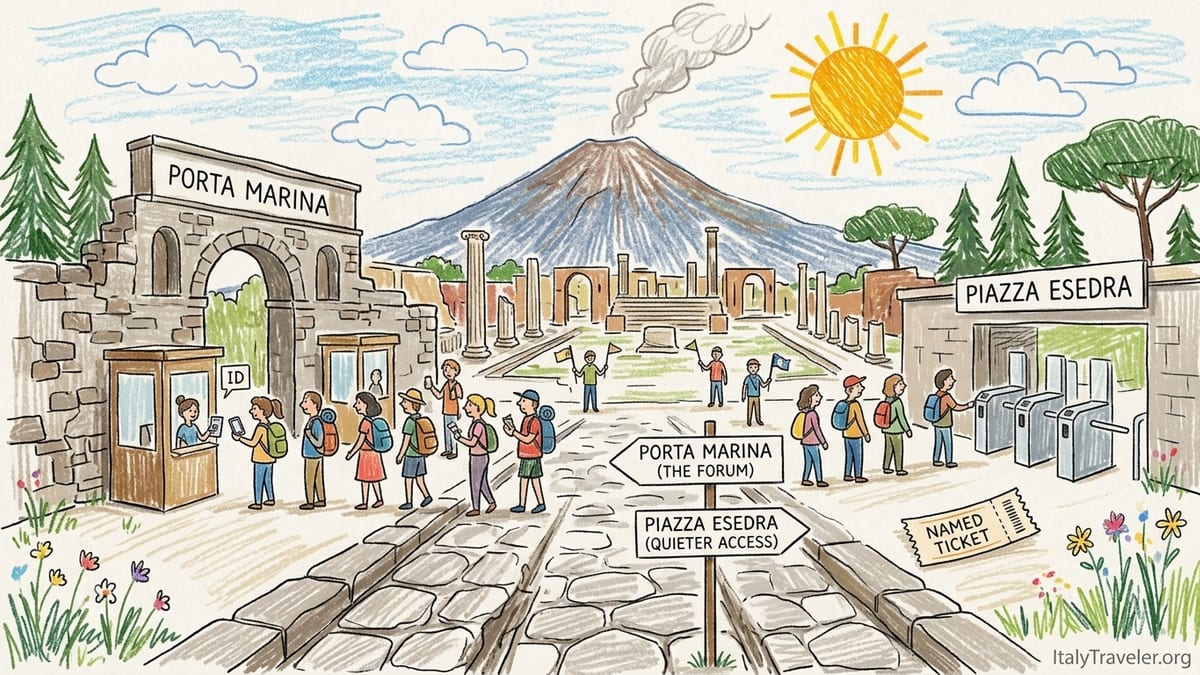
The booking process required entering my full name and date of birth, and the ticket clearly stated that it was nominal and non-transferable. At the time of booking, I had to choose a date but not a fixed entry time, which gave some flexibility. On the day, staff at the entrance checked both the QR code on my phone and my photo ID, matching the name on the ticket. At several points during the day, I watched people turned away because the name on their ticket did not match their passport or because they hoped to reuse someone else’s ticket, something that was still possible a few years ago but is now firmly shut down.
The 20,000 visitor limit sounds large, but it does make a difference in the flow inside the park compared with older trip reports I had read. My day never felt empty, but the crush around the Forum and the Lupanar was slightly less overwhelming than I had expected. That said, weekends and peak summer days still sell out in advance, and I was glad I did not leave ticket purchase to the last minute. I met one couple at the gate around midday who discovered that same-day sales had already hit the cap, forcing them to come back the next morning.
If you are debating between Pompeii Express and Pompeii+, ask yourself realistically how much time and energy you will have. Pompeii alone can easily absorb six or seven hours. On my own full day, even moving steadily, I left several side streets unexplored. If you are deeply interested in Roman villas and have two or three days in the area, Pompeii+ is great value. If you only have a single day and are prone to “museum fatigue,” the cheaper Express ticket is perfectly sufficient and avoids the pressure of racing between scattered sites.
Choosing the Entrance: Why I Started at Porta Marina / Piazza Esedra
Because I was staying in central Naples, I took the Circumvesuviana commuter train on the Napoli–Sorrento line and got off at Pompei Scavi–Villa dei Misteri station. This small station exists almost entirely for visitors to the ruins and is a short walk from the western entrances. From the station underpass I followed signs to Porta Marina and Piazza Esedra. In practice, these two gates sit close together on Via Villa dei Misteri, with Porta Marina historically being the main entrance and Piazza Esedra functioning as a slightly less obvious but extremely useful alternative.
I reached the area just after 8:15 in the morning, ahead of the main wave of group tours. A cluster of visitors had already formed outside Porta Marina Superiore, mostly tour groups huddled around flag-waving guides. The Piazza Esedra gate, a few meters away, looked calmer and featured self-service ticket scanners. Staff were directing ArteCard holders and pre-booked visitors there, which meant I joined a much shorter line. From joining the queue to stepping through the turnstiles, I waited less than 10 minutes.
On the ground, the choice of entrance shapes the first impressions of Pompeii. Coming in at Porta Marina or Piazza Esedra deposits you very close to the Forum, the heart of the ancient city. Within a few minutes of entering, I walked up the ramp and suddenly saw the entire Forum spread out beneath Mount Vesuvius. It is an arresting scene, with column stumps marching down the long rectangular space and the looming cone of Vesuvius directly aligned behind the ruins. This entrance is ideal if you want that classic “Pompeii and Vesuvius” view early on.
By contrast, the Piazza Anfiteatro entrance on the eastern side, near the modern town of Pompei and the Pompei Santuario train stop, feeds you straight toward the amphitheater and the Garden of the Fugitives. That gate is often quieter in the first hour of opening and can work well if you are approaching from the sanctuary area or coming on the Napoli–Poggiomarino Circumvesuviana line. After seeing both ends over the course of my day, if I were arriving again by train from Naples or Sorrento, I would still start at Porta Marina or Piazza Esedra for the impact of the Forum, then exit at Piazza Anfiteatro to explore the modern town and catch a different train back.
Beating the Heat and Surviving a Full Summer Day
Pompeii in summer is hot in a way that photos never quite convey. On my visit the forecast high was around 32 degrees Celsius, and much of the site offers no shade at all. The stone streets and pale walls reflect sunlight and radiate it back upward, turning narrow lanes into slow-moving ovens by late morning. The Archaeological Park’s summer closing time of 19:00, with last entry at 17:30, sounds generous, but the bulk of your walking will likely happen between 9:00 and 16:00, when the sun is strongest.
I wore lightweight, breathable clothing, a wide-brimmed hat and sturdy walking shoes, but I still underestimated how draining the heat would be. The basalt streets are uneven, with deep ruts carved by ancient cart wheels, and you are constantly stepping up and down between sidewalks and crossings. Sandals without firm soles or basic sneakers with worn tread would have been a mistake here. Over the course of the day my step counter logged more than 18,000 steps, much of it on rough surfaces. My feet thanked me for the trail shoes with proper cushioning and grip.
Water management became one of the most important practical details. The park allows you to bring in water bottles, and inside the ruins there are multiple modern drinking fountains where you can refill. That said, the fountains are not on every corner, and they are not always obvious without a map. I started with a 1.5-liter bottle, which I had nearly emptied by 11:00. By mid-day, the refill points near the Forum were surrounded by a ring of thirsty visitors. I watched more than one traveler forced into buying overpriced small bottles at the main café because they had not brought enough capacity to carry water around.
There are a few places to retreat from the sun. The café and restaurant near the Forum, set in the former Casina dell’Aquila area, offer indoor seating, shaded outdoor tables and air conditioning. Later in the afternoon, I took a 40-minute break there over a simple panino and espresso, more for the cool air than the food. There are also picnic areas near Piazza Anfiteatro and Casina dell’Aquila where you can sit down for a while if you bring your own snacks. If you are visiting between June and early September, plan for a long late-morning or early-afternoon pause, and accept that you will not be moving quickly in the middle of the day.
Guide, Audio Guide or Independent: What Actually Worked
Before arriving, I debated between booking a full guided tour, renting the official audio guide or exploring with only a map and a downloaded app. In the end I chose a hybrid approach. At the Piazza Esedra entrance there is an official desk where licensed guides offer small-group tours; these are arranged on site and priced per group rather than per person. I joined a two-hour English-language tour that cost our group a shared fee which worked out to a moderate per-person price, starting at 8:45. Afterward I spent the rest of the day exploring on my own with a paper map and notes I had taken.
The guided portion covered the Forum, the Basilica, the House of the Faun, the Bakery of Popidius Priscus, a bath complex and the Lupanar. Walking these spaces with someone who knew the latest excavation stories turned out to be the single best decision of the day. The guide pointed out small details that I would have walked past: electoral slogans painted in red on side walls, grooves in thresholds where doors once slid, and the difference between private and public water systems. In the Lupanar, for example, she explained how the upper floor, now gone, would have doubled the number of small rooms and how the erotic frescoes served as a menu for clients who might not share a language.
After the tour ended around 11:00, I made a quick stop at the entrance area to ask about audio guides. The park rents official devices near the main gates; several people in my group picked one up for the afternoon, but I chose not to, partly because of the weight and because I prefer wandering without earbuds. Instead I worked with the free park map and a few thematic itineraries downloaded from the official website. I did, however, keep overhearing snippets from other guides through the day and sometimes lingered at the edge of a group for an extra anecdote.
Looking back, was the guided tour worth it? Absolutely, especially for a first visit. Pompeii covers around 66 hectares, and without context it can easily dissolve into a blur of similar-looking walls. The guide helped stitch together a mental map and a human story, so that when I explored later on my own, I could place each street and house within a bigger picture. If I were traveling with children or someone with limited interest in archaeology, I would probably stick to a 2-hour guided tour plus a short independent wander and then call it a day. For history enthusiasts, combining a morning tour with a long self-guided afternoon is an ideal compromise.
The Route I Took Through the Ruins
Starting from Piazza Esedra, our group walked quickly up toward the Forum, pausing at the Antiquarium, the modern museum space near the entrance, to see plaster casts of victims and artifacts recovered from the site. Stepping into the Forum itself so early in the day was a gift; the space was still relatively empty, and the views toward Vesuvius were clear. We circled the Temple of Jupiter at the northern end and the Basilica on the southern side, then moved along Via Marina toward a residential quarter.
From there, the guide led us into the House of the Faun, one of the largest and most famous houses in Pompeii. Even though many of the original mosaics are now in the Naples Archaeological Museum, the replica of the Alexander Mosaic on the floor of one courtyard still gives a powerful impression of the wealth involved. Continuing along, we stopped at a bakery, where carbonized millstones and ovens remain in place, and then ducked into a set of Stabian Baths, where the changing rooms and domed hot-room ceilings survive with elegant stucco decoration.
The final stops of the morning tour were the Lupanar, Pompeii’s best-known brothel, and a stretch of shops along Via dell’Abbondanza. The streets here are famously photogenic, with large stepping stones crossing the carriageways and deep ruts from ancient wheels. Traffic management in antiquity suddenly becomes visible in the stone. When the tour ended back near the Forum, I took a short break and then set off solo.
In the afternoon, I followed a rough west-east route: from the Forum area I worked my way through quieter back streets toward the House of the Vettii, recently reopened after extensive restoration and now one of the absolute highlights of Pompeii. Passing through its sequence of rooms, with vivid wall paintings and delicate garden spaces, felt like being invited into a private world. From there I continued east toward the amphitheater, cutting through residential insulae and pausing frequently in the shade of interior courtyards when I could find them.
Standout Buildings and Moments That Stayed With Me
Several spaces inside Pompeii left a stronger mark than the rest. The Forum, seen twice during the day at different times, framed my whole experience. In the morning, with sharp light and relatively few people, it felt grand and monumental. Late in the afternoon, when I returned on my own, long shadows from the remaining columns stretched across the paving stones, and Vesuvius glowed a muted purple. That second visit, overhearing only the murmur of a few scattered visitors, made it easier to imagine the square as a living civic heart.
The House of the Vettii was the most emotionally affecting private residence. The restoration work has brought back an intensity of color that surprises anyone used to seeing ancient marble statues in museums. Deep reds, blacks and yellows cover the walls, populated by small mythological scenes. In one room, a painted figure of Priapus weighing his oversized phallus on a scale is both humorous and deeply Roman in its mix of fertility, wealth and domestic protection. Standing in the central atrium, watching sunlight fall onto the impluvium pool, I felt the strange intimacy of being inside a home frozen in a specific moment of history.
The amphitheater at the eastern end, approached later in the afternoon, was the most atmospheric large structure. Its elliptical arena, sunken below ground level, is surrounded by stone seating that once held thousands. Walking through the tunnel entrance toward the central sand, I could feel the temperature drop slightly and hear my footsteps echo. At the top of the seating, looking back toward the modern town of Pompei, the contrast between living city and buried one was striking. Nearby, the Garden of the Fugitives, with casts of victims in the positions they held when ash covered them, provided a sobering counterpoint to the architectural spectacle.
Finally, the quieter houses along less-trafficked streets offered small, personal moments. One unassuming doorway led into a modest dwelling where a partially preserved mosaic still marked the threshold. Faded graffiti on another wall recorded casual insults and local elections. These tiny traces of voices from nearly two thousand years ago were easy to miss, but because my guide had trained my eye earlier in the day, I started noticing them everywhere.
How Long I Lasted and What I Would Do Differently
In total, I spent just over eight hours on site, from around 8:25 in the morning until a little after 16:30. I could have stayed longer, given the 19:00 closing time in summer and last entry at 17:30, but by late afternoon my energy was spent. The combination of heat, constant walking and information overload is real. When I exited at Piazza Anfiteatro, my legs were tired, my shoes were dusted with fine volcanic grit, and I still had a list of places I had not seen, including a few suburban villas reachable on longer walks.
If I were planning the same day again under the current rules, I would make three key changes. First, I would reserve a guided tour that explicitly includes one of the thematic routes promoted by the park, such as “Civic Pompeii” or “Daily Pompeii,” because these itineraries are designed to be efficient and highlight recently restored areas. While my on-the-spot guide improvised well, I later discovered I had walked past a couple of significant domus that were open that day without realizing.
Second, I would bring a slightly larger daypack with at least two liters of water capacity and more substantial snacks. While the café near the Forum was serviceable, lines grew long around peak lunch time, and the menu options were limited. A few pieces of fruit and some nuts in my bag would have made it easier to avoid a long, energy-sapping queue in the hottest part of the day.
Third, I would schedule a second, shorter visit on a separate morning if time allowed, rather than trying to do everything in one monumental push. With the named tickets and daily cap, re-entry is not possible on the same ticket, but the cost of a second Pompeii Express ticket is still modest compared with the value of seeing the site rested and focused. On a return morning, I would likely head straight from Porta Marina toward the Villa of the Mysteries on the outskirts, then work backward toward the center before the crowds reach that far.
The Takeaway
Pompeii is not a simple add-on to a Naples or Amalfi itinerary; it is a demanding, rewarding full-day commitment, especially under the post-2026 system of named tickets and controlled daily numbers. The new rules make last-minute improvisation harder, but they also keep the site from becoming completely overwhelmed. With a bit of forethought, you can turn those constraints into advantages and experience the ruins in relative comfort.
From my day inside, several lessons stand out. Book your ticket in advance under your legal name, and decide honestly whether you have the appetite for the broader Pompeii+ network or whether the standard Pompeii Express will suffice. Choose Porta Marina or Piazza Esedra if you are arriving by the main Circumvesuviana line and want to start at the Forum, but consider exiting at Piazza Anfiteatro to see the amphitheater and the modern town. Respect the heat, wear proper footwear and bring more water than you think you need.
Most importantly, invest at least part of your time with a qualified guide. The stones of Pompeii are impressive on their own, but it is the layered stories of families, shopkeepers and worshippers that make them unforgettable. A good guide will give you the tools to read the city, after which wandering its back streets and quiet houses becomes a richer, more personal experience. When you finally step back out into the 21st century traffic and noise, dusty and tired, you will carry with you a much sharper sense of what was lost in AD 79 and why it still matters.
FAQ
Q1. Do I really need to book Pompeii tickets in advance now that they are named?
Yes, you should. Since tickets are now nominal and daily attendance is capped at around 20,000 visitors, same-day availability is not guaranteed, especially in high season and on weekends. Booking ahead under your legal name ensures entry and avoids stress at the gate.
Q2. What is the difference between the Pompeii Express and Pompeii+ tickets?
The Pompeii Express ticket, currently priced at 20 euros, covers entry to the main archaeological area of Pompeii. The Pompeii+ ticket costs 25 euros and includes access to additional related sites in the surrounding area, such as selected villas and the Boscoreale Antiquarium. For a single day focused on the main ruins, Pompeii Express is usually sufficient.
Q3. Which entrance should I use if I am arriving by train from Naples or Sorrento?
If you take the Circumvesuviana Napoli–Sorrento line and get off at Pompei Scavi–Villa dei Misteri, the closest access points are Porta Marina and Piazza Esedra. Both are a short walk from the station and bring you quickly to the Forum. Porta Marina often has more tour groups, while Piazza Esedra can be slightly calmer and is convenient for pre-booked visitors.
Q4. How much time do I need inside Pompeii to see the main highlights?
To visit key areas such as the Forum, a couple of houses like the House of the Faun or House of the Vettii, a bath complex, the Lupanar and the amphitheater at a comfortable pace, plan on at least six hours. I spent about eight hours on site and still did not see everything. Trying to cover Pompeii in less than half a day usually feels rushed.
Q5. Is a guided tour of Pompeii worth the extra cost?
In my experience, yes. A two-hour small-group tour at the beginning of the day provided context and helped me understand what I was looking at, from political graffiti to house layouts. Afterward, exploring independently was far more rewarding because I could interpret details I might otherwise have ignored. For a first visit, a guided tour plus free time works very well.
Q6. What should I wear on my feet for a full day at Pompeii?
Sturdy, closed-toe shoes with good grip are best. The ancient streets are uneven, with high curbs, stepping stones and rutted surfaces. Lightweight hiking shoes or solid trainers with thick soles handle the terrain and reduce fatigue. Flat sandals, fashion sneakers or anything with thin soles can leave your feet sore and increase the risk of slipping.
Q7. How bad is the heat in summer, and how can I cope with it?
In summer, daytime temperatures often reach above 30 degrees Celsius, and there is little shade among the ruins. Wear light, breathable clothing, a hat and sunscreen, and carry at least one to two liters of water. Take advantage of the park’s drinking fountains to refill, and plan a long break at midday in the café or a shaded picnic area to avoid overheating.
Q8. Can I bring food and water into Pompeii?
Yes. You can bring water bottles and light snacks into the site, which is sensible given the walking involved. Large coolers and glass containers are not allowed. There is a café and restaurant area near the Forum and picnic zones near Piazza Anfiteatro and Casina dell’Aquila, so you can either buy food inside or bring your own for a simple picnic.
Q9. Is it possible to leave Pompeii and re-enter later the same day on the same ticket?
Under the current rules, standard tickets are generally valid for a single entry. Once you exit through one of the gates, you should assume you cannot come back in on the same ticket. Plan your visit so that any lunch or rest breaks happen inside the archaeological area rather than in the modern town, unless you are ready to finish for the day.
Q10. What would you prioritize if you only had half a day at Pompeii?
If I had just half a day, I would join a focused two-hour guided tour starting from Porta Marina or Piazza Esedra that covers the Forum, one or two major houses, a bath complex and the Lupanar. After the tour, I would walk toward the amphitheater and the Garden of the Fugitives, then exit at Piazza Anfiteatro. This route offers a concentrated but varied glimpse of public, private and entertainment spaces within the city.