


Plotting a route through Campania is one thing. Finding stays that actually work with ferries, buses, stairs, noise and summer heat is another. On recent research trips I split my nights between Naples, Sorrento, the Amalfi Coast, Capri, Ischia and Cilento, prioritising properties that were easy to reach, genuinely comfortable after long travel days and fairly represented in their descriptions. Below I have separated places I personally stayed from researched alternatives so you can see where first-hand experience ends and careful desk research begins.
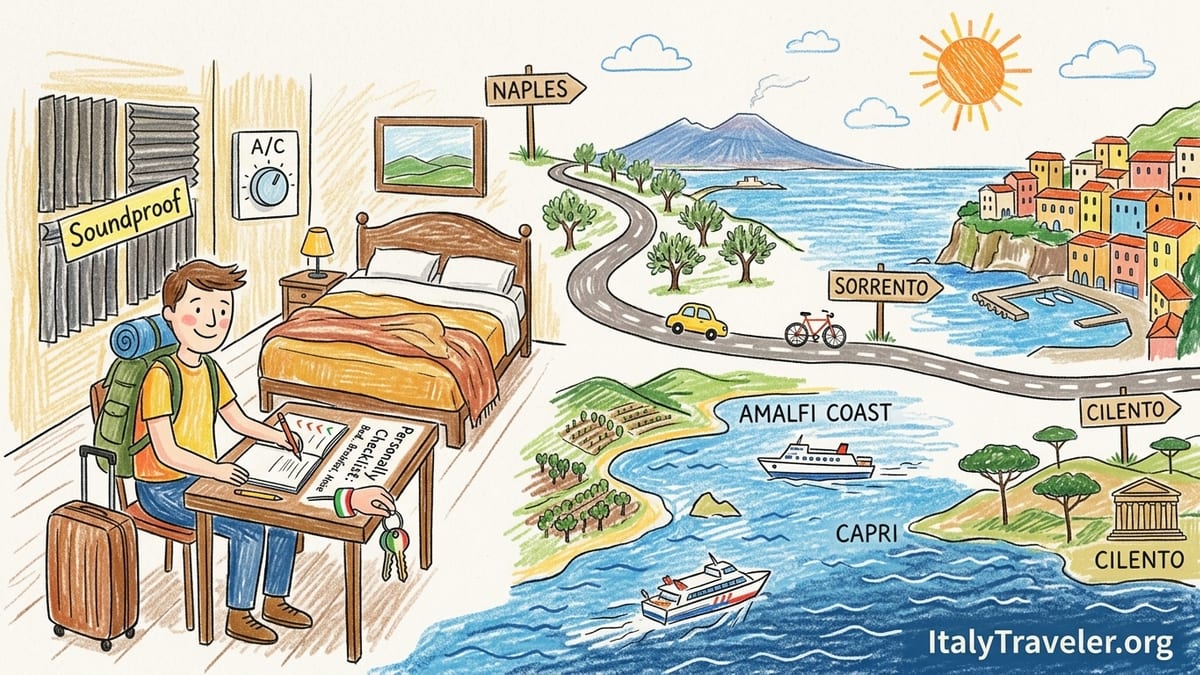
How I Chose and What “Personally Tested” Really Means
Every hotel described as personally tested in this article refers to a genuine overnight stay that I booked and paid for as a regular guest, sometimes with modest media discounts offered only after arrival. I evaluated each place on room size, bed comfort, bathroom layout, air conditioning, breakfast quality, noise, ease of access, and how well the location worked with public transport or ferries. When I quote approximate prices, they are based on recent checks for low and shoulder seasons, not peak August rates.
For each area I also include clearly labelled researched alternatives, based on up-to-date reviews on Italian and international platforms, cross checked against the property’s own information. These have not been personally slept in, so treat them as strong leads to investigate rather than endorsements. Prices in Campania change quickly according to season and major events, so always confirm current rates and conditions when you book.
Campania is full of wonderful hotels with dramatic sea views and historic charm, but some of the most successful stays on my route were quieter city properties with efficient air conditioning, solid soundproofing and simple but reliable breakfasts. The following sections are organised by travel purpose: Naples for urban culture and rail connections, Sorrento for transport convenience, then Amalfi Coast, Capri, Ischia and Cilento for seaside and slower days.
Naples City Stays: Sleep, Soundproofing and Airport Logistics
Personally tested: Midrange business-style hotel near Centrale. For a three-night base focused on museums and day trips, I chose a modern hotel within a short walk of Napoli Centrale and the Circumvesuviana line to Pompeii and Sorrento. My double room was about 18 to 20 square metres, with a queen bed, firm but comfortable mattress and two types of pillows. The bathroom had a walk-in shower with good water pressure and reliable hot water. Air conditioning was individually controlled and strong enough to cool the room within ten minutes, which mattered on humid September evenings.
Breakfast here leaned continental, with pastries, fruit, yogurt and a small selection of hot items. Coffee was from a bar machine rather than a classic Neapolitan bar, but staff were happy to pull extra espressos on request. Noise insulation from the corridor and street was better than I expected for the area. Double glazing meant I could not hear traffic even during the morning rush. There was a lift to all floors and only a handful of steps at the entrance, so arriving with a trolley bag from the station was straightforward. No dedicated parking was available, but garage options within a few blocks served drivers willing to pay nightly fees.
Personally tested: Historic-centre guesthouse for atmosphere. On another visit I moved to a guesthouse near the historic centre and Spanish Quarter to be closer to restaurants and the port. The room was slightly smaller, around 14 to 16 square metres, but the high ceilings and balcony doors kept it from feeling cramped. The bed was a standard double. The bathroom, compact but functional, included a shower cabin and decent storage space for toiletries. Air conditioning worked well, though it took a little longer to cool the space compared with the station-area hotel. Street noise was noticeable until around midnight, especially scooter engines echoing between narrow lanes, so light sleepers should pack earplugs.
Breakfast was served at a partner café with a voucher system, typical for small Neapolitan guesthouses. A pastry and coffee were included, with savoury options available as extras. Stairs were the main trade-off. The guesthouse was on the second or third floor of a historic building, with no lift. For many travellers this is part of the local charm, but anyone with mobility issues or heavy luggage will find arrival and departure more demanding. On the positive side, the location allowed me to walk to the port for ferries to Capri or Ischia in about fifteen to twenty minutes, cutting out taxis.
Researched alternatives in Naples (not personally tested). Travellers looking for a classic waterfront feel often shortlist long-established seafront properties near the Castel dell’Ovo, which offer larger rooms, traditional service and harbour views at higher prices. Recent guest feedback highlights good soundproofing, substantial buffet breakfasts and easy access to the seaside promenade. Another growing option is to stay slightly outside the historic centre in neighbourhoods served by the metro, such as the areas around Mergellina or along Via Toledo, where several boutique hotels combine quiet side streets with quick access to central sights. Always check whether your chosen property sits on a steep hill or up multiple flights of stairs, as this is not always obvious from photos.
Sorrento: Transport-Friendly Hotels That Make Transfers Easier
Personally tested: Central Sorrento hotel near the station. Sorrento works exceptionally well as a transport hub for travellers who want straightforward links to Pompeii, Naples and the Amalfi Coast. I stayed at a midscale hotel about five minutes on foot from the Circumvesuviana station and bus stops. The standard double room measured roughly 18 square metres, with a king-size bed that could be split into twins. The mattress was on the firm side, with crisp linens and blackout curtains. The bathroom had a walk-in shower and enough shelf space for two people’s toiletries, plus a heated towel rail that helped after beach days.
Air conditioning was modern and responsive, controlled by a digital panel near the door. Even during an early September heatwave the room remained comfortable. Breakfast was a highlight, served in a bright dining room with some outdoor seating. There was a wide choice of fruit, cereals, eggs cooked to order, pastries and a small gluten-free corner. Despite being close to the station and a main road, the soundproofing was good. With windows closed I slept through early trains and morning traffic. There was a small lift from reception to the room floors, and only a couple of shallow steps at the entrance.
From a logistics point of view, the central Sorrento base made day trips easy. I could walk with my suitcase from the train, pick up the bus to Positano or Amalfi without a taxi, and reach the port for Capri hydrofoils in about ten to fifteen minutes downhill. Coming back up involves an incline, but it is manageable for most travellers. There was no on-site parking, though several paid garages nearby cater to visitors. For my purposes, being close to public transport mattered far more than having a pool.
Personally tested: Sorrento clifftop hotel with sea view balcony. To understand whether paying extra for a view actually improves the trip, I spent two nights at a clifftop hotel on the western side of Sorrento with a sea-facing balcony. The room itself was similar in size to my central hotel, around 18 to 20 square metres, with a double bed and slightly more traditional décor. The bathroom was a bit larger, with a combined bath and shower. The real difference came from the balcony. It held a small table and two chairs, and opened directly over the Bay of Naples with a view of Mount Vesuvius.
Here the view supplement felt justified. Mornings started with breakfast on the terrace overlooking the water, and in the evening I could watch ferries and cruise ships against sunset colors without leaving my room. On the practical side, the hotel offered a small outdoor pool and a lift to connect lobby and room floors, which reduced stair climbing. The walk into central Sorrento took about fifteen minutes along pavements, with a modest uphill stretch on the way back. For travellers who will actually use the balcony and spend time at the hotel, especially couples on a short break, paying more for the sea view made the stay feel markedly more special.
Researched alternatives in Sorrento (not personally tested). Several well-reviewed small hotels and guesthouses sit between the station and the historic centre, offering easy station access, modern air conditioning and contemporary interiors. Recent reviews often highlight excellent staff support and convenient access to restaurants. On the clifftop side, a mix of four and five-star properties provide panoramic pools, terraced restaurants and private or semi-private elevators down to beach clubs, which can be attractive in summer when public beaches are crowded. Check carefully whether the room category you book genuinely includes a sea view, as some hotels group partial or side views with full ones in their marketing language.
Amalfi Coast Properties: Views vs Stairs
Personally tested: Amalfi town hotel near the harbour. For the Amalfi Coast section of my route, I booked a small hotel in Amalfi itself within five to seven minutes’ walk of the bus stop and harbour. The room was a standard double, about 16 square metres, with a queen bed and a simple, bright interior. The bathroom was compact but functional, with a shower cubicle and good water pressure. Air conditioning worked reliably, though the wall unit was slightly noisier than in my Sorrento stays when running at full power in the afternoon heat.
The biggest benefit of this property was its location on a relatively flat stretch of seafront road, meaning there were only a few internal steps and no long staircases to climb with luggage. Noise at night was moderate, since the Amalfi seafront stays active until late. With balcony doors closed I slept well, helped by double glazing and shutters. Breakfast was taken on a small terrace with partial sea views, offering cold cuts, cheeses, pastries, fruit and coffee made at the bar. There was no on-site parking. For drivers, paid parking garages around Amalfi town are a significant extra cost and should be budgeted for from the outset.
Personally tested: Hilltop guesthouse in Positano area. I also tried a guesthouse on the hills above Positano to see how a more vertical setting shaped the stay. Access involved a local bus from the Amalfi or Sorrento direction, then a climb of about 150 to 200 steps from the main road to the front door. My room was generously sized, approximately 22 to 24 square metres, with a king bed and enough space for two armchairs and a small table. The bathroom included a roomy shower and panoramic window. Air conditioning and cross-breeze through the windows kept the space very comfortable in the evening.
The reward for the stairs was an expansive terrace shared between a handful of rooms, with postcard views across terraced gardens to the sea. Breakfast was delivered on a tray to the terrace, so mornings were exceptionally peaceful. However, the stairs limited how often I went back to the room during the day. Anyone with knee issues, small children or heavy luggage should consider the staircase carefully before booking this type of property. On a short stay focused on relaxation and scenery, the effort felt worthwhile, but for frequent comings and goings it would be less convenient than a town-centre Amalfi hotel.
Researched alternatives on the Amalfi Coast (not personally tested). Along the coast between Vietri sul Mare and Praiano, there is a clear trade-off between immediate seafront access and steps. Hotels right at road level near town centres offer easier arrival and departure with luggage, but often have more traffic noise and smaller terraces. Cliffside properties accessed by long staircases or private lifts offer wide views and quieter nights, but require more effort. Several Amalfi hotels near the harbour receive consistent praise for good breakfast terraces and direct beach access via short walks or lifts. Elsewhere, in villages like Minori, Maiori and Praiano, midrange family-run hotels offer comfortable rooms with balconies and usually include breakfast, providing a more local feel and often better value than the most famous towns.
Capri Accommodation: When a View is Worth the Price
Personally tested: Capri town boutique hotel with garden view. Capri’s prices can be startling, especially in high season, so I chose a midrange boutique hotel in Capri town with garden-view rooms for a two-night stay. The double room offered about 16 to 18 square metres of space, with a queen bed, tiled floor and a small writing desk. The bathroom had a walk-in shower, quality fixtures and a window that opened to the garden. Air conditioning was modern and effective. There was a small private terrace at garden level with a table and two chairs, screened by greenery.
This stay convinced me that in Capri, a calm location slightly away from the noisiest pedestrian streets can matter more than a partial sea view. At night, the garden setting was extremely quiet for such a busy island. I slept with the terrace door cracked open, hearing only distant conversation from the piazzetta. Breakfast was served in a bright room with the option to sit outside. The buffet included fruit, pastries, yoghurt and some savoury options, with eggs available on request. The walk from the funicular station to the hotel took under ten minutes and involved typical Capri inclines but no prolonged staircase sections.
Personally tested: Sea-view upgrade on Capri. For one night I accepted a paid upgrade to a partial sea-view room at the same property to test the difference. The room interior was nearly identical in size and layout, but the terrace looked over tiled roofs out to the Bay of Naples. The effect was atmospheric at sunset, and photographs from the terrace are some of my favourites from the trip. However, street noise was more noticeable on the sea-facing side in the early evening, with more voices and occasional music drifting up. The premium felt worthwhile for a special occasion or very short stay, but travellers on longer trips through Campania might reasonably channel that budget difference into an additional night on Ischia or in Cilento instead.
Researched alternatives on Capri (not personally tested). Capri has several high-end hotels renowned for generous room sizes, sea-facing pools and landscaped grounds. These often include rooms over 25 square metres even in entry categories, terraces large enough for sun loungers and bathrooms with separate tubs and showers. They generally include full buffet breakfasts and in many cases offer porter services from the port to the property. More modest, well-reviewed guesthouses and small hotels in both Capri town and Anacapri provide simpler rooms in the 14 to 18 square metre range, with strong air conditioning and basic but fresh breakfasts. In Anacapri, stays tend to be quieter at night and closer to chairlifts and walking trails, but require bus connections to the main piazzetta and Marina Grande.
Ischia Spa Hotels: Thermal Pools and Room Practicalities
Personally tested: Ischia Porto spa hotel with thermal pools. Ischia is one of the easiest places in Campania to combine ferry convenience with relaxation. I booked a spa hotel in the Ischia Porto area for three nights, arriving by ferry from Naples. The hotel sat about ten minutes on foot from the port along level streets, which made arrival with luggage easy. My standard room measured around 18 square metres and included a queen bed, small desk and balcony facing the gardens. The bathroom had a compact shower cabin, bidet and good ventilation.
The real attraction here was access to the hotel’s thermal pools and wellness facilities. There were at least two outdoor pools of different temperatures and a small indoor pool, all filled with mineral-rich thermal water. Even in cooler shoulder-season weather, guests used the warmer pool well into the evening. Towels were provided and there was a simple but functional system for charging spa extras like massages to the room. Air conditioning in the room was effective, and the stone floors helped keep temperatures comfortable.
Breakfast was served buffet style, with a mix of sweet and savoury items and the option to sit on a partially covered terrace. Noise in the room was low. I could hear faint hallway sounds, but garden-facing rooms like mine were largely sheltered from street noise. There was a lift to the room floors, although a handful of steps separated the main building from some of the pool terraces. For travellers with mobility limitations it is worth asking in advance for the most accessible room and checking how many steps separate key areas of the property.
Researched alternatives on Ischia (not personally tested). Ischia has a long tradition of spa hotels, particularly in areas like Casamicciola Terme, Lacco Ameno and Forio. Many four-star hotels include multiple thermal pools at different temperatures, on-site spa services and gardens with sun loungers. Room sizes often start in the 16 to 18 square metre range for standard doubles, with sea-view categories offering balconies at higher prices. Some waterfront hotels are directly across small roads from the beach, with reserved areas of sand or agreements with nearby lidos. When choosing among them, the key questions are how close the property is to a ferry port or bus stop, whether there is a lift, and how much of the spa area is accessible without climbing steep steps.
Cilento Stays: Space, Calm and Car Logistics
Personally tested: Agriturismo near Paestum. South of the Amalfi Coast, Cilento felt significantly quieter and more spacious, especially around Paestum and along the coastal plain. I stayed at an agriturismo roughly ten to fifteen minutes’ drive from the Paestum archaeological site. My room was large by Campania standards, around 24 to 26 square metres, with a king bed, country-style furniture and a small sofa. The bathroom had a generous walk-in shower and a window overlooking the surrounding fields.
Air conditioning was present but I rarely needed it at night in late September, thanks to cooler inland breezes. Breakfast featured local products such as yogurt, jams and pastries, served in a farmhouse dining room or outdoors when weather allowed. Nights were exceptionally quiet compared to the Amalfi Coast. The main practical consideration was that a car is almost essential here. The property offered on-site parking in an open gravel lot, and local roads were straightforward to navigate, but public transport options were limited to regional trains at Paestum station and occasional buses.
Personally tested: Seafront hotel in Cilento. To balance the rural stay, I also spent two nights at a modest seafront hotel further south along the Cilento coast. The room size was about 18 square metres with a double bed and a balcony overlooking the water. The bathroom was compact but functional, with a shower cabin and small sink area. Air conditioning handled humid nights well. The biggest advantage here was immediate access to a long sandy beach just across a small local road, where the hotel maintained a reserved section with umbrellas and loungers for guests.
Parking was available in a small private lot behind the building, which simplified day trips to nearby villages and viewpoints. Breakfast leaned sweet, with cakes and croissants plus coffee made at the bar. Noise levels were low at night, due in part to the relatively undeveloped character of this stretch of coast. For travellers who have already experienced the Amalfi Coast’s drama, Cilento offers more modest scenery but a calmer rhythm, larger rooms for the same budget and far fewer crowds, especially outside Italian school holidays.
Researched alternatives in Cilento (not personally tested). Along the Cilento coast, especially near towns like Santa Maria di Castellabate, Acciaroli and Palinuro, a mix of beach hotels and small family-run properties provide direct access to sandy shores, on-site parking and simple but spacious rooms. Inland, agriturismi in the hills above the coast and around Cilento and Vallo di Diano National Park focus on local food and quiet nights, often offering rooms or apartments that are larger than typical hotel rooms in Naples or the Amalfi Coast. When researching, confirm whether the road to the property includes steep or unpaved sections and how far it is from the nearest town or train station, particularly if you are not comfortable with night driving on winding roads.
The Takeaway
Looking back across my route, the stays that worked best in Campania were not always the most photogenic or the ones with the most dramatic balconies. In Naples and Sorrento, strong air conditioning, reliable soundproofing and easy access to stations or ports mattered more on a daily basis than marble lobbies. On the Amalfi Coast, I was happiest where the number of stairs matched my energy level and luggage situation. In Capri and Ischia, paying extra for a view or spa access made sense only when I actually planned to spend time at the hotel rather than using it purely as a sleeping base.
In Cilento, the combination of on-site parking, larger rooms and quieter surroundings delivered a different kind of value. Instead of competing for terrace tables at sunset, I watched the sky change over empty fields or long uncrowded beaches. For many travellers, a balanced itinerary might mean starting with a practical base in Naples, moving to transport-friendly Sorrento, then adding either a dramatic Amalfi or Positano view stay, followed by a slower stretch on Ischia or in Cilento where prices soften and space expands.
Above all, it pays to read room descriptions closely, searching for details about square metres, bed size, lift access and bathroom layout, then cross checking recent guest feedback for comments about noise and air conditioning. When a hotel clearly states its strengths and limitations, and those match your priorities, the stay is far more likely to support the trip you have in mind, whether that means dawn ferries and late trains or quiet afternoons in a thermal pool.
FAQ
Q1. Is it better to base in Naples or Sorrento for day trips to Pompeii and the Amalfi Coast? Naples offers faster rail links and more urban energy, while Sorrento is smaller, easier to navigate on foot and better connected by bus and ferry to the Amalfi Coast and Capri, so Sorrento suits travellers who prioritise scenic coastal transport over big-city atmosphere.
Q2. Do I really need to pay extra for a sea view on the Amalfi Coast or Capri? Paying for a sea view is worthwhile if you plan to spend time on your balcony or terrace, but if you will be out exploring most of the day, a quieter garden or town-view room can offer better value and more restful sleep.
Q3. How important is air conditioning in Campania hotels during summer? Air conditioning is very important from June through early September, especially in cities like Naples and in sun-exposed coastal rooms, so check that rooms have individually controlled units and recent guests confirm they work well.
Q4. Are there many stairs at most Amalfi Coast hotels? Many Amalfi Coast properties are built into steep hillsides, so stairs are common, and travellers with mobility issues or heavy luggage should look for hotels close to road level or with lifts and ask in advance about step counts.
Q5. Is driving and parking practical in Cilento compared with the Amalfi Coast? Driving and parking are generally more practical in Cilento, where coastal roads are wider and hotels often include on-site parking, while the Amalfi Coast has narrower roads, heavier traffic and more reliance on paid garages.
Q6. Which area is best for thermal spa experiences in Campania? Ischia is the most convenient area for thermal spa experiences, with numerous hotels offering on-site thermal pools and spa facilities within short taxi or walking distance of the main ferry ports.
Q7. Can I manage without a car in Campania? You can manage without a car in Naples, Sorrento, the Amalfi Coast, Capri and Ischia by using trains, buses and ferries, but a car is very helpful for exploring inland Cilento and more remote coastal stretches.
Q8. How early should I book hotels in Campania for summer travel? For July and August travel, it is wise to book popular areas like Capri, Positano and central Sorrento several months ahead, while spring and autumn stays can often be secured with less advance notice outside holiday weekends.
Q9. Are breakfast standards similar across midrange hotels in Campania? Breakfast standards vary, but many midrange hotels offer a mix of pastries, fruit, yogurt and some savoury items, so travellers who need more substantial or specific options should check recent guest comments before booking.
Q10. Is it safe to arrive late at night to hotels near Naples Centrale? Many travellers do arrive in the area around Naples Centrale in the evening, but if you are concerned about late-night street environment it can be more comfortable to choose a hotel reached by a short, direct taxi ride from the station or airport and check in before it gets very late.