


The first time I went to Campania, I made the classic mistake: I treated it as “Naples plus the Amalfi Coast.” It was only when I forced myself to travel beyond the familiar triangle of Naples, Sorrento and Positano that the region opened up into something far more varied and interesting. Over a series of trips, I based myself in different corners of Campania, testing trains and ferries with luggage in tow, timing visits around crowds, and learning where the glossy photos matched reality and where they did not. This is what truly surprised me once I traveled beyond Naples and the Amalfi Coast.
Learning to Use Naples as a Real Base, Not Just a Gateway
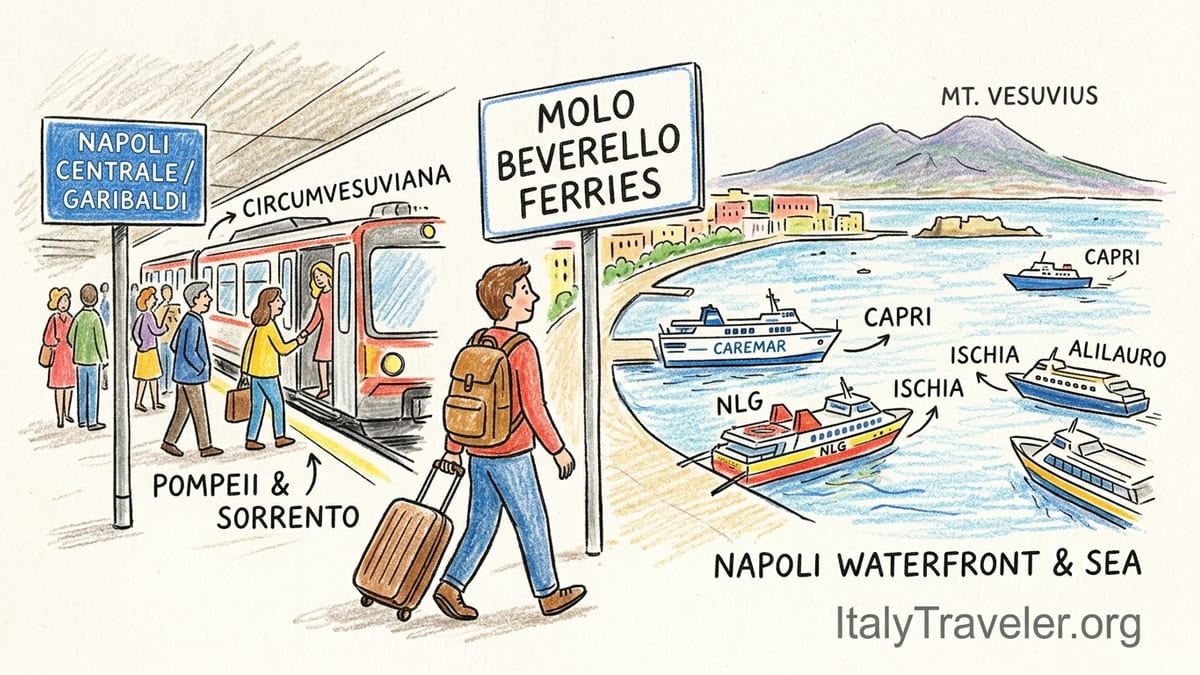
On my first visit, I treated Naples as a necessary stop before “the real trip” to the coast. That was a mistake. On later trips I booked three to four nights in Naples itself, in small hotels around Piazza Garibaldi and the historic center, and used the city as a rail and ferry hub. From Napoli Centrale / Garibaldi station I could drop down to the lower-level platforms and be on the Circumvesuviana line toward Pompeii and Sorrento in minutes, or connect to regional Trenitalia trains for Caserta and Paestum. Staying put in one hotel meant I was not constantly hauling a suitcase between short stays, and I learned that Naples rewarded slow evenings: a pizza at a no-reservations pizzeria near Via dei Tribunali, a walk along the seafront to Mergellina, and then bed before an early train south.
Naples is chaotic, but it works if you learn its rhythms. In the morning, Napoli Centrale is crowded but functional, with clear signage for regional trains and the Circumvesuviana platforms below. I quickly realized that for visiting Pompeii and Sorrento with a suitcase, I preferred the tourist-focused Campania Express over the packed commuter Circumvesuviana. Campania Express uses the same route but runs limited-stop services between Naples, Ercolano, Pompeii and Sorrento with reserved seating and space for luggage. In 2026, this service is suspended from 1 October onward, so in shoulder season I have had to fall back on the regular Circumvesuviana and simply accept the crush of commuters and limited luggage space.
What surprised me most was how quickly the atmosphere shifted once I left the station. Historic Naples felt intense and extroverted, but a ten-minute metro ride from Garibaldi to Municipio delivered me straight to Molo Beverello, where hydrofoils for Capri and Ischia depart. The new underground passage between Municipio station and the port made the transfer far easier than my first trip, when I dragged a suitcase across busy streets and construction. Now I step off Linea 1, follow the tunnel signs to Beverello, and pop up almost opposite the ticket booths of companies like NLG, SNAV, Alilauro and Caremar.
Naples also forced me to adjust my expectations on food and crowds. I ate some of the best pizza of my life in small neighborhood places where a margherita still cost significantly less than on Capri, but I also queued 45 minutes at a famous historic pizzeria that felt more like a production line than a local institution. Over time I learned to avoid the most viral names and follow the queues of Neapolitans instead. My biggest mistake in Naples was underestimating how draining the city can be; on one visit I tried to squeeze in the Archaeological Museum after an early-morning Pompeii visit and a late ferry back from Capri, and I simply could not absorb the treasures that should have been a highlight. Now I plan at least half a day in the museum on a separate, quieter day in the city.
Facing the Reality of Pompeii and the Archaeological Corridor
I had imagined Pompeii as a half-day excursion from Naples. On my first trip I arrived at Porta Marina around 10:30 in the morning on a warm day in May. By then the ticket lines were already long, and tour groups were sweeping through the forum. Tickets to the archaeological park are now sold via the official Pompeii Sites channels and at three entrances, with full-price adult tickets in 2026 costing just under 20 euros and valid for a single entry in the day. Opening hours run from early morning, with last entry in the late afternoon and final exit around sunset depending on the season. Arriving mid-morning meant I spent my first hour dodging crowds in the most popular houses instead of exploring the quieter back streets and newly opened domus.
On later trips I changed my tactic. I booked the earliest train I could manage from Naples and aimed to be at the gates just after opening, when the air is cooler and the tour groups have not yet arrived. Walking up Via dell’Abbondanza almost alone was a completely different experience from my first visit, when every doorway seemed to be plugged by a flag-following group. I learned to carry water and a hat even in the shoulder seasons; the site is exposed, and the stone streets reflect heat quickly. The park has installed some shaded rest areas and water fountains, but you still spend long stretches in full sun. I did make one mistake I would not repeat: on a July visit I decided to combine Pompeii with a hike up Vesuvius on the same day. By mid-afternoon I was exhausted, and the volcano felt like a box to tick rather than the dramatic experience it deserves.
I initially skipped Herculaneum, thinking it would be a smaller, redundant version of Pompeii. When I finally went on a later trip, taking the same Naples to Sorrento train but getting off earlier at Ercolano Scavi, the contrast surprised me. Herculaneum is more compact and better preserved in many places, with upper stories and wooden elements that Pompeii lost. The crowds were markedly smaller when I visited in late September, and I could stand in rooms with intact frescoes in near silence. If I could rearrange my first itinerary, I would pair Herculaneum with a relaxed lunch in Ercolano and leave Pompeii for its own dedicated day.
Further south, Paestum and Velia in the Cilento area changed how I thought about Campania’s ancient sites. I once caught a mid-morning regional train from Naples to Paestum, a ride of about 1 hour 20 minutes, and stepped off at a sleepy station where the ruins are a short walk away. The Paestum Archaeological Park sells tickets on-site from 8:30 in the morning until early evening, with the last admission around 18:30 in summer. The three standing Greek temples rose out of a quiet field where I shared the paths with only a handful of other visitors, a complete contrast to the density of Pompeii. I regretted not planning a night nearby to see the temples lit in the evening and to explore more of Cilento’s inland villages.
Sorrento and the Amalfi Coast: Beauty, Bottlenecks and Overblown Hype
Sorrento was my first base outside Naples, and it initially felt like the perfect compromise: connected by train to Naples and Pompeii, yet close to the Amalfi Coast and Capri, with more manageable crowds and a softer atmosphere. The town’s Circumvesuviana terminus sits a short uphill walk from the historic center, so I could arrive from Naples with my suitcase and wheel it downhill to family-run hotels near Piazza Tasso in ten minutes. Sorrento’s compactness was a blessing; once I checked in, I did not need any local transport. I could walk to Marina Piccola for ferries, wander the narrow shopping streets in the evening, and find a restaurant serving fresh gnocchi alla sorrentina without thinking about buses or taxis.
The reality of day-tripping from Sorrento to the Amalfi Coast, though, was harder than I expected. Buses along the Sorrento to Amalfi route are run by SITA, and in high season the line of people waiting at Sorrento bus station can easily spill onto the pavement. On my first attempt, in late May, I reached the station just after 8:00 and already found a long queue for the 8:30 bus. By the time the bus arrived, only about half of us could board. I eventually squeezed into a later service, standing for much of the winding coastal road. The ride was spectacular but stressful, with the driver braking sharply for hairpin turns while managing traffic and parked scooters. Returning in the afternoon, I faced a similar crush in Amalfi, with travelers from Positano, Praiano and Ravello all converging on the same buses.
Over time, I adjusted. I started using ferries whenever sea conditions were calm enough. Companies such as Travelmar and Alicost operate seasonal services linking Sorrento, Positano, Amalfi and sometimes Salerno and Cilento ports between spring and early autumn, with timetables typically running from around April to early November. When I checked 2026 schedules, the Sorrento routes were active from 1 April, with several mid-morning and afternoon sailings. Boarding the ferry in Sorrento meant a ten-minute downhill stroll from my hotel and an open-air ride with sea breezes instead of diesel fumes. Tickets cost more than the bus, but the difference in comfort and travel time made it worthwhile on crowded days.
Still, I left the Amalfi Coast feeling that parts of it were overrated, especially if you only see it via day trips. Positano’s stacked pastel houses are genuinely beautiful, but in summer the narrow lanes can feel like moving through a slow, expensive shopping arcade. On my first visit, I allotted one rushed afternoon to Positano and another to Amalfi and Ravello, and the days dissolved into queues for buses, cafeterias and viewpoints. What I wish I had done was spend at least two nights in a smaller town like Minori or Cetara, away from the most saturated spots. Instead, by trying to see everything from Sorrento, I turned the coast into a series of logistics problems instead of a place to pause and breathe.
Capri and Ischia: Same Gulf, Very Different Islands
Capri was the island I thought I knew from postcards before I ever set foot there. I caught an early hydrofoil from Naples Molo Beverello, where in 2026 multiple companies advertise dozens of daily sailings between roughly April and early October. On one June visit, I took a mid-morning NLG hydrofoil that scheduled the crossing at around 50 to 60 minutes, with ticket prices that felt steep for a short journey but were broadly similar across operators like SNAV and Caremar. The boat was packed with day trippers. As we approached Marina Grande, the port was a blur of arriving and departing ferries, honking port vehicles and queues for the funicular up to Capri town.
Capri wowed me with its cliffs and the views from the Belvedere of Villa San Michele in Anacapri, but the main town itself felt surprisingly urban and commercial. Luxury boutiques lined Via Camerelle, and the central Piazzetta buzzed with crowds from mid-morning to late afternoon. My biggest mistake on Capri was not staying overnight. As a day tripper, I spent too much time in lines: first for the funicular, then for buses between Capri and Anacapri, and again for the return funicular down to Marina Grande. By the time I reached the famous Blue Grotto jetty, a long line of boats was already waiting in choppy water, and the wait time had ballooned. On a second visit, I skipped the grotto entirely, instead walking the quieter Pizzolungo path around the Faraglioni and having a late lunch away from the main squares, which felt more rewarding.
Ischia, by contrast, surprised me by how lived-in it felt. I took both Caremar ferries and Alilauro hydrofoils from Naples. In 2026, schedules show early-morning departures from Calata Porta di Massa and Molo Beverello, including Caremar ferries that take around 1 hour 30 minutes and Alilauro hydrofoils that can make the trip to Ischia Porto in roughly an hour. One evening departure I used, a Caremar ferry leaving Naples Porta di Massa after 19:00 and arriving at Ischia around 21:00, was filled with island residents, delivery vans and a handful of tourists. The slower ferry ride gave me time to sit on deck, watch Vesuvius recede and feel the gulf widen around us.
On Ischia I made the conscious decision to stay three nights instead of day-tripping. I based myself in Ischia Porto, within walking distance of the harbor, so I could arrive with my suitcase on foot without needing a taxi. From there I used local buses to explore: one day out to Forio and the Poseidon thermal gardens, another toward Sant’Angelo and Maronti Beach. The roads are narrow and busy, but the buses ran frequently enough that I never felt stranded, even in shoulder season. Food prices were noticeably gentler than on Capri; simple seaside trattorie served grilled fish and a carafe of local white wine for what I would have paid for a spritz and a snack near Capri’s Piazzetta. If Capri felt like an elegant stage set, Ischia felt like a working island that happened to have hot springs and dramatic scenery.
What I would change looking back is how I distributed my nights. I would cut one night in Sorrento and add it to Ischia, using the island as a place to slow down, swim and recover between museum visits and archaeological marathons. I would also look more carefully at shoulder-season ferry timetables. Services on some routes reduce significantly outside the April to early November window, and while sites like Naples Bay Ferry aggregate schedules, the final authority is always the shipping companies’ own listings, which I now double-check a day or two before sailing.
Caserta, Cilento and the Quiet Side of Campania
My turning point in Campania came when I started looking inland and further south. One morning I boarded a regional Trenitalia train from Napoli Centrale to Caserta, a ride of about 40 minutes. I went expecting a simple palace visit and found a complex that deserved most of a day. The Reggia di Caserta, the Bourbon royal palace, overwhelmed me with its scale: vast state apartments, a sweeping staircase and a park that stretches in a straight line for several kilometers. Buses and a shuttle service run through the gardens, but I chose to walk at least one direction, passing fountains and English-style landscaping that gradually emptied of people the farther I got from the palace.
I made a mistake there too: I bought a same-day ticket and arrived late in the morning, then tried to rush both the palace and the park before closing. The result was a blur of frescoed ceilings and a mad dash through the English Garden. On a later trip I booked an earlier regional train and arrived close to opening time, which allowed me to visit the apartments in relative calm before the main tour groups arrived from Naples and Rome. Now I recommend treating Caserta as at least a half-day excursion, not a quick stop between other plans.
Further south, the Cilento coast felt almost like another region entirely compared with the Amalfi Coast. I took a regional train from Naples to Salerno and connected either to local trains toward Agropoli and Paestum or to seasonal fast boats. In 2026, the Metro del Mare routes operated by Alicost connect Salerno with towns along the Cilento coast between mid-June and early September, with weekday departures in the morning and returns in the late afternoon. One summer, I used this service to sail from Salerno down past Punta Licosa to smaller ports, where the passengers were mostly Italian families rather than international tourists. The ferries were basic but comfortable, with open decks and small snack bars, and boarding felt relaxed compared with the intense queues at Positano’s small piers.
In Agropoli and Santa Maria di Castellabate, I walked on uncrowded beaches, swam in clear water and found trattorie where the menu changed according to whatever the fishermen had brought in. Road conditions along the Cilento coast are still winding and narrow in parts, but traffic felt much lighter than on the Amalfi road. I rented a small car for one trip, picking it up in Salerno, and drove cautiously south. Having a car opened up hillside villages and agriturismi where public transport is infrequent, but I learned to avoid driving after dark when local drivers take the curves quickly and street lighting can be patchy. If you are nervous about driving, stitching together trains to Paestum and local buses or summer ferries is still a workable way to experience at least part of Cilento.
Practical Lessons: Transport, Luggage and Seasonal Shifts
Across my trips, the biggest practical challenge in Campania was matching my expectations to the realities of transport and seasons. On trains, I learned to treat the Circumvesuviana like an urban metro. It is cheap and frequent but often crowded, with limited space for suitcases. When Campania Express was running, I booked it for travel days with luggage between Naples and Sorrento or Pompeii, accepting the higher fare in exchange for reserved seats and a calmer ride. With the tourist train suspended after 1 October 2026, shoulder-season visitors will need to plan around peak commuter times on the regular line or consider private transfers if budget allows.
For ferries, I now always check two sources: the official sites of companies such as Caremar, NLG, SNAV, Alilauro, Travelmar and Alicost, and one of the aggregate schedule tools that compile daily departures. In 2026, Caremar’s own departure board shows, for example, evening sailings from Naples Porta di Massa to Ischia, including a 19:25 ferry arriving at 21:00, and late-afternoon connections between Capri and Sorrento. Hydrofoils between Naples and Capri run densely from roughly April until early October, but many services cease for the winter, and weather can affect individual sailings even in high season. I once arrived at Beverello to find a line of delayed departures due to rough seas, which would have derailed a tightly timed Capri day trip. Now I avoid booking nonrefundable tours or dinners immediately on arrival days by sea.
Handling luggage is another area where my habits changed. On my first trip, I tried to change hotels every couple of nights, lugging a large suitcase through Naples station, onto buses in Amalfi, and up and down Capri’s staircases. It was exhausting. On later trips, I chose three key bases and radiated out: Naples, Sorrento or Salerno, and one island such as Ischia. From Naples I tackled the big-ticket sites and Caserta; from Sorrento or Salerno I explored the coasts; from Ischia I rested. I downsized my bag to a carry-on with good wheels, which made boarding buses and ferries far easier. In ports like Capri, where vehicles are limited in the upper town, porter services exist but they are expensive, so traveling lighter saved both money and frustration.
Seasonality is perhaps the single most important factor in how Campania feels. In July and August, the Amalfi Coast, Capri and central Naples can be intensely crowded and hot, with busy buses, ferries and long lines at ticket offices. In late April, May, September and early October, I found a far better balance: full ferry schedules, open seasonal routes like the Sorrento and Cilento boats, yet more breathable streets and cooler temperatures. That said, as I learned from the October suspension of Campania Express and the gradual reduction of some ferry services, shoulder season also means checking which “summer-only” options are still running in your specific travel week.
The Takeaway
Traveling beyond the classic Naples and Amalfi Coast circuit changed the way I think about Campania. Naples itself became less of a chaotic transit point and more of a cultural anchor, with the Archaeological Museum and neighborhood pizzerias as experiences worth building days around. Pompeii evolved from a single crowded morning to a site I now visit strategically, early and with intention, often paired with quieter Herculaneum or a longer archaeological corridor south to Paestum. The famous Amalfi Coast kept its beauty but lost some of its mystery once I understood the bottlenecks of buses and the advantages of ferries and slower base towns.
The biggest surprises came from the places I initially treated as optional. Ischia turned out to be a more relaxed and authentic island base than Capri, especially for multi-night stays. Caserta’s royal palace revealed a monumental side of Campania that many visitors miss in their rush to the sea. The Cilento coast, with its combination of Greek temples, quiet fishing towns and less-trafficked roads, offered the kind of coastal Italy that I once assumed no longer existed in the south. If I could redesign my first itinerary, I would cut two or three day trips, stay longer in fewer places, and shift more nights south of Salerno and out on the islands.
Campania rewards travelers who are willing to look past the obvious postcards and to adapt their plans to the reality on the ground: train timetables that change by season, ferry routes that follow summer demand, and crowds that ebb and flow by time of day. It is a region where mistakes become lessons useful for the next visit. Mine taught me to arrive earlier, travel lighter, check the latest schedules directly with local operators, and leave space in the itinerary for the quieter corners of this complex region. Once you move beyond Naples and the Amalfi Coast, Campania stops being a backdrop and starts feeling like a place you can return to again and again, each time a little wiser.
FAQ
Q1. Is it better to base in Naples or Sorrento for exploring Campania?
For archaeological sites and train access, I prefer basing in Naples. For easier access to Capri and the Amalfi Coast, Sorrento works well, but I now use a mix of both on longer trips.
Q2. How crowded are the Circumvesuviana trains to Pompeii and Sorrento?
They are often very crowded at commuter times, especially between Naples and Pompeii. Outside peak hours they are more manageable, but space for large luggage is limited.
Q3. Do I need to book Pompeii tickets in advance?
In high season it is wise to buy tickets ahead through the official Pompeii channels to avoid lines at the three on-site ticket offices, particularly for mid-morning entry.
Q4. Are ferries to Capri and Ischia reliable year-round?
Connections run year-round, but the most frequent hydrofoil services operate from roughly spring to early autumn. In winter and during bad weather there are fewer departures and more disruptions.
Q5. Is driving the Amalfi Coast road worth it?
I found it stressful due to narrow lanes, parked vehicles and heavy traffic. Unless you are very confident, I recommend using buses and ferries there and saving driving for quieter Cilento roads.
Q6. How many nights should I spend on Capri versus Ischia?
If I had to choose, I would give Capri one full day or an overnight and Ischia at least two or three nights, especially if you want time for thermal baths and slower beach days.
Q7. Can I visit Pompeii and Vesuvius in one day from Naples?
It is possible, but when I did both in midsummer it was exhausting. I now suggest dedicating one full day to Pompeii alone or pairing Vesuvius with a shorter site like Herculaneum.
Q8. Is Caserta worth a trip from Naples?
Yes. The palace and its gardens easily fill a half-day or more, and the regional train ride from Naples is short and inexpensive, making it an easy excursion.
Q9. How does the Cilento coast compare to the Amalfi Coast?
Cilento is quieter, less developed for international tourism and generally less crowded, with wider beaches and simpler fishing towns rather than dramatic clifftop villages.
Q10. When is the best time of year to visit Campania?
I have had the best balance of weather, crowds and transport options in late April, May, September and early October, outside the peak summer heat and holiday rush.