


On my first trip to Campania I tried to see everything. On my most recent visit I did the opposite. I chose a handful of experiences, did them slowly, paid attention to how much they cost and how they felt in real time, and asked myself a blunt question on the train home to Rome: which of these would I genuinely carve out time and money for again? The list turned out to be shorter than I expected, and that is exactly why it is useful.
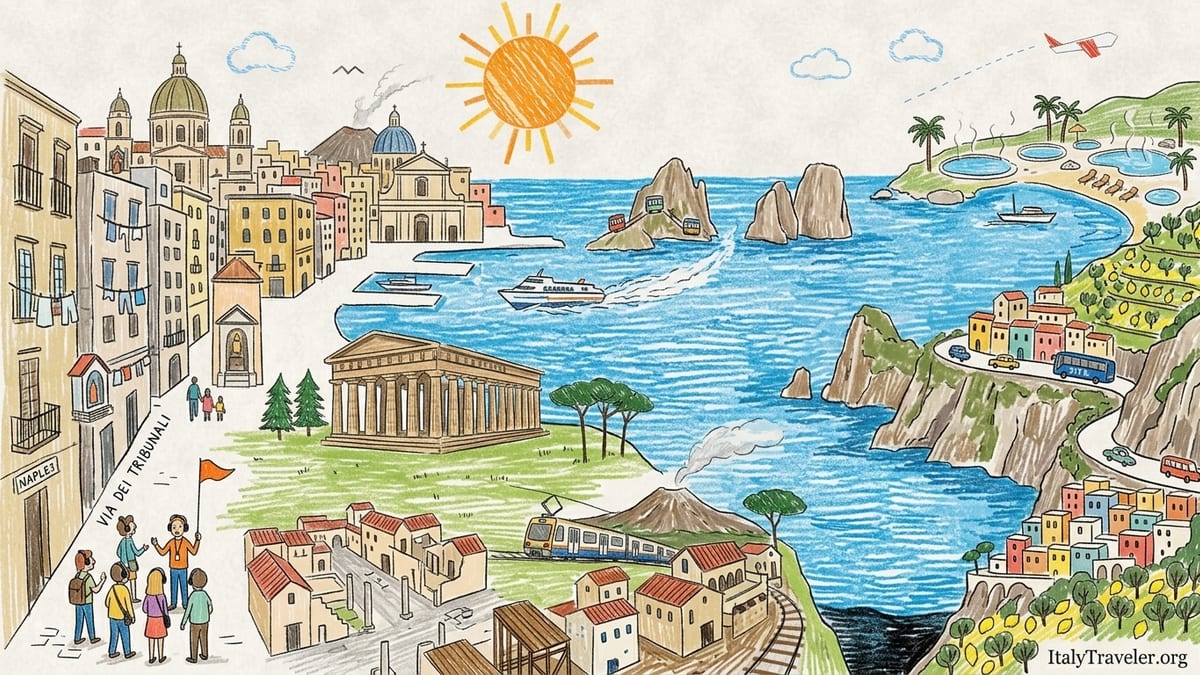
Walking Naples’ Historic Centre Without Rushing
Naples is often treated as a gateway to somewhere else, but the time I stopped using it as a launchpad and gave the historic centre two full days is when the city finally made sense. I stayed near Piazza Dante so I could walk everywhere and joined a two hour historic centre tour that wove through Via dei Tribunali, Spaccanapoli and the area around San Gregorio Armeno. The tour I booked in July 2026 cost just under 40 euros per person for a small group, audio headsets and a licensed guide, which matched the going rate I had seen for comparable historic centre walks that include stops like Santa Chiara and an underground segment around San Lorenzo Maggiore.
Getting there was straightforward. I arrived on a Frecciarossa high speed train from Rome to Napoli Centrale, which usually takes about 70 minutes, then walked twenty minutes up through Piazza Garibaldi into the historic grid. I skipped taxis and the metro on purpose, partly to see how chaotic the walk would feel with luggage. It was busy but manageable, and that initial walk gave me a first look at the worn palazzi, street shrines and laundry lines that make Naples feel instantly different from other Italian cities.
What surprised me most was how compact the UNESCO listed core actually is once you are inside it. On paper the names blur together, but in practice I could go from a slice of pizza on Via dei Tribunali to the cloister of Santa Chiara and then on to Piazza del Gesù Nuovo in less than fifteen minutes on foot. I had assumed I would need public transport to cover ground, but the better choice was to slow down and accept that three or four focused hours on foot in the afternoon, plus the guided walk, were enough for one day.
Would I do it again? Yes, but with intention. I would still pay for a good small group or private tour on my first morning because the context changed how I saw every church façade and side alley. I would budget for two nights in Naples rather than dashing off to the coast immediately, and I would treat the historic centre as a destination in itself rather than something to squeeze between the train station and the ferry port.
Pompeii: A Full Day Among the Ruins
I have visited Pompeii twice now, and the second time confirmed that it belongs firmly on my “worth repeating” list if I can give it a full day. On my latest visit I based myself in Naples and took the Circumvesuviana train from Napoli Porta Nolana to Pompei Scavi Villa dei Misteri, a ride of around forty minutes. A single ticket on this local train line typically costs only a few euros each way, and the station at Pompeii is a short walk from the main Porta Marina entrance.
For tickets I went straight to the official entrance. As of 2026, standard adult entry to the Archaeological Park of Pompeii is listed at around the mid teens in euros on the official tariff, with more complex “Pompeii Plus” formulas at a higher rate that include additional villas and shuttle transport. That matched what I paid at the gate, slightly over 20 euros each once I opted for a combination ticket that allowed access over more than one day and to other nearby sites, which felt fair for the size of the site. I declined a guided tour this time but did rent the official audio guide, which added another reasonable charge per person.
I stayed from late morning until closing, a solid six hours on site with only a short break near the cafeteria. The scale still surprised me even on this second visit. You do not quite understand how large Pompeii is until you pass hour three and realise you are still discovering new streets, bath complexes and villas. The newer reconstructions, careful fresco restorations and some reopened houses since my first visit made the experience feel fresh rather than repetitive.
What I would do again is commit to the full day, arrive with water and sun protection, and accept that I will still not see everything. I would also happily pay the official entry price again, since it remains good value compared to guided day trips that bundle transport, tickets and a fixed route. If I had first timers with me, I might book a half day local guide in advance for context, then let them wander freely in the afternoon.
Herculaneum: The Site I Recommend Most Often
Herculaneum is the site I now recommend first to friends who find Pompeii overwhelming. I reached it on the same Circumvesuviana line that serves Pompeii, but got off earlier at Ercolano Scavi after roughly twenty minutes from Naples. The station sits about a ten to fifteen minute walk downhill from the archaeological park entrance. I chose an early morning departure to be at the gate close to opening time.
At the ticket office I paid a standard adult rate that was a little under what I had paid for Pompeii. Official prices fluctuate over time, but at the time of my visit an individual entrance cost in the low teens in euros, with combination formulas available that included other Vesuvian sites. I bought my ticket on arrival instead of through a third party reseller after checking how official pricing compared to packaged offers, and it was noticeably cheaper than many “skip the line” products that bundle transport and guiding.
I spent about four hours inside the site. What surprised me most was how much more intimate Herculaneum feels compared with Pompeii. Multi story buildings, preserved wooden elements and smaller, denser streets give a sense of a living town that was frozen mid sentence. On a practical level it was also less crowded. I had entire insulae almost to myself at times, even in shoulder season, and that quiet made the experience easier to absorb.
Would I go back? Absolutely. Herculaneum is manageable in half a day, which makes it ideal for a return visit slotted between other activities. I would repeat the early train from Naples and the direct walk to the entrance, and I would encourage others to consider the official ticket office first rather than assuming third party sites are necessary. If I were returning with children or someone less keen on long walking days, I would skip Pompeii entirely and focus on Herculaneum.
A Day on the Water: Ferry from Naples to Capri
Capri by ferry is one of those classic Campania experiences that risks feeling overhyped. I went in with measured expectations and came away convinced that the boat ride itself is half the pleasure, worth doing again if you choose your timing carefully. I booked a morning high speed ferry from Molo Beverello in Naples to Marina Grande on Capri. On the major operators between Naples and Capri, one way adult fares in 2026 typically run from roughly 25 to 30 euros depending on the company and the season, which aligned with the 29 euros I paid for my outbound crossing in June.
From my hotel in the historic centre I walked twenty minutes downhill to the port, giving myself time to find the right pier and queue. The crossing took about fifty minutes on a hydrofoil type vessel with indoor seating and limited outdoor space. The surprise was how quickly the city fell away. Within fifteen minutes Vesuvius and the skyline of Naples framed the wake behind us, and rocky outcrops around Capri began to rise clearly ahead.
I stayed on Capri from late morning until an early evening ferry back, roughly eight hours total on the island. I chose to skip the busiest midday slot at the Blue Grotto and instead took the funicular from Marina Grande up to Capri town, then walked the lanes, detoured to the viewpoints around the Gardens of Augustus and sat for a long coffee break facing the Faraglioni. The island was crowded, but by late afternoon the day trip groups had thinned and the return sailing felt calmer.
Would I take the ferry again? Yes, with conditions. I would book the earliest or near earliest outbound boat from Naples and a later return to avoid the tightest crush, and I would budget around 60 euros per person for the return crossing alone, before anything else on the island. I would also treat the boat ride as part sightseeing cruise, choosing a window seat, watching the coastline of Campania slide past, and accepting that this is not the place to economise heavily if Capri is important to you.
Amalfi Coast Villages by Bus and On Foot
The Amalfi Coast intimidates many visitors not because of the cliffs but because of the logistics. On my last trip I tested the classic combination of SITA Sud buses and walking to connect between villages. I based in Amalfi town, which works as a central hub. To reach Amalfi I took a regional train from Naples to Salerno and then walked from Salerno station to the waterfront to catch a SITA bus. Bus tickets along the Amalfi to Positano to Sorrento line are sold as paper tickets at tabaccherie and small shops near the stops, and most short hops cost only a few euros, often under 2 euros for the simplest segments according to local information and posted price examples.
I spent three nights in Amalfi, using the buses for day trips to Ravello and Positano and walking sections of the coastal road when the mood took me. The first surprise came with the crowds at certain times of day. Mid morning departures from Amalfi toward Positano filled quickly. Even in shoulder season, buses along the Amalfi to Positano to Sorrento route operated on a printed timetable, but real world delays and full vehicles meant I built in plenty of buffer time when I had dinner reservations or ferries to catch further along the coast.
When the bus system worked smoothly, it was worth far more than the modest ticket price. Sitting on the sea side of the bus, watching terraces of lemons and pastel villages stack up the cliffs, felt like a sightseeing tour rolled into basic transport. In Ravello, where the bus deposits you near the centre, I spent a full afternoon wandering between Villa Rufolo, Villa Cimbrone and quiet lanes and was glad I had not committed to returning the same day to a more distant base.
Would I rely on buses again? Yes, but only with a flexible plan. I would happily base in Amalfi for two or three nights again, buy my SITA tickets in advance from the local tobacco shop when possible, carry cash, and allow extra time for queues. If someone in my group was anxious about crowds or motion sickness, I might mix in more ferries between Amalfi, Positano and Salerno, which cost more than the buses but provide a smoother and often less stressful way to see the same cliffs from the water.
Thermal Bathing on Ischia: A Half Day of Heat and Sea
On a hot July afternoon I took the ferry from Naples to Ischia for one reason: to spend several hours at a thermal park. Ferries from Naples port to Ischia Porto or Casamicciola are frequent in season, and single adult tickets on the larger ferries or faster hydrofoils typically range from roughly 20 to 30 euros one way depending on the operator and speed. I booked a mid morning sailing out of Molo Beverello and landed at Ischia Porto in just under an hour.
From Ischia Porto I used the island bus system and a short taxi ride to reach one of the major thermal parks that combine multiple pools, gardens and beach access. I chose a park on the western side of the island that operates seasonally from around late April to late October, similar to the Giardini Poseidon which lists its season over that same span. Entry prices vary by duration and time of day, but illustrative published price lists for comparable parks show full day adult entries comfortably above 40 euros, with discounted afternoon entries from around mid afternoon into the early evening under that figure. I opted for an afternoon ticket that cost a little less than the full day rate and arrived around 14:00.
I stayed until closing, moving lazily between hotter and cooler pools, sea water swimming areas and shaded loungers. What surprised me was not the heat itself but the quiet discipline of the place. There were rules about footwear, pool use, and in some cases minimum heights for thermal pools that staff actually enforced. Families with children tended to gather in the cooler zones, leaving the hottest pools calm and almost meditative.
Would I do it again? Without question. I would repeat the half day model rather than paying for a full day I would not fully use, especially in summer when a few hours of intense heat is enough. I would also consider staying overnight on Ischia instead of returning to Naples the same evening, to avoid watching the sunset from a ferry while tired. The combination of ferry, local bus or taxi, and thermal park ticket is not cheap once tallied, but as a focused indulgence in the middle of an otherwise busy itinerary it felt entirely worth the cost.
The Royal Palace of Caserta: A Different Kind of Day Trip
The Royal Palace of Caserta sits roughly thirty five kilometres north of Naples and gave me a welcome change of pace after several days of ruins and coastal views. I caught a regional Trenitalia service from Napoli Centrale to Caserta, a direct train ride of about forty minutes that cost under 10 euros return in second class. From Caserta station it was a simple ten minute walk straight down a broad avenue to the palace entrance, the façade growing more imposing with every block.
At the ticket office I chose a ticket that covered the royal apartments and the park with its cascades and English garden. In 2026 the official website lists a range of ticket options, with combined palace and park entries for adults priced in a band roughly between 20 and 25 euros depending on season and whether special exhibitions are included. That was consistent with what I paid on the day, including a modest surcharge for a timed entry to the apartments to manage visitor flow.
I spent about five hours at Caserta, dividing my time between the interior and the gardens. Inside, the grand staircase, throne room and long enfilades of decorated rooms were impressive, but the surprise highlight came outside. The park stretches for several kilometres. I decided to walk the main axis up to the series of pools and cascades rather than renting a bike or shuttle, a choice that took longer than I expected but rewarded me with wide open views back toward the palace and fewer people around me as I climbed.
Would I go back? Yes, especially with someone who enjoys architecture and landscape design. I would repeat the regional train from Naples, arrive early to beat school groups, and allow most of the day rather than treating Caserta as a quick stop en route to somewhere else. I might invest in the shuttle or a bicycle next time to reach the far end of the park more quickly, but the overall combination of low cost train trip and fairly priced ticket felt like a very good value excursion.
Paestum: Greek Temples in the Fields
My day at Paestum was one of the quietest of the trip, and for that reason alone I would make room for it again. From Naples I took a regional train toward the Cilento area, getting off at Paestum station after about eighty minutes of coastal and countryside views. A one way regional ticket cost a bit over 10 euros, bought from the Trenitalia machine at Napoli Centrale. The walk from Paestum station to the archaeological park entrance took about fifteen minutes along a relatively quiet road.
At the combined ticket office and museum entrance I purchased a ticket that covered the archaeological area with its three major Doric temples and the onsite museum. Official information for the archaeological park indicates that standard adult tickets for Paestum and Velia combined fall in the mid teens in euros, with various multi day options valid across both sites. My own ticket fell within that range and allowed same day re entry, which was useful in the afternoon heat.
I stayed for around five hours, dividing my time between the temples and the museum. The surprise at Paestum was the sense of scale and emptiness. Unlike Pompeii, where you are constantly aware of thousands of other visitors, here I could stand between the two great Hera temples and hear almost nothing but cicadas. The museum, with its painted tomb slabs and everyday artefacts, added context without taking more than an hour or two.
Would I go again? Yes, but only if I had already seen the main Vesuvian sites or wanted a calmer day. Paestum is a commitment from Naples once you factor in train times and connections, and I would be more inclined to return if I were already staying further south, in Salerno or the Cilento. I would still take the train over any combination of bus and private transfer, and I would gladly pay the modest entry fee again for the chance to stand under those columns in late afternoon light.
The Takeaway
After several trips through Campania, these are the experiences I would personally repeat without hesitation if time and budget allowed: slow walking days in Naples’ historic centre, a full unhurried day in Pompeii, a half day in Herculaneum, a carefully timed ferry trip to Capri, a few days moving along the Amalfi Coast by bus and on foot, a half day soak in Ischia’s thermal parks, a palace and garden day at Caserta, and a quiet temple walk at Paestum. None of them are secrets. All of them are worth the effort when done with enough time and realistic expectations.
The specifics will keep changing. Train timetables, ferry operators, ticket prices and opening rules shift year by year. What has not changed across my visits is the feeling that Campania rewards those who choose depth over breadth. If I were planning another trip tomorrow, I would use the costs and timings described here as a starting point, double check current prices on official channels, and then deliberately under schedule my days so I could notice the details that made each of these experiences worth doing again.
FAQ
Q1. Is it realistic to visit both Pompeii and Herculaneum in one day from Naples?
Yes, it is technically possible, especially using the Circumvesuviana train that serves both sites, but I found each deserves at least half a day and would not personally combine them unless I was very short on time.
Q2. How far in advance should I book ferries from Naples to Capri or Ischia?
In my experience in high season it is worth booking tickets at least several days ahead for preferred morning and late afternoon sailings, although same day tickets are often available for less popular times.
Q3. Are SITA buses along the Amalfi Coast safe and reliable?
Yes, they are widely used by locals and travelers and felt safe on my trips, but reliability can be affected by traffic and overcrowding, so I always allowed extra time and carried a backup plan.
Q4. Is a guided tour necessary for Pompeii or can I explore on my own?
You can absolutely explore on your own using the official map and audio guide, which is what I did on my second visit, but on a first visit I would consider a guided tour for context.
Q5. Is Caserta worth a full day or just a half day from Naples?
If you enjoy architecture and landscaped gardens I would allocate most of a day, since between the palace interiors and the long park axis it is easy to spend five or more hours on site.
Q6. What should I budget for a day trip to Capri from Naples?
Based on my recent visit I would plan for roughly 60 euros per person for round trip ferry fares plus additional costs for local transport, food and any attractions on the island.
Q7. Can I visit Paestum on a day trip without renting a car?
Yes, I did it comfortably by taking a regional train from Naples to Paestum and walking from the station to the archaeological park, and I would use that method again.
Q8. Are Ischia’s thermal parks suitable for children?
Some areas are, but many thermal pools have minimum height rules and temperature restrictions, so I saw families gravitate toward cooler pools and beach sections while the hottest pools remained adults oriented.
Q9. Is it better to stay in Naples or on the Amalfi Coast for exploring Campania?
On my trips I found Naples best as a base for Pompeii, Herculaneum, Caserta and Ischia, while a few nights in Amalfi or another coastal town worked better for exploring the Amalfi Coast itself.
Q10. How much walking should I expect at these sites?
A lot. On most days I easily covered ten to fifteen thousand steps between stations, entrances and exploring, so I would strongly recommend comfortable footwear and planning rest breaks into each day.