


I arrived in Naples with a rolling carry-on, a small backpack, and a stubborn plan: no car, even though I wanted to see everything from Pompeii to Capri and the Amalfi Coast. For seven days I relied on Campania’s trains, ferries and buses, learning where the system flows beautifully and where it grinds to a halt, especially when you are dragging luggage and trying to make connections that look simple on a map but feel very different on the ground.
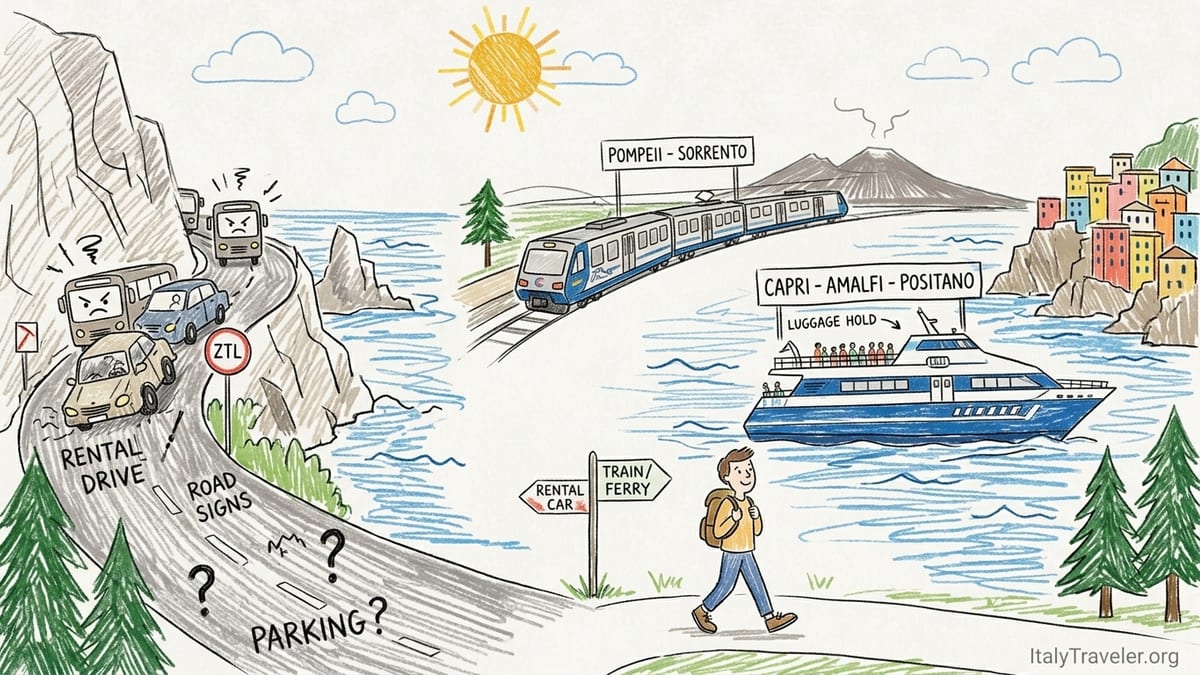
Why I Chose Trains and Ferries Over a Car
The decision not to rent a car in Campania started as a mix of budget and nerves. I had seen enough dash‑cam videos of the Amalfi Coast road to know I did not want to be the one threading a rental car between buses on hairpin bends or searching for parking in Positano. Parking in towns like Amalfi and Positano can cost the equivalent of several dozen euros per day in high season, often in lots perched above town that require a shuttle or a steep walk. On top of that, many coastal villages have ZTL restricted zones that make driving into historic centers both risky and stressful for visitors who do not know the rules.
What tipped the balance was realizing how dense the local rail and ferry networks actually are. From Napoli Centrale you can reach Pompeii, Herculaneum and Sorrento on the Circumvesuviana or the tourist‑oriented Campania Express services, and regional Trenitalia trains connect Naples with Salerno and Paestum without the stress of the coastal road. Across the Gulf of Naples, ferries and hydrofoils knit Naples, Sorrento, Capri, Ischia and Procida together. On paper, it looked like the perfect region to explore with a small bag and a good pair of shoes.
I also wanted the freedom to look out of the window instead of at road signs. On the Frecciarossa high‑speed train from Rome to Naples I watched the Tyrrhenian coast flash by from a reserved seat, then stepped directly into the organized chaos of Napoli Centrale and the very different world of Campania’s local transport. That contrast, between sleek long‑distance trains and old commuter lines, shaped much of my week without a car.
First Encounters with the Circumvesuviana
My first test came an hour after arriving in Naples, when I followed the signs down from Napoli Centrale to the Circumvesuviana platforms at Porta Nolana and Garibaldi. The change in atmosphere was immediate. The platforms were low, the air hotter, and the train that rolled in looked more like an aging metro than a regional train, with few seats and no dedicated luggage racks. Regular users describe it as crowded and scruffy, and that matched what I saw on the ground, especially as commuters and tourists funneled into the same carriages.
I had timed my trip badly, boarding a Napoli to Sorrento train in the late afternoon. The carriage was already packed near the doors when it arrived. People surged forward as soon as it stopped, and I quickly understood why so many travelers talk about “smooshed together” crowds on this line. With a single carry‑on and backpack I could twist sideways and wedge myself and my bag into a narrow strip of floor space. Travelers around me with big checked suitcases were struggling, pivoting their bags at awkward angles and apologizing in multiple languages as people squeezed past for each stop.
The lack of luggage space is not a design flaw so much as a reflection of what the line actually is: a dense commuter railway for locals that also happens to pass world‑famous archaeological sites. Between Garibaldi and Pompei Scavi I stood near the doors, one hand on the suitcase handle and one hand on my zipped backpack in front of me. Other riders did the same, after reading all the warnings about pickpockets on crowded services from Naples. I did not see anything suspicious on that trip, but I understood why people repeat the advice to keep valuables in a money belt or inner pocket and not to let a backpack sit unzipped behind you in a crush near the doors.
Once the train thinned out after Torre Annunziata, it became almost pleasant. A seat opened, my bag tucked against my legs, and Mount Vesuvius filled the window on the inland side. At Pompei Scavi the shift was stark again: half the carriage emptied, all tourists, dragging their bags toward the station exit and the entrance to the ruins.
Luggage, Missed Chances and Learning to Pack Smaller
My original plan had been to go directly from Naples to Sorrento on the Circumvesuviana with luggage, then use Sorrento as a base. One crowded ride was enough to make me rethink that. After my standing‑room‑only run to Pompei Scavi with a single carry‑on, I tried to imagine two people, each with a checked suitcase and a backpack, forcing their way onto the same afternoon train. Regulars in Sorrento forums describe being entirely unable to board peak‑season trains because they were already full when they arrived, and that mental image was enough for me to adjust my route.
Instead of hauling my bag all the way to Sorrento that day, I left it in a deposito bagagli at Napoli Centrale and treated Pompeii as a day trip with just my backpack. Paid luggage storage is not cheap, but the ability to walk free through the site, board and exit packed local trains without worrying about where a suitcase would fit, changed the tone of the day. When I eventually did travel to Sorrento, I chose a quieter mid‑morning Circumvesuviana departure and boarded at Porta Nolana, the terminus, so I could find space and let the train fill around me rather than fighting for inches of floor at Garibaldi.
That adjustment was one of several that Campania’s transport network forced me to make. Timetables, especially for local trains and buses, can look frequent on a website but feel irregular when a delayed train means you just miss the hourly bus onward. I learned to avoid tight self‑made “connections” between different modes. For example, one afternoon I planned to arrive in Sorrento on the Circumvesuviana around 16:00 and catch an Amalfi‑bound SITA bus at 16:15. A minor delay and a slow exit off the train meant I reached the bus queue in Piazza Giovanni Battista de Curtis in time to watch a completely full bus leave. The next bus eventually turned up closer to 17:00 and was standing room only, with luggage wedged into every spare corner.
By day three, I had a new rule: plan my days around one major move and keep everything else flexible. Instead of booking nonrefundable ferry tickets that required a precise connection, I bought on the spot when I could see the boat in port. Instead of trying to shuttle luggage through multiple modes in one afternoon, I chose bases like Naples and Sorrento that sit on the spine of the network, then made day trips outwards with only a backpack.
Ferry Reality: Capri, Ischia, Procida and Seasonal Schedules
On maps and brochures, the Gulf of Naples looks like a playground of boats zigzagging between Naples, Sorrento, Capri, Ischia and Procida all day long. In practice, the network feels very different depending on the month. When I checked schedules for my late spring trip, I could see a clear contrast between the dense summer matrix of departures and the much slimmer shoulder‑season offerings. Routes like Naples to Capri and Sorrento to Capri had plenty of mid‑day sailings, but many links between islands, such as Capri to Ischia via Procida, were limited to a small number of departures or focused on weekends.
My first ferry run was the classic Naples to Capri hydrofoil from Molo Beverello. I arrived about 45 minutes ahead of my chosen mid‑morning departure, bought a ticket at the operator’s window and paid a modest supplement to check my carry‑on sized suitcase into the ferry’s luggage hold. The boarding area felt like an airport gate emptied onto a concrete pier. A staff member tagged my bag and stacked it with dozens of others on a wheeled cart that disappeared into the stern while foot passengers streamed up the gangway with day‑trip backpacks. The crossing itself was smooth and relatively quick, but I noticed how even a bit of wind made the hydrofoil pitch enough that walking inside required a hand on the seat backs.
The real lesson came a few days later when I tried to link Capri to Ischia without returning to the mainland. On summer timetables there are usually direct or through services that connect the islands, sometimes via a short stop at Procida. Outside the core months, those links can shrink to just one or two daily sailings if they run at all. On my dates, the only viable option was an early afternoon boat that required me to cut my Capri day short. When a morning thunderstorm delayed departures at Marina Grande, that plan started to fray. Staff at the ticket counter calmly suggested an alternative: a late afternoon hydrofoil back to Naples followed by an evening ferry to Ischia.
That alternative worked but turned one boat ride into a mini‑odyssey of lines and waiting rooms. I queued in Capri to buy a one‑way ticket to Naples, retrieved my bag from the luggage cart on arrival at Molo Beverello, then walked across the port to Calata Porta di Massa, the dock used by the slower car ferries to Ischia. At the Ischia ticket office I bought another ticket and checked my luggage again. I finally stepped onto Ischia just after sunset, several hours later than my original island‑to‑island dream connection. The experience drove home how important it is, without a car, to keep an eye on the seasonality of ferries and to leave generous buffer time when you rely on the last or second‑to‑last boat of the day.
The upside of traveling this way is that once you are on board and your luggage is safely stowed, the journey itself is relaxing. On the open deck of the slow ferry to Ischia, I leaned on the rail as the dome of Naples receded and watched Vesuvius change shape with every mile. It was a level of sightseeing no driver threading traffic along a ring road could have enjoyed, and for that hour and a half, I did not miss a car at all.
Coastal Buses and the Frustration of the Amalfi Road
If the Circumvesuviana taught me to pack lighter and ferries taught me to respect seasonal schedules, the SITA buses along the Amalfi Coast taught me humility. The stretch between Sorrento and Amalfi is spectacular, carved into cliffs above the sea, but it is also narrow, winding and heavily trafficked in high season. Local advice often tells visitors not to drive it themselves, which pushes even more people onto buses that share the same road with day‑trip coaches and delivery vans.
From Sorrento, I joined the queue for the Amalfi bus in the late morning. By then, dozens of people were already waiting, some with small day bags, others with rolling luggage clearly headed to overnight stays in Positano or Praiano. When the bus pulled in, the driver loaded a limited number of suitcases into the under‑floor compartment and then signaled that there was no more space. A group with several large hard‑shell cases had to wait for the next service, which was estimated to arrive in about 45 minutes, though traffic meant even that was only a rough guess.
I managed to board with just my backpack and ended up standing in the aisle, one hand on the rail and the other bracing against the sway with every curve. The ride was beautiful but slow. At each village the bus squeezed to the curb to exchange passengers, and at several tight bends it had to wait while oncoming coaches carefully inched past. By the time we reached Positano, the bus was so full that several people who had hoped to board simply could not. Watching them left behind on the roadside, I understood why some travelers pay significantly more for private transfers when they have heavy luggage and a fixed check‑in time.
What buses do offer, which no private car can, is the chance to look out of the window without distraction and to share the route with locals. On a later run between Amalfi and Ravello I sat next to a woman commuting home from work in Salerno, who explained that in high summer she sometimes lets one or two buses pass because they are too full to board. Without a car, I had to accept that I was one more body on a system that is stretched at peak times. That meant waking earlier for the first buses of the day, traveling outside the sharpest peaks of mid‑morning and late afternoon, and thinking carefully before bringing any luggage larger than a carry‑on onto these coastal routes.
Making the Most of the Campania Artecard
Before the trip, I bought a three‑day Campania Artecard that combines entry to major cultural sites with public transport in the Campania region. My main motivation was to bundle together Pompeii, Herculaneum and the National Archaeological Museum in Naples, while also covering urban transport in and around the city and on lines such as the Circumvesuviana. The version I chose included several free admissions followed by reduced‑price entries, and covered metro, funicular and many local train and bus services during its validity.
Using the card with public transport required a small mental adjustment. Instead of feeding a paper ticket into turnstiles, I used the physical card as a contactless pass where readers were installed, or showed it to conductors when asked. On the Naples metro, where mobile phone signals can be patchy underground, I was glad I had the plastic card rather than relying on an app. One important limitation I discovered was that the airport Alibus, the shuttle between Naples Airport and the central station and port, is not included on any version of the Artecard, which meant I had to budget separately for that ride and buy a ticket from the driver.
At the archaeological sites, the card made the days smoother. In Pompeii and Herculaneum I went directly to the ticket office window signposted for passes, had my card scanned and walked in without handling cash. The savings add up if you visit several high‑profile sites within the card’s validity period. On my rough calculations, three major entries plus urban transport more than justified the cost of the three‑day version, especially since I was taking multiple metro rides in Naples and hopping on and off the Circumvesuviana around Vesuvius.
The card did have its quirks. Activation starts the first time you use it, and it is easy to burn one of your days on a light transport schedule if you tap in for a short metro ride and then do not manage to pack in museum visits. The other small frustration was the need to carry both the card and, in some cases, a separate transport ticket for services not included, such as the airport bus or certain long‑distance ferries. Still, as someone traveling without a car, having a single product that opened both turnstiles and museum gates felt very aligned with the way I was moving through the region.
Where Public Transport Shined and Where I Missed a Car
Over a week in Campania, I oscillated between gratitude for the existence of dense public transport and occasional longing for a set of car keys. On the positive side, trains and ferries gave me space to relax, watch the scenery and arrive in the heart of places I wanted to see without worrying about parking or ZTL cameras. Stepping off a ferry at Marina Grande in Capri or the port of Ischia and walking straight into town, rather than looking for a distant parking lot, felt liberating. Likewise, hopping on a metro in Naples to reach the Archaeological Museum or using the funicular up to Vomero spared me steep climbs and confusing one‑way streets.
The biggest advantages of not having a car showed up in historic centers. Streets in Naples’ centro storico are narrow and crowded, and in towns like Amalfi and Positano, pedestrian alleys and staircases are simply not accessible by car. Traveling by train and bus meant I arrived already on foot, picking my way through piazzas and markets instead of circling for a rare open parking space. The money I would have spent on fuel, tolls and parking went instead into a guided walk at Pompeii and a seafood dinner in Sorrento.
Where I did miss a car was in the gaps between major routes and in the late evenings. Visiting Paestum from Naples on regional trains was straightforward, but exploring inland wineries or small hill towns beyond the main rail lines would have required patching together infrequent buses or hiring a driver. After dark, too, public transport thins out. On Capri, for example, I had to time my return down from Anacapri so as not to miss the last bus that would connect with my evening hydrofoil to Naples. Along the Amalfi Coast, evening buses are far less frequent than day services, which made me watch the clock far more closely than I would have if I had a car parked nearby.
The other moments when a car sounded appealing were after travel hiccups. Standing in a long, slow‑moving queue for a SITA bus in Positano while taxis whisked a handful of people away at premium prices, it was hard not to fantasize about driving myself. Similarly, when a short delay on the Circumvesuviana made me miss a preferred ferry departure to Ischia, I briefly envied those whose schedules were not built on public timetables. Yet even in those frustrating moments, I could see the trade‑off: my stress was about waiting and crowding, not about navigating mountain roads in the dark or worrying about scraped bumpers.
The Takeaway
Traveling through Campania without a car is entirely possible, often enjoyable, and occasionally exasperating. Over a week of hopping between trains, ferries and buses, what mattered most was not mastering every timetable but adjusting my expectations to the way the local system really works, especially in busy seasons. The Circumvesuviana is not a comfortable intercity train with luggage racks; it is a crowded commuter line where a small bag and an early start make an outsized difference. The Gulf ferries are not a constant shuttle in all months, but a network with strong seasonality, where a missed connection can turn a short hop into a multi‑leg journey through Naples’ ports.
On the positive side, I left with the sense that relying on public transport had deepened my connection to the places I visited. I stood shoulder to shoulder with commuters, watched schoolchildren jump off buses in cliff‑top villages, and saw Vesuvius and the Amalfi cliffs from angles that a driver could never safely enjoy while watching the road. The Campania Artecard tied much of this together, turning my transport into a kind of moving key that opened both turnstiles and ancient gates.
If you are weighing whether to rent a car or rely on trains, ferries and buses in Campania, my experience tips toward public transport for most itineraries focused on Naples, Pompeii, Sorrento, Capri, Ischia, Procida and the main Amalfi Coast towns. Pack light, build in buffer time, and avoid planning tight connections between different modes. Accept that sometimes you will stand, sometimes you will wait, and sometimes you will change plans when weather or crowds intervene. In exchange, you gain freedom from traffic, parking and driving fatigue, and you let the landscape roll past your window while someone else does the work.
FAQ
Q1. Is it realistic to visit Pompeii, Sorrento and the Amalfi Coast without renting a car?
Yes, it is realistic. I used the Circumvesuviana and regional trains for Pompeii and Sorrento, then SITA buses and ferries for the Amalfi Coast. The key is to pack light, allow extra time between connections and avoid planning tight same‑day jumps that rely on everything running exactly on schedule.
Q2. How manageable is the Circumvesuviana with luggage?
With a single carry‑on and backpack it was manageable, though crowded, especially between Naples and Pompei Scavi or Sorrento in the afternoon. Larger checked suitcases were clearly awkward and sometimes prevented people from boarding full trains. Boarding at the terminus in Porta Nolana and traveling outside rush hours made a big difference.
Q3. Are the Amalfi Coast buses too crowded to use with bags?
They can be very crowded in high season. I rode standing in packed aisles between Sorrento and Positano, and I saw travelers with large suitcases turned away because the luggage compartment was full. With only a backpack or small rolling case it was tight but workable. With big luggage, a private transfer or boat may be more practical.
Q4. How did seasonal ferry schedules affect your plans for Capri, Ischia and Procida?
Seasonal schedules mattered a lot. Outside the core summer months, direct island‑to‑island links were limited or reduced to one or two daily sailings. When a storm disrupted departures from Capri, I had to reroute via Naples and then continue to Ischia on a later ferry. Checking timetables for the exact month and having a backup route through Naples proved essential.
Q5. Did the Campania Artecard actually save money when traveling without a car?
For me it did, because I combined several major sites like Pompeii, Herculaneum and the Naples Archaeological Museum with heavy use of urban transport and local trains. The card covered multiple rides on the metro, funiculars and certain regional lines. I still had to buy separate tickets for the airport bus and ferries, but overall the pass provided good value for a concentrated three‑day period.
Q6. How safe did you feel on trains and buses, especially around Naples?
I felt generally safe but stayed alert, particularly on crowded Circumvesuviana services from Naples where pickpocket warnings are common. I kept my backpack in front of me, used inner pockets or a money belt for valuables, and avoided standing near doors with loose items. On buses and ferries the atmosphere was more relaxed, but I treated crowded situations with the same basic precautions I would in any big city.
Q7. What was the biggest advantage of not having a car in Campania?
The biggest advantage was freedom from driving and parking stress on the Amalfi Coast and in Naples. Instead of navigating narrow cliff roads and searching for expensive parking, I could look out of the window, step off in the center of towns, and redirect my budget toward experiences rather than fuel and parking fees. It also made it easier to enjoy wine with meals without worrying about driving afterward.
Q8. What was the most frustrating part of relying on public transport?
The most frustrating parts were overcrowded peak buses on the Amalfi Coast and the occasional missed connection when a delayed train caused me to just miss a ferry or bus. Standing in long queues in Positano or Amalfi while watching full buses drive past can test your patience. Accepting that some waiting and occasional plan changes are part of the experience helped me cope.
Q9. How early did you buy ferry tickets for Capri and Ischia?
I usually bought ferry tickets on the same day at the port ticket windows, arriving 30 to 45 minutes before my chosen departure. That flexibility helped when weather or train delays forced changes. For very early morning boats or during peak holidays, I would consider buying in advance, but the trade‑off is less flexibility if your inland connections slip.
Q10. If you returned to Campania, would you still go without a car?
For an itinerary focused on Naples, Pompeii, Sorrento, Capri, Ischia, Procida and the main Amalfi Coast towns, I would absolutely go without a car again. If I wanted to explore more remote inland villages, vineyards or lesser‑known archaeological sites away from rail lines, I might consider a short targeted car rental in the off‑season or hiring local drivers for specific days rather than keeping a car for the entire trip.