


By the time the ferry pulled away from Naples and the skyline shrank into a pale watercolor, I finally understood why people talk about Ischia in almost mythical terms. The island is not just another beach escape in Campania; it is one of Italy’s great thermal destinations, fed by more than a hundred hot springs and clouds of fumaroles that breathe quietly out of the volcanic rock beneath your feet. I had come for one very specific reason: to spend an entire day inside its famous thermal parks and see what it is actually like, hour by hour, when you give yourself over to hot water, sea views and the slow rhythm of island life.
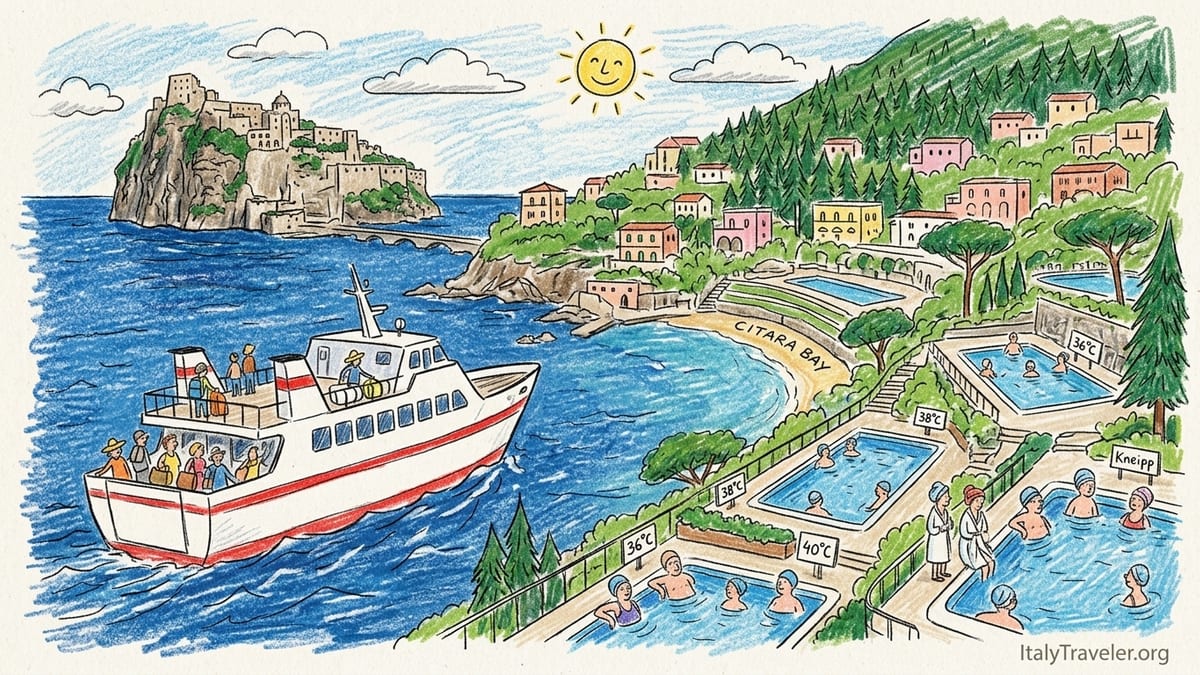
Arriving by Ferry: The First Glimpse of a Thermal Island
The day began early at the port in Naples, queuing with commuters and holidaymakers for the crossing to Ischia. High speed hydrofoils and slower ferries run this route with multiple departures daily through summer, operated by companies such as Caremar and others that connect Naples with Ischia Porto and Casamicciola. The crossing on a high speed hydrofoil typically takes around 50 to 60 minutes, while a conventional ferry is closer to an hour and a half. I had booked a morning hydrofoil so that I could be inside the thermal park by opening time.
As soon as the boat cleared the harbor, Vesuvius fell into the background and the Tyrrhenian Sea opened up, a deep blue plain broken by the silhouettes of Procida and, beyond it, the larger mass of Ischia. Sitting on deck, you begin to notice who your fellow travelers are: couples with small cabin bags for a long weekend, day trippers carrying only a beach tote and a sun hat, and a handful of regulars with soft coolers and the kind of practical water shoes that signal experience. Quite a few were already dressed in light cover-ups over swimsuits, clearly heading straight to the thermal parks as I was.
The first view of Ischia from the water is surprisingly green. Pine-covered slopes climb upwards behind low pastel houses, and on approach to Ischia Porto you can pick out individual landmarks. Somewhere beyond the visible ridges lie the network of thermal resources that make this island so unusual. Italy’s official tourism portal and Visit Ischia, the island’s own destination site, describe Ischia as a major thermal destination with 103 thermal springs and 69 fumarole groups spread across the territory, and hundreds of establishments built around them. Much of this underground energy is not visible from the ferry, but knowing it is there changes how you look at the cliffs and coves as you pull in.
Disembarking is efficient, and within a few minutes you pass from the bustle of the port to the taxi stand and bus stops. I had one clear objective for the morning: reach the west coast and its thermal parks as quickly as possible so that I could see how a full day there unfolds, from the first quiet hours to the evening exodus.
Getting to the Thermal Parks: Buses, Taxis and First Impressions
From Ischia Porto, the most straightforward way to reach Giardini Poseidon Terme in the Citara Bay area or Negombo in Lacco Ameno is by local EAV bus or by taxi. The island bus network runs around the perimeter, with routes connecting Ischia Porto to Forio and Lacco Ameno at regular intervals, especially in the main season. For Poseidon, I chose the bus towards Forio, then continued on the line that drops passengers a short walk from Citara beach. The ride took about 35 to 45 minutes in light traffic, long enough to get a sense of the island’s size and how its villages string together along the coastal road.
On the bus that morning there were several people clearly heading to the parks. Two women in front of me compared notes about whether to choose Poseidon or Negombo for their single day on the island. Their hotel staff had described Poseidon as the largest classic thermal garden, with more than twenty pools and direct beach access, and Negombo as more intimate and design focused, built into the folds of a smaller bay at Lacco Ameno. I had planned to visit both on this trip on different days, but that day would be dedicated to Poseidon, with my memories of an earlier visit to Negombo serving as a comparison.
Arriving at Citara Bay, the bus emptied out quickly, and a small crowd funneled down toward the sea. Even before you reach the park entrance, you can feel the orderliness of the place. Signs point clearly to Giardini Poseidon Terme, and there is a gentle smell of sulfur mixed with sea air that reminds you this is not a standard beach club. The park opens its season in spring and closes in late October; on the day of my visit, the gates were open by 9:00 a.m., and people were already queuing to enter.
At the ticket office, I paid the full day admission, which for the most recent season was listed around the mid 40 euros range for adults, with slightly reduced prices for afternoon entries. Prices shift a little depending on the time of year and any promotions, but the park posts a clear tariff table at the entrance and online. What struck me more than the exact price, though, was the sense that this was a full day commitment; the ticket was valid until closing time in the early evening, and almost everyone at the window seemed prepared to spend at least six hours inside.
Changing Rooms, Gear and That First Step into Hot Water
Inside the turnstiles, the first practical consideration is changing. Poseidon’s facilities feel more like a classic European spa than a casual beach. There are gendered changing rooms with lockers, showers and hairdryers, all very functional if not luxurious. You can rent a locker key for a small deposit and either bring your own towel and robe or hire them on site. On the day I visited, towel rental and use of a bathrobe together added roughly the cost of a simple restaurant main dish in town, so many Italians arrived with their own kit neatly folded in canvas bags.
Bathing caps are compulsory in the thermal pools, something that often surprises first time visitors. You can buy a simple cap on site for a few euros, but it is cheaper to bring one. I had mine already stashed in my bag, along with rubber-soled flip-flops, which proved essential because the paths are stone and can be both hot and slippery when wet. A wristband system controls access, and you leave cash behind; any extras, like restaurant tabs or bar drinks, can be linked to your band and settled when you exit.
Stepping out of the changing area, the park opens up in terraces that cascade down toward the sea. Pools are built into the landscape at different elevations, each fed by natural thermal water with temperatures that, according to official descriptions, range approximately from the mid teens Celsius in the cooler Kneipp paths to around 40 degrees in the hottest baths. Walking past the first few basins, you see clear temperature markers on small tiles and notice that each pool has its own personality: some are almost silent, others filled with easy conversation, a few reserved strictly for quiet relaxation.
I made my way to a medium temperature pool first, marked around 36 degrees. Sliding into that water felt like entering another climate entirely. The morning air was still cool from the night, but the pool wrapped around you like a bath drawn just barely hotter than body temperature. You can feel the subtle difference between simple heated water and true thermal water; there is a faint mineral scent and a softness on the skin that lingers when you get out. Within minutes, time began to stretch, the way it does when you stop rushing between places and commit to staying put.
Exploring Poseidon Gardens: Pools, Temperatures and Crowds
Over the first couple of hours I moved slowly through different corners of Poseidon. The park is large enough that even on a busy day it rarely feels claustrophobic. According to Italy’s national tourism portal, Poseidon has more than twenty pools filled with untreated healing thermal water, with temperatures ranging from roughly 16 to 40 degrees Celsius, plus a sauna carved into a tufa cave that uses the island’s geothermal energy directly. Walking the paths between pools, you occasionally pass a blast of warm air rising out of some hidden vent in the rock, a reminder that all this heat originates beneath your feet.
The hottest pools are small and often marked with time limits, such as recommended maximum stays of 10 or 15 minutes. Sitting in a 38 to 40 degree pool with a view of the bay is intense. After a short while, you begin to feel your heartbeat more distinctly, and it becomes clear why the staff encourages alternating hot and cold. From those high temperature basins, you can wander to a Kneipp circuit, where one channel holds hot water and the adjacent one is filled with cold, around typical seawater or cooler temperatures. Walking back and forth between them is a jolt each time, but it leaves your legs light and your head clearer than before.
The crowds change as the day advances. In the first hour after opening, the park is filled mostly with couples and small groups who look like long-stay spa guests, moving with the unhurried confidence of people who have done this before. By late morning, more day trippers arrive, many from Naples or Sorrento, joining the flow. Sun loungers begin to fill, but the rotation of people moving between pools prevents any one area from becoming packed. The loudest space, predictably, is near the family-friendly zones and the seawater pool, where children can swim under lifeguard supervision, since the therapeutic hot pools are generally reserved for adults and those with appropriate health conditions.
By midday, the glare on the water intensifies and the need for shade becomes more pressing. Poseidon has plenty of umbrellas and shaded paths, and I found a lounger on a mid-level terrace that allowed me to watch the scene without being directly in the rush. That became my base camp for the afternoon: a place to leave my robe, a book, and the lingering sense of real life waiting elsewhere.
Lunch, Cafes and the Slow Rhythm of an Afternoon Soak
Spending a full day at a thermal park is only partly about water; it is also about the interludes between dips. Around lunchtime, the smell of grilled fish and baked pasta began to drift through the garden from Poseidon’s self-service restaurant and bar areas. Most thermal parks on Ischia, including Poseidon and Negombo, have more than one dining option, ranging from cafeteria-style counters to more formal terraces. Prices sit above what you might pay at a simple bar in town but below restaurant levels in some Amalfi Coast hotspots. On my visit, a plate of pasta with local tomatoes and basil, a side of grilled vegetables and a glass of mineral water came to a bit under what a trattoria in central Naples would charge for a two-course lunch.
I chose a shaded table overlooking the sea and watched the ritual unfold at nearby tables. Many Italians eat lightly in the middle of a spa day: salads, fruit and a single main dish. Others fully embrace the indulgence, ordering a second glass of wine and espresso even knowing that the hottest pools are waiting. The park staff are discreet but present, and there are clear signs about drinking enough water, taking breaks between hot baths and respecting any personal health limitations.
After lunch, the park’s tempo slows noticeably. People who arrived early retreat to loungers for a brief sleep, while new arrivals scatter toward the quieter pools that many overlook near the edges of the property. I spent a long stretch in one of the mid-temperature pools close to the sea, where you can hear the surf even if you cannot see it directly. The water there was warm enough to relax muscles but cool enough to linger in for 20 minutes or more without feeling drained.
By mid-afternoon, I realized that the idea of “popping in” to a thermal park for just a couple of hours underestimates what these places are designed for. The experience is cumulative. Alternating between water at different temperatures, resting in between, letting the island light change from harsh midday to softer late afternoon, all work together. At some point, my watch stopped being the main reference point, replaced by more physical cues: slight lightheadedness after a hot pool indicating it was time for shade and water, or the chill on my skin after a cooler bath telling me to wrap up in the robe for a while.
Negombo and Sorgeto: Comparing Different Faces of Ischia’s Thermal World
On a previous trip, I had spent a full day at Negombo, the other major thermal park often mentioned in the same breath as Poseidon and highlighted by Italy’s tourism portal as one of the island’s signature wellness experiences. Negombo sits in the bay of San Montano near Lacco Ameno, a smaller, almost amphitheater-shaped cove, and its layout reflects that geography. If Poseidon feels like a grand terraced garden cascading to the sea, Negombo feels like a series of hideaways tucked into the rock, each with its own character.
The thermal offer at Negombo is also substantial, with multiple pools at different temperatures, but what I remember most are the way some of the basins are carved almost organically into the hillsides and the presence of contemporary sculptures dotting the paths. Official information lists daytime admission prices that in recent seasons have hovered in the range of a few dozen euros, with optional reduced late-day entries and separate tickets for evening events when the pools close. Children below a certain height are restricted from using the hottest pools but can enjoy the sea access and milder water areas. Compared to Poseidon, Negombo felt slightly more compact and artistic, a place where you might spend more time exploring corners than walking long lengths of terrace.
Sorgeto, by contrast, is not a park at all but a natural cove in the Forio municipality, reached by a steep stairway down from Panza. Official descriptions by local tourism boards describe Sorgeto as a true open air thermal basin, where hot springs bubble up in rocky pools at the edge of the sea. There is no admission gate or extensive built infrastructure, and the atmosphere reflects that freedom: more casual, a mix of locals and visitors, some arriving even at night to sit in the warm water under the stars. On my visit there, I descended in late afternoon and found people shifting rocks around to regulate the mix of hot spring water and cooler seawater, creating their own micro-pools at comfortable temperatures.
Experientially, these three places occupy different positions on the same spectrum. Poseidon is the classic full-service thermal garden, large and meticulously organized, where you can truly spend sunrise to closing inside a curated environment. Negombo is a design-focused counterpart in a smaller bay, also offering a full spa day but with a more intimate, artistic feel. Sorgeto is the wild edge of the same phenomenon, where fumarolic heat and seawater meet directly and you negotiate your soaking spot with nature rather than a ticket office. For a visitor trying to choose, the decision is less about better or worse and more about which style of experience you want on a given day.
How Long I Actually Wanted to Stay
Going into the day at Poseidon, I had told myself I would stay four or five hours, thinking that would be enough to try a range of pools, have lunch and rest a bit before heading back to Ischia Porto and the evening ferry. In reality, by the time I reached my original cut-off point, around mid-afternoon, the idea of leaving felt almost absurd. The park closes in the early evening, generally by 7:00 p.m. with slightly earlier closing in shoulder seasons, and I ended up staying until staff gently reminded lingering guests that it was time to think about the exit.
In total, I spent close to eight hours inside, and I was far from alone. Many Italian visitors clearly plan for this, arriving with newspapers, long novels and elaborate snack setups, ready to stretch the day as much as possible. The structure of the park encourages that slow pacing. There is no single “must do” attraction you can tick off quickly; rather, the value comes from letting the cycles of hot, cold, rest and sun accumulate over time. By contrast, my previous day at Negombo had been slightly shorter, around six hours, partly because the smaller layout makes it easier to feel you have sampled most corners in less time, though I still left later than planned.
The key realization for me was that a thermal park day is less like a quick dip at a lido and more like a small residential stay compressed into a single daylight stretch. You develop temporary habits and routines: a favorite mid-temperature pool after lunch, a sun lounger where the breeze feels strongest in the early afternoon, a particular pathway you take down to look at the sea when you need a break from people. These micro-rituals are what made it difficult to leave, even when logic said I should be heading back toward the ferry.
There is also the simple physical effect. After several hours of moving between hot and cooler pools, your body settles into an unusual combination of fatigue and lightness. Muscles feel heavy but not sore, and your mind slows down. Walking back through the turnstiles at closing time, robe rolled under my arm, I noticed that the noise of the outside street and bus stop felt jarring, as if I were leaving a different climate entirely. That lingering sensation alone justified staying as long as possible.
Practical Takeaways: What the Day Really Requires
Looking back on that day and on my earlier visit to Negombo, a few practical observations stand out. First, you genuinely need most of the day to feel you have experienced either of the major parks properly. Counts such as “a couple of hours” do not align with how the places are set up. Even a half day visit tends to expand as you discover new pools or decide to repeat a favorite circuit. If you are coming from Naples or Sorrento on a day trip, it is worth catching one of the early ferries so that travel time does not eat too far into park hours.
Second, budget for extra costs beyond the ticket. While admission itself is straightforward and publicly posted, you may also spend on towel or robe rental, lunch and drinks, and possibly a short taxi ride if you prefer not to navigate the bus system. None of these costs are extreme compared to other Mediterranean spa destinations, but they add up. Bringing your own towel, bathrobe and bathing cap, and perhaps a refillable water bottle, can keep incidental spending lower without compromising the experience.
Third, understand the rhythm of crowds. On my Poseidon day, the quietest hours were immediately after opening and again in the last 90 minutes before closing, when many day trippers began to filter out toward ferries. Midday was naturally busier, especially near the main pools and central restaurants. At Negombo, crowding felt slightly lighter overall, perhaps because of its size and the way the paths meander between pockets that shield noise and movement. Sorgeto was busiest around sunset, when people came specifically to watch the sky change color from within the warm water.
Finally, consider how heat affects you personally. The thermal waters on Ischia draw on serious geothermal energy, and even if you are used to hot tubs or saunas at home, shifting between 38 to 40 degree baths and cooler pools over many hours is different when paired with Mediterranean sun. I found that alternating a hot pool session with a cooler plunge and then at least 20 minutes in the shade with water to drink kept me comfortable throughout the day. Without that pacing, it would be easy to overdo it early and spend the rest of the visit feeling drained.
The Takeaway
Spending a full day at Ischia’s thermal parks is less about chasing a single spectacular moment and more about submitting to a gradual unwinding. From the moment the ferry from Naples pulls away and the island comes into view, you are heading toward a place where heat rises invisibly from underground, where formal gardens have been built around springs and fumaroles that predate modern tourism by centuries, and where people have been coming to soak and heal for generations.
My day at Poseidon confirmed the island’s reputation as a major thermal destination, with its scores of springs and fumarole groups feeding purpose-built parks and informal coves alike. Compared with my earlier experience at Negombo and my hours spent in the rocky pools of Sorgeto, it also showed how varied Ischia’s thermal world can be. There is space here for the carefully orchestrated spa day, for the artistic hillside hideaway and for the simple pleasure of sitting in warm seawater under an open sky.
Above all, what stayed with me was not a single pool or view, but the sensation of leaving at dusk, walking back toward the bus stop with skin still warm and a kind of deep internal quiet that is hard to find in daily life. If you come to Ischia with the idea of “trying” the thermal parks, give yourself the gift of a full day and the willingness to stay longer than you think you will. The island’s hot waters work best when you let time stretch, and when you allow the day to become not just an activity on your itinerary, but the itinerary itself.
FAQ
Q1. Can you visit Ischia’s thermal parks on a day trip from Naples or Sorrento?
You can visit on a day trip, especially if you take an early hydrofoil from Naples and a late return, but expect a long, full day with limited margin for delays.
Q2. How much does it cost to spend a day at Poseidon or Negombo?
Recent published price lists put full day adult admission in the several dozen euro range, with slightly lower prices for afternoon entries and occasional reductions in shoulder seasons.
Q3. Do I really need to wear a bathing cap in the thermal pools?
Yes, bathing caps are compulsory in the thermal pools at both Poseidon and Negombo. You can bring your own or buy a simple cap at the park entrance.
Q4. How long should I plan to stay inside a thermal park?
Plan for at least half a day and ideally a full day. Many visitors, including me, find that four hours pass quickly and end up staying until closing time.
Q5. Are food and drinks available inside the thermal parks?
Both Poseidon and Negombo have on-site restaurants, bars and snack areas offering salads, pasta, grilled dishes and drinks, with prices higher than a basic bar but reasonable for a resort setting.
Q6. What should I pack for a day at an Ischia thermal park?
Bring swimwear, a bathing cap, non-slip sandals, sunscreen, and if you want to save money, your own towel and lightweight robe. A refillable water bottle is also useful.
Q7. Is Sorgeto suitable if I prefer a more natural, less structured experience?
Sorgeto is an open cove with natural hot springs mixing with the sea rather than a formal park, so it suits travelers who like informal settings and do not need changing rooms or organized facilities.
Q8. Are the thermal parks suitable for children?
Children are welcome, but the hottest therapeutic pools are generally for adults. Families often use the cooler pools and seawater areas, and each park has specific rules about age and height for certain basins.
Q9. Do I need to book thermal park tickets in advance?
Advance booking is advisable in peak summer and on weekends, as capacity can be limited. Outside the busiest periods, it is often possible to buy tickets at the entrance on the day.
Q10. What is the best season to experience Ischia’s thermal parks?
Spring and early autumn are ideal, with warm air temperatures, open parks and lighter crowds. High summer offers long days but can feel very hot when combined with the thermal water.