


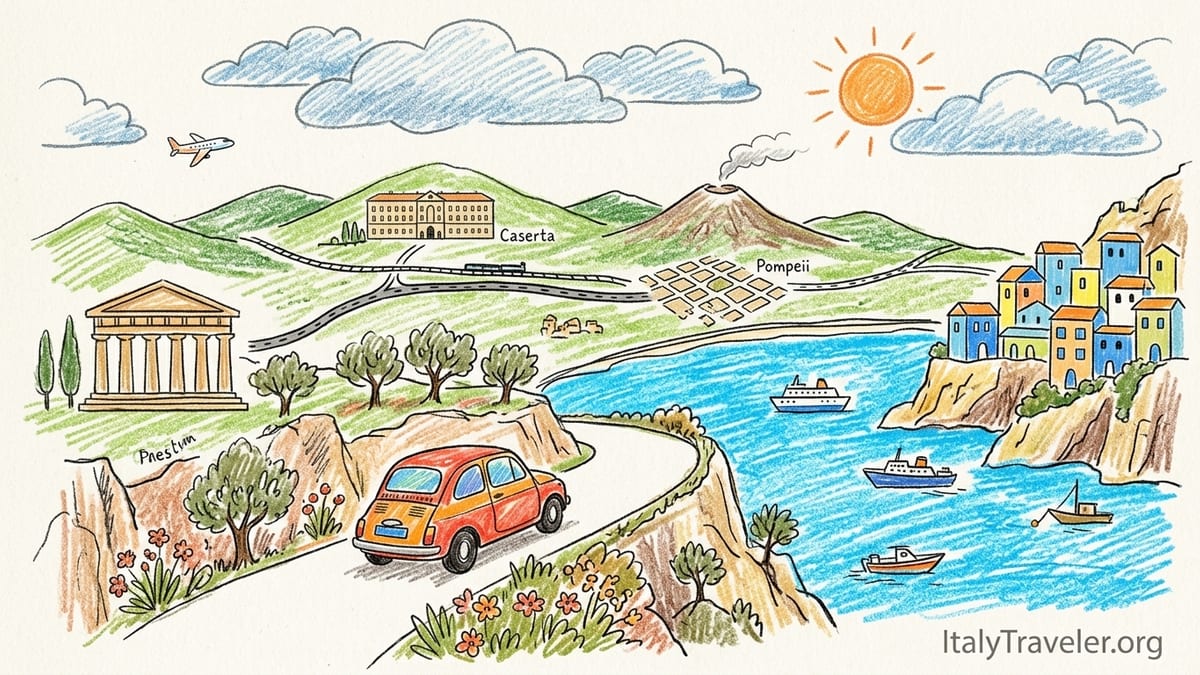
Driving across Campania stitches together very different Italys in a single trip: chaotic Naples, royal Caserta, buried Pompeii, cliff-hugging Amalfi villages, working-class Salerno and the long, quiet sweep of the Cilento coast. On this route I actually drove each section myself, keeping notes on driving times, tolls, fuel, parking, ZTL traps and the moments when the car stopped being a tool and started being a problem. What follows is a road trip that begins in Naples, loops to Caserta and Pompeii, skirts the Sorrento and Amalfi Coasts, then runs on to Salerno, Paestum and deep into Cilento, with a frank look at where a train or ferry would have been the smarter move.
Planning the Campania Loop and Renting the Car
I started and ended this loop in Naples, picking up a compact rental at Naples Capodichino Airport. The airport location avoided the dense web of Naples city ZTLs limited-traffic zones and put me almost straight onto the A56 tangenziale ring road and then the A3 motorway. From the terminal to the A3 on-ramp took around 15 minutes on a weekday late morning, with no toll due until I merged onto the A3 south toward Salerno. For a one-week rental in late spring, a small automatic equivalent to a Fiat 500 or VW Polo was priced around 50 to 70 euros per day including basic insurance; I deliberately chose the smallest car class because of tight parking and narrow coastal roads described later.
Fuel planning matters on this itinerary. Over roughly 550 to 650 kilometers of driving between Naples, Caserta, Pompeii, Sorrento, Amalfi, Salerno and the Cilento coast, my total fuel spend in 2026 prices came out in the 90 to 120 euro range for a petrol car, filling twice at motorway service areas where unleaded hovered around 1.85 to 2.00 euros per liter. Prices shift week by week, but service stations just off the motorway slips were consistently a few cents cheaper than the big autogrill plazas. Tolls were modest compared with the fuel: on the A3 between Naples and Pompeii I paid about 2.20 euros each way at cash lanes, and smaller increments of 1 to 3 euros when jumping down to Salerno or back toward Naples.
The route I actually drove formed a loose clockwise loop: Naples Airport to Caserta and back, then Naples to Pompeii, on to Sorrento, along the peninsula and Amalfi stretch in and out of high season, down to Salerno, then to Paestum and south along the Cilento coast as far as Palinuro and Marina di Camerota before returning inland toward the A2 motorway and back to Naples. Every section described below reflects that real driving experience, including where I eventually parked the car for days and changed to train or ferry to stay sane.
Because this is Italy, the optional extras matter almost as much as the route. I added full collision damage waiver with a zero-excess package because of stories about scraped mirrors on the Amalfi Coast. The extra 15 to 25 euros per day felt expensive while booking, but after seeing buses take blind bends with millimeters to spare, it felt more like the price of a good night’s sleep. I also refused a larger upgrade at the counter; the temptation of a bigger car disappears the first time you have to reverse uphill on a single-lane cliff road while a coach inches past.
Naples to Caserta: Motorway Ease, Urban Stress
The first leg ran from Naples Airport to the Reggia di Caserta, the Bourbon royal palace about 35 kilometers north. Leaving the airport mid-morning on a weekday, I followed signs to the A1/A3 and then onto the A1 toward Rome. In light traffic, the run from airport ramp to Caserta Nord exit took about 35 minutes, with a toll just under 2 euros for the stretch. Once off the motorway, the final 10 to 15 minutes into Caserta’s center required more patience than skill: roundabouts, scooters threading gaps and frequent lane changes but nothing like central Naples’ chaos.
Parking at the Reggia di Caserta was straightforward but not especially cheap. I used a signed pay lot on Viale Vittorio Veneto within a short walk of the palace gates, paying around 2 euros per hour at a ticket machine with coins and card. A four-hour visit cost roughly 8 euros. On another visit I tried street parking marked by blue lines closer to the station; that required feeding a nearby meter and left me less comfortable about leaving luggage in the trunk. The car remained useful here, allowing me to leave Caserta for Naples via a slightly different route on the A30 to avoid commuter traffic near the city.
Driving into central Naples on a different day, however, underlined why so many travelers are advised not to keep a car here. The historic core is ringed with ZTL zones patrolled by cameras; a single mistaken entry can generate a fine in the 80 to 100 euro range that appears months later via your rental company. I navigated with offline maps set to “avoid restricted roads” and still found myself funneled toward unsigned side streets, dodging scooters and double-parked vans. I ended that experiment by parking in an underground garage near Piazza Garibaldi at roughly 3 euros per hour and continuing on foot and metro. In hindsight, reaching Naples by train from another city and renting only when leaving for Caserta, Pompeii or the south would have been simpler and cheaper.
If your travel plan includes several days focused on central Naples, the car is more burden than benefit. Street parking is scarce, garages are costly and the risk of accidental ZTL entry is real. The Circumvesuviana and metro network handle most sightseeing, and long-distance trains connect Naples to Rome and beyond. A smarter approach is to rent the car on the day you leave Naples, and if you want to see Caserta without driving, regional trains from Napoli Centrale to Caserta run in around 45 to 55 minutes for a few euros, dropping you a 10-minute walk from the palace.
Naples to Pompeii and Sorrento: When the Car Still Makes Sense
The drive from Naples Airport to Pompeii along the A3 is one of the easier legs of this loop. Mid-morning on a weekday, the 25-kilometer run to the Pompei Ovest exit took about 30 minutes, and I paid around 2.20 euros at the toll booth heading south. The motorway here is a straightforward dual carriageway, though trucks and lane-weaving cars demand attention. Exiting toward Pompei Scavi, I followed signs to “Scavi” and “Via Plinio,” where private parking lots cluster opposite the main archaeological entrance.
On my latest visit, I used a gated lot on Via Plinio, just beyond the roundabout, that charged 5 euros for a half day or 8 euros for a full day. Attendants directed me into a marked bay and kept the keys. The convenience of leaving luggage out of sight and walking five minutes to the Porta Marina Inferiore entrance made the cost feel fair, especially compared with stories of unofficial touts guiding cars into dirt lots with vague pricing. Arriving before 9:00 in shoulder season meant many spaces were still free; by 11:00 I noticed a line of cars circling for remaining spots.
Continuing from Pompeii to Sorrento, the road shifts character. From Pompei Scavi I rejoined the A3 south briefly before exiting at Castellammare di Stabia and picking up the SS145. The 27 to 30 kilometers from Pompeii to Sorrento took just under an hour in late afternoon, and almost 90 minutes when I repeated the leg on a summer Saturday morning. The SS145 winds along the cliffs with a mixture of tunnels, viaducts and village stretches in Vico Equense and Meta. Traffic often backs up behind buses and delivery vans, and impatient drivers overtake in spaces most visitors would not consider passes.
In Sorrento itself, driving stops being enjoyable and turns tactical. The town operates a camera-enforced ZTL in the historic center, typically active in the evenings and overnight in high season, and bypassing it without perfect GPS routing involves last-minute lane changes as tiny streets suddenly turn restricted. My solution was to pre-book a hotel with garage access just outside the ZTL, drive directly to the ramp following the hotel’s directions, then leave the car there until departure. Garage rates in Sorrento center were around 25 to 35 euros per day, charged by the calendar day rather than 24-hour clock, so a two-night stay cost close to 70 euros for parking alone.
Once parked, I used the Circumvesuviana train from Sorrento station to revisit Pompeii and Herculaneum on separate days. Trains took about 30 to 40 minutes to Pompeii and just under an hour to Naples, for a ticket cost of only a few euros each way. Compared with wrestling the car back onto the SS145 and paying motorway tolls again, the train’s combination of low cost and no parking search made it clearly superior for day trips. For Capri and coastal village visits, I walked down to Sorrento’s marina and bought same-day ferry tickets, another use case where the car remained an inert lump in the garage while sea transport did the work.
Driving the Sorrento Peninsula and Amalfi Coast: Beauty vs Sanity
From Sorrento to Positano and on to Amalfi, I have driven the coastal road twice, once in late October and once in early July. In October, leaving Sorrento around 9:00, the roughly 35-kilometer stretch to Amalfi via Positano along the SS163 took around 80 minutes of actual driving, with a few extra minutes for photo stops at safe pull-offs. In July, driving the same route starting at 10:30, the journey ballooned to well over two hours. Traffic grew dense behind tour buses and rental cars, and finding a legitimate place to stop was almost impossible near Positano and Praiano.
The SS163 is visually spectacular but physically narrow, hugging the cliff with stone walls on one side and a low barrier to the Tyrrhenian Sea on the other. On both trips, buses entering hairpin bends forced oncoming cars, including mine, to reverse a few meters to a wider passing point, often under the guidance of a bus driver gesturing through his window. Local scooters and delivery vans take corners faster than most visitors find comfortable, and line markings serve more as hints than rules. In high season, additional plate-based traffic regulations apply on many days between Sorrento and Vietri sul Mare, prohibiting cars with odd-numbered plates on odd calendar days and even plates on even days for much of the daytime hours. Overnight hotel guests registered with local authorities are often exempt, but day-trippers risk fines if they ignore or misinterpret the rules.
Parking proved the biggest constraint. In Positano in October, I managed to squeeze into a small pay lot above town, paying about 8 euros per hour, with a minimum one-hour charge and a requirement to leave keys with the attendant. In July when I repeated the route, that same lot turned cars away by mid-morning, and ad hoc street parking on the main road was either signed as prohibited or occupied. In Amalfi, a multi-level parking structure at the port offered more capacity but at similar hourly rates, ending up close to 30 euros for a three to four-hour visit. After circling twice one hot afternoon, I abandoned the idea of stopping in Ravello with the car, opting instead to push on to Salerno and return another day by bus and ferry.
In terms of stress versus payoff, my conclusion was clear. The coastal drive is worth doing once, particularly in shoulder season and only if you are comfortable with tight roads and defensive driving. However, as a way to visit the Amalfi villages themselves, the car rapidly becomes a liability. A better pattern on a longer Campania trip is to base yourself in Sorrento or Salerno, park the car for several days in a garage, and explore the coast by a combination of SITA buses and ferries. Sailing from Sorrento or Salerno to Positano and Amalfi in summer took me roughly 35 to 60 minutes depending on route, cost in the 15 to 30 euro range per leg, and spared me any worry about enforcement cameras or plate restrictions.
Salerno, Paestum and Into Cilento: Where the Car Shines Again
From Amalfi to Salerno, the SS163 continues for another 25 to 30 kilometers, then flattens out as it approaches Vietri sul Mare and the outskirts of the provincial capital. In October, I covered Amalfi to Salerno in about 70 minutes, including slower sections near Vietri. In July, hitting the same leg in late afternoon, it took closer to 90 minutes thanks to weekend congestion. The payoff comes once you hit Salerno’s waterfront and the start of the A3 and SS18 corridors south. Unlike Amalfi’s compact villages, Salerno is a working city with wider streets, clearer signage and several large car parks near the center.
I left the car for two nights in a paid underground garage a short walk from the old town at a daily rate of 18 euros, much cheaper than Sorrento or Amalfi. From there I explored Salerno on foot and used ferries back along the coast for day trips, enjoying the paradox that the most car-friendly city on the loop was also the best base for car-free excursions. When it was time to head to Paestum, the car returned to center stage. The drive from central Salerno to Paestum via the SS18 and local roads took about 60 minutes for roughly 40 kilometers in morning traffic, with no motorway tolls and only a few slow points near smaller towns.
Paestum’s archaeological park is one of the places where driving feels like the most practical choice. Free street parking lined the road opposite the main entrance early in the morning, though many bays switched to paid status with meters closer to midday. I opted for a private lot set slightly back from the road, paying around 5 euros for several hours under trees that kept the car cooler. After walking through the Greek temples and museum, I could easily reach nearby beaches and agriturismo restaurants, something that would have been cumbersome relying on the infrequent local trains and buses.
South of Paestum the Cilento coast unfolds for around 100 kilometers toward Sapri, and this was the portion of the trip where the car’s flexibility really came into its own. From Paestum I followed the SS18dir and coastal byroads to Agropoli in about 20 minutes, then pressed on to Santa Maria di Castellabate, Acciaroli, Palinuro and finally Marina di Camerota over three unhurried days. Distances between towns ran from 15 to 40 kilometers, with driving times between 20 and 60 minutes depending on curves and agricultural traffic. Unlike the Amalfi Coast, the road here is still scenic but less exposed and stressful, and parking in shoulder season was usually easy to find either free along the seafront or in small municipal lots for 1 to 1.50 euros per hour.
The inland portion of Cilento, part of the Cilento, Vallo di Diano and Alburni National Park, added another dimension. Using the car I detoured up valley roads toward the Alburni mountains, stopping at small villages and viewpoints that would be effectively unreachable by public transport. On one day I combined a morning swim near Marina di Camerota with an afternoon drive to the hilltop town of Castellabate, then looped back at sunset with little traffic. For travelers who enjoy mixing beaches with rural landscapes, this freedom to string together beaches, farms and archaeological sites such as Paestum and Velia is a strong argument for keeping the car during this part of the journey.
Cilento’s Velia, Inland Roads and Returning to Naples
Where Paestum marks the northern edge of the UNESCO-listed Cilento area, Velia provides a quieter southern counterpart near Ascea. From my base near Agropoli, the drive to Velia’s archaeological site took about 45 minutes, using a mix of the SS18 and smaller connector roads. Signage grew thinner approaching the site, but offline maps and occasional brown heritage signs were enough to stay on track. Arriving mid-morning, I found easy parking in a gravel lot at the entrance, charged a modest flat fee for the day by an attendant. With only a handful of cars there in late spring, it felt worlds apart from the pressure-cooker parking scenes on the Amalfi Coast.
Inland, Cilento’s roads twist and gain elevation, rewarding drivers who are comfortable with second-gear hairpins and quick changes in weather. I drove a loop from Ascea through Rutino and Prignano Cilento, then back toward Agropoli, covering roughly 70 kilometers in two to three hours including photo stops. The road surface was generally good but narrower than coastal highways, and local drivers in small Fiats appeared around bends at enthusiastic speeds. However, traffic volumes were low, and I often drove several minutes without seeing another car. Fuel planning becomes more important here, as smaller hill towns may only have one service station with limited hours, especially on Sundays.
After several days tracing the Cilento coast and hills, it was time to return to Naples. From Marina di Camerota I rejoined the SS18 toward Battipaglia, then merged onto the A2 and A3 corridor back north. The full drive from Marina di Camerota to Naples Airport covered around 200 to 230 kilometers and took me roughly three and a half hours with one service stop. Tolls for this northbound leg added up to around 10 to 15 euros, less than the cumulative cost of piecing together multiple regional train segments from Cilento villages to Naples. Dropping the car back at the airport avoided any last-minute stress about ZTL cameras in the city, and I could step straight into the terminal.
Looking back at the full loop, the pattern was clear. The car was genuinely useful on the motorway edges of Naples, for Caserta, for connecting Naples, Pompeii and Sorrento at flexible times, and, crucially, throughout Cilento and its spread-out coastline and hill towns. It was marginally helpful and often actively problematic within central Naples, in Sorrento’s compact center, and almost everywhere on the narrow, rule-laden Amalfi Coast road during high season. Planning the rental so that the days of maximum car utility align with your time in Cilento and the inland stretches is the key to feeling that the cost and stress have paid off.
Where Train or Ferry Would Have Been Smarter
Several points on this real route stand out as places where, in hindsight, I would have left the car parked or skipped having it altogether. The most obvious is central Naples. After one day threading through barely marked ZTL edges and inching into an underground garage, I realized that most of what I wanted to see in the city fell within walking distance of metro or funicular stations. Between ZTL fines, tight lanes and theft concerns if luggage is left in view, the car there served mainly as a liability. On a future trip I would arrive in Naples by train, explore for two or three days, then pick up the rental only on the day of departure for Caserta or Pompeii.
Sorrento is another example. The combination of scarce street parking, unpredictable ZTL hours and high daily garage rates made me effectively abandon the vehicle as soon as I arrived. The Circumvesuviana train connected Sorrento to Pompeii, Herculaneum and Naples for less than the cost of one hour’s parking, and seasonal ferries from the marina connected Sorrento with Capri, Positano and Amalfi at prices that compared favorably with what extra days of car rental and parking would have cost. In real numbers, a day’s parking plus rental could easily climb above 70 euros, while a return ferry to Capri and a train ride to Pompeii together stayed below that threshold.
The Amalfi Coast itself provides the clearest case where the romance of driving does not match the reality of moving efficiently. On the July run between Sorrento, Positano and Amalfi I spent more time stationary than moving, trapped behind chains of vehicles negotiating every blind bend. Once in town, I faced 8 to 10 euro hourly parking rates and a near-total lack of informal options. In contrast, the ferry from Salerno to Amalfi and Positano took under an hour in smooth water, cost substantially less than day-long parking plus extra fuel and avoided any risk of missing or misunderstanding alternating plate regulations. Large SITA buses also ply the route frequently, and although they can be crowded in peak months, they remove the stress of managing a vehicle on cliff edges.
Even in parts of Cilento, such as the town of Agropoli with its compact old center climbing above the sea, I sometimes parked on the outskirts and continued on foot rather than push the car into medieval alleys. However, the distances between the main Cilento villages and beaches make public transport a patchwork of infrequent buses and local trains that rarely line up with swimming and dining times. Here, unlike Amalfi, the car’s flexibility justifies its presence despite occasional parking hunts in town centers. The balance tilts decisively in favor of alternative transport in big-city Naples, heavily visited Sorrento and the classic Amalfi stretch between Positano and Amalfi.
The Takeaway
Driving a loop through Campania from Naples to Caserta, Pompeii, Sorrento, Amalfi, Salerno and the long Cilento coast is entirely feasible, but only if you are honest about where the car adds value and where it quietly undermines your trip. On the positive side, the motorway links from Naples to Caserta and south toward Salerno are efficient, with predictable tolls and straightforward exits; Pompeii and Paestum are both significantly more convenient by car than by juggling regional trains and buses; and Cilento’s 100-kilometer coastline and inland villages practically invite you to pull off the main road whenever a cove or hilltop catches your eye.
Against that, Naples’ ZTLs and aggressive urban driving, Sorrento’s constrained center and the Amalfi Coast’s combination of narrow lanes, seasonal traffic regulations and expensive parking mean that there are strong arguments for separating your city and coastal sightseeing days from your driving days. Leave the car at the airport or in a garage while you explore by foot, train and ferry where those options exist and are frequent. Bring the car back into the picture when you want the freedom to chase sunsets in Cilento or detour from Velia to a farmhouse lunch on a ridge road.
Based on the roads I have actually driven, the sweet spot looks like this: begin with Naples and perhaps Caserta without a car or with the vehicle parked, rent or collect the car on the day you leave the city, use it intensively for Pompeii and the run to Sorrento, then consider parking it for two or three days while you reach Capri and the cliff villages by sea or bus. Once you reach Salerno, let the car stretch its legs again southbound through Paestum and Cilento until mountain roads and empty beaches have balanced out the stress of Amalfi hairpins. Approach the loop that way, and your Campania road trip becomes less a test of nerves and more a sequence of contrasting landscapes connected by roads you will remember for the right reasons.
FAQ
Q1. How long does it take to drive from Naples Airport to Caserta and what does it cost?
In light traffic the drive from Naples Airport to Caserta via the A1 takes about 35 to 45 minutes, with motorway tolls usually just under 2 euros each way.
Q2. Is it worth driving from Naples to Pompeii or is the train better?
Driving from Naples Airport to Pompeii takes around 30 minutes plus about 2.20 euros in tolls and 5 to 8 euros for parking, while the Circumvesuviana train from central Naples is slower but avoids traffic and parking stress.
Q3. Do I need a car to visit the Amalfi Coast villages like Positano and Amalfi?
No, a car is more often a burden there; ferries from Sorrento or Salerno and SITA buses along the coast are usually faster, less stressful and cheaper than paying high parking fees.
Q4. Are there ZTL zones I should worry about on this route?
Yes, central Naples, Sorrento and towns like Amalfi operate ZTL or similar restrictions, and accidental entry can trigger fines, so you should program navigation to avoid restricted roads and confirm your hotel’s access instructions.
Q5. How expensive is parking in Sorrento and on the Amalfi Coast?
In Sorrento expect around 25 to 35 euros per day for a central garage, while in Positano and Amalfi hourly rates often range from about 8 to 10 euros, making even a brief stop quite costly.
Q6. Is the drive along the Amalfi Coast really dangerous?
The road is narrow, twisting and busy with buses and scooters, so it demands confidence and concentration rather than racing skills; the main risk is stress and minor scrapes, not sheer drop-offs, but many visitors find it unnerving.
Q7. Where does having a car help most on this itinerary?
The car is most useful for reaching Caserta, connecting Naples, Pompeii and Sorrento on your own schedule, and especially for exploring Paestum, Velia and the spread-out Cilento coast and inland villages.
Q8. How much should I budget for fuel and tolls on a week-long loop?
For a compact petrol car over roughly 550 to 650 kilometers, a realistic estimate is 90 to 120 euros for fuel plus 20 to 30 euros in motorway tolls, depending on exact routing and prices at the time.
Q9. Are there good alternatives to driving between Sorrento, Positano and Amalfi?
Yes, frequent ferries run between Sorrento, Positano, Amalfi and Salerno in season, and SITA buses connect the villages along the SS163, both of which remove parking worries and alternating plate regulations from the equation.
Q10. How many days should I allow for the Cilento section of the trip?
To see Paestum, Velia and several Cilento coastal towns without rushing, three to five days works well, giving time for inland detours and relaxed beach stops while making good use of the car.