


I thought getting to Capri for a simple day trip would be straightforward. Then I saw the ferry timetables, company names, seasonal notes and weather warnings, and realized I needed a plan. After doing the trip myself in 2026, first from Naples and later from Sorrento, I learned exactly how much you can realistically fit into one day on Capri, what it feels like on board, and when it is worth staying the night instead of racing back to the mainland.
Choosing Between Naples and Sorrento
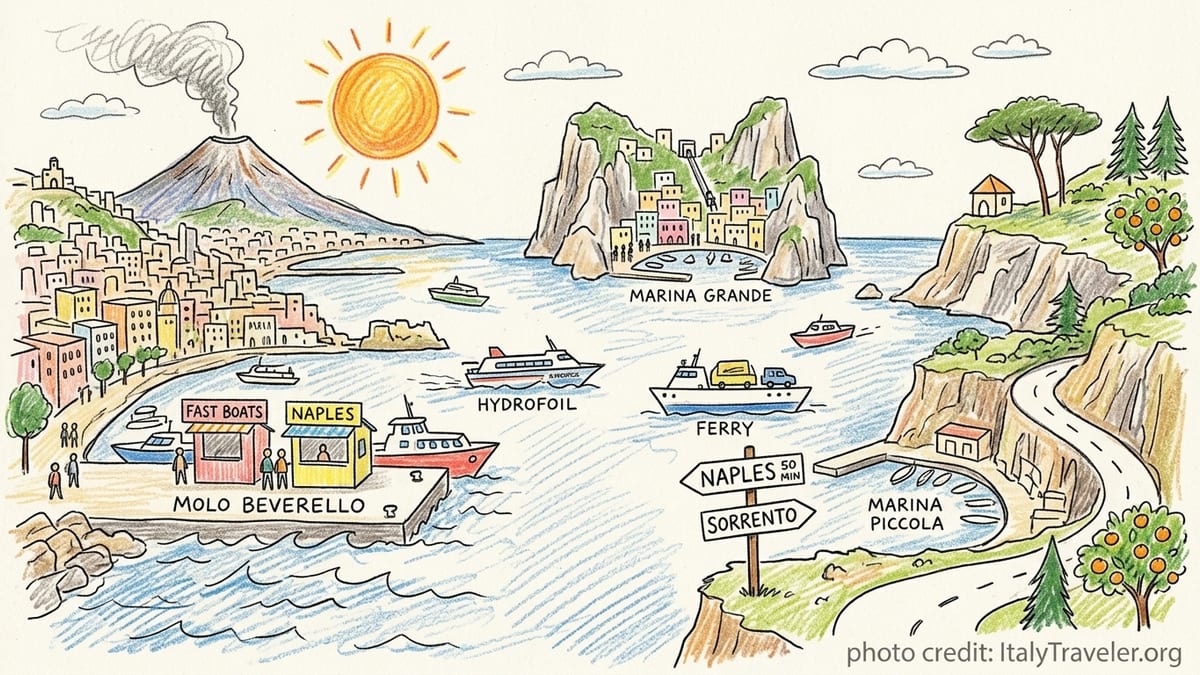
My first Capri day trip started in Naples, my second in Sorrento, and they felt like two very different days even though they ended at the same little harbor in Capri. From Naples, ferries and hydrofoils to Capri leave mainly from Molo Beverello for fast boats and Calata Porta di Massa for slower car ferries. In autumn 2026, I found high speed crossings of about 50 minutes with companies like NLG, SNAV and Caremar from Molo Beverello, and around 1 hour 20 minutes on the slower ferries from Porta di Massa. Tickets for the fast boats were around 26 to 30 euros one way when I checked autumn dates, before adding Capri’s landing tax of 5 euros per person between April and October and 2.50 euros between November and March, which is charged on top of the ticket.
Sorrento is much closer to Capri and that completely changes the rhythm of the day. From Sorrento’s Marina Piccola, the trip in 2026 timetables is usually 20 to 30 minutes on fast ferries operated by Caremar, NLG, SNAV and Alilauro. On summer sample dates I checked, Sorrento to Capri tickets seemed to sit roughly in the 20 to 30 euro range each way, again plus the Capri landing contribution. Because the crossing is shorter, the first departures from Sorrento often left after the earliest hydrofoils from Naples, but I still stepped off in Marina Grande only a little later than passengers who had caught dawn departures from the city.
In practice, Naples made sense when I was already staying in the city and wanted to walk down from the historic center to Molo Beverello in the morning, and Sorrento made sense when I based myself there for the Amalfi Coast. What surprised me was how busy summer crossings from Sorrento could be compared with shoulder season crossings from Naples. Even on an October weekday in 2026, some of the mid‑morning Sorrento to Capri sailings were close to full when I checked availability a few days ahead, while my November Naples crossings felt calmer.
If you are debating where to start, think of Naples as the better option for a cultural city base with an add‑on Capri day trip, and Sorrento as the better option if Capri is one of several boat excursions. Both ports offer early departures and evening returns in the main season, but Sorrento lets you squeeze slightly more island time into a day because of the shorter crossing and simpler walk from town to port.
Buying Tickets and Reading the Fine Print
Before traveling, I sat with three browser tabs open: one for an aggregate site that compared Naples to Capri ferries across companies, and separate sites for NLG, SNAV and Caremar. For Sorrento, I added Alilauro. All of them showed broadly similar prices for a given time slot, though official operator sites sometimes listed special fares or more detailed luggage rules. For a summer Saturday in 2026, I saw multiple Naples to Capri hydrofoils from morning through late afternoon, and return sailings up to early or mid‑evening, while winter dates showed a trimmed‑down but still usable schedule with fewer crossings.
I decided to prebook my July Naples to Capri hydrofoil online about a week in advance. The ticket was an electronic voucher with a QR code, departure time, company name and, crucially, the indication “Molo Beverello” as the terminal. For the November Sorrento trip, I bought in person at the Marina Piccola ticket kiosks the day before travel, which worked well because demand was lower. The main risk of waiting until same day in high season is that popular mid‑morning crossings can sell out or leave you with less flexible return times.
One important detail in 2026 was the Capri landing contribution, sometimes called the sbarco tax, which is added on top of the ferry ticket at the time of purchase. When I checked company fare tables and Capri tourism information, the tax was listed as 5 euros per person from 1 April to 31 October and 2.50 euros from 1 November to 31 March, paid by every visitor arriving by sea and included in the ticket price on official channels. I saw some confusion online from travelers who thought it would be paid separately on arrival; in my experience, it was always bundled into the total ticket cost.
The other fine print worth reading was about changes and cancellations. Weather in the Gulf of Naples, especially from late autumn to early spring, can cause hydrofoils to be suspended while the bigger, slower ferries continue operating. On several stormy days in the 2025 to 2026 winter, live timetables showed high‑speed boats between Naples, Capri, Ischia and Procida canceled while conventional ferries still ran. That informed my November plan: I picked an early ferry rather than the very first hydrofoil, just in case conditions worsened later in the day.
Departure Ports: From City Streets to Open Sea
On the morning of my Naples departure, I walked down from Piazza Municipio to Molo Beverello with a printed ticket and the QR code on my phone. The terminal area felt like a low concrete strip along the water, lined with glass ticket booths labeled by company name. Large departure boards listed destinations like Capri, Ischia and Sorrento, with departure times and company logos. I arrived about 40 minutes before my scheduled sailing, which left enough time to confirm the gate number at the company booth and watch the previous hydrofoil disgorge day trippers from Capri.
Boarding started about 15 to 20 minutes before departure. Staff scanned my QR code at the dock entrance and waved me down a gangway to the hydrofoil. There were no checked‑in luggage belts like at airports. Most passengers were carrying day bags, but a few had rolling suitcases, which staff directed to dedicated luggage racks near the entrance. On both my Naples and Sorrento crossings, there was no additional charge for a normal cabin bag or small suitcase. Very large items or excess pieces might incur a fee depending on company rules, so it is worth checking the luggage section of your chosen operator’s site if you travel with more than one big bag.
Sorrento’s Marina Piccola was a different story. To reach the port, I walked downhill from the main town along a winding road that becomes pedestrian‑only near the bottom. Some travelers chose the local bus and others used the public elevator from near the public gardens, but the walk gave me wide views of the Bay of Naples and, on clear days, Vesuvius. At the bottom, ticket offices for Caremar, NLG, SNAV and Alilauro lined the waterfront. Digital screens showed departures to Capri and sometimes onward boats to Naples or the Amalfi Coast. The boarding process was similar to Naples but more compressed, with separate queues forming along the pier for back‑to‑back departures in busy hours.
In both ports, the biggest surprise was how little time there was between docking and departure on back‑to‑back services. Boats would arrive, let everyone off, the crew would do a fast turnaround and start boarding again within minutes. If you show up exactly at departure time, the gangway could already be raised. For my July Naples crossing, being at the dock 30 minutes early felt comfortable; for my shoulder season Sorrento crossing, 20 minutes was enough, but I was happier having that cushion to account for queues at the ticket window and security checks.
On Board: Seating, Sea Conditions and the Crossing
On the hydrofoils I took in 2026, seating was almost always general admission inside the cabin. The boats had airplane‑style rows with windows along the sides and some small tables toward the middle. There was no reserved seat number on my tickets, so boarding early meant being able to pick a window on the right or left depending on the view I wanted. On the Naples to Capri leg, sitting on the right side gave me a good sweep of the city receding behind, while the left side on the return offered views of Vesuvius and the Sorrentine Peninsula.
The July morning crossing from Naples was calm. The captain warned over the loudspeaker that everyone should stay seated while the hydrofoil was moving, and that the top deck was closed for safety. Many high speed boats on the Capri routes are fully enclosed, so if you are picturing a romantic open‑air ride, it helps to lower expectations. On glassy days, the boat felt smooth and quiet, but in November I experienced the other side of the Gulf: moderate swell, spray hitting the windows and a noticeable up‑and‑down motion as we approached Capri’s cliffs. Several passengers reached for motion sickness tablets or sat near the center of the boat where movement was less extreme.
Traditional ferries running from Naples and Sorrento have more outdoor space. On one return leg, I took a slower ferry instead of a hydrofoil to see the bay from an open deck. The trade‑off was crossing time of a little over an hour but I could stand outside, photograph Capri shrinking behind us and watch the coastline curve toward Naples. In high season, these ferries were popular with families and travelers who preferred fresh air and a more relaxed ride.
Inside, facilities were basic but adequate for such a short crossing. Both the hydrofoils and ferries I used had restrooms, a small bar selling espresso, soft drinks and packaged snacks, and overhead racks for smaller bags. There were no elaborate onboard announcements about destinations and tours; that sort of promotion awaited at Marina Grande. Staff walked the cabin to check tickets soon after departure, so I kept mine handy even when it had already been scanned at the dock.
Arriving in Marina Grande: First Impressions and Moving On
Every arrival to Capri begins with the same drama. The cliffs close in, pastel houses of Marina Grande come into focus, and a tight weave of ferries, private boats and excursion vessels fills the little harbor. We passed the lighthouse on the left and curved into the port, with signs for “Funicolare,” “Bus” and “Taxi” visible even from the boat. Disembarkation on both of my trips was quick: walk down the ramp, follow the crowd, and suddenly you are on the quay surrounded by ticket booths, luggage handlers and agents selling boat tours of the island and the Blue Grotto.
On my first visit, I resisted the sales pitches and went straight to the funicular. The ticket booth sits on the right as you face the harbor from the dock. I bought a single ticket for a few euros and passed through turnstiles to reach the funicular cars. In high season, the queue snaked around the corner and I waited about 25 minutes for my turn. In November, there were only a dozen people ahead of me and I was whisked up to Capri town in just a few minutes. The funicular is efficient, but it stops running for periodic maintenance, usually in late winter, when substitute buses handle the uphill route, so it is wise to confirm operations for your travel dates.
For my second trip, I tested the buses instead. The main bus stops are visible straight ahead from the harbor, where small island buses line up for Capri town and Anacapri. I purchased tickets at a clearly marked kiosk and boarded a bus to Anacapri, where I planned to visit the chairlift to Monte Solaro and later take a bus down to the Blue Grotto area. The buses are small, and in summer they fill quickly. On my July day, I stood packed in with other travelers and a few locals, wedged among backpacks and beach bags. In November, there were enough empty seats that I could sit and look out as the bus climbed narrow roads with serious drop‑offs.
Taxis on Capri deserve a mention, even if they stretch a day trip budget. Many are open‑top convertibles, classic island style, and they line up at a clearly signed rank in Marina Grande. On one visit I split a taxi to Anacapri with two other travelers. The fare was noticeably higher than the bus but the drive was faster and far more comfortable, and the driver offered running commentary on where to eat and which streets to avoid in the afternoon crowds. On a tight one‑day schedule, especially in hot weather, a taxi for one or two key legs can save valuable time.
What I Managed in a Single Day
From Naples, taking a morning hydrofoil that docked around 9:30, my realistic one‑day itinerary looked like this: funicular up to Capri town, a slow wander across the Piazzetta and into the side lanes toward the Augustus Gardens, then a loop through Via Camerelle and Via Tragara for coastal views. After a simple lunch on an outdoor terrace, I walked back to the bus stop and headed to Anacapri in mid‑afternoon. That gave me time for the chairlift up to Monte Solaro on a clear day and a stroll through Anacapri’s quieter streets before catching a bus back down to Marina Grande for an early evening ferry.
It sounded ambitious on paper but on the ground it felt just about right. The longest queues by far were for buses and the funicular, not for sights themselves. In July, the wait for the funicular up and the bus to Anacapri each stretched to around half an hour at peak times; in November, those same transfers took barely 10 minutes door to door. The Blue Grotto was the one major attraction I skipped on my Naples‑based day trip. Boat tours to the grotto leave directly from Marina Grande and from the Anacapri side, but queue times at the cave can easily run to an hour or more in good weather, and it felt risky to tie up a large chunk of the afternoon when I had a fixed evening return boat.
From Sorrento, arriving a little after 9:00 thanks to the shorter crossing, I had a bit more psychological breathing room. That day I reversed the sequence: bus to Anacapri first, chairlift to Monte Solaro before the biggest crowds built up, a lazy coffee on the main square, then an early afternoon stroll in Capri town and the Augustus Gardens. I skipped the Blue Grotto again intentionally, focusing instead on exploring side streets and viewpoints without constantly checking the time. We finished the day with a drink on a terrace in Marina Grande itself, watching the ferries come and go before catching an evening hydrofoil back to Sorrento that arrived in time for a late dinner in town.
Looking back, the maximum I would recommend trying to fit into a one‑day Capri trip from Naples or Sorrento is Capri town with the Augustus Gardens, Anacapri with the Monte Solaro chairlift, and perhaps a quick circuit of the island by boat if sea conditions and schedules align. Trying to cram Capri town, Anacapri, Monte Solaro, the Blue Grotto, several beach stops and a long lunch into one day left several fellow passengers on my return ferry looking stressed and exhausted. The island rewards slow wandering more than checklist sightseeing.
Would I Stay Overnight Next Time
After two deep day trips, I left Capri feeling that an overnight stay would change the experience completely. The most striking difference appears around 4:00 in the afternoon. Day trippers start to queue at the bus stops and funicular in Capri town and Anacapri, clutching return tickets to Naples, Sorrento, Ischia or the Amalfi Coast. By 6:00 or 7:00, depending on the season’s last ferries, the island quiets down. I caught glimpses of this on my second trip when I took a later return boat: the Piazzetta emptied, sunset colors deepened over the Faraglioni, and most visitors were already on the water heading back.
Accommodation on Capri is not inexpensive, but staying even one night would allow a relaxed visit to the Blue Grotto early in the morning before the heaviest crowds and time to linger in Anacapri or explore walking paths like the Pizzolungo without clock‑watching. It would also provide more options if the weather turns marginal. Several times in autumn 2025 and winter 2025 to 2026, service notices showed afternoon hydrofoils between Capri, Naples, Ischia and Procida suspended because of rough seas, while some morning sailings had operated normally. Travelers who had chosen day trips with the very last return boat risked being stranded or scrambling for scarce hotel rooms at premium prices.
In cost terms, the difference between two round‑trip ferry tickets in a row and one round trip plus a night on the island can be significant. In experiential terms, though, the ability to see Capri in the quieter morning and evening windows felt worth serious consideration. If I were planning a return, I would either commit to a proper overnight stay or consciously accept a most‑important‑sights‑only approach to a day trip, giving up the idea of seeing absolutely everything.
Connections with Ischia and Procida
One new element in the 2026 landscape that shaped how I thought about ferry planning was the growth of seasonal routes linking Capri with Ischia, Procida and the Amalfi Coast. When I checked current timetables from operators like Alicost and other companies serving the Gulf of Naples, I saw through lines on route maps that made it technically possible to sail, for example, Salerno to Capri to Ischia or Sorrento to Procida via Capri on certain days between spring and early autumn. These are not year‑round, daily connections. On the timetables I read, many of the coast and island routes only operated from around 1 April to late September or October, and some ran only on selected days of the week before turning daily in the peak summer months.
Direct hydrofoils between Ischia and Capri typically appeared from early April until late October, with several companies sharing the route. During that window, it becomes realistic to combine Ischia and Capri in one itinerary without backtracking to Naples. Similarly, some seasonal services connected Capri or Sorrento with Procida as part of a longer coastal line. A sample timetable flyer I downloaded for 2026 showed a chain of stops including Salerno, Amalfi, Positano, Sorrento, Naples, Capri, Ischia and Procida, with footnotes explaining exactly which dates and days of the week each section operated.
In practice, this meant that for travelers in May through September 2026, a “Capri day trip” might not start from Naples or Sorrento at all, but from Ischia, Procida or an Amalfi Coast town. The crucial lesson from my planning was not to assume daily frequency. On some early shoulder‑season dates, a given Capri to Procida sailing might run on Monday, Wednesday and Friday only; on others, it disappeared entirely outside the peak summer period. When I played with dates across a few weeks using live timetable search tools, departure and arrival times shifted by enough minutes or hours to make tight connections risky.
If you are considering stringing together Capri, Ischia and Procida in one trip, I would treat whatever day trip plan you sketch out as provisional until you have checked actual dates and times for your travel week using official company timetables or a reputable live aggregator. Rough seas affect these longer coastal and island routes as much as the main Naples to Capri axis, and schedules are updated annually or even within a season.
The Takeaway
Looking back on my 2026 ferry days to Capri from both Naples and Sorrento, the pattern that emerges is simple: plan using current timetables, build in margin for queues and weather, decide which two or three experiences matter most, and accept that Capri is better savored than conquered. Naples offered a dramatic approach across the wide bay, the urban energy of Molo Beverello and the feeling of escaping the city for a day. Sorrento offered shorter crossings, easier logistics and a greater sense of slipping out and back between breakfast and dinner without rushing.
I learned that tickets are straightforward to buy once you choose your company and departure port, but the details matter: whether your boat leaves from Molo Beverello or Porta di Massa, whether you are on a hydrofoil or conventional ferry, what the current Capri landing tax is, and how flexible your ticket will be if the wind picks up. On board, you may find yourself on a sleek, enclosed hydrofoil with no outdoor deck or on a slower ferry with open railings and salty spray. Marina Grande will be crowded and chaotic in peak season, so knowing ahead of time whether you will gravitate first to the funicular, bus or taxi rank helps you move with confidence instead of confusion.
In one day, you can comfortably experience Capri town, the Augustus Gardens, Anacapri and Monte Solaro, with perhaps one short boat excursion if conditions and queues are favorable. Anything more will feel compressed. Staying overnight, if your budget allows, unlocks a quieter island where sunrise and sunset belong mostly to those who sleep on Capri itself. With seasonal 2026 routes linking Capri to Ischia, Procida and the Amalfi Coast, there have never been more ways to reach the island, but the core decision remains the same: how do you want to feel when you sail away at the end of the day, satisfied and unhurried or accomplished but exhausted. For me, the lesson was clear. Next time, I will still ride the ferry from Naples or Sorrento, but I will take fewer boxes to tick and more time to simply sit, watch the cliffs and let Capri do the rest.
FAQ
Q1. Do I need to buy Capri ferry tickets in advance in 2026
For July and August, and for weekend mornings in late spring and early autumn, it is wise to buy tickets a few days ahead, especially for popular mid‑morning crossings from Sorrento and Naples. In winter and on midweek days, buying the day before or even same day at the ticket office usually works, but I still preferred to secure at least my outbound sailing in advance.
Q2. How long is the ferry from Naples or Sorrento to Capri
High‑speed hydrofoils from Naples Molo Beverello to Capri take around 45 to 50 minutes in 2026 schedules, while conventional ferries from Naples Porta di Massa take roughly 1 hour 20 minutes. From Sorrento’s Marina Piccola, fast boats to Capri are typically timetabled at about 20 to 30 minutes, which is one reason many travelers staying on the Amalfi Coast choose Sorrento as their jumping‑off point.
Q3. How much does the Capri ferry cost in 2026
On sample 2026 dates I checked, one‑way hydrofoil tickets from Naples to Capri were often in the range of about 26 to 30 euros per adult, and Sorrento to Capri crossings were usually slightly cheaper, often somewhere around 20 to 30 euros. On top of that, there is a Capri landing contribution of 5 euros per person from April to October and 2.50 euros from November to March, which is usually added automatically to the ticket total at purchase.
Q4. What is the difference between the Capri hydrofoil and the regular ferry
Hydrofoils are faster, fully enclosed passenger boats with indoor seating only and limited outdoor access while underway. They get you to Capri more quickly but can feel more confined and can be canceled more readily in rough seas. Regular ferries are larger, slower ships that usually offer outdoor decks and carry vehicles as well as passengers. They take longer but may continue running on days when hydrofoils are suspended due to sea conditions.
Q5. Where exactly do ferries depart in Naples and Sorrento
In Naples, most fast hydrofoils to Capri depart from Molo Beverello, which is the terminal just below Piazza Municipio, while many slower ferries leave from nearby Calata Porta di Massa. Tickets show the departure pier, so checking that detail prevents last‑minute confusion. In Sorrento, ferries to Capri depart from Marina Piccola, the lower port reached by a downhill walk, local bus or public elevator from the town center.
Q6. Can I do Capri, Anacapri and the Blue Grotto all in one day
It is technically possible on long summer days, especially if you travel from Sorrento and catch an early boat, but it will be rushed and heavily dependent on crowd levels and sea conditions. Many travelers find that Capri town, the Augustus Gardens, Anacapri and Monte Solaro already fill a full day when you factor in time spent queuing for buses, the funicular and boat transfers, so adding the Blue Grotto often forces compromises elsewhere.
Q7. How does luggage work on Capri ferries
On the crossings I took in 2026, a normal cabin bag or small suitcase was included in the ticket price and could be stored in onboard racks or overhead shelves. Very large suitcases or multiple extra pieces can incur additional fees depending on the operator, and you must be able to carry your own bags up and down gangways. If you bring substantial luggage, it is worth checking the luggage section of the specific company’s rules before travel.
Q8. Are there direct ferries between Capri, Ischia and Procida
In 2026, there are seasonal direct hydrofoils and coastal routes that link Capri with Ischia and Procida, usually operating from around early April to late October. However, they do not run every day of the year or even every day of the week outside peak season, and exact dates and times vary by company. For any plan that involves traveling directly between these islands, it is important to check live timetables for your specific travel dates.
Q9. Is it worth staying overnight on Capri instead of a day trip
Staying overnight is more expensive but offers a very different atmosphere once day trippers leave on the last ferries. An overnight stay allows quieter early mornings, less crowded visits to places like the Blue Grotto when conditions permit, and time to enjoy sunset and evening in Capri town without watching the clock. If budget allows, one or two nights can make the island feel more relaxed and less like a checklist.
Q10. What happens if ferries are canceled because of bad weather
If strong winds or rough seas develop, high‑speed hydrofoils are often the first services to be suspended, while larger ferries may continue to operate or run with delays. When bad weather is forecast, ferry companies update their schedules on their websites and at ticket offices, and some travelers switch to earlier departures to avoid risk. If all services are canceled, you may need to spend an unplanned night on Capri or the mainland, so building a little flexibility into your itinerary is sensible outside the calmest summer months.