


I arrived in Puglia in late May, just as the olive groves around Ostuni had turned that dusty summer green that means heat is on the way. After a few nights in a whitewashed townhouse in town, I wanted to understand what a masseria really was beyond the dreamy photos. So I booked two nights at Masseria Il Frantoio, a working organic farm and olive estate on the "piana degli ulivi secolari" outside Ostuni, and built my days around tasting its oils and cooking with its produce. What I found was very different from a countryside hotel dressed up in rustic stone. It felt like stepping into the daily life of a Puglian agricultural business that simply happens to welcome guests.
Arriving Through the Olive Groves
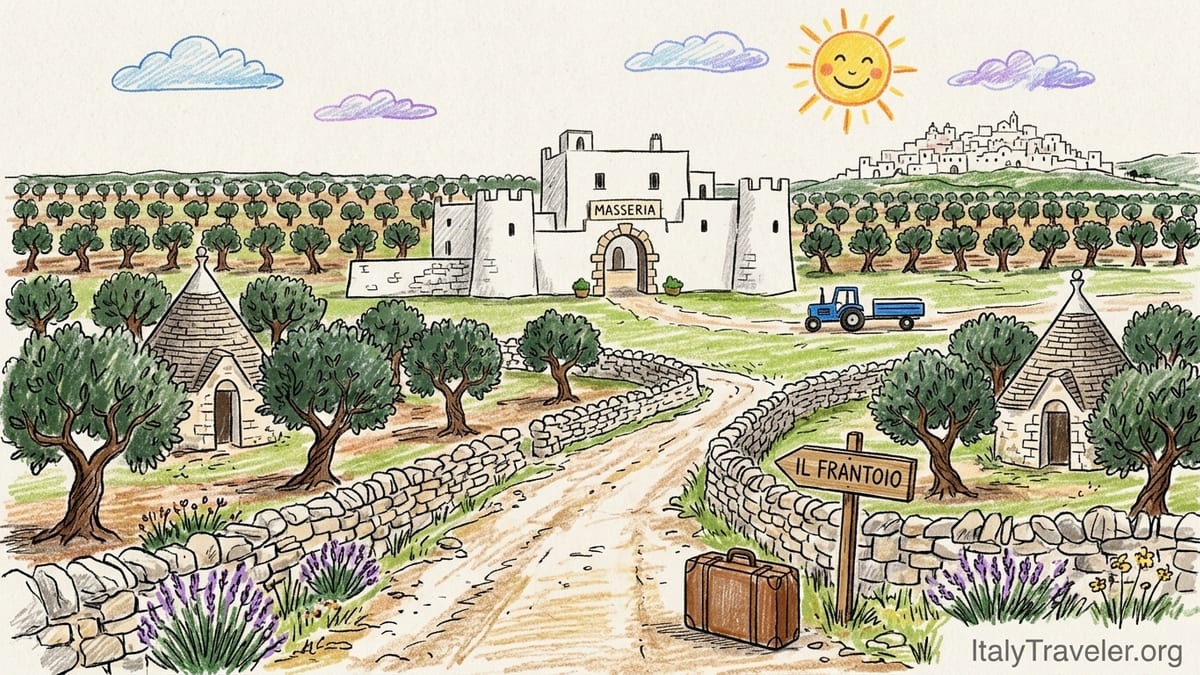
The taxi from Ostuni’s centro storico took barely ten minutes, but by the time we turned off the main road and bumped along the unmarked lane, the white town had disappeared. Dry stone walls closed in on both sides, their limestone blocks the same chalky color as the scattered trulli cones in the distance. On either side, olive trees spread out in regimented rows, trunks twisted like old rope, some of them certified to be many centuries old according to the masseria’s own surveys. The driver slowed almost instinctively; this was no anonymous resort driveway but the private access road of a farm that happens to receive visitors.
Masseria Il Frantoio is signposted only at the last moment, when the lane opens into a gravel courtyard and a square white farmhouse suddenly fills your field of vision. This is not a pastiche of rural life. The core of the building is a 16th‑century fortified masseria, with thick defensive walls and a stone arch leading to an inner courtyard. Behind it stretch roughly 70 hectares of certified organic land planted mainly with olives and vegetables. The owners still run it as a full agricultural business, bottling extra virgin olive oil and producing preserves and liqueurs from the estate’s fruit trees and kitchen garden.
I had booked directly through the masseria’s own reservation system after comparing rates with a few online travel agencies; in late May, my classic double came to around 230 euros per night including breakfast and a fixed‑menu dinner, which is fairly typical for high‑quality working masserie in the Ostuni area. The booking confirmation made clear that this was not an all‑inclusive resort. Olive oil tastings, additional wine, and activities like cooking classes and external tours were priced separately, while the agricultural side operated on its own schedule. Tractors sometimes pass the windows at dawn. Harvest dates can shift. This is part of the experience.
Stepping out of the car, the main soundtrack was not pool music but the low hum of bees in the lavender borders and the faint rattling of cicadas starting up for the day. Only when I wheeled my suitcase across the courtyard did I see a couple of other guests, already dressed for breakfast, sitting under a pergola laden with vines. The staff greeted me with the unhurried warmth that comes from running a small operation for years rather than training a new team each season. Check‑in happened at a wooden table in a former storage room, now the reception, with jars of preserved tomatoes and bottles of estate olive oil stacked behind the desk to remind you why this building exists.
Room, Courtyard and Everyday Life on a Working Masseria
My room occupied a corner of the upper floor that had once housed seasonal field workers. The staircase up was worn in the middle from generations of laborers’ boots. Inside, the design struck a balance between preservation and comfort: stone vaults, limewashed walls, and terracotta floors, softened by a simple rug and crisp white linens. Modern additions were discreet. The air conditioning unit was tucked high on the wall rather than dominating the space, the mini fridge hidden behind an antique wooden door, and rather than a television there was a small bookshelf with titles about Puglian cuisine and agriculture in Italian and English.
Two small windows overlooked different sides of the masseria’s life. From one I could see the inner courtyard, where breakfast tables were being laid and herbs grew in terracotta pots along the walls. From the other I looked out across a dirt farm track to a patchwork of vegetable beds and, beyond them, the first lines of the olive groves. In the late afternoon, a worker would sometimes drive past on a small tractor, dragging equipment for irrigation or pruning. It reminded me that behind the quiet atmosphere, there was constant work keeping the groves and gardens alive in a region facing droughts and disease.
The courtyard itself acted as the masseria’s living room. In the morning it smelled of coffee and toasted bread; at midday, of sun‑warmed stone and basil; in the evening, of slow‑cooked tomatoes and grilled meat. A battered bicycle leaned permanently against one wall, and an old stone trough had been repurposed as a flower bed. Unlike luxury properties that build brand‑new "villages" out of limestone to mimic old Apulian architecture, here the patina is genuine, with rain‑worn niches and faint traces of former doorways visible in the walls. When a delivery van arrived with glass bottles for the new olive oil batch, the driver maneuvered into the courtyard with practiced ease. Guests instinctively pulled their chairs back to make room. It felt like staying inside a working organism rather than in front of a landscape set.
Practicalities mattered too. Wi‑Fi reached my room but faltered slightly in the far edge of the courtyard. Mosquitoes appeared after sunset, despite discreet coils burning in corners. Staff were happy to provide repellent, but if you are used to sealed city hotels, sleeping inside 400‑year‑old thick walls surrounded by irrigated land takes some adjustment. I found the trade‑off worth it for the silence at night, broken only by the occasional dog barking in the distance and the rustle of wind through the olive trees.
Breakfasts, Pool Time and Honest Hospitality
Breakfast at Il Frantoio took place under a canopy in the courtyard, where mismatched wooden tables were covered with straightforward cotton cloths rather than starched hotel linen. The buffet leaned heavily into the estate’s own produce: jars of fig and grape jam, olive oil cakes, homemade biscuits flavored with lemon from the garden, and thick yogurt topped with almonds and seasonal fruit. There were cured meats and cheese for those who wanted a savory start, plus eggs cooked to order. Filter coffee and cappuccinos arrived in sturdy cups that looked borrowed from someone’s family kitchen, which they probably were.
Each morning, one of the team circulated to explain what came from the property and what did not. The olive oil on the table was from the current vintage, pressed from a blend of Ogliarola and Cellina di Nardò olives grown on site. Tomatoes for the bruschetta came from the orto just beyond the walls, irrigated using a carefully rationed system because of increasingly dry summers. When I asked if the orange marmalade was made there too, the hostess nodded and added that in recent years late frosts and heatwaves had made citrus more irregular. That kind of detail is unlikely to come up at a countryside hotel where the olive trees are décor rather than livelihood.
The pool sat a short walk from the main building, screened by low stone walls and small fruit trees. It was a simple rectangle with pale tiles, loungers shaded by canvas umbrellas and a view that opened straight onto the olive fields. Children splashed under parental supervision, but there was no dedicated entertainment team, no bar pumping music. Drinks and snacks were available if requested, often carried down on a tray from the kitchen. At one point, a worker trundled past the far side of the pool with a small trailer of pruning waste, a visual reminder that this tranquil spot existed inside an active farm.
Service throughout was personal but matter‑of‑fact. This is the kind of place where the owner might lead your evening tour one night and then you see them in work clothes inspecting trees the next morning. Staff were candid about practicalities. When I asked about taxis to Ostuni for dinner on a night I was not eating at the masseria, the receptionist warned that return rides after 11 p.m. could be harder to secure and cost around 25 to 30 euros each way, due to limited local drivers. There is no regular public transport to the gate. For travelers without a rental car, this remoteness can feel romantic at sunset but restrictive if you like spontaneous nightlife or varied dining options.
Inside a Real Olive Oil Tasting
The highlight of my stay, and the clearest point of difference from a landscaped countryside resort, was the structured olive oil tasting. Il Frantoio offers a roughly one‑hour experience that combines a brief walk through the grove, a look at historic and modern milling equipment, and a guided tasting of four organic extra virgin olive oils with an in‑house sommelier. At the time of my visit, the price was similar to other masserie in the area that advertise olive tours, around a few dozen euros per person depending on season and whether food pairings are included, though the property sometimes folds tastings into longer farm visits for overnight guests.
We began under the shade of a monumental olive, its trunk split into multiple columns fused together at the base. The guide explained in clear, unsentimental terms that while many of their oldest trees remain healthy, the wider region has been fighting the bacterium Xylella fastidiosa since it was first detected in Puglia in 2013. The disease, responsible for olive quick decline syndrome, is transmitted by sap‑sucking insects such as meadow spittlebugs and chokes the tree’s xylem, cutting off water and nutrients until entire branches desiccate. In some parts of Salento further south, it has killed millions of trees and transformed the landscape, prompting emergency replanting programs and strict phytosanitary controls by the regional authorities and European agencies.
Here on the Ostuni plain, surveillance and containment measures have slowed but not eliminated the threat. The guide described how they monitor for symptoms, follow regional guidelines for weed management to reduce insect vectors, and increasingly plant cultivars thought to show greater tolerance, such as Leccino, alongside traditional varieties like Ogliarola. Hearing this in situ, with a view of both healthy and clearly pruned trees, made it impossible to romanticize the groves as an unchanging postcard. This is a living agricultural system under pressure, and staying on site means you witness the adaptations in real time, from experimental pruning to the layout of new plantings.
Inside the old stone mill, we saw the 19th‑century grinding wheels once pulled by animals, preserved mainly for educational visits. Next door sat the modern stainless‑steel line, used in season to crush and press olives within hours of harvest. The sommelier walked us through the process: hand and mechanical harvesting from October to December depending on variety and intended flavor profile, immediate transport to the mill to minimize oxidation, cold extraction under controlled temperatures, and storage in inert gas‑blanketed stainless steel tanks to protect the oil from light and air. Only then is it bottled to order in dark glass or tins, labeled with harvest date and cultivar.
The actual tasting took place in a cool room off the courtyard, at a long table set not with bread but with rows of small blue glasses. We learned to warm each glass in the hand, trapping the aromas under a plastic lid before inhaling. The first oil, a single‑variety Ogliarola, smelled intensely of green almond and artichoke, with a soft bitterness and a gentle peppery tingle at the back of the throat. The second, a blend including Cellina di Nardò, had riper notes of tomato leaf and fresh-cut grass, with a more assertive bitterness that lingered. A third sample made predominantly from Leccino tasted slightly more herbal and balanced, with a noticeable spiciness that built as you swallowed.
Tasters were encouraged to describe what they perceived, even if clumsily, and to notice defects as well as virtues. One comparative sample, not for sale, showed what happens when olives are milled too late, with faint hints of mustiness and hay. Bread and small bites of raw fennel and apple followed to help reset the palate. This technical approach, rooted in the standards of professional olive oil panels, differs markedly from the casual dipping of bread in oil that many hotels offer free with dinner. It also demystified labels such as "fruttato medio" or "intenso," connecting tasting vocabulary with concrete sensations in my nose and throat.
Cooking with Puglian Ingredients
While Masseria Il Frantoio did not schedule a full cooking class during my short stay, its dinners functioned as a nightly immersion course in Puglian flavors. Each evening, a fixed multi‑course menu showcased vegetables and legumes from the estate, dressed always in a generous pour of their own oil. Orecchiette with cime di rapa appeared one night, the bitter turnip tops blanched and then sautéed with garlic and anchovy. Another evening brought thick slices of focaccia barese, its top blistered from the oven and studded with cherry tomatoes and black olives, served alongside marinated peppers and small fried polpette made of bread and herbs.
Curious to get my hands into the dough on a different day, I arranged a separate cooking experience at Masseria Amastuola, about an hour away near Crispiano. This property also operates as a wine estate and agricultural business, with a formal two‑hour cooking class priced at 60 euros per person for a minimum of two participants. The class, open to outside guests, runs from April to October and involves preparing a two‑course menu plus dessert under the guidance of the resident chef, then eating what you have cooked for dinner with a selection of the estate’s organic wines.
In our small group, we began by mixing semolina flour and water to make the stiff dough used for orecchiette, rolling it into thin ropes and then dragging a knife to form the characteristic "little ears" shape. The chef corrected our haphazard technique with good humor, insisting on the right thickness to capture sauce. We moved on to focaccia, pressing fingertips into a soft, risen dough already glossy with olive oil, then scattering halved tomatoes and oregano over the surface. While the breads baked, we prepared a simple seasonal contorno of roasted peppers and onions, learning to balance sweetness, acidity, and the distinct bite of raw new season oil.
It is worth underlining that these structured cooking classes are not typically included in room rates, whether at Amastuola or at similar estates. They are bookable experiences priced in the range of 40 to 70 euros per person depending on duration and food pairings. When comparing accommodation offers, it is easy to assume that a high nightly rate covers a generous activity program. In reality, agricultural properties need to separate hospitality from production; the money from cooking classes and tastings helps support both sides of the operation.
Working Masseria vs Luxury Countryside Resort
Staying at a masseria that is genuinely agricultural feels very different from checking into a purpose‑built luxury resort that borrows masseria aesthetics. In Puglia, there are celebrated five‑star properties constructed using new limestone blocks to resemble old villages, complete with towers, lanes and piazzette. They offer multiple restaurants, lavish spas, kids’ clubs, and beach clubs, all serviced by large teams. Olive trees there often stand in tidy rows between villas, more landscaping than livelihood. The experience can be wonderful in its own way, focused on comfort, privacy and curated views rather than on farm rhythms.
By contrast, at a working place like Il Frantoio or wine‑and‑olive estates such as Amastuola, daily life is less polished but more revealing. Breakfast may share space with crates of produce awaiting delivery to the kitchen. Mud may cling to tractor tires parked just beyond the guest car park. The pool has a view of irrigation lines and pruned stumps as well as picture‑perfect ancient specimens. Menus at dinner sometimes bend to what is available from the garden rather than what a chef ideally wants to plate for Instagram. Staff talk as much about soil and disease control as they do about spa appointments.
This difference also affects pricing. Nightly rates at top resorts can easily double those of working masserie while including fewer hands‑on agricultural experiences by default. Olive oil tastings at scenic but non‑producing properties may involve tasting oils purchased from elsewhere, or blend entertainment with limited technical content. Meanwhile, an hour‑long farm‑based tasting with access to groves, mills and an experienced guide typically costs around 40 euros per person, similar to the dedicated olive oil sessions advertised by agriturismi in the Ostuni area and by estates like Masseria Torregrande in other parts of Puglia, where a basic one‑hour tasting hovers around that price and food‑pairing options start from roughly 60 euros per person.
The trade‑off lies in what you value. If you want a flawless infinity pool, several dining outlets, and concierge‑arranged yacht charters, a resort model will suit you better. If you prefer conversation with the person who prunes the trees, quiet nights punctuated by the rustle of wind in the branches, and food that always leads back to the soil under your feet, then a working masseria is hard to beat. Both options are legitimate expressions of Puglia’s tourism boom, but only one keeps you aligned hour by hour with the life of olive agriculture.
Heat, Insects, Costs and Other Realities
Romantic images of masserie rarely show the thermometer. In late spring, midday temperatures on the Ostuni plain already nudged past 30 degrees Celsius on clear days, and by July and August they can climb higher still. Thick stone walls keep interiors relatively cool, but common areas, including the breakfast courtyard and poolside loungers, offer only partial shade. I found that my most comfortable hours were early morning and late afternoon; between noon and four, the light was almost blinding on the pale stone, and many guests retreated to their rooms or napped indoors. If you do not tolerate heat well, consider shoulder seasons or accept that your days will be structured around it.
Insects come with the territory. Mosquitoes are an issue at sunset, particularly after irrigation, and while the masseria used discreet measures and provided repellent, I was grateful for long sleeves and trousers in the evenings. Other wildlife was more benign: swallows nesting under eaves, geckos patrolling the walls, and the occasional harmless beetle making its way across the courtyard. Those who expect sealed, climate‑controlled hallways and insect‑free balconies may find this disconcerting. For me, the chorus of crickets and distant frog calls became part of the experience of staying inside a living landscape.
Costs beyond the room add up. Taxi rides between Ostuni and the masseria ran around 20 to 30 euros each way depending on time of day, and with no nearby village in walking distance, every off‑site meal effectively required transport unless I dined on the property. Masseria dinners were fairly priced for the quality and variety, but a fixed menu with wine can still bring the per‑person total close to 60 euros, similar to tasting menus at thoughtful restaurants in town. Olive oil tastings and farm tours, though excellent value from an educational standpoint, are paid extras. Cooking classes at external estates such as Amastuola at 60 euros per person also sit in this category.
There are subtler costs too. Limited dining options nearby mean you may eat variations of the same rustic dishes for several nights in a row. I happen to love bitter greens, legumes, and bread‑based cucina povera, but travelers craving variety and late‑night bars might feel constrained. On the flip side, the quiet and darkness of the countryside helped me sleep better than I had in Ostuni’s lively old town, where scooters and bar chatter sometimes echo through the narrow streets until after midnight.
Comparing a Masseria Stay to Trulli and Town Hotels
Before and after my masseria stay, I spent time in both a trullo near Martina Franca and in a central hotel in Ostuni. Each offered a different lens on Puglia. The trullo, a restored conical stone dwelling amid small fields, felt deeply atmospheric, almost monastic, with its low ceilings and thick walls filtering sound and light. It placed me physically in the Itria Valley’s iconic architecture but, unlike the masseria, did not immerse me in ongoing agricultural work. The small property where I stayed offered a pool and breakfast but owned only a handful of olive trees, more ornamental than productive. Staff were friendly but did not talk much about harvests or pests; their expertise lay more in restaurant recommendations and directions to nearby hill towns.
In Ostuni itself, my townhouse‑style hotel delivered all the pleasures of staying in a white city: bar‑hopping in the old streets, access to multiple restaurants serving everything from traditional orecchiette to creative seafood, and spontaneous evening strolls along the city walls. From there, I could join half‑day olive oil tours run by local operators that bring visitors to masserie for tastings, including to estates close to town where you can tour a historic underground olive mill and enjoy three‑oil tastings paired with local snacks. These excursions, usually costing the price of a decent dinner, are ideal for those without a car or those reluctant to commit to countryside accommodation.
The key distinction is depth and continuity. A day‑trip tasting gave me a strong introduction to olive oil production and a few hours in the groves. Two nights embedded in a working masseria extended that into a daily rhythm: waking to the sound of irrigation pumps, smelling oil in the mill even out of season, seeing how dinners change according to what the garden offers, and hearing staff worry about Xylella, drought, and bureaucracy as much as about online reviews. By the time I checked out, olive trees had shifted in my mind from a tourist backdrop to the protagonists of an ongoing regional story, one that is agronomic, economic, and cultural at once.
If your time in Puglia is short, you might be tempted to choose only one base, perhaps a trullo with a photogenic pool or a central hotel that maximizes restaurant access. My experience suggests that even a single night at a genuine working masseria can recalibrate your sense of the region. It ties the food on your plate and the oil in your glass to specific trees and people in a way that a city stay, however charming, cannot fully match.
The Takeaway
Looking back on my stay at Masseria Il Frantoio, the premium I paid compared with a basic B&B in Ostuni felt justified by the combination of setting, knowledge, and proximity to agricultural realities. This was not luxury in the marble‑and‑butler sense, and some comforts were deliberately limited. Air conditioning was present but not arctic. There was no room service menu, no glossy spa brochure waiting on the desk. Instead there were jars of preserved tomatoes made last summer, a handwritten note about current harvest conditions, and staff who talked about regional olive policies as readily as about day‑trip ideas.
The experience also reframed how I thought about similar offers in the area. Properties like Masseria Torregrande, which openly advertise structured olive oil tastings around 40 euros for an hour, and estates such as Masseria Amastuola with their 60‑euro cooking classes, now read less like tourist upsells and more like essential bridges between visitors and the farming systems that underpin Puglia’s landscapes. They monetize knowledge and culture in a way that helps sustain both, especially in the wake of Xylella fastidiosa and increasing climate stress. For travelers, these activities are opportunities to deepen understanding rather than optional sideshows.
If I had to choose the single activity that gave me the strongest connection to Puglian culture, it would be the technical olive oil tasting, not the cooking session or the poolside afternoons. Learning to read bitterness and pepperiness in an oil, to identify the scent of artichoke or tomato leaf, and to connect those sensations back to cultivars, harvest dates and pressing choices, felt like receiving a new vocabulary. It sharpened my taste at every subsequent meal, whether I was mopping up sauce with focaccia in the masseria courtyard or ordering a simple plate of vegetables in town.
Puglia’s image abroad is often that of timeless olive groves and unchanging rural traditions. A stay at a working masseria complicates that picture in all the right ways. It shows you orchards under pressure from disease and drought, farmers experimenting with resistant varieties and new pruning regimes, cooks who elevate humble ingredients because that is what the land still reliably gives. For travelers willing to trade some convenience and polish for intimacy with this reality, at least one or two nights among the olive trees is not just worthwhile. It is essential.
FAQ
Q1. What exactly is a masseria and how is it different from a regular countryside hotel?
A masseria is a historic fortified farmhouse complex tied to agricultural land, typically still involved in farming activities such as olive or wine production, whereas many countryside hotels simply imitate the architecture without running an active farm behind the scenes.
Q2. How much should I budget for an olive oil tasting at a Puglian masseria?
At working estates around Ostuni and in central Puglia, a structured one‑hour olive oil tasting usually costs around 40 euros per person, with more elaborate tastings that include food pairings starting from roughly 60 euros.
Q3. Are olive oil tastings normally included in the room price at masserie?
No, most masserie treat tastings as separate bookable experiences, so even if you are staying on the property you will typically pay an additional fee for guided olive oil sessions.
Q4. What is Xylella fastidiosa and should it affect my travel plans to Puglia?
Xylella fastidiosa is a plant‑pathogenic bacterium transmitted by sap‑sucking insects that has caused olive quick decline syndrome in parts of Puglia, killing many trees and forcing large‑scale replanting, but it does not pose a health risk to humans and should not deter travel, though it does change the appearance of some landscapes.
Q5. When is the best time of year to stay in a masseria for olive‑related activities?
Autumn, especially from October to early December, coincides with the olive harvest and offers the best chance to see picking and pressing in action, while spring and early summer provide milder weather and green landscapes but less direct harvest activity.
Q6. Do I need a car to stay at a masseria near Ostuni or Martina Franca?
A car is highly recommended because many masserie sit several kilometers outside towns with limited or no public transport, and taxi rides to and from places like Ostuni often cost around 20 to 30 euros each way, especially at night.
Q7. How does a masseria stay compare with renting a trullo in the Itria Valley?
A trullo stay emphasizes unique stone architecture and quiet countryside living, while a working masseria layers on active farming life, on‑site tastings, and closer contact with producers, making the latter generally more agricultural and educational in focus.
Q8. Are cooking classes widely available at Puglian masserie and what do they cost?
Yes, many estates offer cooking experiences focused on dishes like orecchiette, focaccia and seasonal vegetables, with two‑hour classes such as those at wine estates like Masseria Amastuola typically priced around 60 euros per person for small groups.
Q9. What level of comfort and amenities should I expect from a working masseria?
You can expect comfortable rooms with private bathrooms, air conditioning and pools at many properties, but usually not full hotel services such as 24‑hour reception, extensive room service, large spas or multiple restaurants on site.
Q10. Is paying extra for a night in a working masseria really worth it compared with a town hotel?
If you are interested in understanding how olive oil is produced, tasting it at the source and seeing how local food connects to the land, then at least one or two nights in a genuine working masseria generally offers far richer insight than an equivalent stay in a central town hotel.