


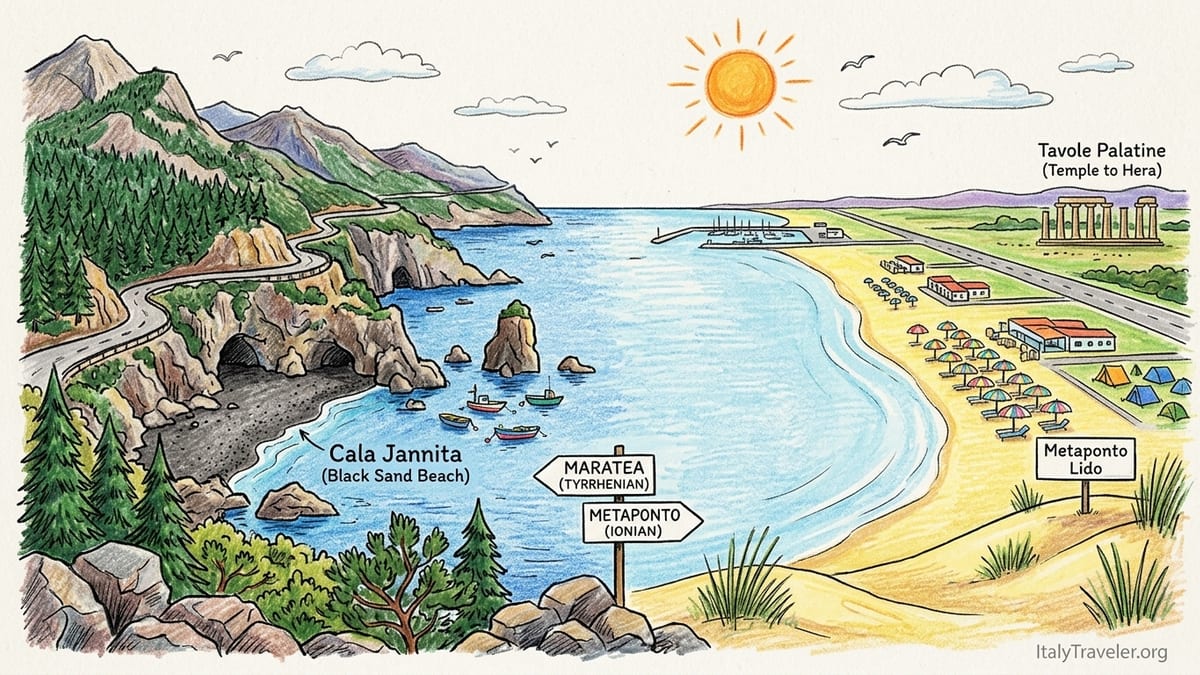
Basilicata has just 32 kilometers of Tyrrhenian shoreline but almost three times as much coast on the Ionian Sea, and the contrast between the two could shape your entire holiday. Around Maratea, steep forested mountains plunge into a broken line of rocky coves, black-sand inlets and pebble beaches. An hour and a half’s drive away on the Ionian side, long, pale strands backed by dunes and pinewoods stretch almost uninterrupted from Metaponto to Nova Siri. Choosing between them is less about which is more beautiful and more about what kind of seaside you need: dramatic and intimate, or broad, accessible and easy-going.
Two Very Different Seas in One Small Region
On a map Basilicata looks like a narrow hinge between Campania, Calabria and Puglia, with a short bite of Tyrrhenian coast around Maratea and a longer, flatter frontage on the Gulf of Taranto. In practice, it feels like two different regions. West of the Apennines, the Tyrrhenian side is mountainous, heavily indented and largely wild. The coastal road twists high above the sea, and beaches sit in rocky coves or at the mouth of short valleys. East on the Ionian side, the land flattens into a wide coastal plain where straight roads run behind ribbon-like beaches lined with beach clubs, resorts and family campsites.
These physical differences matter when you are planning a seaside stay. Around Maratea you are almost always dealing with some combination of steps, paths, small car parks and limited sandy space. The pay-off is scenery: cliffs, sea stacks, caves and clear water that is ideal for snorkelers and photographers. Along the Ionian, between Metaponto Lido and Nova Siri Marina, access is typically much simpler. You park behind the dunes or along beach avenues, walk a short way across sand or boardwalk, and arrive on a broad, largely sandy beach with shallow entry to the water, bars, restaurants and rental umbrellas.
Basilicata’s environmental quality credentials span both coasts. For 2024 the international Blue Flag program lists five locations in the region: Maratea on the Tyrrhenian and Metaponto (Bernalda), Marina di Pisticci, Policoro and Nova Siri on the Ionian. Regional announcements confirm that these same five have been maintained without change. The labels recognize good management, water quality and services, but travelers should remember that a Blue Flag says nothing about daily wave conditions and does not guarantee permanent lifeguard patrols outside core summer weeks.
Another factor shaping your decision is access. The Tyrrhenian coastal highway around Maratea has improved in recent years but remains narrow and sinuous in stretches, which can be stressful in peak August traffic or for nervous drivers. By contrast, the Ionian resorts sit near fast routes such as the SS106 Jonica and are easier to combine with Puglia, Calabria or inland Lucania road trips, particularly if you are arriving by car from Bari, Brindisi or Taranto airports.
Maratea and Its Coves: Acquafredda to Castrocucco
North of Maratea town, Acquafredda marks the start of Basilicata’s Tyrrhenian coastline. Here, slopes of Mediterranean woodland drop to narrow shingle and pebble coves, some of which are protected under environmental regulations as part of a coastal park. Reaching the beach usually involves walking down stepped lanes or footpaths from the main road. The shore is mostly small rounded stones rather than sand, and the water gets deep within a few strokes. Swimmers strong in open water will appreciate the clarity and calm on good days, but younger children may be happier paddling at the edges or wearing flotation aids. Facilities are modest, often limited to seasonal beach clubs with umbrellas, basic changing cabins and a bar serving snacks and drinks, with additional restaurants back on the road or inside nearby small hotels and guesthouses.
Continuing south, Fiumicello is one of the more accessible and family-friendly beaches on this coast. Here the valley opens a little, creating a wider bay with a mix of coarse sand and pebbles. Car access is relatively straightforward compared to more isolated coves, with public and private parking areas signposted from the main road and level approaches that avoid long staircases. The water still gets deep reasonably quickly, but wave conditions are often manageable for confident swimmers, and the beach offers a combination of free sections and stabilimenti that rent umbrellas, loungers and pedal boats. Behind the beach you will find cafes, gelaterie and a small concentration of accommodation, which together make Fiumicello a practical base if you want Tyrrhenian scenery without committing to daily hikes up and down steep paths.
Cala Jannita, often called Spiaggia Nera for its dark volcanic sand and gravel, is the coast’s poster image. Enclosed between cliffs and thick vegetation, it feels almost like a natural amphitheater. The black shoreline creates a striking contrast with the typically clear, blue-green water, which is especially photogenic in early morning or late afternoon light. To reach Cala Jannita you follow a marked footpath through the macchia and then a staircase down to sea level, so it is not suitable for strollers or travelers with significant mobility issues. At the bottom you will find at least one organized beach concession offering umbrella rental, snacks and restrooms, but shade outside the rows of umbrellas is limited during the middle of the day. The seabed becomes deep not far from shore and is rocky in places, which is excellent for snorkelers exploring around the headlands but less comfortable for small children who want to stand.
Further south, the Macarro area combines several small coves, including Illicini, set among low cliffs, sea stacks and protected Mediterranean scrub. Here the beaches are predominantly coarse sand and pebbles, interspersed with flat rocks where people sunbathe between swims. Access again tends to involve footpaths and wooden steps from roadside parking bays or modest car parks. Services are limited in some coves to seasonal kiosks or a single lido, so it is wise to carry water and basic supplies outside peak summer. The water here is particularly prized for purity and marine life, and on clear days visibility can be very good for snorkeling around rocks and seagrass meadows close to shore.
Marina di Maratea, Santa Teresa and Castrocucco
Around the hamlet of Marina di Maratea the coastline becomes slightly more open, though still framed by steep hillsides. Santa Teresa, also known locally as Cala di Don Carlo, is identified by local tourism boards as one of the more spacious beaches here and is included among the sections recognized under the Blue Flag label. Unlike the tighter coves further north, Santa Teresa offers a longer arc of sand and gravel with more room for free beach and organized concessions. Behind the shore there are seasonal beach bars, restaurants focused on seafood and fish of the day, and a larger choice of hotels and holiday apartments. You still need to negotiate minor slopes or short stairways from the main road and parking areas, but access is less demanding than at Cala Jannita or some Macarro coves, which makes Santa Teresa a compromise for travelers who want scenic Tyrrhenian surroundings but do not want every beach day to feel like a mini-hike.
South again, the coastline approaches the wide bay of Castrocucco, backed by alluvial plains and the low ridge of the Serra di Castrocucco. The main beach here, sometimes simply called Castrocucco or Secca di Castrocucco, stands out because it is one of the few almost entirely sandy stretches on the Maratea coast. A long tongue of light sand extends towards the mouth of the Noce River and the border with Calabria. The entry into the sea is shallower and more gradual than at most rocky coves, and there is more space to distribute umbrellas and games, which can be a relief for families. Several lidos manage sections of the shore, providing lifeguard presence in high summer along with changing cabins, showers and simple restaurants serving grilled fish, salads and pasta. Between them are free-access areas that are popular with locals.
The sandier nature of Castrocucco also influences parking and logistics. Here, unlike some cliff-backed beaches, you will find larger flat parking areas at relatively short walking distance from the water, with limited need for long staircases. Accommodation in the surrounding area tends toward small hotels, agriturismi on the plain and rental apartments, a pattern different from the denser resort and village structure on the Ionian coast. For travelers who want a Tyrrhenian base that works with small children, Castrocucco is often recommended as a first look at Maratea before exploring more dramatic coves by boat or on day trips.
Boat excursions are a key part of the Maratea experience and also change how you might use the beaches. From the small harbors at Marina di Maratea and nearby ports, operators run half-day or full-day trips that visit hidden caves, sea stacks and tiny inlets often inaccessible on foot. On calm days, skippers may anchor off Cala Jannita, Macarro or other coves so guests can swim from the boat with masks and snorkels. Costs vary by operator and season, but travelers should expect higher prices in August and lower in June and September. Booking the day before and being ready to shift dates around local weather and sea conditions is important, because no label or certification can override the reality of a windy Tyrrhenian day.
Why Maratea’s Coast Rewards Snorkelers and Photographers
What makes the Maratea stretch special is not convenience but drama. The same steep relief that complicates access creates a near-continuous sequence of viewpoints, cliffs and headlands. Bends in the coastal road often open onto panoramas that combine forested slopes, the Christ the Redeemer statue on Monte San Biagio, and shards of coastline that look more like parts of Liguria or the Amalfi coast than a little-known corner of Basilicata. For photographers, even simple things like the way afternoon sun slants across the cliffs at Fiumicello or glows on the black sand at Cala Jannita can be reason enough to choose the Tyrrhenian side for a few days.
Under the surface, rocky seabeds and scattered boulders are ideal for snorkeling. These habitats support a mix of algae, sponges and small fish that gravitate to structure, especially around the Macarro and Illicini coves and the rocky ends of beaches like Santa Teresa. In calm conditions you can often snorkel just a few meters from shore, watching shoals of small fish among the rocks. Water clarity tends to be good because there are few large rivers entering the sea on this stretch, though heavy rain inland can still affect visibility temporarily.
The very qualities that snorkelers prize can frustrate some families. Pebbles and rocks underfoot are less comfortable for toddlers and parents carrying gear, especially without water shoes. Rapidly deepening water can make it difficult for small children to stand and play independently, and there is simply less flat sandy area to spread out toys and umbrellas compared with the Ionian. Access by steep steps or narrow paths complicates hauling coolers and inflatables, and parking near the most famous coves often fills very early in peak season, which may require arriving before 9 am in August to avoid a long uphill walk in the heat.
As a result, many Italian families with very young children choose to visit Maratea’s coves early or late in the day for atmosphere and photos, then base themselves on the Ionian for the core of a longer beach holiday. Experienced drivers or couples who travel light, by contrast, may find that staying in Maratea town or Marina di Maratea and moving by car or scooter to a different cove each day offers the most rewarding combination of scenery, quiet and variety, especially in June and September when traffic is moderate and temperatures milder.
The Ionian Coast: Metaponto to Nova Siri
From Bernalda’s Metaponto Lido to Nova Siri Marina, Basilicata’s Ionian shore is a nearly continuous sweep of pale sand and fine shingle broken by river mouths and small harbors. The land here is low and flat, with pinewoods, agricultural fields and modern holiday developments behind the dunes. Beach access is usually by straight side roads off the SS106 or local coastal roads, ending in broad parking areas that back directly onto the sand or onto short boardwalks through the trees.
Metaponto Lido, within the municipality of Bernalda, lies at the northwestern end of this run. The beach is broad and largely sandy with some pebbly areas near the waterline, and the seabed slopes gently for some distance, which suits families with children and those who prefer to wade. Facilities include numerous stabilimenti offering classic Italian beach-club services such as umbrella and sunbed rental, showers, changing cabins, lifeguard presence in high summer and organized activities in peak weeks. Parallel streets host pizzerias, seafood restaurants and seasonal shops, and accommodation ranges from simple pensioni and apartments to holiday villages and campgrounds a short walk or drive inland.
South of Metaponto, Marina di Pisticci occupies a slightly quieter stretch backed by a significant belt of pine forest. The shore here typically consists of fine sand mixed with small pebbles, again with a gradual entry into the sea that is comfortable for less confident swimmers. Access roads run through the trees to large parking areas near the beach, and several lidos operate with bars, light dining and services. The area includes resort complexes and apartment-style tourist villages set just behind the pinewoods, some with direct private pathways to the beach. Like Metaponto, Marina di Pisticci is recognized as a Blue Flag locality at municipal level, primarily for water quality and environmental management rather than any guarantee of calm seas or staffing levels.
Further along, Scanzano Jonico’s shoreline continues the same pattern of wide, straight beaches with a mix of sand and small shingle and the sea deepening gently. The area remains less intensively built up than parts of Metaponto or Policoro, with stretches almost entirely occupied by free beach and natural dunes, especially near river mouths. Facilities can be more dispersed, so a car is useful if you want to alternate between wild-feeling sections and equipped lidos. Parking is generally on flat sandy lots or along access roads, without significant staircases or slopes. This simplicity of access, combined with long horizons and reliable summer warmth, is a major draw for road-trippers and families who value ease over drama.
Policoro Lido, part of the municipality of Policoro, is the busiest center on this coast and another Blue Flag awardee. Here, the beaches broaden and are backed by a developed seafront with hotels, campsites, water-sports operators and a marina. The sand is interspersed with fine gravel and shell fragments, especially near the shoreline, but the entry to the water remains gentle. Families appreciate the practicalities: long, level promenades for evening walks, cycle paths, numerous bars and restaurants and a variety of accommodation ranging from large campgrounds with pools to mid-range hotels and serviced apartments. The nearby WWF-protected Bosco Pantano adds a rare natural dimension within walking or cycling distance of a resort environment.
At the southeastern end of Basilicata’s coast, Nova Siri Marina is a calmer alternative that still offers a full-service beach holiday. The Blue Flag designation here applies to the Lido area, where the beach is wide, mostly sandy with some pebbles, and served by both free sections and organized lidos. The seabed is moderately sloping, and the water often feels slightly warmer than on the Tyrrhenian side thanks to the more enclosed Gulf of Taranto and generally calmer summer conditions. A string of hotels, resorts and holiday villages stands just behind the beach or across a small local road, many with their own umbrella sectors reserved on the sand. Parking is typically straightforward in flat lots or along the grid of streets behind the seafront, without the altitude differences that complicate Maratea.
WWF Bosco Pantano and Magna Graecia around Metaponto and Policoro
One of the Ionian coast’s signature experiences lies just inland from Policoro: the Bosco Pantano di Policoro, a protected WWF oasis that conserves one of the last remnants of lowland coastal forest and wetlands in this part of Italy. Paths lead under tall, mature trees and along channels where birdlife and small mammals can be observed, and the area supports turtle conservation and environmental education programs. In practical terms, this means you can combine hot mornings on the beach with cooler late-afternoon walks in the shade, an appealing option for families looking to give children a break from full sun and sand.
Culturally, the Ionian coast is the gateway to the ancient Greek colony world known as Magna Graecia. Metaponto and Policoro stand on or near the sites of the classical cities of Metapontum and Heraclea, and the landscape is dotted with archaeological remains. The best-known monument is the so-called Tavole Palatine, the standing columns of a temple to Hera near Metaponto, which can still be visited independently or as part of guided itineraries. Within Policoro, the National Archaeological Museum of Siritide and the associated archaeological park of Herakleia hold finds from Greek and indigenous settlements spreading across the coastal plain.
Travelers should be aware that the main Metaponto archaeological museum building has been affected by a program of works and accessibility upgrades. Administrative documents from the regional museums directorate refer to ongoing projects both for the Metaponto museum and for removing barriers at Policoro’s museum and the Herakleia park. As a result, some collections may be housed in deposits or only partially accessible during certain periods, and opening hours can differ between museums, parks and temporary exhibition spaces. Before planning a culture-focused day, it is wise to check the latest information with local tourist offices or museum contacts, especially outside the July and August high season.
Even if indoor spaces are temporarily restricted, outdoor archaeological sites continue to offer powerful on-the-ground experiences. Wandering through the columns at Metaponto or across the remains of streets and houses at Herakleia lets visitors link the long ribbon of modern beach resorts with the ancient lines of the Gulf of Taranto’s colonies. Combined with an afternoon swim at Metaponto Lido or an evening stroll on Policoro’s seafront, these visits make the Ionian coast feel less like a generic resort strip and more like a layered cultural landscape.
Blue Flag Status, Safety and Seasonality
For 2024 Basilicata’s five Blue Flag municipalities are Maratea on the Tyrrhenian side and Bernalda (Metaponto), Pisticci, Policoro and Nova Siri on the Ionian. Within Maratea, the recognition covers specific stretches including Acquafredda, Santa Teresa and Calaficarra, Macarro with Illicini and Spiaggia Nera, and Castrocucco with the Secca di Castrocucco. On the Ionian, the label applies to Metaponto Lido, Marina di Pisticci, and the northern and southern sectors of Policoro’s lido as well as Nova Siri Lido. These designations are renewed annually based on criteria such as water quality, environmental education initiatives, waste management and the presence of certain services.
It is important for travelers to understand what the Blue Flag is not. The label is not a real-time safety rating. It does not mean that the sea will be calm on the day you visit, nor that lifeguards are on duty year-round or even daily in shoulder seasons. In Basilicata, as in the rest of Italy, full lifeguard coverage on equipped beaches is most reliable from mid-July to late August, with more limited presence in June and early September that depends on individual operators. Free stretches of beach may have no lifeguards at all. Visitors should always observe local flags and notices about swimming conditions and be cautious about venturing into deeper water during or after windy spells.
Seasonality also affects the overall character of both coasts. June offers long days, generally warm but not oppressive temperatures and significantly lower crowding and prices than August. On the Tyrrhenian side, this is a pleasant time to tackle staircases and footpaths to coves such as Cala Jannita without the heat extremes of high summer. On the Ionian, some beach clubs and seasonal restaurants may only partially operate until schools close, but for many travelers that trade-off is worth the quieter atmosphere. August is the month when both Italians and foreign visitors concentrate their holidays, leading to busy roads around Maratea and very full seafront promenades and campsites in places like Policoro.
September has increasingly become a favored month for those with schedule flexibility. Sea temperatures remain pleasant, especially on the Ionian, and daytime weather is still suitable for swimming while nights grow cooler. Many beach clubs keep part of their services active into mid-September, though reduced hours and earlier closing dates are possible depending on the year’s weather. On the Maratea side, lighter traffic and softer light make it an excellent time for scenic drives and photography, though travelers should account for the shorter days when planning trips that involve mountain viewpoints such as the Christ the Redeemer statue above Maratea town.
Where to Stay and How Prices Shift Between Coasts
Accommodation structures around Maratea are limited by geography. The mountains drop steeply toward the sea, and there is less space for large resort complexes. The offer leans toward small and mid-sized hotels, family-run guesthouses, agriturismi in the hills and scattered apartments or villas. Many of these properties sit on terraces above the coast road with sea views and shuttle guests down to the beaches or to Marina di Maratea. Room counts are modest, which tends to keep average prices higher in peak weeks compared to mass-market Ionian resorts. In June and September travelers often find more competitive nightly rates and packages that include parking and breakfast, while in August availability can tighten sharply, especially around weekends and around the Ferragosto holiday.
On the Ionian side, the flatter landscape of Metaponto, Marina di Pisticci, Policoro and Nova Siri has allowed decades of development of medium and large-scale holiday villages, campsites with pools and entertainment, and resort hotels with direct beach access or short shuttle links. This greater capacity tends to moderate prices in comparison with Maratea in high season, though individual properties can still command premium rates, especially those with large water parks, kids’ clubs or spa facilities. Travelers can often choose between self-catering apartments within walking distance of the beach, all-inclusive or full-board packages in resort complexes and budget-friendly pitches in shaded campgrounds behind the dunes.
While precise nightly prices shift from year to year, concrete examples from booking platforms show a consistent pattern across comparable dates. For early June, it is usually possible to find mid-range hotel rooms in Maratea with sea view and breakfast at noticeably lower rates than in August, with free parking often included. On the same June dates, family rooms in Ionian holiday villages with half-board can represent strong value versus high summer, and campsites around Policoro may offer promotional rates that attract long-stay guests. By mid-August, many Maratea properties approach full occupancy, particularly those with easy beach access, while large Ionian resorts and campsites can still absorb demand thanks to their scale, though minimum-stay rules and higher nightly rates become common.
Road access is another practical cost, not just in money but in comfort. The Tyrrhenian coastal route around Maratea has benefited from improvements and bypasses that reduce some of the bottlenecks of the past, yet several segments remain narrow and winding. Drivers unfamiliar with mountain and coastal roads may find the combination of curves, tunnels and summer traffic tiring, and it is advisable to plan extra time when arriving or departing on Saturdays in August. The Ionian coast is tied into straighter arterial routes that connect more directly with inland autostrade, reducing journey times from major airports and rail hubs for those heading straight to beach resorts.
Three-Day Itineraries: Tyrrhenian vs Ionian
For a three-day stay focused on Maratea’s Tyrrhenian shore, one practical approach is to combine scenic viewpoints, a mix of accessible and more adventurous coves, and the inland character of the historic town. On Day 1, arrive in or near Maratea town, check into a hotel or guesthouse, and spend the afternoon exploring the old center with its churches and narrow lanes before driving or taking a local shuttle up to the Christ the Redeemer statue on Monte San Biagio for sunset views over the coast. Dinner in town gives a first taste of local seafood and mountain-influenced cuisine.
Day 2 can be dedicated to beaches north of the town, balancing relative ease and drama. Start at Fiumicello, where parking and access are straightforward and facilities are ample, making it easier to organize umbrellas and a relaxed swim. After lunch at a lido or nearby restaurant, continue north to Acquafredda to experience the wilder pebble coves, or join an afternoon boat excursion from Marina di Maratea that visits caves and passes under the cliffs below Macarro and Illicini. Depending on sea conditions, some excursions allow swimming stops near Cala Jannita or similarly sheltered inlets.
On Day 3, move south to Castrocucco and Santa Teresa. Spend the morning on the broader sandy expanse at Castrocucco, where shallow entry and wider free beach sections suit families. In the afternoon, if energy allows, shift to Santa Teresa or another nearby cove that combines scenery with organized services, keeping in mind parking and possible staircases. Plan your return drive to avoid the latest part of the afternoon if you are uncomfortable with winding roads in the dark, especially if you need to rejoin inland highways the same evening.
An Ionian-focused three-day stay looks different, oriented around long open beaches, shade in pinewoods and cultural excursions. On Day 1, base yourself in or near Metaponto Lido or Marina di Pisticci. After checking into a beach hotel, apartment or holiday village, spend the afternoon on the sand, getting used to the broad horizons and shallow waves. As the sun lowers, visit the nearby Tavole Palatine temple site for an atmospheric introduction to the area’s Greek heritage before returning to the seafront for dinner in one of the beachside restaurants.
Day 2 centers on Policoro. In the morning, explore the WWF Bosco Pantano, following signed trails through the forest and, when possible, visiting the visitor center or turtle-related activities if they are running. Bring insect repellent and water, especially on hot days. After a shaded picnic or lunch in town, shift to Policoro Lido for an afternoon swim, perhaps renting bicycles from local operators to ride along seafront cycle paths or between lidos and the marina. Evening can be spent on the promenade or at a campsite or resort that offers entertainment programs.
On Day 3, drive southeast to Nova Siri Marina, stopping at Scanzano Jonico if you want a quieter or more natural-feeling section of beach en route. Enjoy a final day on Nova Siri’s Blue Flag sands, choosing between free stretches and organized lidos depending on how much service you require. If you have an evening departure by car, the direct connection to the SS106 makes it easier to time your departure without worrying about mountain roads. Alternatively, use the last morning for a return visit to archaeological sites in Metaponto or Policoro if museum or park opening hours worked better later in your stay.
The Takeaway
Seen from afar, Basilicata’s small slice of Tyrrhenian Sea and longer span of Ionian coastline might look interchangeable within the wider tapestry of southern Italy’s shores. On the ground, Maratea’s tight coves and mountain backdrop deliver a concentrated dose of drama and clear deep water that particularly rewards snorkelers, photographers and couples or solo travelers who pack light and enjoy exploring by car, scooter, footpath and boat. The trade-offs are practical: fewer broad sandy beaches, more steps and paths, and a road network that demands a certain comfort with curves and summer traffic.
The Ionian side from Metaponto to Nova Siri offers a very different kind of ease. Long, accessible beaches, shallow entry into the water, extensive family-oriented accommodation and ready parking behind dunes or along straight resort avenues make it a strong choice for travelers with young children, for larger groups and for those who want cultural visits and nature walks such as the WWF Bosco Pantano without sacrificing simple logistics. Blue Flag designations underline that both coasts meet high environmental standards, but travelers must still evaluate day-by-day conditions, lifeguard presence and their own swimming abilities.
If your priority is scenery, seclusion and underwater exploration, and you can travel in June or September when temperatures are moderate and roads are quieter, basing yourself in Maratea or nearby hamlets and using the Ionian only as an arrival or departure route may suit you best. If instead you need broad, easily accessible sandy beaches, shade for afternoon naps, and a wide spread of family-friendly resorts within quick reach of main highways, then Metaponto, Marina di Pisticci, Policoro and Nova Siri provide the more practical solution. Many travelers ultimately find that the ideal Basilicata holiday is not about choosing one sea forever, but about combining a few intense Tyrrhenian days with a longer, more relaxed Ionian stay.
FAQ
Q1. Is Maratea or the Ionian coast better for families with small children?
For most families with very young children, the Ionian coast is more practical. Beaches at Metaponto, Marina di Pisticci, Policoro and Nova Siri are broad, mostly sandy and have shallow entry into the sea, with easy parking and minimal stairs. Around Maratea, many coves are pebbly with faster drop-offs and often require steps or footpaths, which can be challenging with strollers and lots of beach gear.
Q2. Are Maratea’s beaches mostly sand or pebbles?
Maratea’s coastline is dominated by pebble and shingle beaches with rocky sections, especially at Acquafredda, Fiumicello, Cala Jannita and Macarro. There are sandy areas at Castrocucco and parts of Santa Teresa, but travelers who want long, uniformly sandy strands will find more options on the Ionian side.
Q3. Do I need a car to enjoy the Maratea coast?
A car is highly recommended for Maratea. Beaches and viewpoints are spread along a winding coastal road, and public transport between coves is limited. Having your own vehicle makes it much easier to reach Acquafredda, Fiumicello, Cala Jannita, Macarro, Marina di Maratea, Santa Teresa and Castrocucco, especially outside peak summer when shuttle services are reduced.
Q4. How deep is the water off Maratea compared with the Ionian beaches?
On the Maratea side the seabed usually becomes deep within a short distance from shore and can be rocky, which suits confident swimmers and snorkelers but requires care with children. On the Ionian beaches the entry into the sea is generally more gradual, with sand or fine shingle underfoot, creating extensive shallow areas that are easier for less confident swimmers.
Q5. Does a Blue Flag guarantee lifeguards and calm sea conditions?
No. Blue Flag status recognizes water quality, environmental management and certain services, but it does not guarantee lifeguards at all times or calm seas. Lifeguard coverage on Basilicata’s beaches is usually strongest from mid-July to late August on equipped sections, and visitors must always follow local warning flags and exercise judgment about waves and currents.
Q6. What is special about WWF Bosco Pantano di Policoro?
WWF Bosco Pantano di Policoro protects one of the last remaining coastal forests and wetland areas on the Ionian plain. Visitors can walk shaded trails, observe birdlife and learn about conservation projects, including work with turtles. Its proximity to Policoro Lido means you can easily combine time in the woods with a beach day.
Q7. Can I still visit Magna Graecia sites if the Metaponto museum is affected by works?
Yes. Even when the main Metaponto museum building is subject to works or partial closures, outdoor sites such as the Tavole Palatine temple remain visitable, and the archaeological museum and park at Policoro provide additional context. It is wise to check current opening details locally, but there are always ways to experience the area’s Greek heritage.
Q8. When are road conditions around Maratea most challenging?
Roads around Maratea are most challenging on busy summer weekends in late July and August, especially around the mid-August Ferragosto holiday. The coastal road is narrow and winding, and traffic and parking pressure increase at popular coves. Travelers who are uneasy on curvy roads may prefer to drive outside peak hours or choose June and September instead.
Q9. Which months offer the best balance of weather and crowds on each coast?
June and September generally offer the best balance. On both coasts the weather is warm enough for swimming, but beaches, roads and accommodations are less crowded than in August. On the Tyrrhenian side, cooler air makes stairways and viewpoints more comfortable, while on the Ionian side many services are still operating, though often with reduced schedules late in September.
Q10. Is it realistic to combine Maratea and the Ionian coast in one trip?
Yes. The drive between Maratea and the central Ionian resorts such as Policoro typically takes around 90 minutes to two hours by car. Many travelers spend two or three nights around Maratea for scenery and snorkeling, then move to Metaponto, Marina di Pisticci, Policoro or Nova Siri for a longer stay focused on broad sandy beaches and easier logistics.