


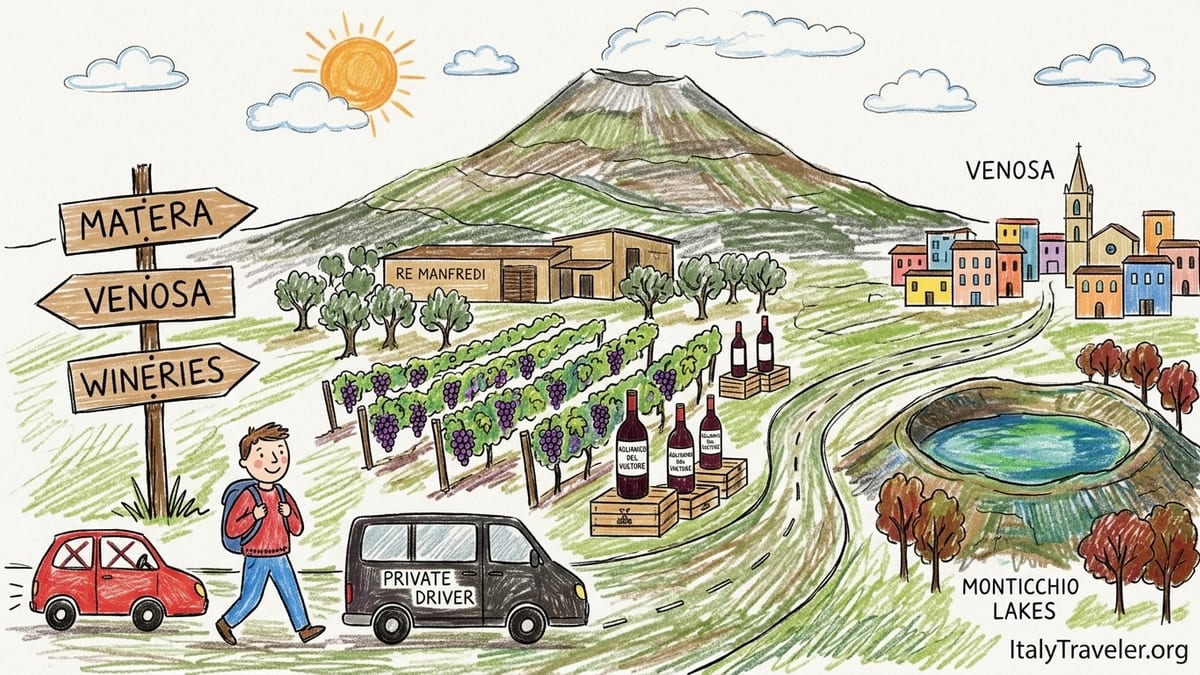
I did not plan to fall for an extinct volcano. I thought I was fitting in a practical transfer between Matera and Naples, with a quick Aglianico del Vulture tasting on the way. Instead, a day around Venosa, Melfi and the Monticchio lakes turned into one of the most grounded wine experiences I have had in Italy, and one I wished I had stretched into a slow overnight stay rather than a rushed detour.
Getting to Vulture and Choosing Not to Drive
My Aglianico del Vulture day started in Matera, where rental cars and guided transfers compete for travelers heading west to Campania. I had a standard compact rental booked, but the more I read about the structure and alcohol levels of Aglianico del Vulture, the less sensible self-driving felt. Even entry-level bottlings of Re Manfredi’s Aglianico del Vulture sit around 14 to 14.5 percent, with powerful tannins that reward slow tasting rather than quick sips. I wanted a proper cellar tour, not a ritual of spit-and-rinse in the car park before tackling provincial roads.
The geography made the decision easier. Matera to Venosa is roughly an hour and a half by car, mostly on fast regional roads, and Venosa to Melfi or Monticchio adds another 30 to 40 minutes of driving. The distances are modest, but the routes weave through rural Basilicata, where lighting is sparse at night and public transport between villages is thin. I booked a private transfer with a local driver based in Potenza who was used to winery stops and agreed to wait during tastings for about 260 euros for the full Matera to Venosa to Melfi and back loop. For a couple or small group, that cost compares reasonably with a one-day car hire plus fuel and the mental cost of sobriety.
Travelers on a tighter budget sometimes stitch together regional buses to Melfi, then arrange a local taxi to Venosa or Monticchio. Schedules change and often run only a few times a day, so for this particular day I wanted the certainty of confirmed pickup times. I shared the transfer with another wine-focused traveler I met through my guesthouse in Matera, and splitting the cost instantly made it feel more justifiable than a private taxi. We agreed from the start that neither of us would drive, remove the car keys from the equation, and build the day around the wines rather than the parking lot.
We left Matera just after 8.30 in the morning to catch a late-morning tasting at Re Manfredi near Venosa. That timing kept the rest of the day open for an unhurried lunch in town and an afternoon leg to Melfi or Monticchio, depending on how the weather treated the volcanic slopes.
Booking Re Manfredi: Three Wines or Five on the Volcano
Re Manfredi, technically Cantina Terre degli Svevi, sits in località Pian di Camera just outside Venosa, on the lower slopes of Monte Vulture. The winery publishes a clear tasting program, which is one reason I chose it over smaller estates that only confirm details by phone. Tastings run year-round by reservation and revolve around Aglianico del Vulture and its siblings. Their official visit options cluster into three main routes: “Viaggio nel Vulture,” an introduction with three wines across white, rosato and red; “Alla scoperta dell’Aglianico del Vulture,” another three-wine flight focused entirely on Aglianico-based reds; and “Le Selezioni di Vigneto,” a deeper, five-wine dive into their vineyard selections. Each is structured as a guided tour plus tasting, with the two shorter experiences scheduled for around 90 minutes and the five-wine encounter close to two hours.
I emailed the winery a week ahead, requesting the five-wine Selezioni di Vigneto option for two people and asking for a late-morning slot. The confirmation came by the next day, with a note that visits were guided in Italian or English depending on staff and that the tasting room doubled as their wine shop. Prices were given on request rather than publicly, and at the time of my visit in autumn 2026 the five-wine tour cost 45 euros per person, while the three-wine routes were quoted to other guests at around the mid-30-euro mark. That rate included the vineyard walk, cellar tour and generous pours rather than symbolic sips.
Pulling into Pian di Camera with a driver felt like an underrated luxury. Instead of immediately assessing how much I could safely taste and still manage clutch control on the way back to town, I stepped straight out of the van into rows of Aglianico vines that spilled away toward the dark outline of Monte Vulture. The winery buildings are modern but low-slung, surrounded by vineyards rather than warehouses, and set just high enough that the view stretches over a patchwork of olive groves and other estates that share this volcanic amphitheater.
Our guide met us outside and set expectations clearly: 20 minutes among the vines to talk about soils and grape growing, 20 to 30 minutes in the production and barrel areas, and then the tasting itself in a glass-fronted room with views back onto the vineyard slopes. It immediately felt structured and professional, closer to the format you find in parts of Piedmont than to a casual bar pour.
Walking the Volcanic Vulture Vineyards
Standing between the Re Manfredi rows gave the first tangible sense of how Monte Vulture shapes the wines here. The guide picked up a handful of soil and let the pebbles run through his fingers. It was a mosaic of crumbly dark ash, lighter pumice and pockets of clay, with rounded stones that looked like charcoal-smudged river gravel. Monte Vulture last erupted more than 100,000 years ago, and over those millennia wind and water redistributed the ash and tuff across slopes of different exposures and elevations. The result is not a single signature “volcanic taste,” but a patchwork of parcels that drain and retain water differently.
In some blocks the topsoil was thinner, with stones closer to the surface. Our guide explained that these plots tend to stress the vines more, producing smaller berries and firmer tannins, so they often feed into the more structured Aglianico del Vulture bottlings. Lower down, slightly deeper soils maintain more moisture, which helps buffer the vines against the increasingly hot, dry summers the region has experienced over the last decade. Those parcels, depending on the vintage, might be directed into wines that are intended to be approachable earlier in their life.
He was careful not to promise flavors that would magically appear just because of geology. Instead, he spoke about the combination of altitude, wind and volcanic subsoils that often correlates with naturally high acidity, thick skins and the potential for long-lived reds. In the glass, that can show up as a tension between dark fruit and a kind of minerally length, but he emphasized that winemaking decisions, harvest timing and barrel choices mattered as much as what lay under our feet.
The morning remained overcast, with low clouds caught around the tip of Monte Vulture. That flat, silvery light made the greens of the vine leaves look almost fluorescent against the darker soil, and the air carried both the scent of damp earth and faint whiffs of fermenting must drifting out from open cellar windows. It was not a glossy postcard view but a working agricultural landscape, which felt precisely right for a day built on a grape better known among Italians than on export wine lists.
Inside the Cellar and a Five-Wine Tasting at Re Manfredi
The cellar tour moved logically from the stainless-steel fermenters to the barrel hall. Re Manfredi works mostly with large oak and a mix of barriques for different cuvées, and as we walked, the guide explained that Aglianico here is harvested relatively late, often in October, to achieve phenolic ripeness. Fermentations are long, with extended maceration to shape the structured tannins that define Aglianico del Vulture DOC and its Superiore DOCG version. We paused beside a row of barrels holding Serpara, their Aglianico del Vulture Superiore, while he described how stricter aging rules and lower yields sit behind that higher designation.
In the tasting room, a long table was already laid with five glasses per setting, local bread, a small selection of aged Lucanian cheeses and slices of cured sausage. The order of the Selezioni di Vigneto flight moved from lighter to more powerful. We began with Manfredi Bianco Basilicata IGT, a white blend with clean citrus and herbal notes that refreshed the palate after the cellar’s cool, oak-edged air. Next came Manfredi Rosa Basilicata IGT, pale copper in the glass, with wild strawberry and a faint savory edge. Both wines offered a glimpse of how the winery interprets the region beyond red.
The transition to red started with Taglio del Tralcio Aglianico del Vulture DOC, a wine often described as the gateway into Re Manfredi’s Aglianico range. In my glass, the 2023 vintage showed dark cherry, plum skin and a distinct graphite note, with tannins that were firm but already integrated enough to drink comfortably with food. The second red was Re Manfredi Aglianico del Vulture DOC itself, from the 2022 vintage, which has drawn solid scores in recent buying guides and sits at a moderate price point in Italian restaurants and shops. The nose here pushed deeper into black fruit, sweet spice and a touch of coffee, with more concentration on the mid-palate and a longer, slightly smoky finish.
The final glass was Serpara Aglianico del Vulture Superiore DOCG, poured from a bottle that the guide described as one of their vineyard-selection flagships. Here the volcanic narrative made the most sense. The fruit was ripe and dense, but an almost saline line and tightly woven tannins carried it forward, suggesting a wine that would reward a decade or more of patient cellaring. With each red, the cheeses and cured meats on the board shifted in relevance: the semi-aged caciocavallo matched the Taglio del Tralcio, while an older pecorino with more crystalline crunch stood up well to Serpara’s structure.
By the end of the two hours, I had tasted through all five wines in meaningful, not symbolic, pours. The service was attentive without being stiff, with the guide comfortable answering questions about vineyard practices, yields and export markets. He was clear when something was a matter of personal opinion rather than official policy, such as whether the Re Manfredi Aglianico was better at five or ten years of age. The bill reflected the quoted 45 euros per person, with no surprise surcharges, and was settled at the shop counter, where the next decision loomed: which bottles, realistically, belonged in my suitcase.
Shopping, Prices and the Wines Worth Taking Home
Re Manfredi’s wine shop sits beside the tasting room, lined with bottles that cater as much to local buyers as to travelers. Prices during my visit roughly matched what I had seen in Italian online retailers, rather than inflated “cellar door” premiums. Taglio del Tralcio Aglianico del Vulture DOC was available in the mid-teens in euros per bottle, while the standard Re Manfredi Aglianico del Vulture DOC hovered in the low to mid-twenties. Serpara Aglianico del Vulture Superiore DOCG climbed into the high twenties or low thirties depending on vintage, reflecting its status at the top of the range.
After tasting, I felt that three wines justified suitcase space for slightly different reasons. Taglio del Tralcio offered genuine value as an introduction to volcanic Aglianico that I could open with friends who might not yet be familiar with the grape. Its tannins were structured but not aggressive, and its price left room for casual uncorking. I bought two bottles with the specific idea of sharing them at a simple pasta dinner back home, where I would not worry about elaborate decanting rituals.
The Re Manfredi Aglianico del Vulture DOC, particularly the 2022 vintage I had in my glass, felt like the sweet spot between price, complexity and aging potential. Knowing that some international critics had scored it respectably and that restaurant lists in Italy sometimes priced older vintages around the mid-thirties in euros gave me confidence that I was buying a bottle that punched above its cost. I picked up two bottles with the intention of drinking one within a couple of years and keeping the other another five to seven years, testing the arc of development I had discussed with our guide.
Serpara was the wine I admired most in the tasting line-up but hesitated over. Its concentration and tannin structure made it the bottle I most wanted to revisit in a decade, yet luggage weight and customs limits are real constraints. In the end I bought a single bottle as a marker of the volcano at its most serious, accepting that this would be a special-occasion wine at home. The whites and rosato charmed me at the table but did not feel distinctive enough to edge out the reds in a finite suitcase. It was a reminder that buying at the winery should follow both palate and practicalities: which bottles will still feel meaningful when you pull them from a cupboard years later.
Horace’s Venosa and Lunch in a Quiet Hill Town
From the winery it took less than fifteen minutes to reach Venosa itself, a town known as the birthplace of the Roman poet Horace, Quintus Horatius Flaccus. A small plaque and references in local guidebooks anchor this literary connection, and the town has leaned into the identity without turning it into a theme park. The streets near the main square are a mix of stone houses, modest shops and cafes that cater primarily to residents rather than passing tour buses.
We stopped for lunch at a trattoria in the historic center, where the chalkboard leaned heavily into local produce and, unsurprisingly, Aglianico by the glass and bottle. The house recommendation was a simple pairing: handmade cavatelli with a ragù of local sausage followed by grilled lamb chops, both natural companions for the structure and acidity of Aglianico del Vulture. I ordered a glass of a different producer’s Aglianico to avoid palate fatigue from Re Manfredi’s line-up, while my travel companion switched to sparkling water, a sensible reset after a full tasting.
Walking Venosa after lunch, we passed the archaeological area where layers of Roman, medieval and later history overlap. Even in a short stroll, the sense that Venosa’s identity predates modern wine tourism by many centuries is strong. The connection to Horace added a contemplative layer to the day. Here we were, tasting wines grown on volcanic slopes that the poet would have known as everyday countryside, even if the current DOC and DOCG frameworks would have been foreign concepts to him.
Despite the town’s quiet character, it felt like a good base for travelers who prefer smaller, working communities to polished resort towns. A handful of B&Bs and small hotels cluster within walking distance of the center, and staying here would allow an early start for additional winery visits or explorations of the surrounding Vulture villages the next day.
Melfi Castle and Weighing Melfi Against Monticchio
The afternoon presented a choice. Cloud cover still clung to the top of Monte Vulture, but forecasts suggested no heavy rain. With limited time, we had to decide between heading straight into the volcanic crater landscape at Monticchio or stopping first at Melfi, whose Norman-Swabian castle is one of the most prominent landmarks in the Vulture region. The driver, who knew both routes well, advised that the lakes are atmospheric even under cloud, while Melfi’s castle and historic center offered more shelter if the weather worsened. We opted for culture first, landscape second, and set off for Melfi.
Melfi sits on a hill topped by the robust outline of its castle, which dates back to Norman times and later became closely associated with the Hohenstaufen emperor Frederick II. The castle has played host to important councils and imperial decisions over the centuries, embedding it deeply in the political and cultural story of southern Italy. Today it houses a museum that showcases artifacts from the area, including significant finds from pre-Roman and Roman times. Entry fees at the time of my visit were modest, in the single-digit euros, and the staffed ticket desk provided basic information on opening hours which can shift slightly with the seasons.
Walking the castle ramparts and courtyards, the connection with the name Terre degli Svevi, “land of the Swabians,” used by Re Manfredi’s corporate identity, clicked into place. The winery’s name, invoking Manfred, son of Frederick II, is a deliberate nod to this medieval power base. Standing within the thick stone walls, overlooking the rolling countryside that now feeds vineyards, gave the day a satisfying historical loop: the same landscape that once mattered for strategic reasons now supports a wine that quietly carries the region’s name into restaurants around the world.
There was no time for a second formal tasting in Melfi, and that constraint underlined how packed even a well-planned one-day itinerary can become. We limited ourselves to an espresso in the town center and a short walk through the streets outside the castle, noting a handful of small hotels and restaurants that would make Melfi a practical overnight base for travelers who prefer a slightly larger town than Venosa but still want direct access to Vulture wineries and the road to Monticchio Laghi.
Monticchio’s Crater Lakes and the Volcanic Landscape
From Melfi it is a relatively short drive to Monticchio Laghi, where two small lakes sit inside volcanic craters on the flanks of Monte Vulture. The road winds through woodland and occasional clearings, and as we gained elevation, the air became cooler and damp. Our driver followed local signs to the lakes and the abbey of San Michele, which hosts the Museo di Storia Naturale del Vulture. The museum, housed within the historic abbey, tells the geological and natural story of the area and operates on a set schedule that changes slightly by day of the week. On the Friday of my visit, it opened in both the morning and afternoon, with the last entrance in the late afternoon before closing early evening.
We arrived with enough time for a brief visit. The displays offered a concise explanation of how Monte Vulture’s eruptions shaped the twin crater lakes and the surrounding forests. Photographs and diagrams traced the line from explosive volcanic activity to the ash and tuff soils we had handled that morning at Re Manfredi, closing the circle between geology and wine. The museum’s free admission policy removed one more barrier to understanding the landscape beyond what fits into a wine label.
Outside, paths skirt the edges of the lakes, passing small docks, simple cafes and picnic areas. On a cloudy afternoon the colors were muted but beautiful: dark green water, russet and bronze leaves in the surrounding woods and the pale stone of the abbey perched above. The atmosphere was quietly dramatic, more introspective than postcard cheerful. For hikers, local guides and associations organize walks that link the lakes with panoramic viewpoints higher up the slopes, and seasonal experiences pair foliage or chestnut picking with Aglianico tastings. Time did not allow for a longer trek on this trip, but even a short walk along the water’s edge hinted at how much more could be explored with an overnight stay in the area rather than a single afternoon.
The drive back from Monticchio toward the main roads highlighted another argument against self-driving if you plan to taste generously. The curves and elevation changes demand attention, and the lack of substantial lighting after dark would add strain for anyone not fully sober. Sitting in the back seat, watching the last outline of the crater fade in the mirrors while the day’s tastings settled into memory, confirmed that the investment in a driver had been worthwhile.
Self-Drive vs Guided Transfer: What Worked Best
Having experienced the day with a private driver, I could clearly imagine how it would have felt behind the wheel instead. Self-driving does offer flexibility. Travelers starting from Bari or Naples could rent a car, weave Venosa, Melfi and Monticchio into a multi-day loop across Basilicata and Campania and drop the vehicle in a different city. A car would also make it easier to detour into smaller villages such as Rionero in Vulture or Atella, whose names appear in the official production zone for Aglianico del Vulture but remain largely untouched by organized tours.
The trade-off sits squarely with alcohol consumption and fatigue. A proper tasting at Re Manfredi, particularly the five-wine Selezioni di Vigneto experience, is not a token pour. Even with spitting, some alcohol absorption is almost inevitable, and the day layers wine on top of travel, meals and walking. If you are committed to strict spitting and limit yourself to a three-wine flight, self-driving may be manageable for an experienced rural driver who is used to Italian road conditions. But if you want to fully experience the spectrum from fresh whites to dense Superiore reds and perhaps sample Aglianico again at lunch or dinner, handing the keys to someone else is the safer and more relaxing choice.
Guided small-group tours that bundle Vulture wineries with stops at Melfi or Monticchio are still relatively rare compared with more famous wine areas. That scarcity leaves travelers choosing between a private driver, a taxi arrangement from a base like Potenza or Melfi, or a hybrid approach that uses public transport for longer legs and local taxis for short hops. The cost of a full-day private transfer can look steep on paper, but spread across three or four people it compares respectably with car rental plus fuel and parking, especially once you factor in peace of mind.
For my own trip, sharing the driver with another traveler struck the right balance. We had the freedom to adjust timings after lunch, choosing Melfi and Monticchio based on the live weather rather than a rigid group itinerary, while never having to moderate tasting pours out of concern for a breathalyzer. The driver’s local familiarity also shaved time off navigation, finding parking near Venosa’s center and threading efficiently through the roads around Monticchio’s lakes.
Where to Sleep, Eat and Linger in Vulture
Although I ultimately returned to Matera that night, spending most of the day in Vulture convinced me that the region deserves at least one overnight stay. Venosa, with its Horatian heritage and compact center, offers small B&Bs and family-run hotels within a short walk of the main square. Staying there would allow a sunset stroll, a relaxed dinner with Aglianico and a quiet morning coffee before another winery visit or a drive toward other villages in the production zone like Rionero in Vulture or Barile.
Melfi, anchored by its Norman-Swabian castle, feels slightly larger and busier, with a broader choice of accommodations and restaurants. An overnight here would suit travelers who want a bit more evening atmosphere while still being within easy reach of both wineries and Monticchio’s lakes. Castle views at dusk, when the stone walls glow softly under spotlights, add a sense of drama that balances the rural calm of the vineyards.
In terms of meals, my standout plates were simple. The lunchtime cavatelli with sausage ragù in Venosa proved almost purpose-built for young Aglianico, its richness offset by the wine’s acidity and tannin. At dinner back in Matera, a steak from local Podolica cattle and roasted peppers with olive oil provided another classic pairing, this time with a bottle of Aglianico del Vulture from a different producer that I ordered by the glass to compare notes. Those meals confirmed that Vulture wines are built for earthy, robust regional food rather than delicate tasting menus.
If I were to repeat the trip with an overnight stay, I would structure it differently. I would book a room in Venosa or Melfi, schedule Re Manfredi for midday of day one and a second, contrasting winery for the following morning, leaving the afternoon of day two free for a longer hike around Monticchio. That slower rhythm would better honor both the wines and the landscape, and make the logistics of wine purchases easier by avoiding the need to lug bottles directly back across regions on the same day.
The Takeaway
By the time the driver dropped us back in Matera, darkness had settled and the volcano felt more present in my mind than the city’s famous stones. The day had unfolded along a clear arc: volcanic soil underfoot at Re Manfredi, structured Aglianico in the glass, Horace’s Venosa at lunchtime, the stones of a Norman-Swabian stronghold in Melfi in the afternoon and the quiet water of Monticchio’s crater lakes before dusk. Each segment reinforced the others without ever feeling like a forced checklist.
My favorite tasting of the day was the Re Manfredi Aglianico del Vulture DOC in the five-wine flight. Taglio del Tralcio was charming and Serpara was majestic, but the core DOC bottling delivered the most compelling balance between immediacy and depth, the one I could most clearly imagine sharing with friends at home without a long preamble. It became the emotional center of my suitcase purchases and the bottle I mentally promised myself to open on a winter evening, a tangible reminder of that walk through volcanic dust.
In financial terms, the day was not cheap. The shared private transfer, five-wine tasting at 45 euros per person, lunch, museum visit, a coffee in Melfi and four bottles bought at the winery added up to a few hundred euros. But for that outlay I gained a set of experiences that stitched geology, history, gastronomy and wine into a single coherent narrative, one that would have been hard to replicate in more crowded, polished wine regions.
Most importantly, the Vulture convinced me that it deserves more than a rushed detour between Matera and Naples. A single day is enough to taste the headline wines and glimpse the crater lakes, but the region’s character lies in repetition: dawn light over the vineyards, a second or third producer’s interpretation of Aglianico, quieter corners of Venosa and Melfi once day-trippers have left. If your itinerary allows it, treat northern Basilicata not as a connector but as a destination. Give Monte Vulture at least one night of your journey, and let its wines and crater lakes work on you at their own, patient pace.
FAQ
Q1. Can I visit Re Manfredi without a reservation?
While the wine shop has regular opening hours on weekdays and Saturday mornings, cellar tours and structured tastings are by advance reservation, so it is best to email or call at least several days ahead.
Q2. How long does the Re Manfredi tasting experience last?
The three-wine options, focused either on a mix of styles or on Aglianico alone, are structured for about 90 minutes including the cellar tour, while the five-wine Selezioni di Vigneto experience runs closer to two hours.
Q3. Is it safe to self-drive after an Aglianico del Vulture tasting?
If you spit consistently and limit yourself to smaller tastings, experienced drivers may manage, but given the strength of the wines and the rural roads, many travelers prefer to hire a driver or join a guided transfer.
Q4. Where is the best base for an overnight stay in the Vulture area?
Venosa offers a quieter, literary-tinged base linked to the poet Horace, while Melfi provides a slightly larger town atmosphere under its Norman-Swabian castle; both work well as hubs for winery visits.
Q5. Are the Monticchio lakes worth visiting in poor weather?
Even under cloud, the crater lakes have a moody, atmospheric beauty, and the abbey of San Michele with the Vulture nature museum provides an indoor complement to short walks along the water.
Q6. Do all Aglianico del Vulture wines taste the same because of the volcanic soil?
No, while volcanic soils and altitude contribute to certain shared traits like structure and freshness, differences in vineyard parcel, elevation, harvest timing and winemaking style create a wide range of expressions.
Q7. How much should I expect to pay for bottles at the winery?
During my visit, introductory Aglianico del Vulture wines were priced roughly in the mid-teens in euros, core DOC bottlings in the low to mid-twenties and top Superiore selections around the high twenties to low thirties.
Q8. Can I reach Venosa and Melfi by public transport?
There are regional bus connections to towns like Melfi from larger hubs, but services can be infrequent and not always convenient for same-day winery visits, so many visitors combine limited public transport with local taxis or private drivers.
Q9. Is an Aglianico del Vulture wine day suitable for travelers new to Italian wines?
Yes, provided you are comfortable with structured reds; wineries like Re Manfredi include approachable whites and rosato in their tastings and guides are used to explaining the region to newcomers.
Q10. How many wineries should I visit in one day in the Vulture region?
Given travel times, the depth of typical tastings and the opportunity to see places like Melfi Castle or Monticchio lakes, most travelers find that one substantial winery visit combined with cultural or landscape stops makes for a fuller, less rushed day.