


Matera can feel overwhelming at first glance. The honey-colored houses seem to tumble into the gorge in every direction, steps dive under arches, and alleys end at cliff edges. Yet the city’s beauty is rooted in something far more complex than photogenic streets. To understand Matera, you need to understand the Sassi districts, the cave churches and cisterns carved into the rock, and the story of how this once-condemned cave city became a UNESCO World Heritage Site. This guide focuses on exactly that: how to explore the Sassi and the Park of the Rupestrian Churches in a practical, respectful way, with a realistic walking route, ticket choices, and essential logistics for 2026.
Understanding Matera’s Sassi, Civita Ridge and Cave Landscape
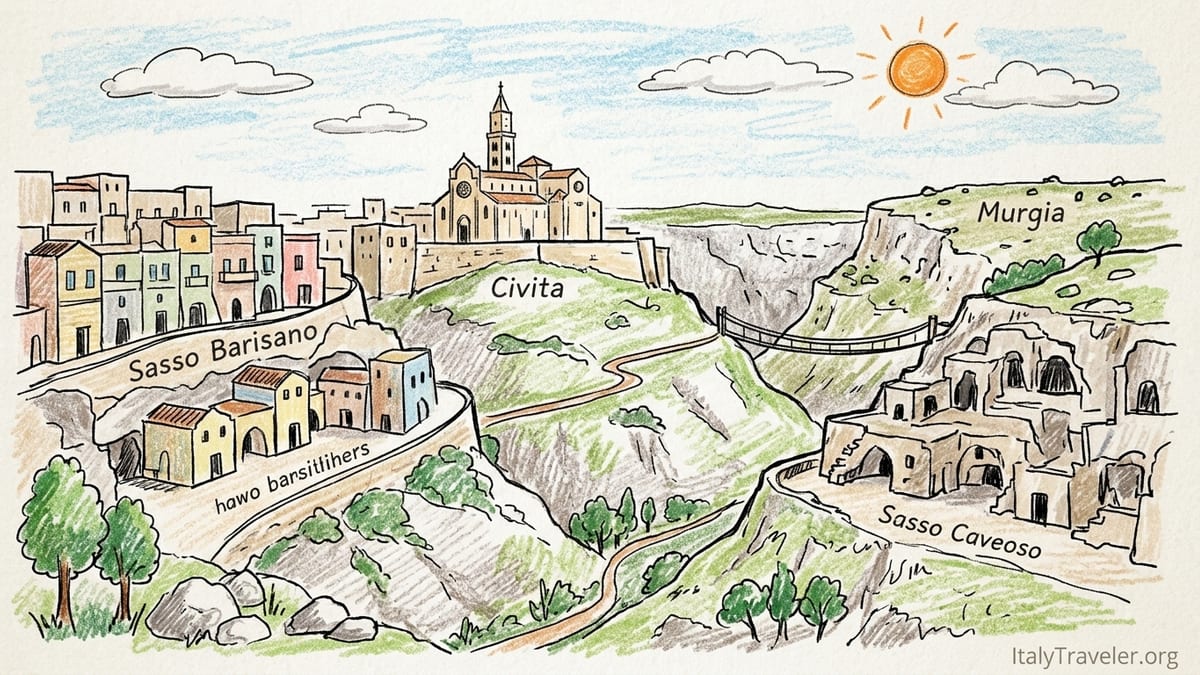
The historic heart of Matera is formed by three interlocking pieces. At the center is the Civita, a rocky ridge crowned by the Cathedral. On either side, two natural amphitheaters descend toward the Gravina gorge: Sasso Barisano to the northwest and Sasso Caveoso to the southeast. What looks at first like a jumble of houses is in fact a vertical city carved into soft calcarenite, where cave dwellings, cisterns and rupestrian churches are layered one on top of another.
Sasso Barisano is the more built-up and restored of the two districts. Many caves here were regularized with stone facades between the 17th and 19th centuries, so from the outside you often see conventional-looking houses, while interiors still plunge deep into the rock. Walking streets such as Via Fiorentini you pass B&Bs, bars and artisan workshops installed inside former cave homes. This is usually the gentlest introduction to the Sassi, with more gradual slopes and slightly wider lanes.
Sasso Caveoso feels rawer and more exposed. Houses are shallower, the rock face is more visible, and entire stretches below the church of San Pietro Caveoso reveal abandoned cave clusters directly facing the Murgia plateau. Here you better grasp how families once lived almost entirely in the cliff, with a single doorway opening from a tiny terrace straight into the main cavern, animals stabled at the back and a private cistern cut under the floor.
The Civita ridge ties it all together. The Cathedral stands roughly between the two Sassi, looking over both amphitheaters and the Gravina gorge. From its terrace you can see how the historic water system worked, with channels that once guided rainwater down into an intricate network of cisterns. Walking from Barisano across the Civita to Caveoso gives you a clear sense of how the districts connect and why Matera’s UNESCO status is based on a complete cultural landscape rather than on a single monument.
Water, Cisterns and Rupestrian Churches: How the Caves Worked
Matera’s caves were not simply shelters hollowed at random. For centuries the entire settlement relied on a sophisticated water-harvesting system. Roofs and terraces were shaped to channel rain into underground tanks, and almost every dwelling sat above at least one cistern. The largest surviving public example is the Palombaro Lungo beneath Piazza Vittorio Veneto, a cathedral-like reservoir fed by rain and springs and lined with thick waterproof plaster. It shows at urban scale what happened on a smaller scale beneath individual houses.
Inside typical cave dwellings you will often notice circular stone lids or carved openings in the floor. These mark the mouths of private cisterns, once covered to prevent contamination. Water collection was essential because the porous rock drains quickly and the Gravina river below is not easily accessible. When you visit reconstructed cave houses such as the Casa Grotta di Vico Solitario you can see where families drew water, how they stored it, and how precious it was in daily life.
Alongside domestic caves, Matera developed a dense network of rupestrian churches carved into the cliff faces of the Sassi and the opposite Murgia plateau. Many date from the early medieval period, when monastic communities sought remote places for worship and contemplation. Stepping into Santa Lucia alle Malve in Sasso Caveoso, for example, you find a barrel-vaulted rock nave lined with frescoes of saints and biblical scenes, some dating to the thirteenth century. Nearby Madonna de Idris and San Giovanni in Monterrone are cut directly into a freestanding rocky outcrop, with chapels burrowing into the interior.
This mix of domestic and sacred cavities is what makes Matera unique. Streets run on the roofs of caves, churches are hidden behind plain stone doors, and what appears to be a simple retaining wall might conceal several levels of rooms. When you walk the Sassi with this in mind, details like small square ventilation holes or carved gutters suddenly reveal themselves as parts of a complete cave-city system rather than picturesque curiosities.
A Practical Walking Route Through the Sassi
For a first visit, the most logical way to explore on foot is to start on the modern plateau and work down through the Sassi, connecting the main cave sites and viewpoints in a single loop. Allow at least three to four hours at a relaxed pace, more if you stop at museums or for a long lunch. Good walking shoes are essential; the stone steps can be polished and slippery, especially after rain.
Begin in Piazza Vittorio Veneto, the main square on the upper “Piano” level. From the balustrade at the edge you get your first broad view into Sasso Barisano. Here you can also visit the Palombaro Lungo, entering via a signed doorway off the square and descending metal stairs into the vast cistern below. A standard visit, including a short guided explanation, usually takes around 30 minutes and gives crucial context before you head into the lanes above.
From the square, walk toward the Cathedral by climbing through the alleys of the Civita. Wayfinding signs labeled “Cattedrale” guide you up through a web of stairways to Piazza Duomo. On the terrace in front of Matera Cathedral you can gaze down into both Sassi at once: Barisano to your right, Caveoso to your left, the Gravina gorge and the Murgia plateau directly ahead. This high point makes it easier to visualize the rest of your route and decide whether you have energy to extend into both amphitheaters or focus on one.
After visiting the Cathedral interior, continue toward Sasso Caveoso, following directions for “San Pietro Caveoso” or “Casa Grotta.” You will soon find yourself descending stone staircases that wind between cave houses and rock walls. The atmosphere shifts as you leave the plateau behind and enter the crater of Sasso Caveoso, where your next goal is the Casa Grotta di Vico Solitario, a key stop to understand domestic life in the caves.
Inside the Caves: Casa Grotta, Santa Lucia alle Malve and Madonna de Idris
The Casa Grotta di Vico Solitario is a reconstructed cave dwelling furnished with original objects from a typical peasant family’s home before the mid-twentieth-century evacuation. In one chamber you see the marriage bed directly opposite the manger for the mule, with a small crib hanging from the ceiling, a loom for weaving, and household tools hung on hooks in the stone. Guides or audio explanations describe how up to ten people, animals included, might share this single space, and point out the cistern trapdoor underfoot.
From 2026 a combined ticket of around 8 euros connects the Storica Casa Grotta di Vico Solitario with several additional sites, including a natural cave used as a neviera for storing snow and ice and a rupestrian church across the ridge. The exact inclusions are listed at the Casa Grotta ticket desk, but the principle is that one admission covers multiple small but evocative rock spaces. This bundled pass is particularly useful if you want a deeper sense of everyday cave life without paying separate fees at multiple micro-attractions.
Continuing down toward Piazza San Pietro Caveoso, you reach the cluster of rupestrian churches managed as a group. Santa Lucia alle Malve, just off Via Bruno Buozzi, preserves some of the most striking painted frescoes in the Sassi. Higher above the piazza, the stairway climbing to Madonna de Idris and the adjoining rock spaces of San Giovanni in Monterrone offers both spiritual atmosphere and unforgettable views back over the Caveoso amphitheater. On the opposite side of the Sassi, in Sasso Barisano, San Pietro Barisano reveals an almost entirely excavated rock interior behind its masonry façade.
These churches are operated together, and in recent seasons visitors have found that a single-church ticket costs a bit less than 5 euros, while combined tariffs for two or three churches are around 8 to 10 euros. Prices can adjust from year to year, but the pattern persists: buying a multi-site ticket usually offers better value if you plan to see more than one rupestrian church. Check the posted opening hours at the first church you visit; in high season they tend to open from mid-morning through late afternoon with a break in the early afternoon, while in winter reduced hours or weather-related closures are possible.
Viewpoints, Sasso Barisano and How to Structure Your Day
From Piazza San Pietro Caveoso, linger at the terrace for one of Matera’s defining views. The rock mass of Madonna de Idris rises above you, the Caveoso caves cascade to your right, and across the Gravina you see the rugged Park of the Rupestrian Churches, dotted with smaller cave openings. This lower terrace is one of the easiest major viewpoints to reach, with only moderate steps from most central accommodations, and is ideal for sunset when the rock glows in warm light and the canyon begins to darken.
To complete a representative loop through Sasso Barisano, climb back toward the Cathedral via stairways such as Via Gradoni Duomo or switchback alleys signposted to “Cattedrale” and then follow signs for Sasso Barisano and “San Pietro Barisano.” This area feels slightly more urban, with more hotels and renovated facades, yet if you look closely you still notice cave entrances below street level and roof terraces that are in fact the ceilings of caverns beneath. Pause at Piazza San Pietro Barisano and the small belvedere points along Via Fiorentini for sweeping views back across the district and toward the Civita ridge.
Across the day, you can think of Matera’s viewpoints in layers. The edge of Piazza Vittorio Veneto gives a first overhead impression of Sasso Barisano. The Cathedral terrace provides the all-encompassing bird’s-eye view of both Sassi and the gorge. Piazza San Pietro Caveoso places you almost at canyon level, looking sideways across the amphitheater. For photographers or anyone wanting postcard perspectives without serious hiking, stitching these three together already provides plenty of material.
If time allows, an additional balcony-style viewpoint sits just outside the densest Sassi, along the modern streets above Via Madonna delle Virtù. Reaching it requires only a short, fairly flat detour and rewards you with a frontal panorama of the Caveoso amphitheater without descending steep steps. This can be a useful alternative for visitors who want the quintessential “Matera from above” photo but are cautious on irregular staircases.
Belvedere di Murgia Timone and the Suspended-Bridge Excursion
The Park of the Rupestrian Churches on the opposite side of the Gravina is not simply another quarter of Matera. It is a separate protected landscape that merits at least half a day on its own. From the Belvedere di Murgia Timone you see the entire Sassi bowl face-on, with the Civita ridge and Cathedral in the center and both Sassi dropping into the canyon. This is the iconic view used in many films and photo features about Matera.
Reaching the Belvedere can be done in several ways. Many visitors take a taxi or organized shuttle from the Sassi up to the Murgia plateau, covering the short but steep road climb by vehicle and then exploring the marked paths and viewpoints on foot. Others arrive on a dedicated bus line that serves the park in high season, with schedules varying across the year. Once at Murgia Timone, short walking loops of 30 to 60 minutes link several small rupestrian churches and cave shelters, giving a feel for the rural side of Matera’s rock culture.
More adventurous travelers can follow the official excursion that descends from the Sassi, crosses a suspended footbridge over the Gravina and climbs the opposite slope into the park. This trek, often described as taking about three hours for the full out-and-back route including stops, starts near the lower part of Sasso Caveoso, drops steeply on rocky paths to the river, uses the Tibetan-style bridge to cross the gorge, and then winds up to the visitor area around Jazzo Gattini and the Murgia Timone viewpoints. Conditions can be hot and exposed in summer, and the stone can be slippery, so sturdy shoes, water and sun protection are essential.
For travelers who are not comfortable with steep trails or who have limited mobility, a vehicle-based visit is usually the best option. Local guides and taxi drivers are accustomed to arranging short Murgia excursions that involve minimal walking, focusing on the main Belvedere terrace and one or two easily reached cave chapels. When booking, explain clearly any mobility concerns so they can choose routes that avoid rough paths or long staircases.
Tickets, Opening Hours and the Choice Between Wandering and Paying
One of Matera’s advantages is that access to the Sassi themselves is free. You can wander the lanes of Sasso Barisano and Sasso Caveoso at any time of day without paying an entrance fee or passing through turnstiles. For travelers who enjoy unstructured exploration, this makes it possible to spend a low-cost afternoon simply following your curiosity, climbing stairways, pausing at viewpoints and discovering quiet corners away from the main tourist flow.
The trade-off is that the most informative interiors require tickets. In 2026, the Casa Grotta di Vico Solitario offers a multi-site admission of about 8 euros that covers not only the main reconstructed dwelling but also additional associated cave spaces. Add to that the rupestrian churches managed in combination, where tariff boards list options for one, two or three churches at incrementally higher prices. A couple planning to visit the Casa Grotta and three churches might therefore budget somewhere just over 20 euros per person for entry fees during a full day in the Sassi.
Opening hours vary seasonally and are subject to occasional changes for restoration or events. Broadly, cave houses and churches tend to open mid-morning, close during the heat of mid-afternoon in shoulder seasons, and then reopen for a late-afternoon window, while in peak summer days the continuous opening can be longer. Because underground sites maintain fairly stable temperatures, they can feel cool in winter and refreshingly shaded in summer. Before setting out on a tightly timed route, it is sensible to ask your accommodation or a tourist information point which sites are currently open and whether any adjusted schedules are in place.
For visitors with limited time, a useful strategy is to pick one domestic site (such as the Casa Grotta or a similar preserved dwelling in Sasso Barisano) and two churches that represent different facets of Matera’s rock heritage, for example Santa Lucia alle Malve for frescoes and Madonna de Idris for dramatic setting. You can then leave the rest of the day for free exploration, using the paid interiors to anchor your understanding without feeling obliged to enter every ticketed doorway.
ZTL, Parking, Buses and Accessibility in 2026
The Sassi and much of Matera’s historic center are covered by ZTL, or limited traffic zones, controlled by cameras. In practical terms this means that if you are driving a private car, you cannot simply follow your navigation system into the old town without risking a fine. Recent municipal ordinances confirm that the Sassi ZTL gates are active every day, with access for non-authorized vehicles prohibited during most daylight and evening hours, while certain streets around the Cathedral and central districts remain off-limits around the clock.
The most straightforward solution is to park outside the ZTL and continue on foot or by shuttle. Structured car parks and marked open-air parking areas ring the modern center; examples include multi-storey facilities on the plateau with day rates that appeal to visitors staying one or two nights. From large car parks such as the one in Via Saragat, a dedicated “Linea Sassi” bus shuttles passengers down toward the historic area at regular intervals, roughly every 30 minutes in normal operation. Tickets are sold at machines or kiosks near stops and are inexpensive compared with private transfers.
If you are staying overnight in a hotel or guesthouse within the Sassi, contact the property in advance. Many accommodations provide detailed instructions on where to park, whether they can register your license plate for limited hotel access, and how luggage transfers are handled. Some arrange pick-up from ZTL-adjacent car parks to avoid guests dragging suitcases over stairs. Because rules can change and enforcement is automatic through cameras, it is wise not to rely on generic online maps alone but to follow your host’s directions precisely.
For visitors with mobility challenges, Matera presents mixed conditions. The upper modern streets and Piazza Vittorio Veneto are relatively flat and paved, and certain panoramic spots, such as parts of the Cathedral terrace and the edge of the plateau, can be reached via gently sloping routes. Within the Sassi, however, many paths involve uneven steps, steep gradients and polished stone that can be hazardous in wet weather. A number of guided tours and small-group excursions are designed specifically for reduced-mobility travelers, focusing on accessible viewpoints and road-accessible terraces rather than deep descents. When planning, be honest about your comfort with stairs and cobbles; for some visitors, appreciating Matera from above and from the Murgia viewpoints will be more enjoyable than attempting to navigate every level of the cave districts.
History, Evacuation and Restoration: Seeing Matera Respectfully
Behind the romantic night-time views of lit-up caves lies a difficult social history. By the mid-twentieth century, overcrowded cave dwellings in Matera had become a national scandal in Italy, with reports describing entire families and their animals sharing damp, poorly ventilated spaces without adequate sanitation or running water. High infant mortality and widespread disease were linked to these conditions, and the Sassi came to symbolize rural poverty rather than quaint tradition.
In the 1950s a national law ordered the gradual evacuation of the Sassi. Thousands of residents were relocated to newly built quarters on the plateau, leaving the old caves largely abandoned. For decades the area was effectively a ghost city, deteriorating without maintenance. Only from the 1980s onward, thanks to restoration initiatives and new preservation laws, did the Sassi begin to be rehabilitated as a historic quarter, culminating in UNESCO World Heritage recognition and, later, Matera’s role as European Capital of Culture.
When you visit a reconstructed cave house today, it is worth remembering that the interior scenes are not museum curiosities from a distant century but reconstructions of living conditions still within living memory. Some guides and exhibitions explicitly address the hardships of pre-evacuation life, describing how residents often welcomed the chance to move into modern apartments even if they remained emotionally attached to their old neighborhoods. Listening to these stories and avoiding language that romanticizes poverty or treats former residents as anonymous figures is part of visiting Matera with respect.
The restoration that turned many caves into boutique hotels, restaurants and galleries has brought economic vitality but also raised questions about authenticity and affordability for locals. As a visitor, you can support a more balanced future by seeking out family-run businesses, visiting cultural centers that tell Matera’s story from local perspectives, and recognizing that what feels like an ancient stone backdrop to you was, until quite recently, a lived-in and contested urban space.
How Long to Stay: Half-Day, Full-Day and Overnight Visits
A half-day visit gives just enough time for a single structured loop through one Sasso and a handful of key interiors. For example, arriving by late morning you could explore from Piazza Vittorio Veneto to the Cathedral terrace, then descend through Sasso Caveoso to the Casa Grotta di Vico Solitario and Santa Lucia alle Malve, finishing at Piazza San Pietro Caveoso before climbing back to the plateau. This sort of compressed itinerary works for travelers passing through by car or bus who accept that they will only scratch the surface.
A full day allows a much richer experience. With eight to ten hours you can walk both Sassi, visit the Palombaro Lungo, tour a cave dwelling and at least two rupestrian churches, linger at several viewpoints and still pause for meals and rest. You might spend your morning focusing on Sasso Barisano and the Civita, retreat indoors during the hottest mid-afternoon hours for underground sites or a museum, and return to Sasso Caveoso and the piazzas near San Pietro Caveoso for late-afternoon light and evening atmosphere. For many travelers, this offers the best balance of depth and time.
Staying overnight, however, transforms Matera from a sightseeing stop into a lived experience. As day-trippers leave, the Sassi become quieter, lights slowly appear in doorways and on terraces, and the outlines of the caves stand out against the night sky. Waking up in a cave room, even a thoroughly modernized one, lends extra resonance to what you saw in the museum-like dwellings the day before. It also frees time to include the Murgia Timone excursion on a separate morning or evening without rushing.
For couples interested in atmosphere and photography, a one- or two-night stay is ideal, providing both sunrise and sunset opportunities from different viewpoints. Families with younger children might feel comfortable with a single night and two relaxed half-days, balancing stair-filled walks with time to rest. History-focused travelers, particularly those keen on rock-cut architecture and religious art, can easily fill two full days between the Sassi interiors, the Murgia churches and the city’s archaeological and art museums on the plateau.
The Takeaway
Exploring Matera is less about ticking off individual sights and more about understanding how landscape, water, faith and hardship shaped an entire rock city. The relationship between Sasso Barisano, Sasso Caveoso and the Civita ridge becomes clear when you walk them in sequence, from the plateau of Piazza Vittorio Veneto through the Cathedral terrace down into the amphitheaters of caves and rupestrian churches. Sites such as the Palombaro Lungo, the Casa Grotta di Vico Solitario, Santa Lucia alle Malve, Madonna de Idris and San Pietro Barisano anchor that walk in concrete spaces where people drew water, prayed, slept and worked.
Practical decisions matter as much as poetic impressions. Choosing where to park outside the ZTL, allowing for steep steps and uneven stone underfoot, deciding whether to cross the Gravina by suspended bridge or reach Murgia Timone by vehicle, and budgeting for a handful of paid interiors all shape the quality of your stay. A carefully planned full day or, better, an overnight visit gives you time to absorb both the Sassi and the Park of the Rupestrian Churches without rushing.
Most of all, approaching Matera with respect for its twentieth-century history helps keep its current success in perspective. The same caves that now host hotels and candlelit restaurants once housed families in conditions severe enough to prompt a national relocation program. Visiting with curiosity, empathy and a willingness to look beyond postcard views ensures that your memories of Matera will include not only its remarkable stone skyline, but also the human story that carved it.
FAQ
Q1. Do I need a ticket to walk around the Sassi of Matera?
Access to the Sassi districts is free, and you can walk the streets and stairways without a ticket at any time. You only pay for specific interiors such as cave houses, rupestrian churches and the large underground cistern beneath Piazza Vittorio Veneto.
Q2. How difficult is the walking in Sasso Barisano and Sasso Caveoso?
Walking involves many stone steps, some steep sections and polished surfaces that can be slippery, especially when wet. Sasso Barisano generally has gentler gradients and wider paths, while Sasso Caveoso includes steeper descents and more irregular stairways. Good footwear and unhurried pacing are important.
Q3. What is included in the Casa Grotta multi-site ticket?
The Casa Grotta di Vico Solitario ticket in 2026 combines the furnished cave dwelling with access to additional related rock spaces, such as a natural cave used historically for storage and a rupestrian church managed under the same organization. Exact inclusions are posted at the entrance and may be updated over time.
Q4. How much time should I allow for the suspended-bridge excursion to Murgia Timone?
The official trekking route that descends from the Sassi, crosses the suspended bridge over the Gravina and climbs to the Murgia plateau typically takes around three hours for the round trip, including pauses for views. It involves steep, rocky paths and is best attempted by reasonably fit walkers with suitable shoes and water.
Q5. Can I reach Belvedere di Murgia Timone without hiking?
Yes. Taxis, organized shuttles and a seasonal bus line connect the Sassi area with the Murgia Timone viewpoints. These options allow you to enjoy the panoramic view of Matera’s Sassi from across the gorge with only short, relatively easy walks from the vehicle drop-off points.
Q6. How do the rupestrian church tickets work?
Several major rock churches, including Santa Lucia alle Malve, Madonna de Idris and San Pietro Barisano, are managed together with a tariff structure that offers single-church tickets and discounted combination tickets for visiting two or three sites. Prices are displayed at the entrance and are usually only a few euros apart between single and multi-site options.
Q7. What should I know about driving and parking near the Sassi?
The Sassi and much of the historic center are covered by ZTL restrictions, so unauthorized vehicles entering signed zones during active hours risk fines. Visitors are advised to leave cars in car parks outside the ZTL and reach the Sassi on foot or via shuttle buses such as the Linea Sassi. If staying in a cave hotel, ask your accommodation for specific parking instructions.
Q8. Is Matera suitable for travelers with limited mobility?
The upper modern streets and some panoramic terraces are accessible with mild gradients, but many interior Sassi routes involve significant stairs and uneven surfaces. Travelers with limited mobility often focus on viewpoints reachable by road, selected terraces in the Sassi and vehicle-based visits to the Murgia rather than attempting the steepest stairways or the bridge hike.
Q9. Is a half-day visit to Matera enough?
A half-day visit is enough to see one Sasso in outline, visit one or two interiors such as a cave house and a church, and enjoy a main viewpoint. However, a full day or an overnight stay allows time for both Sassi, several key interiors, unhurried photography and possibly a side trip to the Murgia Timone viewpoints.
Q10. How can couples, families and history enthusiasts best plan their time?
Couples often appreciate at least one night in a cave hotel, combining a full Sassi loop with sunset and evening views. Families may prefer a single night and shorter walking segments, mixing stair-filled explorations with breaks. History-focused travelers might plan two days, dedicating one to the Sassi’s domestic and religious sites and another to the Park of the Rupestrian Churches and museums on the plateau for a deeper understanding of Matera’s past.