

The alarm on my phone went off in Bari at 6:15 a.m., long before the cafes around Piazza Aldo Moro had even thought about opening their doors. By 7:00 a.m. I was standing under the Ferrovie Appulo Lucane (FAL) sign in Bari Centrale, buying a paper ticket for the local train and replacement bus toward Matera. My aim was to test the internet’s favorite idea: Matera as a simple day trip from Bari. What I actually found, door to door, was a long, fractured day in which transport, queues, stairs and heat ate away at my usable hours, leaving me with only a shallow slice of a city that deserves far more than a rushed checklist.
The Reality of a “Simple” Bari to Matera Day Trip
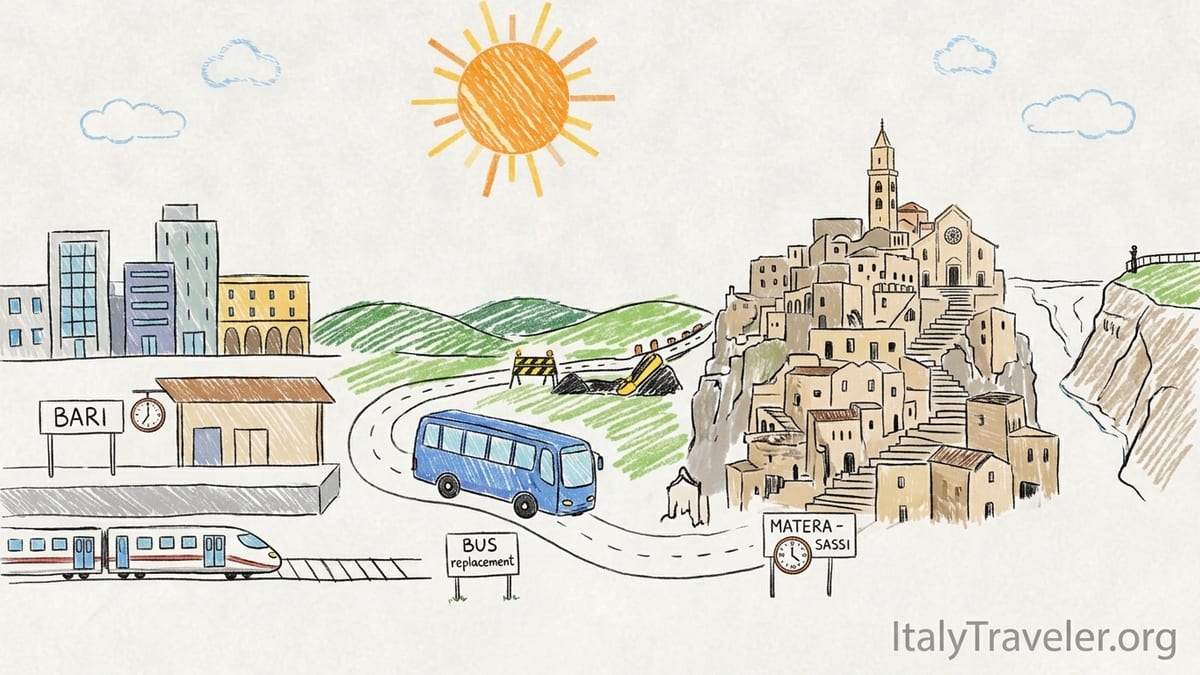
The first surprise came before I even left Bari. The FAL network that connects Bari Centrale to Matera Sud looks straightforward on maps. It is a 72‑kilometre single‑track line managed by Ferrovie Appulo Lucane, with trains and, during ongoing works in 2026, replacement buses on some stretches. At the ticket counter, the staff pointed me to a mid‑morning departure that combined a train out of Bari and a bus from Altamura on to Matera, with a scheduled total travel time of around one hour and forty minutes.
On paper that does not sound like much. In practice, I had to be on the FAL platform at least 15 minutes before departure to buy the ticket, validate it and navigate a small crowd of commuters and tourists. By the time the train pulled out of Bari, my 7:00 a.m. wake‑up had already turned into nearly two hours of preparation and waiting. When we arrived in Altamura, the transfer to the bus involved a short walk and another pocket of uncertainty as everyone checked with the driver that this really was the bus for Matera.
The onward leg from Altamura into Basilicata took a little under an hour, much of it along ordinary roads affected by traffic and roadworks. We finally rolled into Matera’s modern districts and stopped near Matera Centrale. From there it was a twenty‑minute walk to the first edge of the Sassi, longer if you pause to grab a coffee or use a restroom. By the time I reached my first real viewpoint over Sasso Barisano, it was almost 10:30 a.m. I had left the apartment door in Bari at 7:30, and it had taken three hours to turn “Bari to Matera” into actually standing inside the historic city.
When you scroll through glossy itineraries online, those three hours are often treated as a neat, non‑descript block of “transport.” On the ground, they are a combination of early alarm, finding the right station entrance for FAL inside Bari Centrale, ticket machines that sometimes refuse foreign cards, a train that may be busy with commuters, and a bus that has to navigate Apulian and Lucanian roads. The day trip starts eating into itself before you even see a cave dwelling.
What You Really Have Time For Once You Arrive
By 10:30 a.m., Matera’s stone terraces were already crowded. In October 2026, regional officials and local tourism stakeholders have spoken of daily arrivals approaching several thousand people, with peaks in high season that can push close to five figures. The city that was once a curiosity is now on mainstream European itineraries, and the Sassi fill up early with group tours pouring out of buses from Bari, the Ionian coast and cruise ships.
From that 10:30 arrival, I counted backwards from the last reliable return connections to Bari. Between the FAL replacement services and regional buses listed on planning sites, a realistic latest departure that still gets you back to Bari around 20:30 or 21:00 pushes you to leave Matera again by roughly 18:30. Many official and crowd‑sourced timetables show early evening departures only, and travellers who miss them can find later options thin on the ground. In effect, that gave me around eight hours in Matera, reduced once I subtracted lunch, rest, and the slow movement forced by the terrain.
Inside those eight hours, the image many visitors bring to Matera is ambitious. Ask around in Bari hostels and you will hear the same list: Palombaro Lungo, the cathedral, a Casa Grotta showing original cave interiors, at least one rupestrian rock church, a walk through both Sasso Barisano and Sasso Caveoso, sunset views from one of the belvedere terraces, and, if possible, a quick hop across to the Murgia plateau to gaze back at the city from the opposite ravine. That list is sold in brochures and on tour desks as a comfortable day. My own clock told a different story.
By 11:00, I had only just crossed Piazza Vittorio Veneto and joined the queue for Palombaro Lungo, the huge underground cistern beneath the square. Even in shoulder season, timed entries create a modest wait. A guided visit, the standard format, takes around 30 to 45 minutes. By noon I emerged back into the daylight, having ticked only a single item off that mental checklist.
The Steep, Uneven Truth of the Sassi
From Palombaro Lungo, it is a surprisingly long and uneven walk down into Sasso Barisano. Streets turn into steps, and steps turn into ramps of polished stone smoothed by centuries of use. The map distance between points is short, but the vertical difference between them is not. Within fifteen minutes, most of the crowd that had been cheerfully chatting outside the cistern fell quiet and focused on placing their feet safely.
The Sassi are not a flat old town. They are a collapsed amphitheatre of houses stacked on top of each other, many with roofs that serve as streets for the homes above. Moving from one alley to another involves flights of stairs that change height and angle, stepped ramps without handrails and sudden changes in level where the rock has been cut away. Walking from the upper viewpoints of Sasso Barisano, down towards some of the best known casa grotta exhibits near Via Fiorentini, took me another 20 to 25 minutes, with pauses for passing groups and photos.
By 12:30 I was in front of a reconstructed cave dwelling, a Casa Grotta that preserves furnishings and tools from life here before the mass clearances of the 1950s. Entry was a few euros, paid in cash at the door. The line snaked back into the lane as small groups waited their turn inside the compact space. Even moving briskly, I needed around twenty minutes to enter, explore, read the panels and exit. Serious conversations with staff, or simply standing long enough to imagine a family surviving here through a Lucanian winter, would have doubled that.
The physical demands compound as the day goes on. Climbing from Casa Grotta levels back up to the cathedral plateau involves another set of staircases that rise in the sun. In summer these stones store heat, turning each ascent into a short workout. Elderly visitors and families with small children moved even more slowly than I did, and those with mobility issues often stopped entirely at certain flights. It becomes clear quickly that any itinerary which imagines hopping from Palombaro Lungo to Casa Grotta, then down to Sasso Caveoso and up again to the cathedral, significantly underestimates the time the Sassi themselves will ask of your body.
Ambitious Checklists vs Time on the Ground
After Casa Grotta and a laborious climb back towards the Duomo, my watch read 13:15. Hunger, predictably, hit. I found a trattoria on the quieter side of the cathedral plateau, ordered a plate of orecchiette and a glass of Aglianico del Vulture, and watched the clock along with the view. Italian service is rarely built around the North American idea of a 30‑minute turnaround. Even a simple lunch, by the time you wait for a table, place an order, eat, and pay, will absorb 60 to 90 minutes. By the time I stepped back out into the alleys, it was nearly 14:30.
In theory, this is when many day trippers plan to tackle the rupestrian churches and Sasso Caveoso. In practice, I had three solid hours before I needed to turn back uphill towards the modern city and the return bus. I still had not seen the rock‑hewn churches of Santa Maria de Idris or San Pietro Barisano, had not crossed the ravine to the Murgia, and had barely spent any reflective time in the lanes away from the big-ticket monuments.
Choosing a rupestrian church meant queueing again. Discreet visitor caps keep numbers under control in the most fragile spaces, and visits naturally slow as people absorb frescoes and dim interiors. A visit can easily take 30 to 45 minutes. Then came the walk down into the bowl of Sasso Caveoso, which is steeper and more rugged underfoot than the Barisano side. I reached one rock church, waited, visited, and emerged around 16:00.
This was the moment I had to make a decision. If I took a path down towards the Belvedere Murgia Timone shuttle or tried to walk all the way across the ravine, I would be committing at least another hour and a half to the round trip. That is the best case if shuttles are available and running regularly. With a fixed bus to Bari to catch around 18:30, I did not take that risk. Instead, I turned back uphill, resentful of the fact that one of the most iconic views of Matera, the one seen from the wild grasses of the opposite hill, was again relegated to “next time.”
Matera’s Tourism Pressure and Why It Matters
What makes this more than just a personal story of a too‑tight timetable is the wider context. In 2019, when Matera was European Capital of Culture, the city experienced a huge surge in visitors. In the years since, those flows have matured rather than disappeared. Local reports in 2026 speak of strong high‑season arrivals, particularly from neighbouring Puglia, with a shift toward slightly longer average stays compared with the pre‑pandemic period. Hotel and guesthouse owners talk about an increasing number of visitors spending two or three nights, not just one.
This matters because Matera is no longer a semi‑secret day out from Bari. It is a destination in its own right. When tourism authorities and local businesses focus on improving infrastructure, pedestrian flows and cultural programming, they often talk about how to encourage deeper engagement with the Sassi and the Murgia park. The very nature of the Sassi, a UNESCO World Heritage site, means that managing daily visitor pressure is delicate. More people funneled into the same few hours in the middle of the day in high season amplifies crowding in key areas and shortens tempers.
I noticed this compression clearly. Between roughly 10:30 and 16:30, the main viewpoints and lanes felt saturated. Group leaders raised flags and voices to hold their flocks together. Independent travellers looked frustrated as they tried to take in spaces freighted with social history while jostling for space on a narrow terrace. A pattern emerged: the shortest‑staying visitors concentrated their presence in the exact hours that the Sassi are least able to breathe.
Longer‑staying visitors, by contrast, can shift their movements. Speaking with a couple who had booked two nights in a small cave hotel, I learned that they spent their first evening walking almost alone through the lanes after dinner, when most day trippers had already boarded coaches back to Bari or the coast. The next morning they were at the rupestrian churches the moment they opened, sharing the space with a handful of others. Their experience of Matera was qualitatively different from mine, not just because they saw more sights, but because they saw them outside of the day trip crush.
Buses, Trains, Rental Cars and the ZTL Maze
Transport shapes every version of the Matera experience. The public transport route from Bari relies on a mix of FAL trains and, during phases of construction on the line, replacement buses that cover some stretches. Travel planners and local discussions are full of reports of these services being reliable enough for commuters, but susceptible to timetable changes as infrastructure works progress. A scheduled journey time of around one and a half hours between Bari and Matera can easily stretch from door to door when you include waiting at interchanges and walking from stations to the Sassi.
Regional buses and airport shuttles add options. Travellers report taking direct buses from Bari city and from Bari Airport into Matera, with journeys around one hour to one hour and a half depending on intermediate stops. Fares on these routes typically sit in the low single digits to a little over ten euros each way, though exact figures change as operators adjust for fuel costs and demand. These buses have the advantage of depositing passengers closer to the historic area, sometimes within a ten‑minute walk of Sasso Barisano.
Ahead of my visit, I had also considered renting a car in Bari. The idea of rolling into Matera on my own schedule was attractive, but a closer look at the rules made me think again. The Comune di Matera operates an extended Zona a Traffico Limitato, or ZTL, covering the Sassi and parts of the historic centre. Electronic cameras monitor access, and non‑authorised vehicles that cross into the restricted zones during operating hours receive automatic fines. Updated ordinances list active ZTL hours for the Sassi during the late morning and again in the early evening, precisely when many day trippers arrive and depart.
Practically, this means you cannot simply “drive to your hotel door” in most central areas without prior authorisation, and even hotel guests must often register number plates in advance. Public and private car parks sit outside the restricted area, sometimes a fifteen‑ or twenty‑minute walk uphill or downhill from where you actually want to be. Local accounts describe arriving in Matera by car, discovering a planned garage full and spending precious time hunting for another space while trying not to stray into the ZTL. For a day trip where every minute matters, that extra stress and uncertainty is significant.
Why Overnight in Matera Changes Everything
I returned to Matera later for an overnight stay, again arriving from Bari, this time on a mid‑afternoon bus. The difference in my relationship with time was immediate. Checking into a small guesthouse in Sasso Barisano, I left my bag, grabbed a bottle of water and simply wandered. With no fixed deadline to chase a return bus, I could take stairs slowly, loop back when an alley looked inviting, and sit in the shade with a coffee watching how the light moved across the stone facades.
That evening, instead of fretting about missing the last departure, I joined a small group walk across to the Murgia plateau. A local guide led us through the ravine paths as the sun dropped behind the Sassi. We stood in silence as Matera’s electric lights flickered on one by one, turning the cave city into a shimmering basin of warm tones. This experience requires being around after sunset and having the energy to climb back again. No policy change or clever scheduling can gift that to a day tripper who left Bari at dawn and has to be back there by night.
The next morning, I visited the rupestrian churches as they opened. For fifteen minutes inside one chapel, there were only three of us, and the silence allowed the remaining frescoes to speak. Later, in a small Casa Grotta run by a family whose grandparents had been relocated during the clearances of the 1950s, we spent almost an hour in conversation about shame, pride, and the politics of turning poverty into heritage. None of this fit into my original eight hours on the ground. It needed empty spaces in the day, the absence of a ticking clock, and the sense of being temporarily rooted in the city, not passing through.
Overnight stays also alter how you relate to the modern side of Matera. Beyond the Sassi, the contemporary city has its own rhythm of markets, neighbourhood bars and ordinary life that day trippers barely glimpse. On my second visit, a late‑afternoon walk through local streets led me to a bakery selling warm focaccia to schoolchildren and office workers. An hour later I was back on a terrace in the Sassi, but this time my picture of Matera included the people who live above and beyond the postcard view.
Photography vs Understanding: What Are You Really Here For?
Throughout my first day trip, one pattern was striking. Many visitors, time‑poor and eager not to “miss” anything, moved from viewpoint to viewpoint with phones held permanently in front of them. The classic overseeing shot from Piazza Pascoli, the cathedral framed against the ravine, the tight lanes of Sasso Caveoso, the inevitable doorway of a cave hotel. Tour leaders pointed out the best photo angles and gave a compressed soundbite on history, often focusing on the cinematic fame of Matera as a film set rather than its lived past.
There is nothing inherently wrong with photography. Matera is profoundly photogenic. The problem arises when an itinerary is built to maximize photographic output rather than understanding. In a compressed day trip from Bari, visitors may spend more cumulative time composing and taking images at three or four main viewpoints than they do inside Palombaro Lungo, Casa Grotta or a rupestrian church where the social and spiritual history of the city is held.
On my overnight stay, I deliberately left my phone in my pocket for long stretches. Sitting in a quiet corner of Sasso Barisano after dark, listening to voices drift from open windows, I realised that what had been missing from my day trip was the sense of Matera as a lived place and not just a backdrop. You cannot photograph the smell of damp stone in a cistern, the long shadow of forced evacuations in the 20th century or the tension between tourist income and local frustration. You need time and mental space for those to land.
This is where many one‑day itineraries feel not just rushed but disrespectful. By design, they funnel hundreds of people into the same small set of overlooks and interiors, encouraging a consume‑and‑move‑on rhythm that leaves little room for listening to guides, museum staff or residents. If all you carry away from Matera are a dozen dramatic photos and a vague impression that it was “beautiful but crowded,” then the city has been treated as a visual product rather than as a complex community recovering from decades of stigma.
The Takeaway
After two visits, one as a structured day trip from Bari and one as an overnight stay, my conclusion is blunt. Treating Matera as a quick out‑and‑back excursion is a compromise that serves schedules and social media feeds more than it serves the city or the traveller. Transport from Bari, whether you choose FAL train and replacement bus, regional coach or rental car with ZTL headaches, will eat at least three to four hours of your day once you count waiting, walking and minor delays. The Sassi themselves, with their stairs, uneven paving and queues for key sites, demand slow movement. Compressing Palombaro Lungo, Casa Grotta, rupestrian churches, cathedral, multiple viewpoints and the Murgia into a single eight‑hour window is possible only if you strip away meals, reflection and any sense of unhurried discovery.
Tourism patterns in 2026 confirm that Matera is steadily shifting from a one‑night novelty into a place where visitors stay longer. That trend is not just driven by marketing. It reflects the simple arithmetic of what it takes to know this city beyond its skyline. An overnight stay gives you evenings and early mornings when the Sassi breathe more freely, a better chance of meaningful conversations with locals, and the flexibility to absorb delays or heat without every change cascading into missed buses.
Who, then, can still enjoy Matera in a single day from Bari? If you are physically fit, comfortable with long days and uneven ground, and accept that you will see a curated selection of highlights rather than the full story, a well‑planned day trip can still be worthwhile. Choose a realistic number of sites, book key visits in advance where possible, and give up the idea of reaching the Murgia unless transport and timing line up perfectly. For everyone else, particularly travellers with mobility issues, families with young children, or anyone who cares about understanding the places they visit, Matera deserves at least one night, ideally two.
The more I walked those stone steps, the more a simple truth emerged. Matera’s power lies not only in how it looks, but in how it feels to wander, to sit, to listen and to learn. Those things do not fit neatly between a 9:00 a.m. train from Bari and an early evening bus back. If Matera is on your list, treat it as a place to stay, not a box to tick.
FAQ
Q1. Is a day trip from Bari to Matera technically possible by public transport?
Yes, it is technically possible. Trains and replacement buses on the FAL line, plus regional coaches, can get you from Bari to Matera and back in one day, but door‑to‑door travel usually absorbs three to four hours, sharply limiting your usable time in the Sassi.
Q2. How many hours should I expect to have in Matera on a typical day trip?
If you leave Bari around 8:00 a.m. and aim to return by about 9:00 p.m., you are likely to have roughly seven to eight hours on the ground in Matera after accounting for transfers, walking to and from stations, and small delays.
Q3. What are the absolute must‑see sights if I only have one day?
With one day, it is realistic to focus on Palombaro Lungo, a Casa Grotta, one rupestrian church, the cathedral area and a couple of main viewpoints. Adding the Murgia plateau or multiple churches risks turning the day into a stressful race.
Q4. Is driving from Bari to Matera easier than taking the train or bus?
Driving can shorten pure travel time, but the ZTL restrictions and limited parking near the Sassi make it complicated. You will likely need to park outside the restricted zone and walk 15 to 20 minutes, and a wrong turn into the ZTL can generate fines.
Q5. How physically demanding is visiting the Sassi for a day?
Visiting the Sassi involves many irregular stone steps, slopes and uneven surfaces. Over a full day this can be tiring even for fit visitors, and it can be challenging for anyone with knee, hip or balance issues.
Q6. Can I include both Matera and Alberobello in the same day trip from Bari?
Combining Matera and Alberobello in one day from Bari is technically possible but highly compressed. In practice it means very rushed visits to both places and little time to appreciate either beyond quick walks and photographs.
Q7. Is it worth staying overnight in Matera instead of day‑tripping?
Staying at least one night is strongly recommended. It gives you quiet evenings and early mornings in the Sassi, more flexibility around queues and weather, and a better chance to visit both the historic core and the Murgia plateau without rushing.
Q8. What is the best season for an overnight visit instead of a day trip?
Spring and autumn are ideal for overnight stays, with more manageable temperatures for climbing stairs and walking between Sassi Barisano and Caveoso, and slightly fewer peak‑season crowds than high summer.
Q9. How should I prioritise my time if I only have one full day and one night?
Arrive by early afternoon, check into accommodation in or near the Sassi, explore one Sasso area and Palombaro Lungo on day one, then visit a Casa Grotta, one rupestrian church and, if possible, the Murgia viewpoint early the next morning before leaving.
Q10. Who should absolutely avoid treating Matera as a quick day trip from Bari?
Travellers with mobility limitations, those sensitive to heat, families with small children and anyone who values in‑depth cultural understanding over quick photos should avoid a rushed day trip and plan at least one overnight stay instead.