


I booked the Volo dell’Angelo for a clear September Saturday in 2026, seduced by the official photos of tiny human figures flying between the Lucanian Dolomites, the villages of Castelmezzano and Pietrapertosa reduced to toy houses beneath a steel cable. I chose a standard individual ticket at €46 for the full experience, which in theory includes two flights, outward and return, plus shuttle transfers. My confirmation told me to be at the departure ticket office one hour before my time slot. On paper it looked like an afternoon of pure adrenaline. In reality, the high-speed part of the “angel flight” lasted little more than a minute, and the rest was a masterclass in waiting around, watching the weather and wondering whether I had just overpaid for a very short thrill.
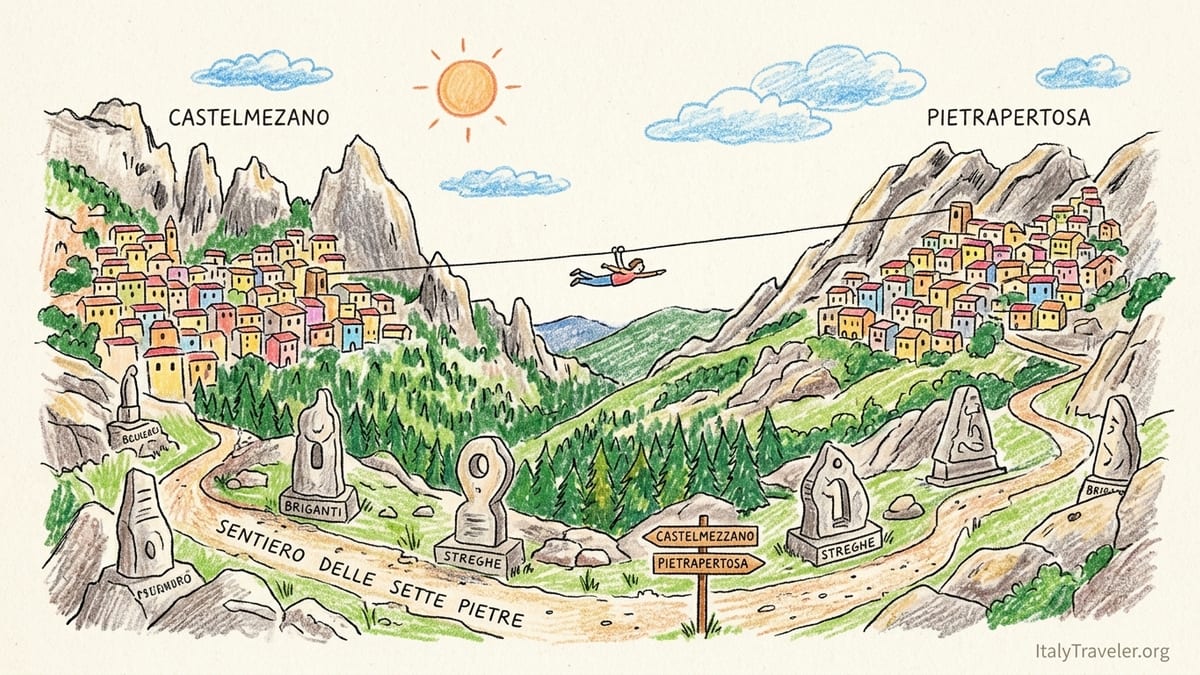
Booking a €46 Dream of Flying Between Stone Spires
I booked online directly through the official system, which in 2026 requires you to pick a specific date, village of departure and a fixed time slot. The calendar fills up quickly for weekends and holidays, with each slot capped at roughly 20 flights, so the impression is of a scarce, premium product that must be secured well in advance. The pricing is clear and unapologetic: €46 for a single rider, €79 for a pair, including both directions on two separate cables and shuttle transport. There are slightly lower prices on some midweek dates earlier and later in the season, but if you are visiting in peak months or on weekends, €46 is the realistic figure you will pay.
My date was a Saturday in early September, with a 15:30 departure from Castelmezzano. The booking engine pushed vivid, wide-angle photos of solo and tandem flyers stretched out horizontally over a sea of rock pinnacles and forested valleys. The copy promised a unique experience above one of Italy’s most dramatic mountain landscapes, and it leaned hard into the idea of a flight lasting “some minutes,” just enough ambiguity to let my imagination extend that into something substantial. As I filled in my details, I took it for granted that the price reflected not only safety and maintenance but a meaningful amount of time in the air.
The terms and conditions are where the romance begins to thin. You must arrive at the ticket office a full hour ahead of your time slot, and there is a strict policy on delays: if you turn up late, you will be reallocated only if there is availability. There are non-negotiable height and weight rules, a ban on sleeveless tops, and repeated reminders that mountain weather can interrupt or halt operations with little notice. By the time I clicked “Confirm,” I already had the sense that the logistics might demand as much attention as the flight itself.
Still, I arrived in Castelmezzano at 14:25, precisely 65 minutes ahead of my scheduled flight, feeling like a diligent participant in this highly managed adventure. The stone village perched on its ridge is gorgeous, a tight knot of houses pressed beneath turrets of rock. Walking up to the ticket office through narrow lanes, though, I was not focused on its charm. I was focused on not missing a one-minute window I had paid €46 to experience.
From Ticket Office to Harness: Where the Time Really Goes
Inside the Castelmezzano ticket office, the “one hour before” rule immediately made sense. There was a snaking queue of people with the same time slot on their confirmations, plus a handful who were early for later slots and others who had been pushed back due to earlier delays. Staff checked each rider’s name, verified documents, and performed weight checks, matching every body to a harness size and an aerodynamic “sail” that regulates speed on the cable. This is serious mountain hardware, and it is clear that safety is not being rushed.
The result, however, is that the first real chunk of your two-village “experience” happens in a cramped interior space lined with posters of smiling flyers. I waited about 25 minutes just to reach the counter, despite having a fixed time. Once processed, I was given a colored band corresponding to my flight group and told to wait outside until called for the shuttle. The operators recommend arriving one hour in advance, but between check-in, kitting up and transport, much of that hour, and then some, is swallowed by procedural steps rather than anything that feels adventurous.
Clothing rules are more restrictive than many casual visitors expect. No sleeveless tops are allowed, so anyone who turns up in a vest or strappy shirt has to layer a T-shirt on top, even in heat. Closed shoes are strongly encouraged because part of the approach involves a rocky mountain path. Small waist packs and slim daypacks are permitted only up to a certain thickness, and loose items like large cameras may be refused. I saw more than one traveler repacking on the pavement, trying to reconcile the romantic idea of “flying like an angel” with the reality of being processed like a small piece of cargo.
By the time our group was finally loaded into the shuttle van that climbs above Castelmezzano toward the launch point, the original 15:30 slot was already creeping past 15:45. At this stage you are committed, strapped metaphorically to the schedule, and the monetary value of your ticket starts to be measured not in minutes of adrenaline but in minutes of waiting.
The Walk to the Platform and the One-Minute Flight
The shuttle does not take you directly to the departure platform. Instead, it drops you at a point from which you must walk a mountain path for about 20 to 25 minutes. This is clearly stated by the operator, framed as a short trek through nature, but after lining up at the ticket office and waiting for the shuttle, it feels like yet another buffer before anything actually happens. The path itself is steep in places, rocky underfoot and fully exposed to the weather. In early September, under an afternoon sun, it was hot and dusty, and several people in our group who had expected an almost plug-and-play thrill were clearly unprepared.
At the top, just behind a ridge of jagged rock, sits the steel platform, cables disappearing dramatically across the valley to Pietrapertosa. Here the atmosphere finally matches the brochure photos. Staff help you step into your harness, lie down on a padded platform and clip into the cable in a prone, “superman” position, face turned toward the void. The village shrinks behind you and the wind pushes at your shoes as you wait.
Once the gate opens, the world contracts into speed and noise. The outbound flight between Castelmezzano and Pietrapertosa covers around 1.4 kilometers, with a vertical drop of more than 100 meters and top speeds that can reach over 100 kilometers per hour. In human terms, this translates into something that feels at once exhilarating and brutally brief. I timed my first crossing at just over one minute from the initial push to the moment the staff in Pietrapertosa grabbed the cable and slowed me down. The middle 40 seconds or so were pure joy: the sensation of flying over a deep green valley, rock spires sliding past in your peripheral vision, the wind pressing the harness against your chest.
There is no questioning the visceral quality of those seconds. You do not feel like you are on a theme park ride. You feel suspended over a real landscape, with the Dolomiti Lucane rising like broken teeth on either side. The houses of Pietrapertosa appear as pale cubes clinging to the slope, and the road you drove in on seems impossibly small. But there is also no escaping the reality that the entire high-speed sensation you paid €46 for is over in a matter of moments. The cable is more than a kilometer long, and the engineering is impressive, but in the time-value equation, you are trading a minute in the air for something closer to two hours of check-in, walking, waiting and transfers across the two villages.
Weather, Waiting and the Frustration of Mountain Logistics
Where the Volo dell’Angelo really tests your patience is in the intersection of strict scheduling and unpredictable mountain weather. The operator is explicit that flights may be suspended during an opening day or closed early due to adverse conditions, and that storms can prompt waits of up to “a couple of hours” before a decision is made to shut down or resume. On the day of my visit, high clouds rolled in shortly after my first flight. A gusty headwind developed in the valley, strong enough that staff in Pietrapertosa briefly paused departures while they monitored conditions.
What followed was a 45-minute limbo in which a growing group of harnessed, helmeted visitors sat or stood around the arrival area waiting to hear whether return flights would resume. Some tried to pass the time taking photos of the view down toward Castelmezzano, which is undeniably spectacular. Others hovered near the staff booth asking for updates. The official line was that operations might resume “soon” if wind speeds dropped, but there was no clear timeline, nor much communication about alternatives, such as transferring back by shuttle if flights were canceled.
The tension is not only about safety, which clearly has to come first. It is also about value. If the operator suspends flights but does not quickly cancel the day, your ticket is still considered active. You cannot request a refund, only a date change or an open voucher. That might work for travelers based in nearby Matera or Potenza who can return within 24 months. It is of little comfort if you are on a once-off road trip from Naples, Bari or further afield, with no realistic chance of coming back. In that case, every extra minute spent waiting under a grey sky feels like your €46 leaking away.
On my day, the wind eventually dropped enough for the staff to restart operations. The return flight, from Pietrapertosa back to Castelmezzano, was again spectacular and again lasted only a little over a minute. But by the time I unclipped from the harness for the final time, I had invested nearly three and a half hours into the experience, of which perhaps two and a half minutes were spent actually in the air. The rest had been a combination of queues, safety procedures, constrained walking and anxious weather-watching.
Safety Rules, Height Limits and Clothing Restrictions in Practice
The Volo dell’Angelo has to operate within tight safety margins, and most of its more onerous rules make sense when you see the system up close. The minimum height requirement of 135 centimeters and narrow weight ranges for both single and tandem flights are strictly enforced at the ticket office, where every rider is weighed. Children cannot fly alone below a certain age, and tandem riders must have no more than a 40 kilogram difference between them. These details are printed in the fine print of the booking pages, but several families in front of me appeared not to have noticed, and one pair was quietly turned away from a couple’s flight because their combined weight exceeded the limit.
Clothing requirements, too, look fussy on paper but are grounded in real risk. Sleeveless tops are not allowed, in part to avoid abrasion from the harness and straps, and footwear must be secure enough for that 20 to 25 minute walk on uneven path to or from the platform. Given how many visitors try to combine the zipline with a summer road trip along the Ionian or Tyrrhenian coasts, plenty show up in flip-flops or beachwear and are forced to improvise. The ticket office sells some basic items, but you are not in a city environment with racks of outdoor gear to choose from.
Rain and storms are the wildcard. The operator clearly reminds visitors that this is a predominantly outdoor, mountain activity where sudden showers are common, and suggests bringing lightweight waterproofs and small umbrellas. That is good advice, but it is also a cost and a packing consideration. If your goal is a quick detour from Matera for an hour of excitement, it feels disproportionate to pack a full change of clothes in case you are drenched on the approach path. Yet without that preparation, you can find yourself soaked, cold and facing a long, damp wait for a flight that may or may not happen.
From a purely experiential point of view, these constraints chip away at the spontaneity that many travelers associate with small Italian mountain villages. Instead of stumbling upon a local festival or a quiet viewpoint, you are moving through a system that looks and feels more like a mountain version of airport security. Necessary, perhaps, but hardly the free-spirited image that the marketing promises.
Comparing €46 of Zipline to a Day on the Seven Stones Trail
The sharpest contrast to the Volo dell’Angelo is the Sentiero delle Sette Pietre, the Seven Stones Trail that runs roughly between Castelmezzano and Pietrapertosa. This 1.7 kilometer path, with about 150 meters of elevation difference, is dotted with sculpted stones and installations inspired by local legends. It is free to access, open whenever the weather and daylight allow, and it offers a slower, more expansive way to inhabit the same dramatic landscape that you glimpse in fast-forward from the cable.
Walking the trail from Castelmezzano up toward Pietrapertosa, you gain a layered understanding of the valley and the villages. The path dips into pockets of woodland, traverses terraces and rocky slabs, and opens onto natural balconies where Castelmezzano appears framed by crags. The “seven stones” themselves are not just decorative; they invite you to pause, read short texts, and imagine the older stories of witches, brigands and migrations that have shaped this corner of Basilicata. Even if you are not normally a hiker, you can cover the route in an hour or so at an easy pace, with plenty of time to rest and take photos.
Seen from the trail, the zipline cables become just one more element of the scenery, a thin artificial stroke against a much larger canvas. You spot riders occasionally, a bright dot gliding across the gap, and the spectacle is undeniably striking. But you also notice how fleeting each crossing is compared with the long arc of the valley below. If you assign a notional €46 value to that dot, you start to weigh it against what else that sum can buy in this area: a long lunch of local dishes in Castelmezzano, perhaps, with a bottle of Aglianico del Vulture, or a night in a simple B&B with views straight onto the Dolomiti Lucane, or a guided walk that connects the trail with nearby via ferrata routes and old mule paths.
I spent a later afternoon wandering Pietrapertosa’s alleys, climbing up toward its Arab quarter and castle. The views back to Castelmezzano at golden hour were at least as spectacular as the ones I had glimpsed from the zipline. They simply unfolded more slowly. With no harness, no schedule and no shuttle to catch, I could stand at a stone wall for fifteen minutes and watch shadows lengthen across the valley. It cost nothing. In that context, the cost-per-minute of the Volo dell’Angelo began to look particularly stark.
Is the Volo dell’Angelo Weak Value or Fair Price for a Unique Thrill?
There is an unavoidable arithmetic to the Volo dell’Angelo. For an individual ticket at €46, you receive two flights that together last a little over two minutes in the air, spread over a multi-hour sequence of preparation, walking and waiting. Even if you are generous and count every second from the moment you lie down on the platform to the moment you unclip at the far end, you are still looking at a cost well into the double digits per minute of genuine high-speed thrill. In purely time-based terms, this is weak value compared to almost any other activity in Basilicata.
Yet value is not only about duration. Operating a high-altitude zipline safely between two mountain villages involves constant inspection, specialized staff and insurance. The experience is genuinely unique at a regional level: the operator holds exclusive rights in southern Italy, and the combination of altitude, length and landscape is not something you can easily replicate. For some travelers, especially those who collect unusual adrenaline experiences, that uniqueness is exactly what justifies the price. Compared to a tandem skydive or a paragliding session over the Alps, €46 begins to look relatively modest.
Where the calculation tips for me is in the imbalance between control and uncertainty. The operator demands strict adherence to its rules and schedules, from the one-hour early arrival to the precise time slot and clothing codes. You, as the customer, are expected to be highly organized. Yet at the same time, you are completely exposed to late-running queues and sudden weather changes that can stretch your experience far beyond what you planned, or cut it short altogether. The official compensation for full weather closures is a date change or an open voucher, which is logical from the business side but can effectively turn your €46 into a sunk cost if your itinerary cannot flex.
In my case, I did receive both flights, and in terms of pure sensation I cannot deny that they were memorable. But the crowded ticket office, the stop-start progression through shuttles and paths, the long, uncertain wait in Pietrapertosa when the wind picked up, and the nagging fear of losing the second flight altogether all combined to give the day a faintly transactional flavor. It felt less like stepping into a dream and more like passing through a monetized funnel built around a single, electrifying minute.
The Takeaway
So is the Volo dell’Angelo worth €46? For me, the honest answer is: only under quite specific conditions. If you are already staying in or near Castelmezzano or Pietrapertosa, have flexible days, and you live for engineered adrenaline experiences, then paying for two one-minute flights over this landscape can be defended as a once-in-a-trip indulgence. Book an early morning or late afternoon slot to avoid the heaviest heat and queues, wear proper walking shoes, pack a light waterproof, and treat the long lead-up and comedown as part of the ritual.
If, however, you are on a tight schedule, visiting on a day trip from a distant base, or counting every euro, the value equation shifts dramatically. You risk tying up half a precious day and a meaningful chunk of your budget in an experience where the high point is spectacular but sharply compressed. In that scenario, hiking the Seven Stones Trail, lingering over a long lunch, and exploring both villages at your own pace offer far more depth for the same or less money.
I left Castelmezzano that evening satisfied that I had “done” the Volo dell’Angelo, but I also knew I would not pay €46 to repeat it. The first crossing gave me the essential memory I wanted: the feeling of skimming above the valley, mountains on either side, villages like models below. A second visit to this area, though, would be devoted to the paths, viewpoints and stories that unfold at walking speed, not cable speed.
In the end, the Volo dell’Angelo is best suited to a very particular kind of visitor: someone physically confident, comfortable with heights, and emotionally prepared to accept delays or disruption without feeling cheated. If you fit that profile and relish the idea of a concentrated jolt of adrenaline framed by some of Italy’s most underrated mountain scenery, then book a slot, bring patience and step into the harness. If you are more drawn to slow travel, village life, and the pleasure of letting landscapes reveal themselves over hours instead of seconds, save your €46 for the Seven Stones Trail, a home-cooked meal and perhaps a second night in these extraordinary Lucanian villages.
FAQ
Q1. How long does each Volo dell’Angelo flight actually last?
The high-speed part of each crossing is roughly a minute, sometimes a little more, depending on your weight and wind conditions.
Q2. How much total time should I budget for the experience?
From arriving at the ticket office an hour early to completing both flights and transfers, plan on at least three hours, possibly more if there are delays.
Q3. What are the current prices for Volo dell’Angelo tickets in 2026?
For peak dates in 2026, an individual ticket is €46 and a ticket for a pair is €79, which includes two flights and shuttle service.
Q4. Do I really need to book online in advance?
Yes. Time slots are limited to around 20 flights and can sell out, especially on weekends and holidays, so advance online booking is strongly recommended.
Q5. What are the height and weight restrictions for flying?
Riders must meet a minimum height of about 135 centimeters and fall within specific weight ranges, with extra rules for tandem flights and maximum combined weight.
Q6. What should I wear for the Volo dell’Angelo?
Closed shoes and a T-shirt or top with sleeves are required, and it is wise to bring a light jacket or waterproof and avoid loose items that can snag or fall.
Q7. What happens if there is rain or strong wind on the day?
The operator may temporarily suspend flights or close early. If flights are fully canceled, you are usually offered a new date or a voucher, not a cash refund.
Q8. Is the experience suitable for people afraid of heights?
Some visitors who dislike heights cope well because they are lying horizontally and firmly strapped in, but the exposure is very real and can be intimidating.
Q9. How does the value compare with hiking the Seven Stones Trail?
The Seven Stones Trail is free and offers several hours of scenery, stories and village time, while the zipline is a paid, very brief adrenaline burst with more logistics.
Q10. Would you personally pay €46 to do the Volo dell’Angelo again?
Having flown it once, I would not. For a return visit I would invest my time and money in walking, eating and staying longer in the two villages instead.