


From a distance, Craco looks exactly like the romantic ruin so many social media posts promise: a jagged hilltop silhouette, church tower spearing the sky, empty windows staring across the clay hills of Basilicata. Before I went, I had read plenty of breathless captions about “wandering alone through an abandoned village.” The reality of visiting Craco in 2026 was very different. It was stricter, more structured and, in the end, far more meaningful than simply sneaking through a ghost town.
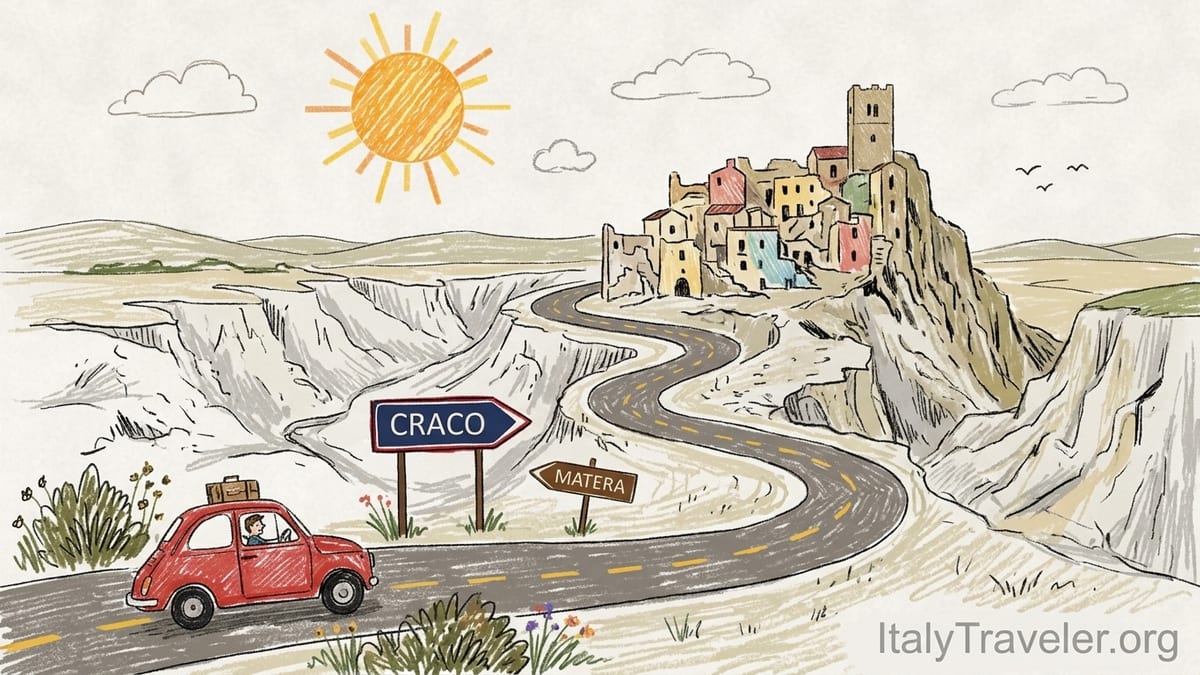
Getting To Craco From Matera: The Drive Into Basilicata’s Badlands
I based myself in Matera, waking up among the stone terraces of the Sassi and picking up a rental car on the modern edge of town. Craco lies roughly 55 to 60 kilometres south, a drive of about 55 to 70 minutes each way in light traffic, depending on which route you choose and how comfortable you are with the bends and provincial roads. Leaving Matera, I skirted the historic centre’s restricted driving zone, followed the signs for the state roads toward Metaponto and Pisticci, then turned inland. Within twenty minutes the landscape had emptied out into low, rolling hills and clay ridges that looked almost lunar.
The final approach to Craco is what finally explains why the village exists at all. The road coils up through soft, deeply eroded gullies known locally as calanchi, pale grey and beige folds that crumble into ravines after heavy rain. At a certain bend, the modern village of Craco Peschiera drops away behind you and the abandoned historic centre appears ahead on its own spur of rock. The medieval tower and the facades of old houses seem to pour over the ridge like a stone waterfall. I pulled into a small lay‑by and simply sat for a few minutes, engine off, listening to the wind and taking in that skyline I had seen so many times in films and photo essays.
From Matera there is no straightforward public transport option that delivers you to the entrance of the ghost town at a sensible time for a visit. Online route planners may suggest combinations of regional buses, but schedules are sparse, subject to seasonal changes and usually leave you several kilometres away in a valley town with no onward taxi rank. Local tourism information in Matera confirmed what most guides repeat: for Craco you realistically need a car, a private driver or an organised excursion. That isolation is part of the reason the abandoned centre has survived as a frozen fragment of Basilicata’s past, but it also means a spontaneous, car‑free visit is very hard to pull off.
Arriving by car, I followed brown tourist signs for “Craco antica” through the modern settlement and up toward the hill. Near the top a small parking area opened beside the access road, a simple gravel strip lined with a handful of cars and a campervan. There is no big visitor centre complex here, no multi‑storey garage. You park where the asphalt ends, with the clay hills dropping away below and the ruined houses, still closed and silent, just above.
First Impressions: From Romantic Ruin To Controlled Archaeological Site
Standing at the parking area, Craco’s empty streets are not yet truly visible. What you see first are the backs of houses patched with old repairs, and the bulk of the church and tower looming above. A short signed path leads down to the base of the old town and to the building that now acts as the gateway: the former convent of San Pietro, which houses the MEC, often translated as the Emotional Museum. This is where every official visit begins, and it is also where the gap between the myth of Craco and its managed reality becomes clear.
Before my trip, I had seen countless online comments implying that you could simply walk up and explore at will, stepping through broken doorways or wandering into collapsing alleys alone. On the ground in 2026, the entire historic centre was firmly off limits without a guide, and barriers made that plain long before you reached the first ruined doorway. Notices explained, in Italian and English, that access to the abandoned town is permitted only on an authorised guided visit, with helmets and a set route, due to the instability of the structures and the constant risk of rockfall or further landslides.
Inside the San Pietro complex the atmosphere shifts from lonely ruin to low‑key but professional operation. A small reception desk, some interpretive panels, and a rack of bright safety helmets dominate the first room. Staff checked my reservation, which I had booked in advance online after seeing warnings that same‑day spaces often sell out in peak season. The fee for 2026 was just over ten euros for the basic guided visit, with the option of a slightly higher ticket that included access to the museum spaces. I paid, collected my ticket and waited in a cloistered courtyard with a mix of Italian visitors, a French couple and a family from Germany.
When our guide appeared, the first thing she did was hand each of us a hard hat and explain, quite firmly, that it had to remain on for the entire 90‑minute visit. Watching people stroll through Craco bareheaded on social media suddenly felt very outdated. She spoke Italian first, then repeated every key point in clear English, emphasising that we would only enter certain parts of the village and only where engineers had confirmed the relative stability of walls, stairways and vaults. “This is not a film set,” she said. “It is a wounded town, and we are guests in what remains.”
Why Craco Emptied: Landslides, Earthquakes And Managed Displacement
We began not with haunting alleys but with a simple orientation panel showing Craco’s position between the Lucanian Apennines and the Ionian coast. The guide pointed out the soft clay slopes below the town, streaked with gullies and scars. These soils, she explained, have been unstable for centuries. Records mention landslides affecting the settlement in the nineteenth century, and by the mid‑twentieth century the combination of ground movement, erosion and poorly controlled water had caused increasingly serious structural damage.
In the late 1960s authorities started moving residents from the highest, most vulnerable part of the village down toward new housing in the valley. Later, earthquakes added further damage. By the early 1980s, after a particularly strong event, the historic centre was formally abandoned. Hearing those dates while looking at cracked masonry made the place feel less like a medieval ruin and more like a very recent wound, still within living memory. Our guide spoke about people who had been children here and now returned as elderly visitors, often in tears, confronted with their former front doors locked behind municipal chains.
What struck me most is how easy it would be to treat Craco’s story as horror scenery. Films and photo shoots have used the empty streets as a dramatic backdrop, and more than one international production has played up its ghost‑town atmosphere. The local interpretation, though, worked hard to frame abandonment not as a spooky curiosity but as the result of real geological risks and planning decisions. Panels in the museum included family photographs, school reports, and documents about the relocation. Instead of talking about a “dead town,” our guide consistently referred to it as a displaced community, a phrase that made me notice small details I might otherwise have missed: a balcony rail bent outward by subsidence, doorways braced with steel, fragments of patterned tiles half‑buried in fallen plaster.
This sensitivity also explained the strict access rules. Craco is not fenced off for the sake of bureaucracy. It is fenced off because walls still shift after heavy rain, because underground cisterns and vaults can fail without warning, and because loose stone can fall from cornices in high wind. Allowing free wandering here would be inviting injury, or worse. Knowing that made it much easier to accept the helmet, the ropes and the prohibition on stepping into tempting side alleys.
Inside The Abandoned Town: Route, Buildings And Atmosphere
Helmets on, we left the convent and passed through a locked gate into the edge of the old town. The route we followed is the one engineers and guides have pieced together over years of risk assessment. It snakes along the safer streets on the upper flank and avoids sections where large cracks or active slips threaten the pavement. Every so often our guide would gesture to a blocked stair or a door sealed with wooden planks and explain that once, older routes had gone that way, but recent structural surveys had ruled them out.
The first building we entered was a modest house on a terrace, chosen because its structure remains relatively intact. Inside, floors had been cleared of rubble and stabilised, but otherwise little had been reconstructed. A fireplace still blackened the wall. Fragments of painted decoration peeked from behind later whitewash. In one room, a wardrobe frame stood against the wall with no door, its shelves empty. We were asked not to touch anything, to avoid adding vibration to already stressed walls. Standing there, I felt less like a tourist and more like someone visiting a sealed time capsule, opened only along its most stable seams.
Farther up, the route climbed toward the main church, the Chiesa Madre, whose facade dominates most distant photographs of Craco. We could not enter the nave, which has suffered serious structural damage, but we did pause in front of the portal while the guide pointed out details that still cling to the stone: a carved lintel here, remnants of pilasters there. She pointed to a wide crack in the paving just beyond the steps and traced, with her finger, where the line of movement runs beneath the town. Knowing that the whole ridge continues to shift, very slowly, underlined why unrestricted access is no longer imaginable.
The most striking accessible viewpoint came near the top of the route, where we stepped onto a terrace with low walls and a view that swept across the calanchi toward the distant Ionian Sea. The wind tugged at our helmets. Directly below, abandoned houses tumbled down the slope, some roofs already collapsed, others sagging inward. It would have been easy to romanticise this as beautiful decay, but listening to the guide talk about how soil conservation is now a major regional concern changed the tone. She pointed out terracing lines, reforested patches and areas where unregulated grazing had worsened erosion in the past. It became clear that Craco is not just a picturesque ruin but a very visible lesson in what happens when geology, water and human settlement collide.
Seasonal Opening, Weather Closures And What The Visit Actually Feels Like
Practical details anchor the experience. For 2026, the municipality and local operators published a schedule of daily guided visits from April through October, with multiple departures through the late morning and early afternoon. In winter, from early November to the end of March, visits run in a reduced pattern focused on weekends and public holidays, usually between late morning and mid‑afternoon. During my spring visit, mid‑day slots filled quickly with small groups, while the first slot of the morning remained quieter.
Summer brings special evening openings. In August 2026, for example, additional night visits were scheduled on selected dates, with entry times around 20:30, 21:30 and 22:30, all bookable in advance by phone. These do not change the basic rules. You still enter with a guide, still wear a helmet, and still follow the fixed route, but you experience the alleys and facades under warm, low light rather than harsh midday sun. Staff in the museum told me that these evenings have become popular with Italian visitors staying on the Ionian coast who drive inland after dinner to escape the crowds.
Weather is a serious factor, not a footnote. Craco sits on exposed ridges where wind can funnel unpredictably, and its clay slopes react quickly to heavy rain. The town’s regulations allow for visits to be suspended or cancelled outright when conditions make rockfall, slides or structural movement more likely. During my stay, one afternoon departure was cancelled after a storm front swept through; those with bookings were either refunded or moved to another day. It is the sort of place where you must travel with a plan B, however inconvenient that may be for a tight itinerary.
On a dry spring morning, though, the guided visit feels calm and measured rather than rushed. The approximately 90 minutes pass in a rhythm of walking, stopping for interpretation, and simply standing in silence. Our group spent longer in certain spots because someone asked a detailed question about building techniques or about the relocation process. At no point did I feel hurried along purely for the sake of group management. Nor did it feel like a haunted house attraction. Conversations revolved around geology, rural life in the mid‑twentieth century, and the challenges of preserving something that cannot really be restored.
Beyond The Fences: Views From Outside Versus Guided Interior Access
It is entirely possible to drive to the area around Craco, stop on the valley road, and admire the skyline from a distance without ever joining a guided visit. Some travellers do exactly that, especially when short on time or travelling without a reservation. The classic view comes from a stretch of road that runs along the opposite hillside, where you can pull over briefly and photograph the entire profile of the town, tower and all, with the clay gullies below. There are also spots in the modern village where, simply by looking up, you can see the ruins perched above like a film set.
Having done both, I can say that the exterior view gives you the postcard but not the story. From outside the fences, Craco is a dramatic outline and little more. You do not see the cracked tiles on the floor of a living room, the pattern of repairs on the stone walls, the way modern concrete beams were added mid‑century in a last attempt to stabilise roofs. You cannot feel the give of certain steps under your boots or notice how some alleys tilt perceptibly sideways, small signs of long, slow movement. Nor do you hear the voices of people who grew up here, which guides often fold into their commentary.
Is the guided interior access worth the detour from Matera? For me the answer was yes, but with a caveat. If your main interest in Craco is capturing a striking photograph of a hilltop ruin and you feel indifferent to the why behind it, then the distant view may satisfy you. The drive from Matera still takes the same hour each way, the roads are the same, and you can combine it with other stops in the region without committing to a timed slot. On the other hand, if you are drawn to abandoned places because you want to understand the lives that unfolded there, or if the intersection of geology and human settlement fascinates you, then being inside the controlled perimeter changes everything.
During the tour, our guide used almost every corner to illustrate some aspect of local history: a courtyard to talk about daily agricultural life, a stairway to explain how families once expanded their homes vertically, a cracked vault to demonstrate how engineers read structural stress today. Without that, Craco risks becoming a hollow backdrop, another “creepy village” on an Instagram reel. Interior access turns it into a layered case study of southern Italy’s twentieth century, from post‑war poverty and emigration to disaster management and heritage tourism.
Costs, Logistics And Who Craco Is Really For
Costs for visiting Craco in 2026 were relatively modest compared with many high‑profile European heritage sites, but they are an essential part of planning. My guided visit ticket, booked through the official local channels, cost a little over ten euros for the standard 90‑minute route. A combined ticket that added entrance to the museum spaces was just a few euros more. Children, students and some local residents benefited from reduced rates. Payment on site was straightforward, though staff repeatedly insisted that advance booking was highly recommended, especially from April to October and on public holidays.
Getting there and back is where expenses can rise. Renting a car in Matera or Bari for a day, including basic insurance, easily eclipses the tour fee itself. Fuel costs add another small sum, and you should factor in parking arrangements at your base in Matera, where leaving the car in a structured lot or on regulated street spaces incurs daily charges. For travellers who prefer not to drive, local agencies and guides sometimes offer Craco as part of a private or small‑group excursion, bundling in transport from Matera and often another stop in the region. Those packages can cost several times the basic entry fee, though in return they remove the stress of navigating provincial roads and ZTL restrictions in historic centres.
Craco is not an easy tick on a quick southern Italy checklist. It demands half a day at minimum from Matera once you include driving, parking, check‑in at the museum and the guided visit itself. In reality it makes most sense as the focus of a three‑quarter‑day loop that might also include a stop in a nearby hill town or at an agriturismo for a late lunch. Because weather can cancel visits at short notice, it also rewards flexible itineraries more than rigid ones. If you are squeezing Matera into a single overnight between better‑known Puglian towns, it may be better to keep your time in the Sassi rather than rush to Craco and back.
So who is Craco best suited for? During my visit, the people who seemed most engaged were those with clear interests in abandoned architecture, geology, rural history or photography. They asked about soil types, about traditional building methods on unstable slopes, about the logistics of moving a town. Families with young children coped well with the route but needed to keep small hands away from tempting cracks and rubble. Casual visitors who had hoped for a more free‑form wander through dramatically ruined interiors sometimes looked a little disappointed at the restrictions, at least at first, until the guide’s explanations sunk in.
The Takeaway
Walking back through the gate at the end of the tour, handing in my helmet and stepping out into sunlight without a crumbling wall at my shoulder, I felt more thoughtful than exhilarated. Craco is beautiful, yes, but also sobering. Its emptiness is the result of slow disasters and hard decisions, not a fairytale curse. Standing in one of the accessible rooms, I had peered through a cracked doorway at a stair that disappeared into darkness, barred off with a simple rope and a red sign. Every instinct said to sneak up just a few steps for a photograph, but the tour’s framework, and the story behind it, made obedience feel like a form of respect.
From a practical standpoint, my visit cost little more than the price of a modest dinner in Matera and half a tank of fuel, but it delivered an experience I have kept turning over in my mind long after. The most memorable moment was not a sweeping view or a particularly picturesque ruin. It was when our guide, standing on a narrow lane between houses, pointed at a faint inscription on a door lintel and said quietly, “My grandfather’s cousin lived here.” In that instant, the ghost town ceased to be anonymous. It became a displaced neighbourhood.
Would I recommend Craco to every traveller passing through Basilicata? Not necessarily. If your time in southern Italy is short and your heart is set on the sea, on food and on the iconic Sassi of Matera, you may leave Craco until a future trip. The drive, the need for advance booking, the risk of weather cancellations and the strict access rules mean it is not the easiest outing. But if you have an extra day, some curiosity about how landscapes shape lives, and a willingness to exchange easy freedom of movement for deeper understanding, then joining a guided visit inside Craco is absolutely worth the detour.
Most of all, it corrects the lingering myth that you can or should simply sneak into the abandoned streets alone. In 2026, responsible travel to Craco means a helmet, a guide, and a healthy respect for the unstable earth beneath your feet. Within those constraints, the town still has a powerful voice. You just have to be willing to listen to it on its own terms.
FAQ
Q1. Can I explore Craco’s abandoned streets on my own without a guide?
Independent access to the historic centre is prohibited. Entry is only allowed on authorised guided visits that start at the San Pietro complex, with a fixed route and mandatory helmets.
Q2. How long does the guided visit inside Craco last?
The standard guided walk through the accessible parts of the old town lasts about 60 to 90 minutes, depending on group size, questions and exact route conditions on the day.
Q3. Do I really have to wear a helmet during the visit?
Yes. A hard hat is compulsory for all visitors from the moment you pass the access gate until you leave the historic area, due to ongoing risks of falling masonry and structural instability.
Q4. How do I get to Craco from Matera without a car?
There is no convenient direct public transport from Matera to Craco. Reaching the site without driving usually requires a private transfer, taxi or organised excursion arranged through local operators.
Q5. When is Craco open to visitors in 2026?
For 2026, guided visits were scheduled daily from April through October, with reduced operations focused on weekends and holidays from November to March, and occasional special evening openings in August.
Q6. Can my visit be cancelled because of bad weather?
Yes. Tours can be suspended or cancelled at short notice in heavy rain, strong wind or other conditions that increase landslide or rockfall risk. Travellers should keep schedules flexible and check ahead.
Q7. Is parking available near the entrance to the ghost town?
Visitors arriving by car can park on a simple gravel area near the access road above the modern settlement. Spaces are limited, so arriving a little early for your reserved time slot is sensible.
Q8. How much does a guided visit to Craco cost?
In 2026, the basic guided visit cost a little over ten euros per adult, with slightly higher prices for combined tickets that include museum access and discounts for some categories of visitors.
Q9. Is the guided tour suitable for children and less experienced walkers?
The route includes uneven surfaces, some slopes and steps but no technical sections. Children and reasonably fit adults usually cope well, although it is not suitable for pushchairs and can be challenging for those with limited mobility.
Q10. Is Craco worth visiting if I am already planning to see Matera?
Craco is about an hour’s drive from Matera and makes a worthwhile half‑day or longer detour for travellers interested in abandoned settlements, geology and local history; others may prefer to focus limited time on Matera itself.