


By the time I finally shut the heavy wooden door of my cave room in Matera, my shirt was stuck to my back, my carry-on had new battle scars, and the romantic idea of “sleeping in the Sassi” had collided with the practical reality of steps, stone and the city’s unforgiving ZTL. The photos of Matera’s cave hotels are real, but they only tell half the story. The rest you only understand when the day-trippers leave, the rock cools, and you are alone with the dripping walls.
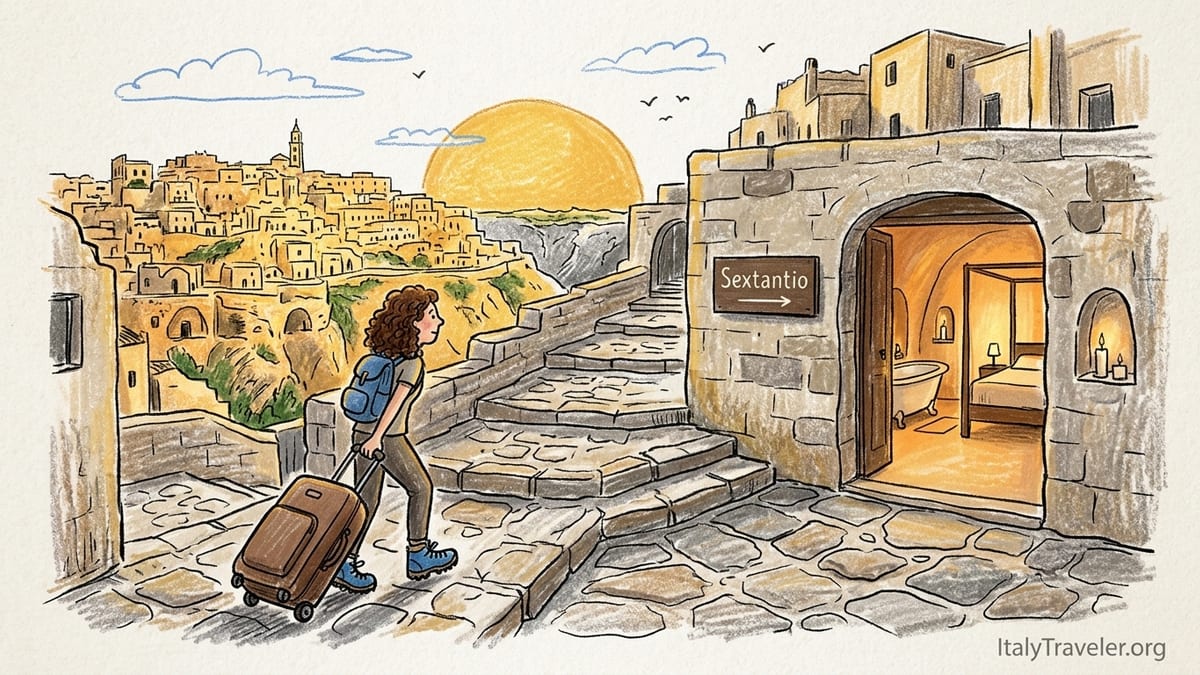
Checking In: A Cave Suite With a View and a Long Walk
I booked a night at Le Grotte della Civita, part of the Sextantio group, one of Matera’s most atmospheric cave hotels carved into the upper edge of the Sasso Barisano. I chose a "Classic Room" cave suite, one of the simpler categories, at 290 euro for a midweek October night booked directly with the property. Prices for these rooms fluctuate with season and demand and on other dates I checked the same room ranged closer to 350 to 400 euro, very much a premium compared with conventional hotels outside the Sassi.
My arrival was timed for late afternoon, around 5 pm, when the sun was already low and the pale tufa stone of the Sassi was starting to glow honey-gold. I had driven in from Bari with a rental car, which is the point where Matera’s beauty collides with bureaucracy. The Sassi are almost entirely inside a limited traffic zone, or ZTL, with cameras at the access points, no on-street parking and fines that can arrive months after a trip. The hotel had emailed me precise written instructions in advance, including a warning not to trust the rental car’s GPS once I neared the old town.
Following their directions, I bypassed the historic core and drove to a partner garage outside the ZTL on the northern side of town. The nightly rate there was 20 euro, plus 20 euro for a shuttle service that carried me and my luggage to the closest drop-off point near the Civita. From there, it was still a five to seven minute walk along narrow stone lanes and staircases, with the driver pointing out the path and then leaving me to it. Anyone expecting to be dropped at a lobby door the way you might at a conventional hotel will get an early lesson in Matera logistics. The Sassi are built for feet, not cars.
Dragging Luggage Across Stone and the First Glimpse Inside
From the drop-off point, the route to the hotel wound over uneven flagstones and down flights of shallow but irregular steps. The stone underfoot was smooth as old marble after centuries of wear. With a 10-kilogram rolling suitcase and a smaller backpack, it was manageable, but I would not have wanted anything heavier. In light drizzle or with the polished stone still wet from a storm, these surfaces are genuinely slippery. The hotel had told me to wear shoes with grip and in that moment I was grateful I had taken the advice seriously.
Le Grotte della Civita does not have a large neon sign. Instead, there is a discreet wooden plaque and a heavy door set into the stone. Inside, the reception occupies a former cave dwelling with vaulted white rock, a couple of worn wooden desks and candles tucked into alcoves. The atmosphere is almost monastic rather than flashy luxury. Check-in was quick and personal, with the staff walking me through breakfast times, how the lighting in the caves worked and the fact that the room keys are physical brass keys, not keycards. The receptionist then led me to my cave, which meant more exterior staircases and narrow passages. Accessibility here is limited in a very literal, physical way. If you have mobility issues or large suitcases, there is no way to make the Sassi truly easy.
The door to my room opened directly from an exterior stone terrace into darkness edged with soft amber light. There is always a moment of adjustment when you step from the blazing white of Matera’s exteriors into the dim interior of a cave. My first impression was of space and silence. The room was deeper and higher than I expected from the photos, like a small church nave carved into stone. Pale rock soared overhead in a rough barrel vault, while the back wall curved away into shadow.
Stone, Shadow and the Reality of a Cave Room
Once my eyes adjusted, the details emerged. Every surface was stone: the floor a patchwork of original rock and pale tiles cut to fit, the walls rough and pitted, the ceiling scalloped where centuries of smoke and water had marked the tufa. Only a few sections were finished more smoothly, where the hotel had stabilized crumbling areas. There was a four-poster bed on a low platform, a freestanding bathtub parked almost theatrically near the center of the space, and a simple wooden table and two chairs against one wall. The furnishings were intentionally sparse, meant to keep your attention on the architecture.
Lighting was carefully layered but still deliberately soft. Small uplights at floor level washed the curves of the ceiling, while a couple of wrought-iron lamps provided warmer pools of light near the bed and table. Several real candles were already lit in niches when I arrived, scentless but atmospheric. Even with every electric light on, the room never reached the brightness of a normal hotel; this was gentle dusk at best. For reading in bed, I found the bedside lamps adequate but only just. Anyone who likes very bright, clinical lighting might find the space frustrating. On the other hand, if you have ever wanted to feel like you are sleeping in a centuries-old chapel, this is as close as a modern, legal hotel is likely to get.
The air felt noticeably cooler inside than outside, which was welcome after hauling bags across the stones. In October, Matera can still be warm during the day, but the rock retains a cave-like coolness. The room had discreet underfloor heating, which the staff explained could be adjusted via a small wall panel. There was no noisy fan unit on the wall, no humming mini-split; instead, it was radiant warmth rising from the floor. The ventilation came from a couple of high-level vents and a small window near the entrance. With the door closed, the room never felt stuffy, but the air was heavier and more humid than in a conventional hotel room. My clothes in the open suitcase felt slightly cool and damp to the touch by evening.
Humidity, Sound and a Night in the Historic Fabric
Humidity is the detail that photos never convey. The cave walls themselves seemed to sweat very slightly. When I ran my fingers along a rough section of stone, they came away with a fine dust rather than visible moisture, but in the corners near the back of the room I could see patches where the rock was a deeper, darker color that suggested it often held water. The hotel clearly monitors this: there were subtle signs of dehumidifiers operating somewhere out of sight. Still, the sheets felt fresh and dry, and the mattress itself was no different in comfort from a good four-star city hotel. The slight coolness in the air, combined with a thick duvet, made for very comfortable sleeping conditions.
Soundproofing in a cave is both better and worse than you would expect. The stone walls and lack of big windows meant there was no traffic noise at all, only the occasional echo of footsteps in the passage outside as other guests came and went. Voices from neighboring rooms did not carry in any obvious way. Yet small sounds inside the cave seemed amplified: the click of the light switch echoed, water from the rain outside trickled audibly across a rock gutter somewhere above the ceiling. It was not noisy, but it had a presence. Around 3 am, when the town fell completely silent, the space felt intensely still, the kind of quiet that makes you very aware of your own breathing.
The bathroom had been inserted into one end of the cave as a more modern cube, separated by a partial wall and a heavy curtain. Inside, the floor was tiled and there was a walk-in rainfall shower with good pressure and reliable hot water. Here, the lighting was brighter and whiter, a necessary break from the cave ambience if you are trying to put in contact lenses. There was no bathtub in the bathroom because the tub was out in the main cave space. The arrangement looked beautiful in photographs, but in practice it meant steam drifting into the room after a hot bath and briefly spiking the humidity. Towels dried slower than they would on a heated rail in a normal hotel room.
After Dark in the Sassi: Empty Lanes and Slippery Steps
Once I had settled in, I headed out again for a walk through the Sassi after dark. This was the moment that justified the logistical effort. By 8 pm, the day-trip groups had gone and the tour buses that line the upper modern streets during the day had faded away. The carved facades and cave mouths of the Sasso Barisano were picked out in soft yellow streetlights, while across the ravine the plateau of the Murgia sat as a dark silhouette. The stone staircases that had felt functional in daylight now felt like stage sets, with each bend revealing a different balcony or archway.
Walking here at night requires attention. The same smooth stones that make every photo look so romantic become genuine hazards when they are damp or when shadows fall in complicated patterns. The lighting is atmospheric rather than practical, more concerned with making the Sassi glow than with evenly illuminating every step. I saw more than one visitor hesitate at a particularly polished stretch of stairs. In flat-soled shoes with decent tread, I felt secure, but anyone in sandals or dress shoes might struggle. This is a town where a small flashlight on your phone is not overkill.
The contrast with daytime could hardly be stronger. Earlier that afternoon, the main arteries of the Sassi were full of people: guided groups following flags, couples pausing at viewpoints, electric three-wheeled tuk-tuks shuttling guests and luggage up from parking lots. You line up to enter cave churches, listen to guides explaining how families and animals once shared these spaces, and it can be hard to imagine anyone choosing to sleep here now. At night, when the streets are almost empty and the only sound is the distant murmur of a restaurant on a terrace, you suddenly feel the weight of history much more sharply. I stood at one overlook above the Gravina ravine for several minutes and did not see another person. The city felt like it belonged to those who were actually staying in it.
Dawn in the Rock and the Trade-Off Between Atmosphere and Comfort
I set an alarm for early the next morning and stepped out while it was still blue-dark on the horizon. The air was cool and damp, the stone under my feet cold even through the soles of my shoes. A few hotel terraces were being set up for breakfast, chairs gently clinking, but otherwise the Sassi were silent. As the sun rose behind the plateau, light spilled slowly across the facades and into the caves, turning grey rock back to warm white. Laundry lines, satellite dishes and modern doors that disappear in nighttime photos re-emerged. This was when the atmosphere of sleeping in the historic fabric felt most real. I was not just visiting a museum piece; I had spent the night inside the organism.
Back in the room, though, the trade-off between atmosphere and comfort became clearer. There was no desk in a conventional sense; the small table served for writing but offered little task lighting. There were no big closets, only a hanging rail and some hooks drilled into the stone. Charging outlets were present but not abundant, tucked where they could be without damaging the ancient walls. Wi-Fi reached into the room, but the thick stone occasionally made the signal patchy. For one or two nights, these limitations felt like charming quirks. For a week-long stay, especially if you needed to work, they could quickly become annoyances.
The historic fabric also imposes subtle limits on climate control. On my autumn visit, the balance felt almost perfect: cool rock, gentle radiant heat. In peak summer, reports from other guests at cave hotels in Matera suggest that some rooms can feel warm and less able to shed heat overnight, even with modern air-conditioning, simply because the stone has soaked up days of intense sun. In a standard modern hotel room, the gap between interior and exterior climate can be made quite extreme by simply turning up the air conditioning. In a cave room that must breathe through older stone and limited vents, change is slower and less absolute.
ZTL Rules, Parking Logistics and Why It Matters
Because I was curious how unusual my experience was, I checked the municipality’s most recent information on Matera’s ZTL. The Sassi sit inside what local documents label the yellow zone, where access is restricted every day during core visitor hours. Between late morning and early afternoon, and again in the evening, only authorized vehicles such as residents, taxis, certain electric vehicles and those with specific permits can pass the gates. There is no stopping allowed on the narrow Sassi streets and permanent parking is forbidden. In practice, this means normal hotel guests cannot simply drive to a cave hotel and abandon a car nearby, even briefly.
Different hotels use different workarounds. Le Grotte della Civita relies on partner garages and shuttle transfers. Another well-known cave hotel on the Sasso Caveoso side, Sant’Angelo Luxury Resort, clearly states that it cannot be reached with a private car at all and directs guests to a specific parking facility outside the Sassi, often the Sant’Isidoro Parking, from which they can arrange a pick-up by small vehicle. Properties like Hotel San Giorgio, which also occupies historic structures in the Sassi, highlight the presence of public shuttles that stop near their reception but still remind guests that access is regulated.
On the ground, this translates to a set of very practical tips. First, you must choose your garage based not just on price but also on which side of the Sassi your hotel is located. Crossing the entire historic basin with luggage is tiring even with light bags. Second, you need to be comfortable leaving your car overnight outside the hotel zone and trusting a shuttle or your own feet. Third, you must ignore your instinct to drive “just a little closer” when you see your hotel on a map. The ZTL cameras are automated and fines for unauthorized entry are processed later, often long after a trip has faded from memory. Several travellers I spoke to in Matera and elsewhere in Italy had stories of fines arriving months later for a few minutes of driving down the wrong street.
Price Comparisons: Cave Romance Versus Conventional Comfort
To understand the premium you pay for a cave room, I compared my booking date with a handful of other hotels in Matera. On the same mid-October weeknight, Classic cave rooms at Le Grotte della Civita hovered around 290 euro including breakfast. At Sant’Angelo, entry-level cave-style rooms for the same night were listed in a similar 280 to 320 euro bracket, rising into the 400s for suites with terraces overlooking Piazza San Pietro Caveoso. Upscale but more conventional properties just outside the Sassi, such as hotels on the ridge above the ravine or near the main square of modern Matera, showed double rooms around 140 to 180 euro for the same night, often with larger windows, easier access by car and more straightforward room layouts.
Even more telling were mid-range business-style hotels in the newer city. A standard double room in one such property, about a fifteen-minute walk from the Sassi entrances, was priced around 110 to 130 euro, with modern bathrooms, full soundproofing and dedicated desks. Several also offered private underground parking for guests, eliminating the ZTL puzzle entirely. For anyone on a tighter budget, these numbers make it clear that the cave experience can easily cost twice as much as a comfortable conventional room.
Is it worth it? As a one-night splurge, I would say yes, if you go in understanding that part of what you are buying is mood and narrative rather than traditional hotel luxury. You are paying to sleep inside a UNESCO-listed landscape, to step out onto your terrace at dawn and see the ravine and the stone city without crowds. You do not get a spa, a rooftop pool or abundant natural light. You get rock, shadow and the sense that you are briefly inside a living archaeological site.
Who Should Book a Cave Room and Who Should Stay Nearby
After a night in the cave, I came away convinced that this kind of stay is magical for some travellers and wrong for others. If you are the sort of person who values originality over predictability, who prefers a story to tell rather than a list of amenities, then at least one night in a Matera cave hotel belongs on your itinerary. Photographers, architecture enthusiasts and anyone with an interest in social history will find enormous satisfaction in lying in bed and looking up at the same rock that sheltered families here decades, even centuries, ago.
However, if you are a very light sleeper, anxious about humidity, or reliant on full accessibility, a conventional hotel near the Sassi might make you much happier. People with reduced mobility will find the steps, lack of railings and irregular floors of many cave properties genuinely challenging. Families with very young children might also feel more secure in a modern building with elevators, railings and more space for luggage and strollers. For anyone on a road trip who already feels stressed about driving in Italian historic centers, eliminating the ZTL from the equation by staying just outside the core can reduce anxiety significantly.
In terms of duration, I would personally cap a cave stay at one or two nights. The first night delivers the thrill and the novelty, the second allows you to fully settle into the rhythm of the space and enjoy early mornings and late evenings without rushing. Beyond that, the practical limitations of storage, light and climate start to weigh more heavily, particularly if you are combining Matera with long stretches in other Italian cities where you might appreciate a traditional, functional room.
Would I book another cave room? Yes, but with intention. I would align it with shoulder-season dates to avoid the most intense summer heat inside the rock, pack lighter to make the walk in and out easier, and plan my driving days so I arrived in Matera without needing the car again until I left. Now that I understand the balance of romance and reality, I would recommend a cave stay wholeheartedly, but only to travellers who arrive prepared for stone, stairs and an experience that is as atmospheric as it is imperfect.
FAQ
Q1. Is it possible to park directly at a cave hotel in the Sassi?
In practice, no. The streets inside the Sassi are within a ZTL, with no on-street parking and permanent stopping restrictions. Most cave hotels arrange off-site garages and shuttle services or ask guests to park outside the historic core and walk in.
Q2. How difficult is it to reach a cave hotel with luggage?
Reaching a cave hotel almost always involves walking over uneven stone and navigating stairs. With a small rolling suitcase and backpack it is manageable, but large or multiple bags make the walk tiring, especially in heat or rain.
Q3. Are cave rooms in Matera damp or uncomfortable to sleep in?
Cave rooms feel cooler and slightly more humid than standard hotel rooms, but well-run properties manage this with underfloor heating and discreet dehumidification. Bedding and mattresses are typically dry and comfortable, though towels and clothes can feel slower to dry.
Q4. Do Matera cave hotels have air conditioning and heating?
Most established cave hotels provide modern climate control, often via underfloor heating and unobtrusive air-conditioning systems. The effect is gentler than in a modern glass-and-steel building because the stone changes temperature slowly.
Q5. Are the Sassi safe to walk around at night?
The Sassi feel calm and residential after dark, with far fewer people than in the day. The main concern is not crime but footing: polished stone steps and low lighting mean you need to watch where you walk.
Q6. How many nights should I spend in a Matera cave hotel?
For most travellers, one or two nights is ideal. This gives enough time to experience sunrise, sunset and the atmosphere after day visitors leave, without the practical limitations of cave living becoming frustrating.
Q7. Is a cave room suitable for travellers with mobility issues?
Often not. Many cave hotels are reached only by staircases and sloping alleys, and interiors may have steps and uneven floors. Some properties offer partially accessible rooms, but travellers with reduced mobility are usually better served by modern hotels near, rather than inside, the Sassi.
Q8. How much more expensive is a cave hotel compared with a normal hotel in Matera?
On identical dates, cave rooms inside the Sassi commonly cost around twice as much as comfortable modern hotels outside the historic core, reflecting the premium for the location and atmosphere rather than additional amenities.
Q9. What should I pack for a stay in a cave hotel?
Pack light, with luggage you can comfortably carry up and down stairs. Shoes with good grip are important for walking on smooth stone, and a small flashlight or phone light is helpful at night on dimly lit steps.
Q10. Who is better off choosing a conventional hotel near the Sassi instead?
Travellers who prioritize easy car access, elevators, strong natural light, predictable climate control and full accessibility will usually be happier in a conventional hotel close to, but not inside, the Sassi, using short walks to explore the historic area.