


On Sunday 18 May 2025, I stood outside Matera Centrale station staring at an empty bus bay and an even emptier timetable. I had planned to reach Castelmezzano for the day, travelling Matera to Potenza, then on to the Lucanian Dolomites. By 9.30 a.m. I had already spent 10 euros on a Ferrovie Appulo Lucane ticket to Potenza and discovered that the SITA Sud bus I needed from Potenza to Castelmezzano simply did not run on Sundays before late afternoon. A taxi driver quoted me 90 euros one way to Castelmezzano and 140 euros if I wanted a return after sunset. I ended up abandoning the plan and spending the day sulking in Matera instead. That was the moment I realised how sharp the gap is between “getting to Basilicata” and actually exploring Basilicata without a car.
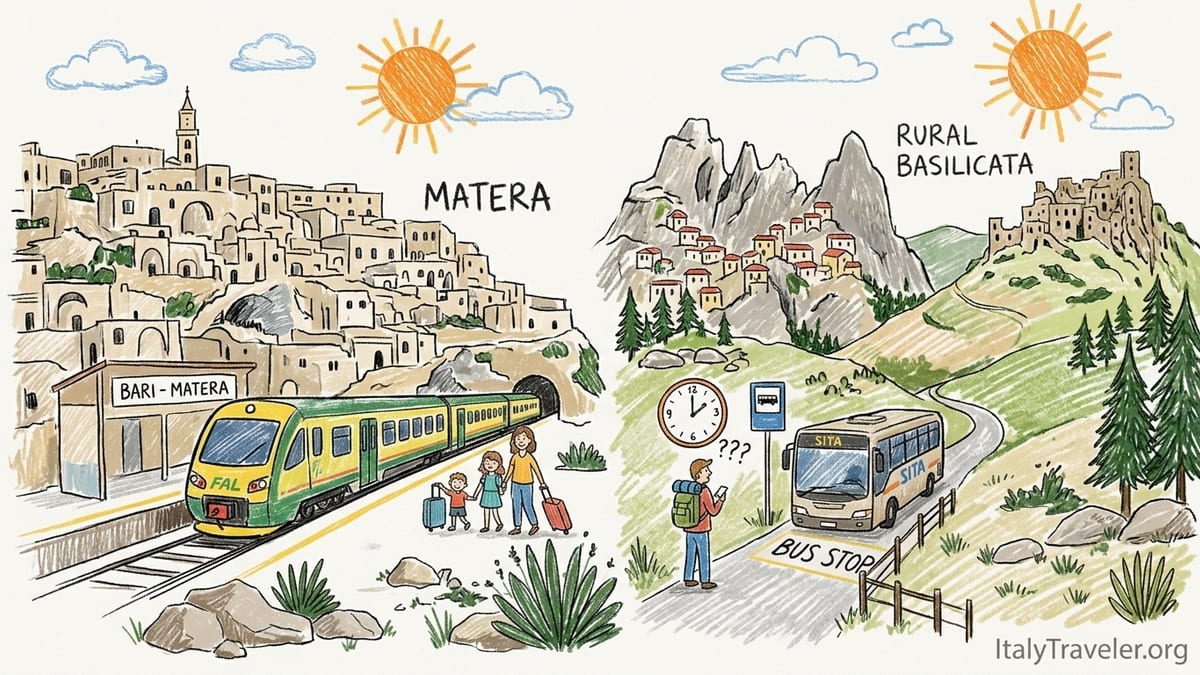
Gateway Cities vs the Reality of Rural Basilicata
Reaching Basilicata’s main centres without a car is not the problem. Matera, the region’s headline destination, has frequent narrow-gauge trains and buses run by Ferrovie Appulo Lucane (FAL) between Bari Centrale and Matera Centrale on weekdays, with services starting around 4.15 a.m. and continuing until about 10 p.m. According to FAL’s current service information and published timetables for late 2026, the trip takes roughly 80 to 100 minutes depending on whether part of the route is covered by replacement bus. Tickets are modestly priced, usually under 10 euros for the full Bari–Matera journey, and can be bought in stations, online or via the FAL app.
Potenza is also well connected to Bari and the Tyrrhenian side through a mix of FAL regional services, Trenitalia trains and long-distance buses. Maratea, Basilicata’s Tyrrhenian gateway, sits directly on the national railway line between Salerno and Calabria, and regional trains in the current timetable period connect it with Salerno and Naples several times a day. In other words, getting into the region from a major Italian hub is straightforward, and for point-to-point travel between cities and a few larger towns the system works well enough.
The difficulty begins when you try to go beyond the main axis of Potenza, Matera and Maratea and into the scattered mountain villages, archaeological sites and national park trailheads that actually define Basilicata. Regional and interurban services exist, but they often run only a few times per day, concentrate on school days, and offer little help on Sundays and public holidays. The jump from “there is a bus” to “this is usable for a traveller with limited time” is huge, and it is in that gap that many carefully planned car-free itineraries quietly fall apart.
On paper, I too once believed the official maps and route lists. Only when I started cross-checking FAL timetables, SITA Sud PDFs and local council notices did I realise how many of the services that appear in abstract are essentially impractical if you are visiting for three or seven days and want to see more than one base town.
Matera and Potenza: Well Linked, With Important Asterisks
Matera’s position is unique. Trains and buses with FAL connect it to Bari multiple times per day, and the current weekday timetable shows departures roughly every hour at peak times on the Bari–Altamura–Gravina–Matera route. On Sundays and holidays, rail services are partially or fully replaced by buses, with rail tickets remaining valid, which keeps the link alive even on quiet days. Recent information from local travel guides and FAL itself confirms an early departure from Bari before dawn and a final evening service after 10 p.m., giving plenty of flexibility for arrivals and departures.
But this apparent convenience hides two caveats. First, Matera is not connected to the national rail network, so onward connections always involve a change in Bari or Potenza. Second, once you arrive in Matera, the local transport offer is heavily focused on movement inside the city. Miccolis operates urban buses and a specific seasonal line between the city and locations on the Murgia plateau, including the Cava del Sole events area, but these services are designed primarily around local commuting patterns and occasional concerts, not around visitors reaching remote hamlets or trailheads in the countryside. A traveler who imagines using Matera as a pure car-free base for exploring all of Basilicata will quickly hit the geographical limits of that idea.
Potenza, the regional capital, sits at the centre of several road and rail corridors. FAL services reach Potenza from Bari through the Alta Murgia and Lucanian hills, and national rail lines link the city toward Salerno and the Tyrrhenian and toward Taranto. SITA Sud’s timetable pages show numerous regional bus lines converging on Potenza on school days, including runs to Castelmezzano, Laurenzana, Brienza and other hill towns. Yet even in Potenza, frequency drops sharply outside school-term peaks and on weekends. Midday gaps of four hours or more are common on some routes, and Sunday timetables can be skeleton versions of the weekday charts or may not run at all.
When I tried to use Potenza as a springboard for the Lucanian Dolomites and the Vulture area, I found that simply matching arrival and return times without extremely long waits was like solving a puzzle with half the pieces missing. In theory, you can travel Matera–Potenza–Castelmezzano and back in a day entirely by public transport. In practice, the risk of missing a tight connection or discovering a school-day-only service makes this a fragile plan unless you are comfortable accepting that one missed bus could mean a 60 to 100 euro taxi or an unplanned night away.
The Lucanian Dolomites and Craco: Routes That Exist but Rarely Align
Castelmezzano and Pietrapertosa, the so-called Lucanian Dolomites, may be Basilicata’s most famous mountain villages. SITA Sud does operate a bus route between Potenza and Castelmezzano. The current timetable, valid for the 2026 school year, lists several weekday departures in each direction, roughly aligned with students commuting to and from the provincial capital. Some runs continue beyond Castelmezzano in the direction of Pietrapertosa or nearby localities. On paper, this proves that the connection exists. The problem is what happens when you look closely at the times.
Inbound buses from Potenza often arrive in Castelmezzano mid-morning or around lunchtime, while the last useful return toward Potenza may leave in the late afternoon. On weekdays this might just allow for a decent half-day visit, but on Saturdays and especially Sundays departures are fewer, and in some periods there may be no morning services at all. That makes it very hard to combine a Dolomites hike or the famous flight-line zip wire between Castelmezzano and Pietrapertosa with safe onward travel, especially if bad weather or delays intervene. The theoretical bus link becomes a narrow time-window that does not match the way most travellers actually like to spend their days.
Craco, the abandoned hill town that haunts many Instagram feeds, is an even sharper example. Access is tightly controlled through guided tours that depart from the visitor reception point outside the historical centre. Reaching Craco without a car usually means catching a regional SITA Sud bus toward Pisticci Scalo or neighbouring villages and then disembarking at one of several scattered stops, followed by a transfer with a pre-booked local driver. The timetable shows that Accettura–San Mauro Forte–Craco–Pisticci Scalo has scheduled runs, but frequencies are low and skewed to school days. You might reach the area once in the morning and once in the afternoon, with no guarantee the timings match your allocated tour slot.
On my own attempt, I abandoned a plan to reach Craco from Matera after realising that I would arrive at the junction nearly two hours before the visitor centre tour time, and that the last plausible bus back in the evening would leave before the tour was over. The alternative was to pay a local driver around 80 to 100 euros for a half-day round trip from a better-connected town, which rapidly eroded the cost advantage of travelling car-free.
Vulture, Monticchio and Pollino: The Final Kilometres Problem
North of Potenza, the Vulture area mixes volcanic lakes, monasteries and wineries. Towns such as Rionero in Vulture and Melfi are reachable by regional trains or buses from Potenza, and some interurban lines approach Monticchio or pass on the main roads nearby. That should, in theory, make it a promising car-free destination. Yet here the gap between village and landscape becomes obvious. The lakes of Monticchio, the abbeys on their slopes and the vineyards that produce Aglianico del Vulture wines are spread across a wide, hilly area. Even when a bus drops you in a village labelled “Monticchio,” the accommodation you have booked or the winery you want to visit may still be four to eight kilometres away, typically along narrow provincial roads without pavements.
Winery visits in particular are difficult to arrange without a vehicle. Many producers are family-run and do not have regular public tasting-room hours. They expect visitors to arrive by car at pre-arranged times, and they are often located on rural lanes far from any formal bus stop. A taxi from Rionero in Vulture to a vineyard and back may cost 40 to 60 euros, and if you add waiting time while you enjoy a tasting or lunch, the bill quickly rises. Attempts to patch this together with walking can be pleasant on a cool autumn morning, but much less so in the heat of June or September, when gradients and a lack of shade turn what looked like a “short stroll” into an uncomfortable trudge.
Pollino National Park is even more challenging. Official park information emphasises coach and bus links from major Italian cities to towns at the edge of the park such as Rotonda, Lauria and Castrovillari. This works well if you are travelling on a point-to-point national bus route from Rome or Naples. It works far less well if you have based yourself in Matera or Potenza and you want to reach a specific trailhead near Terranova di Pollino or the high ridges above Rotonda. Interurban services in the valleys are very limited, and most hiking routes start a long way above the last village bus stop.
In practice, hikers either rely on local guides who include transport from the nearest town in their fee or they rent a car for at least part of their stay. When I weighed the cost of two or three taxis from Rotonda to popular trailheads and back, I found that even modest taxi rates of 1.20 to 1.50 euros per kilometre, multiplied across mountain distances, outstripped the price of a small rental car for three days, including fuel and basic insurance.
Maratea and the Coasts: Manageable Bases, Frustrating Details
Maratea is the rare Basilicata destination where I would still actively encourage travellers without a car to stay. Its station on the Tyrrhenian railway gives regular connections north to Salerno and south into Calabria, and the historic centre, harbour and Cristo Redentore statue can all be reached by a mix of walking, local shuttle services and taxis. In summer, extra local buses tend to run between the various hamlets and beaches of Maratea, and although frequencies are not high, the distances are short enough that a missed bus can be redeemed with a quick taxi or a manageable uphill walk.
The limitations start when you want to treat Maratea as a base for exploring the wider Tyrrhenian and Ionian coasts of Basilicata. Reaching the more isolated beaches between Maratea and the border with Calabria, or the long stretches of Ionian sand near Policoro and Nova Siri, generally involves multiple changes and irregular rural bus lines whose timetables are still anchored to school-term patterns. Getting from Maratea to an Ionian beach town by public transport often requires backtracking to a railway junction and then travelling inland before returning to the coast, which can turn a 70 kilometre journey into a three or four hour odyssey each way.
Even along the Tyrrhenian, where the railway hugs the shore, the so-called “final kilometres” problem appears again. Beach clubs, small coves and family-run guesthouses are not always within 500 metres of a station. Some coves can be reached only by footpaths starting at awkward points along the highway, where buses do not stop regularly, and where walking from the nearest official stop along the roadside is neither comfortable nor entirely safe. A family carrying beach gear and travelling with children will often conclude that a 15 to 20 euro taxi each way is the only sensible option for certain stretches, which adds up quickly over a week.
On the Ionian side near Metaponto and Policoro, the national rail line does bring you close to the sea, but archaeological parks, protected dunes and nature reserves typically lie one to three kilometres from the nearest station, with sparse local shuttles outside peak summer weekends. Here too, the issue is not the absence of public transport in the broad sense, but the way its structure ignores the specific, scattered way visitors use the landscape.
Three- and Seven-Day Scenarios: What Actually Works
It helps to compare concrete scenarios. Imagine a solo traveller with three full days, flying into Bari and determined not to drive. A realistic car-free plan might be: Bari to Matera by FAL train or bus on day one, a full day exploring Matera’s Sassi and the Murgia belvederes on day two, and a return to Bari or onward train to Naples on day three. Total public transport costs for this itinerary are modest. A return Bari–Matera ticket is likely to come in under 20 euros total, and local buses or occasional taxis inside Matera will rarely add more than 20 to 30 euros across the stay. This feels efficient and stress-free.
Now imagine the same traveller trying to add Castelmezzano and Craco in those three days without a car. They would need to time a FAL service from Bari to Potenza or Matera, then coordinate a SITA Sud bus to Castelmezzano. Even if they managed one Dolomites day, fitting in Craco as well would require either a long string of rural bus changes or a dedicated taxi from a town on the Metapontino plain. Based on current taxi quotes shared by local tourism offices and travellers, this could mean 80 to 120 euros for Craco alone. Suddenly, the carbon-saving and cost-saving logic of going car-free starts to wobble.
For a couple with seven days, the comparison is starker. One option is a pure public transport loop: Bari–Matera–Potenza–Maratea–Salerno or Naples. Accommodation and internal movement remain centred on those hubs, with perhaps one organised excursion to the Dolomites from Matera or to Pollino from Maratea or Rotonda, at a cost of 70 to 120 euros per person for a small-group tour including transport. The other option is to stay two or three nights car-free in Matera, then pick up a rental car for four days to explore Vulture, the Dolomites, Pollino or the coasts before dropping it in Potenza or back in Bari.
Rental prices fluctuate, but at the time of writing a small manual car picked up in Matera or Bari often costs in the region of 40 to 60 euros per day including basic insurance, with fuel in Basilicata hovering around prices similar to the national average. Over four days of moderate touring, a couple might spend 160 to 240 euros on rental, 60 to 90 euros on fuel, and another 40 to 60 euros across parking fees, tolls and ZTL avoidance schemes, for a total somewhere in the 260 to 390 euro range. That is not negligible, but it compares favourably with three or four interurban taxi days that could easily reach or exceed the same figure without giving you control over your schedule.
Families feel the pinch most. A family of four travelling entirely by public transport will save on rental and fuel, but they will still face the same taxi fares to and from rural accommodations or beach coves. A single 20 kilometre taxi at 1.50 euros per kilometre plus a base fare might cost around 40 euros one way, meaning that a there-and-back outing to a Pollino trailhead could cost 80 euros regardless of how many passengers are inside. Over a week, three or four of these rides run close to 300 euros. In that context, renting a car for three or four days, even after adding full insurance for peace of mind, looks less like a luxury and more like a rational response to the geography.
Why a Bus Stop Is Not the Same as Access
One of the patterns that emerges when you study Basilicata’s maps and timetables is the tendency to equate a village with its surrounding landscape. Tourist brochures and regional planning documents often list a village and its nearby attractions together, then mark that village as “served by bus” or “served by rail.” In reality, the village is a compact cluster of streets, while the attractions can be scattered across hillsides and valleys several kilometres wide. A SITA Sud bus to Castelmezzano does not bring you to the start of a high-level ridge hike. A FAL service to Potenza does not place you at the gates of Pollino National Park. These final kilometres, which are invisible on timetable PDFs, are where car-free plans most often fail.
Accommodation patterns reinforce this. In many rural communities, historic centres are losing residents, and new houses, agriturismi and B&Bs have sprung up on the outskirts or along country lanes. Booking platforms encourage guests by describing these as “near” a well-known village, sometimes indicating distances “as the crow flies” rather than along actual roads. When you arrive by bus and discover that your charming farmhouse stay is three kilometres uphill from the nearest stop, you face an unpleasant choice between hauling luggage on foot or calling a taxi for what feels like a very short but surprisingly expensive ride.
Trails and archaeological sites suffer the same problem. The ruins of Metaponto’s temples and the museums at Policoro are separate from the railway stations that nominally serve them. Signed walking routes around Monticchio Lakes or Monte Vulture begin at car parks, not at bus stops. Craco’s ghost-town viewpoints are gated and managed from a reception area that expects visitors to arrive on four wheels. None of this is unique to Basilicata, but the combination of steep terrain, hot summers and infrequent rural buses magnifies the impact for anyone refusing to drive.
My own experiments taught me to treat every “served by public transport” claim as a starting point, not a guarantee. Before I commit to a car-free excursion in Basilicata now, I map the last kilometre from bus stop to accommodation or trailhead and ask directly about transfers. If the answer is vague, I mentally assign at least 40 euros of taxi costs to that outing and compare it with simply renting a car for the day.
A Realistic Car-Free Itinerary Centered on Matera
Despite these criticisms, it is perfectly possible to enjoy a rich, car-free trip to Basilicata if you respect the limits. My ideal Matera-based itinerary for travellers without a car now looks like this. Arrive in Bari by air or long-distance train and continue to Matera with FAL on the same day. Spend your first full day exploring the Sassi districts, rock churches and belvederes on foot, perhaps adding a guided walking tour. On day two, cross the ravine to the Murgia plateau on foot or with a local shuttle, taking in the cave churches on the park side and returning to the city by sunset. If the seasonal Miccolis line to Cava del Sole or Murgia belvederes is running, use it, but plan your day so you can comfortably walk at least part of the way if services thin out.
On day three, consider one organised small-group excursion from Matera. Options offered by local tour companies typically include the Lucanian Dolomites, with stops in Castelmezzano and Pietrapertosa, or a loop through Aliano and the badlands south of the city. Prices fluctuate, but a full-day tour with transport often falls in the 80 to 120 euro range per person. This is not cheap, yet it bundles what would otherwise be complex public transport gymnastics and taxi transfers into a coherent day. On day four, you might depart for Bari or Naples, or continue by bus or train to another region entirely.
If you have longer, you can add a second base that remains relatively kind to car-free travellers. Maratea is the strongest candidate, reached by national rail from Salerno or Sapri. From there, spend your time hiking short coastal stretches, using local shuttles where available, and taking the occasional taxi for night-time returns from restaurants or high viewpoints. For a one-week trip without a car, a split of three nights in Matera and four in Maratea works far better than trying to include Pollino, Vulture and the Ionian in a single loop.
What I would no longer attempt car-free, based on recent experience and current timetables, are tightly packed multi-centre itineraries that treat Matera, Potenza, Castelmezzano, Craco, Monticchio, Rotonda and Policoro as interchangeable stops on a continuous circuit. That kind of route can work in Tuscany or around the Italian Lakes, where regional trains and dense bus networks fill the gaps. In Basilicata, it usually produces frustration, dead time at empty bus stops and mounting taxi bills.
The Takeaway
After several trips and a great deal of hours spent zooming in on PDF timetables, my conclusion is simple and not especially romantic. Basilicata’s publicly funded transport does a reasonable job of linking its main cities and a few tourist-favoured towns with regional hubs like Bari, Salerno and Naples. It does a much poorer job of serving the dispersed, often spectacular landscapes that make travellers fall in love with the region’s images in the first place. There are bright spots: FAL’s Bari–Matera link, Potenza’s hub role, Maratea’s position on the Tyrrhenian railway and some seasonal shuttles on the coasts. But these are islands in a wider sea of sparse frequencies, school-focused schedules and missing last kilometres.
For visitors, the practical lesson is to decide honestly what kind of trip you want. If you are content with deep exploration of one or two centres, with occasional guided excursions and a willingness to spend on the odd taxi, you can avoid renting a car entirely and still have a rewarding stay. If your dream Basilicata includes sunrise over Pietrapertosa, sunset at Monticchio Lakes, a day among Pollino’s loricate pines and swims on both the Tyrrhenian and Ionian coasts, then relying purely on trains and buses will almost certainly box you into a corner.
In that second scenario, the most balanced strategy is often a hybrid one. Stay car-free in Matera or Maratea, where walking and local shuttles suffice, then rent a car for a defined block of days to venture into Vulture, the Dolomites, Craco, Aliano or Pollino. Factor in rental, fuel, parking and full insurance in your budget from the start. Once you compare that total with the real cost of multiple rural taxis and the wasted time between misaligned buses, you may find, as I did after that failed May 2025 attempt to reach Castelmezzano, that selective driving in Basilicata is not an indulgence but a tool that lets you experience the region as more than a list of unreachable horizons.
FAQ
Q1: Can I visit Basilicata completely without a car if I only have three days?
With three days, a car-free visit works best if you focus on Matera alone, perhaps adding one guided day trip. Trying to combine Matera with distant villages like Castelmezzano or Craco using only scheduled buses usually leads to long waits or expensive taxis.
Q2: Is public transport in Basilicata unreliable, or just infrequent?
Based on recent timetables and my experience, services are generally reliable when they run, but many routes are infrequent and skewed toward school days, which makes them hard to use for sightseeing and weekend travel.
Q3: Which parts of Basilicata are most practical without a car?
Matera and Maratea are the most practical bases without a car. Both have good links to major Italian cities and compact centres that are pleasant to explore on foot, with some local shuttles or short taxi rides covering the gaps.
Q4: Is it realistic to reach Castelmezzano and Pietrapertosa by bus for a day trip?
There is a SITA Sud bus route from Potenza to Castelmezzano, and some services extend toward Pietrapertosa, but the limited frequency and school-focused schedules mean that fitting in a full day of hiking or activities with safe return connections is difficult, especially on weekends.
Q5: How expensive are taxis in rural Basilicata?
Taxi prices vary, but for planning it is sensible to assume at least 1.20 to 1.50 euros per kilometre plus a base fare and possible waiting time. Short rural rides to trailheads or agriturismi can quickly add 30 to 60 euros each way.
Q6: Does staying near a village guarantee easy access to trails and wineries?
No. Many trails, wineries and agriturismi lie several kilometres outside the nearest village, often along narrow roads without pavements. A bus stop in the village centre may still leave you with a long uphill walk or the need for a taxi transfer.
Q7: For a week in Basilicata, is renting a car for only part of the trip worthwhile?
Yes. A common strategy is to spend a few days car-free in Matera, then rent a car for three or four days to explore Vulture, the Dolomites, Craco, Aliano or Pollino, before returning the car in Bari or Potenza.
Q8: Can I use trains to explore Basilicata’s Ionian and Tyrrhenian beaches?
Trains reach Maratea and several Ionian towns like Metaponto and Policoro, but many specific beaches and coves still require walking long distances from the station or using occasional local buses or taxis, especially outside peak summer weekends.
Q9: Are there any seasonal transport services that help car-free travellers?
Some seasonal shuttles run to event venues near Matera and between Maratea’s hamlets and beaches, particularly in summer, but they do not cover all rural attractions and often run on limited timetables.
Q10: If I refuse to drive at all, what is the single best itinerary in Basilicata?
The most realistic fully car-free itinerary is a three to five day stay in Matera, possibly followed by train travel to Maratea for another three or four days, relying on guided excursions for any forays into the more remote mountains or archaeological areas.