


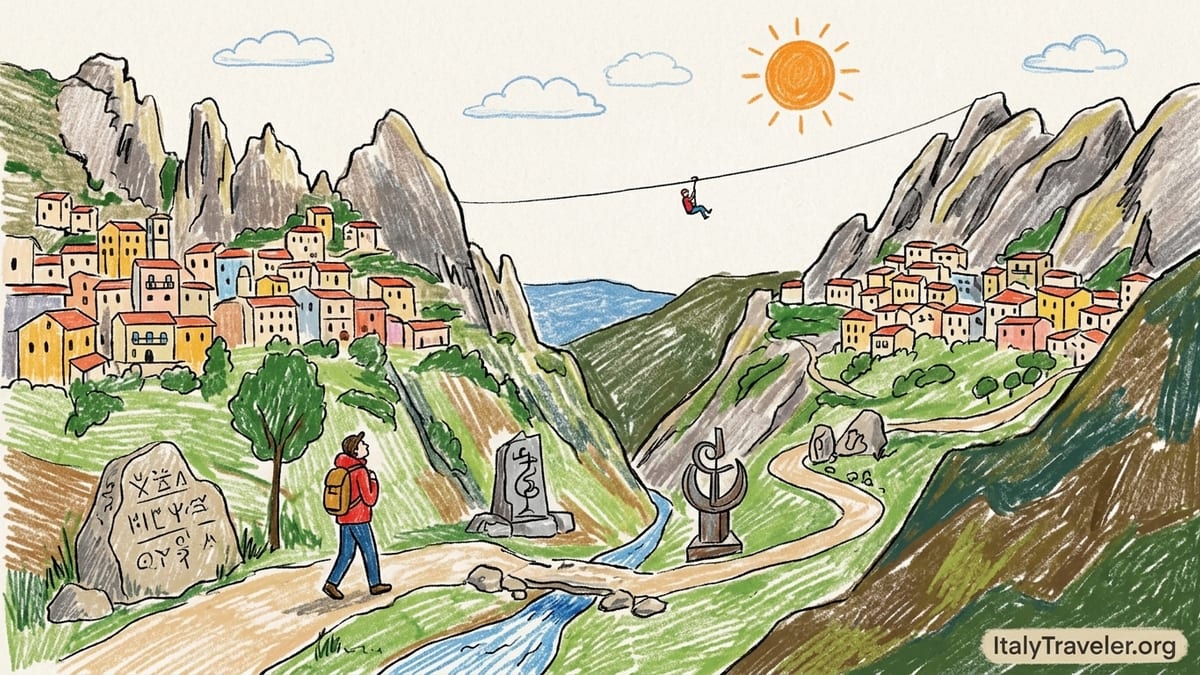
I arrived in Castelmezzano on a cool, bright October morning, fully expecting the Volo dell’Angelo zipline to be the headline of my day. Instead, it was a 2‑kilometre storytelling path between two cliff villages that stayed with me long after the harness came off. This is how my hike along the Sentiero delle Sette Pietre, the Seven Stones Trail between Castelmezzano and Pietrapertosa in the Lucanian Dolomites, turned into the real heart of the trip.
Starting From Castelmezzano: Weather, Parking and First Impressions
I walked the Seven Stones Trail on October 12, 2026, at the tail end of Basilicata’s hiking season. The forecast promised early sun and clouds later, with temperatures hovering around 14 degrees Celsius at 9 a.m. and a light breeze coming through the Basento valley. In the shade of Castelmezzano’s narrow alleys it felt cooler than that, so I began the morning with a fleece and a thin windproof shell that I could stow away once the climb began.
I chose to start from Castelmezzano rather than Pietrapertosa because I had slept there the night before and wanted to see the village wake up. I left my car in the main pay parking area below the historic center, where several terraces of marked spaces climb the slope underneath the village. On my visit in 2026, the meters in this area still charged by the hour during the day, with slightly higher rates in summer and on busy weekends compared with mid‑October. From the parking terraces, a short but steep paved ramp led me into the web of alleys.
Castelmezzano at that hour felt half‑asleep. A delivery van blocked one of the tight main bends, swallows circled the dolomite spires above the houses and the stone facades were just starting to catch direct light. The Lucanian Dolomites here are not as high as their famous cousins in northern Italy, but the rock towers rise almost vertically above the roofs, so close you feel as if someone has squeezed a village into a crack in the mountains. My expectation was simple: a pleasant leg‑stretcher between zipline runs, something scenic but secondary. I knew the official description spoke of a two‑kilometre literary path inspired by a local novel, but in my mind it was still an add‑on.
Finding the start of the Sentiero delle Sette Pietre turned out to be straightforward once I stopped following instinct and started following signs. From the small main square, I kept an eye out for brown trail markers pointing towards Pietrapertosa and the “Percorso delle 7 Pietre.” The route drops out of the village past the last houses and then tilts more sharply towards the valley of the Caperrino stream. Almost immediately, Castelmezzano began to shrink behind me, framed by rock towers and the faint hum of the first zipline riders overhead.
What the Seven Stones Trail Really Is
Officially, the Sentiero delle Sette Pietre is a restored rural path of about two kilometres, connecting Castelmezzano at around 770 metres above sea level with Pietrapertosa at roughly 920 metres, dipping down to about 660 metres in the valley of the Caperrino along the way. It is short on paper but feels longer underfoot, because the descent and climb stack up into more than 300 metres of elevation gain between the two directions. On my hike, my GPS watch counted roughly 5.5 kilometres including the extra little approaches inside the villages, but the heart of the experience happened on those literary two.
The route is based on Mimmo Sammartino’s book “Vito ballava con le streghe,” a slender but intense story woven from local oral traditions of witches, spells and love. Along the path, that literary source becomes a series of installations, soundscapes and sculpted stones that punctuate the forest and the rock walls. Each of the seven stages corresponds to a key word from the story: destini, incanto, sortilegio, streghe, volo, ballo and delirio. At each stop, you are supposed to pause and let that word, together with the artwork and the recorded voices, shift the way you see the landscape around you.
What surprised me was how naturally the narrative layers into a day in the mountains. This is not an art walk pasted awkwardly over a scenic path. The old rural trail already needed to wind down through chestnut trees and scrubby oak, cross the stony bed of the Caperrino and then haul itself steeply back up towards Pietrapertosa. The installations live in clearings, on boulders or against rock faces that feel like natural stages. Even without reading the book in advance, I felt slowly pulled from the pragmatic rhythm of a hike into something quieter, more internal.
Locally, tourism offices and some guides advertise longer “Seven Stones” experiences that fold in side detours, loops and village time. My day stayed faithful to the core path. I walked on my own between Castelmezzano and Pietrapertosa and then back again, without any alternative upland loops or longer circuits in the national park. That meant every ascent, every slippery patch and every piece of rocky ground I describe here is something I actually stepped on, not a brochure summary.
From Castelmezzano to the Valley: Forest Paths and First Stages
Leaving the last houses behind, the path immediately turned to compacted earth sprinkled with loose stone. In the early shade, the ground was still damp from the night, with patches of fallen leaves already starting to stick. The first few minutes felt easy, a gentle balcony‑like traverse with glimpses back to Castelmezzano wedged under its towers. Then the route tipped more decisively downhill towards the forest and the first stage.
The opening segments of the trail pass through mixed woodland, with chestnut and oak giving way to patches of pine. Underfoot, the terrain alternates between well‑built stone steps and rougher dirt sections scored by rain. Even in dry weather, the shaded bits hold moisture, and I noticed how quickly flat stones could feel slick under my trail shoes. Trekking poles were not essential in this direction, because gravity was working with me, but I was glad to have shoes with a firm sole and real grip. A couple I met wearing smooth city sneakers tiptoed hesitantly down one particularly shiny rock slab and admitted they were reconsidering their footwear choices.
The first installation, tied to the idea of destini, sits in a small clearing where the trees thin out and you can catch a glimpse of both villages if you turn the right way. Sculpted forms and carved inscriptions emerge from the rock, and recorded voices tell fragments of Vito’s story in Italian, mingling with the wind. I watched another hiker stand stock‑still, eyes closed, listening to the audio; for me, the moment was more about the way the sound echoed off the rock around us, as if the cliff itself were speaking. It was at this first stop that I realised the hike was not going to be just a pretty shortcut between two viewpoints.
As I continued descending, the forest grew denser and the light dimmer. The second and third stages, incanto and sortilegio, arrived faster than I expected. One made use of a natural rock wall as a canvas for metal shapes that looked half‑script, half‑branch; another was almost hidden, a low stone arrangement that you could miss if you were hurrying. This was where the path started to play tricks with scale. The villages were out of sight, the valley floor still below, and the only constant was the crunch of gravel and the occasional call of a bird. Despite being less than thirty minutes from a bar serving espresso and cornetti, I felt pleasantly far away.
Crossing the Caperrino and Climbing to Pietrapertosa
The lowest point of the trail announces itself in sound before sight. I heard the Caperrino stream long before I saw its stony bed, water murmuring over rounded rocks. After about forty minutes of unhurried walking and stopping to look at the installations, the path spat me out into a more open gully where the stream runs. In October, the flow was modest, but enough to require attention when stepping from rock to rock. In wetter months, hikers sometimes encounter higher water or muddy approaches that make the crossing messier and the stones more slippery.
Here, the terrain changed character. Leaving the stream, the Sentiero delle Sette Pietre started to climb firmly, and my legs knew it immediately. Short, steep zigzags carried me up the opposite side of the valley. The surface varied between packed earth, embedded stone steps and stretches where exposed bedrock tilted upwards at a calf‑tightening angle. Without being technically difficult, the path demanded steady effort. This was the moment I understood why local hiking notes classify the experience as moderate rather than easy, despite the short distance.
Some of the middle stages, including streghe and volo, are placed along this ascent. The witches theme appears not as cartoonish figures but as hints: cut‑out silhouettes, rusted metal shapes that could be brooms or branches depending on the light, and snippets of whispered narrative in the soundtracks. I remember pausing at one of these installations, sweating slightly despite the cool air, and realising that the word volo applied as much to the idea of launching oneself emotionally into a forbidden love as to the physical act of flying. Above me, the faint sound of a real zipline rider drifted across the valley, connecting the literal and the metaphorical in an almost too‑perfect way.
The final approach to Pietrapertosa steepens again as the trees thin out and rocks take over. The last stage, delirio, sits in a stony amphitheatre just before the village streets begin. Here, the artwork spills across multiple boulders, and the sound design is more intense, almost swirling. After the solitude of the forest, the sudden appearance of narrow lanes and pale stone houses felt like surfacing from a dream. My watch read about one hour and twenty minutes of moving time from Castelmezzano, with an extra twenty minutes accounted for by my frequent stops at the installations and for photos.
Exploring Pietrapertosa and the Arabata Quarter
Emerging into Pietrapertosa from the Seven Stones Trail, I found myself at the lower edge of the historic core, looking up at houses stacked improbably against raw rock. Pietrapertosa sits higher than Castelmezzano, and you feel that extra altitude in the clarity of the air. The village is officially listed among the most beautiful in Italy, and from this lower entrance, narrow streets wind sharply up towards the older Arabata quarter and the castle. Before climbing higher, I ducked into a small café on a side street, where an espresso and a simple cornetto alla crema cost only a few euros, and took a moment to watch village life drift by.
Arabata, Pietrapertosa’s oldest district, clings to the eastern side of the rocky ridge. Reaching it from the Seven Stones entrance involved another short, stiff ascent up twisting alleys and staircases carved partly into the rock itself. This section is not part of the literary trail, but it feels like a natural extension of it. Doorways open directly onto steps, tiny terraces hold plastic chairs that serve as front‑row seats over the valley, and stone arches frame glimpses back towards Castelmezzano, now far across the void. The layering of houses, rock and sky is so tight that it is sometimes difficult to tell where architecture ends and geology begins.
Continuing upwards, I followed signs to the castle, which occupies the highest rocky point above Arabata. The final approach involves negotiating rough stone stairs and ramps cut into the ridge, some of them irregular and a little worn from centuries of use. The reward is a sweeping view over the Basento valley, the jagged Lucanian Dolomites all around, and the straight line of the Volo dell’Angelo cables stretched between the peaks. I stood there for several minutes, tracing my morning route with my eyes. The forested valley I had walked felt even steeper from above, and I gained a new respect for how much climbing is packed into such a short horizontal distance.
Lunch options in Pietrapertosa range from simple bars with panini to family‑run trattorias specialising in local dishes like cavatelli with porcini or peperoni cruschi. I stopped at a small trattoria near the main church and ordered a plate of handmade pasta with a tomato and sausage ragù, plus a glass of local red wine. The bill, including water and a coffee, stayed under 20 euros, a reminder that this part of Basilicata still feels refreshingly affordable compared with more famous mountain destinations. Eating in town rather than rushing back to the zipline timetable was one of the conscious choices that shifted the day away from checklists and towards immersion.
Walking Back: Pietrapertosa to Castelmezzano Compared
Most descriptions of the Seven Stones Trail focus on hiking it in one direction, but walking both ways in a single day revealed how different the experience feels depending on where you start. The route profile is essentially a V shape, with the Caperrino stream at the bottom. That means whichever way you go, you must descend and then climb. From Castelmezzano to Pietrapertosa, the main climb is concentrated in the second half of the walk. On the way back, I discovered that starting with a descent from Pietrapertosa and then finishing with the long pull up to Castelmezzano feels noticeably more tiring, especially when your legs already have a morning’s effort in them.
Leaving Pietrapertosa mid‑afternoon, the light had shifted. Sections that had been in deep shade on the outward journey were now dappled with warm sun piercing through the trees, while other parts had turned cooler. The rocky steps above the stream that had felt grippy on the way up from Castelmezzano now required more careful foot placement on the way down; a thin film of dust had accumulated on some stone slabs after several hours of hikers passing, making them slightly more slippery. I shortened my poles by a few centimetres and leaned into them to protect my knees on the steeper pitches.
Climbing towards Castelmezzano from the stream, I understood fully why some local guides advertise this direction as borderline demanding for less experienced walkers. The gradient is sustained, and there are fewer obvious resting benches built into the path. Instead, I used the installations as psychological milestones, giving myself permission to stop briefly at each stage, letting the associated word and artwork be an excuse to catch my breath while pretending to be purely absorbed in culture. By the time I reached ballo and then delirio on the Castelmezzano side, my thighs were burning. The village perched ahead, glued to its jagged ridge, looked almost vertical.
For reasonably fit hikers used to uneven terrain, the trail remains very manageable in both directions. My total moving time for the round trip, excluding the hours spent in Pietrapertosa, came to just over three hours. Including stops at each stage and plenty of photos, you could comfortably budget four hours of actual trail time if walking both ways, or around ninety minutes if only going in one direction and using a transfer back. What makes the path feel more physical than its numbers suggest is the combination of altitude, cumulative climbing and surface variety, not any single extreme stretch.
Village Life, Food and Where I Slept
Back in Castelmezzano, late afternoon light painted the rock spires in soft gold and cooled the air. Instead of heading straight to my car, I wandered through the village again, this time with the deep satisfaction of having connected it on foot to its neighbour. Small details jumped out that I had rushed past in the morning: a fresco over a doorway, a cat balanced on a stepside wall, herbs drying in an open window. The hiking trail had sharpened my eye for the human scale tucked into the dramatic geology.
I stayed the night in a small guesthouse in Castelmezzano’s historic centre, in a stone house that had been converted into a handful of simple but comfortable rooms with en‑suite bathrooms and thick walls that held the mountain quiet. Prices in October hovered around the same or slightly less than many mid‑range Italian city hotels, especially midweek, making it an easy decision to linger rather than tackle the drive back to Potenza in the dark. From my window, I could look straight out at the illuminated rock towers, the lines of the zipline just visible in silhouette.
Dinner in Castelmezzano revolved around the robust flavours of Basilicata’s interior. At a small restaurant just off the main square, I ordered a plate of strascinati pasta with mollica, a toasted breadcrumb topping with local peperoni cruschi, followed by a simple grilled sausage and a side of seasonal vegetables. Most main dishes hovered in the low teens in euros, and the house red wine was poured generously by the carafe. It felt like the kind of meal designed for people who spend their days outdoors, not an exercise in delicate presentation.
One of the pleasures of staying overnight rather than day‑tripping for the zipline is the chance to see both villages lit up at night. From the belvedere near the top of Castelmezzano, past the church, I could just make out the pinpricks of light on Pietrapertosa’s ridge in the distance. Knowing that I had walked the dark shape of the valley between them made that view richer. If you have the time, booking accommodation in one village and then walking to the other for lunch before returning gives the day a rhythm that no quick drive through or singular thrill ride can match.
Beyond the Zipline: How the Hike Compares to Volo dell’Angelo
The Volo dell’Angelo, a twin zipline that sends riders across the void between Castelmezzano and Pietrapertosa in a harness, is understandably the headline act in most promotions for the Lucanian Dolomites. It is fast, photogenic and easy to explain in a single image. I rode it the day before my hike, clipping into the cable, flying horizontally over the valley and then being towed back up to a platform. The views were astonishing, the sensation intense, and the entire experience from check‑in to completion lasted less than an hour.
By contrast, the Sentiero delle Sette Pietre is slow, quiet and cumulative. Its impact grows with every step, every change in vegetation, every echo of the story in the art and sound. On the zipline, you pass over the Caperrino in a few seconds; on the trail, you hear it long before you see it, pick your way among its stones and feel the small splash of cold water if you misjudge a step. The zipline gives you an aerial snapshot of the villages and the valley. The hike gives you their textures, smells and small imperfections.
From a practical perspective, the two experiences also demand different kinds of preparation. For the Volo dell’Angelo, you need to book a time slot in advance in high season, respect weight limits and show up with closed shoes and perhaps a windbreaker. For the Seven Stones Trail, what matters is footing and endurance. Good trail shoes or light hiking boots, a small daypack with water and snacks, and a realistic idea of your own fitness are more important than timing harness checks. I made one clear mistake on my hike day: I underestimated how little shade the upper sections near Pietrapertosa would offer in early afternoon and carried only one one‑litre bottle of water. I finished the climb back to Castelmezzano rationing my last sips and wishing I had brought at least 1.5 litres.
Emotionally, the hike proved more memorable for me. The zipline is pure adrenaline, a bright flash that you recount later in a sentence or a social media post. The trail, by contrast, lingered. Specific images stayed with me: metal silhouettes against sky at the streghe stage, the sound of recorded voices mingling with the rustle of leaves, the way Pietrapertosa seemed to hang from the heavens as I approached it on foot. Given a choice to repeat only one, I would choose to walk the Sentiero delle Sette Pietre again, perhaps in late spring when wildflowers soften the slopes, and watch the story unfold once more under different light.
The Takeaway
My day on the Seven Stones Trail began as a side project to a famous zipline and turned into a compact masterclass in how landscape, story and village life can weave together. Castelmezzano and Pietrapertosa may be connected by steel cables high above the valley, but they are bound more deeply by the old path that farmers once walked long before tourism boards thought of harnesses and helmets. Following that path with Mimmo Sammartino’s witches whispering in the background changed the way I saw both villages.
If you are planning a visit to the Lucanian Dolomites, give the Sentiero delle Sette Pietre the same respect you would give a longer mountain hike. Wear shoes with grip, bring more water than you think you need, and allow extra time not only for the climb but for the installations and for village wandering at both ends. Whether you start in Castelmezzano or Pietrapertosa, the trail will ask something of your legs and give something back to your imagination.
In the end, my round trip between the two villages involved roughly three hours of walking, not counting the generous pause for lunch and exploration in Pietrapertosa. My favourite stage was streghe, not for any literal witch imagery but because of the way its art and audio made the forest feel momentarily inhabited by all the stories the locals had ever told about it. And when I think back on that October day now, it is not the seconds of flight on the Volo dell’Angelo that I replay in my mind, but the slower, steadier rhythm of footsteps on stone and leaf, tracing an old line through a living landscape.
FAQ
Q1. How long does it take to hike the Seven Stones Trail between Castelmezzano and Pietrapertosa?
The core trail between the two villages usually takes about 1 to 1.5 hours one way at a relaxed pace, not counting time spent stopping at the seven artistic stages or exploring the villages at each end.
Q2. Is the Sentiero delle Sette Pietre suitable for beginners?
It can be suitable for reasonably active beginners, but the elevation change and some steep, uneven sections mean it feels more demanding than its short distance suggests. Good footwear and unhurried pacing are important.
Q3. Which direction is easier, Castelmezzano to Pietrapertosa or the reverse?
Both directions involve a descent to the stream and a climb out, but many hikers, myself included, find Castelmezzano to Pietrapertosa slightly gentler psychologically, because the main climb comes after you have already warmed up on the descent.
Q4. Do I need a guide to walk the Seven Stones Trail?
No, the main path is signposted and can be walked independently. However, guided options exist that combine the trail with additional loops, storytelling and time in both villages, which can enrich the experience if you like context and company.
Q5. What kind of shoes and gear should I bring?
Wear trail shoes or light hiking boots with good grip, especially because some stone sections can be slippery. A small backpack with at least 1 to 1.5 litres of water, a light jacket, sun protection and optional trekking poles is usually sufficient.
Q6. Is the trail open all year round?
The path is generally accessible most of the year, but conditions vary with weather. Spring and autumn are the most comfortable times, while winter can bring ice or snow on shaded sections and summer afternoons can be hot on exposed slopes.
Q7. Can I combine the hike with the Volo dell’Angelo zipline in one day?
Yes, many visitors ride the zipline and walk at least one direction of the Seven Stones Trail on the same day, but you need to plan around your zipline booking time and allow several hours for the hike and village visits.
Q8. Are there food and water sources along the trail itself?
There are no cafés or fountains directly on the forested sections of the trail, so you should start with enough water and snacks. Both Castelmezzano and Pietrapertosa have bars, restaurants and small shops where you can refuel before or after the hike.
Q9. Is the Sentiero delle Sette Pietre suitable for children?
Children who are used to walking and can handle steep, uneven terrain often enjoy the trail, especially the artistic installations. Very young children or those unused to hiking may find the climbs tiring and will need close supervision near rocky sections.
Q10. Do I need to read “Vito ballava con le streghe” before doing the hike?
Reading the book beforehand is not required, but it can deepen your appreciation of the installations and the story they reference. Even without it, the mix of art, sound and landscape still creates a compelling narrative atmosphere.