


The photos that convinced me to book a La Maddalena archipelago boat trip looked almost unreal: empty white coves, neon‑blue shallows and a single yacht at anchor. My actual day out, in August 2026, was still beautiful, but it was also noisy, crowded, occasionally rushed and far more complex than the brochure suggested. Here is exactly how my trip to Spargi, Budelli, Santa Maria and La Maddalena unfolded, what it cost and what I would do differently next time.
Booking the Trip: From Santa Teresa Gallura to La Maddalena
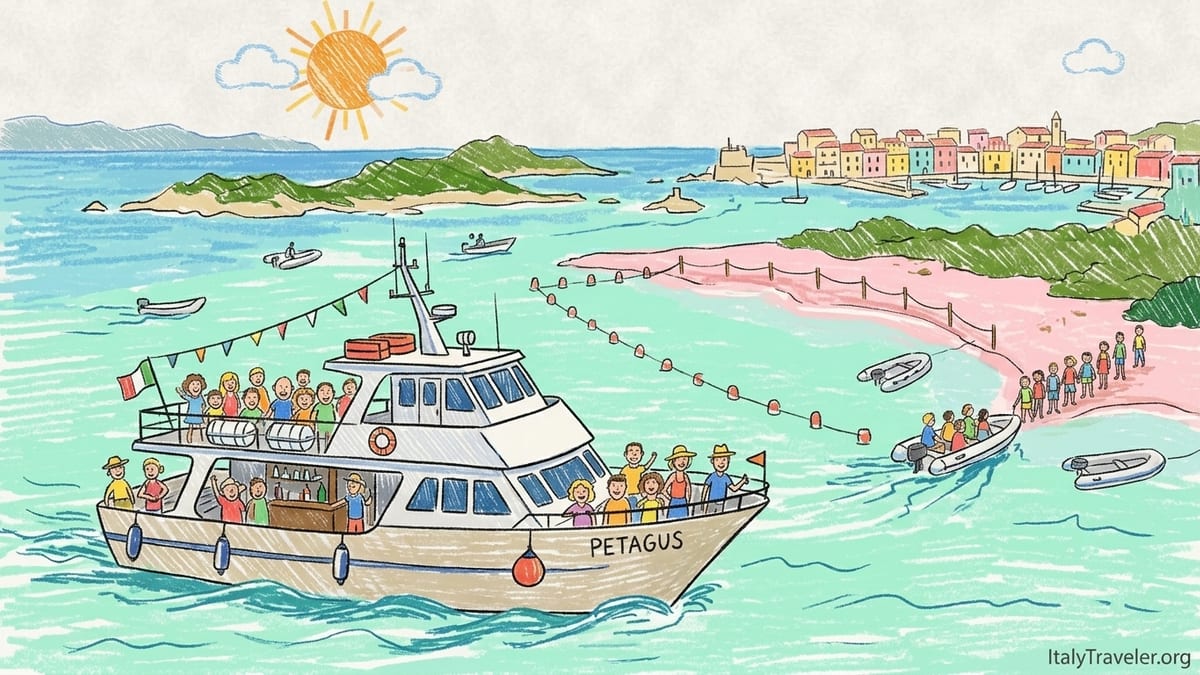
I was staying in Santa Teresa Gallura and wanted the classic island‑hopping circuit without the stress of driving to Palau at dawn. After comparing operators and itineraries, I chose a large day‑excursion boat run by Petagus, one of the long‑established companies that sail the La Maddalena archipelago out of Santa Teresa Gallura and collaborate with the Consorzio delle Bocche on various routes. I booked directly in town at their kiosk on the waterfront, where staff confirmed that in high summer the standard tour includes Spargi, the viewpoints around Budelli, a swimming stop near Santa Maria and a walk ashore on La Maddalena town.
The ticket price for August 2026 was in line with what most authorized operators were advertising from Santa Teresa Gallura: 65 euros per adult, with children discounted and infants free on a parent’s lap. Similar full‑day trips from Palau on large motor vessels with Consorzio delle Bocche were listed at 60 euros in May and around 65 to 70 euros in July and August, including the daily landing fee for the national park. From Santa Teresa, my 65 euros covered the boat trip, the crew and guiding in Italian and basic English, but not lunch or drinks. There was an optional pasta dish on board for a modest extra charge, or the choice to bring your own food.
I traveled in mid‑August, right in the busiest Ferragosto period, which was a deliberate decision. I wanted to see not just the dreamy water but also how these islands actually cope under peak pressure. My date was printed clearly on the ticket, which also mentioned La Maddalena Archipelago National Park and the municipal landing taxes, reassuring me that this was a legitimate, authorized excursion rather than an improvised side hustle.
At the kiosk, the staff also mentioned the strict rules at the most sensitive sites, including the pink beach of Budelli and selected coves on Caprera like Cala Coticcio and Cala Brigantina, where access is controlled separately by the park authority and, in some cases, by online reservation with a licensed guide. That conservation framework hung over the whole day and shaped some of the frustrations and the positives of the trip.
Departure: The Reality Behind the Brochure
Most glossy images show your boat gliding alone into a deserted cove. My day began with a queue. We were told to be at the Santa Teresa Gallura pier by 8:00 a.m. for an 8:30 departure. By 7:50, a small crowd had already formed along the quay, families pushing strollers, couples clutching beach bags and coolers. The boat was a wide, multi‑deck motor vessel, the classic “motonave” used by many consortia in this area, with capacity for well over a hundred passengers.
Boarding was organized but undeniably hectic. Staff checked printed or digital tickets, assigned us loosely to decks and warned that particular rail‑side spots could not be reserved. I had expected more of a leisurely wander aboard, coffee in hand; the reality was more like boarding a fast ferry. The top deck filled fastest, with people jockeying for a front‑row view as we motored away from the granite headlands of Santa Teresa Gallura toward the scatter of islands that form the La Maddalena archipelago.
The sea itself that morning was a typical Mistral‑season compromise. The forecast showed a moderate northwesterly wind, and out in the open stretch of water the boat moved enough that the crew quietly circulated with sick bags for those who needed them. The brochures tend to show a pane‑flat turquoise sheet; in August 2026 the surface was textured, steel‑blue here, translucent there, with just enough swell to remind you that these are the Bocche di Bonifacio, not a hotel pool.
As we approached the shelter of the inner islands, the color changed dramatically. The granite mass of Spargi and the low outline of Budelli rose out of the water, and in the protected channels the sea switched to the famous impossible shades of mint, cyan and cobalt. This approach, with the morning sun already high, was the first moment that matched the photos in my head.
First Stop: Swimming and Sand at Spargi
Our first real stop was Spargi, one of the wildest and least inhabited islands, where the large boats commonly anchor off sandy coves like Cala Corsara. Even from a distance, we could see how popular it was: a loose arc of excursion boats, small ribs and a few private yachts already bobbed in the bay when we arrived, each hemmed in by buoys and park‑mandated distances from the shore.
The captain announced our swimming break and two options. Stronger swimmers could descend a metal ladder from the stern and swim from the boat to the beach, staying within the designated corridor marked by buoys. Those less confident could wait to be ferried in small groups on the ship’s tender, which shuttled continuously between the boat and the sand. This was the first time the sheer number of passengers became very real. It took almost 25 minutes before the last people who wanted to go ashore had made it there, and another 20 or so before they had all returned ahead of departure.
In total, we had about an hour and fifteen minutes linked to Spargi, but the usable time on the beach felt closer to 40 minutes by the time you factored in the shuttle and the walk across the hot sand. The cove itself was beautiful, with soft sand, low granite boulders and clear water over a bright, sandy bottom. I packed a mask and snorkel and was glad I did, although in such a sandy cove with many people entering and exiting, the visibility near shore was milky. Better snorkeling was found along the rocky edges, where posidonia meadows and small fish flickered in the shadows.
The atmosphere was friendly but crowded. Children squealed in half‑a‑dozen languages, and beach towels occupied almost every usable patch. It was very different from the empty‑cove imagery on marketing posters, but it also had its charm. You could hear families from Lombardy chatting with couples from Germany and Spain, and our boat’s crew kept a discreet eye on the time, giving ten‑, five‑ and two‑minute warnings over the loudspeaker so no one was left stranded.
Budelli and the Myth of Spiaggia Rosa
After Spargi we motored toward Budelli, the island made famous by its pink beach, Spiaggia Rosa, a symbol of both the beauty and fragility of this archipelago. On the way, the guide explained the rules. Since the mid‑1990s, the pink beach has been placed under integral protection, with a permanent ban on landing, walking on the sand or swimming directly in front of it. Boats cannot anchor close by, and there is a cordon of buoys offshore to keep vessels and swimmers away from the beach itself. Those rules remained firmly in place in 2026, with periodic reports of heavy fines for people who stepped over the line.
This is an important reality check. Many promotional images and even some online posts still give the impression that you can spend the day sunbathing on the pink sand or at least stroll along it. On our tour, that was never on the table. Instead, the boat slowed to a crawl outside the protected zone, and we glided past Spiaggia Rosa at low speed while the guide pointed out the delicate rose hue along the shoreline and the elevated wooden walkway on shore. Everyone surged to the railings to take photos, but we remained well offshore and certainly did not swim there.
The captain made it very clear that anyone seen swimming beyond the allowed area or attempting to land on the beach could be identified by park rangers and coast guard patrols, with substantial fines involved. A couple of recent newspaper stories about tourists punished for doing exactly that were mentioned over the loudspeaker, a pointed reminder that the rules are not theoretical. This deliberate distance preserved the dreamlike image of the pink beach, but it also introduced a sense of frustration among some passengers who had expected a closer, more intimate encounter.
Our actual stop connected to Budelli happened a little further away, in waters where anchoring and swimming remain permitted under park rules. Here the water was almost absurdly clear, a white sandy bottom forming a bright reflector for the midday sun. We had about 30 minutes for swimming directly from the boat. With no beach landing, the movement of people was quicker, but the time felt short. By the time many passengers had jumped in, adjusted masks and floated toward the bow, the three blasts on the horn signaled it was time to climb back up the ladders.
Santa Maria: A More Relaxed Break
From Budelli we cruised to Santa Maria, a lower and greener island with a sheltered beach that feels slightly more laid back than Spargi’s headline cove. Here our boat was able to anchor in a way that allowed both swimming from the ladder and going ashore via tender to the sandy beach, which faces an almost lagoon‑like stretch of water.
We were promised a longer stop here, and this was where the day finally found a calmer rhythm. In total, we stayed just over an hour and a half. Once again, the practical time depends on where you fit in the line for the tender, but the slightly lower density of boats in this particular bay and the wider beach absorbed the crowds better. I chose to swim from the boat to the shore with a dry bag and sandals inside, then wandered to the end of the beach where the rocks begin. There, with my mask and snorkel, I found clear water with schooling fish and patches of seagrass, and for 20 minutes it was easy to forget just how many people were sharing the same stretch of sand.
On board, the crew served a simple but welcome lunch. Pasta with tomato and basil, a piece of bread and a small drink cost a modest supplement, which I paid directly at the bar. You could also buy cold drinks, coffee and a few snacks throughout the day, but nothing about the food was compulsory or heavily pushed. Many families had brought generous picnics, spreading out on the upper deck benches under the shade of the awning.
Compared with Spargi, Santa Maria felt less rushed and allowed time to dry off in the sun, take photos and even sit quietly watching the traffic of other boats coming and going. This was also the point where I noticed the fatigue setting in among some passengers, especially younger children. The combination of heat, salt and constant movement worked its way into everyone’s mood. The brochures show carefree smiles; the reality also includes napping toddlers and adults rubbing sunscreen into slightly pink shoulders.
La Maddalena Town and Park Controls on Caprera
In the afternoon we headed for La Maddalena town, the small but lively settlement on the main island that gives the whole archipelago its name. Approaching the harbor, the scene shifted from postcard wilderness to something more urban: pastel facades, a busy waterfront promenade and the gentle chaos of ferries shuttling to and from Palau.
Our boat tied up along the quay, and we were given around an hour to walk around independently. This is rarely emphasized in the brochures, but it is an important part of the day. The shops and gelaterie lining the streets cater squarely to visitors, yet there is still a sense of local life in the small piazzas and side streets. I took the opportunity to stretch my legs, refill my water bottle and enjoy a quick espresso at a café set back from the main flow. Some people ducked into boutiques selling linen clothing and ceramics; others made a beeline for the nearest gelato counter.
The guide also used this stop to talk briefly about the rest of the national park beyond the classic Spargi–Budelli–Santa Maria loop, particularly Caprera. Caprera is laced with trails and small coves, but some of its most photogenic inlets, such as Cala Coticcio and Cala Brigantina, are under separate and stricter control. In recent seasons, access to these fragile coves has often required a reservation and the presence of an authorized guide, with numbers capped per day to limit environmental impact. That is a very different experience from jumping off a boat into a busy bay, and one that rewards planning ahead if you crave quieter, more regulated nature.
Back on board, departure from La Maddalena town involved the inevitable wait as latecomers trickled back. The boat’s horn eventually prodded those last lingering in the shops. This was one of the few moments in the day when waiting became mildly frustrating, as we were all back in our seats while a handful of passengers pushed the schedule. On a small sailing boat, you would know everyone and probably coordinate return times more easily. On a large excursion vessel, such delays are simply part of the deal.
Crowds, Music and Movement: The Atmosphere On Board
The reality of the onboard atmosphere sits somewhere between a mini‑cruise and a floating beach club. On our Petagus operated boat, music played for much of the day through speakers on the main deck, a mix of Italian summer hits and international pop. It was never loud enough to drown out conversation, but if you expect complete tranquility, you will not find it on a high‑season group excursion of this size. Families danced briefly near the bar, and children treated the central aisle like a corridor in a holiday resort.
There were quiet spots. The bow area, when open, gave the most direct connection with the sea and wind, and the upper deck corners were relatively peaceful when people migrated toward the shaded center. Still, every scenic moment, such as the pass by Spiaggia Rosa, triggered a spontaneous gathering at the railings, cameras out, elbows nudging for space. The brochure suggests you will always have an uninterrupted front‑row view; the reality is that you learn to weave in and out, taking your pictures quickly and then stepping back.
Sea movement was most noticeable in the more exposed channels. While the boat was large and stable, there was a constant low‑level motion that occasionally produced a chorus of “ooohs” if we crossed a bigger wake. A few passengers looked pale toward mid‑morning, but I did not see anyone actually ill. The crew recommended staying on deck and looking at the horizon when the chop picked up and discouraged people from moving around too much when the vessel rolled.
The staff presence and professionalism were very clear positives. Announcements came in Italian first and then repeated in simpler English, and safety information was delivered early on, including instructions for life jackets and what to do in case of sudden weather changes. At each swimming stop, at least one crew member watched the water continuously, counting heads as people climbed up the ladders. This sort of structured vigilance is less obvious in glossy marketing materials, but it makes a huge difference when dozens of people are in the water at once.
Comparing Big Boats, Small Sailboats and Private Charters
Spending a day on a large excursion boat is only one way to experience the La Maddalena archipelago. In the weeks before my trip, I looked at smaller options, including sailing boats and private or semi‑private motorboats, both from Santa Teresa Gallura and from Palau. Prices in 2026 painted a clear picture of the trade‑offs between cost, comfort and intimacy.
The big group boats like the one I chose typically charge around 60 to 70 euros per adult in high season from Santa Teresa Gallura or Palau, sometimes a little less in shoulder months. Landing fees for the national park are usually included, which simplifies the process. You get a defined itinerary with Spargi, Budelli viewpoints, Santa Maria and La Maddalena town, with fixed times and a crowd of anywhere from 80 to more than a hundred people on board. This is the most economical way to see the headline islands in a single day, but it is also the least flexible and the most crowded.
By contrast, I found several operators in and around Palau offering full‑day sailing or catamaran trips for far smaller groups, often between 8 and 12 passengers. Prices depended on the type of vessel and inclusions, but common 2025 and 2026 examples ran from around 110 to 150 euros per person for a shared sailboat with lunch and drinks included. Private charters, whether sailing or motor, climbed much higher: a well‑appointed private motorboat for a couple or small group could easily cost 500 to 600 euros or more for a full day, plus fuel.
There are also semi‑private rubber dinghy or small motorboat tours with skipper, particularly from Palau, where you share with a handful of others. Those might cost 80 to 120 euros per person depending on season and extras. In all these cases, the benefit is obvious. With fewer people on board, you have more space, a more tailored route chosen according to weather and crowd conditions, and a better chance of negotiating longer or quieter swimming stops in less visited coves. You are still bound by the park’s strict rules around Budelli and, in some areas, by daily quotas, but you can experience the same transparent water in a more relaxed setting.
Looking back from my spot on the crowded upper deck, watching a sleek catamaran slide by with only a dozen people lazing on its netted bow, the appeal of the smaller options was undeniable. Yet there is also a certain democratic joy to the big boat. For many families, the difference between 65 euros and 130 euros per person can be decisive. The group experience, the multilingual murmur of voices and the bustle of the decks are part of a different kind of Mediterranean holiday mood.
Costs, Inclusions and What I Would Change Next Time
My total outlay for the day ended up higher than the ticket price alone suggests. The excursion itself from Santa Teresa Gallura cost 65 euros. On board, I spent about 10 euros on the pasta lunch and another 8 to 10 euros on cold drinks and coffee over the course of the day. Add a gelato and espresso in La Maddalena town and a small fridge magnet, and the grand total crept to around 90 euros for a full day of island hopping.
From Palau, a very similar excursion on a large motorboat would likely have cost something in the 60 to 70 euro range in August 2026, again with park tax typically included but food and drinks extra or optional. Some operators offer packages that include a simple lunch in the ticket price, but usually at the higher end of the price band. In both departure ports, children’s discounts and off‑season reductions can bring costs down, but for a family of four or five, it is still a significant budget item.
In terms of value, the day undeniably delivered a lot: four main islands or viewpoints, multiple swim stops, several hours on the water and a glimpse into the protected core of the national park. The weak points mostly related to crowding and time pressure. At Spargi especially, I would have loved an extra 30 minutes, enough to snorkel along the rocks and still sit quietly on the sand. The Budelli viewing pass, necessary and ethically justified, felt tantalizingly distant; it is hard not to want a closer look at such a famous beach.
If I were planning a repeat visit, I would seriously consider combining experiences. One day I would take a small‑group sailing or catamaran excursion from Palau or La Maddalena to enjoy a slower, more intimate tour of quieter coves, even at a higher per‑person cost. On another day, I might use the regular ferry from Palau to La Maddalena, rent a car or scooter and then explore Caprera on foot, booking a guided hike that includes access to a controlled cove like Cala Coticcio, rather than trying to fold everything into a single, all‑purpose group cruise.
The Takeaway
When I compare my actual La Maddalena archipelago experience to the brochure imagery that first caught my eye, several truths stand out. The sea really is that blue, and in the right light the granite and sand glow just as brightly as in the most flattering photographs. Spargi’s coves, the translucent shallows near Budelli and the gentle bay at Santa Maria are not marketing inventions. They exist, and they are spectacular. At the same time, they are shared by many boats and many people, especially in August, and the rules that protect the most delicate environments necessarily keep you at a respectful distance.
My favorite stop, perhaps surprisingly, was Santa Maria. The combination of a longer stop, a gentle beach and the chance to find a slightly quieter corner for snorkeling made it the place where I felt most at ease and least hurried. Spargi was a close second for raw beauty, but the constant flow of tenders and swimmers made it feel more intense. The weakest stop, if I had to choose one, was not a place but a moment: the brief Budelli swim near, but not too near, Spiaggia Rosa. Visually it was unforgettable, but the tight schedule and the knowledge that the pink beach itself was strictly off limits left me both impressed and yearning for more.
All in, my day from Santa Teresa Gallura cost around 90 euros once extras were included. For that, I gained a powerful first impression of one of the Mediterranean’s most celebrated marine parks, but I did not get the silent, semi‑private idyll that glossy leaflets imply. Next time, I would keep one day on a big boat for the social, panoramic overview and invest in a second day on a smaller sailing or catamaran trip, even at double the price, to savor the water and coves without sharing rail space with a hundred fellow passengers. La Maddalena more than lives up to its reputation, provided you arrive with realistic expectations and an honest understanding of how protection, crowds and cost intersect on the water.
FAQ
Q1. Can you land and swim on the pink beach at Budelli (Spiaggia Rosa)?
Access to the pink beach itself is strictly forbidden. You cannot land, walk on the sand or swim directly in front of Spiaggia Rosa; boats must stay outside a protected zone marked by buoys, and many tours only offer a slow pass at a distance.
Q2. How much does a La Maddalena archipelago boat trip cost in 2026?
Large group excursions from Santa Teresa Gallura or Palau usually cost around 60 to 70 euros per adult in high season, with national park landing taxes generally included but food and drinks extra.
Q3. Is it worth paying more for a smaller sailing or catamaran trip?
For travelers who value space, quieter decks and flexible timing at each stop, paying roughly 110 to 150 euros per person for a small‑group sailboat or catamaran can be very worthwhile compared with large, budget group boats.
Q4. Which island stop feels the most relaxed on a standard group tour?
On my trip, Santa Maria felt the most relaxed, thanks to a slightly longer stop, a wide sandy beach and calmer water that spread people out and allowed time for both swimming and simple lounging.
Q5. Are the swimming stops rushed on big excursion boats?
Some can feel rushed, especially at popular coves like Spargi where shuttle tenders move passengers to and from the beach. Expect around 40 to 60 minutes of usable time at many stops, depending on how quickly you board and disembark.
Q6. Do I need to book in advance for August trips?
In peak season, especially from mid‑July through late August, it is strongly advisable to book several days ahead in Santa Teresa Gallura or Palau, as popular boats and small‑group tours often sell out.
Q7. What should I bring for a La Maddalena boat excursion?
Bring a mask and snorkel, reef‑safe sunscreen, a hat, water bottle, light cover‑up, and sandals or water shoes for rocky shorelines, plus some cash or card for drinks and snacks on board or in La Maddalena town.
Q8. How do park controls affect visits to Caprera’s famous coves?
Some Caprera coves, such as Cala Coticcio and Cala Brigantina, are under stricter protection and often require advance booking with an authorized guide, with daily visitor numbers capped to protect the environment.
Q9. Is the sea very rough on these excursions?
Conditions vary by wind and season. In summer the sea is often moderate, but channels between islands can still be choppy, so those prone to seasickness may want medication and should stay on deck watching the horizon.
Q10. If I only have budget for one day, which type of tour should I choose?
If cost is a key factor, a large excursion boat from Palau or Santa Teresa Gallura offers a good overview at around 60 to 70 euros. If your budget allows and you prefer calm and flexibility, a smaller sailing or catamaran trip is usually more rewarding.