


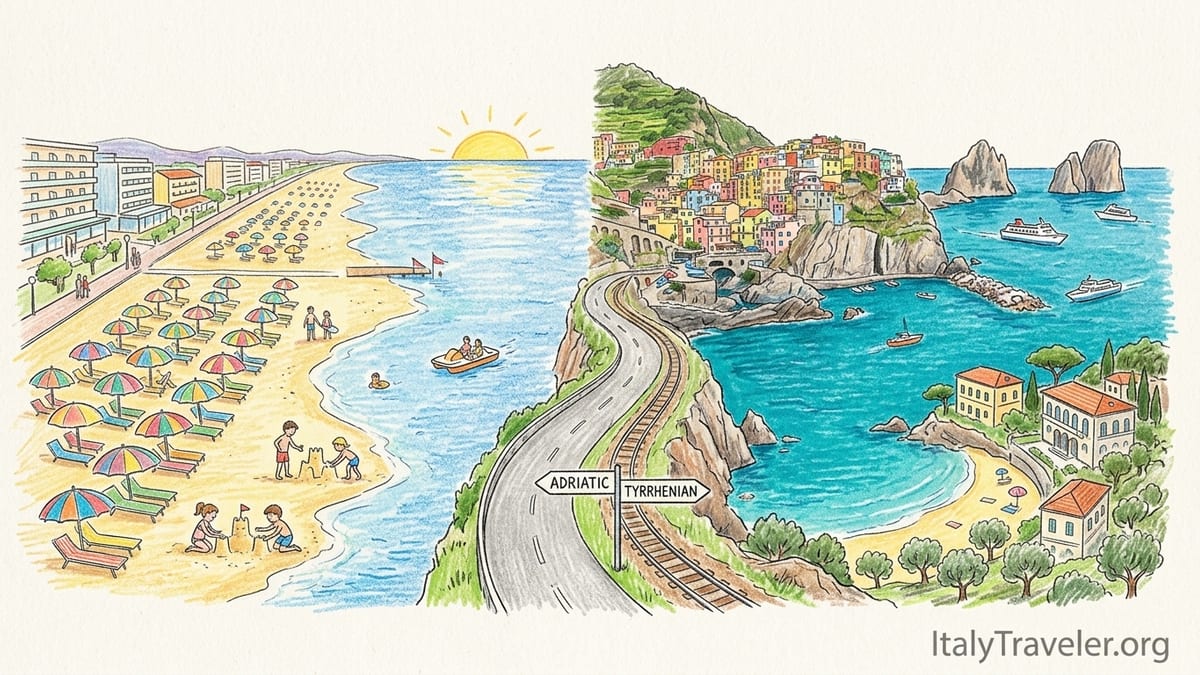
Italy is almost all coastline, but the experience along its two main mainland seas could not feel more different. On the west, the Tyrrhenian coast serves up cliffs, coves, islands and dramatic views that star in countless postcards. On the east, the Adriatic coast stretches for hundreds of kilometres in a largely smooth ribbon of sand, with shallow water and scores of purpose-built family resorts. If you are planning an Italian beach holiday and trying to decide between “west” and “east,” this guide walks you through what each side does best, with concrete examples, price ranges and logistics to help you choose.
An Overview: Two Very Different Coasts
Look at a map of Italy and you will see the contrast immediately. The Adriatic shore on the east side is relatively straight and low-lying, especially in the north, which translates in real life to long, flat, mostly sandy beaches backed by promenades and resort towns such as Rimini, Jesolo, Bibione, Caorle, Lignano Sabbiadoro and Riccione. Much of this coastline is one near-continuous strand, divided into numbered beach clubs with rows of umbrellas and shallow water that can remain waist-deep for many metres offshore.
The Tyrrhenian coast on the west is more intricate. From Liguria down through Tuscany, Lazio, Campania and Calabria, the shoreline is broken into bays, rocky headlands and coves, punctuated by island chains such as Elba and the Tuscan Archipelago, Ischia and Capri in the Bay of Naples, and the Aeolian Islands off Calabria and Sicily. Famous stretches like the Amalfi Coast, the Cilento Coast, the Coast of the Gods in Calabria and the Cinque Terre are defined less by continuous beaches and more by dramatic scenery, terraced villages and smaller coves tucked below cliffs.
This geographic difference shapes almost every other aspect of a trip, from how you get around to the kind of accommodation that dominates. The Tyrrhenian side is ideal if you dream of scenic road trips, romantic views and mixing beach time with sightseeing. The Adriatic side is unbeatable if you want an easy, predictable beach holiday with children, lots of services at your fingertips and potentially lower costs in the north.
Both coasts also have regional variations. The northern Adriatic in Veneto and Emilia-Romagna is where you find ultra-long resort beaches, while further south in Puglia the Adriatic becomes more varied, with cliffs and coves around Gargano and Polignano a Mare. On the Tyrrhenian, Liguria and Amalfi are rocky and dramatic, while parts of Tuscany’s Maremma and Lazio offer long sandy strands like the Adriatic but with more wild stretches and nature reserves.
Beach Experience and Swimming Conditions
For straightforward, low-stress beach days, the Adriatic in the north usually wins. Resorts like Bibione, Lignano Sabbiadoro, Jesolo and Rimini offer wide sandy beaches with very gradual entry into the sea, which many families with small children and less confident swimmers find reassuring. In Bibione or Lignano, it is common in summer to see toddlers splashing near shore while older kids play beach volleyball, with lifeguard stations and rental pedal boats available right in front of large family hotels and apartments. These resorts often have designated “family zones” and playgrounds directly on the sand.
The Tyrrhenian, by comparison, often has steeper drop-offs and deeper water close to shore, especially around cliffy stretches like Amalfi, the Sorrento Peninsula or the Aeolian Islands. Places such as Positano, Praiano and Capri are spectacular but the beaches are mostly pebbly or coarse sand, and the sea can become deep quickly. Strong swimmers love the emerald depths around Tropea on Calabria’s Coast of the Gods or the rocky coves of Elba Island, but parents of very young children sometimes prefer the shallows of the Adriatic or the more gently shelving sandy sections of Tuscany such as Marina di Grosseto or San Vincenzo.
Water temperature and clarity vary more by local conditions than by sea, but in practice many travellers report the Tyrrhenian around southern Tuscany, Campania and Calabria feeling slightly warmer and clearer at the peak of summer, with turquoise tones that rival islands further south. On busy stretches of the northern Adriatic, the water can appear a little more opaque due to fine sand and the very shallow depth being stirred up, even when it is clean and safe for swimming. If your priority is long swims in deeper water from scenic coves, the Tyrrhenian has the edge. If you want to wade out with a paddleboard for hundreds of metres without losing your footing, the Adriatic is your coast.
Beach clubs are ubiquitous on both sides. On a typical July day along the northern Adriatic, expect to pay around 20 to 35 euro for two loungers and an umbrella in a midrange stabilimento, with higher prices in front-row sections or at four-star hotels. On the Tyrrhenian, prices on marquee stretches such as the Amalfi Coast or Versilia in Tuscany can be similar or higher, especially in August, while more local beaches in Lazio or Calabria may remain closer to 15 to 25 euro for a day setup.
Scenery, Atmosphere and Sense of Place
If you are choosing primarily for scenery, the Tyrrhenian coast is difficult to beat. The combination of steep cliffs, pastel villages and terraced hillsides plunging into deep blue water along the Amalfi Coast, the vertical hamlets of the Cinque Terre, the lava-black and pumice-white shores of the Aeolian Islands and Calabria’s sunset views towards Stromboli volcano all define many travellers’ mental picture of “the Italian sea.” Driving or boating between Positano and Amalfi, or taking the ferry from Salerno to Capri, delivers one postcard view after another, with far fewer stretches of flat, repetitive shoreline.
The Adriatic’s beauty is quieter and more horizontal. In the north, the horizon often feels low and wide, with lines of umbrellas backed by pine woods, bike paths and hotel strips. The charm is in evening passeggiate along pedestrian seafronts in places like Riccione or Caorle, the glow of beach bars at sunset and the rhythm of local families who return to the same resort every year. Further south, the Adriatic becomes more dramatic. The Gargano Peninsula in northern Puglia, with its white limestone cliffs, sea caves and forested headlands around Vieste and Peschici, feels almost like a smaller, more laid-back version of the Amalfi Coast. Around Polignano a Mare and Monopoli, coves framed by whitewashed towns offer a good compromise between dramatic setting and easier swimming.
Culturally, the Tyrrhenian coast leans more towards a blend of sightseeing and seaside. From Sorrento you can day trip to Pompeii and Capri; from La Spezia you can reach the Cinque Terre by train and still be back in time for an evening aperitivo on the seafront. Inland historic cities such as Naples, Pisa, Lucca and Rome sit close to the Tyrrhenian, making it easy to combine a city break with a few days at the beach in neighbouring resorts like Santa Marinella near Rome or Viareggio near Pisa.
On the Adriatic, especially in the north, the atmosphere is more overtly “holiday resort.” Many towns largely shut down in winter and spring to reawaken in late May with rows of pedal boats, water slides and mini clubs. That does not mean there is no culture: Ravenna with its mosaics, the walled town of Gradara near Cattolica, the historic centre of Rimini and the Venetian hinterland are all near the coast. However, the overall feel tends to be more about sunloungers and family entertainment, with less of the dramatic village-on-a-cliff imagery that defines the Tyrrhenian.
Families, Nightlife and Overall Vibe
For classic package-style family holidays, the northern Adriatic is Italy’s workhorse coast. Towns like Bibione, Lignano Sabbiadoro, Jesolo and Rimini are designed around families: almost every block has a gelateria, playground, casual pizzeria and ice-cream stand. Many hotels offer half-board with kids’ menus, family rooms with bunk beds, and organised activities. Playgrounds and inflatable water parks appear right on the sand in high season, and attractions such as aquaparks and small theme parks sit close to the main resort strips. This concentration of family infrastructure, combined with shallow water and long sandy beaches, makes the Adriatic particularly easy with young children.
The Tyrrhenian also serves families well, but in a slightly different way. Versilia in northern Tuscany, for example, has long sandy beaches and a strong tradition of multi-generational Italian family holidays, but with more elegant liberty-style architecture and tree-lined avenues. Calabria’s Tyrrhenian coast around Tropea and Capo Vaticano mixes family-friendly beaches with a more relaxed, southern feel, and many resorts offer “village” formulas with kids’ clubs and sports. However, cliffier stretches such as Amalfi and the Cinque Terre can be challenging with strollers due to steep staircases, limited beach space and higher prices; these work better for older kids or couples.
Nightlife also differs. Rimini and Riccione on the Adriatic have been classic nightclub hubs since the 1960s, with beach bars, clubs and late-night events that attract both Italian and European youth. In July and early August, it is normal to see late-night buses running to large discotheques in the surrounding hills. The Tyrrhenian has nightlife too, particularly in Viareggio, Forte dei Marmi, Salerno and on islands like Capri and Ischia, but the overall vibe often skews more towards aperitivo bars and late dinners rather than large-scale clubbing outside a few hotspots.
If you want a lively but family-friendly scene where your teenagers can walk to beachfront bars while younger siblings join a mini disco at the hotel, a mid-sized Adriatic resort like Cattolica or Caorle is hard to beat. If you prefer a more romantic or scenic atmosphere with candlelit dinners overlooking the sea and boat trips to islands, the Tyrrhenian side offers more options, from Amalfi to the Aeolian Islands.
Road Trips, Car-Free Travel and Logistics
How you plan to get around can be a deciding factor. The Tyrrhenian side is excellent for road trips but can be less straightforward for purely car-free beach hopping, particularly on more rural stretches. The Amalfi Coast’s famous coastal road between Vietri sul Mare and Positano rewards confident drivers with spectacular views but can be stressful in high season due to narrow lanes and traffic. Parking in popular towns is expensive and limited, so many visitors opt to stay in fewer bases and use local buses or ferries for day trips. In Liguria, the Cinque Terre villages are better approached by train and boat than by car, and some coastal roads are steep and winding.
The Adriatic coast offers a different picture. The geography lends itself to a single long ribbon of coastal highway and railway. You can travel from Venice down through Jesolo’s hinterland, to the beaches of Emilia-Romagna and on to the Marche and Abruzzo using a combination of regional trains and local buses, rarely having to deal with hairpin curves. For example, frequent trains link Rimini with nearby Riccione, Cattolica and smaller stops, making it easy to sample different beaches without a car. In the north, flat terrain also makes cycling along seafront bike paths an easy way to move between towns.
For car-free travellers flying into Rome, the Tyrrhenian does offer several straightforward beach escapes. Ostiensis trains and the Rome–Lido railway connect the capital with Ostia’s beaches, while regional trains reach Santa Marinella, Sperlonga and the Circeo area on Lazio’s coast. From Naples, local trains and ferries take you to Sorrento, the Amalfi Coast, Ischia and Procida. Further north, Pisa and Florence are linked by rail to Viareggio and other Tuscan seaside towns. However, moving along the coast from region to region by public transport can be slower than simply choosing one hub and exploring locally.
By car, both coasts are manageable. If you dream of stopping spontaneously at scenic overlooks and small villages, the Tyrrhenian has more dramatic drives. The highway that skirts the Calabrian Tyrrhenian with views towards the Aeolian Islands, or the coastal roads through Cilento south of Salerno, turn even short transfers into mini road trips. On the Adriatic, the main coastal route is more utilitarian but makes for quick jumps between resort towns, and access roads are usually straightforward and well signed, with plenty of parking areas serving large beaches.
Hotels, Rentals and Typical Costs
Accommodation styles differ markedly between coasts. On the northern Adriatic, especially in Veneto and Emilia-Romagna, midrange hotels, apartment residences and family-run pensions dominate. Many offer half-board or full-board, with set dinner menus and breakfast buffets included in the room rate. It is common to find standard double rooms in June and early July starting around 90 to 130 euro per night in simple three-star hotels one or two blocks from the beach, often including breakfast and sometimes a reserved umbrella and loungers. Apartments suitable for a week-long family stay can undercut those prices on a per-night basis, particularly if booked outside the peak week around mid-August.
On the Tyrrhenian coast, there is a wider spread of accommodation types and price points. In high-profile areas such as the Amalfi Coast, Capri or Portofino, expect boutique hotels, small guesthouses and luxury properties where peak-season doubles can easily exceed 250 to 400 euro per night and sometimes much more. Room rates there pay for cliffside terraces, design and location rather than resort-style facilities. Yet within the same sea, you also find more modestly priced options: family-run hotels and agriturismi in the Maremma region of Tuscany, simple seaside pensions in Lazio, and beachside apartments in Calabria and Sicily that often stay closer to 80 to 150 euro per night outside the very peak weeks.
Self-catering is easy on both coasts, but the style of stay differs. On the Adriatic, many travellers book a one- or two-bedroom apartment a short walk from the sand and then rent a spot at the same beach club for the duration of the stay, essentially building a temporary “second home” with familiar neighbours. On the Tyrrhenian, self-catering apartments and villas are common in hilltop towns or along less developed coasts, with guests using a car to explore different beaches rather than staying loyal to a single stabilimento for the whole week.
Overall, if you are budget-conscious and flexible on exact town, the Adriatic north of the Po Delta and down through Emilia-Romagna can be slightly cheaper for a like-for-like family resort stay than the most famous Tyrrhenian stretches. At the same time, less internationally famous Tyrrhenian areas such as parts of Lazio, Cilento south of Amalfi, and much of Calabria offer competitive or lower prices than big-name Adriatic resorts, especially for travellers willing to rent a car and stay in local guesthouses rather than seafront hotels.
Which Coast for a First Italian Beach Trip?
If this is your first Italian beach holiday and you are looking for a straightforward, low-stress introduction, the Adriatic is often the easier choice, especially if beaches are the main focus. For a family flying into Venice, combining a couple of days in the city with a week in nearby Jesolo, Bibione or Caorle gives an immediate taste of Italian seaside life: long beaches, evening passeggiata along the promenade, kid-friendly restaurants and simple logistics. Likewise, basing yourself in Rimini or Riccione and taking a day trip to the historic centre of Rimini or San Marino provides a mix of culture and sea without complex transfers.
For couples or travellers who want their beach days wrapped in iconic scenery and easy access to historic sights, the Tyrrhenian might be more rewarding as a first experience. A classic first-timer route is to spend a few days in Rome followed by several days in Sperlonga or the Amalfi Coast, or to pair Florence and Pisa with the Tuscan seaside around Viareggio or the Maremma. Even if actual sandy beach time is slightly more limited, many visitors feel they are getting “more Italy” in a compact area: colourful villages, archaeological sites, vineyard-covered hills and dramatic coastal views.
Season can also influence your decision. In July and August, both coasts are busy, but the northern Adriatic is particularly organised for high-season crowds, with infrastructure designed to absorb large numbers. Shoulder seasons can be ideal on the Tyrrhenian: late May or September on the Amalfi Coast or around Elba can deliver warm sea temperatures and less congestion along scenic roads. In contrast, some Adriatic resorts feel sleepy or partially closed in late September and May, when beach facilities scale back operations.
Think honestly about what you want most. If your dream is to walk down from your hotel in a resort town, find everything you need within a few blocks and spend most days on a sunlounger, the Adriatic is likely the better starting point. If you picture yourself taking boats between cliffside villages, exploring islands and mixing swims with visits to ancient sites, the Tyrrhenian will probably feel closer to the Italy you have in mind.
The Takeaway
There is no single “better” Italian coast, only different strengths. The Adriatic, especially in the north, excels at family-friendly, efficient seaside holidays with long sandy beaches, shallow water and towns built around tourism. Prices can be relatively predictable, public transport between resorts is straightforward and almost every convenience sits within a short walk of the sand. It is an easy, forgiving choice for a first-time beach trip, nervous swimmers and travellers who value convenience above scenery.
The Tyrrhenian coast, by contrast, trades some of that simplicity for drama and variety. Its cliffs, coves, islands and historic coastal towns offer the kind of views that define Italian travel dreams, and its geography makes it ideal for road trips and combined city-and-sea itineraries. While marquee spots such as the Amalfi Coast and Capri come at a premium, less publicised stretches in Tuscany, Lazio, Campania and Calabria can offer excellent value along the same sea, with more of a balance between local life and tourism.
In practice, many travellers find themselves returning to Italy and eventually sampling both sides. If you lean towards comfort, long sandy walks and kids’ facilities, start with the Adriatic and perhaps plan a day trip to a more dramatic section such as Gargano. If you lean towards scenery, photography and a blend of culture and coast, let the Tyrrhenian show you why its villages and islands have inspired painters and filmmakers for decades. Either way, with some planning around season, transport and budget, Italy’s shores offer more than enough variety to keep you coming back.
FAQ
Q1. Which coast is better for families with young children, Tyrrhenian or Adriatic?
The Adriatic, particularly the northern resorts like Bibione, Lignano Sabbiadoro and Rimini, is generally better for young children because of its long sandy beaches, shallow water and dense concentration of family-oriented hotels, playgrounds and beach clubs. Parts of the Tyrrhenian such as Versilia in Tuscany and some sandy stretches in Calabria can also be excellent, but overall the Adriatic offers a more uniformly easy setup for families with toddlers and early swimmers.
Q2. Where will I find the most dramatic scenery, on the Adriatic or Tyrrhenian coast?
The Tyrrhenian coast is better known for dramatic scenery. Iconic areas such as the Amalfi Coast, the Cinque Terre, the Aeolian Islands and Calabria’s Coast of the Gods offer cliffs, coves and terraced villages that drop to deep blue water. The Adriatic has beautiful sections, particularly around Gargano and parts of Puglia, but its northern resort stretches are flatter and more about wide horizons than rugged cliffs.
Q3. Is one coast generally cheaper than the other for hotels and food?
For traditional beach resorts, the northern Adriatic often works out slightly cheaper for comparable three-star and family hotels, especially outside the mid-August peak. However, less famous Tyrrhenian areas such as parts of Lazio, Cilento and Calabria can compete on price with or even undercut big-name Adriatic resorts. Food costs in casual trattorias and pizzerias are reasonably similar on both coasts, with prices rising in the most touristed hotspots on either side.
Q4. Which coast is better if I do not want to rent a car?
If you prefer to stay put in a single resort and maybe visit nearby towns by train or bus, the northern Adriatic is usually simpler because the rail line closely follows the coast and links many beaches. For a mix of city break and sea without a car, combinations like Venice plus Jesolo or Rimini plus nearby resorts work very well. On the Tyrrhenian, car-free trips are also possible, especially if you focus on hubs such as the Amalfi Coast, Sorrento, Cinque Terre, Viareggio or islands like Ischia and Capri, but moving between multiple coastal regions without a car takes more planning.
Q5. How do the swimming conditions differ between the two coasts?
On the Adriatic, especially in the north, swimming conditions are defined by shallow water that deepens gradually, making it ideal for wading and for those who prefer to stand for much of the time. On the Tyrrhenian, water often becomes deeper more quickly and many coves have rockier bottoms, which confident swimmers enjoy but which may be less comfortable for very small children. Both coasts offer lifeguarded beaches and a mix of sandy and pebbly stretches; local conditions such as wind and recent weather matter more than which sea you choose.
Q6. Which coast is better for nightlife and going out?
The Adriatic, particularly the stretch around Rimini and Riccione, is famous for large nightclubs, beach parties and a long-standing youth nightlife scene, with late-night buses and open-air venues in summer. The Tyrrhenian has nightlife too, especially in Viareggio, Forte dei Marmi, Salerno and islands like Capri, but it tends to be more focused on bars, live music and late dinners rather than big-club culture, outside a few specific hotspots.
Q7. Can I combine a city break with beach time more easily on one coast?
Both coasts allow city-and-sea combinations, but the Tyrrhenian offers more classic pairings in a compact area. Rome with nearby beaches such as Ostia or Sperlonga, Naples with Sorrento and Amalfi, and Florence with Viareggio or the Tuscan Maremma are well-established itineraries. On the Adriatic, pairing Venice with a nearby resort like Jesolo or combining Bologna or Ravenna with Rimini or Cattolica are equally feasible, though the cities and beaches can feel more distinct in character compared to the intertwined landscapes on parts of the Tyrrhenian.
Q8. Is the water clearer on the Tyrrhenian or Adriatic side?
Water clarity varies locally and with weather, but travellers often perceive the Tyrrhenian, especially around southern Tuscany, Campania, Calabria and the islands, as having slightly clearer, more intensely coloured water, particularly where beaches are pebbly or rocky. On busy stretches of the northern Adriatic, the very fine sand and shallow depth can give the sea a more opaque appearance even when it is clean. That said, there are many Adriatic areas, especially in Puglia and around Gargano, where the water is strikingly clear and turquoise.
Q9. Which coast works better outside of peak summer?
In late May, June and September, both coasts can be pleasant, but the Tyrrhenian often feels livelier outside July and August because many of its towns are lived-in year-round and combine tourism with other activities. Places like Sorrento, Amalfi, Salerno, Viareggio and the towns of Liguria keep a broader range of restaurants and services open in shoulder seasons. Some northern Adriatic resorts, by contrast, scale back significantly once the main beach season ends, so visiting in October or early May can feel very quiet with limited facilities.
Q10. If I can only visit one coast on my first trip to Italy, which should I choose?
If your main goal is a relaxed, family-friendly beach holiday with easy logistics, choose the Adriatic and pick a well-equipped resort that matches your budget. If you are dreaming of iconic Italian views, cliffside villages, islands and a mix of culture and coast, choose the Tyrrhenian and focus on one or two regions such as the Amalfi Coast and nearby Cilento or the Ligurian and Tuscan shores. In both cases, it is better to pick a small area and explore it well than to rush between distant stretches of coastline.