


The Tyrrhenian coast of Italy can be a dream road trip or a frustrating sequence of traffic jams, parking hunts and mystery fines. Whether you are starting in Pisa, Rome, Naples, Salerno or Lamezia Terme, the key decision is not just which car to book but whether you actually need one for the trip you are planning. This guide focuses on when a rental car genuinely improves a Tyrrhenian itinerary, and when trains, ferries and buses will serve you better.
Do You Really Need a Car on the Tyrrhenian Coast?
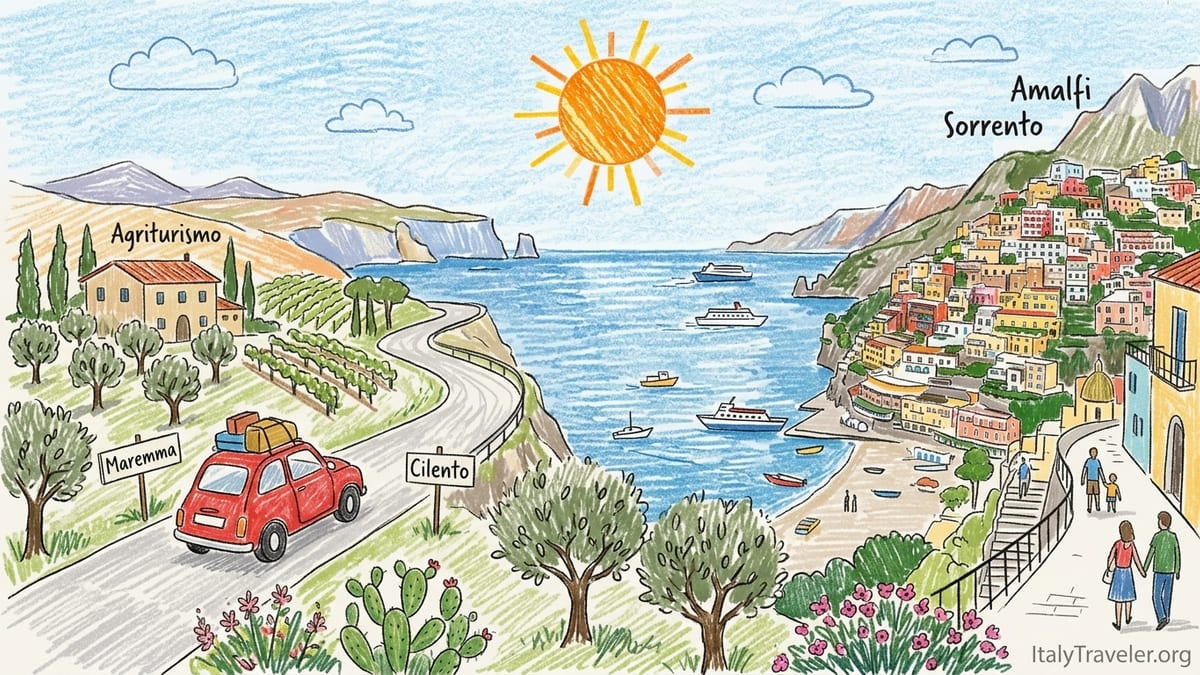
Before you lock in a rental, map your actual overnight bases. A car is extremely useful for rural stretches like southern Tuscany’s Maremma, the Cilento coast south of Salerno, the clifftop villages around Maratea, and much of Calabria’s Tyrrhenian shore. These are areas where trains are infrequent, buses sparse and many agriturismi, beach clubs and hill villages sit several kilometres from the nearest station. For example, reaching a farmhouse near Capalbio in the Maremma or a beach guesthouse outside Acciaroli in Cilento is straightforward with your own wheels and awkward by public transport.
In contrast, a car can actively complicate trips focused on dense historic towns where streets are narrow, parking is scarce and limited traffic zones (ZTLs) are tightly enforced by cameras. This is particularly true on the central Amalfi Coast between Positano and Amalfi, and in the cores of cities like Pisa, Rome and Naples. Travellers often find that once they park the car, it stays put while they move around by ferry or bus. If most of your nights are in places like Sorrento, Positano and central Rome, a one-way rental for only the rural segment usually makes more sense.
Think of the Tyrrhenian not as one continuous “drive the whole thing” coast, but as a chain of different driving zones. Long-distance links like Pisa to Rome or Rome to Naples are well served by high-speed trains, while local loops in Maremma, Cilento or Calabria almost demand a car. Build your rental around those car-friendly segments, not around your flight ticket alone.
Finally, consider your comfort level. If the idea of threading a compact car through Naples traffic or Amalfi Coast hairpins fills you with dread, you will probably enjoy your holiday more by renting for calmer sections only. There is no rule that says you must have a car from touchdown to takeoff.
Where to Start: Pisa, Rome, Naples, Salerno or Lamezia Terme?
Pisa, Rome, Naples, Salerno and Lamezia Terme all work as practical rental gateways, but they serve very different types of Tyrrhenian itineraries. Pisa airport is ideal if you are exploring northern and central Tyrrhenian routes such as the Tuscan coast, the Maremma and northern Lazio. You can land at Galileo Galilei Airport, pick up a small hatchback and be on the motorway toward Livorno or Grosseto in minutes, avoiding Pisa’s historic ZTL entirely by skipping a city detour and heading straight to the coast or countryside.
Rome Fiumicino (FCO) is the main long-haul gateway and a natural pickup point if your road trip runs through northern Lazio, Argentario, the Maremma or south toward Gaeta and Sperlonga. Many travellers now choose to visit Rome itself car free, then return to Fiumicino by train for car collection so they can drive directly to the A91 and the GRA ring road without tangling with the city’s ZTL cameras. Typical summer rentals from FCO for a compact automatic can cost more than from Pisa or Naples, so it pays to compare quotes for both city and airport locations.
Naples airport is the obvious choice if your trip pivots around Campania: perhaps a loop through the Phlegraean Fields, Paestum and Cilento, or onward to Basilicata and Maratea. However, if your main focus is the central Amalfi Coast, it is often smarter to reach Sorrento or Amalfi by train plus ferry, then rent later from Salerno for a southbound journey into Cilento or Puglia. Salerno’s station district has multiple agencies and allows you to step off a high-speed train from Rome or Naples, pick up a car and be on the A3 toward Agropoli and Palinuro within minutes.
Lamezia Terme airport in Calabria is the strategic gateway for the southern Tyrrhenian. Car rental desks sit just outside the terminal, and from there the A2 Autostrada and coastal roads lead west to the Costa degli Dei around Tropea, north toward Maratea or south along Calabria’s wild shoreline. Here, a car is less a luxury and more a practical necessity, particularly if you want to reach beaches and hill towns that lie far from the mainline railway.
When a Rental Car Truly Shines: Maremma, Cilento, Maratea and Calabria
The Maremma, stretching along southern Tuscany and northern Lazio, is one of the clearest examples of a Tyrrhenian region where a car pays for itself in freedom. Many of its highlights are remote: the secluded coves of Parco dell’Uccellina, agriturismi down unsigned tracks, Etruscan sites tucked into wooded hills. Trains can get you to hubs like Grosseto or Orbetello, but without a vehicle you will be reliant on irregular buses or expensive taxis. With a compact car, you can move from a farmhouse near Magliano in Toscana to the Argentario promontory for an afternoon swim and be back in time for dinner, all on your own schedule.
South of Salerno, the Cilento coast offers similar logic. Villages like Castellabate, Acciaroli, Palinuro and Marina di Camerota sit along a broken coastline where the railway only touches certain points. A typical day might involve an early drive to the Greek ruins at Paestum, a lunch stop in Agropoli’s hilltop old town and an afternoon at a small spiaggia accessible by winding local road. Coordinating those moves by public transport can hamstring your days. By contrast, a small rental lets you zigzag between inland villages and tiny marinas without constantly checking timetables.
Further south, Maratea in Basilicata and its surroundings are famously beautiful and famously awkward without a car. The town clings to steep slopes, beaches are scattered in coves and the larger railway station sits a good distance from many places to stay. Visitors who arrive by train often end up relying on hotel shuttles or prebooked taxis. With your own vehicle, you can drive up to the Christ the Redeemer statue for sunset, then drop down to a seafood restaurant by the harbor afterward, rather than choosing one location and staying put.
Calabria’s Tyrrhenian, accessed most efficiently via Lamezia Terme, magnifies this pattern. Towns like Tropea, Pizzo, Scilla and the quieter stretches of the Costa Viola are connected by rail, but many of the most characterful agriturismi, wineries and beach clubs lie inland from the main line. A car allows you to combine mountain villages and coast in a single day, or to base yourself in one spot and still sample distant coves. Here, public transport can feel skeletal away from main routes, especially outside peak season. For travellers who want to explore broadly rather than stay in one resort, a rental is close to essential.
When a Car Makes Life Harder: Amalfi Coast, Big Cities and ZTL Zones
On the central Amalfi Coast, a car quickly shifts from asset to liability. The coastal road between Positano, Amalfi and Ravello is narrow and often gridlocked in high season, with local buses, delivery vans and scooters all competing for space. Parking in towns like Positano and Amalfi is limited and expensive, with garages charging daily rates that can rival your accommodation. Many hotels have to valet park cars in distant lots, and some do not accept cars at all. Travellers frequently report leaving their rental untouched for days while they move by SITA bus or ferry.
The historic centres of Pisa, Rome and Naples add another layer of complication through ZTL zones. These limited traffic areas ring the old core and are enforced by cameras rather than barriers. Signs are easy to miss when you are jet-lagged and following a navigation app, and fines typically arrive months later via the rental company, often with an additional processing fee. Rome’s centro storico, Trastevere and many central streets fall within such zones, and Naples has its own restricted areas and bus-only lanes that catch visitors unaware.
Driving into these cities can work for locals who know every sign and parking garage, but for visitors it often means stress and added cost. In Rome, a common strategy is to avoid driving anywhere near the city centre, returning the car at Fiumicino or at a rental branch near the ring road before spending final days in town. In Naples, it can be smarter to base in Sorrento, Salerno or along the Circumvesuviana line and use trains and ferries to visit the city for a day rather than storing a vehicle in an urban garage.
If your Tyrrhenian itinerary is city heavy, think very carefully before committing to a full-trip rental. Long-term parking, potential ZTL fines and the simple hassle of urban driving can outweigh the perceived convenience of having a car at your disposal every day.
Choosing the Right Car: Automatic vs Manual, Size and Deposits
Most Italian rental fleets still lean toward manual transmission, especially in the smaller and cheaper categories. Automatics are widely available at major gateways like Pisa, Rome, Naples and Lamezia Terme, but they cost more and can sell out in peak months. It is important to explicitly select an automatic when booking if you are not confident with a manual. Arriving at the counter and expecting a free automatic upgrade is risky, particularly in August when cars are tight and agencies are working at capacity.
Size matters along the Tyrrhenian. Roads to hill towns, coastal hamlets and agriturismi are often narrow, with tight hairpins and compact village squares. A small car like a Fiat 500 or similar compact hatchback is usually easier to park and manoeuvre than a large SUV or people carrier. Even if you are used to driving a bigger vehicle at home, downsizing in Italy can reduce stress and damage risk. Many travellers only realise this after scraping a mirror on a stone wall or spending half an hour circling for a parking spot that fits.
Expect the rental company to place a deposit hold on your credit card at pickup, which can be several hundred euros or more depending on car category and insurance choices. This is not a charge but a temporary hold that reduces your available credit until after return. If you rely on one card with a modest limit, high deposits can be a surprise. For one-way rentals that start in a large airport like Rome and end in a smaller branch in Calabria or vice versa, deposits and one-way fees can be higher, so factor this into your budget.
Check in advance whether your card supports foreign currency holds comfortably and whether you need a backup. It also pays to inspect the car thoroughly, photographing existing scratches and any warning lights on the dashboard. This documentation can be invaluable if there is a dispute at return time, particularly when branches are busy and staff are moving quickly between vehicles.
Insurance, Tolls, Fuel and Practical Driving Tips
Insurance options at the counter can be confusing. Standard Italian rentals typically include basic liability and collision coverage with a substantial excess, meaning you remain responsible for the first chunk of any damage. Additional waivers can reduce or eliminate this excess for an extra daily fee. Some travellers rely on coverage offered by their credit card or third-party policies, but those usually require you to decline the rental company’s extra waivers and pay for any damage upfront, then claim reimbursement. Knowing in advance what your card or policy covers in Italy helps you avoid expensive duplicate coverage and pressured upsells.
On the Tyrrhenian routes, you will use a mix of toll motorways and free roads. Major stretches, such as the A1 and A3 between Rome, Naples and Salerno, have tolls, while some sections of the A2 in Calabria do not. At toll booths, you can pay with cash or card in the general lanes, while Telepass lanes are for tag holders only. Accidentally entering a Telepass lane without a tag can lead to fines or complicated retroactive payments, so watch the signage carefully and follow the lanes marked for manual or card payment.
Fuel costs in Italy are relatively high compared with many countries, and service stations on motorways may charge more than those in towns. Many pumps switch to self-service mode at night or during lunch breaks. If a staff member fills your tank, expect to pay a small premium. It can be worth topping up in larger towns before heading into rural stretches of Cilento or Calabria, where fuel stations are fewer and may keep limited hours.
Practical driving habits round out the picture. Italian drivers can be assertive, particularly around Naples and Rome, and scooters often filter between lanes. Use your mirrors constantly, signal early and avoid sudden lane changes. In villages, watch for pedestrians and parked cars narrowing the road to a single lane. When in doubt on a tight bend, slow down and be prepared to stop. Defensive driving and patience matter more than speed on these roads.
ZTLs, Parking and One-Way Rentals Along the Tyrrhenian
ZTLs are among the most misunderstood features of Italian driving. These limited traffic zones typically protect historic centres from through traffic, and they are controlled by cameras that record your license plate as you enter. Unlike barrier systems, there may be no physical gate, only signs that can be hard to interpret at a glance. If your rental car enters without the right permit, fines are posted later to the vehicle owner and then passed on to you with an administrative fee. This process can take months, long after your holiday has ended.
Along the Tyrrhenian, major cities like Pisa, Rome and Naples all operate ZTLs in or near their historic cores. Many small towns also use them in central streets and piazzas. The safest approach is to park outside signed restricted zones and walk in, or use official garages that lie outside or have arrangements for guest access. Never rely solely on a navigation app, as some do not fully account for ZTL restrictions. If a route seems to cut straight through a historic old town, double-check signs at the roadside and be ready to divert.
Parking practices vary by town. In resort areas like Sorrento, Amalfi or Positano, private garages can be expensive but are often the only realistic option, especially in high season. In smaller coastal towns in Cilento or Calabria, you may find signed blue-line street parking that requires payment at a meter or via app, while white lines usually indicate free parking with time limits. Coastal villages popular with locals may have informal overflow parking fields in summer, but these can fill quickly on weekends.
One-way rentals are common along the Tyrrhenian corridor and can be very useful for open-jaw itineraries, such as picking up in Pisa and dropping in Rome after driving through the Maremma, or starting in Naples and returning the car in Lamezia Terme after exploring Cilento, Maratea and Calabria. Agencies typically charge a one-way fee that can range from modest to significant depending on distance and the combination of pickup and drop-off locations. When comparing quotes, check not only the base rate but also one-way and after-hours drop-off fees, as well as whether the chosen branch offers secure parking if you return outside staffed hours.
Trip Planning Examples: Matching Gateways to Real Itineraries
To see how all these factors play out, consider a week-long northern Tyrrhenian itinerary starting in Pisa. You might land at Pisa airport, spend your first night in the city car free to see the Leaning Tower, then return to the airport by taxi the next morning to collect a small automatic. From there, you could drive south to the Maremma, staying three nights at a countryside agriturismo near Grosseto with day trips to the beach at Castiglione della Pescaia and inland villages. After that, continue to Orbetello and Monte Argentario for coastal walks before dropping the car in Rome and finishing with two nights in the capital without driving.
For central and southern Tyrrhenian routes, a realistic option is to fly into Rome, take the train into the city for several nights, then return to Fiumicino for car pickup before heading to Sperlonga, Gaeta and south to Paestum and Cilento. In this model, the car serves the rural and small-town segments, while Rome and perhaps Naples remain car free. You might return the vehicle in Salerno, walk to the station and continue by train to Naples for a final urban stay.
A southern-focused itinerary could start with a flight into Naples, a transfer by train to Sorrento or Amalfi for a few days without a car, then a train down to Salerno to collect a rental for Cilento and Maratea. After looping through coastal villages and hill towns, you could continue south to Calabria, end in Tropea and drop the car at Lamezia Terme airport before flying out. In this case, the rental connects the less-served stretches that are awkward by public transport, while the congested Amalfi Coast and big-city legs stay off your driving roster.
These examples underline the central point: design your rental around the car-friendly sections of your plan rather than out of habit or fear of missing out. On the Tyrrhenian coast, that choice can mean the difference between a flexible, scenic road trip and a week spent feeding parking meters and dreading the mailbox back home.
The Takeaway
Driving the Italian Tyrrhenian coast can be one of Europe’s great road trips when you choose your segments wisely. A car opens up the wild beaches and hill towns of the Maremma, the coves and ruins of Cilento, the layered landscapes around Maratea and the rugged shoreline of Calabria. In these regions, it transforms what you can see in a week. At the same time, forcing a car into the tight streets of Amalfi, Positano, Rome or Naples can add expense, anxiety and the risk of late-arriving fines without giving you much in return.
The most rewarding Tyrrhenian itineraries usually blend modes: trains and ferries for major city and Amalfi Coast hops, a rental car for the rural and small-town arcs between Pisa, Rome, Naples, Salerno and Lamezia Terme. By matching your gateway, car type, insurance and route to the realities on the ground, you can enjoy Italy’s western shoreline at its best, with the freedom of the open road when it helps and the ease of public transport when it does not.
FAQ
Q1. Is it worth renting a car just for the Amalfi Coast?
For most travellers, no. Traffic and parking between Positano, Amalfi and Ravello are major headaches, and ferries plus buses usually work better. A car makes more sense if you are continuing to Cilento or Basilicata afterward.
Q2. Which airport is best for starting a Tyrrhenian road trip?
Pisa is ideal for the northern Tyrrhenian and Maremma, Rome Fiumicino for flexible north or south loops, Naples for Campania and Basilicata, and Lamezia Terme for Calabria and the far south.
Q3. Do I need an automatic car in Italy?
You do not need one, but if you are not fully comfortable driving a manual on hills and in traffic, paying extra for an automatic is wise. Be sure to reserve it specifically, as automatics are a smaller share of the fleet.
Q4. How bad are ZTL fines in Italian cities?
Fines vary but can be significant, and they often arrive months later via the rental company with an extra administrative fee. Avoid driving into any signed limited traffic zone unless you are certain you have permission.
Q5. Is it safe to drive in Naples and along the Amalfi Coast?
It is generally safe, but driving is intense. Expect assertive drivers, scooters filtering between lanes and tight curves on cliff roads. Many visitors prefer to avoid driving in these areas altogether and instead rent for calmer stretches.
Q6. How much should I budget for tolls on the Tyrrhenian route?
Toll costs depend on your exact route, but you should plan for regular charges on major motorways between cities like Rome, Naples and Salerno. Rural stretches such as parts of the A2 in Calabria may be toll free.
Q7. Can I do a one-way rental between Pisa, Rome, Naples, Salerno and Lamezia Terme?
Yes, one-way rentals between major Tyrrhenian gateways are common, but agencies usually charge a one-way fee. Check this cost carefully when comparing offers, as it can vary depending on distance and demand.
Q8. Is parking easy along the Tyrrhenian coast?
It depends where you are. In small towns in Maremma, Cilento or Calabria, parking is often manageable. In Amalfi Coast resorts and big cities, spaces are limited and can be expensive, especially in summer.
Q9. Do I need an International Driving Permit?
Many visitors do. If your licence is not in Italian or another EU language, authorities and rental companies often expect an International Driving Permit alongside your home licence, so it is safer to bring one.
Q10. When is it better to rely on trains and buses instead of a car?
For city-focused stays in Rome, Naples and Pisa, and for hopping between major Amalfi Coast towns, trains, buses and ferries usually beat driving. Switch to a rental car for rural segments like Maremma, Cilento, Maratea and much of Calabria.